
Seed/private investments in 200 web3 projects, @EtherRock, #cryptoPunk $BTC (from $40) and #SpaceX early investor, Pre-IPO checks in AI and military stocks
Joined August 2010
- Tweets 7,964
- Following 11,520
- Followers 24,031
- Likes 13,298
1,213 Photos and videos








Pinned Tweet

24 Feb 2023
53
44
261
67,693
BitProp retweeted

Jun 13
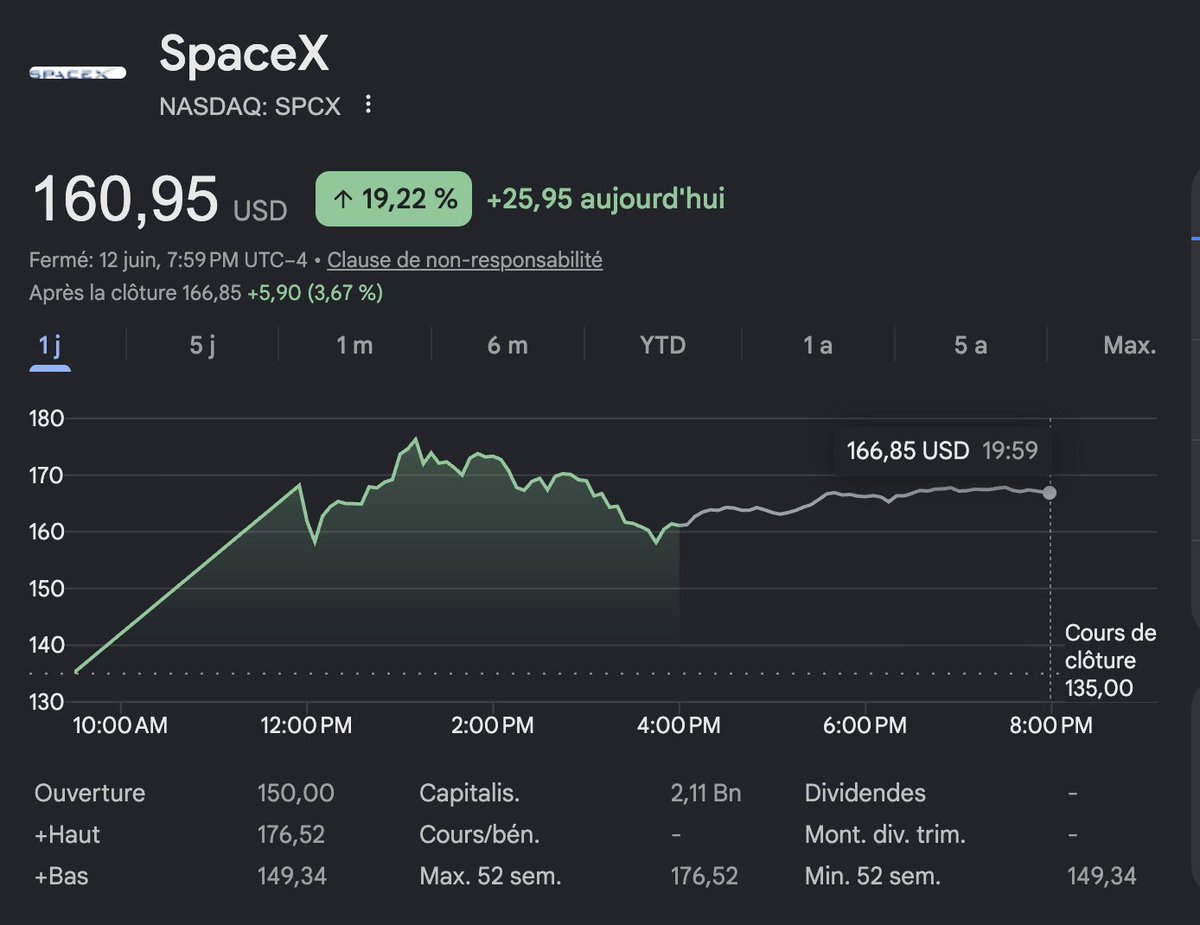
SpaceX a clôturé son premier jour de cotation à 2 100 milliards de dollars, 19%. Tout le monde regarde le chiffre. Personne ne regarde ce qu'il price réellement.
Laissez-moi vous dire ce que le marché vient d'acheter, et pourquoi je pense que cette boîte vaudra 30 à 50 trillions d'ici 5 ans.
D'abord, le symbole. Cette IPO est un référendum. D'un côté, 20 ans de discours sur la décroissance, la sobriété, la redistribution, la fin de l'histoire gérée par des comités. De l'autre, un homme qui a dit "je vais rendre l'humanité multiplanétaire", que tout le monde a traité de clown, et qui vient de créer la plus grosse entreprise cotée de l'histoire en partant d'un entrepôt à El Segundo. Le marché a voté. Le wokisme avait des départements RH, SpaceX avait des fusées. Les fusées ont gagné.
Ensuite, la mécanique économique, parce que c'est là que tout le monde se trompe. Les analystes valorisent SpaceX comme une entreprise de lancement plus Starlink. C'est comme valoriser Internet en 1995 sur le marché du fax. Starship ne réduit pas le coût du kilo en orbite de 20%, il le divise par 100. Et chaque fois dans l'histoire qu'un coût d'infrastructure est divisé par 100, ce n'est pas le marché existant qui grossit, ce sont des industries entières qui naissent. Le coût du calcul divisé par 100 a donné Internet, le smartphone, l'IA. Le coût de l'orbite divisé par 100 va donner une économie spatiale complète.
Faisons la liste de ce qui devient rentable quand le kilo en orbite coûte le prix d'un billet d'avion. Les data centers orbitaux, avec énergie solaire continue et refroidissement gratuit, au moment exact où l'IA fait exploser la demande énergétique terrestre. La fabrication en microgravité de semi-conducteurs, de fibres optiques, d'organes imprimés impossibles à produire sous gravité. Le tourisme orbital de masse, puis les hôtels lunaires, qui passeront du fantasme au business plan exactement comme la croisière de luxe au 20ème siècle. Le transport point à point terrestre, Paris-Tokyo en 40 minutes. L'industrie minière des astéroïdes, dont un seul corps de classe M contient plus de métaux que tout ce que l'humanité a extrait depuis le néolithique. Et Mars en ligne de mire, pas comme destination touristique, mais comme le plus grand projet d'infrastructure jamais entrepris, avec tout ce que ça implique de demande en énergie, matériaux, robotique, IA.
SpaceX ne participera pas à ces marchés. SpaceX possède le péage d'entrée de tous ces marchés. C'est AWS, mais pour la civilisation. Apple vaut 3 500 milliards en vendant des rectangles de verre sur une seule planète. Le premier monopole d'accès à une frontière infinie à 30 ou 50 trillions dans 5 ans, ce n'est pas de l'exubérance, c'est une simple règle de trois sur l'expansion du marché adressable.
Et maintenant, la partie que je préfère. Ce futur n'a pas besoin de bureaucrates. Il n'y a pas de comité consultatif en orbite. Pas de commission Théodule sur Mars. Chaque dollar de cette nouvelle économie sera créé par des ingénieurs, des techniciens, des soudeurs, des pilotes, des entrepreneurs. Les diplômés en gestion de la norme vont devoir apprendre un métier utile, et franchement, c'est une excellente nouvelle pour eux aussi : construire est infiniment plus fun que contrôler.
Parce que c'est ça, le vrai signal d'aujourd'hui. Pendant 50 ans on nous a vendu un futur rétréci : moins d'énergie, moins d'enfants, moins d'ambition, gérer le déclin proprement. Et là, d'un coup, le plus gros actif financier du monde est un pari sur l'abondance, l'expansion et l'aventure. Le pessimisme vient de passer en position vendeuse sur lui-même.
Le futur sera méga fun. Il y aura des hôtels avec vue sur la Terre, des honeymoons en orbite, des gamins qui diront "papa, c'était comment avant les fusées réutilisables" comme on dit "c'était comment avant Internet". Et quelque part dans les années 2030, un humain marchera sur Mars en livestream devant 5 milliards de personnes, et ce jour-là plus personne ne se souviendra du nom d'un seul de ses détracteurs.
Achetez de l'optimisme. C'est encore sous-valorisé.
209
605
2,791
255,231
BitProp retweeted

Feb 14
EtherRock 71 purchased for $132,000 (63.3 ETH)
33 mins ago (Feb-14-2026 03:33:11 PM UTC)
Txn: etherscan.io/tx/0xaa09b22cee…

214
102
1,013
332,587
BitProp retweeted

25 Dec 2025


150
1,810
31,129
499,926
19 Dec 2025
How the duck this guy is still in business?
19 Dec 2025

RAOUL PAL SAID #BITCOIN IS ABOUT TO EXPLODE LIKE A ROCKETSHIP IN THE NEXT 13 DAYS
HERE WE GO 🚀
5
1
5
276
18 Dec 2025
This guy should just give up.
Like @RaoulGMI
18 Dec 2025

Bears are fucked. Game over. Check mate. Exactly as I predicted. Up only from here on gents.
2
4
222
BitProp retweeted
18 Dec 2025
ELON IS WHAT HAPPENS WHEN CAPITAL MEETS COMPETENCE
Elon isn’t wealthy because he hoards.
He’s wealthy because he converts money into outcomes faster than almost anyone alive.
When he left PayPal with roughly $180 million, that wasn’t an exit.
It was seed capital.
What followed were reusable rockets, mass-market EVs, a global satellite internet network, and launch cadences no one thought were possible.
Ask how he’d start over if everything disappeared and his answer isn’t cute or theoretical.
He’d raise money again and multiply it again, because that’s literally what he’s done for two decades.
Investors don’t fund Elon out of charity.
They fund him because resources put in his hands tend to come back larger, faster, and attached to real infrastructure.
SpaceX didn’t just make rockets reusable.
It normalized it.
Starlink didn’t just add internet.
It reached places governments and telecoms ignored for decades.
Now he’s talking about data centers in space, which sounds absurd until you remember landing rockets once did too.
Some people manage systems.
Elon builds new ones.
That’s why the question isn’t whether he has too much capital.
It’s whether the world can afford to slow down the rare people who know how to turn ambition into reality.
Source: @PBDsPodcast @elonmusk
79
381
2,796
120,488
18 Dec 2025
This is nuts.

1
5
187
17 Dec 2025
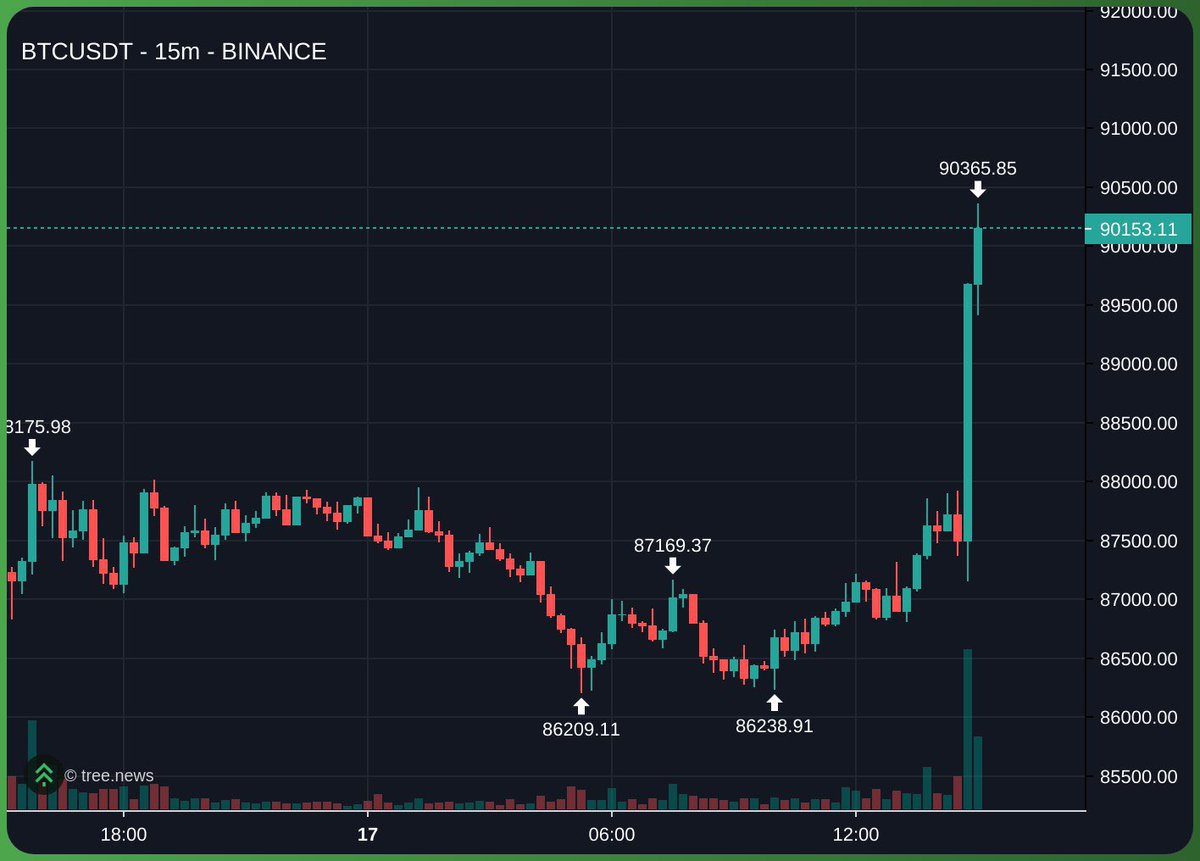
epic pump

3
6
328
BitProp retweeted
16 Dec 2025
EtherRock 38 purchased for 90 ETH ($265,533)
1 hr ago (Dec-16-2025 09:52:59 PM UTC)
Txn: etherscan.io/tx/0xcf5596e356…

32
19
127
32,528
BitProp retweeted

15 Dec 2025
Elon Musk is the first person in human history to touch $600B in net worth, yet he lives nothing like people expect.
He doesn’t own mega-mansions, doesn’t party on yachts with models and bottles, and isn’t burning cash on materialistic things that most billionaires spend $ on. In fact, he sold off all of his homes and lives in a small, modest house near SpaceX in Texas, close to the work, worth ~$50K.
Almost everything he owns is in companies pushing humanity forward - Tesla, SpaceX, Starlink, xAI, Neuralink, 𝕏, Boring Company. He uses his $ to push the mission of his companies forward.
And I bet he’ll continue to use his wealth to make Earth safer, accelerate sustainable energy, and ensure humans become a multi-planetary species on Mars.
This is FAR from comfort.
That’s what makes him different. Most billionaires optimize for lifestyle, while Elon optimizes for outcomes that matter to civilization.
Time will tell, but I believe people won’t remember him for what he owned, but rather people will remember him for what he sacrificed and built.
Congrats Elon.

734
1,939
9,771
217,428
BitProp retweeted

15 Dec 2025
The best thing exchanges could do is delist all but 100 tokens, make it competitive to stay listed on the exchange and stop dividing the melting ice cube of retail capital across thousands of worthless assets.
133
157
2,152
125,482
15 Dec 2025
And already down on this buy by $50mill ?
15 Dec 2025

3
1
5
624
15 Dec 2025
This guy here can just fuck off.
Pocketing $30mill on his scam and now trying to clear the evidence.
Prove me otherwise.


2
172
15 Dec 2025
By this time now, you should own 0 crypto and you should not care if it dumps.
5
1
7
244
BitProp retweeted

12 Dec 2025
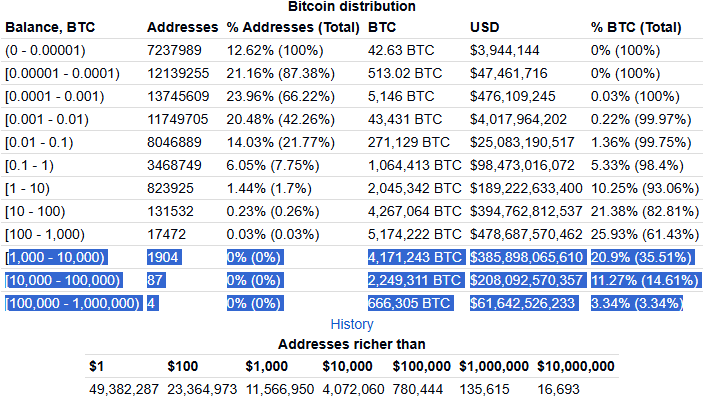
Bitcoin let me teach you what you do not know.
1,995 addresses hold 36% of all BTC.
19,467 addresses hold 61% of all BTC.
150,999 addresses hold 83% of all BTC.
What do you think this means?
247
283
1,550
121,678
12 Dec 2025
Few knows this.
When you criticise him, you get his minions trolling you, too.
11 Dec 2025

Raoul Paul is hands down one of the biggest morons in web3
Let me leave you with this absolute banger
Last time I clowned him on basics of how inflation works … he blocked me lol he has zero understanding of investing and trading. Just a good salesman
5
9
364

BitProp retweeted

9 Dec 2025
SpaceX is about to become the most important company on Earth. And maybe off it.
$30-40B raise. $1.5T valuation. Largest IPO in history. Those are the headlines.
Here’s what they’re actually telling you.
Musk just told investors that Starlink will generate $22-24B in 2026 revenue, up from $8B in 2024. That’s tripling in two years. At 100x forward revenue, the market is pricing Starlink like it’s the next AWS.
The comparison isn’t crazy.
AWS did $90B last year with 31% of cloud market share. Starlink has 8M subscribers and approximately zero real competition. Amazon Kuiper has 153 satellites. Starlink has 7,000 . OneWeb did $216M in 2024. Starlink did $8B. By the time Kuiper launches commercial service in late 2026, the race is already over.
But Starlink is the boring part of this story.
Musk said last month that “cost effectiveness of AI in space will be overwhelmingly better than AI on the ground” within 4-5 years. SpaceX plans to use IPO proceeds to build space-based AI data centers. Starship can deliver 100GW per year to high Earth orbit. For context, total US electricity consumption is 490GW. Average AI data center demand is projected to hit 123GW by 2035, up from 4GW today.
The math: Earth cannot build power plants fast enough. Gas turbine backlog is 7 years. Nuclear takes a decade. Meanwhile Musk is talking about solar-powered AI satellites with radiative cooling in orbit. Google’s Sundar Pichai called it a “moonshot” and said Project Suncatcher could launch prototype servers by 2027. His exact words: “only possible because of SpaceX’s massive advances in launch technology.”
ARK just published an open-source valuation model. Monte Carlo simulation, 17 variables, 1 million iterations. Base case: $2.5T by 2030. Bull case: $3.1T. That’s a 38% CAGR from December’s $350B round.
The model assumes:
- Full Starlink constellation (42,000 satellites) by 2035
- $300B annual revenue at maturity (15% of global communications spend)
- Mars development funded by Starlink cash flows
And here’s where it gets weird.
Musk announced 5 uncrewed Starship launches to Mars in 2026. He gives it 50-50 odds. If they land intact, crewed missions begin 2029-2031. By 2033, he’s targeting 500 launches per window. The goal: 1 million people on Mars, self-sustaining city in 20 years.
The timeline:
- 2026: 5 test flights (10t payload each)
- 2028-29: 20 launches, first humans
- 2030-31: 100 launches
- 2033: 500 launches
ARK’s model explicitly excludes Mars revenue because “projecting cash flows from extraterrestrial settlements can be speculative.” But they note Mars infrastructure could eventually enable asteroid mining.
Jensen Huang called space data centers “a dream.” Fair. Radiation shielding for Blackwell GPUs doesn’t exist. Deploying tens of thousands of square meters of thermal radiators is science fiction today.
But SpaceX has a history of turning science fiction into quarterly revenue.
At $1.5T, you’re paying for:
1. Starlink monopoly on LEO internet (priced in)
2. Space-based AI compute infrastructure (speculative)
3. Mars colonization (not priced, possibly unquantifiable)
Here’s the bear and bull cases.
Bear case
100x multiples assume flawless execution on subscriber growth, zero price compression from competition, and regulatory goodwill in 100 countries. Musk’s timelines slip by years. Starship has had multiple test failures.
Bull case
SpaceX is the only company that can simultaneously solve the AI power crisis, provide global internet, and make humanity multiplanetary. The TAM is literally civilization.
I don’t know if SpaceX is worth $1.5T or $3T or $500B. Neither does anyone else. The honest answer is that traditional valuation frameworks break when you’re pricing optionality on space-based computing and interplanetary colonization.
But I know this… if you’re building a 20-year portfolio and you can only own one company, the argument for SpaceX has never been stronger.
9 Dec 2025

JUST IN: SpaceX plans to go public at $1.5 trillion valuation in 2026, the largest IPO in history, Bloomberg reports.

132
512
3,201
604,008