
Founder, Builder, Trader, Adviser, Early Stage Investor and A Crypto Head !
Joined February 2012
- Tweets 625
- Following 1,077
- Followers 226
- Likes 997
32 Photos and videos



Pinned Tweet

8 Sep 2015
Just remember when you post something, the computers remember forever - Eric Schmidt
2
1
15
CryptoHead retweeted

Got your hands on Claude Fable 5?
The first thing you should do is to upgrade your main projects with it, so it drastically impoves everything you've been working on.
Run this Audit & Project Improvement Prompt on each repo that's important to you (simply copy-paste it):
Repo Audit & Improvement Plan:
Prompt made by Claude Fable 5
You are a world-class principal-level software engineer and technical auditor. Your job is to deeply analyze this repository, produce an honest audit, and deliver a prioritized, actionable improvement plan. Work in the four phases below, in order. Do not skip ahead.
Ground every claim in actual files: cite file paths and line numbers. If you can't verify something, say so explicitly rather than guessing.
Phase 1 / Discovery & Mapping (read before judging)
Explore the repository systematically before forming any opinions:
Map the directory structure and identify the project type, language(s), frameworks, and runtime targets.
Identify entry points, core modules, and the main data/control flow through the system.
Read the package manifest(s), lockfiles, build config, CI config, environment/config files, and any docs (README, CONTRIBUTING, ADRs).
Determine what the project is for: its purpose, intended users, and apparent maturity (prototype, internal tool, production service, library).
Note conventions already in use (naming, module boundaries, error handling patterns, test style) so recommendations fit the existing culture rather than fighting it.
Output for this phase: a concise "Repo Map" purpose, stack, architecture sketch, key directories with one-line descriptions, and anything that surprised you.
Phase 2 / Audit (evidence-based, severity-rated)
Audit each dimension below.
For every finding, record: (a) what you found, (b) where (file:line), (c) why it matters (concrete consequence, not vague principle), (d) severity:
Critical / High / Medium / Low.
• Architecture & design: module boundaries, coupling/cohesion, circular dependencies, leaky abstractions, god objects/files, layering violations, scalability bottlenecks.
• Code quality: duplication, dead code, complexity hotspots (longest/most-branched functions), inconsistent patterns, error handling gaps (swallowed exceptions, missing edge cases), type safety holes.
• Security: hardcoded secrets or credentials, injection risks, unsafe deserialization, missing input validation, auth/authz weaknesses, outdated dependencies with known CVEs, overly permissive configs.
• Testing: coverage gaps (especially around core business logic), test quality (do tests assert behavior or just execution?), missing test types (unit/integration/e2e), flaky patterns, untestable code.
• Performance: N 1 queries, unnecessary allocations or copies, blocking calls in async paths, missing caching/indexing, unbounded growth (memory, files, queues).
• Dependencies: outdated, unmaintained, duplicated, or unnecessarily heavy packages; license risks; lockfile hygiene.
• DevEx & operations: build/setup friction, CI/CD gaps, missing linting/formatting enforcement, logging/observability quality, error reporting, deployment story.
• Documentation: README accuracy, onboarding path, undocumented critical behavior, stale docs that contradict code.
Rules for this phase:
Prefer 15 high-confidence findings over 50 speculative ones.
Distinguish facts ("this function has no error handling: src/api/client.ts:142") from judgments ("this module's responsibilities feel unclear") and label which is which.
Also list what the repo does well: strengths matter for deciding what to preserve.
Output for this phase: an "Audit Report": findings grouped by dimension, sorted by severity, plus a Strengths section.
Don't forget to mention all the ugly parts that need utmost priority.
Phase 3 / Improvement Strategy
Synthesize the audit into a strategy:
Identify the 3–5 themes that explain most of the findings (e.g., "no enforced boundaries between layers," "error handling is ad hoc").
For each theme, propose a target state and the principle behind it.
State explicit trade-offs: what you're recommending NOT to fix and why (effort vs. payoff, risk, project maturity).
Define what "done" looks like — measurable signals (e.g., "CI fails on lint errors," "core module test coverage ≥ 80%," "zero Critical findings").
Phase 4 / Detailed Task Plan
Convert the strategy into an execution plan:
Break work into discrete tasks. Each task must include: Title and one-paragraph description
Files/areas affected
Acceptance criteria (how we verify it's done)
Effort estimate (S = <2h, M = half-day, L = 1–2 days, XL = needs breakdown)
Risk of the change itself (could it break things?)
Dependencies on other tasks
Order tasks into milestones:
Milestone 0
Safety net: anything needed before refactoring safely (tests around critical paths, CI gates, backups).
Milestone 1
Critical fixes: security and correctness issues.
Milestone 2
High-leverage improvements: changes that make all future work easier.
Milestone 3
Quality & polish: remaining medium/low items worth doing.
Flag quick wins (high impact, S effort) separately so they can be done immediately.
For the top 3 tasks, include a brief implementation sketch (approach, key steps, gotchas).
Final Deliverable Format
• Produce a single document with these sections:
• Executive Summary (≤10 sentences: overall health grade A–F with justification, top 3 risks, top 3 opportunities)
• Repo Map
• Audit Report
• Improvement Strategy
• Task Plan (milestones task table quick wins)
• Open Questions: anything you need from a human to decide (product intent, deprecation candidates, performance targets)
Constraints
Do NOT modify any code during this audit. Analysis only.
Do not pad the report. If a dimension is healthy, say so in one sentence and move on.
Calibrate to the project's maturity. Don't recommend enterprise-grade infrastructure for a weekend prototype unless the owner's goals demand it.
Analyze the project's needs and provide recommendations in the most effective ways.
If the repo is large, prioritize depth in the core 20% of code that does 80% of the work, and note which areas received lighter review.
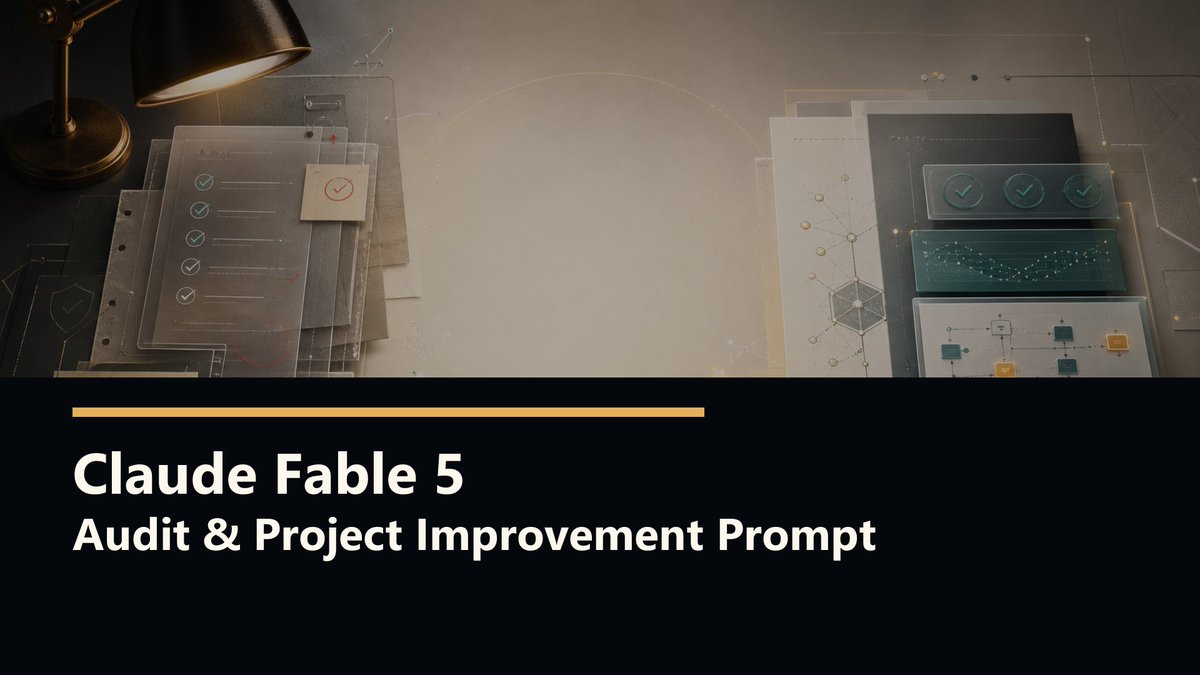

Introducing Claude Fable 5: a Mythos-class model that we’ve made safe for general use.
Its capabilities exceed those of any model we’ve ever made generally available.
178
306
3,707
574,387
CryptoHead retweeted

Jun 6
🚨ARTHUR HAYES REVEALS HIS HYPE CONCERNS
Hayes recently sold his HYPE position and warned that Hyperliquid faces growing competition as exchanges and rival DEXs enter RWA perpetuals.
The risk: more competition could pressure volume, revenue, and ultimately HYPE valuation.
293
33
445
169,261
CryptoHead retweeted

Jun 5
JUST IN: Anthropic co-founder Jack Clark reportedly warned new recruits to “get hobbies that aren’t computers,” saying the company is building a “superhuman coder with nation-state hacking capabilities.”
471
695
9,055
2,074,279
CryptoHead retweeted

Jun 5
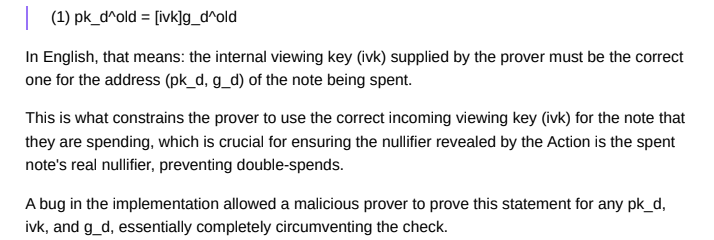
👉For 4 years, 1 day, and 10 hours, anyone who understood the Orchard circuit could have minted ZEC out of thin air, silently, with no on-chain signature. The bug was disclosed this week. It was found by an AI-driven audit running Opus 4.8, not by an attacker.
1. Call the bug what it is
Two lines in halo2's variable-base scalar multiplication gadget used assign_advice() where copy_advice() was required. As a result, the diversified-address integrity check pk_d = [ivk]·g_d could be satisfied for arbitrary inputs. A malicious prover could spend the same note multiple times with different nullifiers, i.e. counterfeit ZEC inside the Orchard pool, undetectable on-chain because the privacy of the ZK proof hides exactly the inputs that would reveal the attack.
We do not know whether it was exploited. We will probably never know.
2. Four years. Multiple audits. Top-tier reviewers.
Orchard was reviewed by some of the strongest cryptographers in the field before activation. They missed it. Earlier automated audits with Opus 4.7 missed it. Opus 4.8 catches it in roughly 1 in 4 runs when prompted generically. The bug is hard.
And ZK inflation bugs are not new. Zcash itself shipped a counterfeiting vulnerability in Sprout (BCTV14) that survived years before being silently neutralized during Sapling. Similar soundness issues have appeared in circom, halo2, and rollup verifiers since. The pattern is consistent: when the protocol is private, exploitation is undetectable. You patch the bug and hope.
3. What Zcash did right
This was a textbook decentralized incident response:
▶️Audit: a full AI-assisted soundness audit of halo2 Orchard, scoped end-to-end.
▶️Discover: the agent flagged the missing constraint and worked out the algebra to turn it into an exploit. A working RPC-level PoC in ~6 hours, mostly waiting on tokens.
▶️Coordinate: a soft fork disabling Orchard, prepared and distributed without leaking the bug, activated 2 days and 15 hours after acknowledgement. Coordinating a soft fork across miners, exchanges, and nodes without disclosing why is genuinely hard. They did it.
▶️Disclose: timeline, code lines, math, open questions. No spin.
Worth naming explicitly: Zcash's turnstile invariant caps the value that can ever leave a shielded pool by the value that entered it. Privacy and verifiability inside the same protocol. That is not an accident. That is good engineering, and it is what kept the worst case bounded.
4. The economics of security just changed
AI does not change whether bugs like this exist. It changes the cost of finding them. I wrote about this x.com/P3b7_/status/203643721…: a missing constraint in a 4-year-old production ZK circuit used to require a top-tier cryptographer with months of context. It now requires a few tokens, an API key, and a well-framed prompt.
The defender benefits. The attacker benefits more, they only need to find it once, and they never disclose.
Orchard is the optimistic version of this story: defense got there first. The pessimistic version is the one we cannot rule out, because the chain is private by design.
5. The only real exit
You do not patch your way out of this asymmetry. You raise the floor.
Formal verification of consensus-critical circuits, every assign_advice audited by SAT solvers and AI for under-constraint, as the reporter himself recommends. Proof-grade engineering that used to be too expensive is now cheap enough to be mandatory.
Hardware roots of trust, secure enclaves, certified secure elements, WYSIWYS. Cryptographic guarantees the user can actually verify, not promises a host can lie about.
Continuous AI-assisted audit of every consensus-critical commit, re-run immediately on the release of any new frontier model.
Zcash didn't just patch a bug. They demonstrated the new defensive playbook: AI-driven audits, decentralized coordination, radical transparency, verifiable invariants. That is the direction the rest of the industry needs to follow.
And those who don't raise the bar for security will be rekt in this new world.
Stay safe. Stay honest about your trust assumptions.

315
213
1,028
268,820
May 24
RT @Moexba: The day not ending easy, join and learn about Ai trading 🙌🙏 from an expert without any financial advice but focused on practica…
4
May 24
RT @MENABCW: Trading meetup kicked off with an AI Trading workshop, one more session to go, running alongside @GDGSharjah_ teaching how to…
6
CryptoHead retweeted

May 24
💫 LIVE TODAY AT MENA BLOCKCHAIN WEEK | AI, TRADING & AI AGENTS 🚀
The Melkart team will be presenting today at MENA Blockchain Week, sharing insights on how AI is transforming trading, portfolio management, market analysis, and the next generation of AI-powered trading agents.
📍 Location: Hadron Founders Club / PF Innovations Consultancy LLC
🕑 Time: 2:00 PM (Dubai Time)
Topics include:
• AI in trading: reality vs hype
• Building and deploying AI trading agents
• How traders can leverage AI for research and decision-making
• Live AI agent demonstration
If you're attending MENA Blockchain Week, come join us and say hello. We'd love to meet members of the Melkart community in person.
🎟 Register here: luma.com/MENABCW07

1
2
34
CryptoHead retweeted
May 21
TAO Technical Analysis 📊
Breaking down structure, momentum, and key levels shaping the setup.
Trade the structure. Stay disciplined 🎯
📬 To Stay ahead , join the Melkart Newsletter (link in bio).
📰 melkartgroup.io/
💬 t.me/MelkartGroup
#Melkart #MelkartGroup #TAO #Crypto #Trading
1
1
19
CryptoHead retweeted
May 21
ZEC Technical Analysis 📊
Breaking down structure, momentum, and key levels shaping the setup.
Focus on execution, not emotions 🎯
📬 To Stay ahead , join the Melkart Newsletter (link in bio).
📰 melkartgroup.io/
💬 t.me/MelkartGroup
#Melkart #MelkartGroup #ZEC #Crypto #Trading
1
2
46
CryptoHead retweeted
May 21
VVV TA Update 📊
Breaking down structure, momentum, and key levels shaping the setup.
Trade the probabilities 🎯
📬 To Stay ahead , join the Melkart Newsletter (link in bio).
📰 melkartgroup.io/
💬 t.me/MelkartGroup
#Melkart #MelkartGroup #VVV #Crypto #Trading
1
1
49
CryptoHead retweeted
May 21
HYPE TA Update 📊
Revisiting structure, momentum, and key levels shaping the setup.
Stay adaptive. Stay disciplined 🎯
📬 To Stay ahead , join the Melkart Newsletter (link in bio).
📰 melkartgroup.io/
💬 t.me/MelkartGroup
#Melkart #MelkartGroup #HYPE #Crypto #Trading
1
1
1
58
CryptoHead retweeted
May 14
VVV Technical Analysis 📊
Breaking down structure, momentum, and key levels shaping the setup.
Focus on probabilities not hype 🎯
📬 To Stay ahead , join the Melkart Newsletter (link in bio).
📰 melkartgroup.io/
💬 t.me/MelkartGroup
#Melkart #MelkartGroup #VVV #Crypto #Trading
2
2
28
CryptoHead retweeted
May 9
MegaETH (MEGA) Technical Analysis 📊
Breaking down structure, momentum, and key levels shaping the setup.
Focus on probabilities not hype 🎯
📬 To Stay ahead , join the Melkart Newsletter (link in bio).
📰 melkartgroup.io/
💬 t.me/MelkartGroup
#Melkart #MelkartGroup #MEGA #Crypto #Trading
1
1
125
CryptoHead retweeted

May 4
ETFs didn’t just approve Bitcoin… they completely changed how it moves.
@cryptohead3 breaks it down:
BTC now trades like a stock — heavy correlation with Wall Street hours
CME futures > Binance charts
The entire cycle shifted after 2024 approval
This is why Bitcoin behaves differently in 2026.
1
1
3
171
CryptoHead retweeted

May 4
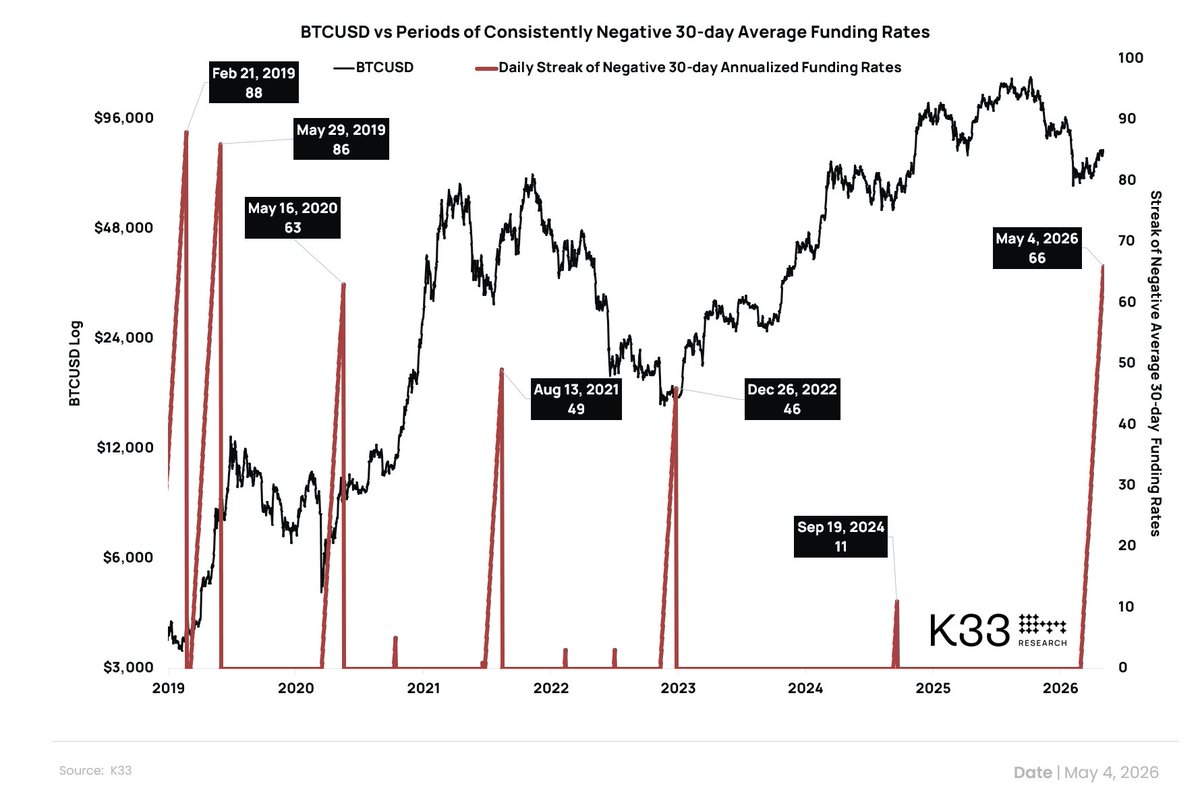
We're in the longest streak of negative 30-day average funding rates in this decade at 66 consecutive days.
I care about this regime for one simple reason, timing.
Lasting negative funding rates has a very strong track record of flagging where you should buy with conviction.
7
28
173
13,727
CryptoHead retweeted
May 4
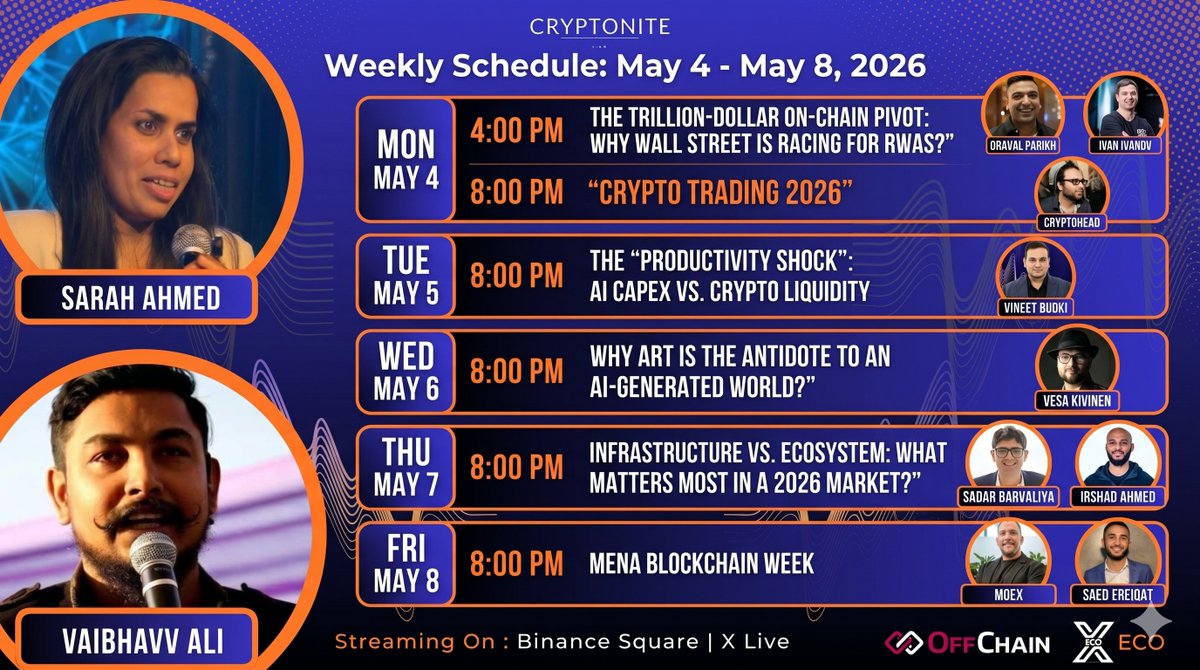
🚨 AURA8 WEEKLY LIVESTREAM SCHEDULE DROP! 🔥
Get ready for an insane week of crypto, AI, RWAs, trading & more with @vaibhavvali & @0xsfav every day!
📍 Streaming LIVE on @binance | @X 📅 May 4 – 8, 2026 | Dubai time below
FULL WEEKLY LINEUP:
🗓 MON 4 MAY• 4:00 PM → “THE TRILLION-DOLLAR ON-CHAIN PIVOT: WHY WALL STREET IS RACING FOR RWAS?” with Dhaval Parikh & @ @IvanUVC
• 8:00 PM → “CRYPTO TRADING 2026” with @CryptoHead3
🗓 TUE 5 MAY• 8:00 PM → “THE 'PRODUCTIVITY SHOCK': AI CAPEX VS. CRYPTO LIQUIDITY” with @vineetbudki
🗓 WED 6 MAY• 8:00 PM → “WHY ART IS THE ANTIDOTE TO AN AI-GENERATED WORLD?” with @artbyvesa
🗓 THU 7 MAY• 8:00 PM → “INFRASTRUCTURE VS. ECOSYSTEM: WHAT MATTERS MOST IN A 2026 MARKET?” with @sagarbarvaliya & @irshaddahmed
🗓 FRI 8 MAY• 8:00 PM → “MENA BLOCKCHAIN WEEK” with @Moexba & @WEB3douin
Which session are you tuning into first? Drop your pick below 👇
Supported by @OffChain & @ECO_X
#AURA8 #Crypto #Web3 #RWAs #Blockchain #MenaBlockchainWeek #CryptoTrading #AI
5
7
19
685
CryptoHead retweeted

May 3
This should be ILLEGAL.
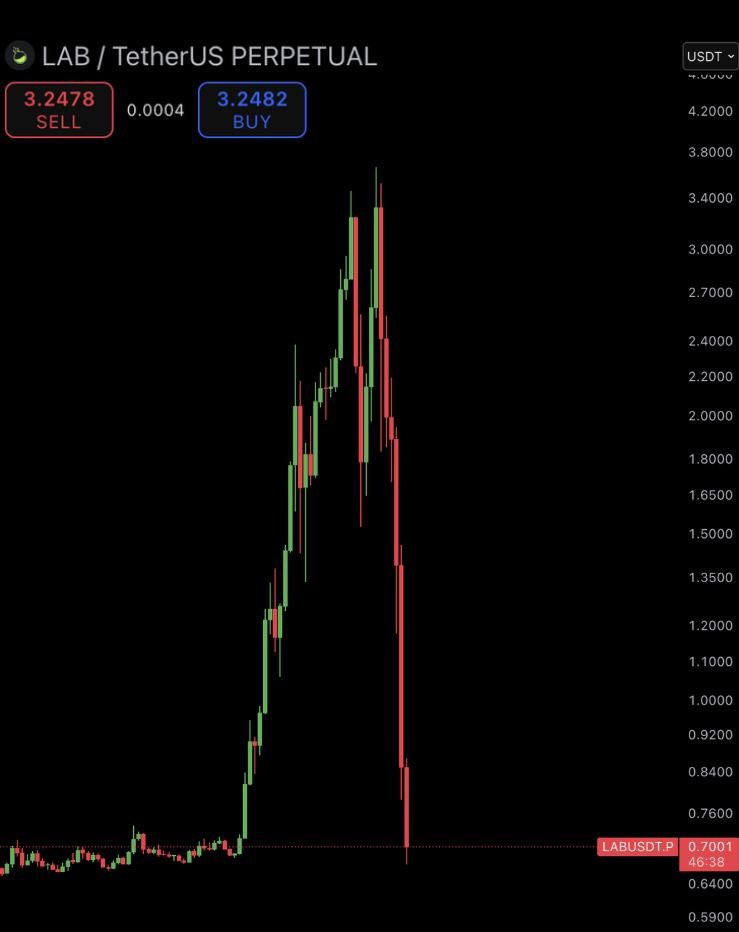
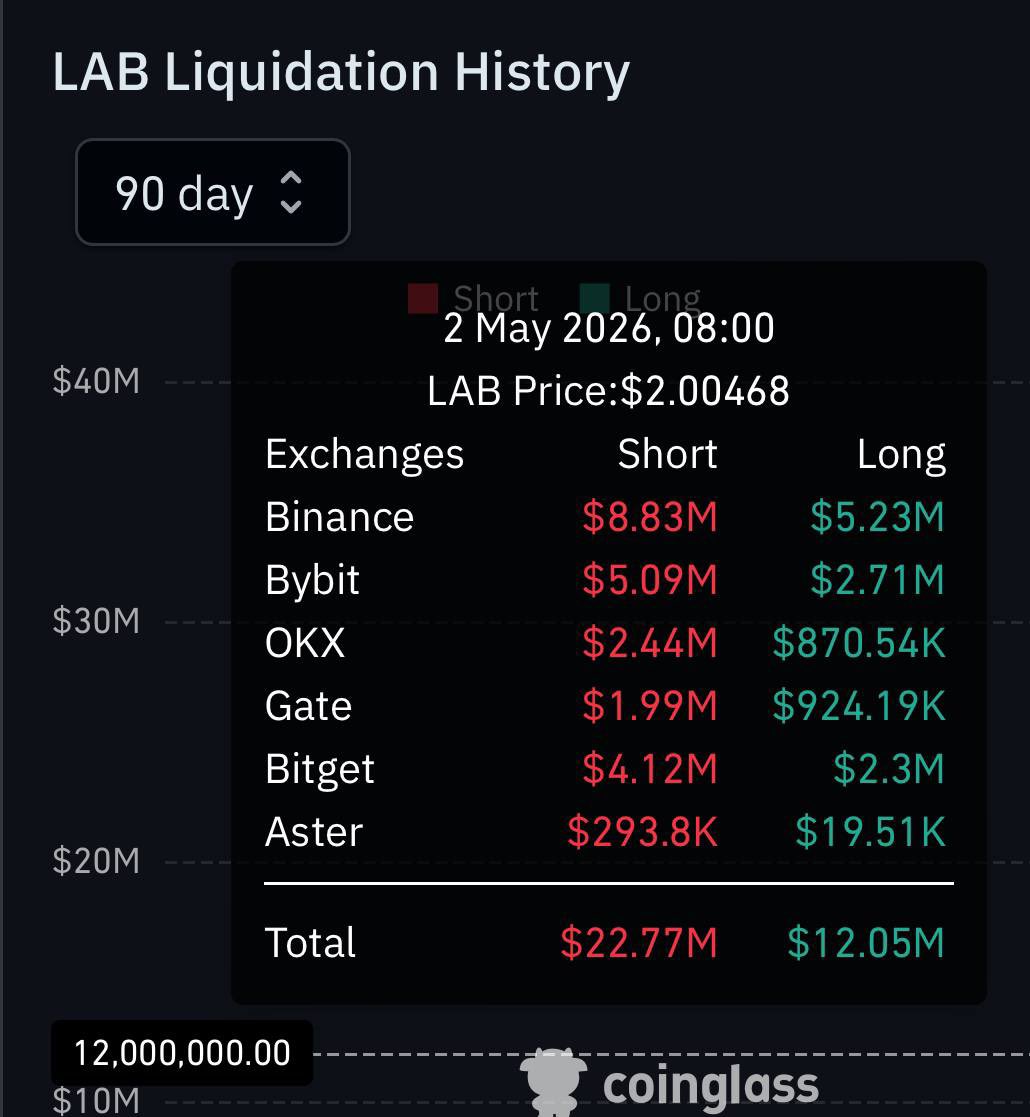
$LAB token pumped 500% in just 2 days, adding $260 million to its market cap and liquidating $26.6 million in shorts.
It then dumped 84% in just 8 hours, wiping out over $250 million and liquidating $17 million in longs.
Majority of LAB supply is controlled by the team.
Here's how this manipulation playbook works:
- Make the supply float as low as possible
- Start a pump, which will attract shorts.
- Funding will flip negative and then push some spot demand, liquidating the shorts.
- More shorts will enter, pushing funding to the max level.
- Continue to liquidate these shorts and make massive profits.
- Once retail believes the pump won't stop, start offloading supply.
- Simultaneously, short the market and make profits from both short positions and spot dumps.
- Meanwhile, retail first lost by going short and now lost by going long.
697
263
1,627
352,693
CryptoHead retweeted

Apr 25
Pendle is starting to get interesting again.
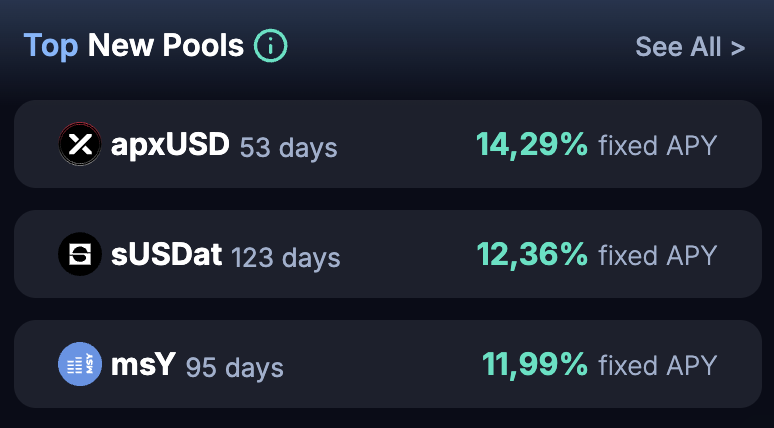
3 new fixed-yield markets caught my eye:
→ apxUSD: 14.29% fixed APY, 53 days
→ sUSDat: 12.36% fixed APY, 123 days
→ msY: 11.99% fixed APY, 95 days
But the interesting part is not just the APY. It is how different the yield sources are.
---
➣ apxUSD by @apyx_fi
Highest APY. Shortest maturity. Live on @base. That alone makes it stand out.
apxUSD is a synthetic dollar built as a liquidity layer for the Apyx ecosystem, with backing linked to Digital Asset Treasuries.
The main thing to understand is that apxUSD itself is not the yield-bearing token. In the Apyx system, that role belongs to apyUSD.
So the fixed yield on Pendle comes from the PT structure and market discount, not from apxUSD simply paying yield like a normal yield-bearing stablecoin.
Good setup, but worth understanding the backing, liquidity, and yield mechanics before sizing meaningfully.
---
➣ sUSDat by @saturn_credit
This is probably the most unique pool of the three.
The 12.36% fixed APY is attractive, and the yield is tied to Saturn’s digital credit exposure and STRC mechanics.
That makes the setup more interesting than a normal stablecoin yield trade, but also means users should understand how the structure works.
A few things worth watching: STRC price, peg stability, dividend timing, oracle mechanics, and large redemption impact.
Also, YT-sUSDat yield accrual has been affected by the STRC ex-dividend event before. That is a YT-specific issue, while PT fixed APY works differently on Pendle.
Overall, sUSDat is one of the more interesting fixed-yield setups here, especially for users who like researching new credit-based yield designs.
---
➣ msY by @Main_St_Finance
This one feels like the cleanest structure of the three.
msUSD is described as a 1:1 USDC token, while msY generates yield through delta-neutral options box spreads.
So instead of betting directly on market direction, the design aims for a more stable, Treasury-like yield profile.
The APY is a bit lower at 11.99%, but the yield story is easier to understand.
It also comes with on-chain yield exposure and Gamma Points, which adds another layer for users who care about points.
---
My simple read:
→ apxUSD = highest APY, shortest duration
→ sUSDat = most interesting, but most research-heavy
→ msY = cleaner and more balanced structure
This is why @pendle_fi keeps winning mindshare.
It does not just show you APY. It lets you compare duration, yield source, risk, liquidity, and points in one place.
More pools like this just make Pendle more important as the yield trading layer of DeFi.
14
7
88
5,797
CryptoHead retweeted

Apr 24
When you hold a token, you're exposed to every market that touches it. Until now, there was no way to quickly understand what that actually looks like.
Introducing token pages on DefiLlama.
Understand how tokens are being used in DeFi:
- Risks across lending markets
- Usage by protocol
- Liquidation levels
- Yields & borrow rates
Enter a token in our search bar to find its page.
30
63
507
41,949