
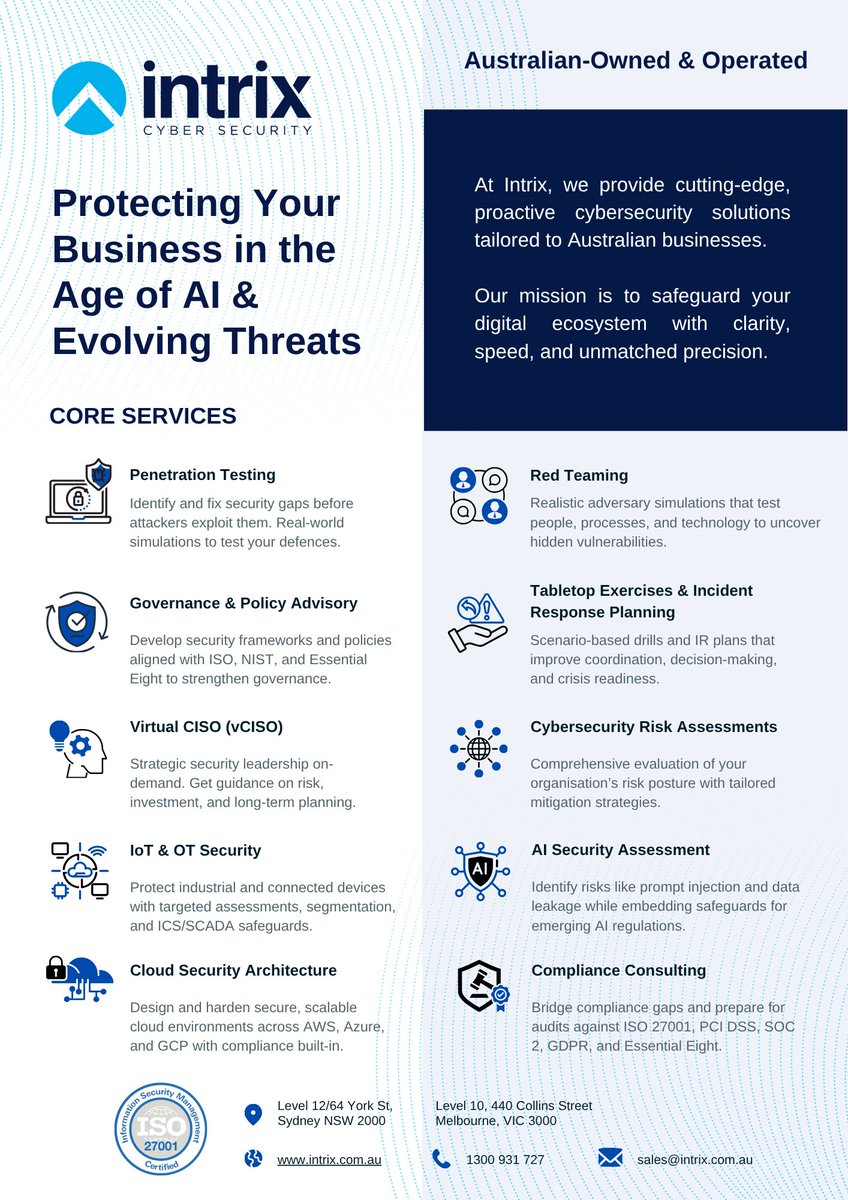
We help Australian businesses build the right cyber strategies to protect systems from cyber-threats, data breaches and attacks.
Joined July 2020
- Tweets 119
- Following 103
- Followers 50
- Likes 20
69 Photos and videos









Pinned Tweet

Cyber threats are evolving fast and so should your defence.
If you’re unsure how exposed your business might be or where to start, that’s usually the best place to begin the conversation.
Explore how we can support your business: intrix.com.au
1
1
28
At Intrix, we are proud to sponsor and support a local community youth program, helping create opportunities for young people to connect, learn, grow, and build confidence through leadership, teamwork, and mentorship.
3
Fake banking app updates hosted on GitHub are being used to spread the NFCShare Android malware, targeting users with convincing impersonations of legitimate banking apps.
#CyberSecurity #AndroidMalware #MobileSecurity #BankingSecurity #ThreatIntelligence
12
Security testing is no longer just an IT task. It's becoming a board-level requirement.
Organisations need proof that controls work, risks are understood, and weaknesses are identified before attackers find them.
Read more:
intrix.com.au/blog/why-secur…
#CyberSecurity #PenTesting
11
Australia's cyber regulations are evolving fast.
From ransomware reporting and CPS 230 to smart device security standards, organisations must now prove controls work, not just that they exist.
Read more:
intrix.com.au/blog/navigatin…
#CyberSecurity #GRC #IntrixCyberSecurity
16
Thousands of legitimate websites have been compromised to spread ClickFix and FakeUpdate malware.
Fake errors. Fake updates. Real infections. Even trusted websites can become attack vectors. Stay vigilant.
#CyberSecurity #Malware #ClickFix #FakeUpdate #IntrixCyberSecurity
33
Data security and data privacy are often used interchangeably, but they're not the same thing.
Understanding the difference is critical for effective GRC, compliance, and risk management.
Read more:
intrix.com.au/blog/not-the-s…
#CyberSecurity #DataPrivacy #DataSecurity #GRC
1
14
Cybersecurity is shifting from threat-focused defence to business risk management.
As boards demand clearer risk visibility, GRC is becoming a critical part of business strategy, not just compliance.
Read: intrix.com.au/blog/shifting-…
9
APAC ransomware pressure: Ransomware and extortion in APAC increasingly exploit third‑party vendors and unpatched access, with data exfiltration in under 72 minutes, stressing vendor control and rapid detection.
9
Canvas LMS breach impact: A large breach at Canvas LMS hit thousands of Australian education providers, exposing student and staff data and underscoring SaaS platform and third‑party risk.
13
Australia’s new Cyber Security Act 2024 tightens mandatory incident and AI‑driven event reporting, raising expectations on IR playbooks, governance and board‑level accountability.
6
The UK and Australia are increasing focus on AI security risks as adoption grows across critical infrastructure and businesses.
Intrix Cyber Security helps businesses navigate AI risk with GRC support, vulnerability assessments, and cybersecurity strategy development.
15
Microsoft’s May 2026 Patch Tuesday fixes 118–130 flaws, including critical SharePoint, DNS, Netlogon and SSO issues, demanding risk-based patch prioritisation for Microsoft-heavy environments.
11
Australia’s Cyber Security Act introduces smart-device standards, mandatory ransomware reporting, and review mechanisms, making compliance a core part of operational resilience.
10
Recent Canvas/Instructure breach impacting multiple Australian education providers underscores third-party SaaS risk and the need for data mapping and vendor assurance.
30
AI is changing the cybersecurity landscape faster than ever. Attackers are now using AI to automate phishing, generate adaptive malware, and launch more sophisticated attacks at scale.
Read more here: intrix.com.au/blog/ai-powere…
#CyberSecurity #AI #IntrixCyberSecurity
8
AI-fuelled attacks surge: Fortinet and APAC research show a 389% YoY rise in ransomware victims and 81% of organisations breached via APIs, driven by AI-accelerated exploits—tightening patch windows and spotlighting identity, API security, and continuous monitoring.
19
New AU ransomware rules: Australia’s Cyber Security Act 2024 now mandates that organisations over AUD $3M report any ransomware payment to ASD within 72 hours, turning ransom choices into regulated board-level compliance events with potential civil penalties.
23
Education SaaS breach: Global Canvas-Instructure LMS breach hit 9,000 institutions and up to 275M users, including Australian universities, highlighting third-party SaaS and supply-chain risk for education and other SaaS-heavy sectors.
16
ACSC warns active cPanel exploitation: Public-facing hosting infrastructure under active attack creates patch-urgency decisions for SMBs and service firms, turning routine maintenance into business-continuity response.
3
Queensland Canvas breach leads: Direct Australian impact across schools and TAFEs showcases third-party risk as a board-level concern, affecting education, healthcare, legal and professional services where vendor data custody defines commercial trust.
4