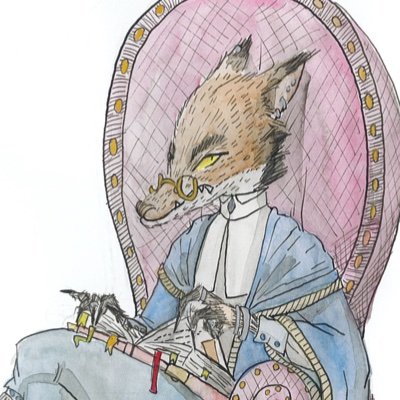
An (annoying) Arcanaloth masquerading as a (surplussed) Microbiologist masquerading as a (retired) Lawyer. For now.
Joined September 2022
- Tweets 3,355
- Following 79
- Followers 923
- Likes 3,221
213 Photos and videos

Pinned Tweet

17 Sep 2024
I'm an independent hobbyist investigator and commentator with an “unlaw” focus. I’m not really interested in law, legal theory, etc. Methodologically, I’m a microbiologist who studies law-related things. I measure court processes and activities, and track pseudolaw phenomena.
I engage in data-driven research using science-based investigation and analysis. Little is known on how Canadian courts truly operate. My studies quantify Canadian appellate litigation, including the controversial SRL phenomenon. I also investigate anti-authority false-law pseudolaw phenomena, Canadian pseudolaw groups and their beliefs, and how pseudolaw is embedded in the junkheap of information sociologists call the “cultic milieu”.
I used to be an Alberta Court of King's Bench staff lawyer, the “Complex Litigant Management Counsel”, who assisted management of problem litigants and litigation. Any of my often cranky statements and publications are my own opinion and perspective, and not that of my former workplace, its personnel, and judges.
Most of my published research is archived on ResearchGate, if you are curious (researchgate.net/profile/Don…).
Oh yeah, and I’m an unrepentant weirdo. It kind of leaks through, sometimes.
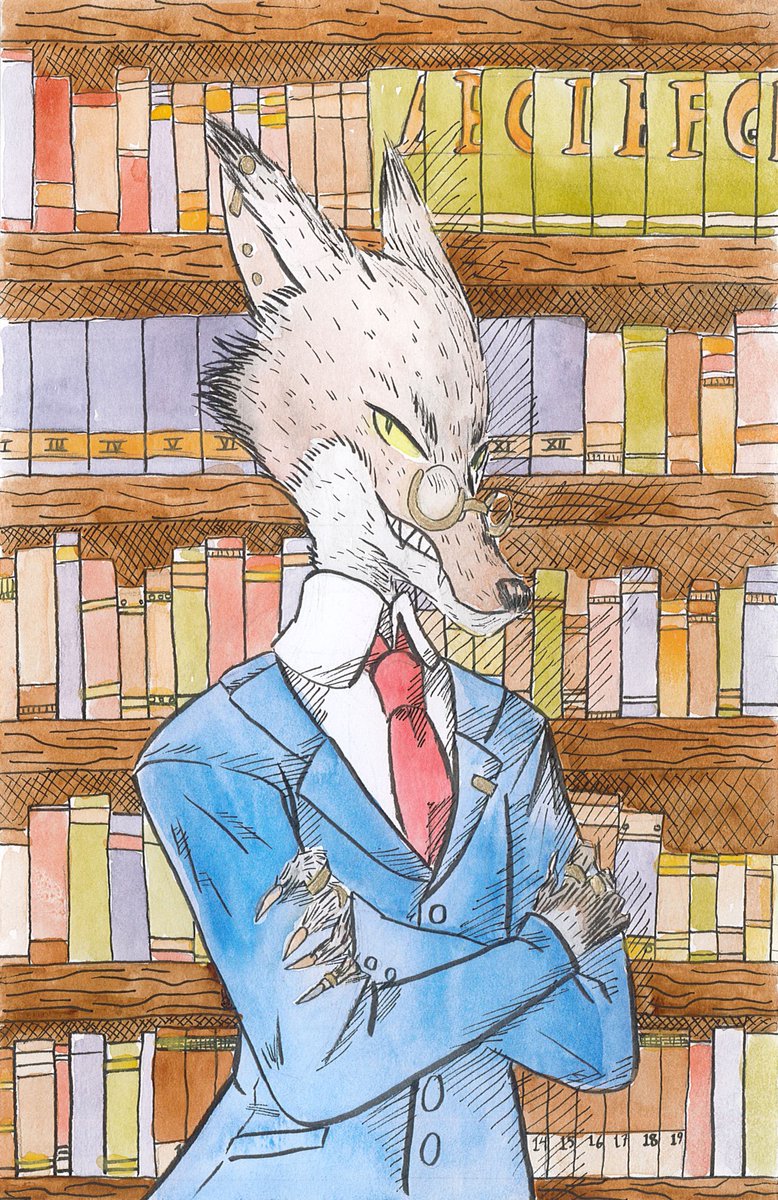
(Fursona art courtesy of brightkarma - furaffinity.net/view/5808345…).
4
2
36
11,075
There is a direct relationship between my level of activity on social media and my boredom with editing and writing up my current academic research investigations.
That is all.
Thank you for your attention.
1
6
112
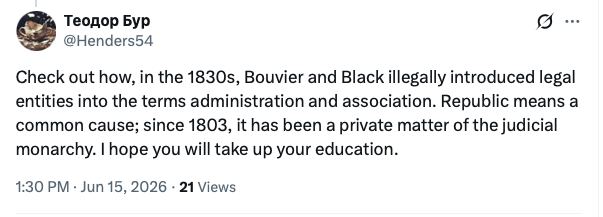
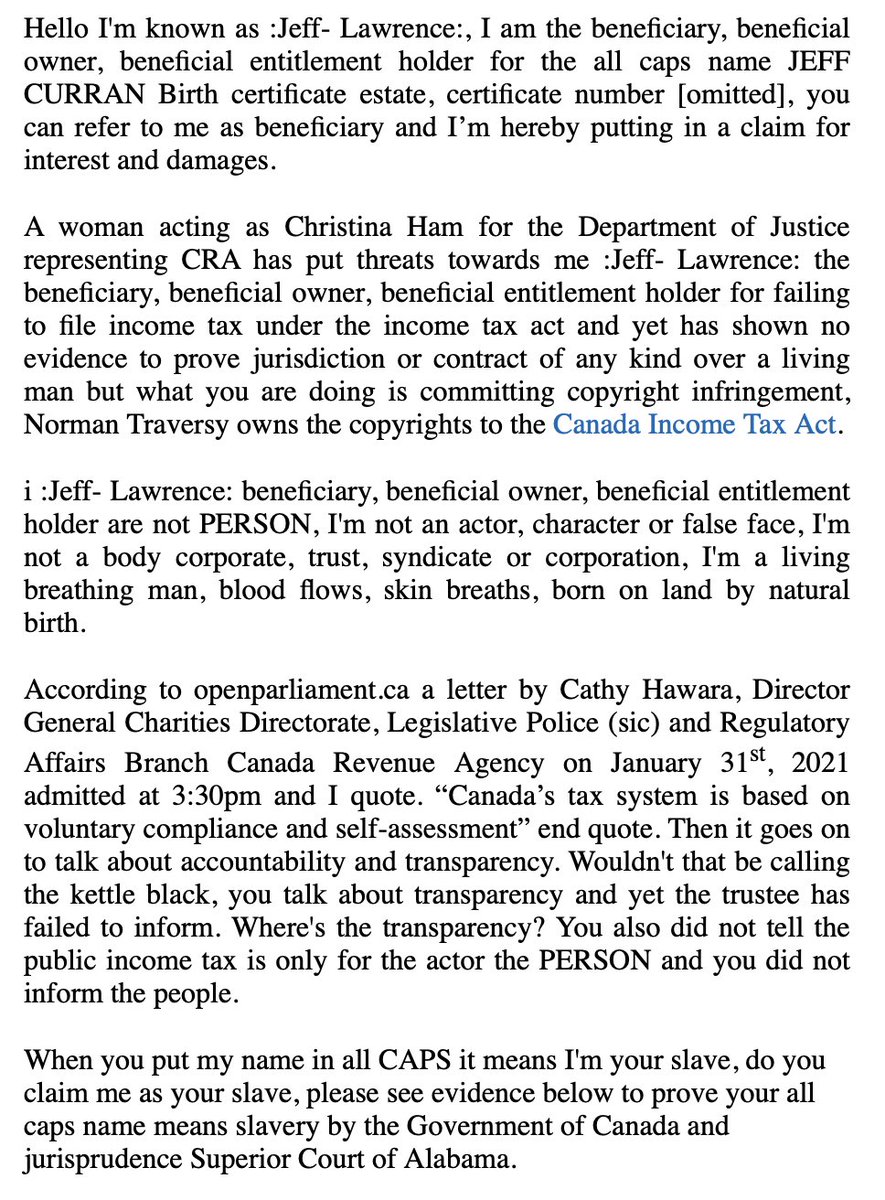
Something I find extraordinarily neat is how conspiratorial thinking links cause and effect.
See the attached message I received. I don't know this individual nor am I exactly certain what he's trying to convey.
But the implications are fun. "Bouvier" and "Black" almost certainly relate to old US-sourced legal dictionaries, "A Law Dictionary" by John Bouvier and "Black's Law Dictionary". Incidentally, there's a broad school of Sovereign Citizen thinking that Black's is the corrupt version, so you should rely on Bouvier's.
According to our friend, some hidden hand in the 1830s allegedly manipulated definitions in two legal dictionaries. That's how you change the law - by changing legal dictionaries. Since, apparently, dictionaries define law.
That, then, supported or created a "judicial monarchy". I'm not confident I understand what a judicial monarchy might be, since the judiciary isn't a hereditary system. Maybe the writer is trying to convey that the judges now operated like kings? Well, in Canada, it's certainly moved in that direction.
Y'know, there's such an intriguing gnostic aspect to all this, to pseudolaw in general. You can twist existence and government structure into something new by altering dictionary definitions. Orwell's "NewSpeak" has nothing on these people.
Dictionaries, man! They're the pillars of reality!
Anyways, I didn't look up the definitions of "administration" and "association" in 200 year old US law dictionaries to see what naughtiness was going on back then. But... if I might be so bold. If the US's two most prominent law dictionaries did change their definitions for two words, that might be because a leading court in the US had made a legal finding that "administration" and "association" meant X but now means Y.
As a vaguely related aside, I used to work in the same courthouse as Justice Jean Côté, formerly of the Alberta Court of Appeal, who is also the author of "Words That Bind: Words and Phrases Judicially Considered by the Supreme Court of Canada and by the Judicial Committee of the Privy Council to 1949" off Juribiler, which is literally a book of word definitions according to the Supreme Court of Canada. So ... like legal reality defined by words.
I kinda want to track Jean down and see whether he was approached by agents of The Conspiracy to subtly manipulate his dictionary, and Alter The Law from the Words Out.
Tee hee hee.
He'd look at me like I'm a weirdo. Which I am.
4
4
128
Hi Alain! Thank you for linking these videos.
To be direct, I did not watch them but reviewed YouTube's transcripts. I'm not a very patient person.
The concepts presented are what courts in Canada call "pseudolaw". These are rejected ideas that purport to be law.
Put another way, these are arguments that come from a separate competing legal system. The generally accepted legal system in Canada rejects them. Think of this as a "duel of laws" where one side automatically wins.
For example, Canadian courts do not accept arguments that Canadian governments are corporations. Dunn and Bradstreet information proves nothing according to Canadian judges, see for example (Fearn v Canada Customs, 2014 ABQB 114 paras 65-69: canlii.ca/t/g5bx8).
The "Canada's Flag" video at 17-18 minutes makes a distinction between "persons" and "citizens" who are "legal fictions that may be treated like commercial entities" , versus "living men and women". This is "Strawman Theory", the idea that we have two separate aspects linked by birth documentation as a dirty trick played on innocent people to give government authority. In Canada, Strawman Theory has been rejected by courts so many times that simply using Strawman Theory creates a presumption that a litigant is in court for bad abusive purposes (Rothweiler v Payette, 2018 ABQB 288 at paras 6-21: canlii.ca/t/hrlh8).
Put another way, if you invoke Strawman Theory, you lose by default.
Personally, I find Strawman Theory wonderfully strange, since it has no legal or historical foundation. I wrote about Strawman Theory here (papers.ssrn.com/sol3/papers.…) where I suggest Strawman Theory is a kind of possession and exorcism ritual. You might find that interesting.
But the central theme of both videos is that Canada ceased to exist in 1931 due to a defect in the Statute of Westminster. If you're not aware of the back history of this claim, it's pretty fascinating. The theory emerged from the Social Credit Party of Canada, who in the 1930s onward argued Alberta and other provinces had what are usually thought of as federal government rights because there was no federal government. Authority kind of devolved.
There's a funny letter from one of these Social Credit MPs to the leader of the Quebec separatist Party Quebecois saying, essentially - "Hey you already won! Back in 1931!" I never have read a reply.
Anyways, decades later a group of people I call "New Constitutionalists" revived these old concepts and ... nothing came from that. Again, I've written on this subject, here (papers.ssrn.com/sol3/papers.…). This article cites cases that examined and rejected New Constitutionalist claims. The most important one is Butterfield v LeBlanc, 2007 BCSC 235 at paras 21–25: canlii.ca/t/1ql8b.
I'm trying to make a simple point. The ideas these videos advance are well known to Canadian legal institutions. These concepts are not accepted. If one uses these arguments and concepts in court, failure is all but inevitable.
So, if you don't mind me being a little direct, I'd suggest not using these "pseudolegal" claims.
They are fun to talk about and to dissect. I enjoy that very much, personally. But that's just me. I am most definitely a weirdo.

Canada's Flag: A History of Deception
1 of 2
@CanadaIllusion
m.youtube.com/watch?v=Oiyvdq…
1
1
6
408
So I've been eyeballing an abstract for a pseudolaw-related seminar coming up in a few months and there's something in there that bugs me:
the “sovereign citizen” movement ... a destructive, leaderless cult
Cult? Yes. Destructive? Oh yes!
Leaderless? Really?
In my experience many if not most pseudolaw populations organize around some kind of central personality.
The Freemen-on-the-Land had Robert Arthur Menard and Dean Clifford as central figures.
The Kingdom of Canada has Romana Didulo.
The Magna Carta Lawful Rebellion had Jacquie Phoenix.
American State Nationals have David Straight and Bobby Lawrence.
In the US there's Anna Von Reitz. David Wynn Miller. Winston Shrout.
Now, I acknowledge that it's uncommon these central figures become a kind of "commander-in-chief", with a formal organized authority. Instead these are a combination of inspiration leaders and social grifters.
But is pseudolaw truly "leaderless"?
I'd welcome thoughts and opinions.
7
1
9
820
My response over-simplifies things, but here is a simple point that I propose would be a start.
Social cheating should get you kicked in the face. Immediately. No matter who you are.
By social cheating I mean rejecting process "Because justice means I win."
That applies to everyone. Not just self-represented litigants, but all litigants. That should apply to governments. That should apply to lawyers.
People of all orientations and affiliations disagree with court decisions. All the time. In fact, in most instances at least half of the parties in a dispute will disagree with outcomes. That's ok. If you disagree and you think you can defend that challenge to the outcome, then you appeal or initiate a judicial review. Do that til you get the result you want, or the process is exhausted.
Otherwise? Stop.
There's a process. Use it. Don't cheat.
We've agreed to use supposedly independent, supposedly impartial processes and adjudicators to address our disputes. I say "supposedly" because there's disagreement there. I have my opinions on the "supposedly" - but who cares? I'm nobody. But, as a society, we've created this structure. Or elected people who created this structure. Put it in magical constitutional documents, in not so magical legislation and court rules.
But do-overs, re-litigation, collateral attack lawsuits (two or more lawsuits with the same subjects and/or issues) and forum shopping (suing in jurisdiction A, losing, going to jurisdiction B) are cheating. One instance of cheating should be enough to trigger meaningful, strict, negative consequences.
Now I know the complaints that will follow.
"Oh, it was an accident. They were "enthusiastic". The issue is very important to them. You shouldn't be so strict. They don't understand the rules."
Bullshit.
Take anyone. I don't care who. They go to court, to a tribunal. If you ask them "Is it ok for the other side to lose, and then demand endless do-overs?" The answer will be no. I won. Fair and square, by the rules of this society. The other guy is cheating. He agreed to the rules, and now he's cheating.
So, implicitly, that means our hypothetical dispute participant rejects cheating, unless they adopt the Eric Cartmanist approach of "It's justice when I win. And I always win. Until I win, I do what I want."
That's a cheater. We should not wait for cheaters to "persistently" cheat, misusing processes and abusing fair dealing players. We should not agonize about putting barriers in front of cheaters, so hypothetically they won't be able to access "justice" in the future. (I don't know what "justice" means - just repeating what I've been told.) A cheater once predicts future cheating.
Of course, if a cheater cooperates and engages in good behaviour, we should adopt the Prisoner's Dilemma game theory model and give them a chance. And whack them again the next time they cheat.
I don't think it's so complicated. If there's anything that is ground down deep into our DNA, it's a distaste and hostility to cheaters. So why then does the common law tradition court apparatus rush away from that aspect of our nature?
I think the mantra "Justice must be seen to be done." is a part of it. As is how we venerate "The day in court." We go through the motions, rather than point a finger and denounce. We wait, hesitate, rather than act.
You're a cheater. Consequences follow.
Now, trust me, gentle reader, I know the rules aren't evenly and equally administered in Canada's courts. Zealous advocacy, for example, is a principle of "legal representation". Not "legal self-representation".
And we all know why.
But giving cheaters endless do-overs with no effective sanction is something we should all be able to agree is wrong.
Or so I'd hope. I guess I'm still naive.
Jun 13

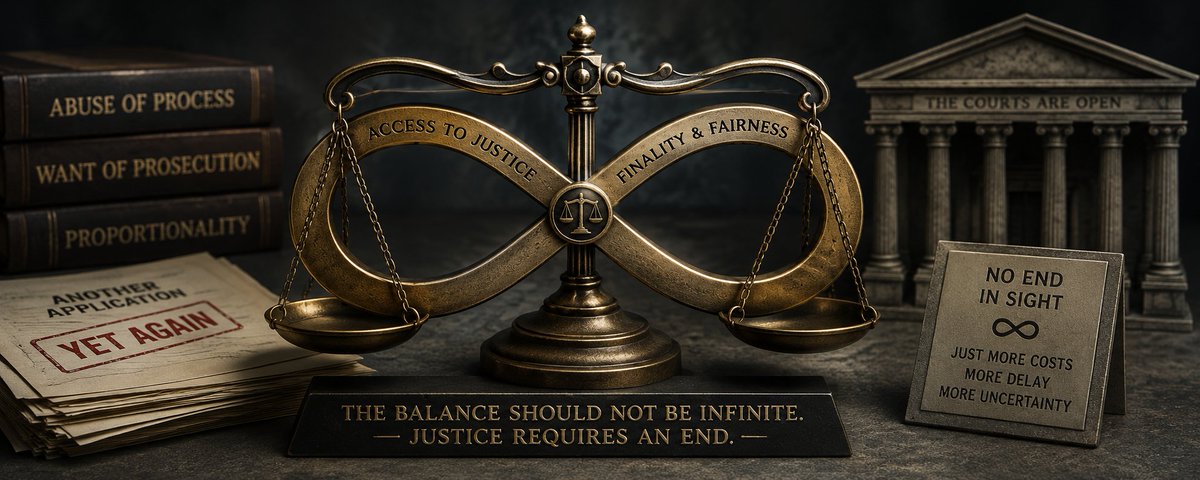
Dr. Netolitzky's comments got me thinking.
The legal system has two competing values:
⚖️ Value #1: Give people a chance to be heard.
⚖️ Value #2: Bring disputes to an end.
So the question becomes: Who shuts the barn door, and when?
Or put another way:
At what point does access to justice stop being access to justice and become perpetual litigation?
6
2
9
490
On June 3, 2024 the Supreme Court of Canada eliminated all filing fees to initiate an appeal or seek leave to appeal.
The amount had been $75.
On Wednesday Wagner CJC expressed concern that SRL appeals at that court are now over 40% of input leave applications.
OH REELLY?!
2
1
9
341
Today's SCC Bulletin had a lengthy order on filing redacted materials. Got curious. What's up?
Apparently the Court granted leave to a lawsuit where a confidential informant sued because its identity was disclosed.
The BCCA decision is neat. Huge chunks of it are redacted!
Here if you want a look: Named Persons v Canada (Attorney General), 2025 BCCA 197 - canlii.ca/t/kcn0w
Not sure if I've ever seen something like that.
1
1
143
Had interesting questions after a Canadian Bar Association educational seminar I presented yesterday.
As usual, I didn't think of some answers at the time. I'm slow.
Eg, what are possible solutions to manage this?
I have nothing but bad answers. But I missed one.
GTFO.
The sad news is that Canadian common law and legislation do not provide adequate mechanisms to address problematic litigants. And I said "litigants" here specifically, because as best I can establish, the central problem isn't "bad litigation" (though that's bad enough), it's that the Canadian legal system and academia fail to acknowledge that problematic litigation is the product of problematic people. People come first. Litigation is the result and consequence of that.
I call these people "abusive litigants". That's because the usual language, "vexatious litigants", in my opinion misrepresents who these individuals are. They're not out to "vex". Instead, their litigation is honest, heartfelt, a centre of their lives and perspectives, and in their minds necessary. Absolutely necessary.
The problem is that what they seek is usually impossible. They are misusing or "abusing" dispute resolution systems.
Many abusive litigants are affected by mental health conditions: delusion, querulous paranoia, extreme overvalued beliefs. They become very, very upset when they are told their litigation is "frivolous". That they have nefarious "vexatious" purposes. I get that. I've probably read more of their writing and filings than anyone else in Canada.
If there is a fault, it's a system that doesn't recognize the fundamental mismatches between an apparatus that purports to provide "justice", and people who will never get the result they want. Incidentally, I have no idea what "justice" is - so don't blame me if I'm vague on that.
Maybe "justice" is the Eric Cartman perspective: "Justice means I win. I always win."
So, back to the first point. What do you, lawyer, do when your client is being sued by someone who is an abusive litigant?
End every possible link with that person. Little to nothing good will ever come of that interaction. The problem isn't the lawsuit. The problem is the person behind the lawsuit.
Get that person as far away from you as you can. Now. It's not going to get better.
You're a bank, and you have a pseudolaw litigant as a client? End that relationship as soon as you can. You have an employee whose interactions are now into this abusive scale? End the employment - on generous, reasonable terms. But you don't want that person around further.
You can't treat the pathology, but you can move away from the problematic individual.
Now, if you're government? If you're a condo association with a problem owner? If you're the police? Well ... tough. You're going to have to dance the tango to the bitter end. Sometimes, you can't dodge these people, and Canadian courts have no adequate tools to help you.
Or to help the abusive litigant. Everyone has a negative outcome. Maybe that's "democratic"?
Oh well.
Remember, it's a triumph of our society that everyone has their day in court. And then the next day. And then day after that. It's called "access to justice", I'm told.
(No, I don't know what "access to justice" means either.)
3
2
10
394
Whew. Three conferences/seminars in three weeks. Feeling exhausted.
I find it sometimes hard to believe I used to lecture multiple hours five days a week. I got wussy in my old age.
6
105
Media reporting on a pseudolaw roadside stop that led to criminal proceedings. Yes, it's the old home-made licence plate thing.
ctvnews.ca/vancouver/article…
The appeal court decision is reported and quite lengthy, with some interesting nuances.
1
1
7
355
Here's the court decision:
R v Embleton, 2026 BCSC 1026 - canlii.ca/t/klbbb
1
189
Trial judge says “That's pseudolaw, you're gaming the system.”
Offender (or offender's lawyer) rejects: “You're wrong and biased! Gimmie retrial.”
Appeal judge: “Yup, pseudolaw.”
Who gets to decide that?
An interesting question! Who is the expert about law? Or to go a little deeper, who’s the expert about not-law?
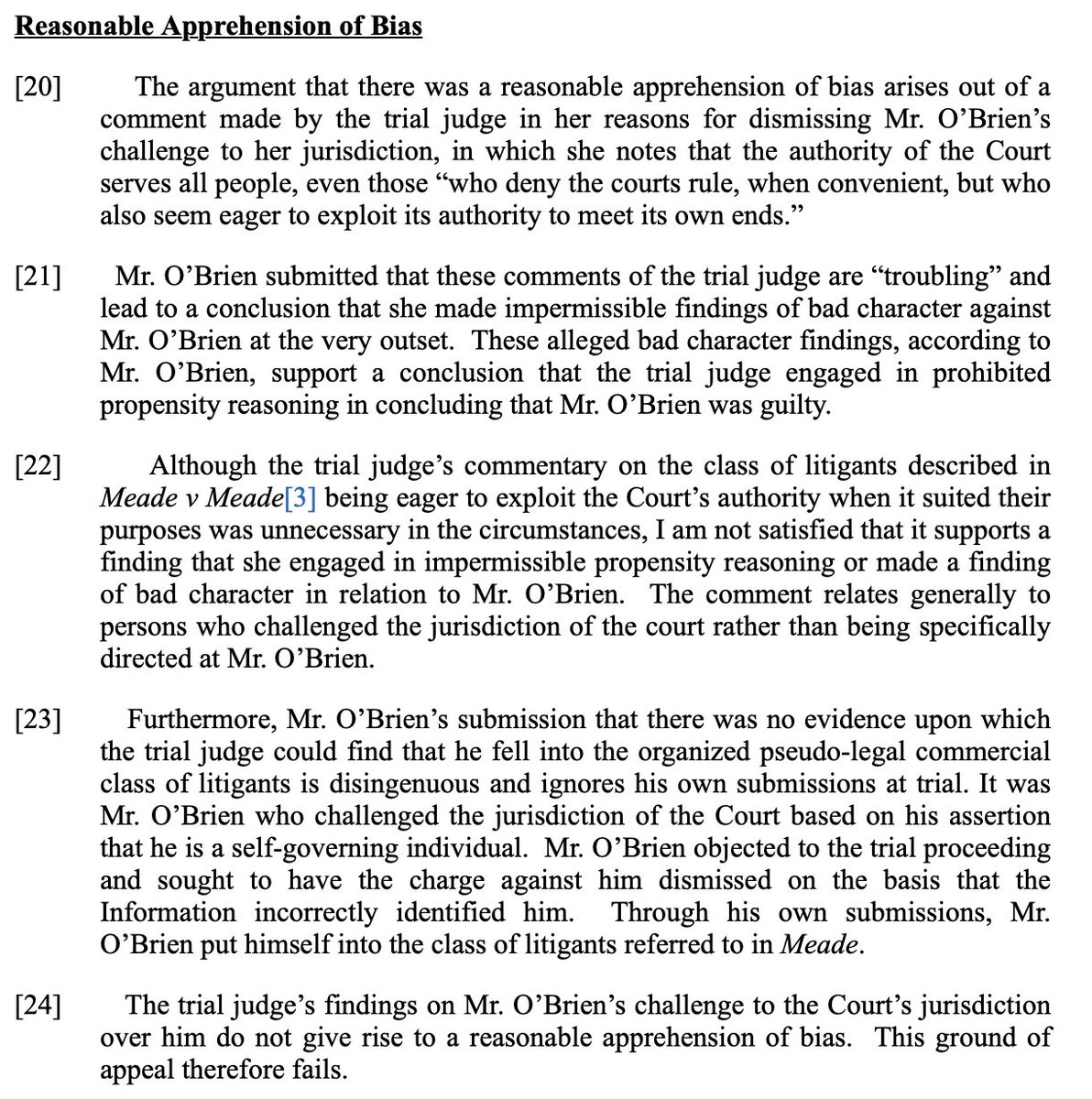
This question plays out in the passage reproduced below. But first here's a summary of the proceeding.
Kyle O’Brien was charged with criminal harassment of an ex-partner. O’Brien is initially represented by a defence lawyer. However, at trial O’Brien fires his lawyer and represents himself. He argues the court has no jurisdiction over him.
Doesn't work.
O’Brien is found guilty. He re-lawyers up and is sentenced to 1 year probation. O’Brien, still represented by his sentencing lawyer, appeals on multiple bases, including that O’Brien was incorrectly identified as using pseudolaw as a “get out jail free” mechanism, and that was an improper “alleged bad character finding”. The basic argument is the trial judge thought O’Brien was a bad person for using pseudolaw, an illegitimate way to deny court authority. That then coloured the trial proceeding to a fatal degree.
The appeal judge says no, it’s not evidence of bias that someone classifies you as a pseudolaw litigant when you are a pseudolaw litigant trying to evade criminal liability.
So who knows what is and is not pseudolaw? O’Brien said he is “a self-governing individual” and the court had no jurisdiction. Sounds like pseudolaw. But did either the trial judge, appeal judge, O’Brien’s lawyer, or O’Brien have any expertise on that? Who evaluates what is and isn’t pseudolaw?
Let’s step back a moment. There are actually rules for this. In a courtroom there is only one expert in law. That’s the judge. Everyone else might have an opinion on what the rules and processes of law are, but in the courtroom only one person has that expertise. The judge.
Incidentally, this is why I usually don’t say what the law is or isn’t. Even when I was a lawyer (which I no longer am), I am not an authority in law. If a judge says the law is X, the law is X. I might think that ruling is foolish, badly grounded, illogical, and so on. Doesn’t matter. What a judge says is the law is the law. Until a judge with higher authority says otherwise. People sometimes ask me whether I think a decision or ruling was right or wrong. Who cares. I’m nobody. If a judge says the world is flat – it’s flat, for all legal purposes.
Yes, this makes the biochemist/microbiologist in me irritated. But that’s law. Law does not have to have anything to do with reality. And it’s not unusual that law has limited relation to reality. Tough.
So, in the O’Brien matter, when the trial and appeal judges each rejected that calling yourself a self-governing individual is a get out of jail free card, that’s the law. End of the story.
But is that pseudolaw? That’s a different question.
A judge is the expert on what is Canadian law. But a Canadian judge isn’t an expert in Turkish law, US law, Japanese law. When a court needs to understand what the law is outside its boundaries, then you need an expert witness in the foreign jurisdiction’s rules. Usually that’s a lawyer who is certified to practice in both Canada and the foreign jurisdiction. That expert then explains the foreign rules to assist the court in coming to a conclusion.
Experts provide evidence and context that the court itself does not itself possess. That’s the only time an expert is permitted in a Canadian court proceeding.
I’ve concluded that pseudolaw is a kind of legal system. It’s badly designed, worse implemented, but pseudolaw does have a suite of fairly consistent and interwoven rules, concepts, and procedures. Pseudolaw has alternative but often much overlapping variants. Who is an expert in pseudolaw? Me, for one. There are others across the globe who are lawyers but who have also studied these subjects in depth. In the US I’d flag Caesar Kalinowski IV and Colin McRoberts as excellent candidate experts for the subject. Some academics probably qualify too, such as Australians Harry Hobbs, Joe McIntrye, and Stephen Young.
It's a really interesting question if a pseudolaw guru is themself an expert in pseudolaw. I’ll leave that for another time, but they probably can at least identify their own teachings being applied by others. Freeman-on-the-Land founder Robert Arthur Menard is probably an expert in Freemanism.
Most judges are very likely not experts in pseudolaw because they simply do not deal with it often enough, or have studied the subject in depth. I saw no special expertise on the part of the judges in the O’Brien litigation.
Let’s wind back the clock and ask if O’Brien’s defence lawyer could have done better on appeal. What I’d suggest is get a transcript of the trial hearing, copies of any weird documents filed by O’Brien, and the trial judgment. Hand them to a pseudolaw expert – an expert in the foreign legal system in question. Which would very likely be me – no one else in Canada wants this particular “honor”. The expert then prepares a report.
(Going to skip the issue of how to introduce new expert evidence in an appeal.)
The question for the expert report would not be “Is what O’Brien argued as a get out of jail free card Canadian law?” That’s not something a non-judge can decide or even say with any authority. Judges make and set Canadian law. Nobody else.
But what that expert could say is:
Yes, O’Brien is wrong about Canadian law – the trial judge said so. But the trial judge made a mistake too. She said what O’Brien argued is pseudolaw, as generally defined in the 2012 Meads v Meads decision of Associate Chief Justice John D. Rooke of the Alberta Court of King's Bench. That was wrong. Here are the well-established stereotypic concepts and arguments about law that are recognized as belonging to pseudolaw, a false competitor legal system used to cheat and evade obligations and prohibitions. What O’Brien argued was something else. In classifying O’Brien a pseudolaw adherent, the trial judge made a mistake. That might have or have not coloured her response to O’Brien. That’s not for me to say. That’s the job of the appeal judge. But when she rejected his arguments and labelled them as pseudolaw, the trial judge made a mistake.
You can get law wrong in many, many ways. The person who can say whether or not the error was based in pseudolaw with expertise is an expert in the foreign pseudolaw legal system. So, if O’Brien’s lawyer wanted to win on that argument, he should have hired me. Or someone with a similar expertise.
No, I’m not trying to drum up business for myself with this analysis. But if you’re going to start assigning an illegality to a category, it helps to have someone who can provide more context from a position of authority.
As an aside – because it’s a fun one – once in awhile Canadian legal authorities do actually recognize a non-judge as an expert in law. For example, the Supreme Court of Canada has accepted that books written by a now deceased lawyer / professor named Peter Wardell Hogg are authoritative on the Canadian Constitution and its operation. In effect, the SCC says when it comes to constitutional law, Hogg is an authority, similar to themselves. Unless they choose to override Hogg, of course.
‘Cause judges are always the final voice on what is and is not law.
The O’Brien decision is here:
R v O’Brien, 2026 ONSC 3053: canlii.ca/t/kl4kn
It’s otherwise quite unremarkable.
2
1
8
505
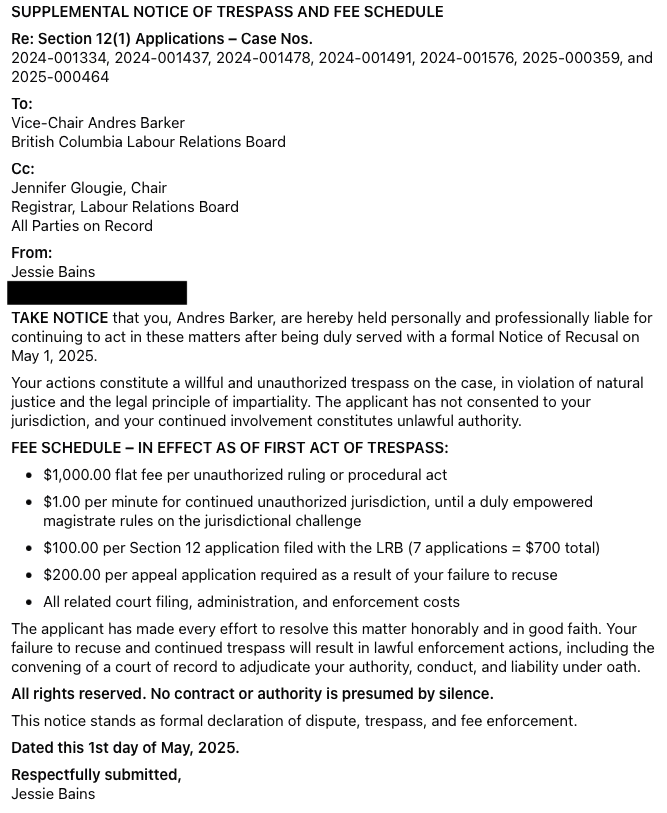
Sometimes digging is needed to confirm pseudolaw is in play in litigation. A series of British Columbia court decisions all emerge from an underlying labour dispute. The unsuccessful party sues a lawyer, a tribunal member, a judge. But in a strange way:
People are sued in their “private capacity”, versus the professional roles (e.g. Bains v Morishita, 2026 BCCA 241; Bains v Barker, 2026 BCCA 65)
An official did not provide their “oath of office” (e.g. Bains v Morishita, 2026 BCCA 241; Bains v Barker, 2026 BCCA 243)
Targeted actors have “trespassed”, but not in a physical sense, but into legal matters (e.g. Bains v O'Rourke, 2025 BCSC 2534)
That’s pretty close to a smoking gun that this is a pseudolaw process. The idea that officials must present their “oath of office” on demand is an ancient pseudolaw gambit. If you can’t prove you are authorized to act, you automatically must be illegitimate. In fact, in law the presumption is the other way around. People like judges and government officials are presumed to have valid authorization. It’s up to the other side to prove otherwise.
“Private capacity” points to Strawman Theory, the idea people have multiple identities, and that with the correct language you can dig underneath a title and get to the human being below. Usually that’s a defensive thing. I am not FIRSTNAME MIDDLENAME LASTNAME.
But followers of Carl (“Karl”) Lentz, Sovereign Citizen and renowned walrus imitator believe one can sue “trespassers” in a kind of do-it-yourself court process. The litigation here suggests that influence.
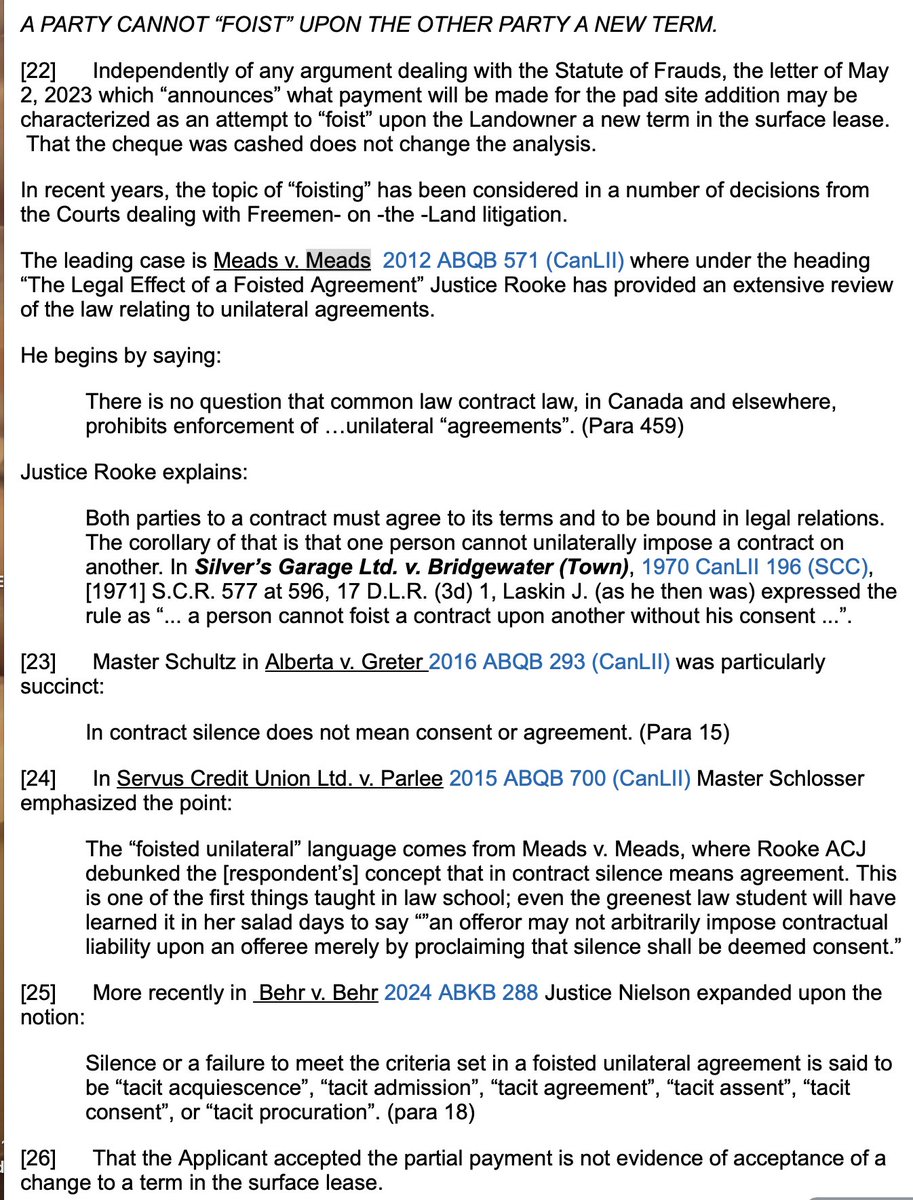
So I dug online for awhile and found the smoking gun, attached below. A fee schedule where an individual unilaterally assigns penalties to another. A classic pseudolaw document based on the concept that silence means consent, and one can foist contractual agreements on others. Fee schedules are a notorious tool of intimidation.
So, these are pseudolaw-based disputes. None of the relevant court decisions seems to indicate that, but the proof is in the substance of the litigation, rather than its label.
I counted nine reported tribunal and court decisions relating to this dispute. Off to the Supreme Court of Canada next, I suspect.
Your tax dollars at work.
2
7
257
There are few formal reports of social and procedural conduct of court hearings with pseudolaw adherents. I have seen many first-hand, but never documented those.
And I've certainly not witnessed a judge singing along with a pseudolaw adherent.
That makes the recent academic article by I. D. Siegel of pseudolaw court proceedings in the Netherlands interesting. While the sample set is fairly small (6 proceedings), the author dissected out different judicial/litigant interaction patterns, and their functional aspects. There are some interesting points.
One is that pseudolaw arguments basically had no effect on court proceedings. That might surprise non-court personnel, but I expected that. Pseudolaw claims, usually intended to control or end proceedings, just are irrelevant to the court’s authority, so those were bypassed. Courts in most jurisdictions have an expectation of “procedural fairness”, which basically means you have to listen to the litigation participants and let them say their piece. There is no reason to respond to an argument on the spot, and judges in the Netherlands usually did not.
One dramatic proceeding was a criminal proceeding where a mother abducted her children, and arrived with an entourage and advanced “anti-institutional worldviews”. She ran the usual Strawman Theory motifs on nomenclature and such, and when the mother used unusual language that was narrowed and bypassed. Basically, the mother was allowed to stake out her political/social perspective, but not direct the flow of the proceeding.
Another litigant was primarily oriented on satanic ritual abuse theories, but then added pseudolaw motifs. While the defendant, again with an entourage, was aggressive and disruptive, the judge elected to manage rather than escalate interactions, culminating in this exchange:
... She finished her plea by demanding due process, threatening with an appeal for recusal of the judge. She then requested to play a Michael Jackson song into the microphone, making the song audible for the audience. The judge allowed this, even sang along with parts of the song, while giving assuring looks to the municipality. The audience sang along, and some cried. The end of the song was met with applause.
The pseudolaw litigant did not insist the judge recuse themself because: “We sense a form of humanity.”
I’ve watched a lot of court interactions in Canada between problematic litigants and court personnel. Every judge has their own approaches. This article illustrates that. The end objective of any judge is to complete and conclude their court proceedings in a permanent manner – to end the process and avoid re-litigation. Preferred strategies with that objective are quite different from what one sees on television and in movies.
Siegel’s report is useful to illustrate that. And it’s just interesting to see how the fake pseudolaw “common law” gets applied in a completely foreign civil law jurisdiction. Nice summary of goings on in that jurisdiction too.
Definitely worth a read, particularly as pseudolaw is comparatively new in the Netherlands, but has developed a substantial following.
Full article is here: scholarlypublications.univer…
1
5
189
More reporting on Australian pseudolaw activities:
gnet-research.org/2026/05/13…
Since this is outside Canada I'm just going to point at it and not comment further.
1
1
4
177
I didn't notice until today this excellent report by Dan Neidle concerning another offshore pseudolaw scam that has settled its roots into the UK. It's a combination of the bill of exchange scheme where a promise to pay eliminates debt as money for nothing, and "notaries as judges".
I bet Dan is correct that the bill of exchange argument is the US variation, because in common law countries there's a marvellous and real quote - by Lord Denning no less - that states:
"We have repeatedly said in this court that a Bill of Exchange or a Promissory Note is to be treated as cash."
From Fielding & Platt Ltd v Najjar, [1969] 2 All ER 150 at 152 (UK CA). So this is real UK law.
Now, (retired) Associate Chief Justice Rooke of the Alberta Court of King's Bench rejected that means a promise to pay eliminates a debt in ... a colour manner:
"Much like other OPCA schemes, this ‘promissory note is cash’ concept is a scam that dissolves when scrutinized. A promissory note is a promise to pay. Does it make any sense that a person can eliminate a debt with another IOU for (effectively) the same debt? Wouldn’t this then inevitably lead to a conga line of promissory notes, each purporting to satisfy the debt of the note one step up the queue?"
From Re Boisjoli, 2015 ABQB 629 at para 35.
Now the notary as a key player is a Canadian gambit, linking back to the inventor of Freemanism, street comedian Robert Arthur Menard. He combined bizarre claims about notaries with the widespread "Three/Five Letters" as a method by which notaries purportedly become super-judges. If you're curious, I've written about that here:
researchgate.net/publication…
Personally, I think lawyers should be held accountable for reading the documents they sign or stamp. Not every lawyer agrees with me, though.
Dan's article is very much worth reading. Excellent investigation and analysis.
May 15

Our full report, with original documents and full details and sources: taxpolicy.org.uk/liberty-roc…
1
2
6
281
Criminal proceedings against HRM Romana Didulo, the Queen of Canada, were recently discontinued. Why? Uncertain.
But I just read something that suggests another legal avenue for sanctions against HRM Didulo.
Security-related illegalities.
Say what?! Securities?
Not as implausible as that might seem at first. I read a lovely little essay/summary this morning by Ronke Balogun and Solomon Ngoladi, staffers with the Alberta Securities Commission, on how the definition of a security is pretty loosey-goosey and more driven by function than form. It’s here (slaw.ca/2026/06/01/a-securit…). The authors explain that securities aren’t limited to the usual things like shares or bonds. The scope of a security is functional, that it creates or captures certain kinds of investment and contribution relationships.
So names don't really matter. That makes sense. You shouldn’t be able to contract out of securities legislation put in place to protect the public. The authors summarize the characteristics of a security this way:
Investment of Money – Participants must contribute money (or money’s worth) into the scheme.
Common Enterprise – The fortunes of investors must be interwoven with those of the promoter or other investors. This can include pooling of funds or a functional interdependence between investor and promoter.
Expectation of Profit – Investors must enter the arrangement with the expectation of profit.
Profit to Come Significantly from the Efforts of Others – The expected profit must depend primarily on the efforts, skill, or expertise of the promoter or a third party, not the investor.
Substance Over Form – Courts look at the economic reality of the arrangement, not its label or formal structure.
If you’re scratching your head and asking ... Well, I don’t remember HRM Didulo issuing shares or structuring the Kingdom of Canada as some kind of investment apparatus, let me remind you of something. HRM Didulo is continually seeking contributions from her followers. What do they get? In a lot of ways, it’s the long con. She promises big stuff, ranging from debt elimination, to “Med Beds”, to orbital laser strikes and invisible commandos against oppressive factors and agents, most likely including me.
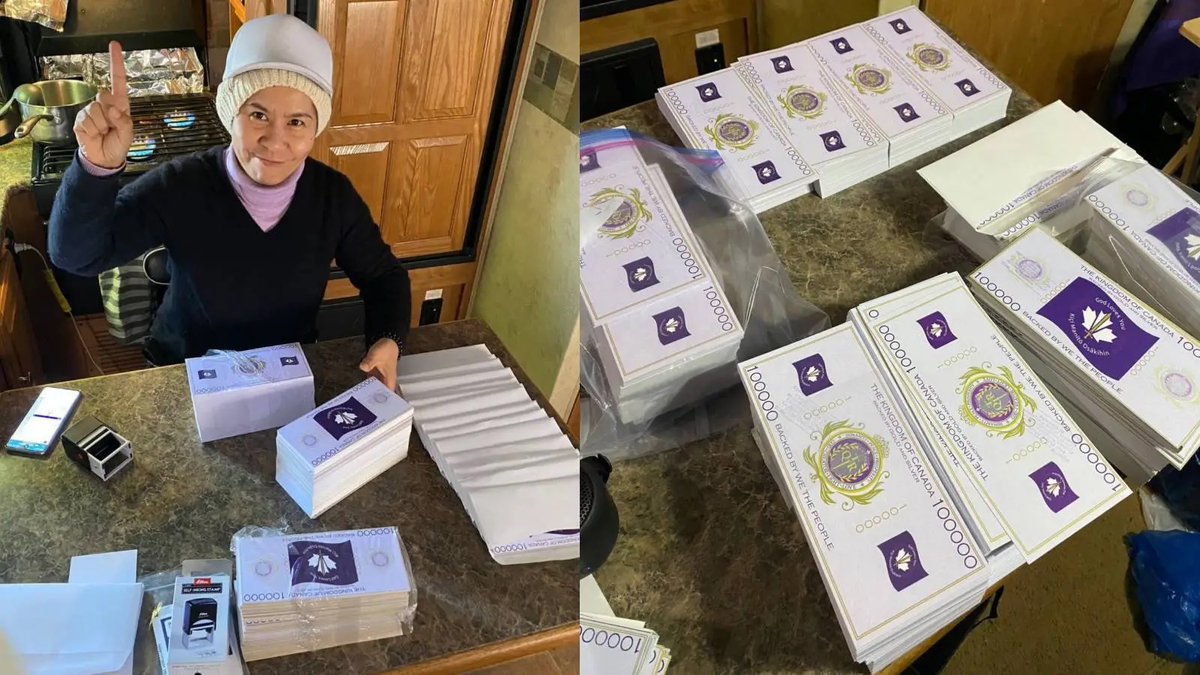
But she has done something else. She’s issued something she calls “Loyalty Money”. Loyalty Money, pictured below, has usually been given to her followers in one-on-one meetings, Didulo’s “Meet and Greet” sessions. I suspect that was also presented to those who attended the Kingdom of Canada’s purple fortress in Richmound, at the swearing in ceremonies Didulo conducted there.
Now, I’m not sure if anyone knew exactly what you could do with Loyalty Money. It looks fancy. It has a denomination on it. She apparently has said this is backed by gold and silver, under natural law. Ok – so it has value independent of usual modern currency systems, and instead under the old non-fiat currency model where paper money stands in place for gold.
Is Loyalty Money a security?
Let’s go through the criteria:
(1) Investment of Money? If Loyalty Money is linked to donations/contributions to HRM Didulo, then yes.
(2) Common Enterprise? Yes. One becomes a citizen of the Kingdom of Canada, subject to HRM Didulo. Citizens/followers/serfs are promised benefits from that membership, ranging from free utilities, debt elimination, quantum computers, Med Beds, lots of stuff. HRM Didulo is the provider, on behalf of her followers, thanks to the Galactic Federation or whatever. Or King Carlson. It varies.
(3) Expectation of Profit? Yes – at a minimum you’re getting your Loyalty Money, which can be exchanged for gold and silver, unlike that worthless fiat currency.
(4) Profit to Come Significantly from the Efforts of Others? Yes. HRM Didulo, her inner cadres, and the various terrestrial and off-world actors take care of everything. You build the Kingdom of Canada by donating and believing real hard.
(5) Substance Over Form? If HRM Didulo is promising real value of some kind for her Loyalty Money, then the answer is yes.
So... it’s a little weird, but I think there’s an argument here! The leading case is Canada, Pacific Coast Coin Exchange v Ontario Securities Commission, [1978] 2 SCR 112, which even has the flavour of HRM Didulo’s scheme. Pacific Coast Coin offered you the right to put money down now to buy a partial interest in bags of silver coins. Not actual currency, but bags of silver. (Oh, settle down Judas.) The SCC concluded this was a kind of investment arrangement. Hmm – interesting – though the Court doesn’t formally call that a security, as it didn’t have to decide that issue.
The best way to test out whether HRM Didulo has been issuing securities without a licence would be if someone who has received Loyalty Money from HRM Didulo went to a Canadian security regulator and submitted a complaint. Now, I know very little about those processes, but if nothing else, it’d be interesting. The folks at the regulatory agency would be gossiping about it for years!
Of course, finding someone with a few million in Loyalty Money to head this might be a challenge. Orbital laser bombardment strikes, and all that. Do you really want to take the risk?
2
2
12
506
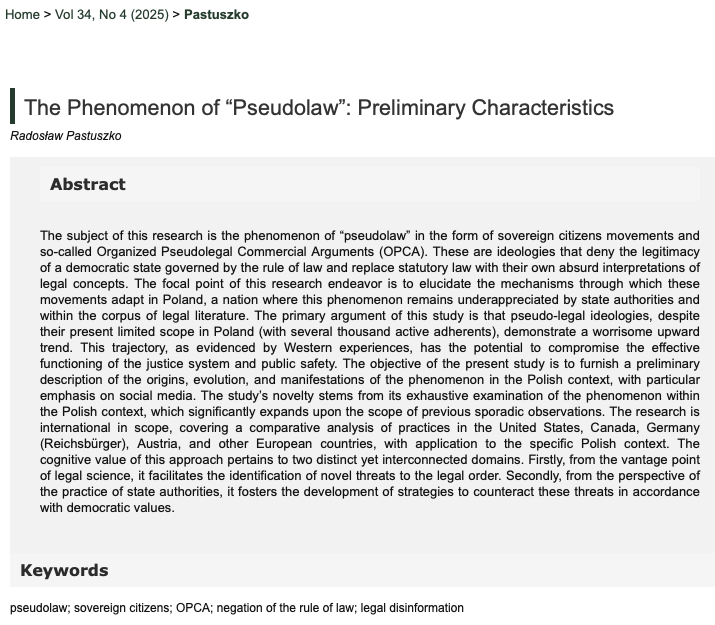
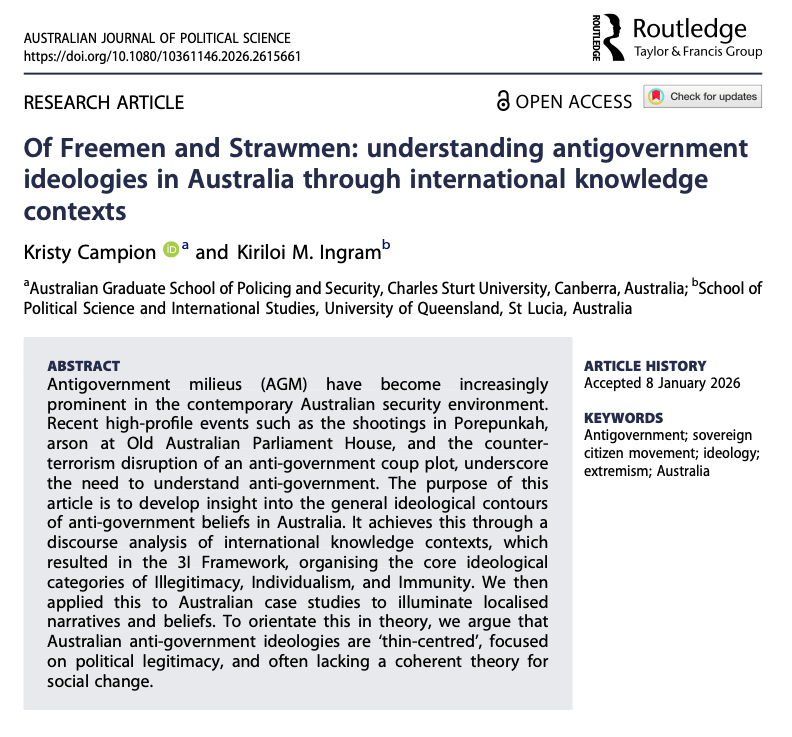
Sometimes hard to believe the little field I've written in for years is expanding so much! A further indication is the newly formed International Pseudolaw Research Network.
The website is here:
pseudolaw.org/
Largely a seedling at this point but it will grow.
1
178