Dr Suri Lab Pvt Ltd is now CGHS Empanelled lab in Delhi
Joined October 2012
- Tweets 17,124
- Following 5,137
- Followers 7,306
- Likes 10,267
468 Photos and videos



Pinned Tweet

18 Nov 2025
Hello and welcome. I’m Dr J S Suri with Dr Apica Sharma the Host and the producer of the Podcast.
Today we discuss one of the biggest silent threats to healthcare in India — Antimicrobial Resistance (AMR).
The host of this Podcast oiis Dr Apica Sharma, a renowned economist from NITI Aayog ,
who brings vital insights into AMR’s economic and policy impact.
In India, antibiotics are often used without proper testing or prescription.
What seems like a quick fix is actually making infections stronger and treatments less effective.
AMR now affects not just health, but also our economy, healthcare access and national productivity.
In this episode, we’ll briefly explore:
Why antibiotics are losing effectiveness
How misuse, weak regulation and diagnostic gaps contribute
And, with Dr Apica Sharma, what AMR really costs India — and what actions are urgently needed
If you’ve ever wondered why some infections no longer respond to treatment — this conversation is for you.
I am extremely thankful to Dr Apica Sharma .
Let’s begin.
youtu.be/wgP118InxAc?si=Vpwu…
1
25
22,027
🧪 Dr Suri Lab Wellness Newsletter – Post 9
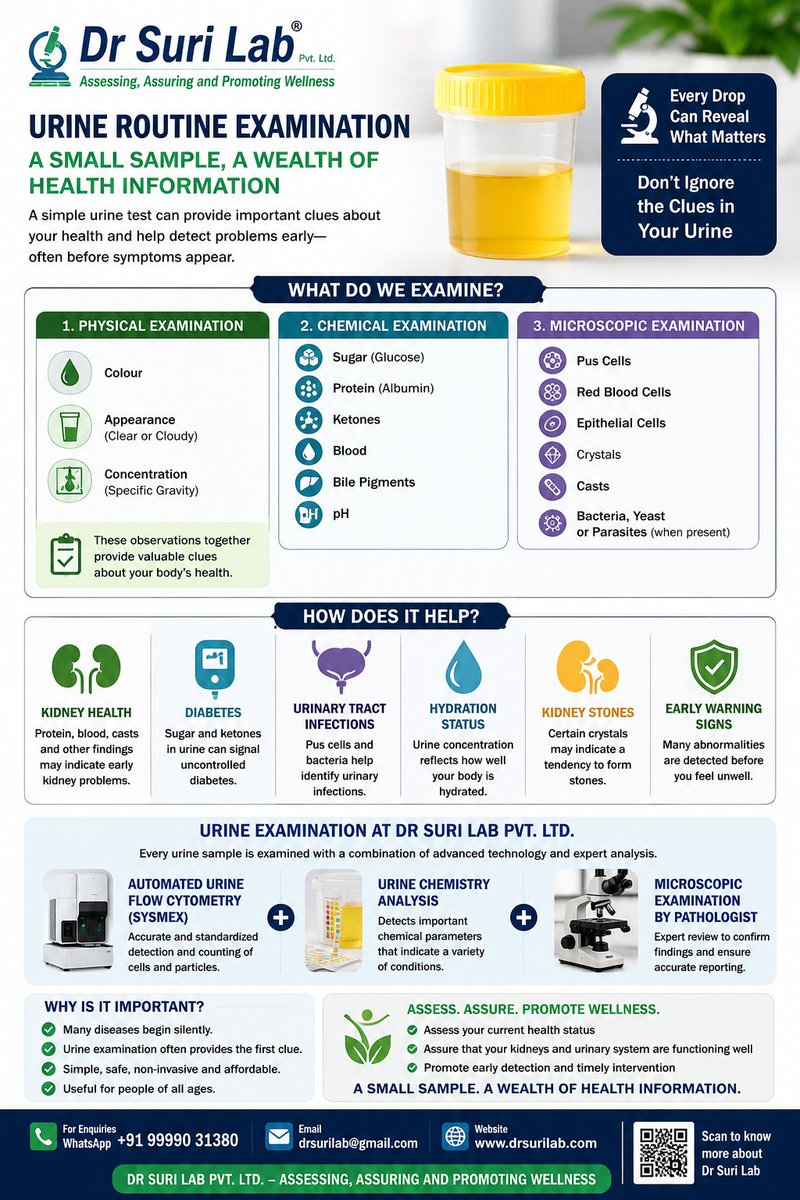
Urine Routine Examination — A Small Sample, A Wealth of Health Information
Dear Patron,
Among the many laboratory tests available today, the Urine Routine Examination remains one of the simplest, most affordable, and most informative.
A small urine sample collected in a few minutes can provide valuable insights into your health and often detect problems before symptoms appear.
🔬 What Does a Urine Routine Examination Reveal?
Urine can provide important clues about:
🩺 Kidney health
🍬 Diabetes
🔥 Urinary tract infections
💧 Hydration status
🪨 Kidney stone tendency
⚖️ Overall metabolic health
Many abnormalities can be detected long before a person feels unwell.
🌟 A Comprehensive Urine Examination at Dr Suri Lab
At Dr Suri Lab, every urine sample undergoes a comprehensive evaluation using:
✔ Urine Chemistry Analysis
Tests for:
• Sugar (glucose)
• Protein (albumin)
• Ketones
• Blood
• pH and other chemical parameters
These provide important clues about kidney function, diabetes, hydration, and metabolic health.
✔ Automated Urine Flow Cytometry (Sysmex)
Advanced flow cytometry technology rapidly and accurately detects and counts:
• Red blood cells
• White blood cells
• Bacteria
• Other urinary particles
This improves standardization, sensitivity, and reliability.
✔ Microscopic Examination
Every abnormal or clinically relevant finding is further evaluated through microscopic examination and expert review.
Technology and expertise work together to ensure clinically meaningful results.
---
⚠️ Why Is It Important?
Many conditions affecting the kidneys and urinary system begin silently.
A urine examination often provides the first clue that something needs attention, enabling timely diagnosis and intervention.
---
🌱 Assess. Assure. Promote Wellness.
This simple test helps:
✔ Assess your current health status
✔ Assure that your kidneys and urinary system are functioning well
✔ Promote early detection and timely intervention
A small sample can reveal a surprising amount about your health.
📬 Ask Dr Suri Lab
Do you have a question about urine testing or any other laboratory investigation?
We welcome your:
• Questions
• Suggestions
• Feedback
• Topics for future newsletters
📧 Email: [Insert Email]
📱 WhatsApp: [Insert Number]
Selected questions may be featured anonymously in our future "Ask Dr Suri Lab" section.
Questions are welcome. Curiosity is healthy.
Understanding your laboratory tests is an important step toward understanding your health.
1
2
31
13h
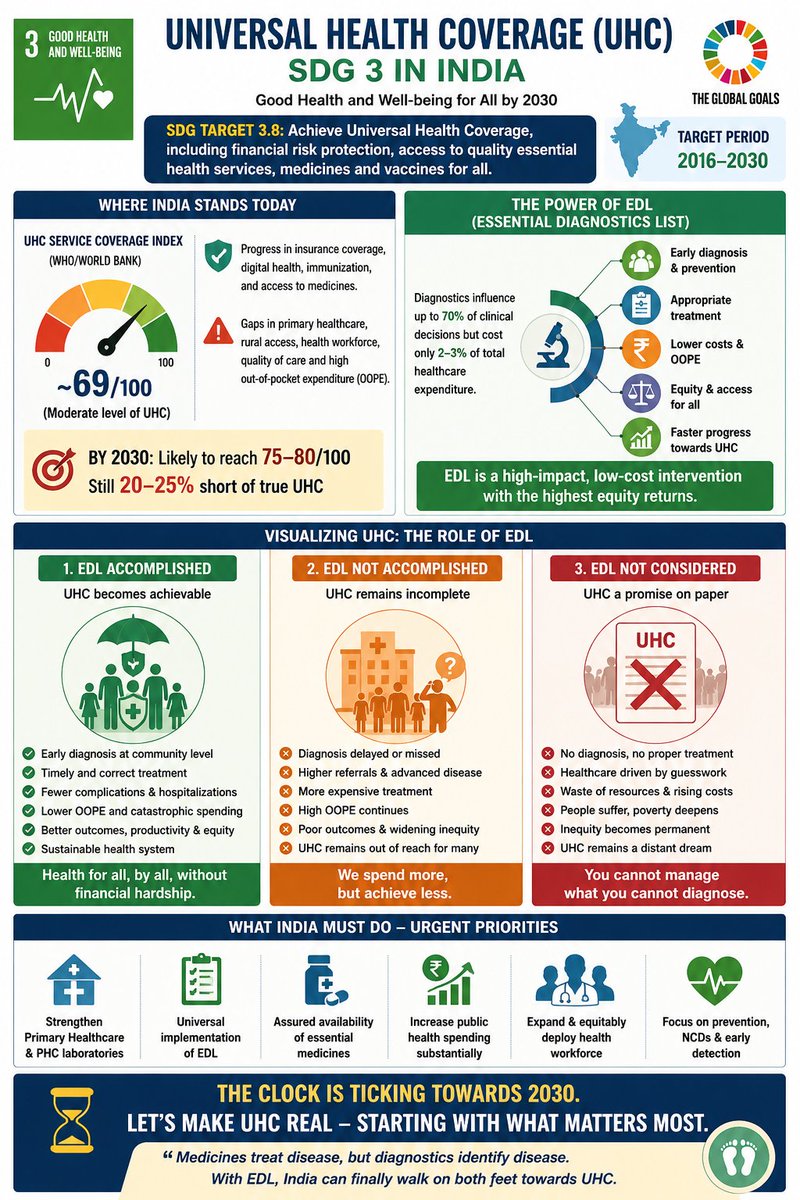
Universal Health Coverage (UHC): India's SDG 3 Challenge and the Missing Piece Called EDL
The United Nations Sustainable Development Goal 3 (SDG 3) aims to ensure healthy lives and promote well-being for all by 2030. At its heart lies Target 3.8: Universal Health Coverage (UHC) — access to quality healthcare without financial hardship.
India has made progress. More people are covered by health insurance schemes. Digital health is expanding. Access to medicines and services has improved in many areas.
Yet, UHC remains a work in progress.
A simple question deserves attention:
How can we treat what we have not diagnosed?
This is where the Essential Diagnostics List (EDL) becomes critical.
Diagnostics influence a majority of clinical decisions, yet they consume only a small fraction of total healthcare expenditure. Early diagnosis leads to timely treatment, prevents complications, reduces unnecessary referrals, and lowers healthcare costs.
Without diagnostics, healthcare often becomes a costly exercise in educated guesswork.
With EDL implemented across Primary Healthcare Centres and community settings, India can move closer to:
✔ Early diagnosis and prevention
✔ Reliable and rational treatment
✔ Reduced out-of-pocket expenditure
✔ Greater equity in healthcare access
✔ Faster progress towards UHC
The irony is that while we discuss artificial intelligence, precision medicine, and futuristic healthcare, many citizens still struggle to access basic diagnostic tests that could change the course of their illness.
Perhaps the road to UHC is not blocked by the absence of grand ideas.
Perhaps it is waiting for the implementation of a few practical ones.
EDL may well be one of the most affordable, feasible, and impactful healthcare interventions available today.
UHC is not merely about building more hospitals. It is about ensuring that every citizen can access the right diagnosis, at the right time, at the right place.
The clock is ticking towards 2030.
The question is not whether India can afford Essential Diagnostics.
The question is whether India can afford to delay them any longer.
#UHC #SDG3 #UniversalHealthCoverage #EDL #EssentialDiagnostics #PrimaryHealthcare #PublicHealth #HealthcareEquity #Diagnostics #IndiaA
"In healthcare, we often celebrate the latest breakthroughs. Yet millions are still waiting for the basics. Sometimes the shortest path to the future begins with implementing what we already know works."
40
Jun 14
Cutting the Coat according to the Cloth
I dream of a nation where healthcare is fair,
Where illness brings treatment, not debt or despair.
But age and experience whisper to me,
"Resources are finite, my friend, can't you see?"
So I looked at the cloth and measured the coat,
And found many promises struggling to float.
Some wear designer healthcare stitched with gold thread,
While others sell cattle when a child has a fever in bed.
The market says softly, "Efficiency first."
The poor say, "That's fine—but please quench our thirst."
The experts hold conferences under bright light,
Discussing tomorrow, till late in the night.
Meanwhile a village PHC waits in the sun,
Short of a doctor, a nurse, or even one.
UHC stands at the doorway, patient and wise,
Still waiting for action beneath lofty skies.
The economists tell us, "Be practical, dear.
There isn't enough money for everyone here."
They're right, to a point. We must live within means.
No treasury is endless, however it seems.
But humour me briefly, and answer this plea:
What use is a coat if most shiver in misery?
The goal is not marble, nor hospitals tall,
But fewer sick people needing them at all.
A vaccine, clean water, nutrition, a test,
May quietly achieve what money does best.
So yes, cut the coat according to cloth,
That wisdom is sound—I don't quarrel with that.
But let us not spend all our time tailoring sleeves,
While forgetting to weave more fabric for those in need.
For healthcare is neither pure charity nor trade;
It is a measure of the choices a society made.
And my heart, stubborn as ever, continues to say:
"Count the cost, certainly.
But count the people first."
1
1
62
Jun 12
The Republic of Waiting
We launch a scheme, unveil a plan,
Cut ribbons whenever we can.
A summit here, a slogan there,
A promise wrapped in hopeful air.
Yet somewhere in a distant lane,
A mother walks through dust and pain.
The PHC has peeling walls,
No doctor comes, no ambulance calls.
A child is pale, an elder weak,
Healthcare remains a distant peak.
We boast of robots, AI and space,
Yet basic care still loses the race.
The wealthy swipe a card with ease,
The poor sell land for surgeries.
Out-of-pocket, year by year,
Remains the nation's hidden fear.
UHC waits at the station still,
Holding a long-unapproved bill.
Equity knocks upon the door,
But VIP guests arrive before.
Public health spends a modest share,
Then wonders why the outcomes stare.
The irony is hard to miss—
Disease is common, solutions exist.
Clean water, nutrition, vaccines, tests,
Strong PHCs would do the rest.
But prevention rarely makes the news,
And ribbon-cuttings get more views.
One day history may gently ask:
"Was health a right or a market task?"
And conscience may quietly reply:
A nation is not judged by the height of its hospitals,
but by how little illness, debt, and despair reach its poorest citizen.
42
Jun 11
Anaemia: India's Silent Report Card
When almost one in every two women and a substantial number of children remain anaemic, it is difficult to view anaemia merely as a medical condition.
It becomes a measure of how effectively nutrition, primary healthcare, and preventive health services are reaching people.
The prevalence of anaemia is more than a health statistic. It is a silent report card of public healthcare over the last seven decades.
Anaemia is neither difficult to diagnose nor difficult to treat. In most cases, the tools are simple, affordable, and widely available.
Yet millions of children, adolescents, and women continue to remain anaemic.
We have conducted surveys, launched missions, formed committees, published reports, renamed surveys, and awaited new data.
The irony is that while the names of programmes keep changing, the anaemia numbers seem reluctant to do the same.
Anaemia reflects much more than iron deficiency.
It reflects gaps in nutrition, maternal and child health, primary healthcare, public awareness, early diagnosis, and equitable access to essential diagnostics and treatment.
A nation aspiring for Universal Health Coverage cannot afford to treat anaemia as just another indicator in a report.
Perhaps the question is no longer whether we know the problem.
The question is whether we are ready to act on what we already know.
Anaemia should not remain India's longest-running public health audit.
The time for measurement is important. The time for action is overdue.
#Anaemia #PublicHealth #Healthcare #UniversalHealthCoverage #PrimaryHealthcare #Nutrition #EssentialDiagnostics #IndiaHealth :::
"If anaemia remains widespread after 79 years of independence, the problem is no longer diagnosis. It is implementation."
Anaemia is not merely a deficiency of haemoglobin. It is often a deficiency of implementation.
The diagnosis is known. The remedies are known. The urgency should be too.
1
1
178
Jun 10
Scarcity and Value
What lies in plenty, we often ignore,
What is rare, we seek even more.
A drop of water beside a stream,
May pass unnoticed, like a dream.
The same drop found in desert sand,
Becomes a treasure in the hand.
A seat, a ticket, a moment, a smile,
Grows in value when scarce for a while.
Not because rarity alone is king,
But because it offers a meaningful thing.
For scarcity without worth is vain,
Like a rare pebble lost in the rain.
Yet when need and rarity meet,
Value rises, quiet and sweet.
So cherish not only what is few,
But what is useful, trusted, and true.
For value is born where these combine—
A lesson both simple and divine.
43
Jun 8
Healthcare is not truly universal until it reaches the last village, the poorest family, and the most vulnerable citizen—with equity for all. #UHC
1
31
Jun 7
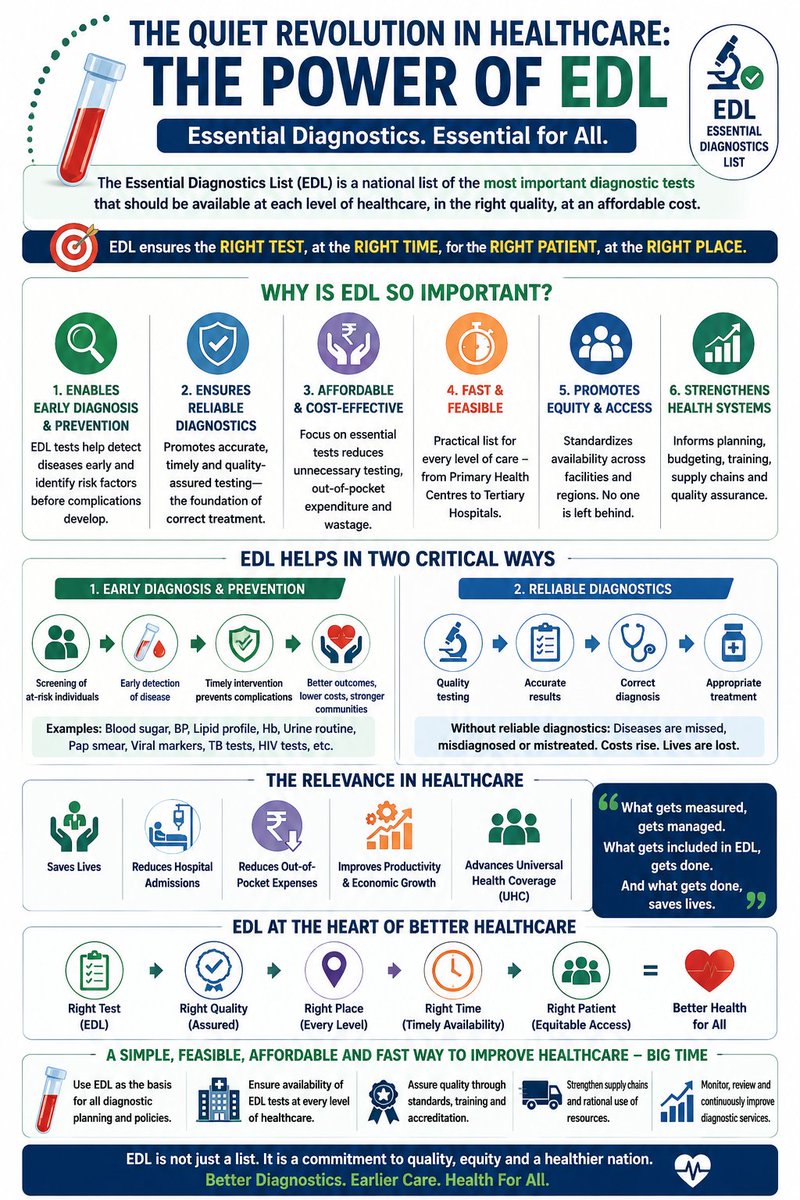
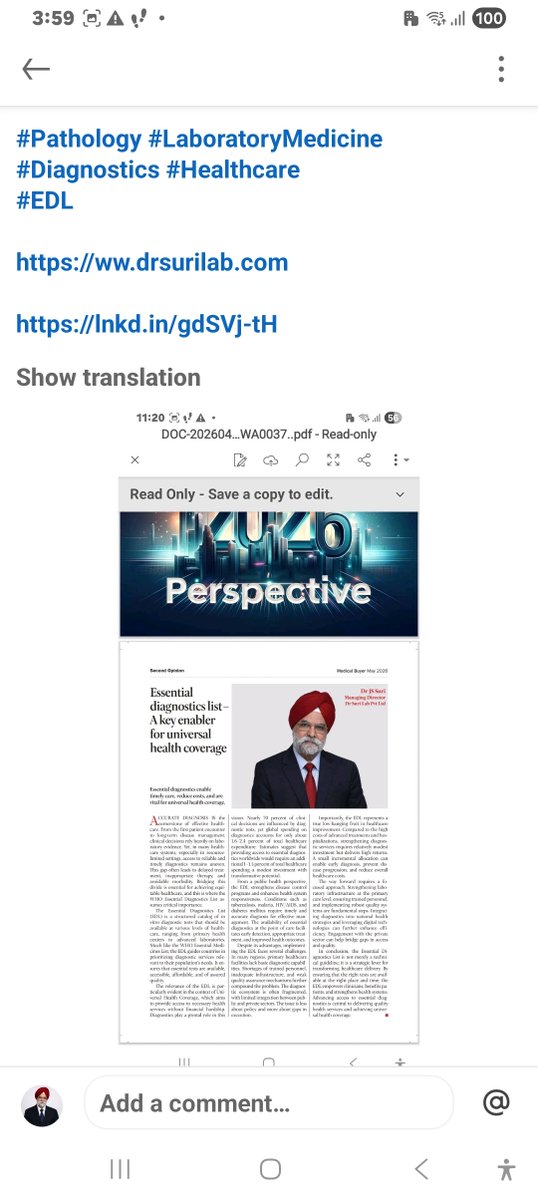
The Essential Diagnostics List (EDL): Perhaps the Fastest, Most Feasible and Most Affordable Way to Improve Healthcare
When we think of improving healthcare, we often think of building hospitals, buying expensive equipment, or recruiting more specialists.
All are important.
But there is a simpler, faster, and often overlooked solution:
Make the right diagnostic tests available to the right patient at the right place and the right time.
That is precisely what the Essential Diagnostics List (EDL) aims to achieve.
The EDL, introduced by the World Health Organization and adopted by India, identifies the essential diagnostic tests that should be available at different levels of healthcare—from Primary Health Centres to tertiary hospitals.
Why is EDL so important?
Because it strengthens two of the most important pillars of healthcare:
1. Early Diagnosis and Prevention
Disease detected early is easier, safer and less costly to treat.
EDL-supported tests help identify:
✔ Anemia before complications develop
✔ Diabetes before kidney, eye and heart damage occurs
✔ Tuberculosis before it spreads further
✔ Hypertension and cardiovascular risk before catastrophic events occur
Prevention stops disease from starting.
Early diagnosis stops disease from progressing.
2. Reliable Diagnostics
Healthcare cannot be better than the diagnosis on which it is based.
EDL promotes:
✔ Availability of essential tests
✔ Standardization of diagnostic services
✔ Quality-assured testing
✔ Rational use of healthcare resources
Reliable diagnostics lead to correct diagnosis, appropriate treatment and better outcomes.
Without diagnostics, healthcare becomes guesswork.
Why EDL Matters
✔ Saves lives
✔ Reduces delays in diagnosis
✔ Reduces unnecessary treatment
✔ Lowers out-of-pocket expenditure
✔ Improves health equity
✔ Strengthens Primary Healthcare
✔ Accelerates Universal Health Coverage (UHC)
Perhaps the greatest strength of EDL is that it does not require revolutionary technology or massive expenditure.
It simply ensures that essential tests are available where people need them most.
What gets measured gets managed.
And what gets included in the Essential Diagnostics List gets measured, managed, and ultimately improves health outcomes.
In healthcare, few interventions offer such a combination of impact, feasibility, affordability and speed.
Better Diagnostics. Earlier Care. Health for All.
45
Jun 6
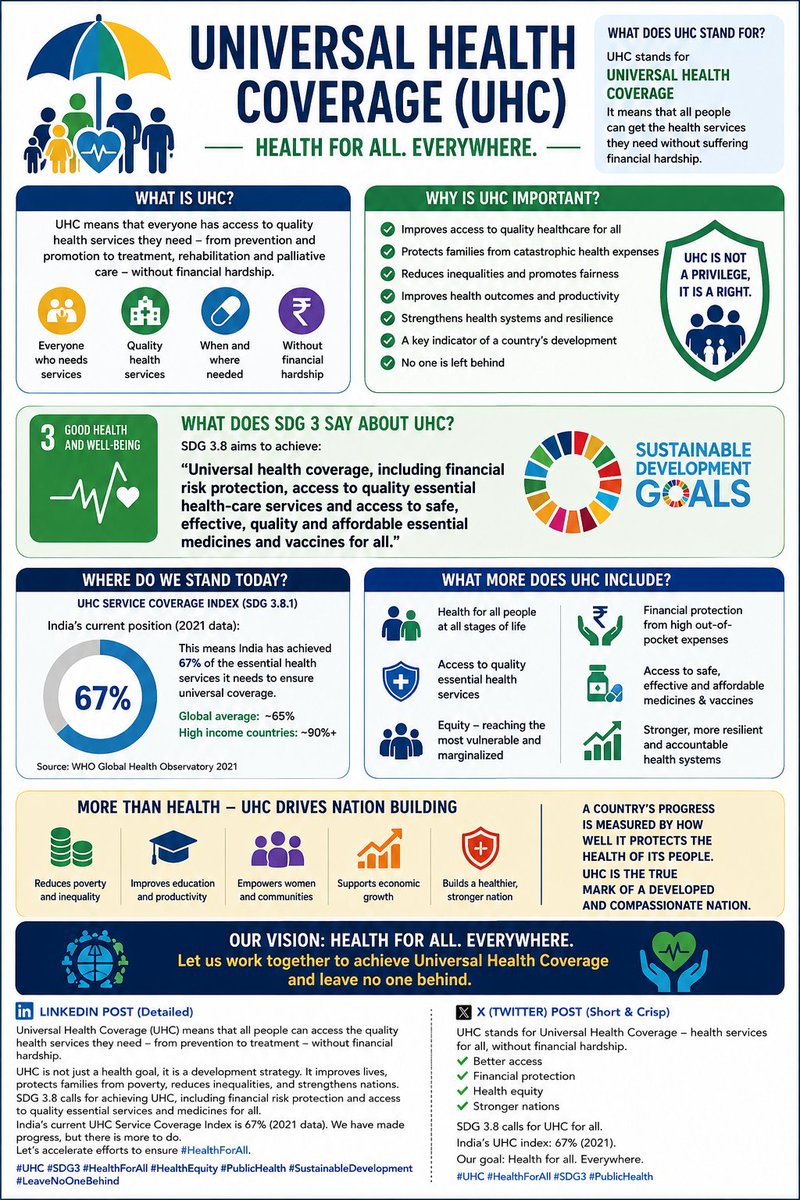
Universal Health Coverage (UHC): The True Test of a Nation's Healthcare
UHC stands for Universal Health Coverage.
In simple terms, it means that all people receive the health services they need, when they need them, without suffering financial hardship.
UHC is not merely a health goal.
It is a measure of a nation's commitment to equity, dignity, and social justice.
The World Health Organization defines UHC as access to quality promotive, preventive, curative, rehabilitative, and palliative health services for all, along with protection from financial hardship.
Why is UHC important?
Because healthcare should not depend on where a person lives, how much they earn, or whether they can afford treatment.
Strong UHC leads to:
✅ Better health outcomes
✅ Reduced poverty due to medical expenses
✅ Greater health equity
✅ Higher productivity and economic growth
✅ Stronger and more resilient health systems
Recognizing its importance, the United Nations included UHC in SDG 3 (Good Health and Well-being).
SDG Target 3.8 calls for achieving Universal Health Coverage, including financial risk protection, access to quality essential healthcare services, and access to safe, effective, quality, and affordable medicines and vaccines for all.
Where does India stand?
India's UHC Service Coverage Index has improved substantially over the past two decades and is currently around 67 out of 100, reflecting important progress. However, significant gaps remain in access, quality, equity, and financial protection.
High-performing countries typically score above 80–90.
The journey towards UHC requires:
🔹 Strong Primary Healthcare
🔹 Essential Diagnostics and Medicines for all
🔹 Adequate Public Investment in Health
🔹 Skilled and Motivated Healthcare Workforce
🔹 Digital Health Systems
🔹 Focus on Prevention and Early Diagnosis
Healthcare is not truly universal until it reaches the last village, the poorest family, and the most vulnerable citizen.
A country's greatness is not measured by the wealth of its richest citizens, but by how well it protects the health of its most vulnerable.
UHC is not a privilege.
It is a promise that no one will be left behind.
#UHC #UniversalHealthCoverage #HealthForAll #SDG3 #PublicHealth #PrimaryHealthcare #Diagnostics #Healthcare #India
1
1
53
Jun 6
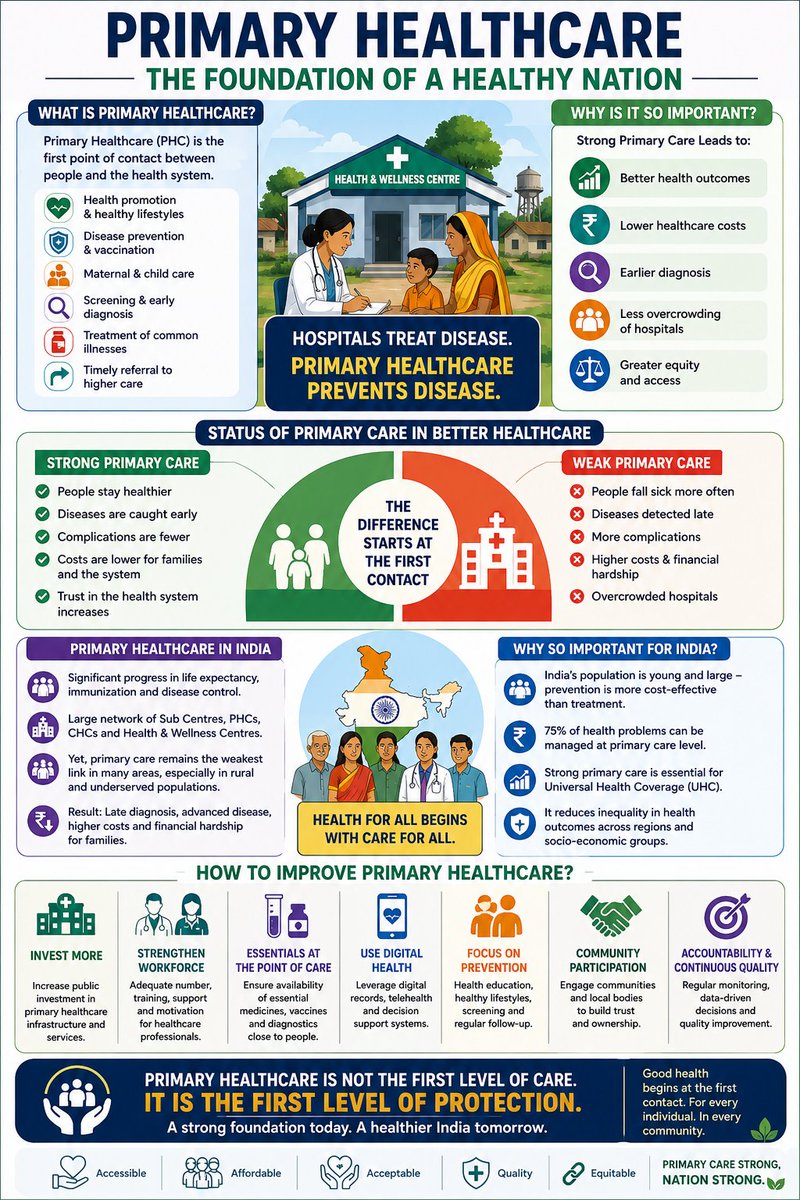
Primary Healthcare: The Most Important Part of Healthcare That Most People Never See
When people think of healthcare, they think of hospitals, ICUs, robotic surgery, MRI scanners, and super-specialists.
But the strongest healthcare systems in the world are built on something far less glamorous:
Primary Healthcare (PHC).
PHC is the first point of contact between people and the health system. It includes health promotion, disease prevention, vaccination, maternal and child care, screening, early diagnosis, treatment of common illnesses, and timely referral when needed.
Why is it so important?
Because most health problems can be prevented, detected early, or managed effectively at the primary care level.
Countries with strong primary care generally have:
✅ Better health outcomes
✅ Lower healthcare costs
✅ Earlier diagnosis
✅ Less overcrowding of hospitals
✅ Greater equity and access
In simple terms:
Hospitals treat disease. Primary Healthcare prevents disease.
India has made significant progress in life expectancy, immunization, and disease control. Yet primary healthcare remains the weakest link in many areas, particularly in rural and underserved populations.
The result?
Patients often reach hospitals late, diseases are detected late, costs become high, and families face financial hardship.
To strengthen primary healthcare, India needs:
🔹 Greater public investment in health
🔹 Stronger primary care infrastructure
🔹 Adequate and motivated healthcare workforce
🔹 Essential diagnostics and medicines at the point of care
🔹 Digital health support systems
🔹 Greater emphasis on prevention and health literacy
Healthcare excellence is not built from the top down.
It is built from the ground up.
If hospitals are the pillars of healthcare, Primary Healthcare is the foundation.
And no building can stand long without a strong foundation.
1
49
Jun 5
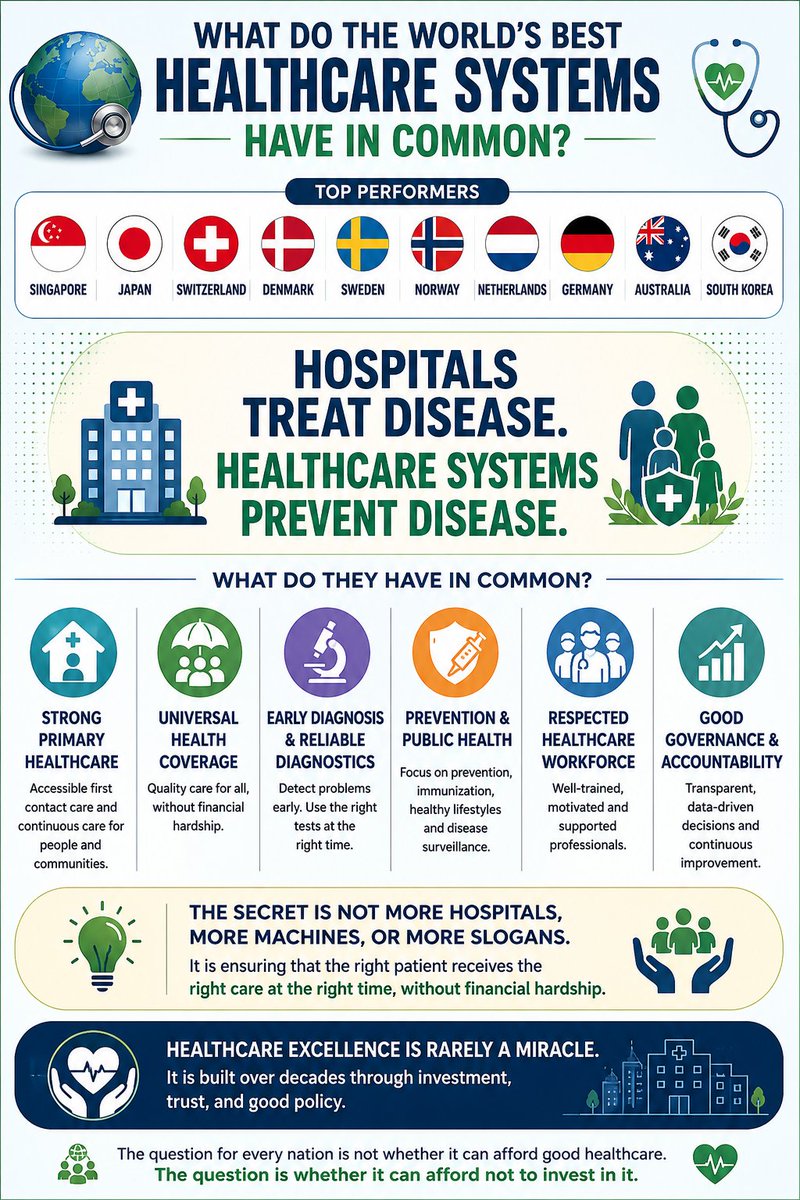
The world's best healthcare systems are not necessarily the richest.
🇸🇬 Singapore
🇯🇵 Japan
🇨🇭 Switzerland
🇩🇰 Denmark
🇸🇪 Sweden
🇳🇴 Norway
🇳🇱 Netherlands
🇩🇪 Germany
🇦🇺 Australia
🇰🇷 South Korea
What do they have in common?
✅ Strong Primary Healthcare
✅ Universal Health Coverage
✅ Early Diagnosis & Prevention
✅ Good Diagnostics
✅ Adequate Public Investment
✅ Respect for Healthcare Workers
✅ Accountability & Good Governance
A simple lesson:
Hospitals treat disease.
Healthcare systems prevent disease.
The secret is not more buildings, more machines, or more slogans.
It is ensuring that the right patient gets the right care at the right time, without financial hardship.
Healthcare excellence is rarely a miracle.
It is usually the result of decades of steady investment, good policy, and public trust.
#Healthcare #PublicHealth #UHC #Diagnostics #PrimaryCare #HealthForAll
73
Jun 5
1/3
The Delhi Medical Council election must not become a case where questions are dismissed simply because the voting is over.
When substantial concerns are raised by members of the profession, the response cannot be silence. The response must be transparency.
1
1
1
101
Jun 5
2/3
Professional self-governance derives its legitimacy from trust.
If doctors begin to lose faith in the fairness of the electoral process, the damage extends far beyond one election—it affects the credibility of the institution itself.
1
43
Jun 5
3/3
An independent inquiry into all credible allegations, with findings made public, is the minimum that the profession should expect.
Democracy demands not only a result, but a process that can withstand scrutiny.
#DMCElections #DelhiMedicalCouncil #Transparency #Accountabili
44
May 28
Between X and LinkedIn which is better
0%
X
0%
LinkedIn
0 votes • Final results
23