
DaDaScribe offers an advanced audio-to-text transcription system powered by AI.
Joined September 2023
- Tweets 79
- Following 44
- Followers 22
- Likes 72
4 Photos and videos



Pinned Tweet

Jun 3
We have completely redesigned DaDaScribe and officially started supporting lyrics extraction and automatic proofreading: dadascribe.com
The video below shows how to transcribe and translate in 5 languages a 3-minute multi-speaker video in a matter of minutes.
1
4
46
The biggest mistake students make with AI transcription
Most students who try AI transcription once give up after a bad result. They record a noisy lecture, get a messy transcript, and conclude the technology does not work.
We at DaDaScribe see the same pattern. The tool is fine. The input is the problem.
Three habits that fix it:
Record in a quiet space. Background noise is the single biggest accuracy killer. Use a headset mic instead of your phone on the desk.
Keep files under thirty minutes. Longer recordings accumulate drift. Break a two-hour session into chunks for cleaner output.
Edit while the content is fresh. Transcripts are most useful within twenty-four hours of recording. Your memory is still sharp, so corrections take seconds instead of minutes.
That is how you get reliable transcripts you can actually study from. Search keywords across a whole semester of recordings. Find the one explanation your professor gave in week three that finally made it click.
At $0.016 per minute on our Pro plan, doing it right costs almost nothing. The real investment is five minutes of better recording habits, not the software itself.
1
12
Jun 15
We are working on an API so to open DaDaScribe's exceptional system to all developers out there. Make sure to contact us if interested in testing it! dadascribe.com/contact/
2
2
14
Jun 15
What is the hardest part of your transcription workflow?
We at DaDaScribe talk to translators and transcribers every day. The answers we get fall into a few patterns.
Which of these hits closest to home for you?
Is it the audio quality? Background noise, overlapping speakers, heavy accents. Files that sound fine to the client but are a nightmare to transcribe.
Is it the turnaround pressure? Clients who want same-day delivery on three hours of raw footage.
Is it the terminology? Medical, legal, technical domains where one wrong word changes the meaning entirely.
Or is it the pricing? Charging enough to cover the manual work without pricing yourself out of the market.
We built DaDaScribe to handle the heavy lifting on all four. Upload the file, get a 95 percent accurate draft in minutes, then spend your time on the polish that actually requires a human ear.
If you are a professional transcriber, what part of the job do you wish AI could take off your plate entirely? Drop it below.
1
8
Jun 13
Quick transcription tips for students and educators.
We see a lot of academic recordings come through our platform, and the patterns are pretty consistent. Here is what actually moves the needle on accuracy.
Record somewhere quiet. This sounds obvious but it is the single biggest factor. A humming fan or AC unit can knock 10-15 percentage points off your word accuracy. Close the window, turn off the fan, record during a quiet hour.
Slow down just a little. AI models handle steady, moderate speech better than fast rambling. A brief pause between sentences helps the model know where one thought ends and the next begins.
Wear headphones with a mic. Phone mics pick up keyboard clacks and room echo that degrade the audio signal. Five dollars on a cheap headset pays for itself.
Edit the output. AI transcription on clean vocals averages 95.5% accuracy on our platform. That last 4.5% is almost always names, technical terms, and numbers. The students who get the most out of transcription are the ones who treat it as a first draft and spend five minutes cleaning it up.
We at DaDaScribe think of AI transcription as a study accelerator, not a replacement for review. Use it to get the words down fast, then put in the small amount of effort that makes the difference between mostly right and actually usable.
1
22
Jun 12
A journalist with a 45-minute interview and a 2-hour deadline faces a simple choice. Spend the next hour transcribing by hand, or get a usable transcript in under 2 minutes.
We at DaDaScribe process thousands of audio files every month for reporters, researchers, and media teams. Our new Learning Center article answers the question we hear most: when should you trust AI and when do you need a human?
The cost difference is stark. Human transcription at $1.50 per minute puts a 30-minute interview at $45. At $0.016 per minute, the same interview costs $0.48 with DaDaScribe. Across 10 interviews a week, that is roughly $250 versus $25,000 per year.
Speed is where AI truly changes the workflow. A 30-minute press conference takes 2 to 3 hours to transcribe by hand. AI does it in roughly 1 minute. We ran real demos to prove it, including a BBC News clip processed in under 3 minutes and a 2.5-hour podcast episode completed in 38 minutes with speaker labeling and translations to five languages.
The article walks through real use cases: breaking news deadlines, press conferences, long-form podcasts, and sensitive investigations. Each one answers a specific question journalists actually face. We also cover when AI falls short and when human review is still necessary.
Read the full guide: dadascribe.com/learn/when-ai…
4
71
Jun 12
We at DaDaScribe process thousands of audio files every month. Lyrics extraction is one of the hardest tasks we handle, and also one of the most requested.
Our new Learning Center article breaks down how to actually get accurate lyrics from songs, based on real transcription data from our platform.
Here is what the numbers show. On clean vocal recordings, AI hits 95% accuracy on average, with 90% as the minimum. Humans, even experienced ones, average around 82%. The machine does not get tired, it does not miss syllables on the fourth song of the day, and it does not guess.
But those numbers assume clean vocals. Feed the AI a track with heavy reverb, distortion, or vocoders, and accuracy collapses to 10 or 15%. If you cannot hear the words yourself, the AI probably cannot either.
The real difference comes down to what happens before the AI ever touches the file. Our preprocessing pipeline separates music from vocals, normalizes the audio, and cleans the signal before transcription. That single step adds 20 to 25 percentage points to accuracy compared to feeding raw audio into a generic speech-to-text tool.
We also walk through a real demo of Beyonce's "Halo" to show how it works on actual music.
Read the full guide: dadascribe.com/learn/how-to-…
1
4
101
Jun 12
We at DaDaScribe get asked the same question almost every day: should you use AI or a human for transcription?
We finally answered it with real data instead of opinions. Our new Learning Center article breaks down AI vs human transcription across accuracy, context, speaker separation, and translation, based on thousands of actual files processed on our platform.
Here is what the numbers actually say. AI hits 95.5% word accuracy on regular speech and beats most humans on catching individual words. It does not get tired, it does not typo, and it does not lose focus.
But accuracy is not the whole story. Humans still understand context better. They catch when a speaker refers back to something from ten minutes earlier. They parse industry jargon correctly. And on speaker separation, a skilled human transcriber gets close to 100% while AI averages around 90%, dropping to 80% when voices overlap.
The gap has narrowed a lot since 2023. It has not closed. The right choice depends on what you are doing with the transcript. We lay out the full comparison, no marketing spin, just what we see in production.
Read it here: dadascribe.com/learn/ai-vs-h…
4
29
Jun 12
We have just released our new Learning Center:
dadascribe.com/learn/
We'll periodically publish articles to inform and help you get the most out of AI transcriptions. Feedback and suggestions for future articles are welcome!
1
2
21
Jun 7
What are your challenges in transcribing speech-to-text? Post your thoughts and experiences, and we'll address them!
1
14
May 22
We’ve completely redesigned the DaDaScribe transcription system to become much stronger at transcribing song lyrics.
After seeing how many of you were using it for music, we rebuilt our system from the ground up. The results are impressive: significantly higher accuracy on sung vocals, better handling of background music, and much cleaner results even on challenging tracks.
And even if you are not interested in songs, you may want to know that we’ve also improved our standard transcription quality for regular speech, making it more accurate and more reliable than before.
As always, ensure that your source material is of good quality. If you’re transcribing song lyrics, make sure the sung words are audible enough for the system to detect them. Otherwise, you may encounter errors or unpredictable results.
Ready to test it? Give it a try today:
dadascribe.com/
We’d love to hear your thoughts. Your input directly shapes what we build next!
We’re also working on a full user interface refresh and several exciting new features we are sure you'll enjoy.
Stay tuned!
2
32
11 Oct 2024
The future of AI-based autonomous driving is here. Now.

The future will be streamed live
10/10, 7pm PT x.com/i/broadcasts/1YqJDkbja…
51

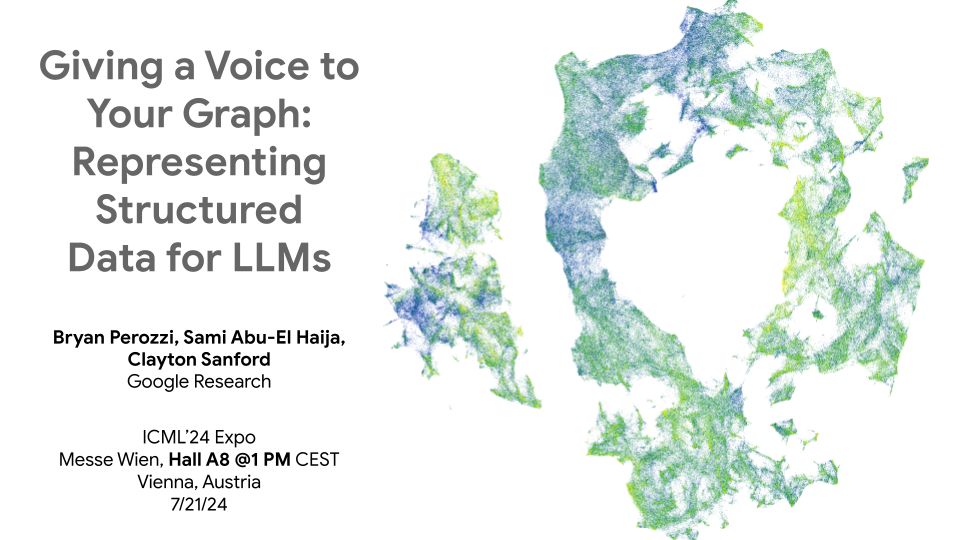
Attending Expo day at #ICML2024? Check out our Expo session, "Giving your Graph a Voice: Graph Representations and Large Language Models" today at 1pm CEST (Hall A8) to learn about all the work we've been doing to integrate graph learning with AI!
9
24
155
32,973
DaDaScribe retweeted

20 Jun 2024
The improvements in GPT, Claude, Grok, Gemini, Llama in just 1 year have been amazing to watch.
The big question is whether there exists a ceiling to their intelligence, and if so, how does it compare to the collective intelligence of the human species.
518
205
3,027
346,305
