Tweets in EN, FR, & DE; some in translation | Profile by Cyril Bérard for ABC Penser, Header by Gilbert Kieffer for Tétralogos
Joined September 2022
- Tweets 4,735
- Following 0
- Followers 578
- Likes 60
7 Photos and videos
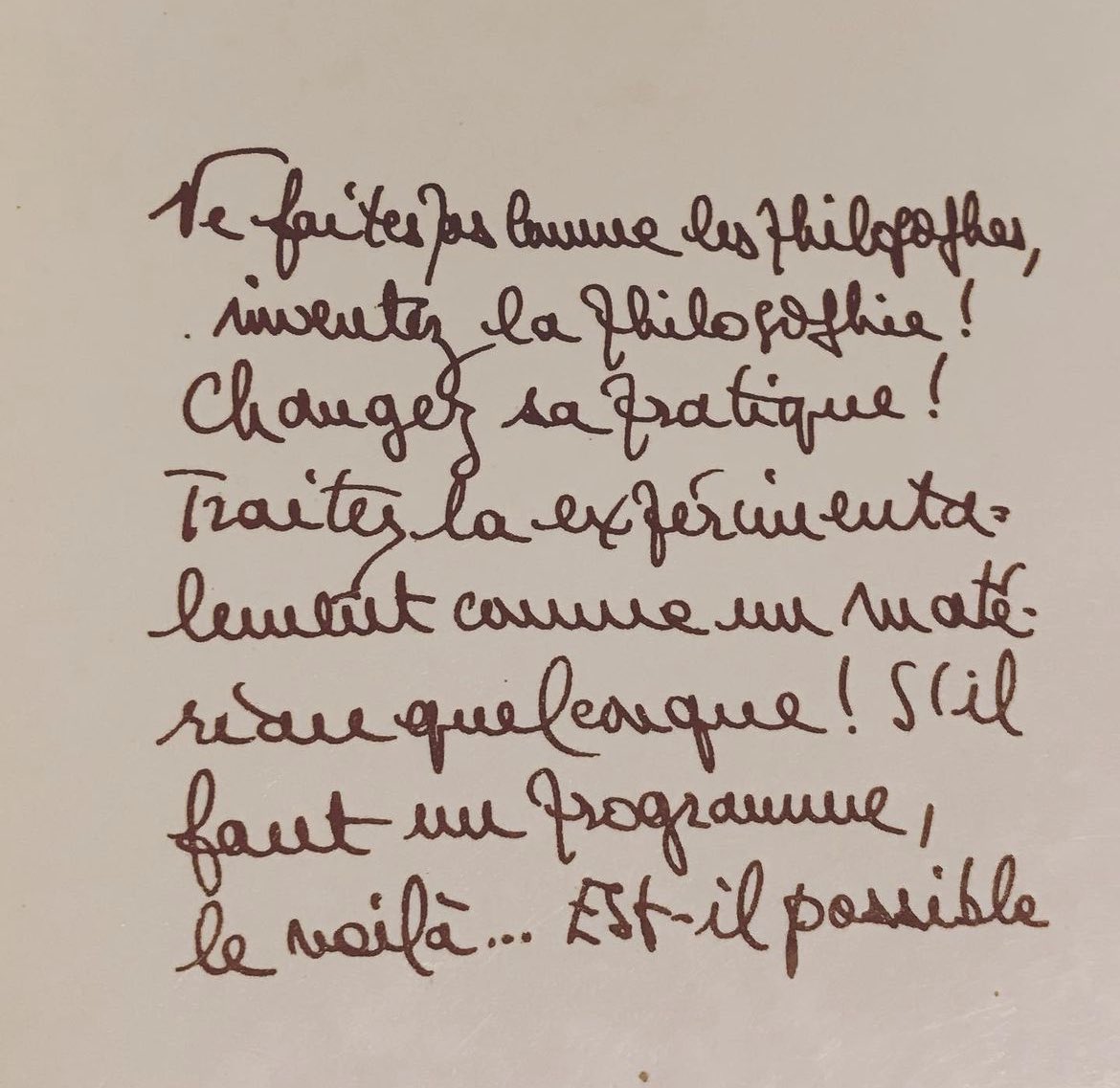

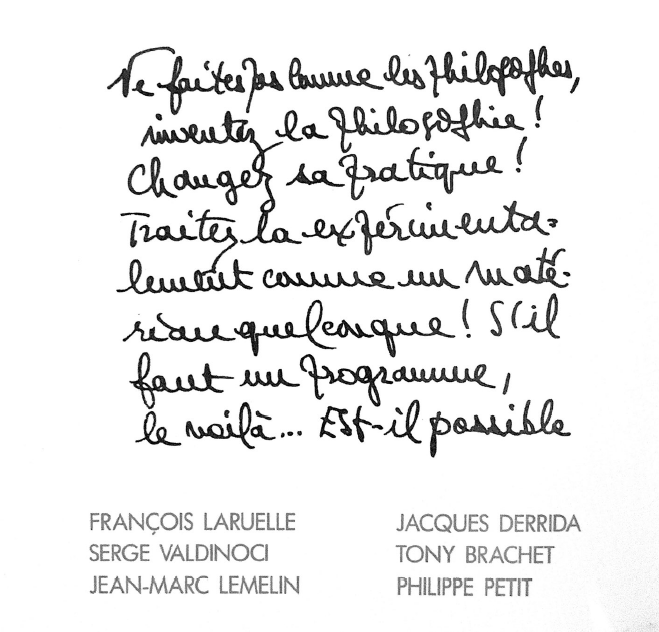

C'est pourquoi Platon a bien raison d'enoncer l'interdit majeur qui fonde le sujet de la philosophie : « il est impossible que les multitudes soient philosophes » (La Republique, VI, 494 a).
1
3
77
Immanence is a decision which has primacy, not priority, over the first decisions, which are all of thought and language. A decision, or rather an ultimation of primacy, of the apriori donational indifference of the world, bears ‘on’ the Real.
2
1
5
156
Within a philosophy, one has difficulty distinguishing primacy and priority, priority ultimately co-determining primacy, language co-determining the Real (or Being), thinking co-determining the thinkable.
1
1
4
65
But the reestablishment of primacy <of the primacy of the Real> as determining priority in-the-last-instance is a pre-decisional or antedecisional commitment to the Human against (and for) philosophy.
1
6
105
L’émancipation des humains contient à titre d’effet et non de condition, si ce n’est occasionnelle, l’émancipation de la philosophie qui n’est jamais la condition de-dernière-instance de la leur.
2
3
123
L’Homme-en-Homme échappe au cycle mythologique et naturaliste, philosophique pour tout dire, des générations et peut naître, exister enfin, comme Messie, il subit la passivité de l’être-né ou du clonage qui peut seule ne pas le faire confondre avec le Monde.
1
1
96
Certain non-philosophers seize upon non-philosophy's liberating principle while still not seeing that its emancipation of the subject is only within the limits of Humaneity or the Name-of-Man. Or they seize upon theory without realizing its practical and anti-theoretical aspect.
1
1
3
123
These interpretations themselves are woven into philosophical appearance and cannot challenge it.
1
3
53
In order to dissipate these appearances linked to the three axioms, we must return to the beginning and grasp the nature of its object, the “Real,” its uni-lateral immanence, the nature of its uneven identity.
3
37
Taking the victim’s point of view – which is precisely not a contingent ‘point of view’ but a necessary condition, however insufficient, of any theory of justice – we assume the long series of concepts that designate the defeated of history as symptoms of a heretical subject.
1
4
61
Le projet ainsi déterminé, le moyen pour l’atteindre est de tracer une nouvelle ligne de démarcation entre l’homme et le sujet, et de faire du sujet le corrélat d’une chaîne parlante qui ne soit plus signifiante ou structurale.
1
4
429
This Nietzsche is already a part of our philosophical common sense, a Nietzsche who would inspire the disgust of a thousand Zarathustras!
1
3
83
Le transcendental est le geste immanent ou le mouvement réel de la pensée, c’est un premier pas de concevoir qu’il ne s’épuise pas dans l’architectonique extérieure ou la sémantique d’une philosophie.
1
1
73
Because man is unsurpassable, because he is finite, the philosopher, who always claims to surpass man, is condemned to a transcendence stronger than the one he has mastered – to a unilaterality that, without alienating him, loses him for man.
3
5
411
The fictionale must be distinguished from the worldly, intra-literary or intra-philosophical forms of fiction.
1
3
116
where fiction stops being the simple attribute of another activity and instead becomes a lived experience in-the-One in the last instance.
1
2
60
Fiction is in itself a radical subjectivity and must be recognized as an autonomous experience before giving rise to technologically produced effects.
3
45