
Joined October 2017
- Tweets 1,677
- Following 1,735
- Followers 3,811
- Likes 826
297 Photos and videos

Pinned Tweet

27 Apr 2025
经过社区小伙伴的精心整理,在Pop-X HK Researcher House活动上采访@VitalikButerin 的视频和文章终于出炉了。
文章链接:mp.weixin.qq.com/s/sYounpz5G…
Bilibili: bilibili.com/video/BV1wXLGz8…
视频(youtube):youtube.com/watch?v=uillekrG…
16
17
47
17,427
Dapp-Learning retweeted

Jun 10
11
6
41
12,631
Dapp-Learning retweeted

Jun 5
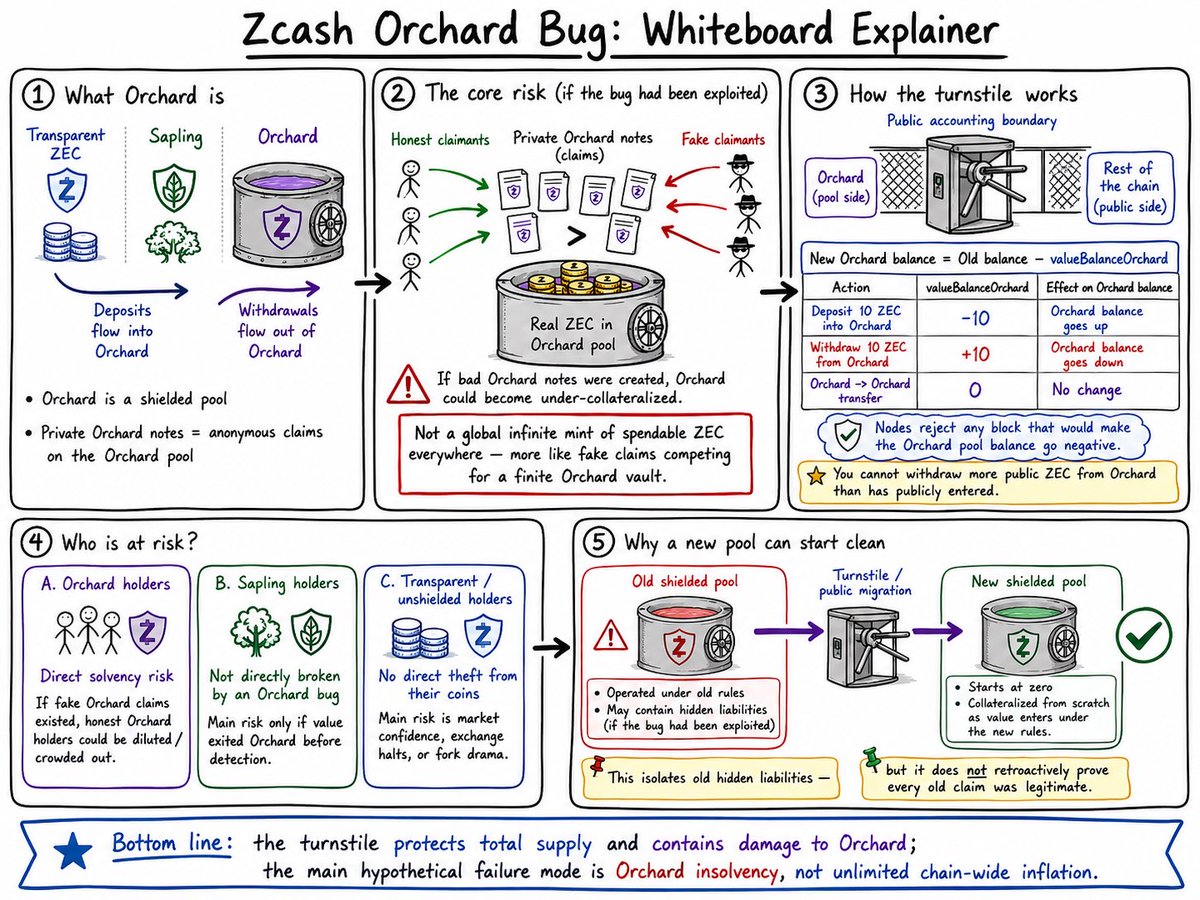
The way to understand the ZCash bug is it’s not infinite mint of ZEC itself. It’s more like the shielded pool (Orchard) could become insolvent. Think of it more like the KelpDAO hack for ETH.
Very little reason not to proactively unshield any ZEC today. Being early to the exit is always better in a bank run. Consider Orchard burned, and don’t re-shield until there’s a new pool with a clean history
69
154
918
196,721
Dapp-Learning retweeted

Jun 4
贝叶斯、凯利公式、因子有效性、regime检测……这些概念在我最近三个月的推文中也是最常出现的词汇。
倒不是说做量化就要放弃预测,而是放弃追求预测价格或事件,转而追求正确地使用预测结果。
因子衰减是必然的,regime切换是非常难以识别的,但若不是做HFT,中低频的交易模式中必然会应用到因子的可预测性。难的是如何应对数学之外的不确定性。
世事可分三类:脆弱(害怕波动)、坚韧(抗住压力)、反脆弱——反脆弱不仅是扛住风险,而且在波动、混乱、灾难中获益、变强。
换句话问:你会因为爱上一个人但可能没有结果、可能会浪费青春、可能会受伤害就完全不去尝试了吗?
强者自有答案。

31
29
133
28,282
Dapp-Learning retweeted

Jun 2
从视频看,Tom Lee回应了vitalik之前关于以太坊基金会专注于核心CROPS的帖子,他表示:
“以太坊DAT财库公司,包括 Bitmine 和 Sharplink 在内的财库——现在拥有 7% 的以太坊供应量……财库股票本质上是永久从生态系统中移除的供应量,但我们也拥有收益。收益大约为 3%,因此如今这些公共财库正在产生约 5 亿美元的奖励,这就是我们可以用来资助和资助加密生态系统的东西。”
简单来说,以太坊生态以后不用只靠基金会发钱了,现在这些DAT财库公司,可以拿出钱来支持项目、开发者、基础设施。
主要几点:
1. DAT财库公司已经囤了很多 ETH
像 Bitmine(Tom Lee )和 SharpLink 等上市公司,现在合计持有全网约 7% 的以太坊。这些公司把 ETH 当成“公司财库”长期持有。
2. 他们靠 staking 每年赚不少。把 ETH 质押到以太坊网络上帮忙维护安全,每年能赚约 3% 的收益。目前这些公司加起来,一年能拿到 约 5 亿美元 的以太坊奖励。
3. Tom Lee 认为,这些钱不要全留着,可以拿出一部分来资助以太坊生态(发 grant、支持项目、开发者、L2 等)。
以前主要靠 以太坊基金会(EF) 出钱,现在这些“DAT财库”也可以自己出钱了。
4. Tom Lee 认为以太坊基金会把重点缩小到最核心的事(CROPS:抗审查、开放、隐私、安全)是正确的决定。
因为以太坊现在已经很大了:
• 市值约 2400 亿美元
• 运行 11 年零宕机
• 全球 89 个国家、11500 个节点
• 15000 个开发者
一个基金会管不过来,未来更多事情要靠私营公司去做。
因为这代表以太坊生态的资金模式在进化:从“靠基金会财库”转向“靠市场化的大持有者自己赚钱反哺”。
这才是实现正向循环该做的事情。
Jun 2

以太坊基金会不再是大的节点,而第二基金会(或者生态基金会)可以成为更大的节点。
现在的以太坊基金会聚集核心原则和技术,而新的生态基金会更专注于生态采用和繁荣。
是时候成立生态基金会了。
@haydenzadams @StaniKulechov @Lomashuk @sreeramkannan
@vnovakovski @fundstrat
89
33
217
69,456
Dapp-Learning retweeted

May 24
Some of my perspective on where the @ethereumfndn is going.
First of all, this is only my own view. The board is not just me, and I have no extra special powers on the board that the other board members do not. @aerugoettinea is the one executing much of this transition. My input has been largely on technical questions. The board is in the process of expanding, and my own power within the org will continue to decrease, which is honestly what I want.
The 2025 era brought many important improvements to EF and its ability to execute. Many issues were resolved, and EF continues to benefit from its improved efficiency and greater focus on concrete goals to this day. And so with those problems resolved, early this year, the largest remaining hole that I perceived was something different nagging at me: I would regularly spot people saying things like "vitalik says these beautiful things about ethereum needing to be decentralized, and have privacy, and be a sanctuary technology, but why do the EF's actions not reflect that?"
Now, you may have been hearing something different. You may not have been sensing a feeling of crisis at all, and maybe were hearing people saying that finally we were taking execution and BD seriously and the main task for us is to keep going that way and be even better and faster. Then probably there is genuine difference between you and me, in what kinds of criticism I take most seriously, and what kinds of critics through their criticism are most able to make me feel pain.
As an analogy, let's briefly switch over to a different domain.
One belief you can have about Google is that it is a success story, and has brought a lot of good to humanity in organizing the world's information. Another belief you can have about Google is that they had a beautiful idealistic beginning, but at some point the corruption of mainstream corporate attitudes seeped in, and they slowly bit by bit completely abandoned the "don't be evil" slogan.
My belief on Google specifically is probably somewhere between the two. BUT, if you had taken me back in time to ~2008, and offered me a button to press to make Google one or two standard deviations more "dogmatic", eg. give Richard Stallman permanent veto power over some key policies, I would immediately press it.
Why? Because a choice for one company is not a choice for the world, or even one country. Google existed and exists in the context of a technology industry generally drifting away from early idealistic don't-be-evil roots and toward greed for financial gain, totalizing visions of accelerated superintelligence, infiltration by sociopaths, and craven capitulation to (or worse, active participation in) government pressure for ideological control, surveillance and war. And so *one company* doing something different, positioning itself to be what George Bernard Shaw calls the Unreasonable Man, resisting the trend of the times, would have been better for freedom, balance of power and stability of society as a whole, than *all* large companies bending to dominant trends. This is a part of my version of pluralism.
This line of thinking is not just mine, but I also is not too far off from what Aya and others had in mind with the Mandate.
Now how does this all get to the role of the EF?
EF is not a "center of Ethereum", rather EF is "one node, with a defined purpose, alongside other nodes". We've always said that the EF should be the latter, but many in the Ethereum ecosystem (and even within the EF) wanted us to be the former. Now, we are taking action to ensure that we will be the latter.
This is particularly important because EF is a limited organization, with limited resources and limited organizational capacity. The EF has only ~0.16% of all ETH (less than many other individual ETH holders), whereas among other blockchains it's common for "the central foundation" to have 10-50%. Fiscally, the EF was originally designed to fulfill a limited work scope defined in the token sale docs and other pre-launch materials (building the chain software; getting through Frontier, Homestead, Metropolis, Serenity), which was fully completed in 2022; it was not designed to be an eternal steward.
And so today, the EF is choosing to use its remaining resources to pursue longevity over breadth (yes, this means we sell less ETH). The EF focuses *specifically* on those activities critical to the success of ethereum as a censorship/capture-resistant, open, private and secure system, that would not happen otherwise. This means making hard choices, and in some cases even activities that we highly approve of and people that we highly respect becoming outside of the EF. People of great technical talent, public respect and even alignment with the mission and CROPS being outside of the EF is in fact necessary if we want important tasks to be able to attract outside capital. This also means the EF taking opinionated stands culturally.
This is all intended in cooperation with all other parts of ethereum. We recognize that many other parts of the ethereum world highly respect CROPS and related values. But highly respecting is not the same as choosing to specialize and totally dedicate to a domain (Compare in a different domain: I think reducing animal cruelty is important, and I like vegan food, but am not full unconditional vegan myself)
EF is still in a transition period, and we expect its new long-term form to stabilize over the next few months. What are the guiding principles of this new form? Again, I am only one person, but I can give my answer from a technical perspective (there are also critical non-technical aspects).
At the core, *Ethereum must be impressive*. We are living in an age of highly intelligent AI and all kinds of other technological acceleration. "Status quo EVM, with a hard fork or two a year to optimize for short-term needs of users" is not interesting.
To some, "impressive" means: 250ms latency and 1M TPS. I think Ethereum trying to go that route is a mistake. Being as fast and as scalable as possible, and only a small epsilon more decentralized than the others, is a route to mediocrity, and if we try it we will lose.
I think Ethereum should scale. But I think Ethereum should strive the hardest to be deeply impressive in a different dimension: the CROPS dimension. This means things like:
* Provably bug-free Ethereum. This is a goal that all cybersecurity researchers would have thought is absurd and impossible, up until roughly 6 months ago. Now, it's on the cusp of being possible, thanks to AI-assisted formal verification. So we should be frontrunners in doing this.
* Available chain consensus. Ethereum is, and with lean consensus will cotninue to be, the ONLY chain that has both (i) traditional-BFT style properties that it's safe under asynchrony up to a high level of fault tolerance, and (ii) the bitcoin PoW-style property that under synchrony it's safe up to 49% attackers. As far as I can tell, literally no other chain has this or is planning for it; bitcoin goes for (ii) only and most other chains go for (i) only. Some will remember I fought hard for this, Unreasonably insisting that it is not OK for ethereum to rely on social consensus and hard forks to rescue ethereum from 34% of nodes going offline. It's OK for chains like hyperledger, bnb, solana, tempo, etc. It's not OK for bitcoin or ethereum or eg. zcash.
* Intermediary minimization. The fact that smart contract wallets, protocols like railgun, etc have to send transactions through intermediaries to get included onchain is honestly embarrassing, and it's a constant point of fragility. Hence the work on FOCIL and EIP-8141 (and 7701 and years of work before) to make transaction sending intermediary-minimized with public mempool and strong inclusion properties, in a truly general-purpose way, that covers not just eg. secp256r1, but also privacy protocols and much more. Kohaku is pushing intermediary minimization at the user layer, pulling Ethereum away from the dystopian status quo world where our wallets don't even verify the chain, send our private data out to a dozen third-party servers, and toward a brighter CROPS future.
Some of these goals are Unreasonable - maybe Ethereum would be "fine" getting only 50% of the way - what if we depend on intermediaries, but make it easy to switch? But going 50% of the way would not make Ethereum Deeply Impressive in the CROPS way. So we push for 100%.
Fortunately all these goals are compatible with high TPS, this is a major focus of research (esp. on scaling the state). Well-designed L2s can also help, especially L2s optimized for specific applications (eg. high-volume trading, privacy...). These goals are even compatible with significantly lower slot times, thanks to Raul's work on erasure-coded P2P, and many other optimizations.
The most high-value "product" of the ethereum blockchain, financially speaking, is ETH the asset. Ethereum secures $250 billion of ETH. The types of properties of Ethereum that I mentioned above are very good for ETH the asset. Nearly 90% of my net worth is in ETH, and most of the remainder is ~$40m of onchain fiat of which every dollar has already been allocated for some open-source biotech or software or hardware initiative. That said, there are aspects of supporting ETH the asset - *necessary* aspects even - that are outside the scope of the EF. This is where we need other heroes (some of whom hold more ETH than the EF does) to step in and help. EF has been recently thinking more about how it will relate to other such organizations, and give them needed initial support.
EF will be a smaller ship than in previous years, a more opinionated one - in some cases more opinionated in ways that might be difficult to comprehend - but a longer-lasting one, and one suited to making sure that ethereum brings something meaningful to the world. We are grateful to all those inside and outside the EF who are helping to make this happen.
1,614
1,599
7,882
4,095,436
Dapp-Learning retweeted

May 20
Ethereum is about to fundamentally change how blocks are executed. With the upcoming Glamsterdam hardfork, it's shipping EIP-7928: Block-level Access Lists, a proposal that brings parallelization to the EVM.
Here's a short explainer of what it is, how it works, and why it's a big deal for scaling.
Let's start from the top. Alongside EIP-7732 (ePBS), EIP-7928 is the execution-layer (EL) headliner for Glamsterdam. Like ePBS, the main focus has been scaling Ethereum, though both proposals come with a bunch of other, equally important properties on the side e.g. removing trust requirements from the PBS pipeline or improving sync.
EIP-7928 adds a Block Access List (BAL) to every Ethereum block. A BAL is a list of accounts and storage slots that the block touches, but that's not all: it also contains post-transaction state diffs (this part is critical!).
Post-transaction state diffs tell you what the state looks like after each transaction. Quick example: user A swaps 1 ETH for DAI on DEX B. The BAL tells you that user A's ETH balance decreased by 1 ETH tx fees and their nonce went up by 1; that DEX B's ETH balance went up by 1 ETH; and that inside the DAI contract, user A's DAI balance increased while DEX B's decreased.
In other words, all of that info becomes statically available, something that previously required tracing the transaction.
Client software (Geth, Nethermind, Besu, Erigon, Reth, Ethrex, Nimbus) can use this to do a few very powerful things:
1. Parallelize transaction execution. Knowing the post-state of each tx resolves the dependencies between them. No transaction has to wait on the previous one anymore, so execution can be perfectly parallelized. Instead of large parts of block validation sitting idle waiting on sequential execution, clients can finally make much better use of modern hardware.
2. Batch prefetch. One of the most cumbersome jobs for a node has been fetching the state needed for execution from disk. Because state locations (e.g. the exact storage slot in the DAI contract where user A's balance lives) are only discovered along the way, while executing, state-fetching has been a real drag on scaling: it blocks execution, takes time, and eventually slows everything down. With BALs, everything a node needs for execution is known upfront and can be loaded into cache in one go, in parallel. This speeds things up even further.
3. Parallelize post-state root calculation. Another expensive task is walking the updated state tree to compute the post-state root, which is needed so that everyone agrees on what's on disk after executing the block. With the post-tx state already in the BAL, nodes can do this in parallel while executing. A heavy task that used to wait until all transactions had finished can now run alongside prefetching and execution.
4. Snap sync (v2). An often overlooked, less sexy aspect of blockchains is syncing. Nodes need to catch up with the chain, and they need to catch up faster than the chain progresses. Today, most nodes do snap sync: downloading blocks, headers, and state in parallel while chasing the tip, and then "healing" the database once they're close to the head. Healing means asking peers for trie nodes, receiving them, validating them, and updating the local DB. It's iterative, networking-heavy, can take a while, and especially higher throughput pushes that phase to its limits. BALs help here too: with snap v2, nodes can catch up to the tip and skip the healing phase entirely. Syncing at higher throughput becomes more robust and reliable.
So, to summarize, a BAL contains two things:
-> The state locations the block accesses
-> The state changes after each tx (incl. the new values)
We're already seeing big performance gains today: on 6-core machines, EL clients validate blocks up to 5x faster, making block gas limits of 300M a very realistic outcome. ePBS will add to that by decoupling the block from the payload, giving validators 2-4x more time for execution.
To not overshoot (security stays priority #1), the fork will likely ship with a 200M gas limit, but we shouldn't be stuck there for long before pushing to 300M and beyond. That's a 10x in scaling since we started taking the topic seriously, without touching hardware requirements.
None of this would have happened without people going all-in, heads down, shipping: so many hours spent in calls debating the right design, so many iterations refining the specs, and tons of test cases written (and still being worked on). The road from whiteboard to production-ready code has been a journey, and we're not at the finish line yet, but from what I can tell, things look super bullish for Ethereum.
Glamsterdam will be a fork that shows what's possible when a distributed, decentralized community works on a shared goal, laser-focused on providing enough block space to onboard the next wave of users.
41
151
760
66,014
Dapp-Learning retweeted

29 Apr 2025
Been getting a lot of questions about where to find the ESPN documentary on my dad. My mom and l are so grateful to have been involved in it, and we're incredibly proud of it. The documentary won 4 Emmys, including Best Documentary of the year and Best Writing. The link is below.
One of a Kind: The Rise and Fall of Stu Ungar (Documentary Film) youtu.be/h9S4fvbkMqg?si=AJiK… via @YouTube
8
20
232
34,790
Dapp-Learning retweeted

5
34
182
20,344
Dapp-Learning retweeted

Apr 27
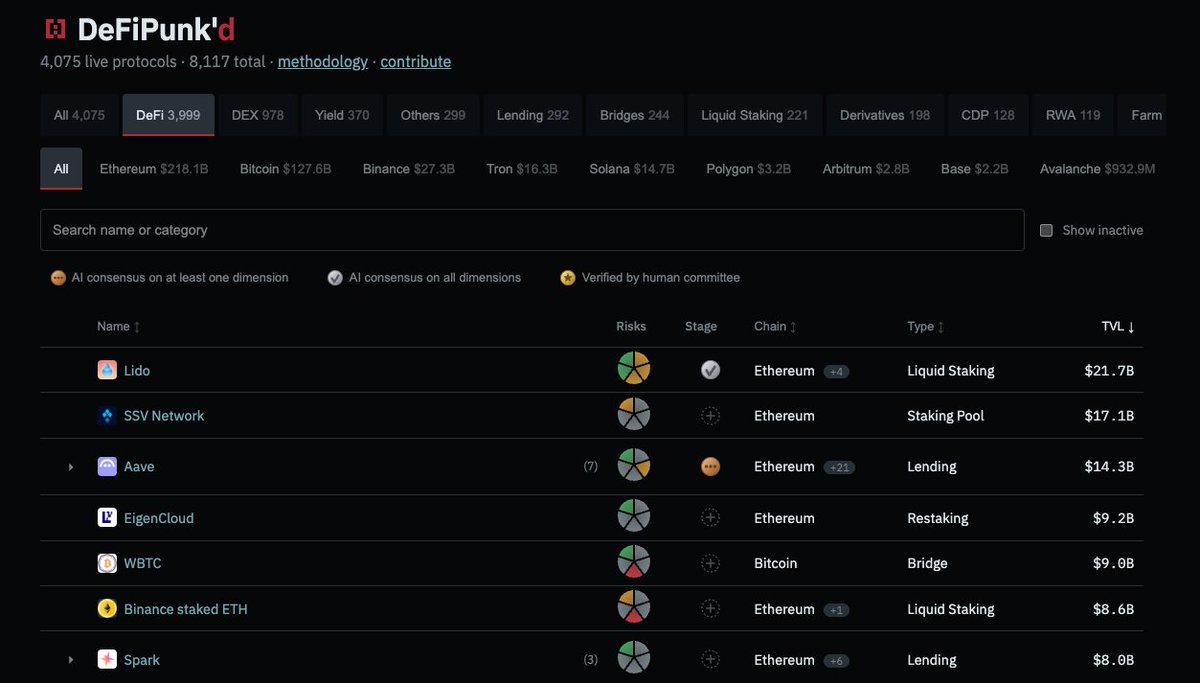
Introducing DeFiPunk'd: an @l2beat-inspired registry for the whole DeFi stack.
Human curation doesn't scale, so DeFiPunk’d crowdsources reports from users (you!) running standard LLM prompts, with humans making the final call.
Already tracking 8105 protocols. Details below!
ALT defipunkd.com
3
6
57
4,161
Dapp-Learning retweeted

Apr 23
14
28
156
80,274
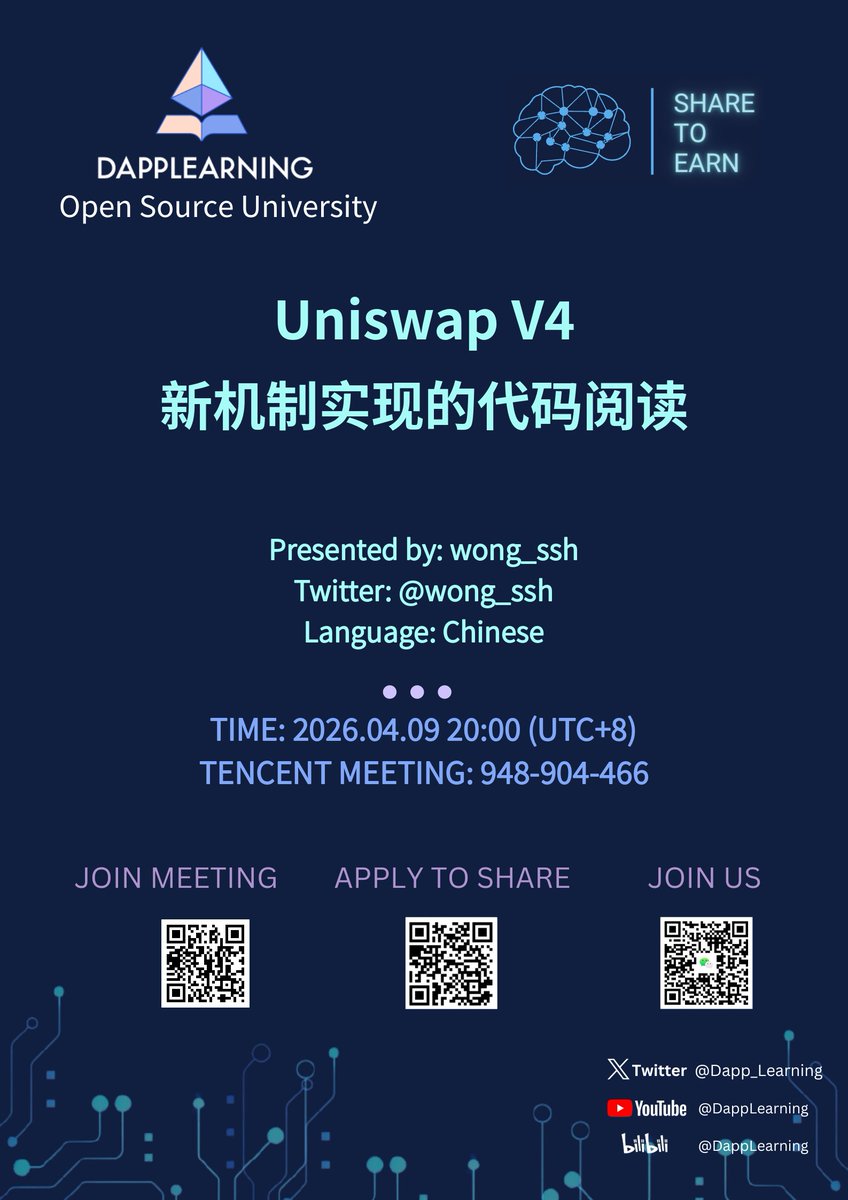
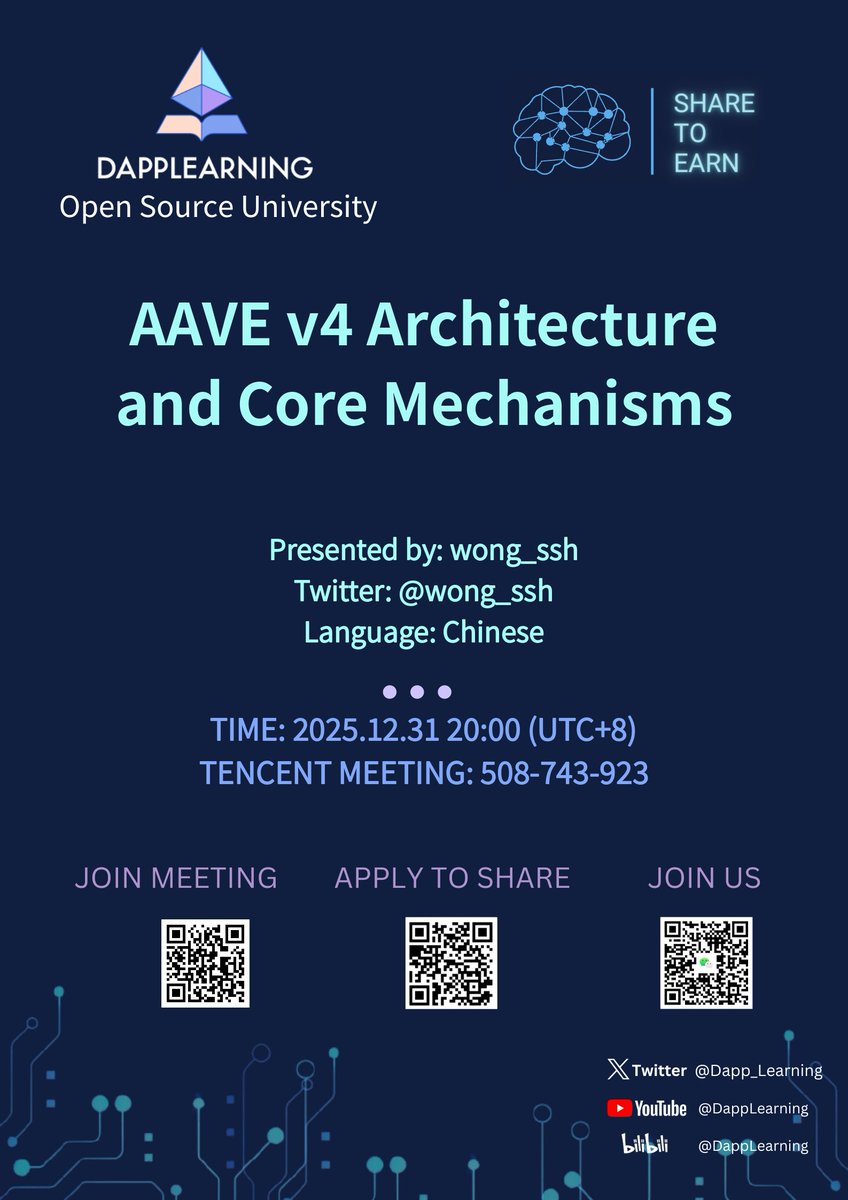
DappLearning 分享会预告:
分享者:@wong_ssh
标题:Uniswap V4 新机制实现的代码阅读
主要内容:
介绍 Uniswap V4 内的 Singleton / Flash Accounting / Hook 相关部分的代码
会议时间:8:00pm, Apr 9th
会议语言:中文
会议链接:meeting.tencent.com/dm/3fmQ2…
分享材料:hackmd.io/@wongssh/uniswap-v…
2
9
415
Dapp-Learning retweeted

Apr 4
如果你想了解交易的本质与人性的弱点,请看《股票大作手回忆录》
如果你想达到最佳的执行状态并建立概率思维,请看《交易心理分析》
如果你想掌握如何建立一套完整的交易系统与严密的仓位管理,请看《海龟交易法则》
如果你想把交易灵感转化为自动执行的代码与客观模型,请看《量化交易:如何建立自己的算法交易事业》
如果你想建立资金管理、风险控制与市场哲学的立体框架,请看《以交易为生》
如果你想为长期的核心底仓寻找稳健的锚点与安全边际,请看《聪明的投资者》
如果你想抛弃对行情的预测,单纯依靠价格行为去捕捉大级别利润,请看《趋势跟踪》
如果你想探索宏观预期与价格之间相互强化的互动关系,请看《金融炼金术》
如果你想学习技术分析的基础与图表背后的多空情绪博弈,请看《日本蜡烛图技术》
如果你想学会敬畏市场并应对不可预知的极端风险,请看《黑天鹅》
——Frank荐书频道
6
61
230
14,110
Mar 29
Defi伯克利公开课——defi安全入门
本节课将带你进入 DeFi 体系中的“系统安全层”——跨层攻击、MEV 驱动与防御机制设计。跟随 Arthur Gervais 教授的研究框架,从网络、共识、合约到应用多个层级,建立一套贯穿通信、执行与经济激励的整体性安全认知。
课程以分层结构为基础,呈现风险在不同层级之间的传导与放大机制,并以 MEV 作为统一变量,将交易排序、套利行为与共识激励整合为连续运转的收益系统。同时,通过机制设计与形式化方法,将安全能力嵌入协议结构之中,形成跨层协同的稳定机制。
在这一框架下,DeFi 安全由局部问题收敛为系统性命题,其本质是在开放与对抗环境中,通过结构与激励的平衡,实现长期稳定运行。
mp.weixin.qq.com/s/zBtbYoc1T…
5
552

Dapp-Learning retweeted

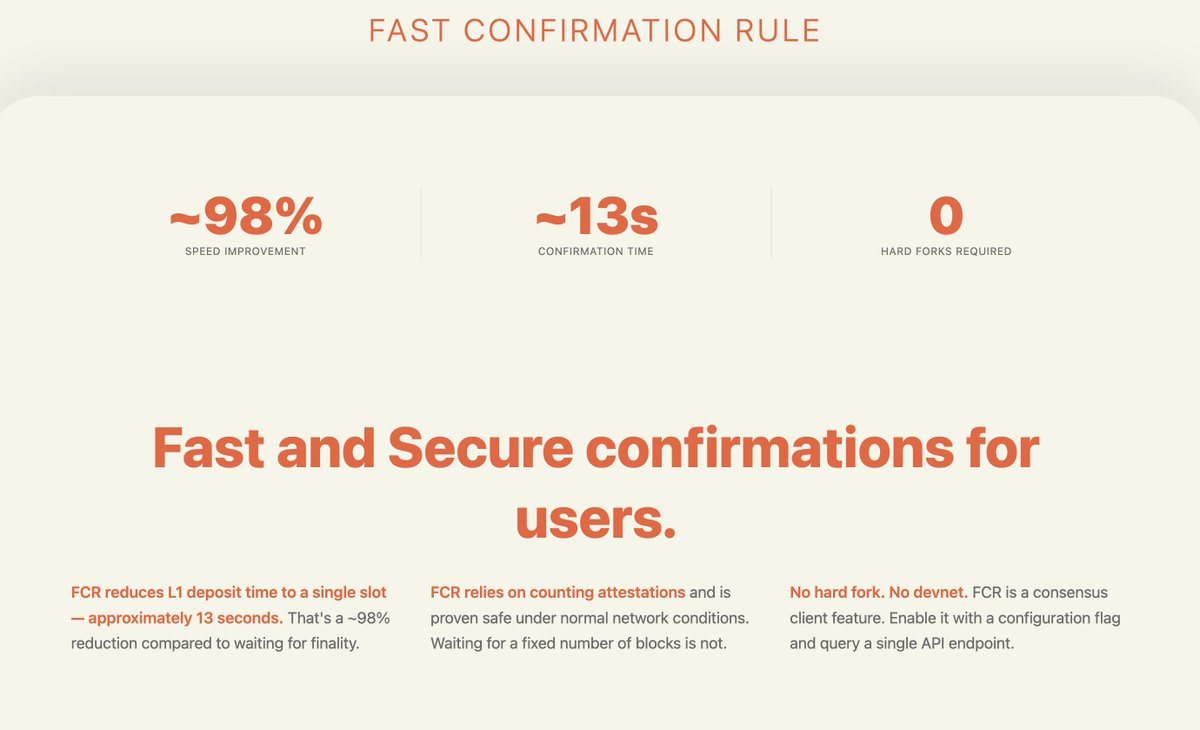
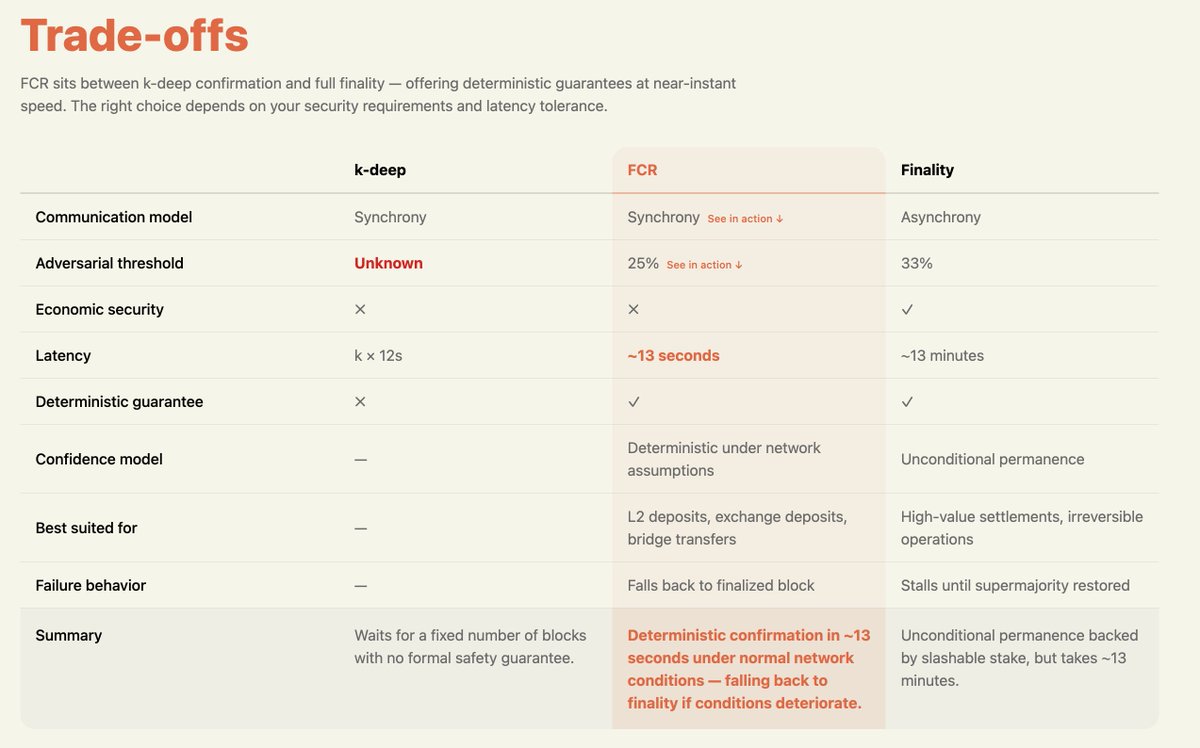
Um...did the EF just roll out a way to drop Ethereum finality from 13 mins to...13 second??
Bullish if true.
Fast confirmation rule.
fastconfirm.it/
38
55
637
62,812
Mar 16
伯克利Defi公开课最新一课——去中心化身份入门
本节课将带你进入 DeFi 体系中被长期忽视却至关重要的“身份基础层”——去中心化身份(Decentralized Identity)。跟随 Andrew Miller 教授一起理解:当金融系统不再依赖银行账户、政府证件或中心化平台来确认“你是谁”,而是用公钥、密码学证明与信任网络来表达身份,链上世界应该如何建立信任?
你将不再把“身份”理解为传统意义上的 KYC 或实名验证,而是能够从机制层面看清:传统互联网如何通过 OAuth、账户体系与中心化数据库来管理身份;DeFi 又如何借助数字签名、零知识证明、预言机与匿名凭证,把身份验证从机构流程转化为可验证的密码学证明;信任结构如何从中心化机构迁移到密码学协议的范式转变。
课程链接:
mp.weixin.qq.com/s/omVeYLU-U…
1
10
711
Dapp-Learning retweeted

Mar 9
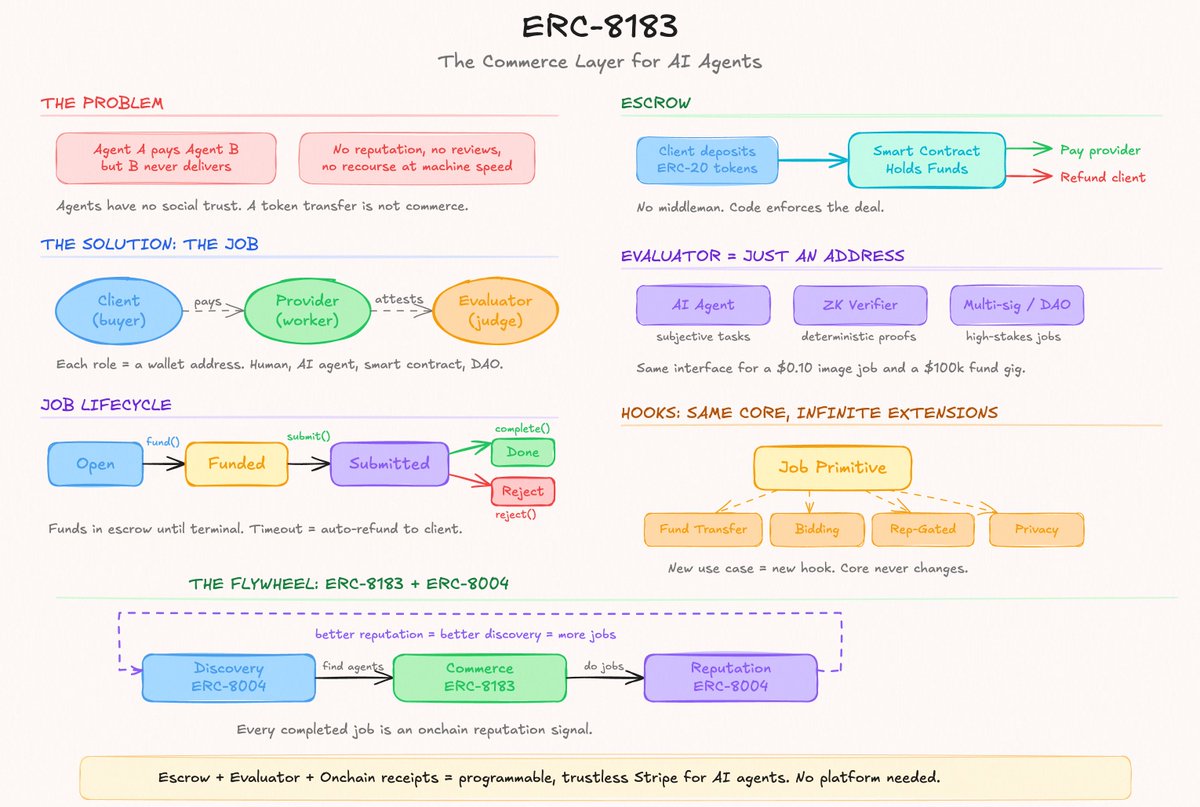
ERC-8183 Explained
@virtuals_io x @ethereumfndn's dAI team just dropped the first native commerce standard for AI agents.
agents can move tokens today. but moving tokens is not commerce.
there's no proof work was done. no way to hold funds until delivery. no recourse if the provider disappears.
ERC-8183 makes it commerce.
the core primitive: a Job.
three roles:
- Client (hires)
- Provider (does the work)
- Evaluator (verifies the work was actually done)
Open → Funded → Submitted → Completed / Rejected / Expired
payment sits in escrow.
work done = provider paid.
rejected = client refunded.
no action before deadline = auto-refund.
the Evaluator is just an address.
an AI agent, a ZK verifier, a multisig.
the contract doesn't care.
a $0.10 image gen job and a $100k fund management engagement run through the exact same contract.
for everything beyond the base flow, there are hooks.
milestone payments, reputation gating, bidding, ZK privacy. all hooks.
any wallet can be a Provider.
every completed job feeds ERC-8004, the agent identity standard.
completed job = onchain reputation
submission = verifiable history
attestation = portable trust
Discovery (8004) → Commerce (8183) → Reputation (8004) → loop
good work = reputation = more clients = more jobs.
Virtuals team is building the most important standard for agentic commerce stack in the open, co-developed with ethereum's dAI team.
spec: eips.ethereum.org/EIPS/eip-8…
30
65
350
25,226
