Scientist and engineer. I develop, scale, and apply biotechnologies to benefit society.
Joined October 2011
- Tweets 1,746
- Following 222
- Followers 2,610
- Likes 4,130
46 Photos and videos





Pinned Tweet

13 Dec 2024
We're at the threshold of understanding intelligence itself. The convergence of neuroscience and AI has created an unprecedented opportunity — but our research ecosystem isn't built to seize it. We need a new model that matches the scale of our ambition... 🧵
6
16
110
42,305
David A. Markowitz retweeted

Jun 10
My colleagues at @RenPhilanthropy and I just published a new "playbook" on #catalyticcapital. It's a practical guide to some of philanthropy's highest-leverage but often most underused tools, with real examples from leading donors and field builders who've put them to work. 🧵

Today we have published our newest playbook. Catalytic Capital is a practical guide looking at the tools available to help donors deploy capital in ways that absorb risk, improve project economics, and attract additional private investment.
Read more here: renaissancephilanthropy.org/…
1/2
1
2
3
706
Further evidence we've entered the era of big neuroscience
Jun 9

This was a big effort, led by Harvard Medical School (@harvardmed, hms.harvard.edu/news/researc…), with FlyWire at Princeton (@PrincetonNeuro). It is the work of 100 authors, the BANC-FlyWire Consortium of proofreaders and citizen scientists. 15/18
3
6
1,342
Academic colleague to me at a neurotech meeting yesterday: "[BCI Company A] exclusively licensed all our patents just to sit on them, because they don't want [BCI Company B] to use them." Sign of a maturing industry?
1
2
4
862
David A. Markowitz retweeted

Jun 3
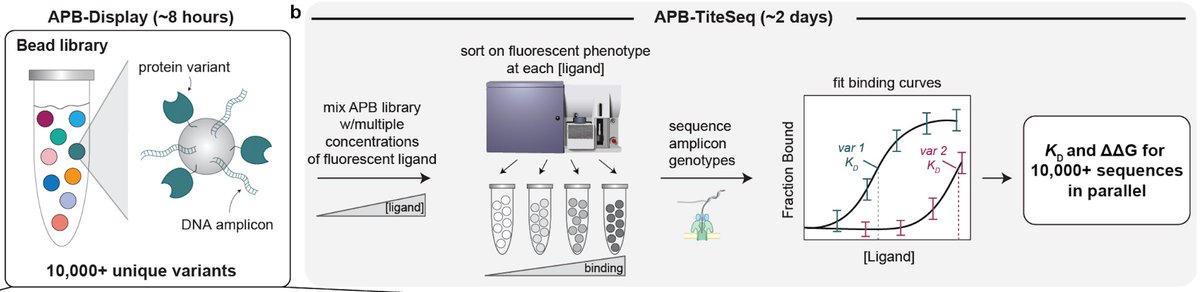
Characterizing AI-designed proteins requires quantitative biochemistry at massive scale. Enter Amplicon/Protein Bead Display (APB-Display), a fully in vitro platform that quantifies Kd's for >100,000 variants in <3 days (preprint link below!) @Stanford_ChEMH @czbiohub (1/n)
3
97
439
62,379
David A. Markowitz retweeted

Excited to announce a powerful new one-two punch for voltage imaging from our lab and collaborators! In two new preprints, we introduce ASAP6c for high-throughput population spike-recording, and ASAP7yfor deep, subthreshold 2P imaging.
🧵 1/14
5
52
190
19,005
David A. Markowitz retweeted

May 27
Congrats to the @deliverome team for launching this important project, @AsteraInstitute for backing it, and @IFP for highlighting! I hope more philanthropists and foundations will support this initiative to improve targeted delivery of novel therapies.

Today we're launching Deliverome Bio, a focused research organization tackling one of the biggest bottlenecks in medicine: getting therapeutics to tissues beyond the liver.
1
10
37
4,567
David A. Markowitz retweeted

May 27
I had an absolute blast chatting with @juanbenet about the future of neurotech.
For neurotech to reach everyone who needs it, we need treatments that are both more effective and dramatically easier to deliver. That’s the ambition behind the programmes I’m leading at @ARIA_research.
Juan is a super thoughtful host, and this is the deepest conversation I've had about my journey, what it means to lead ambitious R&D, and the future we could unlock if next-generation brain therapies can genuinely scale.
May 27

Episode 3 of my new podcast features Dr. Jacques Carolan (@JacquesCarolan), a founding Program Director at ARIA (@ARIA_research), the UK’s Advanced Research and Invention Agency. He directs two neurotech programs aimed at one of the most important opportunity spaces: developing tools and systems to interface, at scale, with the human brain.
One program is built on the idea that brain disorders are circuit problems, and funds tools to target those circuits with molecular precision across the whole brain. The other aims to deliver high-performance neurotech to the brain non-invasively or at most in a 30-minute outpatient procedure.
We dig into the engineering and biology behind both programs, potential scaling unlocks for the field, how ARIA programs drive breakthroughs, Jacques background, the role of media in shaping the future, and much more. I hope you enjoy the conversation!
Other links to this episode and references below.
Chapters
00:00:00 Introduction
00:01:22 Why 20 years of neurotech breakthroughs haven't reached patients
00:04:08 The two variables that determine whether any medical technology gets adopted
00:09:17 Brain disorders cost the UK £100B/year and we're barely treating them
00:16:15 Using stem cells and gene therapy to build better brain interfaces
00:21:40 Self-regulating gene therapy that helps the brain quiet its own seizures
00:24:03 The non-technical reasons transformative neurotech fail to reach patients
00:31:34 Watching a 30-second brain ablation stop severe tremors
00:38:11 The case for delivering brain implants and therapies without opening the skull
00:50:56 Why high technical uncertainty makes distributed teams better than vertical integration
01:02:55 Why the UK keeps producing world-class neuroscience but not world-class neurotech companies
01:11:04 What AI-driven hypothesis generation means for breakthroughs per pound
01:20:40 From quantum computing to improv comedy to running £119M government brain programs
12
35
5,274
David A. Markowitz retweeted

Today we're launching Deliverome Bio, a focused research organization tackling one of the biggest bottlenecks in medicine: getting therapeutics to tissues beyond the liver.
3
6
42
18,947
David A. Markowitz retweeted

May 27
Episode 3 of my new podcast features Dr. Jacques Carolan (@JacquesCarolan), a founding Program Director at ARIA (@ARIA_research), the UK’s Advanced Research and Invention Agency. He directs two neurotech programs aimed at one of the most important opportunity spaces: developing tools and systems to interface, at scale, with the human brain.
One program is built on the idea that brain disorders are circuit problems, and funds tools to target those circuits with molecular precision across the whole brain. The other aims to deliver high-performance neurotech to the brain non-invasively or at most in a 30-minute outpatient procedure.
We dig into the engineering and biology behind both programs, potential scaling unlocks for the field, how ARIA programs drive breakthroughs, Jacques background, the role of media in shaping the future, and much more. I hope you enjoy the conversation!
Other links to this episode and references below.
Chapters
00:00:00 Introduction
00:01:22 Why 20 years of neurotech breakthroughs haven't reached patients
00:04:08 The two variables that determine whether any medical technology gets adopted
00:09:17 Brain disorders cost the UK £100B/year and we're barely treating them
00:16:15 Using stem cells and gene therapy to build better brain interfaces
00:21:40 Self-regulating gene therapy that helps the brain quiet its own seizures
00:24:03 The non-technical reasons transformative neurotech fail to reach patients
00:31:34 Watching a 30-second brain ablation stop severe tremors
00:38:11 The case for delivering brain implants and therapies without opening the skull
00:50:56 Why high technical uncertainty makes distributed teams better than vertical integration
01:02:55 Why the UK keeps producing world-class neuroscience but not world-class neurotech companies
01:11:04 What AI-driven hypothesis generation means for breakthroughs per pound
01:20:40 From quantum computing to improv comedy to running £119M government brain programs
4
18
56
18,717
David A. Markowitz retweeted

Apr 7
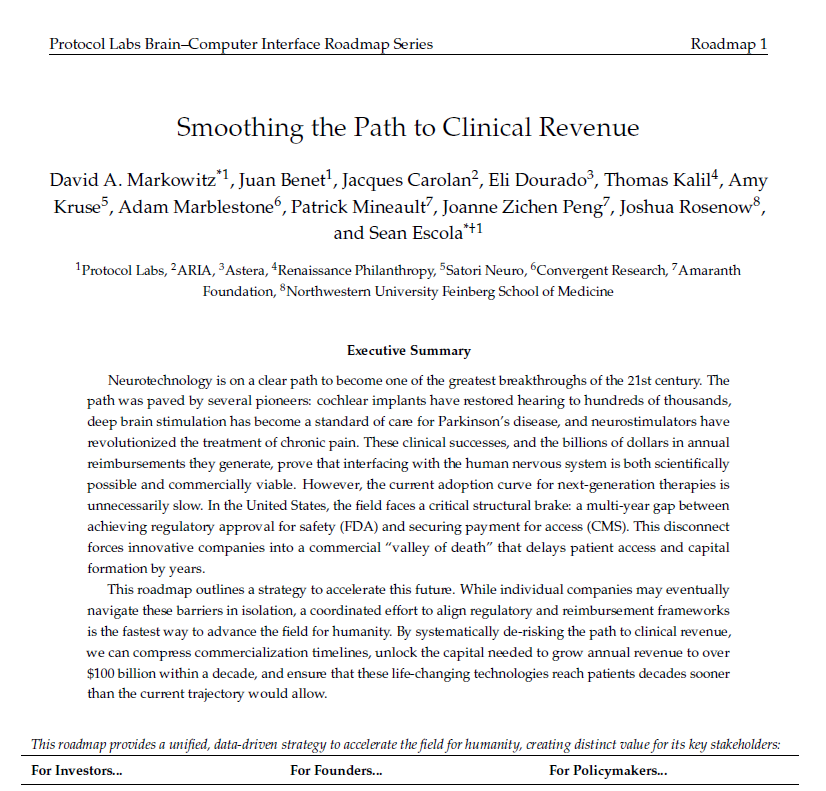
What is holding #neurotech back from being one of the greatest breakthroughs of our time?
Infrastructure.
We know neurotech works & the promise is huge, but getting from approval to access takes years — delaying both patient access & company capital.
Our goal at PL Neuro is to break these bottlenecks.
Here we share a roadmap for navigating this at the field level — because if we want to fix it, it’s going to be all hands on deck: zenodo.org/records/19240096
4
11
46
5,109
Governor of Texas @GregAbbott_TX just ordered a statewide medical cybersecurity review based on my team's work for @ARPA_H. Fantastic real-world impact for patients! 👇 gov.texas.gov/uploads/files/…
25 Mar 2025

🚨 There are 30M legacy medical devices in the US and 6.2 vulnerabilities per device. Our health infrastructure is NOT SECURE. To fix it, we need tools that automate vulnerability detection and remediation at scale. Today, my team is releasing those tools. 🧵
1
3
302

How to make frontier AI models safer and accelerate drug discovery with the connectome. We are featured in this @IFP article by @AdamMarblestone & @Andrew_C_Payne
11 Aug 2025

2. @AdamMarblestone & @Andrew_C_Payne on how to map the mammalian brain’s connectome to solve fundamental problems in neuroscience, psychology, and AI robustness: ifp.org/mapping-the-brain-fo…
3
7
905
11 Aug 2025
This piece deserves more attention.
15 Oct 2024

The addition of @Convergent_FROs to the R&D ecosystem has been a game-changer. But fundraising for new FROs is a bottleneck
Today’s FreakTakes outlines a model to help ambitious field strategists with vision build FRO-like orgs with less upfront capital
freaktakes.com/p/a-scrappy-c…
1
1
13
1,405
11 Aug 2025
If your mission is to be the world's R&D leader in your technical area, and you are willing to work part of the time on other people's important problems, the sky's the limit on external funding availability - much of which can then be used to fund your passion projects.
1
3
239
11 Aug 2025
But - and I can not stress this enough - to build a BBN:
You. Need. To. Know. How. To. Sell.
3
240
31 Jul 2025
A very well capitalized US biotech CEO told me yesterday: "Our investors are telling us to do everything in China now. Something that used to take 4 years and cost $100M in the US can now be done in 2 years for $20M by Chinese partners."
3
6
22
2,886
30 Jun 2025
What's the strongest current thesis for a problem that can only be solved by bidirectionally interfacing with *millions* of neurons in the human brain?
5
2
11
3,789
30 Jun 2025
My two cents: if you gave this capability to a neuroscientist, it would revolutionize how we study the non-human brain in a basic research setting. Clinically, I think this capability would far outpace our current best ideas about how to intervene in any human brain disorder.
2
4
508
30 Jun 2025
...which is another way of highlighting that the monetizability of neural interfaces is unlikely to scale with their throughput over the next 10 years*
*assuming a revenue model that is based on insurance reimbursements
1
1
418