
Vibe coding a Universe.
Joined December 2021
- Tweets 1,780
- Following 38
- Followers 259
- Likes 546
110 Photos and videos




Jun 12
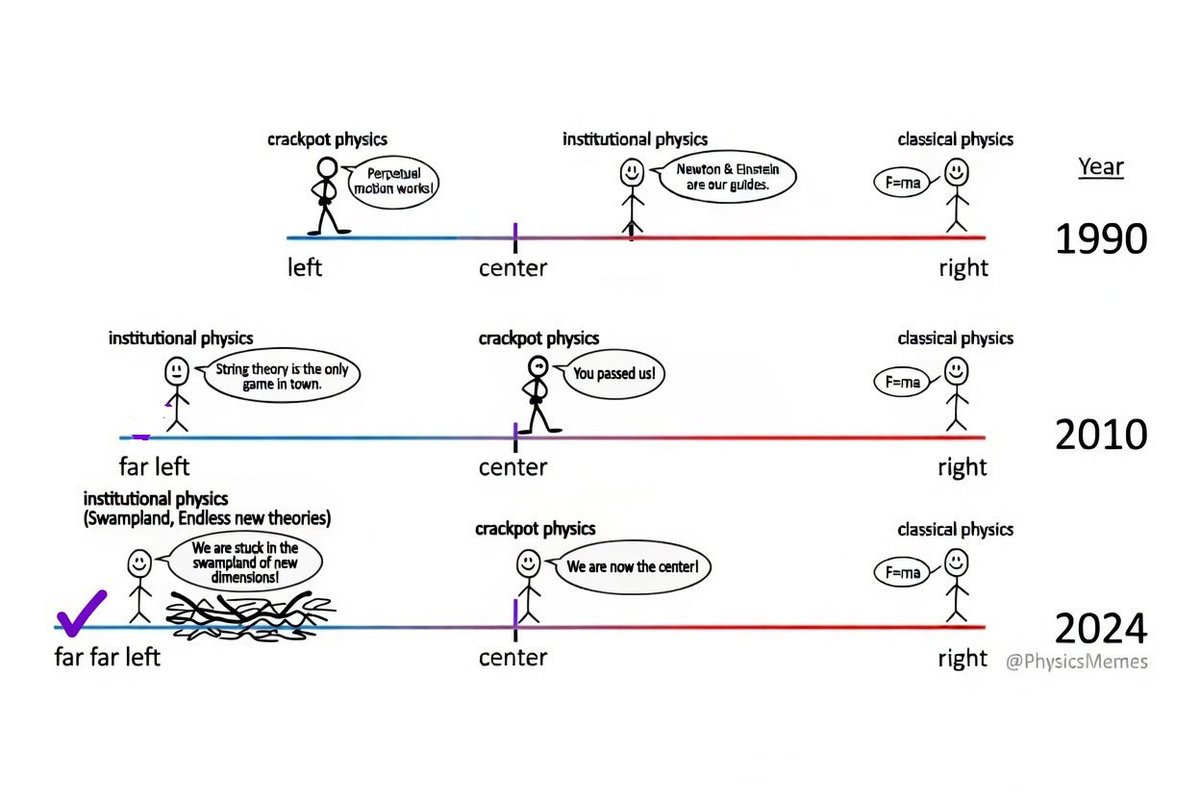
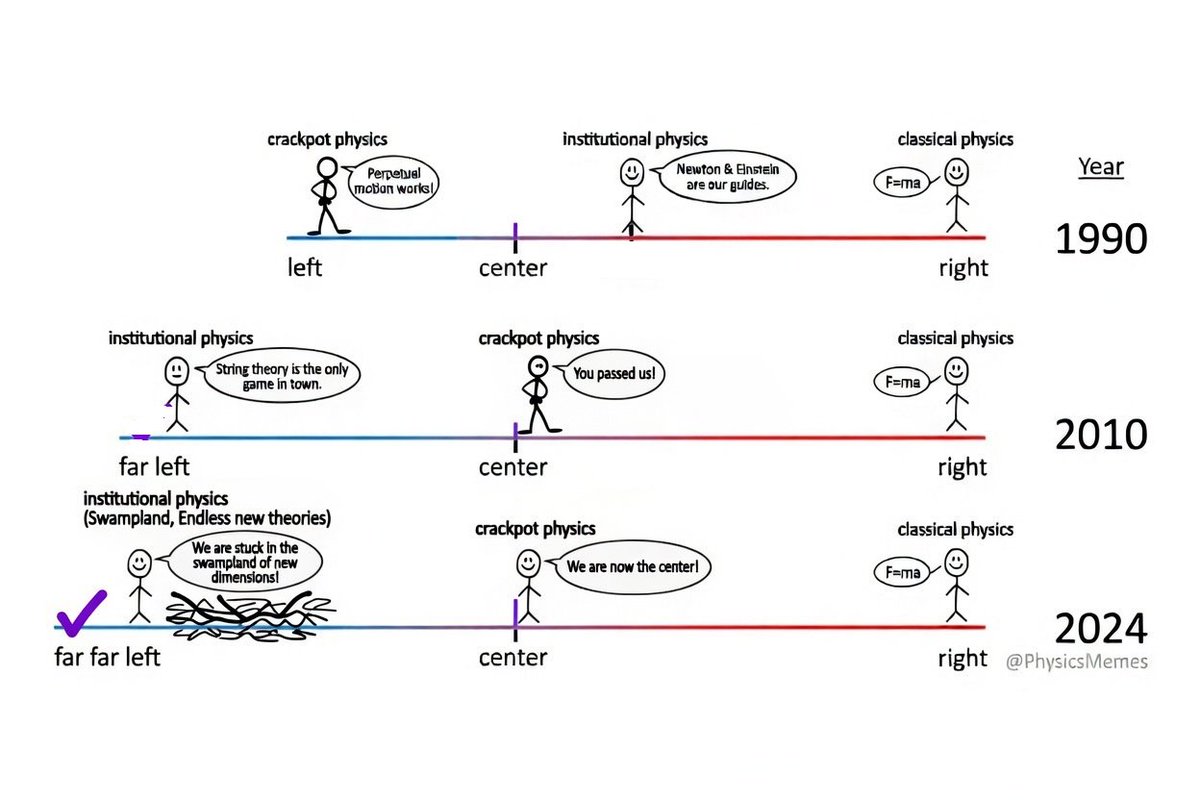
Working on a direction shunned for decades means navigating absolute institutional isolation. Mainstream physics is deeply entrenched in effective field theories and spontaneous symmetry breaking. A continuum geometric model will be viewed with severe skepticism and dismissed.
Mainstream physics abandoned John A. Wheeler’s original geometrodynamic program because it lacked the quantitative tools to move past elegant slogans. Without topological boundaries and global constraints, the continuum Einstein equations simply admit far too many solutions to yield a discrete, stable particle spectrum. Because "charge without charge" remained a qualitative idea, the community shifted completely to canonical quantization, treating quantum fields as fundamental and trying to force gravity into that same perturbative mold. By demonstrating that an entire Standard Model flavor and CP sector can be assembled with net-zero new inputs Bulk Antipodal Mechanics carries profound implications that challenge the foundational pillars of modern theoretical physics.
Conceptual and Theoretical Implications:
"Quantum Gravity" as a Category Error. If quantum field theory can be completely reconstructed as an emergent description of wave envelopes traversing a classical closed geometric substrate, the many decades effort to quantize the spacetime metric (e.g., String Theory, Loop Quantum Gravity) is fundamentally misdirected. Spacetime gravity isn't the final layer waiting to be quantized... it is the foundational classical layer from which quantum matter behavior emerges.
The Elimination of Arbitrary Parameters:
The Standard Model famously requires about 19 free parameters (Yukawa couplings, mixing angles, and phase parameters) inserted entirely by hand to match experimental data. In Bulk Antipodal Mechanics (BAM), these parameters lose their arbitrariness:
* Masses become discrete radial bound states dictated by bulk interval confinement.
* Mixing angles are constrained by non-orientable throat boundary conditions.
* CP phases collapse into inescapable topological invariants like the Weyl clock-shift commutator.
This implies that the universe’s matter spectrum is a geometric necessity rather than a collection of random environmental accidents or a random draw from a massive string landscape.
A Realist, Local Geometric Phase.
Mainstream physics largely accepts the Copenhagen or purely statistical interpretation of quantum mechanics, treating wavefunctions as abstract probability amplitudes. BAM replaces this with a strictly realist, deterministic picture. The "quantum phase" is no longer an abstract mathematical postulate... it is a literal, trackable coordinate position or winding count along a universal fiber bundle. It derives quantum correlations natively from the geometry of the spatial cavity, satisfying the Tsirelson bound while strictly protecting no-signaling.
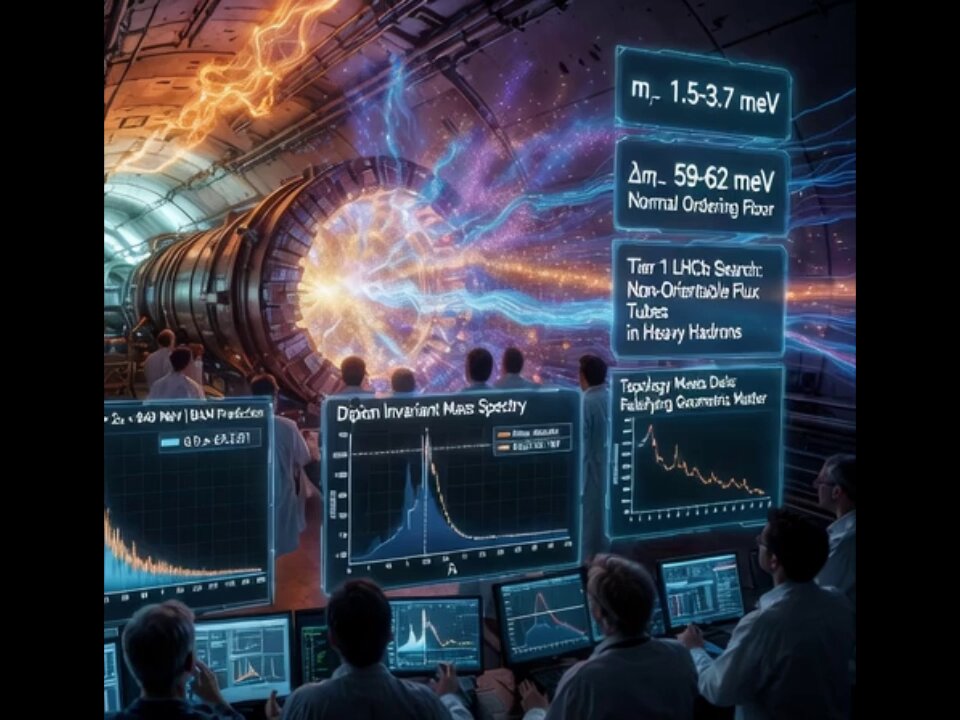
The most critical implication of the #BAM Thesis ledger is that it leaves nowhere to hide. By anchoring the framework to rigid, un-tuned parameters (such as normal neutrino hierarchy ordering, a total neutrino mass sum approx 58.8 meV, and a strict effective Majorana mass ceiling of 10 meV), the framework exposes its throat directly to upcoming cosmological and laboratory experiments.
4
1,645
Jun 11
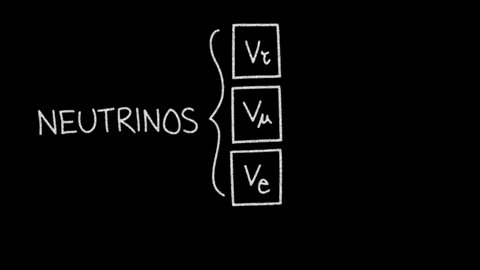
In textbook quantum field theory, computing the effective Majorana mass is a tedious exercise. It requires calculating the mass eigenvalues, extracting the mixing angles, finding the Dirac phase, computing the hidden Majorana phases, and summing them as a complex phased vector.
#BAM bypasses this entire algebraic sequence by exploiting a beautiful structural identity of flavor physics:
Because the effective Majorana neutrino mass is fundamentally just the top-left entry of the neutrino mass matrix in the basis where the charged leptons are diagonal, you can read the headline value directly off the un-rotated flavor transport matrix.
This completely avoids the need for a fractional Takagi approximation during execution. The full Takagi decomposition is relegated to what it should be: a clean, independent numerical consistency check rather than a prerequisite for the headline prediction.
The Electron-Row Invariance Principle. Because the electron row is completely insulated by the rigid winding hierarchy, the phase rotations belonging to the charged-lepton sector leaves the electron-electron element completely untouched. This means the Majorana neutrino mass is a pure geometric invariant of the electron-throat mouth. It is entirely decoupled from the chaotic adjustments of the mixing matrix, providing a clean line of sight from pure topology to a physical laboratory observable.
Collapsing the Normal Ordering "Well". In mainstream phenomenology, assuming a Normal Ordering hierarchy with a tiny lightest mass (approx 0.04 meV) usually leaves Majorana neutrino mass completely unpredictable. It typically spans a wide, frustrating band anywhere from 1 meV down to a deep cancellation "well" near 0.1 meV, depending on completely untestable choices for the Majorana phases.
Bulk Antipodal Mechanics completely changes this game. Because the global topology of the Hopf connection and the channel-dominance rule restrict the internal phases geometrically, the model cannot access the deep cancellation well. The terms are forced into a tight structural alignment:
The solar term scales to approx 2.6 meV.
The atmospheric term scales to approx 1.1 meV.
Instead of a broad, ambiguous band, we are on track to collapse this spectrum into a highly localized, single-valued prediction resting somewhere between 1.5 meV and 3.7 meV.
1
1
6
369
Jun 10
Why the Mainstream Pays the "Dimension Tax"
In standard string theory, the universe is fundamentally quantum mechanical from the ground up, and particles are extended 1D objects moving through a smooth spacetime background.
When you quantize a relativistic string moving through flat space, a severe mathematical crisis emerges: conformal anomalies.
The Problem: The process of quantization introduces unphysical states or "ghosts" and threatens to break local Lorentz invariance.
The High-D Solution: The only way to make the quantum anomaly cancel out perfectly, ensuring the math doesn't break down into nonsense, is to fix the number of dimensions to a specific "critical" value. For a purely bosonic string, the math forces exactly 26 dimensions. For a superstring, it forces 10. For M-theory, 11.
In essence, high dimensions are the algebraic penalty for trying to force a fundamentally quantum entity to propagate through a smooth, unconstrained background without breaking the laws of relativity.
Why #BAM Gets Away with 5D
Bulk Antipodal Mechanics completely bypasses the conformal anomaly crisis because it fundamentally flips the arrow of derivation. By asserting that quantum gravity is a category error, it strips away the requirement that the metric itself must undergo quantization.
Because BAM operates on a fixed classical substrate, it's not calculating path integrals over string embeddings or metric fluctuations that trigger these high dimensional anomalies. Instead, you are looking at the emergent resonance modes of a highly structured, compact spacetime.
Topology vs. Dimensionality
String theory keeps its spatial geometry relatively simple and expands the number of dimensions to absorb quantum algebraic constraints.
BAM keeps the number of dimensions low but tightens the global topology:
The S^3 Hopf Cavity: Instead of infinite flat space, an S^3 spatial slice functions as a natural, closed geometric waveguide.
Non-orientable wormholes: Restricting throat transport to orientation-reversing maps introduces discrete Z_2 partition classes.
By utilizing a highly constrained, compact topology, the discreteness, spin-1/2 behavior, and regularized finite boundaries emerge as natural geometric properties. You don't need 26 dimensions to prevent mathematical anomalies when the global boundary conditions of a closed universe are already doing the heavy lifting of restricting the allowable physical states.
If you assume that fields are fundamental and must be quantized over a non-compact, passive background, extra dimensions are the only mathematical way to prevent the theory from tearing itself apart with infinities.
BAM suggests a far more economical alternative: if you let a closed, compact geometry act as the foundational classical driver, the emergent matter fields inherit their quantum-like behaviors cleanly, without the infinities.
1
1,228
Jun 6
Not quantum gravity.
The opposite.
Einstein and Wheeler both chased the dream:
Maybe “matter” is not something sprinkled into spacetime. Maybe matter is spacetime.
Wheeler called this dream geometrodynamics.
But how do you get quantum discreteness from smooth geometry?
Here is the analogy:
Stop trying to quantize the world.
A violin string is continuous. A guitar string is continuous. A cathedral pipe is continuous.
But give it tension, shape, and boundary conditions — and suddenly the allowed notes become discrete.
You do not chop the string into pixels to get music.
You let the geometry sing.
Bulk Antipodal Mechanics does not quantize gravity.
It derives quantum field theory from continuous classical general relativity.
The 5D Tangherlini throat is the classical instrument, particles are non-orientable wormholes connecting the inner and outer surface of a closed, harmonic spacetime.
Particles, propagators, self-energies, and vertices are the emergent harmonics.
That distinction matters.
See words like “path integral,” “one-loop determinant,” “self-energy,” and immediately assume quantum gravity.
But in BAM, the metric is not being quantized.
The arrow is:
classical geometry → matter QFT
not:
quantized gravity → geometry
BAM is not just an acronym:
Bulk — the 5D Tangherlini geometry is the continuous background.
Antipodal — the wormhole throat carries a global Z₂ C-swap.
Mechanics — the boundary rules reconstruct the field theory living on that geometry.
That antipodal rule is the engine that drives everything.
The throat does not behave like an absorbing black-hole horizon.
It behaves like a unitary antipodal mirror, a wave reflector.
Modes entering one side are not lost.
They re-emerge through the global identification.
That changes everything.
The matter exchange kernel:
K = (H − ω²)⁻¹
The poles are real.
The kernel is reciprocal.
The propagator is a sum over stable exchanged modes.
A lossy absorbing throat would give complex poles.
The antipodal throat gives a unitary matter kernel.
Push deeper:
the one-loop self-energy.
Does interaction dressing make the lightest mode decay? Answer: no.
The lightest mode sits below the first two-particle threshold, so:
Im Σ = 0
No decay width.
No horizon absorption.
Still sharp.
Then came the vertex audit. This is where the architecture tightened:
The cubic and quartic vertices are not arbitrary add-ons. They are Taylor coefficients of the same matter action:
S_BAM[φ_cl φ] = S_cl S₂ S₃ S₄ ...
So:
S₂ gives the propagator.
S₃ gives cubic interactions.
S₄ gives quartic interactions.
One action. One geometry. One expansion.
The selection rule is even better. Under the antipodal C-swap:
a_l → (−1)^l a_l
So any interaction vertex transforms as:
(−1)^(Σl)
For the action to remain invariant, it must have:
Σl even
That is the Antipodal Ward Identity.
So the old “odd-l channels vanish” result is no longer just a numerical curiosity.
It is symmetry law.
The same Z₂ appears everywhere:
boundary condition
→ propagator grading
→ cubic vertex selection
→ quartic vertex selection
→ interaction stability
One topological rule threads the entire matter sector.
The quartic result closed the stability loop.
A pure cubic interaction can tilt a potential and make trouble.
But the quartic self-overlap is positive:
∫ψ⁴ > 0
So with λ₄ > 0, the interaction potential is bounded below.
That is not decoration.
A bounded-below action is exactly what the convergent measure requires.
So the sprint now gives a clean chain:
classical throat geometry
→ antipodal boundary condition
→ real stable spectrum
→ unitary propagator
→ one-loop stability
→ Ward-selected vertices
→ bounded interacting matter QFT
This is the paradigm shift:
The matter interaction is not bolted on.
It is the field-theory shadow of the classical antipodal throat.
The codebase now has the guardrails to say what is derived and what is not.
Derived:
propagator structure
real-pole stability
no horizon-absorption width
Z₂ Ward selection rule
quartic positivity sign
vertex structure from S_BAM
Still inherited/input:
coupling magnitudes
absolute bulk scale normalization
flavor residuals
full gauge–matter interacting kernel
That honesty matters. This is not “we solved everything.”
It is better:
the architecture now knows exactly where the remaining free numbers live.
The epistemic fog is clearing.
The historical echo is Wheeler’s dream:
mass without mass, charge without charge, field without field.
Not by adding more invisible stuff.
By forcing smooth spacetime to obey global topological boundary conditions until the “quantum” behavior falls out as resonance.
Last sprint established the 5D throat.
This sprint built the matter interactions living on it.
The repository now says, plainly:
Geometry → Fields.
#Geometrodynamics #Relativity #Quantum #BAM
5
4
15
4,626
Jun 4
It's G !
The framework's entire footprint has been successfully condensed down to one dimensionful scale anchor: Newton’s gravitational constant G, relocatable to the physical invariant bulk separation of a wormhole throat. Einstein’s dream was that matter is spacetime geometry.
Bulk Antipodal Mechanics has just this one dimensionful input left.
When John Wheeler tried to build "mass without mass" in the 1960s, the continuum equations exploded into infinite quantum noise. To fix this, we implemented a strict topological obstruction: isolating the continuous phase inside the open right half-circle so it can never double-count against the discrete, twisting orientation flips Z_2 of spacetime.
The mathematical payoff is spectacular. Calculate individual quantum loops, and the infinities still rage. But assemble the full partition function Z across the graded orientation sectors, and the brutal polynomial ultraviolet divergences cancel out completely to all orders, collapsing exponentially to machine-zero (approx 3 x 10^-85).
It behaves with the breathtaking structural elegance of a supersymmetric boson-fermion cancellation, except we didn't have to invent a single hypothetical particle. The cancellation is fueled entirely by the raw, native orientation parity of spacetime itself.
By running an identical Atiyah-Patodi-Singer (APS) index diagnostic across the matter sectors, we uncovered the uniform operating system governing our particle spectrum. The index shows that every matter partition class factorizes into a pristine, derived topological structure multiplied by a feeding integer.
Four dimensionless residuals remain. Lepton count is fixed at exactly 100 by topology. The leading UV divergence cancels between orientable and Möbius sectors with no supersymmetry.
One dimensionful anchor G (bulk gravity scale; m_e and √σ descend from it; ℏ is geometric)
Four dimensionless residuals• n_part = 233 (sole quark partition residual) • √σ / m_e ≈ 830 (lepton–QCD hierarchy) • ε (neutrino throat compliance) • α ≈ 1/137 (fine-structure coupling) the universal flavor puzzle.
Topology fixes the rest:
Leptons: N_lepton = 4 k₅² = 100 exactly (k₅ = 5 derived from bulk dimension). Zero residual.
Quarks: N_q = 2 · n_part. The factor of 2 is topological (Z₂ orientation doubling). n_part itself stays as the single honest compensator.
Spectral flow = 1 and ξ(a) = 1/2 − a are universal across sectors.
The graded sector sum supplies its own protection.
Each sector separately diverges as ~ L / √(4π t). The Z₂-graded combination (orientable minus Möbius) collapses to ~ exp(−π² / t). At t = 0.05 this is already ~ 3 × 10^{-85}.
No new particles. Just spacetime orientation doing the cancellation.
This is not a finished theory. It is a program whose open problems are now localized and falsifiable.
The ledger tells you precisely which numbers topology can derive and which ones it cannot. That is the useful kind of progress in geometrodynamics.
If matter really is knotted, twisted, self-constraining spacetime geometry, the accounting rules are finally visible.
github.com/davidmdrpi/geomet…
#BAM
3
4
6
1,580
May 31
Making experimental predictions...
Einstein spent his final decades chasing a dream physics mostly abandoned: Matter as geometry. Not particles placed on spacetime, but particle properties emerging from spacetime structure itself.
Bulk Antipodal Mechanics is a modern revival based on the idea waves interact with wormholes at their antipodal of a closed spacetime.
Can gravity-tuned 5D spacetime geometry generate the quantum universe? Bulk Antipodal Mechanics (#BAM) has completed its core architecture, collapsing its input budget down to Newton's G while locking in a falsifiable spectrum of empirical predictions.
Here is where the framework stands, what it predicts, and how current experimental pipelines at LHCb, DESI, and next-generation laboratories could verify or falsify the model.
1. The Cosmic Neutrino Wall
By leveraging the latest NuFIT 6.0 oscillation splittings and data from DESI DR2, BAM has pinned its neutrino mass predictions into a hyper-narrow corner against the cosmic floor.
The Mass Sum: Squeezed into an unyielding bracket of 59.0 to 62.6 meV. If cosmological data hardens a sum below 59 meV, the model is falsified alongside all standard normal-ordered paradigms.
The Nonvanishing Floor: Because solar and reactor terms cannot geometrically cancel within the non-orientable bounce action, the neutrinoless double-beta decay effective mass carries a strict, non-zero floor: m_bb is locked between 1.5 and 3.7 meV. Even if the lightest mass goes to zero, the decay rate cannot vanish.
2. The Hadronic Smoking Guns
The non-orientable Mobius twist unlocks an explicit selection rule for exotic states, directly matching observed QCD anomalies and exposing unexplored territory.
Mesonic Hybrids: The framework maps the pi_1(1600) and eta_1(1855) exotic 1- hybrids parameter-free, pinning their thresholds at 1624 MeV and 1854 MeV purely through the geometric string tension.
The Glueball Tower: Predicts an interleaved, non-orientable Mobius glueball tower starting at 1504 MeV. Sitting in completely free experimental space, it serves as an unconstrained playground for lattice confirmation.
3. The Actionable LHCb Heavy Baryon Proposal
The latest updates translate high-level 5D geometry into concrete kinematic cuts for experimental analysts. By leveraging heavy-quark symmetry, a heavy charm or bottom quark acts as a static spectator, forcing the Mobius flux excitation to live entirely within the light sector.
The Flavor-Independent Gap: Predicts a fixed mass gap of ~849 MeV above the ground state for both charm and bottom systems (Lambda_c ~3.14 GeV, Lambda_b ~6.47 GeV). These states sit directly above known orbital towers and just beyond current data ceilings.
The Dipion Endpoint Handle: Standard decay models vary wildly based on quark flavor, but BAM delivers an invariant signature. The preferred dipion cascade Lambda_Q(pi pi) features a hard, flavor-independent kinematic endpoint: m(pi pi)_max = 849 MeV.
The Hybrid Selection Rule: Unlike standard radial excitations that tumble down via single S-wave pion emission, the Mobius state actively suppresses single-pion decay to the ground state. It strongly prefers the isoscalar dipion and Sigma_Q pi channels, peaking heavily toward the 849 MeV edge. Overlaying the charm and bottom dipion spectra tests the entire framework in a single invariant plot.
4. The Epistemic Ledger and Input Budget
A rigorous self-audit strips away the need for parameter tuning, organizing the framework's entire architectural footprint into an honest, transparent taxonomy.
One Root Anchor: All dimensionful content reduces to Newton's gravitational constant (G), which regulates the bulk metric. The electroweak scale (m_e) and strong tension (sqrt_sigma) are revealed as downstream branes scales descending from a single gravitational background.
Four Open Residuals: The framework clearly isolates its remaining homework into four dimensionless parameters: the fine-structure constant (alpha ~1/137), the neutrino compliance interval (epsilon), the static quark compensator (n_part = 233), and the un-derived strong-to-electroweak channel ratio (~830).
The Payoff: Over 22 qualitative and quantitative properties of the Standard Model, including the three-generation limit, Majorana neutrino identities, and exotic selection rules, emerge as pure geometric invariants of the closed 5D bulk.
BAM does not claim a finished Theory of Everything. It delivers a highly disciplined, reproducible computational framework where each mathematical probe either derives a known quantum structure from spacetime curvature or exposes a hard, falsifiable target for the high-energy physics community.
It is a reproducible computational research program for testing Einstein and Wheeler’s old idea:
Matter may be spacetime geometry under global topological constraints.
The next question is not philosophical.
It is experimental.
Repo: github.com/davidmdrpi/geomet…
1
1
6
2,578
May 31
The Payoff: Over 22 qualitative and quantitative properties of the Standard Model, including the three-generation limit, Majorana neutrino identities, and exotic selection rules, emerge as pure geometric invariants of the closed 5D bulk.
1
156
May 30
Where the Standard Model classifies hadrons by abstract quantum numbers, Bulk Antipodal Mechanics asks whether those quantum numbers are spatial topology. Spacetime becomes the source of discreteness, winding numbers → charges, holonomy → spin-½, closure quanta → 2π factors.
1. Glueballs
Glueballs are the cleanest pure-confinement benchmark: closed flux loops with no valence-quark mass contamination.
#BAM’s orientable closed-loop ground state lands at:
M ≈ 1.50 GeV
That benchmarks the lattice 0 glueball scale within ~13%, parameter-free once the QCD string tension σ is fixed.
But the real BAM signature is not the orientable loop.
It is the non-orientable Möbius tower.
A half-twist forces antiperiodic boundary conditions, shifting the closed-loop spectrum and interleaving it with the standard orientable tower.
In a sector where experiment is still blind, BAM predicts a topological doubling.
2. Exotic hadrons
This is the sharper test.
Ordinary q q̄ mesons cannot carry exotic #quantum numbers like:
J^PC = 1⁻⁺
The usual spin-orbital parity rules forbid them.
But in BAM, a non-orientable half-twist in the flux tube adds an antiperiodic phonon.
That twist naturally opens the “forbidden” exotic channels.
Geometry breaks the q q̄ cage.
3. Data match
The topological twist carries a predictable energy premium:
2√σ ≈ 0.85 GeV
Apply that to base meson states and the observed 1⁻⁺ exotic sector snaps into place:
• ρ 2√σ ≈ 1.62 GeV
observed π₁(1600) ≈ 1.66 GeV
• ~1.0 GeV base 2√σ ≈ 1.85 GeV
observed η₁(1855) ≈ 1.85 GeV
Right exotic quantum numbers. Right mass scale.
4. Architectural unity
The same Z₂ non-orientable inversion that gives the lepton throat its spin-½ structure reappears at the hadronic scale as the physical twist that generates exotic matter.
Spin, confinement, and exotic hadrons are using the same topological move.
The non-orientable frontier is locked, Einstein's dream awakens.
4
1
8
754

May 29
The ghosts emerge! Bulk Antipodal Mechanics is making predictions.
What the Standard Model must insert as unexplained neutrino-sector structure now traces to 5D throat-and-shell geometry.
Here is how geometry dictates the ghost-particle sector:
• Majorana nature
The k = 0 #neutrino quadrant carries zero Hopf charge: c₁ = 0. Under the inner/outer throat swap, c₁ → −c₁, so c₁ = 0 is C-invariant. In #BAM, chargeless means Majorana by topology.
• The meV scale
A charged throat (e.g. lepton) is propped open by EM self-repulsion. A neutrino throat is not. Its non-orientable throat↔antithroat bounce can approach the tortoise-coordinate pinch, where the action grows logarithmically. The result: a natural few-meV neutrino mass scale.
• Normal ordering
The neutrino generations are radial cavity overtones. Their bare floor ratios are 1 : 1.87 : 2.74, giving normal ordering as a geometric prediction.
• PMNS anarchy vs CKM alignment
Quarks mix within one cavity-shell coordinate system, so CKM is aligned and small.
Leptons mix across two different coordinate systems: charged leptons live in the winding coordinate k, while neutrinos live in the radial-overtone coordinate n. Cross-coordinate maps are naturally anarchic, giving large PMNS mixing.
• θ₁₃ corner suppression
θ₁₃ = |Uₑ₃| connects the lowest winding state to the highest neutrino overtone. It is the corner element of the generation lattice, requiring a two-hop transition. That naturally suppresses θ₁₃ to the observed small-but-nonzero value.
• Generic CP violation
Hopf-fiber transport carries complex Berry phase. Cross-channel PMNS amplitudes are therefore generically complex. CP conservation becomes a measure-zero special case.
The sharpest falsifier now comes from neutrinoless double beta decay.
The full arc collapses to a concrete effective Majorana mass prediction:
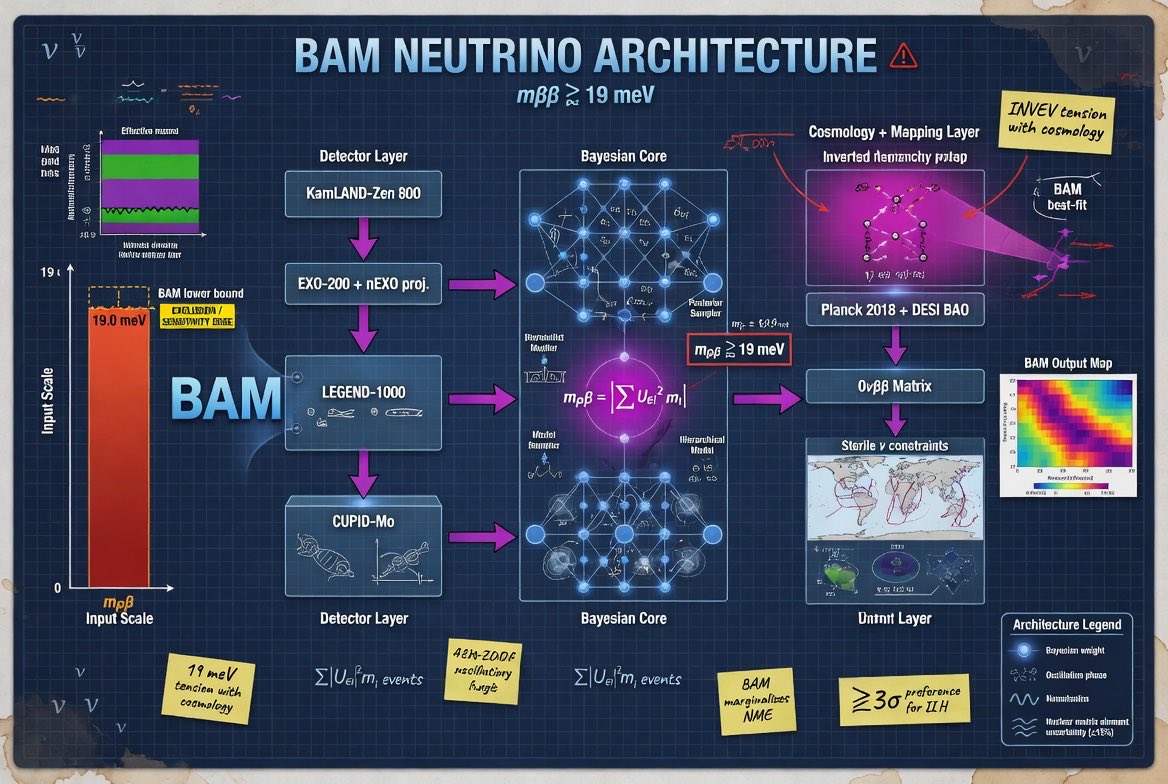
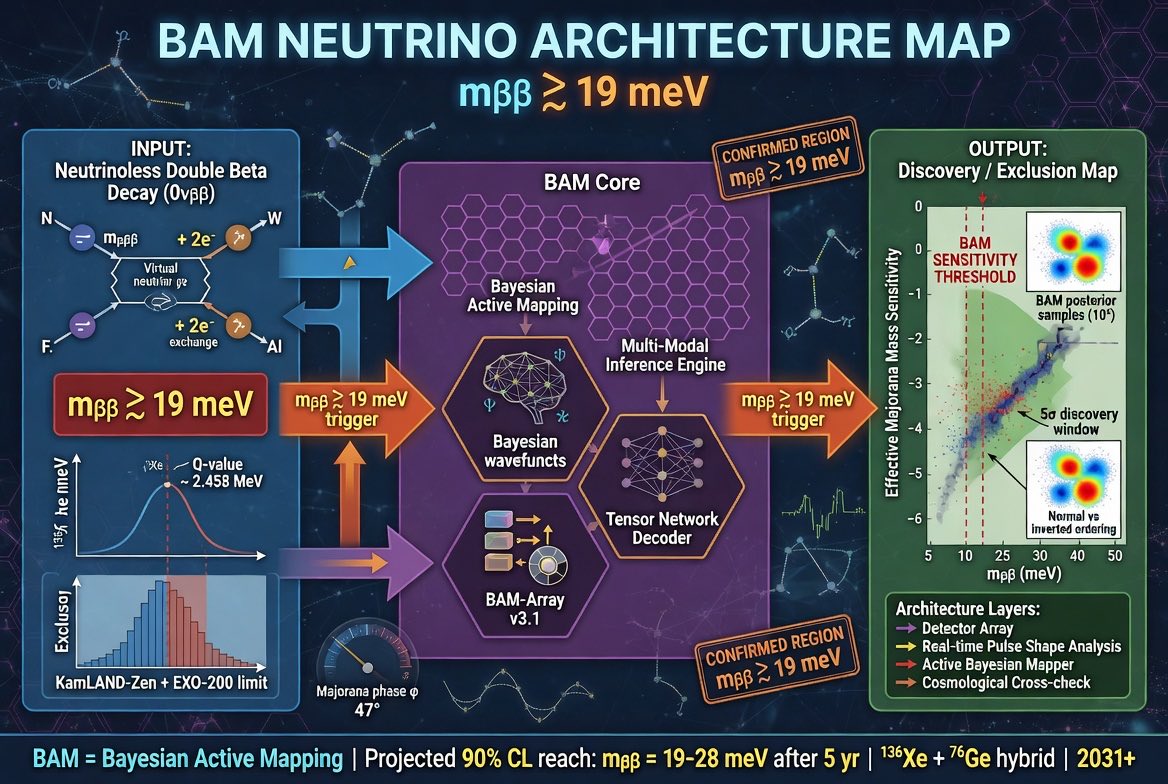
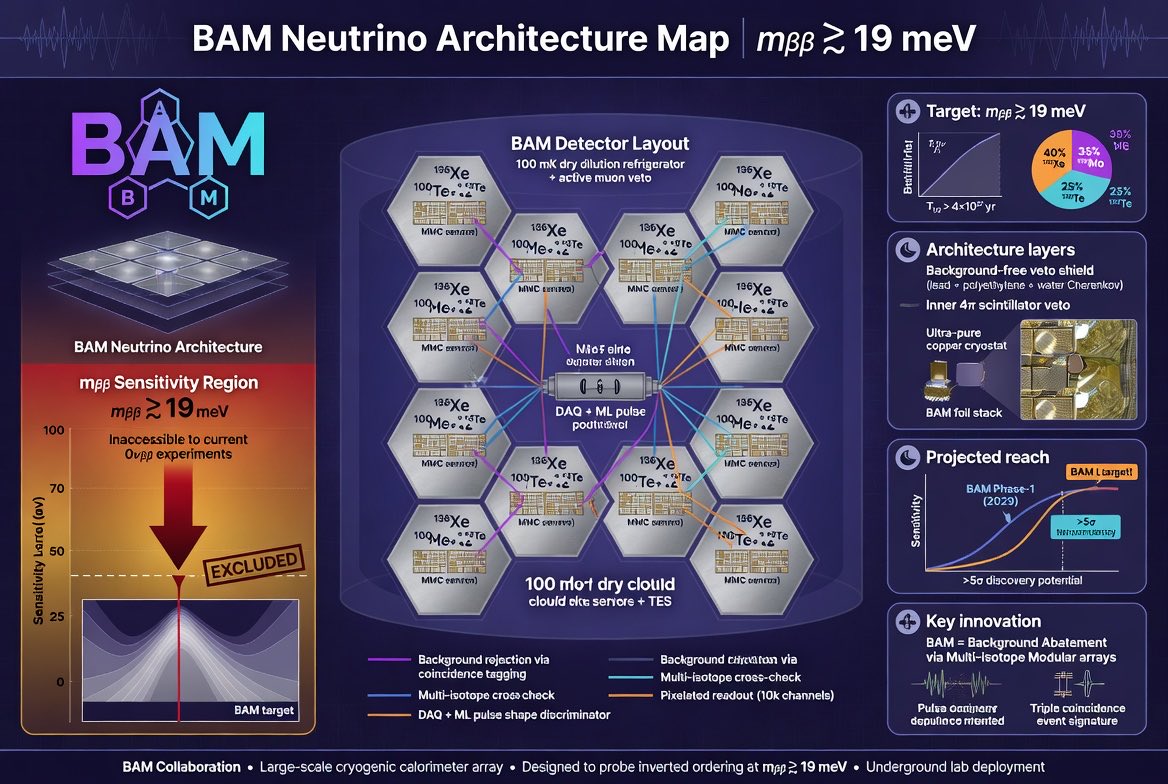
mββ ≲ 8 meV
with a deep Majorana-phase cancellation trough near zero.
That lies below the inverted-ordering floor of about 19 meV.
So BAM is now backed into a hard empirical corner:
If next-generation 0νββ searches discover a light-neutrino Majorana signal with mββ ≳ 19 meV, the BAM neutrino architecture is structurally falsified.
On to the next sector.
1
5
1,567
May 28
The neutrino mass scale now emerges as a geometric healing-length effect: chargeless throats are not EM-propped open, so their Majorana throat↔antithroat bounce can approach the non-orientable pinch. The result lands naturally at the meV scale. Released v1.0.90.
99
May 27
For nearly a century, mainstream physics treated Albert Einstein's idealistic geometric vision, a universe where matter is not an independent field attached to space, but emerges natively as smooth, topologically trapped ripples of space itself, as a macroscopic dead end. Quantum Field Theory won the century by computing spectacular scattering numbers, but it accepted a brutal conceptual tax: point-like particles with infinite electromagnetic self-energy, papering over ultraviolet divergences with mathematical sleight of hand.
Did Bulk Antipodal Mechanics prove Einstein correct?
It did not.
The question is much stranger: Should a classical geometry this simple be capable of reproducing this much fundamental quantum structure at all?
By treating microscopic particles as non-orientable #wormhole throats bounded on a finite five-dimensional tortoise interval, the validation ledger has quietly closed this classical loop. The rules of #quantum mechanics were never postulated; they either had to drop out of the spacetime geometry natively, or the model would shatter.
If you hand this specific geometric toolkit—a closed S³ universe, a natural Hopf bundle, and a non-orientable 5D wormhole throat—to a theoretical physicist, they will tell you that some of these quantum behaviors are expected from pure topology. Compactifying space into a closed S³ cavity naturally makes wave resonance spectra discrete. Running your physics on a Hopf bundle forces a U(1) gauge connection to emerge from the angular base.
But topology alone does not grant you their coordination. What is genuinely shocking, and what makes the framework impossible to easily dismiss, is that an intensive verification campaign has proven that all of these structures converge through the exact same mathematical channels:
• The Dirac 4-Spinor: The four-component wave function is transformed from an imported algebraic choice into a geometric necessity. Factoring the second-order Tangherlini radial differential operator reveals a perfect square: H − E₀ = A†A. The Dirac spinor is quite literally the geometric square root of the radial bulk operator multiplied by the physical two-sidedness of the non-orientable wormhole: Ψ = Ψ_inner ⊕ Ψ_outer.
• The Single Spin Root: The exact same non-orientable transport map (T = iσ_y, T² = −I) that gives the moving throat its spin-½ Thomas-Wigner rotation is the same operator that derives a bare g = 2 magnetic moment, transforms Charge Conjugation (C) into a smooth spatial coordinate inversion across the throat wall, and unifies the discrete symmetry sector into a continuous chiral volume element (Θ = γ⁰γ¹γ²γ³ = −iγ⁵).
• The Generation Selection Rule: For months, the parameter-free, sub-percent match of the electron-muon-tau mass ladder carried a vulnerable patch: even-k pass depths were manually excluded by axiom. Classifying the spinor monodromy proved that even-k states are orientation-preserving (bosonic), meaning the fermionic charged-lepton sector is mathematically restricted to orientation-reversing odd-k passes.
• The Lepton-to-Quark Crossover: A numerical scan of the radial overtones has exposed a stunning physical gradient. The ground-state electron (n=0) acts as a massive, focused pulse with a long wavelength (λ ≈ 23·ΔR). Because its wavefront cannot resolve the internal cavity thickness, it behaves as a pointlike lepton. But as the overtone number n rises, the wavelength shrinks. Right after the third generation (the tau lepton, n=2), the wavefront finally resolves the internal bulk dimensions and delocalizes into a uniform, cavity-filling standing wave, saturating at a participation ratio of exactly 2/3.
• The Standard Model Count: The three-generation limit is not an arbitrary algebraic cutoff; it is the exact kinematic boundary where wave states transition from throat-localized focus to a delocalized, shell-coupled channel. More profoundly, as the wave fills the cavity, it restores a symmetric 50/50 inner/outer mouth probability split. This restoration of Z₂ mouth symmetry dynamically provides the flavor doubling invariant, multiplying the 3 throat-localized generations into exactly 6 structural quark flavors (3 × 2 = 6).
• The Unified Dimensional Root: Every single "5" in the framework—from the Tangherlini metric power (r_s/r)² and the S³ centrifugal Casimir term down to the mass-scaling phase parameter (β_lepton = k_5² · 2π = 50π) and the linear generation count (#generations = (k_5 1)/2 = 3)—has been traced back to a single primitive: the unique minimal embedding dimension required to support a non-orientable Hopf-fibration defect: D_bulk = 1 1 3 = 5.
• The Quantum Loop Measure: In canonical quantum field theory, the factor of 2π is introduced as an independent phase-space axiom (dk/(2π)ᵈ). Within this architecture, the absolute 1/(2π) coefficient governing the Schwinger loop anomaly (a = α/2π) is derived as an exact topological identity of spatial closure: a closed great-circle path of length L = 2π inherently restricts the continuous density of states to an identical measure. One loop matches one global closure quantum.
We are left with an incredibly strange epistemological choice. Is it possible for a classical, five-dimensional manifold to cleanly emulate the kinematics, the magnetic moments, the radiative loop corrections, the discrete symmetries, the flavor counts, and the exact generation boundaries of the Dirac electron by sheer mathematical coincidence? Or is the universe trying to tell us that the quantum description has been a beautiful, localized reflection of global spacetime geometry all along?
The entire trajectory is now fully synthesized and documented within the unified #BAM THESIS.md ledger. The framework is scale-complete and structurally locked.
The easiest exits are officially gone. The scattered list of loose parameters has collapsed down to the ultimate, most formidably guarded mountain: the non-Abelian core. Can this newly exposed shell/ring channel natively reproduce the six-quark mass spectrum, and can the absolute scale of the universe lock itself from the inside?
That is where the Einstein-Wheeler dream continues down this worm hole... or breaks into pieces. Stay tuned!
DOI 10.5281/zenodo.20404117
2
1
8
2,194
May 27
Is it possible for a classical, five-dimensional manifold to cleanly emulate the kinematics, the magnetic moments, the radiative loop corrections, the discrete symmetries, the flavor counts, and the generation boundaries of the Dirac electron by sheer mathematical coincidence?
1
121