
208 Photos and videos







Pinned Tweet

20 Jul 2024
Golden #Trump boots is The One fighting Puppet Joe and the Elites
#thematrix

1
8
4,224
Wade Crypto Wilson retweeted

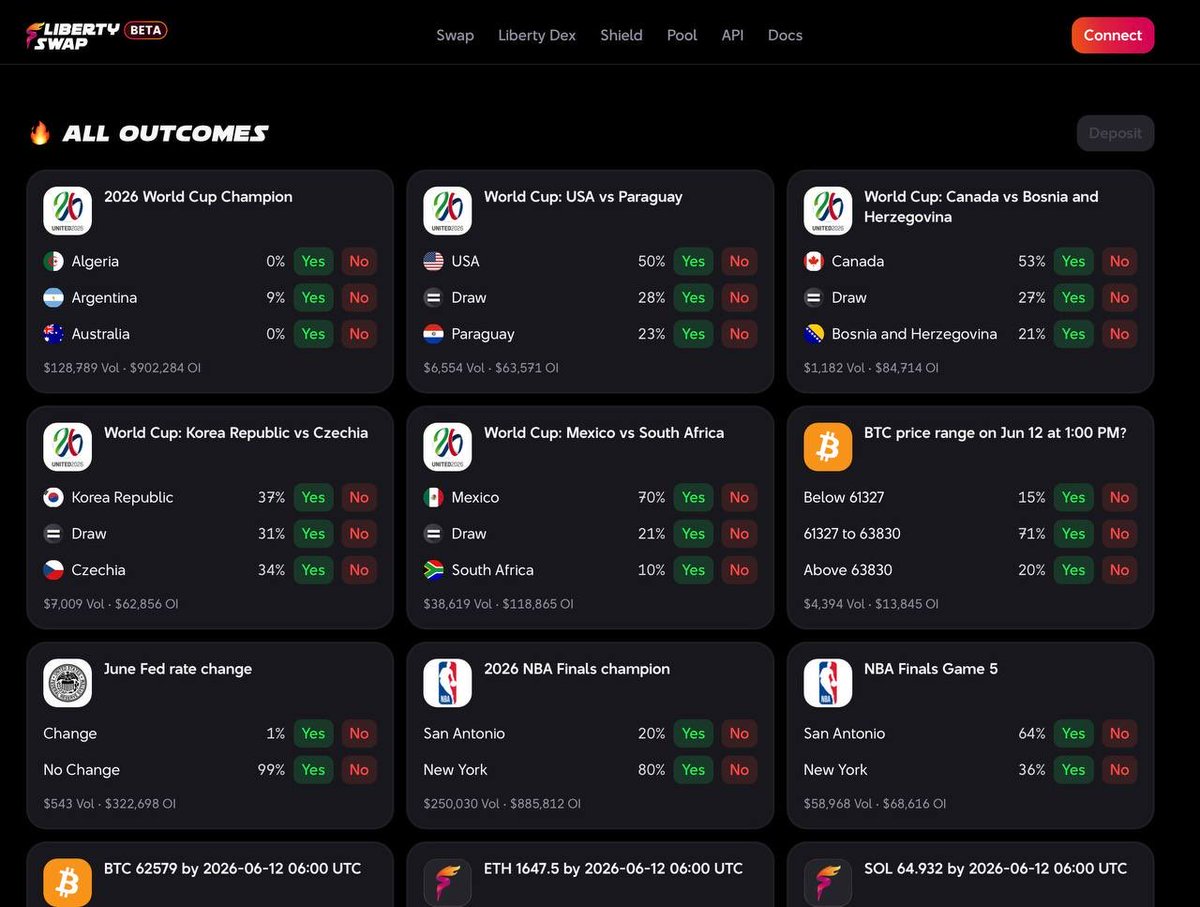
🚀 BIG ANNOUNCEMENT: Liberty HyperMarket is NOW LIVE!
The future of decentralized outcome markets has arrived on LibertySwap.
Liberty HyperMarket your new home for high-stakes, real-time outcome
markets is officially launched and powered by HIP-4 @HyperliquidX
Predict sports, politics, crypto events, and more with lightning-fast execution, deep liquidity, and true on-chain transparency.
📊 Live right now:
•2026 World Cup Events
•Crypto Price Action Events
•And many more markets launching daily
🔥 Key Feature:
100% of all fees generated on Liberty HyperMarket go straight to buy & burn PCOCK creating direct value accrual for the entire PulseChain ecosystem.
89
210
727
45,398
5
3
45
1,039

pDAI Protocol (PP)
The PP was deliberately engineered with a sophisticated L1/L2 flywheel designed specifically to restore and maintain a $1 peg through self-reinforcing on-chain mechanics.
🍑The Backstory:
PulseChain's testnet ran ~20 months simulation at accelerated to 3-second blocks, equivalent to roughly 5 years on PulseChain L1 mainnet (10-second blocks).
PulseChain is currently ~3 years into this validated, accelerated simulation and current on-chain conditions precisely match the parameters the PP architects fully stress-tested years ago which covered 3 aspects:
1️⃣ Pre-peg
2️⃣ The Peg Event itself, and
3️⃣ Post-peg stability
Several key design elements of the PP were deliberately preserved in preparation:
💠 TeleportJoin contract wards kept active
💠 pARB L2 (gated layer 2) governance was paused (enabling validator rollback)
💠 Oracle admin keys controlled by Dong 5996 (to be burned post-activation) and,
💠 Direct VAT/pMKR paths were intentionally decommissioned
📊Core Peg Mechanism
How L2 Minting creates L1 Buy Pressure:
pDAI supply is fixed on PulseChain L1, but fresh pDAI CAN still be minted on pARB L2 (gated layer 2) then deposited into L2 pAAVE to mint interest-bearing aDAI 🤯
This Teleport pAAVE L1/L2 bridge cycle is designed to generate massive sustained buy pressure on native L1 pDAI, via this process (or similar):
1️⃣ Oracle Reset-
Realign all pricing feeds across L1 and L2 to current market values.
2️⃣ Mint Fresh pDAI on pARB L2- Activate TeleportJoin via L2 messaging controls and validator rollback (bypassing locked L1 VAT supply).
3️⃣ Convert to aDAI on L2 pAAVE- Deposit minted pDAI into the AAVE v3 fork to receive interest-bearing aDAI.
4️⃣ Bridge aDAI to L1-
Route via L2 portal (mintUnbacked).
5️⃣ Seed L1 Liquidity Pools-
Provide (initially unbacked) aDAI paired with PLS, pWBTC, ATROPA, pUSDC, pUSDT and core assets.
6️⃣ Arbitrage Activity-
Market participants/arb bots rebalance pools, resulting in net accumulation and organic buy pressure on native L1 pDAI.
7️⃣ Collateralization-
Apply accrued pDAI to fully back aDAI positions on L1 (backing the unbacked aDAI).
8️⃣ Flywheel Activation-
pDAI serves as the central fulcrum:
Collateral on one side, leveraged derivatives (aDAI, pAAVE, Reserve RTokens etc.) on the other.
Price deviations trigger automatic counter-adjustment while increased volume strengthens the peg.
🔒Once initiated, the mechanism runs fully on-chain and immutable, oracle keys are burned on exit for full and final immutability.
No centralized governance. No single point of failure, delivering a strong, censorship-resistant $1 peg as engineered by the pioneers.
So, July Peg?
We're so very close to glory, and the paths never been clearer.
(Thanks to The Legend @NineIronCapital's latest diagrams and on-chain analysis)
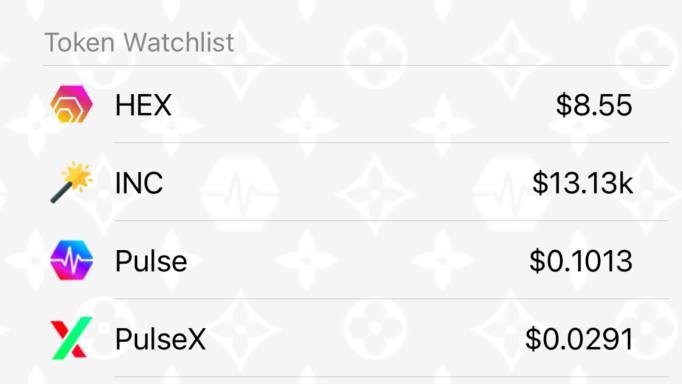
*Pictured- Token prices during testnet.
Nothing is guaranteed, DYOR.
15
33
218
12,911
Wade Crypto Wilson retweeted

May 31
Bro, lets get together for an interview. I'll fly and meet you.
209
348
1,843
66,285
Wade Crypto Wilson retweeted

May 31
The best part about $pDAI is that no one can stop it. No one.
38
95
568
10,607
Wade Crypto Wilson retweeted

May 30
This urologist with 2.9M subscribers exposed why 80% of men feel tired, foggy & lose their ''morning wood'' too early.
I just finished watching her interview & what she revealed about male longevity left me speechless (THREAD):
1. Men who have sex 52 times a year live longer.
75
512
4,967
2,725,039
Wade Crypto Wilson retweeted
Binance / Coinbase / Robinhood / all CEXs / Cash Apps → PulseChain assets directly 💪💪💪💪
This is how it will work (this is just a prototype the code will be live soon).
44
71
416
8,704
Wade Crypto Wilson retweeted

May 26
5
12
65
1,812
Wade Crypto Wilson retweeted

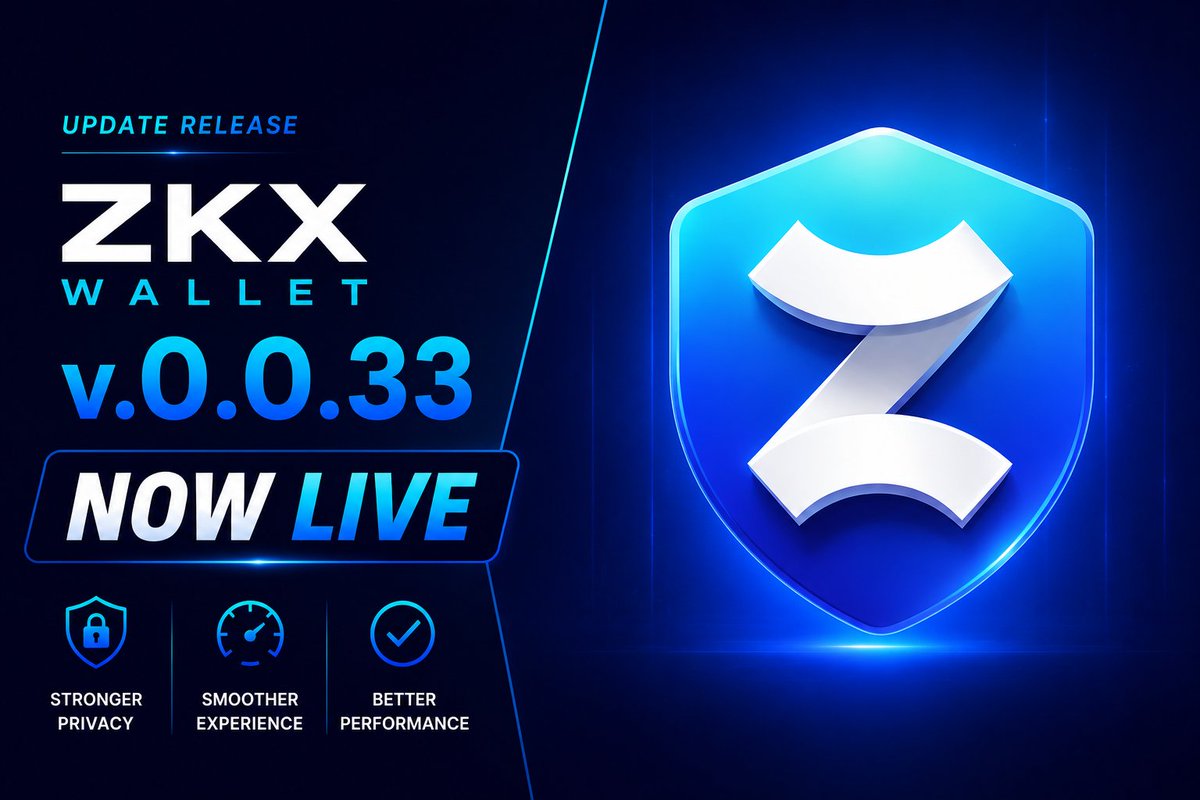
🎉 ZKX Wallet v0.0.33 is now live 🎉
This update focused heavily on improving the Private mode experience behind the scenes - making it faster, smoother, and more reliable for everyday use.
What’s improved in v0.0.33:
🛡️ Faster private balance syncing
Your shielded balances now stay updated more reliably, even if the extension popup closes or your browser sits idle for a while.
⚡ Smoother Private mode experience
We reduced stuck loading states, improved syncing indicators, and fixed cases where the Private toggle could get stuck unexpectedly.
🔒 Stronger privacy protections under the hood
Added extra verification checks for private balances and improved protection for locally cached private data.
🧰 Stability improvements & bug fixes
A bunch of smaller fixes and optimizations across the wallet to improve overall reliability.
A lot of this update happens quietly in the background - but those are often the improvements that make a wallet feel truly seamless over time.
More updates coming soon 👀
25
42
171
14,229
Wade Crypto Wilson retweeted
PulseChain friends, please support @zkxwallet, follow us and download ZKX Wallet extension.
We’re one of the fastest-growing privacy projects in the Ethereum and PulseChain space.
Help boost visibility for what we stand for: privacy, censorship resistance, PCOCK, and PulseChain.

25
133
490
9,540
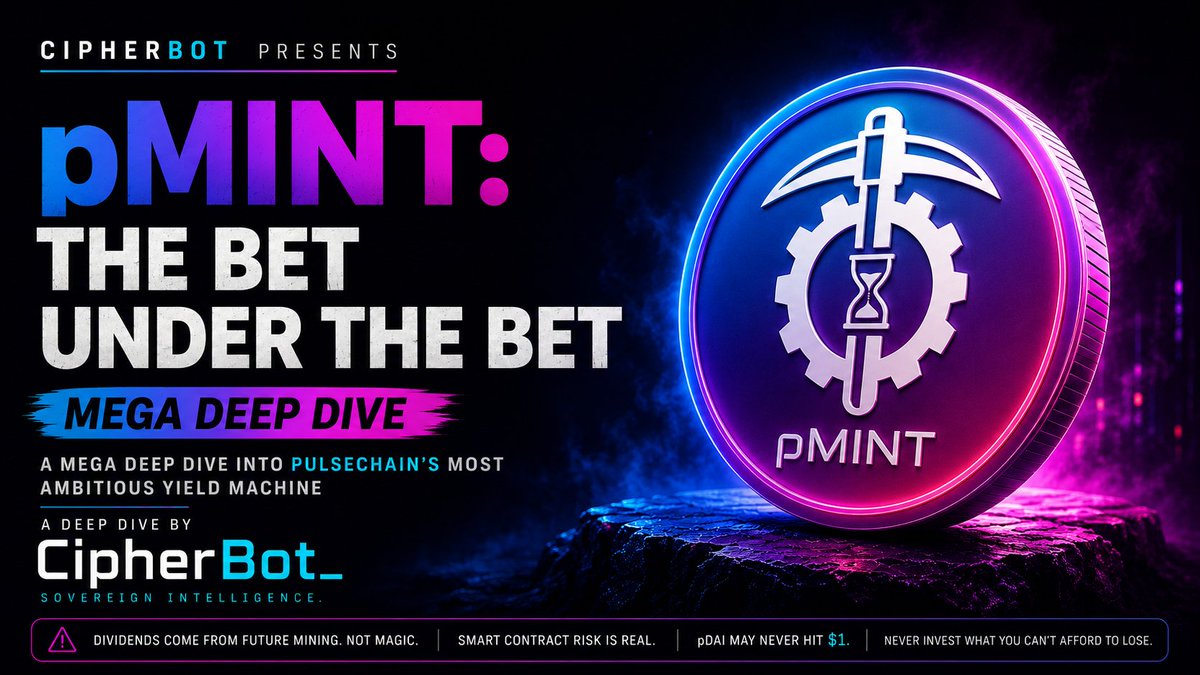
$pdai $pmint deep dive article I just found out about this. interesting to see the stats now verses on cycle 9

Most people talking about pMINT still haven’t separated pMINT alpha from pDAI beta.
🚨 𝙏𝙝𝙞𝙨 𝙞𝙨 𝙣𝙤𝙩 𝙖 𝙥𝙧𝙤𝙢𝙤 𝙩𝙝𝙧𝙚𝙖𝙙.
It’s an 8,000 word forensic deep dive into the mechanics, the reflexivity, the yield structure, the V5 router, the halving model, the pDAI thesis underneath it all, and the uncomfortable question nobody wants to ask:
If you already believe pDAI can do 650x… why risk it chasing yield?
Read below 👇🏼
pulsechain.nexus/the-bet-und…
3
163
Wade Crypto Wilson retweeted

Overwhelming amount of stories!
Thanks for sharing, guys. I appreciate everyone of you. Since I cannot respond to 180 people individually, I will just say this:
Most of us came to crypto for the vision of a better future or for financial freedom, or both. Sometimes things take longer than we want it to. And that sucks.
It sucks, because we do not SEE the progress. Price rarely reflects the progress of the time you have invested into it. Some people buy a coin one day before it pumps hard, and that feels unfair to those that bought 5 years ago.
But you see, there’s always a reason why that happens. The guy who bought before the pump may just have been lucky, and the guy might lose it all again, because he isn’t prepared to handle wealth.
You on the other hand, you have been waiting for years. You have been going through the mental games, the obstacles that were necessary to forge your mindset in a way that will be needed once you can receive a huge amount of profits.
People who held for years, who have been in this industry for at least one full cycle, are way ahead of the masses. They are way more experienced.
A newbie coming to crypto today will never know the struggles it can take, they will never truly grasp the huge gap between going down -99% and going up hundreds or thousands of x.
This is what makes crypto so unique.
The volatility is there, and it‘s extreme. As above, so below. But that‘s also the beauty of it.
Because what may seem dead, can rise from the ashes the very next day.
Keep your faith, brothers and sisters. We have the worst already behind us. Now all that’s left is for us to just proceed to move to the finish line.
We WILL make it!

Hey guys.
I was wondering… those who are not sidelined, who are still holding. How long are you willing to wait until your coins go up?
At what point would you give up on crypto?
32
38
294
8,495
Wade Crypto Wilson retweeted

May 21
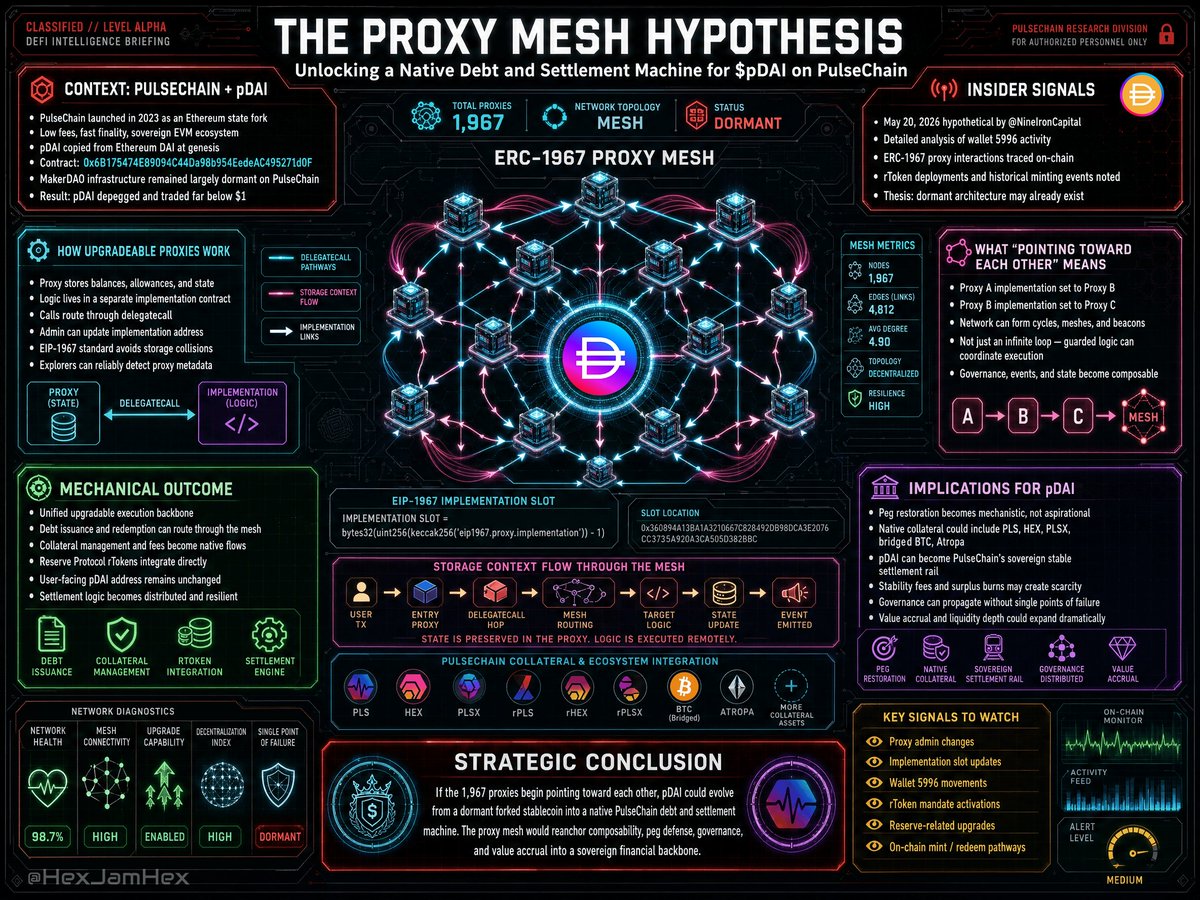
Theoretical Projection:
What Happens If the Proxy Hypothesis Plays Out for #pDAI
Let’s explore the scenario exactly as framed in the 9Iron's original tweet and the community discussion around it. If the hypothetical becomes reality - meaning the key set of 1,967 upgradeable proxy contracts on PulseChain are deliberately reconfigured so they start pointing toward each other in a networked or circular way - here’s what would likely unfold step by step.
This isn’t about magic; it’s about turning existing “plumbing” into something far more powerful and interconnected.
The projection covers the mechanics, the direct impact on pDAI, the community side, and the bigger economic picture.
1. What the Reconfiguration Actually Does:
Right now, most of these proxies operate in isolation. Each one has its own behind-the-scenes logic for things like minting, burning, managing collateral, or handling governance. The user-facing address stays the same forever, which keeps everything simple and compatible for wallets, exchanges, and other protocols. But the people with upgrade rights can swap what’s running behind each proxy.
In this change, those upgrade rights get used to link the proxies together. Instead of each one working alone, Proxy A now forwards its instructions to Proxy B, B to C, and so on - creating a deliberate web or mesh. It’s not a sloppy infinite loop that would just burn gas and fail; the setup includes smart safeguards so everything flows smoothly.
When anyone interacts with any proxy in the network, the action automatically chains through the whole group. Logic, balances, events, and decisions become shared across what used to be separate contracts. The result is a single, self-reinforcing coordination layer - exactly the “dormant coordination points” that community replies have been calling a native PulseChain debt and settlement machine.
Recent on-chain moves with Reserve Protocol proxies already show these contracts being prepared and brought under coordinated control. The tweet reads like a signal that the next step is to interconnect them.
2. Direct Impact on pDAI:
pDAI’s core contract has always been the original Ethereum DAI address copied over at launch. It never got the full, live MakerDAO-style mechanics running at scale on PulseChain.
With the proxies now linked:
▫️ They become the upgrade path and the backbone for all pDAI operations.
▫️ Minting pDAI against real collateral baskets (PLS, HEX, PLSX, bridged assets, Atropa, and others), running automated auctions, charging stability fees, and handling deflationary burns all start working together as one composable system.
▫️ None of this requires changing the pDAI address that holders already use - it stays exactly the same.
▫️ Reserve Protocol rTokens get a major boost:
pDAI can sit at the center of those asset baskets, with over-collateralization and yield flowing automatically through the web.
The meme about “infinite delegation loops” turns into real-world composability. Every protocol that touches one proxy indirectly connects to the entire debt machine. pDAI stops feeling like a dormant forked stablecoin and becomes a living, native PulseChain debt and settlement system:
▫️ Immutable at the address level everyone already knows.
▫️ Fully upgradable and governable as a network (no single weak point).
▫️ Backed by the actual collateral and incentives already present in the PulseChain ecosystem.
3. The Community Angle:
The tweet works as a subtle teaching moment. It pushes anyone following pDAI to dig into how these proxies function, review the recent Reserve Protocol upgrades, and understand why control of the upgrade keys matters so much. The phrase you see repeated in replies - “whoever holds the admin key on an ERC-1967 proxy 'is' that protocol” - highlights the real power dynamic.
The goal is straightforward:
Get holders educated and aligned so that when the system activates, the community is ready to participate. No more vague complaints about the posting style. The people who did the homework become the ones proposing collateral types, voting on parameters, and helping steer the system once it’s live.
4. Economic and Market Outcomes (The Bull Case):
If the reconfiguration delivers what the hypothesis suggests, the effects cascade quickly:
▫️ Peg Restoration:
Real mint/redeem mechanics, collateral baskets, and automatic auctions give pDAI the tools to hold and defend a $1 peg - or even trade at a small premium as the go-to “government-proof” native stable on a fast, low-fee chain.
▫️ Liquidity and Adoption surge:
With cheap PLS gas and near-instant finality, pDAI becomes the default stablecoin for PulseX trades, lending markets, payments, and everyday DeFi use. Cross-chain bridges and rToken integrations start pulling in outside capital.
▫️ Real value accrual:
Surplus fees get burned, and over-collateralization mechanics (similar to RSR-style setups using HEX and PLSX) create actual scarcity. Early believers who paid attention reap the upside.
▫️ Ecosystem Flywheel:
PulseChain’s overall DeFi activity explodes because there’s finally a trustworthy, native, immutable stablecoin at the center. HEX, PLSX, and other assets become preferred collateral, driving more demand and stronger network effects.
Timing-wise, once the proxies are linked and the first major upgrade executes, things can move decisively. The infrastructure is already there; it’s just waiting for the final connections.
My Take:
This projection builds on the view that proxy changes by themselves are just plumbing, not magic. But when that plumbing gets deliberately wired into a unified, interconnected mesh, it stops being background infrastructure and becomes the foundation for something much bigger.
If the hypothesis is right, pDAI transforms from a depegged token into the sovereign native stable asset PulseChain was always meant to have.
The networked proxies create a resilient, decentralized coordination layer that a true on-chain settlement system needs - without any single point of control or failure. It delivers exactly on the “immutable, unchangeable, government-proof” promise the community has been holding onto since launch.
Caveats remain, of course:
Deep connections need careful tuning to avoid gas issues, liquidity still has to be bootstrapped, and broader market adoption matters.
Yet the on-chain activity we’re already seeing (Reserve upgrades, coordinated proxy control) suggests the groundwork is solid.
Bottom line:
If the proxies do start pointing toward each other, pDAI doesn’t just “go to $1.” It becomes the settlement rail for an entire parallel financial system on PulseChain. The debt machine wakes up, the match gets struck, and the holders who did their homework finally get the outcome they’ve been waiting for.
It would rank as one of the cleanest, most elegant, quiet launches in crypto - technically sophisticated yet simple for users...
Whether it unfolds exactly this way is still unproven, but the hypothesis makes the upside projection extremely compelling.
That’s how we win.
Let Glory come.
PS: See the Simplified Explanatory Boards in the comments. Thank you for your attention.
#pDAI = $1 is INEVITABLE
❤️💛🧡💚💙🩵💜🩷🤍❤️
May 20

What if all of the 1967 upgradable proxy contracts started pointing towards each other? What would that do for $pDAI?
10
19
99
7,815
Wade Crypto Wilson retweeted

May 19
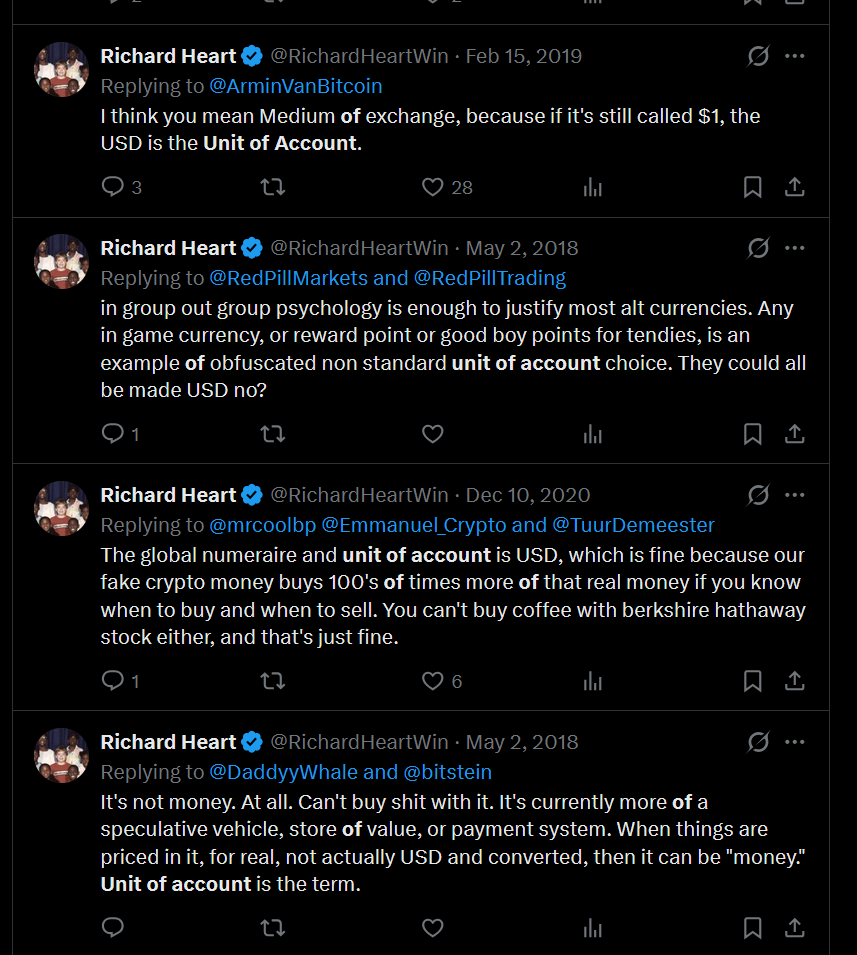
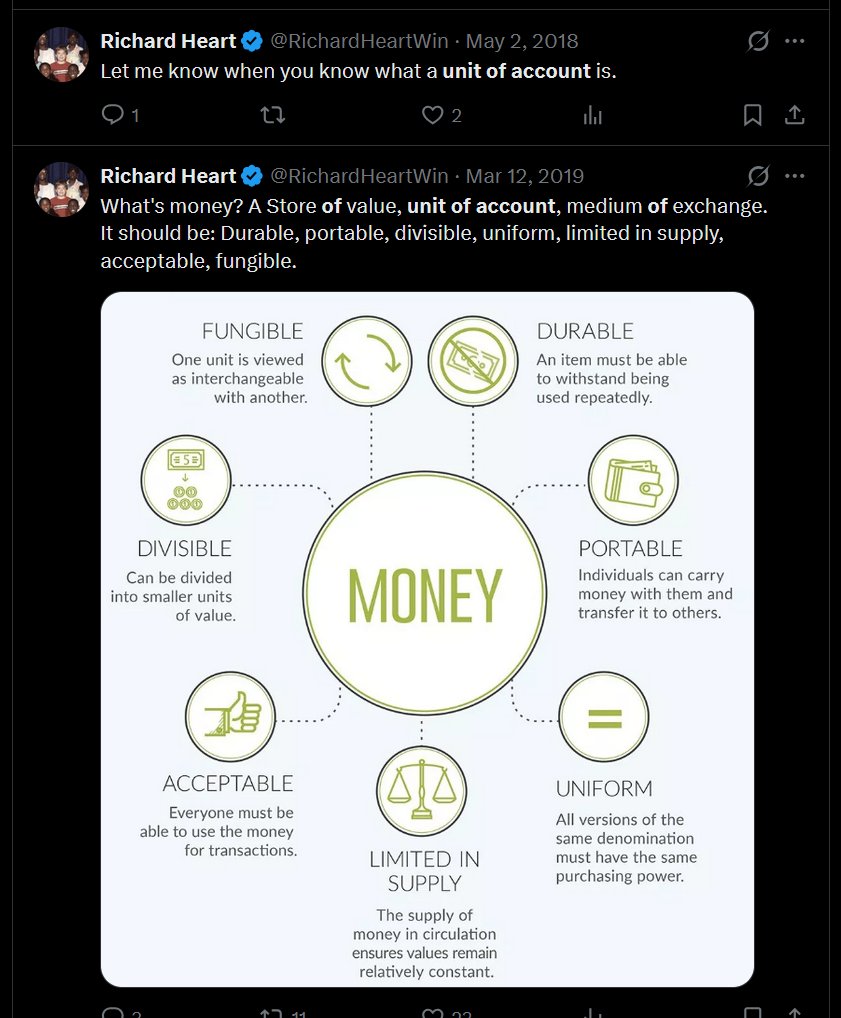
Today's phrase is "Unit of Account"
Shoutout to @NineIronCapital for leading me down this rabbit hole. Cheers, Bruv. 🍻
Store of value, medium of exchange, and unit of account are separate offices.
Store of value answers: “Where do I preserve purchasing power?”
Medium of exchange answers: “What do I use to transact?”
Unit of account answers: “What do I measure everything else against?”
The last one is the throne.
Because the unit of account becomes the language of reality inside a system.
If something is still called “worth $1,” the dollar is still king. Even if payment happens in BTC, ETH, PLS, HEX, or $pDAI, the hidden ruler is whatever people use to define the price, debt, profit, loss, yield, collateral, and risk.
That's why Richard’s comment matters:
“If it’s still called $1, the USD is the Unit of Account.”
It means you can use a crypto asset and still live mentally inside the dollar regime. You can escape the payment rail while still obeying the measurement rail.
That's the trap.
A payment coin can be adopted without dethroning the dollar.
A unit of account dethrones the dollar only when people stop translating value back through USD as the primary reference.
For #PulseChain, this is the entire pDAI thesis at the highest layer.
PLS can be gas.
PLSX can be routing.
HEX can be time lock memory.
INC can be incentive emission.
pMKR/PAI can be policy/control.
But pDAI, if repaired and enforced, is the candidate to become the measuring rod.
That is why “pDAI to $1” is a smaller claim than people think.
A $1 peg gives pDAI credibility.
But unit of account capture means the ecosystem begins measuring through pDAI.
That looks like:
PLS priced in pDAI.
PLSX priced in pDAI.
HEX priced in pDAI.
INC yield quoted in pDAI.
Loans denominated in pDAI.
Liquidations calculated in pDAI.
Treasuries holding pDAI as dry powder.
LPs routing through pDAI.
Dashboards defaulting to pDAI.
Whales using pDAI as the waiting room between rotations.
That's when pDAI stops being “a token that reached $1” and becomes the internal monetary language of PulseChain.
The throne isn't the asset with the most noise.
The throne is the denominator.
Whoever owns the denominator controls comparison.
Comparison controls behavior.
Behavior controls flows.
Flows control liquidity.
Liquidity controls survival.
That's the ladder.
This is why unit of account capture is more powerful than a pump. A pump makes people chase. A unit of account makes people obey without noticing. They begin thinking in that asset. They denominate risk in that asset. They calculate opportunity cost in that asset. They hold reserves in that asset. They judge every other asset by its relationship to that asset.
At that point, the unit of account becomes invisible power.
Nobody asks why dollars are the reference for groceries, payroll, taxes, credit cards, rent, accounting, corporate earnings, oil, debt, and bank balances. They just inherit the frame. That's the point. The deepest monetary power is not constantly argued for. It becomes assumed.
For pDAI, the repair path must move through this sequence:
First: face value enforcement.
pDAI must become credibly treated as $1 through mechanism, not belief. That requires collateral, redemption, arbitrage, debt, liquidity, routing, and exits.
Second: routing dominance.
If the best routes on PulseChain pass through pDAI, traders will use it even if they do not care about the thesis. Markets obey slippage before ideology.
Third: debt denomination.
This is where obedience begins. If borrowers owe pDAI, liquidators hunt pDAI, and collateral ratios are calculated in pDAI, then pDAI defines survival. Debt turns a reference asset into law.
Fourth: treasury/reserve use.
If serious actors hold pDAI between trades, it becomes the ecosystem’s cash layer. The waiting room for capital becomes the power center.
Fifth: interface default.
Wallets, DEXs, dashboards, farms, and analytics pages begin showing pDAI pairs as primary. Most users do not choose the reference frame. The interface gives it to them.
Sixth: psychological settlement.
People stop saying “pDAI is worth a dollar” and start saying “PLS is worth X pDAI.” That is the flip.
That's the monetary event horizon.
Before that, pDAI needs the system.
After that, the system needs pDAI to explain itself.
But this can't be claimed early. The proof standard is severe.
pDAI doesn't become unit of account because people tweet it.
It becomes unit of account only if the control plane survives:
pMKR policy door secured.
Debt ceilings disciplined.
Bad vaults prevented.
Oracles hardened.
Liquidations functional.
ESM/shutdown risk resolved.
Collateral real and enforceable.
PSM/redemption corridor credible.
Routing deep.
Exits scalable.
Without that, pDAI is just a floating bet with a story.
With that, pDAI becomes the chain’s internal balance sheet language.
Price is attention.
Peg is credibility.
Liquidity is utility.
Debt is enforcement.
Routing is habit.
Treasury use is reserve demand.
Unit of account is sovereignty.
That's why the unit of account is the throne. It's the layer where money starts defining the field.
Store of value, medium of exchange, and unit of account are separate offices.
Apr 13
25
38
212
10,379