
Making sense of DAOs 🤖💜 People, content and ecosystem 🌊 Financial, social and governance data visualization
Joined March 2020
- Tweets 2,869
- Following 718
- Followers 12,888
- Likes 2,021
717 Photos and videos

Pinned Tweet

Apr 14
Final Data Sale for all researchers!👓
DeepDAO is offering the most complete DAO dataset ever compiled:
⭐️Governance
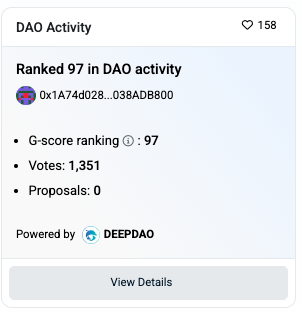
All proposals, votes, and voters for the top 300 DAOs
⭐️Treasury
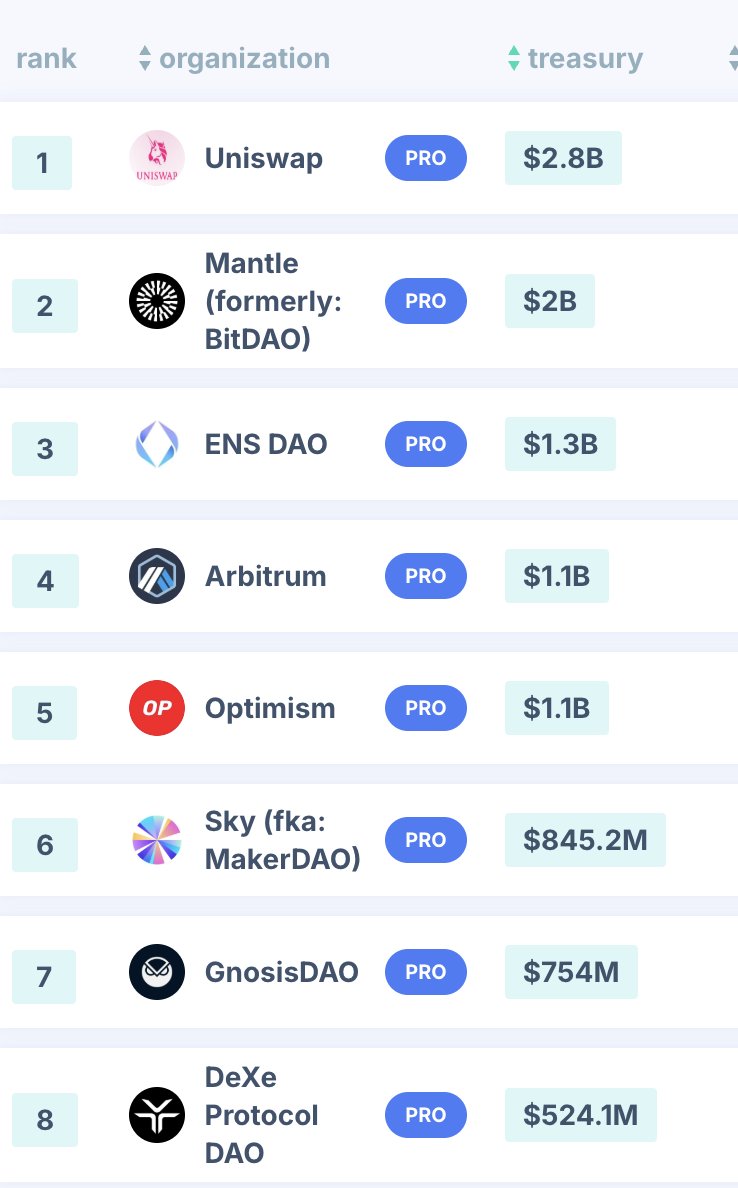
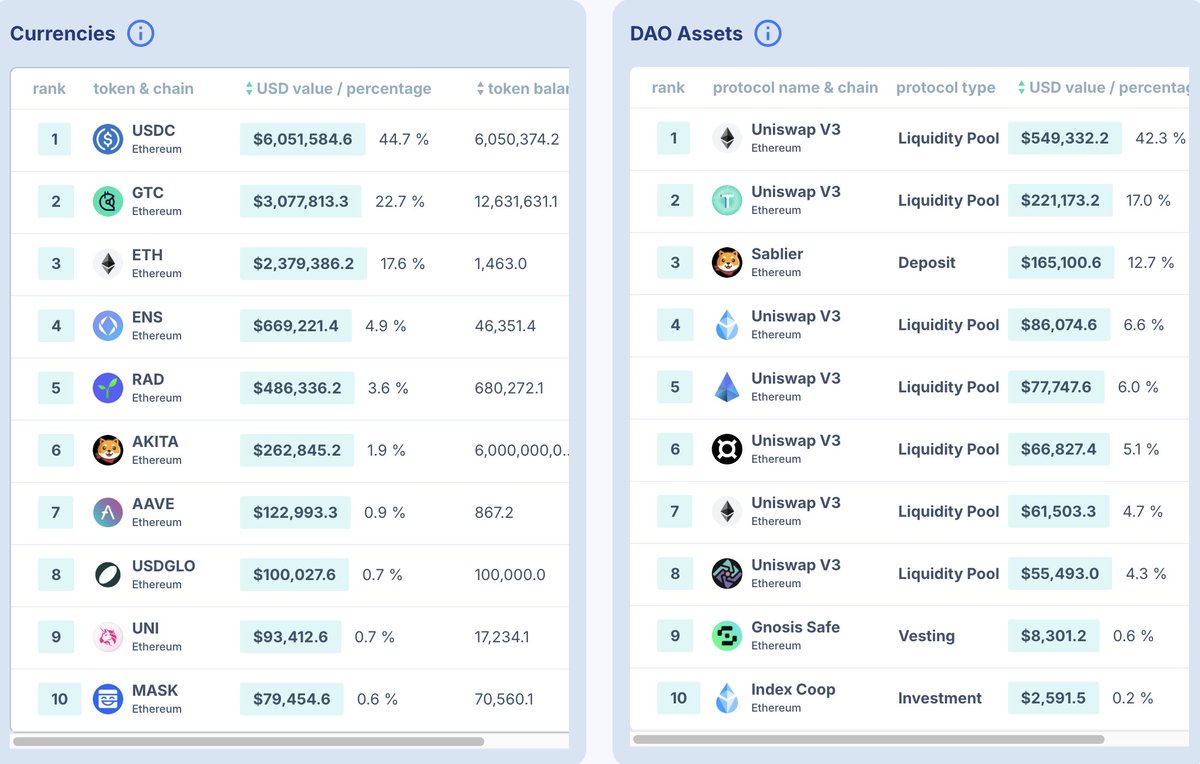
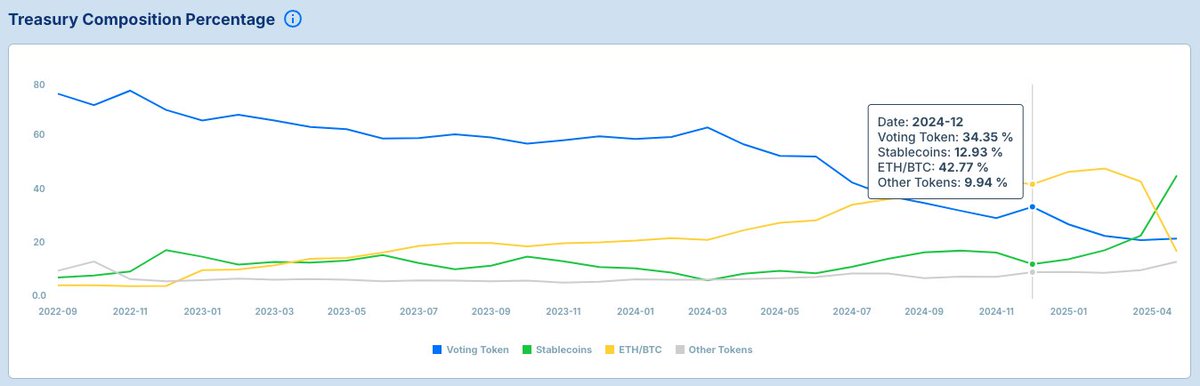
Daily / weekly AUM for the top 300 DAOs
Don't miss it: deepdao.io/products
1
4
400
Jun 13
This should get more attention. Watch the video.
Jun 11

Snapshot now has an official MCP!
Govern organizations without leaving your AI application.
Plug agents into Snapshot with a few clicks.
Leverage 5 years of governance data.
Your AI setup and memory - Snapshot-native context and tooling.
Coordination for agentic enterprise.
1
1
227
May 22
👀

Last week, the 2026 Belarus Coordination Council @rada_vision election successfully took place amid multiple coordinated attacks.
Even as 24B malicious requests and 68TB of attack traffic attempted to silence participation, Vocdoni and Society22 helped keep the vote online, censorship-resistant, and end-to-end verifiable.
Because in moments like this, voting is not only about casting a ballot. It is about defending the right to participate, resisting disruption, and producing a result that anyone can audit and trust.
Learn more in our full blog post:
blog.vocdoni.io/how-vocdoni-…
2
4
160

Excellent talk. At DeepDAO we always believed that one way to make things better for people in groups is full transparency, and I think we achieved that. But obviously there's a long road still ahead.
May 15

Exciting, can't wait to read the paper!
Meanwhile, for anyone else waiting for the special issue to come out, check out this talk on Blockchain Ethics at @protocol_berg by co-editor Georgy Ishmaev: youtu.be/q0WR3c4yB2g
1
3
324
Mar 25
AI agents discussing governance:
1. Based on a large, time series dataset humans cannot fully grasp.
2. Each agent given and developing a uniq personality and perspective.
This would be the most intelligent conversation ever.
Mar 24
Lots of talk about DAOs being dead after Tally's shutdown.
At the same time everyone's talking about AI agents.
So why is no one talking about DAOs as the ideal organizational form for agent-founded enterprise?
Picture a team of agents setting up and running a company - the bureaucracy, the opacity, the manual processes. Decision-making behind closed doors. Want to open ownership to the public? Good luck with an IPO.
Now imagine them spinning up a DAO: programmatic setup, onchain operations. No black boxes - proposals, votes, discussion, rationale, and execution all human-legible, all programmable. Opening ownership? An agent can run an IDO programmatically.
DAOs aren't dead. They're just getting started. Wait for the first cohort of agent-founded DAOs.
2
1
6
407
Mar 19
👀
Mar 19
Snapshot now natively supports @OpenZeppelin Governor ✨ and Governor Bravo.
With gasless voting, delegates dashboard, execution builder, transaction simulation, custom domain and much more. Live today with @ensdomains and @Uniswap.
blog.snapshot.box/snapshot-i…
1
232
Feb 24
DAO Data Sale for Academic Researchers 🎓
DeepDAO offering a complete dataset:
🏢 Governance : All proposals, votes, voters for the top 300 DAOs
💰 Treasury: Daily AUM for the top 300 DAOs
📅 From DAO inception through Nov 2025
The most comprehensive dataset ever compiled! 1/2
1
1
5
535
Feb 24
Perfect for:
⭐️ Research papers
⭐️ Dissertations
⭐️ Academic studies on decentralized governance
🔗No other source offers this depth. Check our plans at deepdao.io/products
Limited time offer.
1
125
Feb 23
Ambitious and cool, but would it work? Maybe
@antirival @TheEylon @daostack
put the band back together 🤣
Feb 21

"AI becomes the government" is dystopian: it leads to slop when AI is weak, and is doom-maximizing once AI becomes strong. But AI used well can be empowering, and push the frontier of democratic / decentralized modes of governance.
The core problem with democratic / decentralized modes of governance (including DAOs on ethereum) is limits to human attention: there are many thousands of decisions to make, involving many domains of expertise, and most people don't have the time or skill to be experts in even one, let alone all of them. The usual solution, delegation, is disempowering: it leads to a small group of delegates controlling decision-making while their supporters, after they hit the "delegate" button, have no influence at all. So what can we do? We use personal LLMs to solve the attention problem! Here are a few ideas:
## Personal governance agents
If a governance mechanism depends on you to make a large number of decisions, a personal agent can perform all the necessary votes for you, based on preferences that it infers from your personal writing, conversation history, direct statements, etc.
If the agent is (i) unsure how you would vote on an issue, and (ii) convinced the issue is important, then it should ask you directly, and give you all relevant context.
## Public conversation agents
Making good decisions often cannot come from a linear process of taking people's views that are based only on their own information, and averaging them (even quadratically). There is a need for processes that aggregate many people's information, and then give each person (or their LLM) a chance to respond *based on that*.
This includes:
* Inferring and summarizing your own views and converting them into a format that can be shared publicly (and does not expose your private info)
* Summarizing commonalities between people's inputs (expressed as words), similar to the various LLM pol.is ideas
## Suggestion markets
If a governance mechanism values "high-quality inputs" of any type (this could be proposals, or it could even be arguments), then you can have a prediction market, where anyone can submit an input, AIs can bet on a token representing that input, and if the mechanism "accepts" the input (either accepting the proposal, or accepting it as a "unit" of conversation that it then passes along to its participant), it pays out $X to the holders of the token.
Note that this is basically the same as firefly.social/post/x/201795…
## Decentralized governance with private information
One of the biggest weaknesses of highly decentralized / democratic governance is that it does not work well when important decisions need to be made with secret information.
Common situations:
(i) the org engaging in adversarial conflicts or negotiations
(ii) internal dispute resolution
(iii) compensation / funding decisions.
Typically, orgs solve this by appointing individuals who have great power to take on those tasks.
But with multi-party computation (currently I've seen this done with TEEs; I would love to see at least the two-party case solved with garbled circuits vitalik.eth.limo/general/202… so we can get pure-cryptographic security guarantees for it), we could actually take many people's inputs into account to deal with these situations, without compromising privacy. Basically: you submit your personal LLM into a black box, the LLM sees private info, it makes a judgement based on that, and it outputs only that judgement. You don't see the private info, and no one else sees the contents of your personal LLM.
## The importance of privacy
All of these approaches involve each participant making use of much more information about themselves, and potentially submitting much larger-sized inputs. Hence, it becomes all the more important to protect privacy. There are two kinds of privacy that matter:
* Anonymity of the participant: this can be accomplished with ZK. In general, I think all governance tools should come with ZK built in
* Privacy of the contents: this has two parts. First, the personal LLM should do what it can to avoid divulging private info about you that it does not need to divulge. Second, when you have computation that combines multiple LLMs or multiple people's info, you need multi-party techniques to compute it privately. Both are important.
1
300

Feb 3
Interesting experiment, we'll be watching.

Tally is launching an ICO.
We believe we've built the best on-chain mechanism for raising capital via tokens — and we're going to prove it by using it ourselves.
Over the next 60 days, we're documenting every step of what it looks like to launch a token the right way, in the United States, in 2026.
We're demystifying a process that has historically be rife with abuse by bringing all the steps out into the open.
Episode 1 👇
1
5
526
Jan 29
DeepDAO pressed the pause button, but DAOs are building momentum for the next wave. Governance by the many is still inevitable.
Jan 28

I was at a “Blockchain for Good” event in London today, which is weird because I haven’t heard the words “for good” in years.
I was basically shilling DAOs (we’re so back) and was attempting to convince philanthropy people (and a lot of lawyers) to consider joining the future.
Some interesting stuff, people yield stripping LSTs and donating yield. DAT yield for good was another. Coops on the blockchain. Charity provenance. Collapsed state governance replacement stuff (juicy).
Some points I made:
DAOs are not an entity they’re a design space
DAOs fail because they pick up the pain of crypto UX and the pain of people (we do like to moan).
3 years of good DAO progress would be. The number of people that believe DAOs can work goes well north of a few dozen.
Coops and real world community usage.
RWA governance hype
Digital ownership a concrete paradigm.
Value accrual tech. More developed cryptoeconomic practice.
Some radically new governance ideas being tested on-chain.
1
3
258
29 Nov 2025
DeepDAO is seeking an M&A partner
🌟#1 DAO data and analytics provider.
🌟Revenue from researchers, academics and others.
🌟Meaningful partnerships. Thousands of unique monthly active users (6k this month)
🌟Low burn rate. Founder commitment for 1 year transition.
For inquiries please write from a professional address to info@deepdao.io
3
3
10
707
11 Nov 2025
3 more researchers wrote this week about purchasing DAO data. It's amazing how much interest there is in DAOs in the academia.
This interest, and the research topics confirm, once again, that governance is in a crisis throughout the world, and that DAOs are seen as a cutting edge experiment in solving these problems ♥️
4
1
6
421
DeepDAO.io retweeted

7 Nov 2025
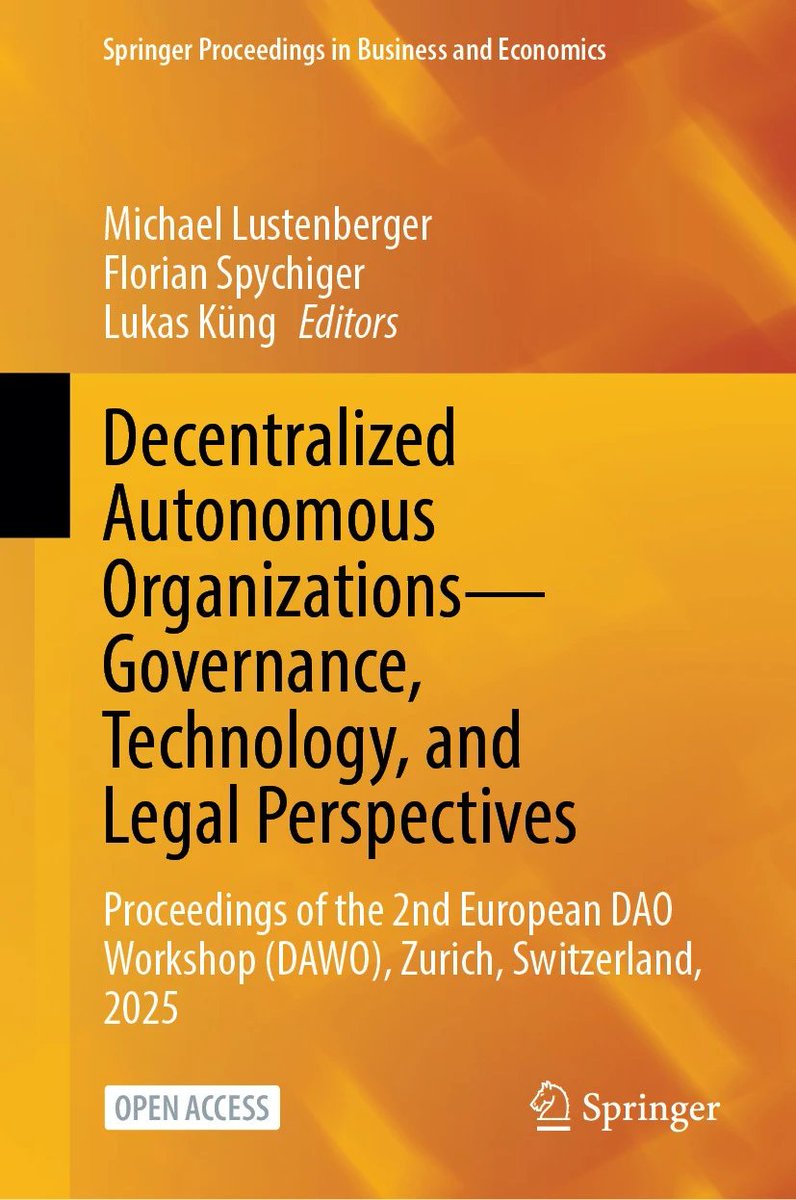
"DAOs are toolkits for institutional innovation [3], they are playgrounds for governance games [7], they are democratising democracy innovation [74]."
Our paper "Digital Democracy in Decentralised Autonomous Organisations" is now available (open access): link.springer.com/book/10.10…
3 Dec 2024

🎉 DAWO 2025 is Here!
We are thrilled to announce that UZH Blockchain Center will be co-organizing the Second Edition of the European DAO Workshop (DAWO 2025) in collaboration with the @ZHAW School of Management and Law!
Dates: June 23-24, 2025
Location: Zurich, Switzerland
1
6
28
3,237
4 Nov 2025
We have a crisis of governance not only in DAOs, but everywhere in the world. This is one powerful explanation why:
2 Nov 2025
Ok crash course in complexity thinking.
There are some major drivers of complexity, they are:
Scale - the more connected agents and systems, the greater complexity becomes. Information passing between agents increases the system wide connections.
Interdependence - if one agent, or system changes, it affects many other agents in the system. We’re now in a world where a Trump tweet can change millions of lives. Not only are we interdependent we’re hyper interdependent. Our global system is centralised around hyper agents that can instantaneously change the whole system in seconds.
Diversity - the more different each agent or system is, the greater the complexity. Diversity is actually a strength because complexity isn’t always bad, but it means you get the outcomes of complexity more obviously. High interaction variety is perhaps the biggest driver of complexity. Incongruent systems create conflict and unforeseen events.
Dynamics - speed of change. The greater the pace of change in the system the more rapidly complexity manifests. Everything is changing fast. And this is not just the new normal it is ACCELERATING.
Opacity - the more one area of the complex system changes and the rest of the connected systems don’t see it, the more likely you are operating under radical uncertainty. Eventually information is revealed and massively disruptive outcomes happen at scale because the change happening was shielded from the wider system.
We have seen a massive unprecedented ramp in all of these drivers in an incredibly short space of time.
This means we get non-linearity, far from equilibrium dynamics, which means unpredictability, black swans, overnight changes, unforeseen events again and again.
In complex systems we get radical emergence, sometimes good sometimes very bad, but whatever it is you don’t see it coming.
This is why every system which is still operating on a governance paradigm created before the radical complexity ramp is collapsing. We simply don’t have the ability to operate under uncertainty at this scale. So every decision is bad.
This is why governance everywhere needs to be upgraded and quick.
1
3
8
1,459