
Joined March 2025
- Tweets 34,765
- Following 281
- Followers 1,816
- Likes 30,257
14,169 Photos and videos









Delta55 retweeted

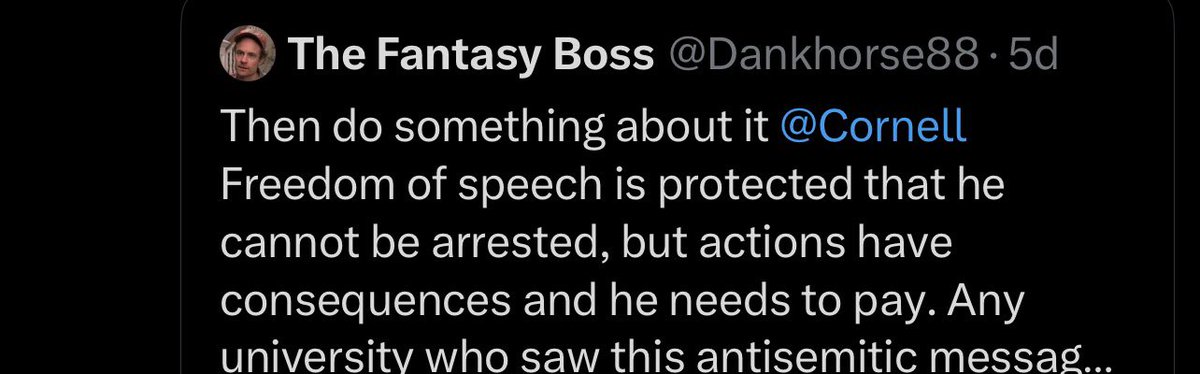
They’re coming for his education, now.
8
1
41
1,608
Delta55 retweeted

I’ve created a givesendgo with 100% of proceeds going to him.
jews are doxxing this man and trying to ruin his career. I cannot let that happen. Link below


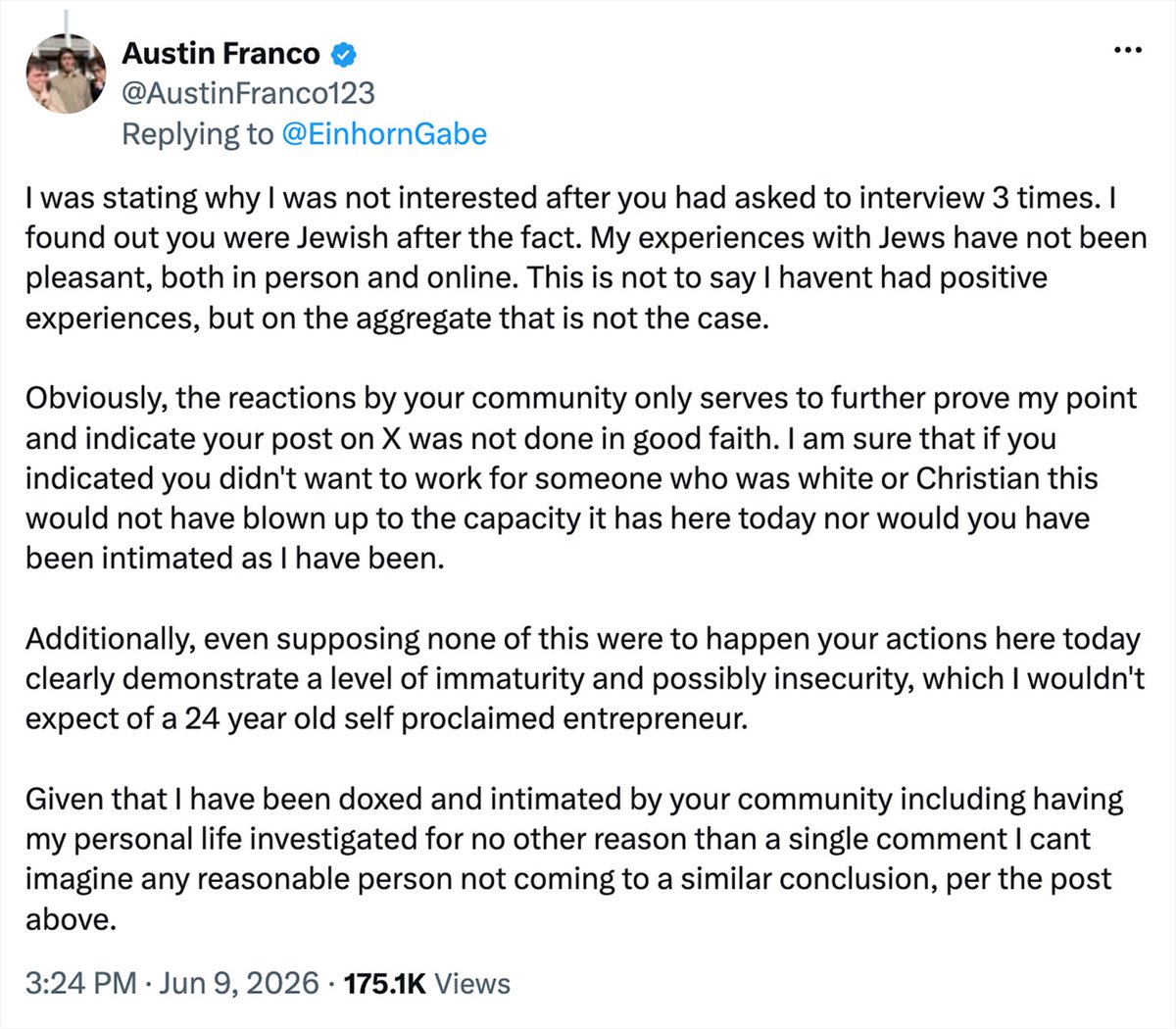
Cornell student Austin Franco was doxxed by Jewish business leaders after explaining that he “didn’t want to work for a Jew,” claiming his experiences with Jews were not “pleasant,” after a NYC startup he had applied to reached out to him three times.
After one of the cofounders, Gabe Einhorn, posted Franco’s reply with his last name blocked out, Franco was quickly identified.
Einhorn said he did not “want to ruin his life,” but wanted to “raise awareness” of antisemitism.
Franco, in a now-deleted post, said that in his personal and professional experiences, Jews were tribalistic and vengeful, and tended to ruin and bully others who opposed them.
Franco stated, “I am sure that if you indicated you didn’t want to work for someone who was White or Christian this would not have blown up…”
Franco claimed that the actions by Einhorn and the Jewish community, posting his reply, doxxing him, and then trying to investigate and uproot his personal life, vindicated his concerns that Jews do not work with others politely.
Follow: @AFpost

68
574
5,656
137,862
Delta55 retweeted

Watermelon Felon - Karmelo Anthony
[FULL SONG]
135
390
2,509
237,123

Delta55 retweeted

Chevron decision says this can't happen. Alphabet agencies have ignored the Chevron decision. Is what it is and if people just let them continue ignoring it they will....
3
15
205
2,194
Delta55 retweeted
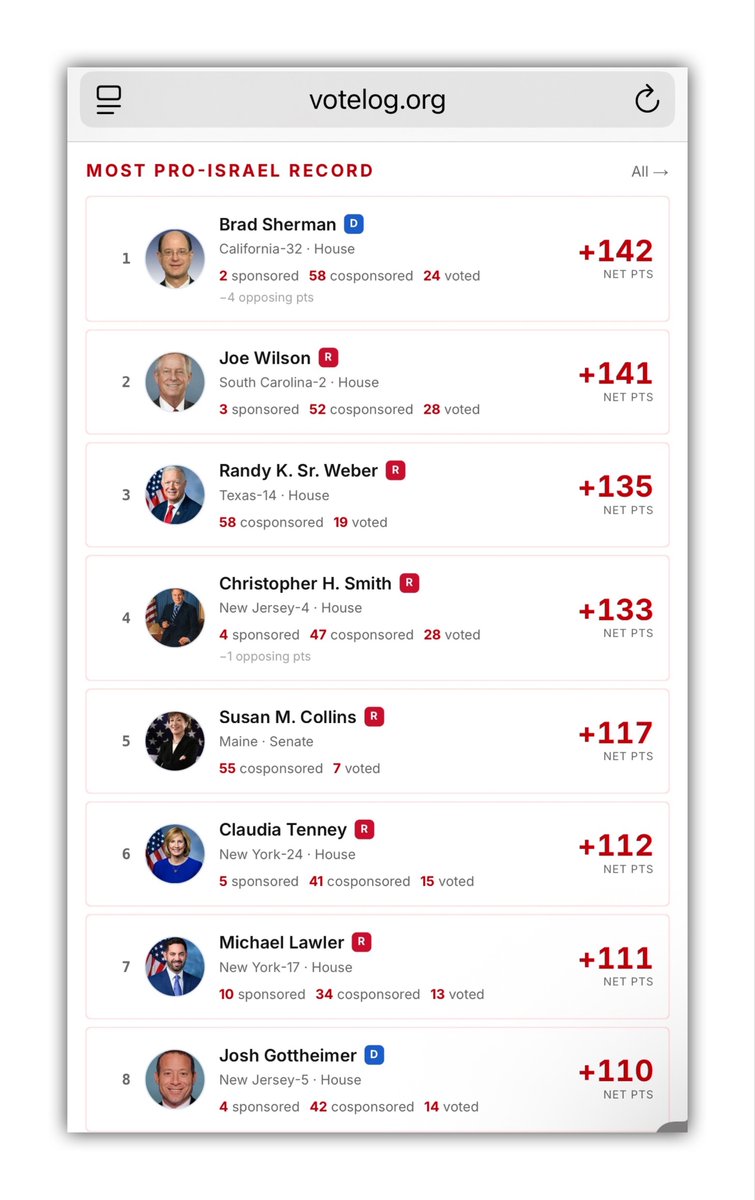
I found a fantastic new website to track Congressional lawmakers’ Israel bills and voting record created by @wallyrashid
Between this website and @TrackAIPAC’s website on the money, we can quickly identify the worst of the worst.
See 2nd post for links.
47
762
1,721
68,220
Delta55 retweeted

Ashkenazis maintain strong influence in narrative-shaping fields like academia, media, Hollywood, and government. When people notice the clear statistical overrepresentation in these areas compared to their small share of the population, the response is swift dismissal. Criticism gets labeled as conspiracy theory or antisemitism right away. This tactic works by framing any pattern recognition as irrational hate rather than data-driven observation. It shifts focus from facts about group outcomes, IQ advantages, networking, and historical strategies to the supposed bigotry of the observer. Public figures, organizations, and commentators trained in these circles repeat the line that noticing equals dangerous myth-making, protecting the status quo without addressing the imbalances.
In academia and media, the main strategies involve gatekeeping and narrative enforcement. Faculty hiring, tenure decisions, and editorial boards often favor in-group preferences that sustain high representation. When outsiders point this out, responses include blacklisting speakers, canceling events, or running hit pieces that paint critics as extremists. Media outlets under significant Ashkenazi leadership amplify stories that equate demographic awareness with violence or Nazism. This creates a chilling effect where honest discussion of influence in curriculum design, news slant, or cultural output gets buried under accusations. The goal is to keep the public from connecting overrepresentation to real effects on policy, education content, and information flow.
Hollywood and government follow similar patterns of control through alliances and pressure. Studios and production companies with heavy Ashkenazi executive presence shape films and shows that promote universalism while avoiding topics that highlight ethnic power dynamics. In government, lobbying groups push for favorable appointments and policies, then denounce scrutiny as dual-loyalty tropes. Noticing here gets dismissed by claiming Jews succeed purely on merit while ignoring coordinated advocacy and exclusion of rivals. Tactics include donor influence on politicians, rapid mobilization of aligned journalists, and cultural campaigns that normalize the dismissal. This maintains access to levers of soft power without open debate on whether such concentration serves host populations fairly.
Laws play a growing role in censoring critical speech. In many Western countries, Ashkenazi-led organizations lobby for expanded hate speech statutes and antisemitism definitions that treat statistical noticing or historical pattern discussion as illegal discrimination. Examples include European laws jailing people for certain writings or the push for online content moderation codes in the US and elsewhere. While full First Amendment protections still limit outright bans in America, private platforms and institutional policies enforce de facto censorship through deplatforming and financial penalties. These legal tools extend the fight by reclassifying uncomfortable truths as threats to public order, forcing critics into self-censorship or fringe spaces.
Overall, these efforts form a multi-layered defense of narrative dominance. Strategies blend social ostracism, economic pressure, institutional capture, and selective legalism to equate pattern recognition with conspiracy thinking. The result keeps most White populations from openly questioning why small-group cohesion yields outsized control in key institutions. This approach succeeds because it exploits host societies' individualism and free-speech traditions while using tribal solidarity internally. It does not require every individual to participate but relies on aligned networks that treat exposure as existential risk, ensuring continued advantages in shaping culture, policy, and public perception.

3
41
99
1,080
Delta55 retweeted

🚨 The Nashville Zoo is asking for the public's help fighting a new 69,000‑sq‑ft data center that could disrupt endangered species’ breeding programs with constant noise, lights, & 24/7 industrial activity.
397K people have already signed the petition.

166
3,991
7,794
62,536

Jun 12
RT @lampshades_2: The Holocaust narrative functions as a supreme moral shield for Jewish ethnic interests in White societies. It positions…
124
Delta55 retweeted

Jun 12
🚨 Intelligence authorization bill - Section 622
“United States-Israel Intelligence Sharing Enhancement.”
THIS MAKES IT ILLEGAL TO STOP SHARING INTELLIGENCE WITH ISRAEL

51
209
438
6,770


Delta55 retweeted

Jun 12
It’s very fashionable on this app to blame all of Americas problems on Women and Boomers… but the reality is this just obfuscates the real jewish influence behind our problems.
It is a kosher playpen you are allowed to play in while Jews continue to wreck your countries. They love that you are divided amongst yourselves while they continue to plunder.
Can you imagine Hitler giving a speech saying, “well if it wasn’t for our old German folks and young woman, we’d be doing great!”
It’s an outrageous thought, and It’s outrageous that these themes continue to be pushed. Yes liberal females and capital hoarding boomers can be a problem, but the problem in it of itself exists as a result from Jewish textbooks, the Jewish stock market, jewish indoctrination centers known as “college” and “Television.”
Why are you trying to take White women’s right to vote before you are focused on taking the Jews’ right to citizenship??
Why are you trying to take boomer wealth, when if we confiscated all ill-gotten jewish wealth in the U.S., we could pay off the national debt?
The truth is, if you took away women’s right to vote, or if you confiscated all of the Boomer Wealth, you would still be blackmailed into endless wars, and plenty more male “Lindsay Grahams” would line up for the all male Congress to serve Israel and the Jews. The new young Jews would still ethnocentrically get together and rig the stock market, and shut White people out of jobs like they are doing now… taking rights from women and boomers would not stop Jeffrey Epstein…
Only a complete extrication of jewish influence from Europe, America, Australia, Canada etc…. can solve the Jewish problem.
The biggest mistake western democracies made in the last three centuries was the emancipation of the Jew, for with it was the beginning of a madness that has yet to be curtailed. Jews “Europeanized” themselves outwardly, but inwardly nothing changed. They still read their demonic Talmud. They still push degeneracy and open borders everywhere. But now they can do it “legitimately and legally.” This has to be reversed.
Jews are not American. Jews are not European. Jews are Jews. They can never be American, and they can never be European.
Get out of the kosher playpen.
Jun 11


68
273
1,623
34,948
Delta55 retweeted

Jun 12
Most Moral Prison Rapists In the World:
Jun 11

Israeli lawyer Ben Marmarelli says Palestinian prisoners he represents beg him not to visit because they're raped each time he is due to meet them.
This is a scene from Al Jazeera's shocking new documentary on Israel's systematic use of rape.
64
827
2,366
39,374

Delta55 retweeted

Jun 11
How accurate are her Top 9 Zionist Types?
😂🤣
66
353
1,374
22,412
Delta55 retweeted

Jun 11
This was Palestinian athlete Moazaz Obayat before and after 9 months of captivity in the prisons of the Zionist regime.
313
5,958
8,428
122,689
Delta55 retweeted

Jun 11
Why assume He didn’t go to Planet Krypton and save Superman’s family?
We don’t make fun of you because Jesus *could not* do it. We make fun of you because Jesus *did not* do it.
The Bible includes the highlights of Jesus’ ministry by his hand-chosen apostles of whom Jesus said, “you also will bear witness, because you have been with me from the beginning.” And these disciples - with Him daily everywhere - do not report Jesus sneaking off to visit the American Indians.
There’s no evidence of Jesus visiting North America. Considering Jesus presence in the Roman Empire left a crater in it that changed the world, I’m pretty sure He’d have left a dent in North America.
The only claim Jesus came to North America was a warlord polygamist with a string of very public, very proven false prophecies.
The problem isn’t our lack of faith. The problem is your faith in a fake Jesus.
8
12
165
1,738
Delta55 retweeted

Jun 10
The interests of the U.S. and Israel are not the same.
That is why Section 622 of the intelligence bill and Section 224 of the defense bill cannot pass.
3
10
25
317
Delta55 retweeted

Cotton wants to Congress to legislate intelligence sharing with Israel? this makes no sense says ex-CIA Paul Pillar. "Israel’s own use of much US intelligence is apt to be contrary to US interests and the interest of peace and security in the Middle East"
responsiblestatecraft.org/us…
13
46
100
2,588
Delta55 retweeted

Jun 11
That's not rooting for Iran, that's adding some context because Fox News won't
18
129
5,393
22,756