
Joined February 2025
- Tweets 1,539
- Following 67
- Followers 1,486
- Likes 1,698
62 Photos and videos








Pinned Tweet

Jun 11
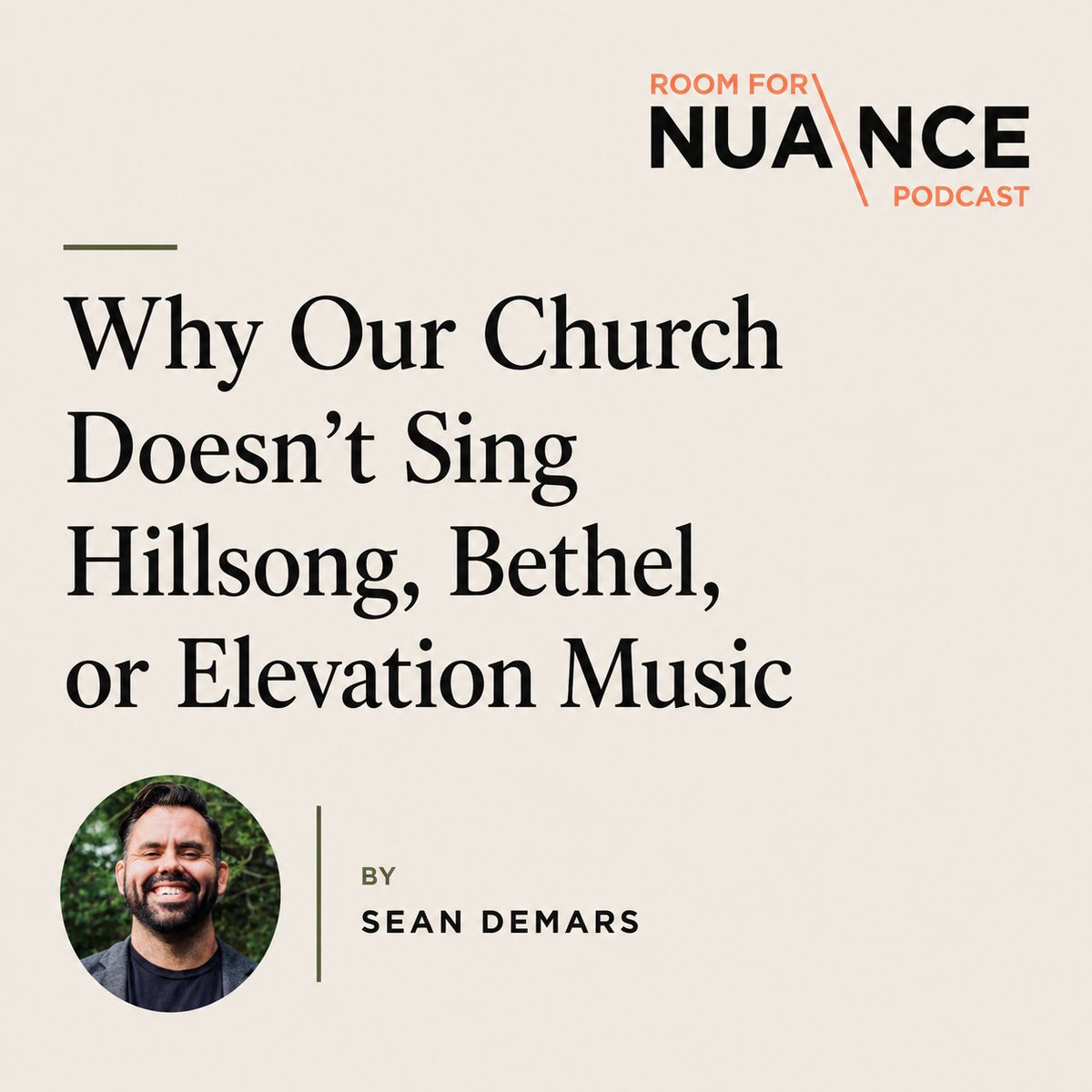
Why Our Church Doesn't Sing Hillsong, Bethel, or Elevation Music
Every few years the debate resurfaces: Should churches sing songs from Hillsong, Bethel, Elevation, and similar ministries?
Some Christians believe the answer is obvious. If a song isn’t theologically wonky, we are free to sing it. Others, however, argue that the source of a song matters just as much as the lyrics. Our church falls into the latter category. Why? Because we believe pastors have a responsibility to think carefully about what they place before God's people in corporate worship.
Here are a few reasons why we’ve chosen not to sing songs from these ministries, and why we would encourage you not to, either.
1. If I Wouldn't Recommend Their Teaching, I Shouldn't Recommend Their Music
Imagine a church member approaching you after the service and saying, "Pastor, I'd like to learn more from Bethel. What books would you recommend?" I'm guessing your answer would be the same as mine: none.
Or suppose another member approached you and said, "I've been listening to Hillsong lately. Are there any sermons you'd point me to?" Hopefully, your response would be the same as mine: "Let me strongly exhort you away from their preaching ministry!”
Most faithful evangelical pastors would answer such questions the same way and without hesitation. We wouldn’t recommend their books, their sermons, their conferences, or any form of their teaching ministries. Which leads me to ask: If we wouldn’t recommend their teaching, why would we recommend their songs? Singing, after all, is a teaching ministry of the church (Col 3:15, Eph 5:18-19).
If we truly believe that ministries such as Bethel and Hillsong are untrustworthy teachers of God's Word, that they promote serious theological errors and unhealthy ministry practices, that they are leading unbelievers astray and true believers into a compromised and weakened walk with the Lord, why would we place their songs in the mouths of the congregation every Sunday?
At this point, many Christians attempt to separate the music from the ministry. "We're not endorsing their teaching," they say. "We're just singing one of their good songs." The problem here, of course, is that every song functions as a recommendation, if not explicitly then implicitly.
When we place a ministry's songs on the lips of our congregation week after week, we communicate (whether intentionally or not) that this is a voice worth listening to. The books we recommend, the conferences we promote, the missionaries we support, and the songs we sing all communicate trust. They all function as endorsements to one degree or another.
Here's a good rule of thumb for thinking through this issue: If I wouldn’t hand a church member one of their books, we probably shouldn’t be singing their songs in corporate worship.
2. People Really Do Follow the Music Back to the Ministry
This concern is not merely theoretical. Many Christians openly testify that they were introduced to Bethel, Hillsong, or Elevation, not through books, conferences, or social media, but through their worship music.
The testimony of Christians who have experienced this progression is remarkably consistent: songs are not merely songs. They often function as gateways. This should not surprise us. "Whoever walks with the wise becomes wise, but the companion of fools will suffer harm" (Prov. 13:20). The voices we repeatedly invite into our lives inevitably shape us.
In fact, Bethel and Hillsong understand this reality themselves. Their worship leaders are often encouraged to think of themselves as the tip of the missionary spear, introducing people to the broader ministry through music.
The point is simple: if we believe a ministry teaches serious error, we should not be surprised when our people eventually follow the trail we helped them discover.
3. When We Sing Their Songs, We Are Financially Supporting Their Ministries
Before making this point, it's important to acknowledge that many Christians simply don't know how music licensing works. Why would they? Therefore, if you've never considered this issue before, don't feel bad. I certainly don't assume bad motives on the part of churches that sing these songs. But I do think it's important to understand how the system works so that we can make informed and discerning decisions.
Most churches report and license their worship music through CCLI and similar licensing agreements. Every time we sing, report, stream, reproduce, or distribute copyrighted songs, royalties (i.e. money) flow back to the rights holders. In other words, our churches are not merely using these songs for worship, we are actively funding the ministries that produced them.
This raises a simple question: Should our churches financially support ministries we believe teach serious doctrinal error?
Imagine discovering that your church was sending monthly support checks to a ministry that promoted prosperity theology or some other serious theological error. Most pastors would object immediately, even if it were only a small amount. Yet every time a church sings songs from these ministries, money flows from our offerings to their coffers. That’s a problem.
The amounts may be small and the mechanism may be indirect, but the principle remains the same. Money is a form of partnership. Paul thanked the Philippians for their "partnership in the gospel" because of their financial support, after all (Phil. 1:5). Financial support is never merely financial; it’s an expression of shared priorities and mission. Therefore, churches should think carefully before using congregational worship as a means of financially supporting ministries they would never otherwise endorse.
4. Pastors Must Not Bind Consciences Without Biblical Warrant
Every Sunday morning pastors call God's people to participate in corporate worship. We ask them to pray, confess, sing, and listen to God's Word. In doing so, we are binding consciences. We are not merely suggesting that our people participate in these actions; we are requiring it according to the clear teaching of Scripture. That is a tremendous and weighty responsibility.
Crucially, pastors must understand that they possess no authority to require God's people to do anything apart from God's Word. Every element of a worship service should pass a simple test: Can I confidently stand before God and his people knowing that what I am asking them to do is biblical?
I can confidently ask believers to sing psalms, hymns, and spiritual songs. I can confidently ask them to praise and petition the Lord in prayer. I can confidently ask them to confess biblical truth with one heart and mind. What I cannot confidently do is require them to sing songs produced by ministries I believe are teaching serious theological error.
The question is not whether every lyric we sing is orthodox. The question is whether Scripture authorizes me, the pastor, to place my congregation in the position of having to separate sound lyrics from an unsound ministry in the first place. I do not believe it does.
The good news is that we don’t have to put ourselves in such a position. We live in an age of embarrassing musical riches. The church has inherited centuries of faithful hymnody, and with each passing year, biblically sound ministries produce more and more new songs that are both beautiful and biblical. There is no shortage of excellent music for God's people to sing. Therefore, we are not forced to choose between singing Bethel, Hillsong, or Elevation and mediocre worship music. We have thousands upon thousands of beautiful and biblical songs at our disposal—songs produced by faithful Christians and faithful churches that do not require us to compromise our theological and pastoral convictions in the process.
5. Most of Their Songs Are Designed for Performance, Not Congregational Singing
One final concern that is often overlooked: most of these songs are not conducive to congregational singing.
To be clear, I am not saying every Hillsong, Bethel, or Elevation song is unsingable. Some are quite accessible. But taken as a whole, these ministries produce music in an environment, and with an aim, that is fundamentally different from God’s design for the local church: performance.
Their songs are often written by professional musicians, performed by highly trained vocalists, accompanied by full bands, and designed for large-scale worship events, recordings, and broadcasts. As a result, many of them feature wide vocal ranges, difficult melodies, extended instrumental sections, and arrangements that depend heavily on the skill of the musicians leading them, i.e. the professionals on stage.
But congregational worship is not a concert. Paul tells believers to “address one another through psalms and hymns and spiritual songs" (Eph. 5:19). Singing is one of the primary ways the church teaches, encourages, and builds up the body. For that reason, pastors and worship leaders should prioritize songs that ordinary Christians can sing confidently and joyfully. The best worship songs for Sunday morning enable an entire congregation to lift their voices together.
When a church fills its worship services with songs that only talented musicians can lead effectively, the congregation gradually becomes an audience rather than an instrument of worship. We should strive for something better by choosing songs that invite the whole church to sing together.
Answering the Most Common Objection
There are many objections to the arguments I’ve laid out in this article, but the most common one I hear sounds like this: "What about Horatio Spafford? Didn’t he go on to compromise the gospel in some very disturbing ways later in life? If we can sing It Is Well, why can't we sing Bethel, Hillsong, or Elevation songs?" The answer is simple: these situations are not comparable.
Virtually nobody sings It Is Well With My Soul and then goes home to investigate Horatio Spafford's theological views. Nobody subscribes to the Horatio Spafford podcast. Nobody attends the annual Horatio Spafford conference to hear him preach. Nobody buys Horatio Spafford bible study materials. Nobody pays royalties in support of Horatio Spafford Ministries.
The influence pipeline for Horatio Spafford doesn’t exist. The same, sadly, can’t be said of Bethel, Hillsong, and Elevation Music. These are ministries with influential platforms, active teachers, thriving conferences, massive publishing arms, and strong financial structures. Their music functions as a front door into the larger ministry. The same cannot be said of the long dead hymn authors of yesteryear.
Conclusion
Some readers will see these arguments and assume I am advocating a kind of one-drop purity test for all worship music. “If a song contains even the slightest theological imperfection, throw it out! If a songwriter has ever been wrong about anything, ban the song!”
Nothing could be further from the truth.
There’s no such thing as a perfect song or a flawless hymnbook. If we examined every song with sufficient scrutiny, we would likely find phrases we would word differently, emphases we would adjust, or theological nuances we would wish were clearer.
The issue is not whether a song, or the ministry that produced the song, is utterly free of theological blemishes. The issue is whether we should knowingly and repeatedly platform, promote, and financially support ministries that teach serious and persistent doctrinal error. A drop of dirt in a glass of water is one thing. Discovering that the well itself is contaminated is another. I am not arguing that every song must pass an impossible standard of theological perfection. I am arguing that pastors and worship leaders should exercise wisdom when choosing which wells they draw from week after week.
All I am urging pastors and worship leaders to do is “test everything; hold fast what is good" (1 Thess. 5:21). Don’t just test the songs, test the ministries behind them. And where serious error exists, choose music from the vast treasury of faithful songs God has already given His church.
----------------------------
P.S. I chose to publish this on socials rather than through traditional media source so it can be shared more easily without external link/algorithm issues.
16
17
83
7,318

Sean DeMars retweeted

1
2
267
Jun 13
Praise the Lord.
Jun 12

JUST IN: 57 Planned Parenthood abortion facilities across 20 states have CLOSED since January 2025 due to federal funding cuts
Defund Planned Parenthood permanently!
2
14
1,140
Jun 12
Posting here so hopefully I don't have to keep answering the same question.
2
22
1,955
Jun 12
ICYMI
Jun 11

Why Our Church Doesn't Sing Hillsong, Bethel, or Elevation Music
Every few years the debate resurfaces: Should churches sing songs from Hillsong, Bethel, Elevation, and similar ministries?
Some Christians believe the answer is obvious. If a song isn’t theologically wonky, we are free to sing it. Others, however, argue that the source of a song matters just as much as the lyrics. Our church falls into the latter category. Why? Because we believe pastors have a responsibility to think carefully about what they place before God's people in corporate worship.
Here are a few reasons why we’ve chosen not to sing songs from these ministries, and why we would encourage you not to, either.
1. If I Wouldn't Recommend Their Teaching, I Shouldn't Recommend Their Music
Imagine a church member approaching you after the service and saying, "Pastor, I'd like to learn more from Bethel. What books would you recommend?" I'm guessing your answer would be the same as mine: none.
Or suppose another member approached you and said, "I've been listening to Hillsong lately. Are there any sermons you'd point me to?" Hopefully, your response would be the same as mine: "Let me strongly exhort you away from their preaching ministry!”
Most faithful evangelical pastors would answer such questions the same way and without hesitation. We wouldn’t recommend their books, their sermons, their conferences, or any form of their teaching ministries. Which leads me to ask: If we wouldn’t recommend their teaching, why would we recommend their songs? Singing, after all, is a teaching ministry of the church (Col 3:15, Eph 5:18-19).
If we truly believe that ministries such as Bethel and Hillsong are untrustworthy teachers of God's Word, that they promote serious theological errors and unhealthy ministry practices, that they are leading unbelievers astray and true believers into a compromised and weakened walk with the Lord, why would we place their songs in the mouths of the congregation every Sunday?
At this point, many Christians attempt to separate the music from the ministry. "We're not endorsing their teaching," they say. "We're just singing one of their good songs." The problem here, of course, is that every song functions as a recommendation, if not explicitly then implicitly.
When we place a ministry's songs on the lips of our congregation week after week, we communicate (whether intentionally or not) that this is a voice worth listening to. The books we recommend, the conferences we promote, the missionaries we support, and the songs we sing all communicate trust. They all function as endorsements to one degree or another.
Here's a good rule of thumb for thinking through this issue: If I wouldn’t hand a church member one of their books, we probably shouldn’t be singing their songs in corporate worship.
2. People Really Do Follow the Music Back to the Ministry
This concern is not merely theoretical. Many Christians openly testify that they were introduced to Bethel, Hillsong, or Elevation, not through books, conferences, or social media, but through their worship music.
The testimony of Christians who have experienced this progression is remarkably consistent: songs are not merely songs. They often function as gateways. This should not surprise us. "Whoever walks with the wise becomes wise, but the companion of fools will suffer harm" (Prov. 13:20). The voices we repeatedly invite into our lives inevitably shape us.
In fact, Bethel and Hillsong understand this reality themselves. Their worship leaders are often encouraged to think of themselves as the tip of the missionary spear, introducing people to the broader ministry through music.
The point is simple: if we believe a ministry teaches serious error, we should not be surprised when our people eventually follow the trail we helped them discover.
3. When We Sing Their Songs, We Are Financially Supporting Their Ministries
Before making this point, it's important to acknowledge that many Christians simply don't know how music licensing works. Why would they? Therefore, if you've never considered this issue before, don't feel bad. I certainly don't assume bad motives on the part of churches that sing these songs. But I do think it's important to understand how the system works so that we can make informed and discerning decisions.
Most churches report and license their worship music through CCLI and similar licensing agreements. Every time we sing, report, stream, reproduce, or distribute copyrighted songs, royalties (i.e. money) flow back to the rights holders. In other words, our churches are not merely using these songs for worship, we are actively funding the ministries that produced them.
This raises a simple question: Should our churches financially support ministries we believe teach serious doctrinal error?
Imagine discovering that your church was sending monthly support checks to a ministry that promoted prosperity theology or some other serious theological error. Most pastors would object immediately, even if it were only a small amount. Yet every time a church sings songs from these ministries, money flows from our offerings to their coffers. That’s a problem.
The amounts may be small and the mechanism may be indirect, but the principle remains the same. Money is a form of partnership. Paul thanked the Philippians for their "partnership in the gospel" because of their financial support, after all (Phil. 1:5). Financial support is never merely financial; it’s an expression of shared priorities and mission. Therefore, churches should think carefully before using congregational worship as a means of financially supporting ministries they would never otherwise endorse.
4. Pastors Must Not Bind Consciences Without Biblical Warrant
Every Sunday morning pastors call God's people to participate in corporate worship. We ask them to pray, confess, sing, and listen to God's Word. In doing so, we are binding consciences. We are not merely suggesting that our people participate in these actions; we are requiring it according to the clear teaching of Scripture. That is a tremendous and weighty responsibility.
Crucially, pastors must understand that they possess no authority to require God's people to do anything apart from God's Word. Every element of a worship service should pass a simple test: Can I confidently stand before God and his people knowing that what I am asking them to do is biblical?
I can confidently ask believers to sing psalms, hymns, and spiritual songs. I can confidently ask them to praise and petition the Lord in prayer. I can confidently ask them to confess biblical truth with one heart and mind. What I cannot confidently do is require them to sing songs produced by ministries I believe are teaching serious theological error.
The question is not whether every lyric we sing is orthodox. The question is whether Scripture authorizes me, the pastor, to place my congregation in the position of having to separate sound lyrics from an unsound ministry in the first place. I do not believe it does.
The good news is that we don’t have to put ourselves in such a position. We live in an age of embarrassing musical riches. The church has inherited centuries of faithful hymnody, and with each passing year, biblically sound ministries produce more and more new songs that are both beautiful and biblical. There is no shortage of excellent music for God's people to sing. Therefore, we are not forced to choose between singing Bethel, Hillsong, or Elevation and mediocre worship music. We have thousands upon thousands of beautiful and biblical songs at our disposal—songs produced by faithful Christians and faithful churches that do not require us to compromise our theological and pastoral convictions in the process.
5. Most of Their Songs Are Designed for Performance, Not Congregational Singing
One final concern that is often overlooked: most of these songs are not conducive to congregational singing.
To be clear, I am not saying every Hillsong, Bethel, or Elevation song is unsingable. Some are quite accessible. But taken as a whole, these ministries produce music in an environment, and with an aim, that is fundamentally different from God’s design for the local church: performance.
Their songs are often written by professional musicians, performed by highly trained vocalists, accompanied by full bands, and designed for large-scale worship events, recordings, and broadcasts. As a result, many of them feature wide vocal ranges, difficult melodies, extended instrumental sections, and arrangements that depend heavily on the skill of the musicians leading them, i.e. the professionals on stage.
But congregational worship is not a concert. Paul tells believers to “address one another through psalms and hymns and spiritual songs" (Eph. 5:19). Singing is one of the primary ways the church teaches, encourages, and builds up the body. For that reason, pastors and worship leaders should prioritize songs that ordinary Christians can sing confidently and joyfully. The best worship songs for Sunday morning enable an entire congregation to lift their voices together.
When a church fills its worship services with songs that only talented musicians can lead effectively, the congregation gradually becomes an audience rather than an instrument of worship. We should strive for something better by choosing songs that invite the whole church to sing together.
Answering the Most Common Objection
There are many objections to the arguments I’ve laid out in this article, but the most common one I hear sounds like this: "What about Horatio Spafford? Didn’t he go on to compromise the gospel in some very disturbing ways later in life? If we can sing It Is Well, why can't we sing Bethel, Hillsong, or Elevation songs?" The answer is simple: these situations are not comparable.
Virtually nobody sings It Is Well With My Soul and then goes home to investigate Horatio Spafford's theological views. Nobody subscribes to the Horatio Spafford podcast. Nobody attends the annual Horatio Spafford conference to hear him preach. Nobody buys Horatio Spafford bible study materials. Nobody pays royalties in support of Horatio Spafford Ministries.
The influence pipeline for Horatio Spafford doesn’t exist. The same, sadly, can’t be said of Bethel, Hillsong, and Elevation Music. These are ministries with influential platforms, active teachers, thriving conferences, massive publishing arms, and strong financial structures. Their music functions as a front door into the larger ministry. The same cannot be said of the long dead hymn authors of yesteryear.
Conclusion
Some readers will see these arguments and assume I am advocating a kind of one-drop purity test for all worship music. “If a song contains even the slightest theological imperfection, throw it out! If a songwriter has ever been wrong about anything, ban the song!”
Nothing could be further from the truth.
There’s no such thing as a perfect song or a flawless hymnbook. If we examined every song with sufficient scrutiny, we would likely find phrases we would word differently, emphases we would adjust, or theological nuances we would wish were clearer.
The issue is not whether a song, or the ministry that produced the song, is utterly free of theological blemishes. The issue is whether we should knowingly and repeatedly platform, promote, and financially support ministries that teach serious and persistent doctrinal error. A drop of dirt in a glass of water is one thing. Discovering that the well itself is contaminated is another. I am not arguing that every song must pass an impossible standard of theological perfection. I am arguing that pastors and worship leaders should exercise wisdom when choosing which wells they draw from week after week.
All I am urging pastors and worship leaders to do is “test everything; hold fast what is good" (1 Thess. 5:21). Don’t just test the songs, test the ministries behind them. And where serious error exists, choose music from the vast treasury of faithful songs God has already given His church.
----------------------------
P.S. I chose to publish this on socials rather than through traditional media source so it can be shared more easily without external link/algorithm issues.
11
1,269
Jun 11
The algorithm rewards controversy.
Jesus Rewards Faithfulness
Choose wisely.
1
2
71
3,207
Sean DeMars retweeted
1
2
419
Sean DeMars retweeted

✅@WillyRice elected as SBC president
✅@albertmohler Truth & Unity Amendment received 75% support
✅ Resolution 9 on Pastor/Elder/Overseer approved overwhelmingly
What an encouraging SBC meeting!
Praise the Lord.
#SBC26
1
12
151
4,287
Jun 10
Even the prayer for God’s grace is preceded by God’s grace.
- Michael Horton
1
2
26
1,033
Jun 10
A word to aspiring Christian authors:
There are about 340 million people in America.
Roughly 60–65% identify as Christians. Let's call it 210 million (a fairly generous estimate).
About a quarter of those would identify as evangelicals. Now we're down to roughly 50 million.
How many of THOSE are meaningfully interested in Reformed theology related stuff? Maybe 10–20%? Let's be generous and say 10 million.
Now, how many of THOSE regularly read Christian books? Maybe half? Now we're down to 5 million.
Here's where things get really depressing: The average reader isn't waiting around for your book. Every year, hundreds of thousands of new books get published. Thousands upon thousands of them are Christian books. Every one of them is competing for the same finite resource: attention.
Your book isn't competing with ten other books. It's competing with...
-Every unread book already sitting on someone's shelf.
-Every podcast they've downloaded but haven't listened to.
-Every sermon they've been meaning to get around to.
-Every article they've bookmarked but never read.
-Every YouTube video in their feed.
-Every Netflix series they haven't finished.
-Every audiobook they bought during a sale and forgot about.
How many of those 5 million readers will ever even hear that your book exists?
Most books sell less than 1,000 copies. Not 100,000. Not 10,000. ONE THOUSAND.
Among those who do buy books, many never read the books they buy. Many who start them never finish them.
Where am I going with this? Simple: One of the most liberating realizations for an author is discovering how small your audience really is.
So write what you genuinely believe will glorify God and build up His church, and be content with however far the winds of providence cause your content to travel.
10
8
79
5,785
Jun 10
Don't forget to sign up. Staff, leaders, and volunteers are all welcome to come and consider what God's word has to say about faithful worship.
eventbrite.com/e/southeast-w…
2
878
Sean DeMars retweeted

Jun 10
I’m thankful for the overwhelming support to move ahead so that we can vote on the Truth and Unity Amendment tomorrow morning. Plan to be there by 8am to vote for the amendment. Let’s get this thing done. Please be in the room early—ready to vote—so we can get this done.
19
61
633
49,435
Jun 10
Correct.
Jun 9

Christian brothers and sisters, stop tolerating wicked speech and behavior from your favorite influencer.
"But we NEED him to help us WIN"
This is worldly thinking.
"Do not be misled. Bad company corrupts good character." - 1 Cor. 15:33
1
18
2,624
Jun 9
Kevin is a faithful pastor, father, husband, theologian, and Christian. It doesn't get much more masculine than that. Posts like this (and the comments in support of it) are way more of a threat to biblical masculinity than someone's physique.
Oh, and I've read the book and given it to young men in my church. You should definitely buy a copy.


41
10
205
31,817
Sean DeMars retweeted

Jun 9
I like reading Calvin's commentaries, not because I think he's always right but because his perspective is completely independent of modern categories of liberalism, conservatism, wokeness, feminism, etc.
13
1
116
7,099
Jun 9
FUEGO
Jun 9

𝗣𝗿𝗼𝗽𝗵𝗲𝘁: “Behold, something greater than Jonah is here” (Matt 12:41).
𝗣𝗿𝗶𝗲𝘀𝘁: “But I say to you that something greater than the temple is here” (Matt 12:6).
𝗞𝗶𝗻𝗴: “Behold, something greater than Solomon is here” (Matt 12:42).
3
1,793
Jun 9
Pure gold.

1
4
1,871
Jun 9
Pastors need continuing education.
1
5
968