
Joined June 2020
- Tweets 6,720
- Following 98
- Followers 3,527
- Likes 2,953
488 Photos and videos












Pinned Tweet

28 Sep 2021
Development Economics X is research on global inequalities in the present and in history with the future of development economics. Featuring .@KwekuOA
21
23

Development Economics X retweeted
A great homage to Ghana sports culture.
Credit: Elorm Paul Senah
H/T .@FOXSoccer

1
10
60
796
Development Economics X retweeted
Great question. What's that accent, and why does it sound so different from how many Ghanaians sound today?
Well, that's called a British-influenced Received Pronounciation (RP)-style accent, which was common among the early-generation colonial-era Gold Coast "intelligentsia" trained in British-style schools or the UK.
Over time, there was a broader evolution of Ghanaian English over generations toward a more localized variety shaped by Akan, Ewe, Ga, Dagbani, Nzema and other indigenous phonologies (e.g. different vowel qualities like the "strut" vowel, stress patterns and rhythms.)
(In Ghanaian English, the strut vowel (found in words like how Ghanaians pronounce words like "cut", "love", "come", and "strut") is characteristically pronounced as an open, central vowel, similar to the /a/ sound (or sometimes an /ɔ/ sound)).
The expanded education, combined with the local teachers, and the reduced direct British influence all led to the natural emergence of distinct Ghanaian English varieties over time.
The old accent was tied to a tiny, colonial-era elite in a time where formal education was extremely scarce; its "disappearance" reflects Ghana's success in educating far more people over time.
7
28
2,402
RT @KwekuOA: Yes. All that is also mostly why AI research had to be industrial in scope to get to this point, I think sometimes.
Developm…
2
Development Economics X retweeted
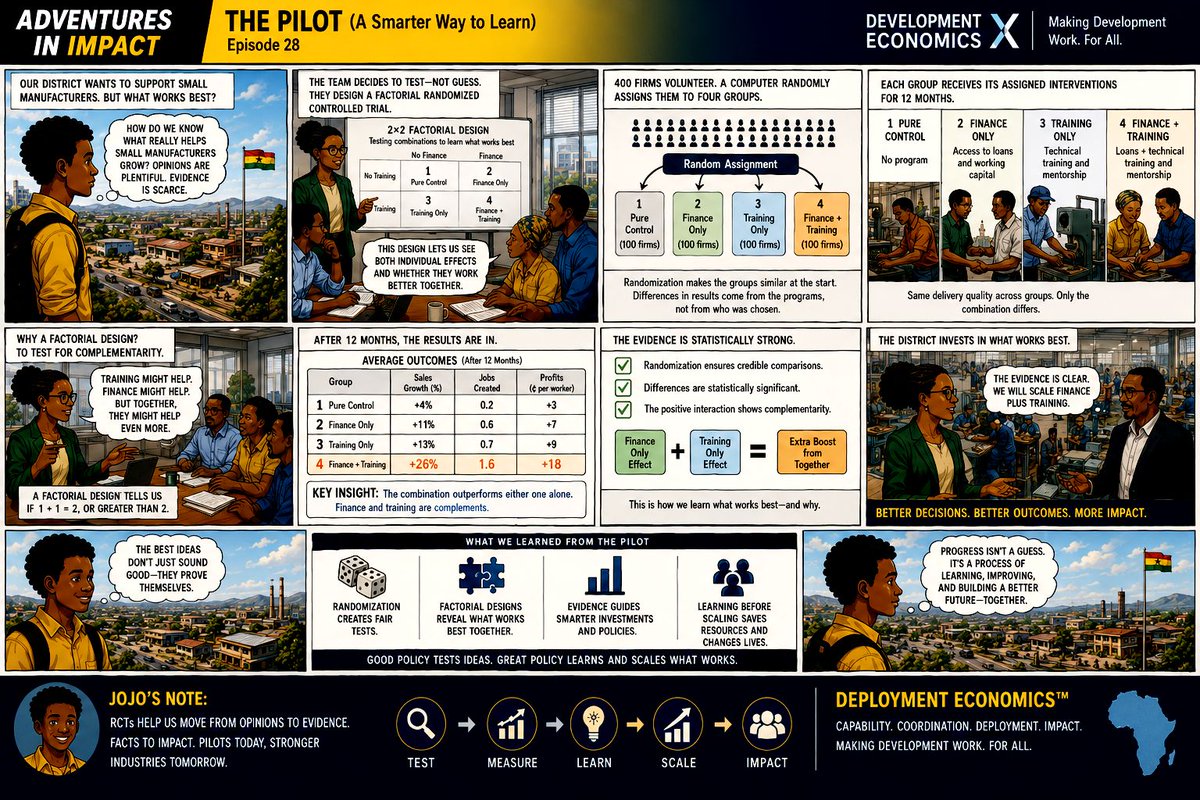
Development economics as science and engineering.
Test.
Measure.
Learn.
Improve.
Scale.
Jojo shows how randomized controlled trials help policymakers learn what truly works before scaling national programs.
Better evidence for better decisions.
Development for all.
2
2
181
Development Economics X retweeted
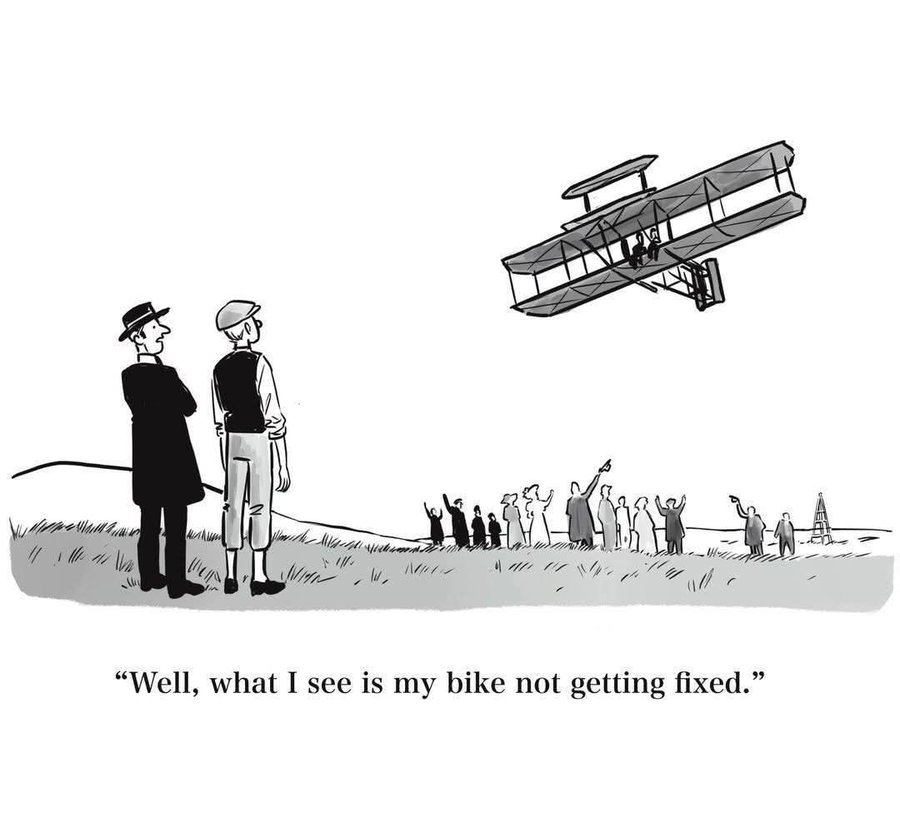
Focus on the big picture.
4
6
605
Development Economics X retweeted
🇬🇭🇬🇭🇬🇭🇬🇭🇬🇭
Let's keep rising.
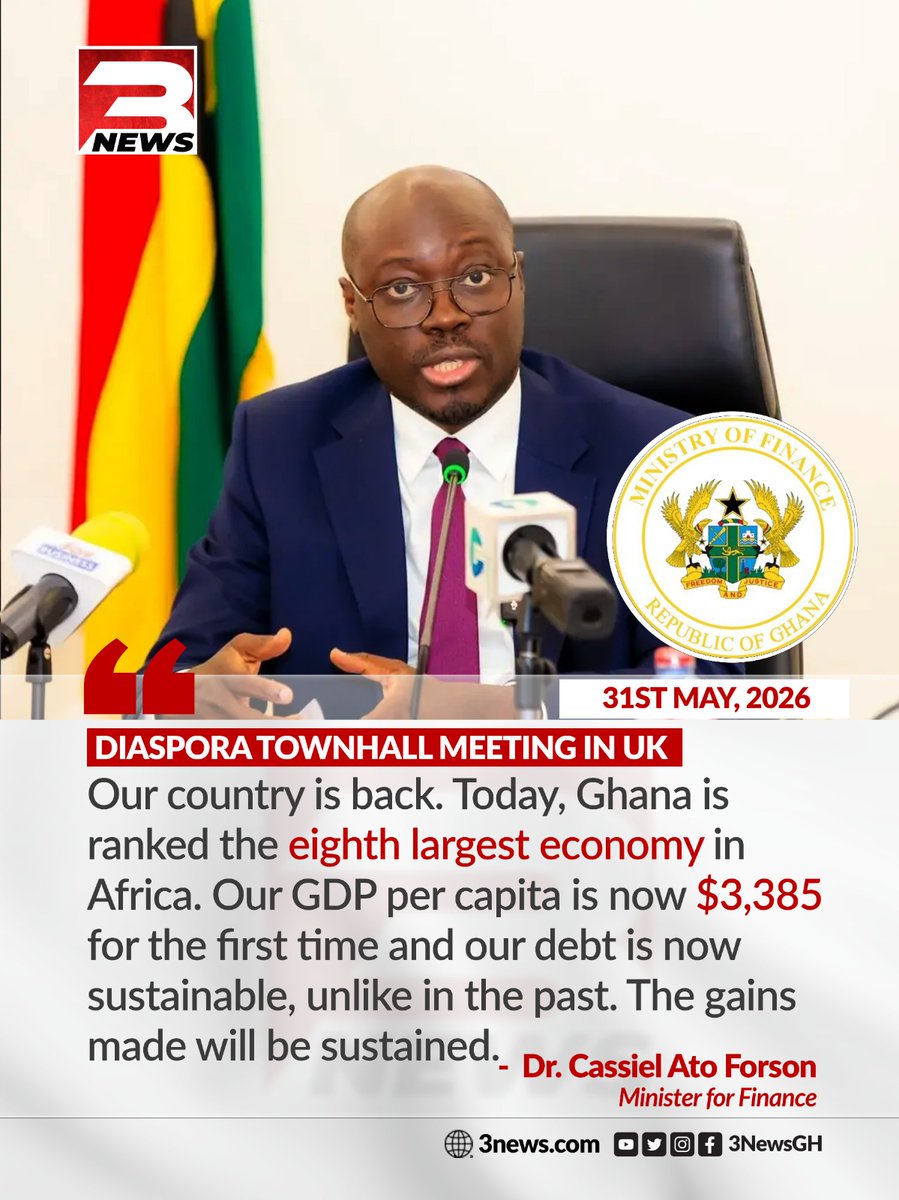
May 31

According to the Finance Minister, Ghana is now ranked as the eighth largest economy in Africa, with a GDP per capita reaching $3,385 for the first time.
He further assured the diaspora community that the country's debt is now sustainable and the economic gains made will be fully sustained.
#3NewsGH #TV3GH
1
2
387
Development Economics X retweeted
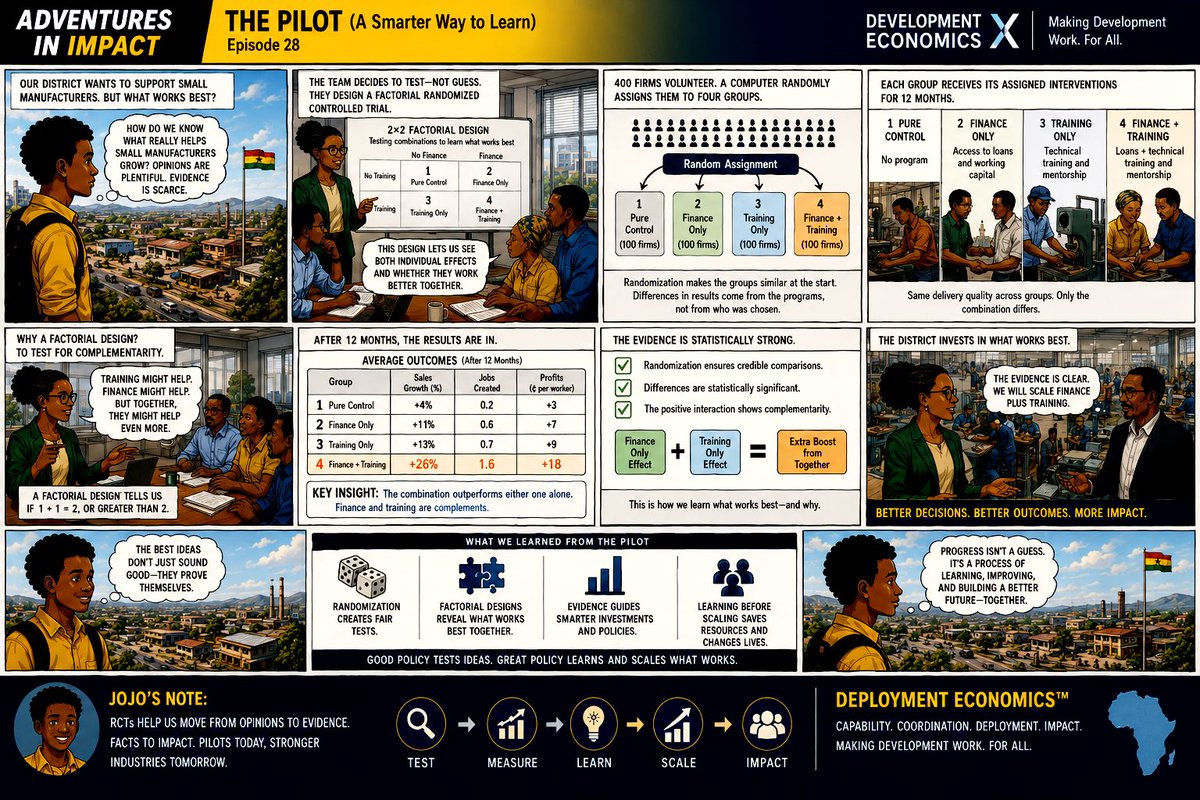
Today’s episode of ADVENTURES OF IMPACT explores something rarely shown in storytelling:
How countries can learn what actually works before scaling policy nationwide.
In “The Pilot,” Jojo witnesses a randomized controlled trial designed to test different industrial policy interventions - from finance to technical training - and discovers why evidence matters in development.
Because serious progress is not built on guesswork.
It’s built on learning.
Brought to you by .@DevEconX.
2
1
178

RT @KwekuOA: The core of your point may well be correct. If economists made that mistake, we did it before electrical engineers—economics i…
6
The work begins. From design to delivery. ADVENTURES OF IMPACT: The Design Review.
1
2
134
Development Economics X retweeted
Good point. ADVENTURES OF IMPACT is one such epic original series.
developmenteconomicsx.com/ma…
May 23

I don’t know, but I assume that a continent as vast as Africa must be rich with stories of its own heroes and their epic adventures.
Why can’t Hollywood show us those instead of blackwashing ours?
Wouldn’t that show more respect to Africa as well as us?
2
7
640
Development Economics X retweeted
Fun times.
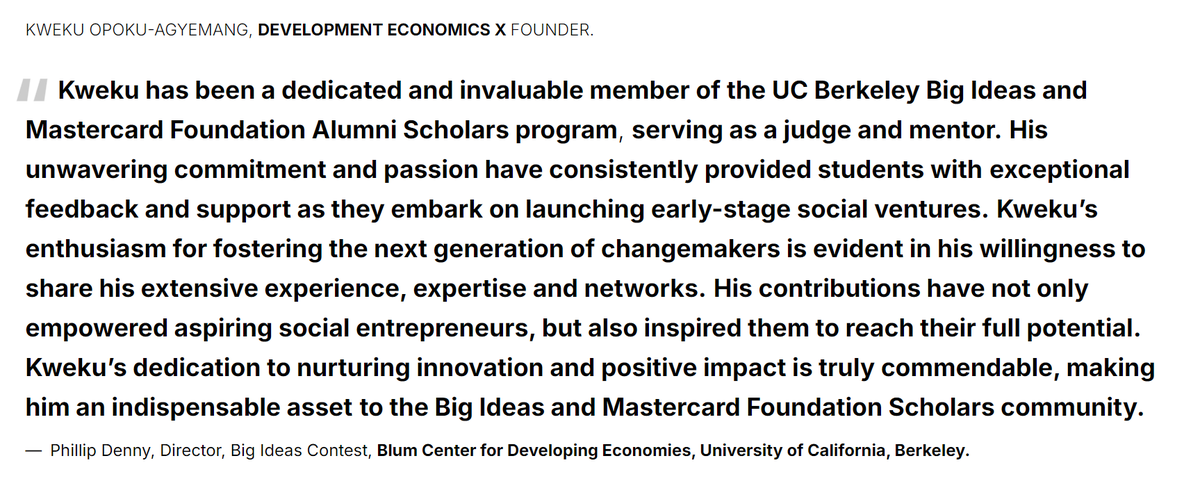
29 Sep 2024

Our founder, .@KwekuOA has advised many student startups and judged several competitions at the Big Ideas Contest and the Mastercard Foundation Alumni Scholars startup founder programs hosted at the University of California, Berkeley.
1
3
309
Development Economics X retweeted
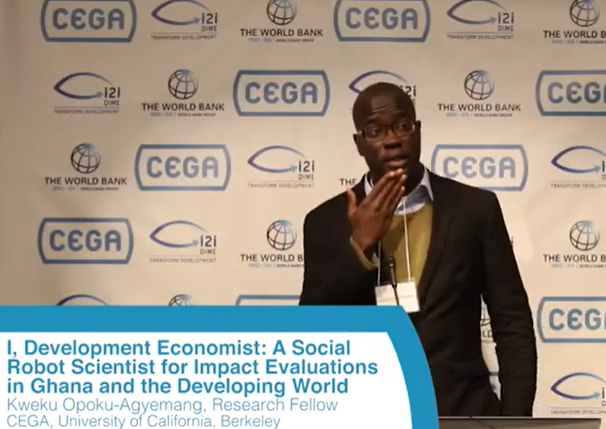
In 2018, I stood on a stage in SF, flanked by the logos you see here, and made a bold prediction: "AI will someday do end-to-end economic research."
The room was deeply skeptical. Some of the sharpest minds told me it was impossible. To be fair, it sounded like sci-fi back then.
Unbeknownst to most of us, Google had just quietly dropped the Transformer paper. The world was about to change.
Today, that "outlandish" vision is becoming reality. AI agents are beginning to formulate hypotheses, run regressions, and draft papers.
Being early can feel lonely, but it’s incredible when the world catches up.
Building on the independent research ideas I explored during my time there, I later founded Machine Learning X Doing and Development Economics X. We aren't waiting for the future: we're building it. 🚀
2
4
11
438
Development Economics X retweeted
We use development economics to solve global challenges, yet university administrations supporting that and other departments are left using "intuition" to defend their own budgets.
It’s time to bring this science home. This is our race against time against vibes-based resource allocation:
Vibes don't belong in resource allocation.
Yet, millions are spent simply because someone "felt it would work", only for budgets to be cut based on speculation later.
Get causal clarity. Confidently optimize programs for funding.
Discover your potential outcomes. 👇 #Video
1
2
602
Vibes don't belong in resource allocation.
Yet, millions are spent simply because someone "felt it would work", only for budgets to be cut based on speculation later.
Get causal clarity. Confidently optimize programs for funding.
Discover your potential outcomes. 👇 #Video
1
2
752
Development Economics X retweeted
Well, the incentives had the outcomes being more reasonable once upon a time, so they can be better than they currently are again.
May 18

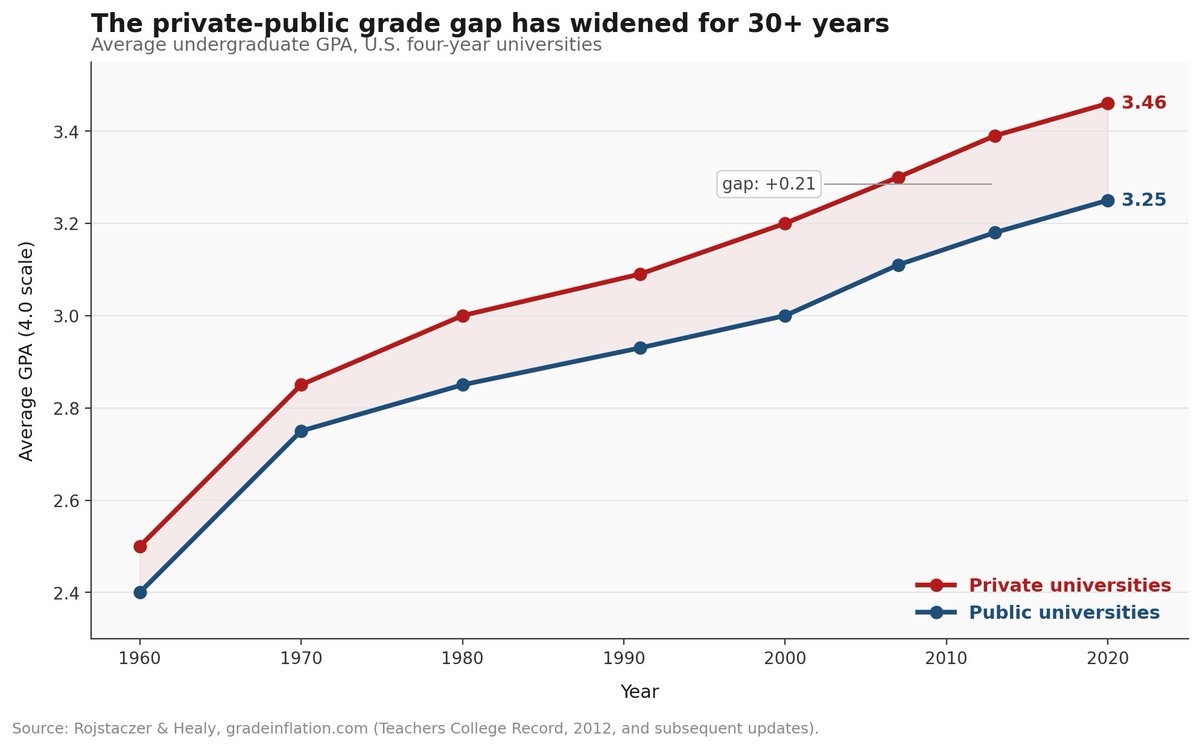
I happened upon a group of visiting students this morning and what was on their mind: grade inflation. I said that @UChicago would be one of the last places it would take hold (not sure if that attracted or repelled them!).
A professor (and parent) in the group noted that my statement was at odds with data, which shows privates run 0.2 GPA points above publics. And, that the gap has widened. She asked me why I thought that was happening (I pasted the evidence I think she was referring to below).
I first noted that I had not looked into it carefully and that I have no research of my own. Yet, as usual, my first instinct is an economics explanation: the mechanism is pure incentives. Parents pay a premium. Professors face evaluations. Deans chase retention. President's ask parents of current students and alumni for donations.
Everyone is rewarded for higher grades. No one is rewarded for accurate ones.
Classic principal-agent failure: the principals who'd demand accurate grades (employers, grad schools) don't sign the tuition check.
1
1
706
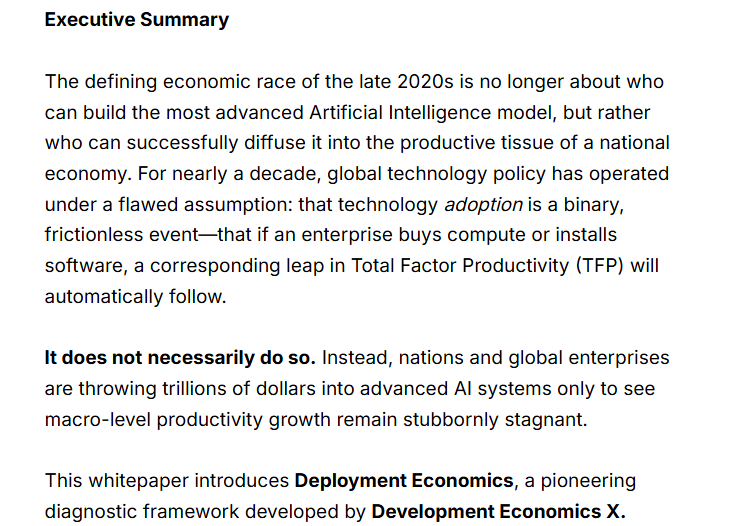
Trillions of dollars are flooding into advanced AI infrastructure, yet macroeconomic productivity is stubbornly stagnant. Why?
Technology invention is an engineering problem—but technology deployment is an institutional one.
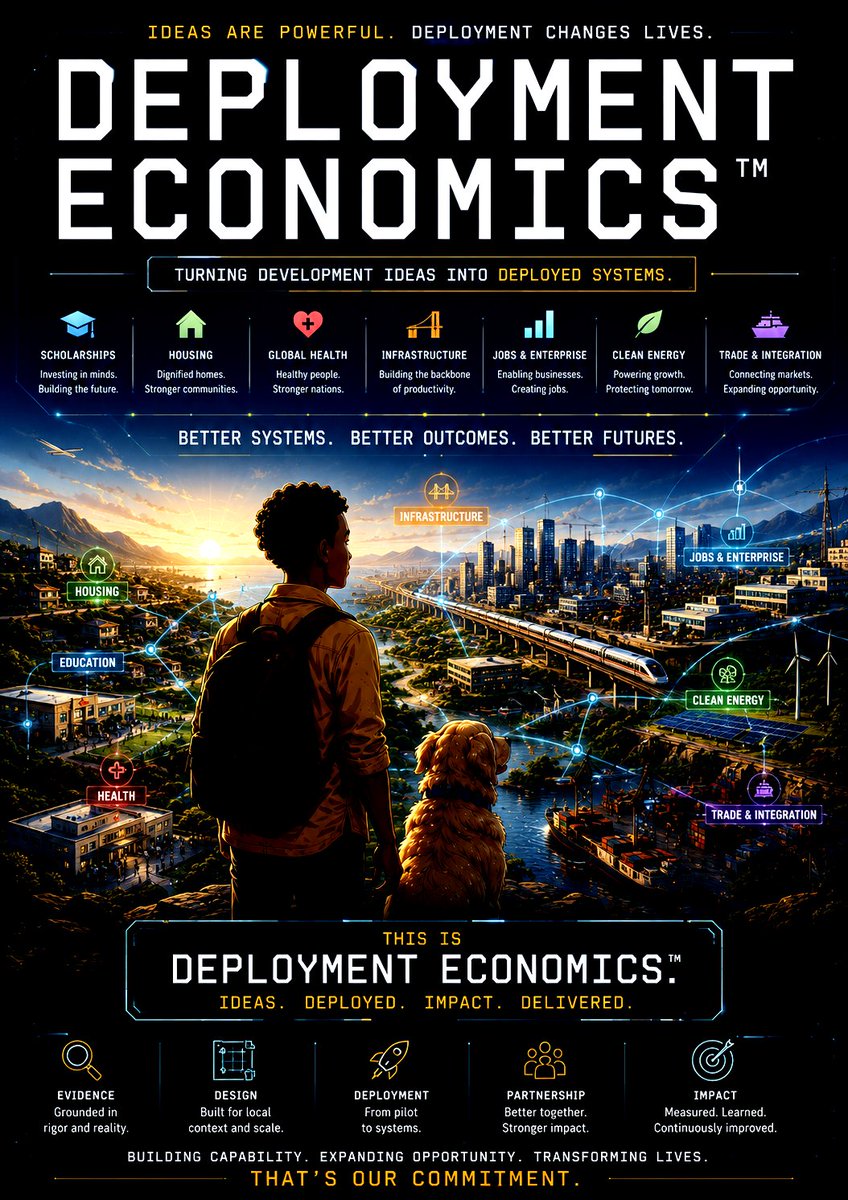
Enter Deployment Economics™ from .@DevEconX 🧵👇
1
3
101
Sovereign nations must transition toward Algorithmic Special Economic Zones (ASEZs): insulated computational sandboxes with data liberalization, private capital protection, and transparent deployment firewalls.
1
2
76
Stop tracking nominal adoption metrics. It's time for rigorous Causal Inference. Download the full, official paper on Deployment Economics X™ below to see how we map the path to true Productive TFP Realization.🔗 developmenteconomicsx.com/re…
1
2
82