
MOD||Content writer|| A crypto trader||Active yapper||Airdrop Hunter||Researcher.
Joined June 2024
- Tweets 24,514
- Following 1,631
- Followers 2,228
- Likes 19,931
1,193 Photos and videos






Pinned Tweet

18 Nov 2025
Each of the four dynamic epochs that make up the @Alignerz_-Wallchain Campaign is intended to reward persistent engagement over a period of 29 days:
Epoch 1 (Days 1–7): Establish your streak by joining the community, finishing onboarding tasks, and beginning daily check-ins.
Epoch 2 (Days 8–14): Increase interaction by sharing high-quality content, recommending friends, and continuing your winning streak to earn multipliers. Peak activity period
Epoch 3 (Days 15–21), during which top performers are granted access to exclusive roles and increased point weights.
Epoch 4 (Days 22–29): The last sprint, where the greatest contributions and longest streaks guarantee the top spot on the leaderboard and the biggest reward share.
Continue to be active every day. Your gains are compounded with each Epoch @wallchain
17 Nov 2025

@wallchain Campaign Essentials: Earn 3.84% of Total Supply! Wallchain is starting an incredible rewards campaign that will distribute 3.84% of the total token supply exclusively to top contributors!
This is your opportunity to participate early and earn a huge share of tokens by actively participating.
To qualify, you must:
1.Engage on X (posts, replies, spaces)
2.Create high-quality content & memes
3.Refer friends & build the community
4.Stake, provide liquidity, or complete key tasks.
The more you contribute, the higher you move up the leaderboard, and the biggest rewards from this generous 3.84% allocation will go to the top ranks.
The campaign is live now for a short time only. Don't miss out! Join the Wallchain movement, increase your activity, and earn incredible rewards @Alignerz_
34
7
32
336
Diamond IN Web3 | 𝔽rAI retweeted
18 Nov 2025
Each of the four dynamic epochs that make up the @Alignerz_-Wallchain Campaign is intended to reward persistent engagement over a period of 29 days:
Epoch 1 (Days 1–7): Establish your streak by joining the community, finishing onboarding tasks, and beginning daily check-ins.
Epoch 2 (Days 8–14): Increase interaction by sharing high-quality content, recommending friends, and continuing your winning streak to earn multipliers. Peak activity period
Epoch 3 (Days 15–21), during which top performers are granted access to exclusive roles and increased point weights.
Epoch 4 (Days 22–29): The last sprint, where the greatest contributions and longest streaks guarantee the top spot on the leaderboard and the biggest reward share.
Continue to be active every day. Your gains are compounded with each Epoch @wallchain
17 Nov 2025
@wallchain Campaign Essentials: Earn 3.84% of Total Supply! Wallchain is starting an incredible rewards campaign that will distribute 3.84% of the total token supply exclusively to top contributors!
This is your opportunity to participate early and earn a huge share of tokens by actively participating.
To qualify, you must:
1.Engage on X (posts, replies, spaces)
2.Create high-quality content & memes
3.Refer friends & build the community
4.Stake, provide liquidity, or complete key tasks.
The more you contribute, the higher you move up the leaderboard, and the biggest rewards from this generous 3.84% allocation will go to the top ranks.
The campaign is live now for a short time only. Don't miss out! Join the Wallchain movement, increase your activity, and earn incredible rewards @Alignerz_
34
7
32
336
Diamond IN Web3 | 𝔽rAI retweeted
17 Nov 2025
@wallchain Campaign Essentials: Earn 3.84% of Total Supply! Wallchain is starting an incredible rewards campaign that will distribute 3.84% of the total token supply exclusively to top contributors!
This is your opportunity to participate early and earn a huge share of tokens by actively participating.
To qualify, you must:
1.Engage on X (posts, replies, spaces)
2.Create high-quality content & memes
3.Refer friends & build the community
4.Stake, provide liquidity, or complete key tasks.
The more you contribute, the higher you move up the leaderboard, and the biggest rewards from this generous 3.84% allocation will go to the top ranks.
The campaign is live now for a short time only. Don't miss out! Join the Wallchain movement, increase your activity, and earn incredible rewards @Alignerz_
17 Nov 2025
Why @Alignerz_ Prioritizes Long-Term Vesting Over First-Come, First-Served Models
In the volatile world of crypto launchpads, traditional first-come, first-served (FCFS) models often reward speed over substance, leading to immediate dumps by quick-flippers and devastating token price crashes post-TGE.
AlignerZ.bid (@Alignerz_), a next-gen launchpad on @0xPolygon, flips this script with its Tradable Vesting Schedules (TVS)—ERC-721 NFTs representing allocations that unlock gradually over time.
By prioritizing long-term vesting via Initial Weight Offering (IWO), AlignerZ mathematically engineers incentives for commitment.
Longer vesting periods unlock deeper pool discounts, dividends, voting power, and community perks, transforming "time" into the ultimate currency.
This minimizes primary-market inflation, shifts selling pressure to secondary TVS trades, and creates unmatched token scarcity—dripped by the second for sustained price stability.
Even degens benefit: Flip TVS early for quick profits without crashing the token, or hold for exponential upside in a healthier economy.
As @Alignerz_ pitches, it's "whoever accepts longer vesting wins," fostering genuine alignment, rug-proof growth, and long-term project thriving over extractive frenzy.
58
15
55
661
Diamond IN Web3 | 𝔽rAI retweeted
17 Nov 2025
Why @Alignerz_ Prioritizes Long-Term Vesting Over First-Come, First-Served Models
In the volatile world of crypto launchpads, traditional first-come, first-served (FCFS) models often reward speed over substance, leading to immediate dumps by quick-flippers and devastating token price crashes post-TGE.
AlignerZ.bid (@Alignerz_), a next-gen launchpad on @0xPolygon, flips this script with its Tradable Vesting Schedules (TVS)—ERC-721 NFTs representing allocations that unlock gradually over time.
By prioritizing long-term vesting via Initial Weight Offering (IWO), AlignerZ mathematically engineers incentives for commitment.
Longer vesting periods unlock deeper pool discounts, dividends, voting power, and community perks, transforming "time" into the ultimate currency.
This minimizes primary-market inflation, shifts selling pressure to secondary TVS trades, and creates unmatched token scarcity—dripped by the second for sustained price stability.
Even degens benefit: Flip TVS early for quick profits without crashing the token, or hold for exponential upside in a healthier economy.
As @Alignerz_ pitches, it's "whoever accepts longer vesting wins," fostering genuine alignment, rug-proof growth, and long-term project thriving over extractive frenzy.
16 Nov 2025
@Alignerz_ In the evolving world of decentralized finance (DeFi), Initial Weight Offering (IWO) emerges as a fairer alternative to traditional token launches like Initial DEX Offerings (IDOs).
Unlike speed-based mechanisms where bots and high-gas bidders dominate, IWO prioritizes conviction through weighted bidding.
At its core, IWO allows participants to allocate funds into a pool, where contributions determine "weight" rather than first-come-first-served access.
Users bid with tokens (often stablecoins), and the total pool funds the project while distributing new tokens proportionally. Higher bids signal stronger belief in the project's potential, democratizing access for genuine supporters over automated snipers.
The process unfolds in phases: announcement, bidding window (typically 24-72 hours), calculation, and distribution.
During bidding, anyone can commit funds without rushing; no need for MEV bots or frontrunning.
Post-window, weights are computed—e.g., if User A bids 10% of the pool, they receive 10% of tokens, adjusted for caps to prevent whale dominance.
Key advantages include anti-bot fairness, reduced gas wars, and aligned incentives.
Projects raise capital efficiently, while participants avoid FOMO-driven haste.
However, risks persist: overbidding on hype or illiquid post-launch dumps.
Popularized by platforms like Polkastarter or custom protocols on Ethereum/Solana, IWO fosters long-term holders by rewarding patience and research over reflexes. As DeFi matures, IWO exemplifies "conviction capital," bridging equity-like commitment with crypto accessibility study @wallchain
55
13
49
679
Diamond IN Web3 | 𝔽rAI retweeted
16 Nov 2025
@Alignerz_ In the evolving world of decentralized finance (DeFi), Initial Weight Offering (IWO) emerges as a fairer alternative to traditional token launches like Initial DEX Offerings (IDOs).
Unlike speed-based mechanisms where bots and high-gas bidders dominate, IWO prioritizes conviction through weighted bidding.
At its core, IWO allows participants to allocate funds into a pool, where contributions determine "weight" rather than first-come-first-served access.
Users bid with tokens (often stablecoins), and the total pool funds the project while distributing new tokens proportionally. Higher bids signal stronger belief in the project's potential, democratizing access for genuine supporters over automated snipers.
The process unfolds in phases: announcement, bidding window (typically 24-72 hours), calculation, and distribution.
During bidding, anyone can commit funds without rushing; no need for MEV bots or frontrunning.
Post-window, weights are computed—e.g., if User A bids 10% of the pool, they receive 10% of tokens, adjusted for caps to prevent whale dominance.
Key advantages include anti-bot fairness, reduced gas wars, and aligned incentives.
Projects raise capital efficiently, while participants avoid FOMO-driven haste.
However, risks persist: overbidding on hype or illiquid post-launch dumps.
Popularized by platforms like Polkastarter or custom protocols on Ethereum/Solana, IWO fosters long-term holders by rewarding patience and research over reflexes. As DeFi matures, IWO exemplifies "conviction capital," bridging equity-like commitment with crypto accessibility study @wallchain
16 Nov 2025
Just earned 0.32 Quacks on @wallchain in one day 🦆
Turn insights into rewards and climb the leaderboard 🥇
I have been active talking about one project which is my favourite project @Alignerz_
Use my referral link – quacks.app/?ref=Diamond_Ucha
25
4
26
515
Diamond IN Web3 | 𝔽rAI retweeted
16 Nov 2025
Just earned 0.32 Quacks on @wallchain in one day 🦆
Turn insights into rewards and climb the leaderboard 🥇
I have been active talking about one project which is my favourite project @Alignerz_
Use my referral link – quacks.app/?ref=Diamond_Ucha
40
2
25
269
Diamond IN Web3 | 𝔽rAI retweeted
15 Nov 2025
Teams, investors, and contributors can distribute tokens securely and transparently thanks to Tokenized Vesting Schedules (TVS) in @Alignerz_.
With linear or cliff-based schedules, tokens are locked in smart contracts and released gradually over predetermined periods, usually 12 to 48 months.
Cliffs postpone first releases (such as a six-month lock) and then unlock them on a monthly or quarterly basis. TVS aligns incentives, prevents dumps, and fosters trust.
@Alignerz_ integrates with DAO governance, supports custom vesting (such as performance milestones), and automates compliance through on-chain rules.
Revocable provisions permit restitution for wrongdoing. Transparency is ensured by unchangeable audit trails.
TVS lowers administrative costs, lowers legal risks, and encourages sustained dedication to Web3 projects.
15 Nov 2025
Through creative incentives and social interaction,
@Alignerz_, a next-generation launchpad supported by Polygon, seamlessly integrates with @wallchain to promote community-driven growth.
Alignerz turns token generation events (TGEs) from speculative races into conviction-based systems by utilizing Wallchain's AI-powered AttentionFi ecosystem.
In order to ensure sustainable value creation, users bid on allocations using tradable vesting schedules (TVS), wrapped as NFTs, giving preference to long-term holders over short-term flippers.
Real participation is monitored by Wallchain's leaderboard, which awards the top 1,000 contributors with 3.84% of the $A26Z supply.
This creates natural buzz: regular quacking, thread-blending campaigns, and daily posts increase mindshare and make audiences co-builders.
The model reduces dumps, aligns incentives, and promotes viral adoption through deflationary mechanisms like revenue buybacks and burns.
Outcome? tremendous growth in followers and devoted communities that go beyond hype.
30
19
39
173
15 Nov 2025
Through creative incentives and social interaction,
@Alignerz_, a next-generation launchpad supported by Polygon, seamlessly integrates with @wallchain to promote community-driven growth.
Alignerz turns token generation events (TGEs) from speculative races into conviction-based systems by utilizing Wallchain's AI-powered AttentionFi ecosystem.
In order to ensure sustainable value creation, users bid on allocations using tradable vesting schedules (TVS), wrapped as NFTs, giving preference to long-term holders over short-term flippers.
Real participation is monitored by Wallchain's leaderboard, which awards the top 1,000 contributors with 3.84% of the $A26Z supply.
This creates natural buzz: regular quacking, thread-blending campaigns, and daily posts increase mindshare and make audiences co-builders.
The model reduces dumps, aligns incentives, and promotes viral adoption through deflationary mechanisms like revenue buybacks and burns.
Outcome? tremendous growth in followers and devoted communities that go beyond hype.
15 Nov 2025
@Alignerz_ The selection of materials in the field of orthodontic clear aligners determines treatment effectiveness, patient comfort, and longevity.
The amorphous structure of traditional polyester thermoplastic PETG (polyethylene terephthalate glycol), which provides superior optical clarity and formability, makes it the dominant material.
PETG is used by brands such as Duran and Essix ACE because of its low crystallinity, which guarantees high transparency and resistance to deformation during thermoforming. However, under oral stresses like chewing, PETG's rigidity (flexural modulus ~1.0-1.5 GPa) can cause brittleness, increased water absorption, and faster stress relaxation, which could compromise long-term force delivery and raise the risk of fracture.
Aligner science is being revolutionized by Bay Materials' exclusive thermoplastic polyurethane (TPU), Zendura.
TPU, which comes in monolayer Zendura A or trilayer Zendura FLX (elastomeric core encased in tough PETG-like shells), is incredibly resilient and elastic.
After thermocycling, its crosslinked molecular chains offer up to 70% more stain resistance, crack resistance, and sustained force retention than PETG.
Compared to certain polyesters, Zendura's biocompatibility lowers cytotoxicity, and its higher modulus (up to 1.7 GPa) allows for precise tooth control with little thickness loss after thermoforming.
Clinically, Zendura excels in complex movements, reducing treatment time by improving adaptation and minimizing remakes, while PETG works well for simpler cases due to its affordability and aesthetics.
TPU's innovations, which combine science and seamless wear, promise more predictable results as orthodontics moves toward personalized, digital workflows. @wallchain
35
7
30
370
Diamond IN Web3 | 𝔽rAI retweeted
15 Nov 2025
Through creative incentives and social interaction,
@Alignerz_, a next-generation launchpad supported by Polygon, seamlessly integrates with @wallchain to promote community-driven growth.
Alignerz turns token generation events (TGEs) from speculative races into conviction-based systems by utilizing Wallchain's AI-powered AttentionFi ecosystem.
In order to ensure sustainable value creation, users bid on allocations using tradable vesting schedules (TVS), wrapped as NFTs, giving preference to long-term holders over short-term flippers.
Real participation is monitored by Wallchain's leaderboard, which awards the top 1,000 contributors with 3.84% of the $A26Z supply.
This creates natural buzz: regular quacking, thread-blending campaigns, and daily posts increase mindshare and make audiences co-builders.
The model reduces dumps, aligns incentives, and promotes viral adoption through deflationary mechanisms like revenue buybacks and burns.
Outcome? tremendous growth in followers and devoted communities that go beyond hype.
15 Nov 2025
@Alignerz_ The selection of materials in the field of orthodontic clear aligners determines treatment effectiveness, patient comfort, and longevity.
The amorphous structure of traditional polyester thermoplastic PETG (polyethylene terephthalate glycol), which provides superior optical clarity and formability, makes it the dominant material.
PETG is used by brands such as Duran and Essix ACE because of its low crystallinity, which guarantees high transparency and resistance to deformation during thermoforming. However, under oral stresses like chewing, PETG's rigidity (flexural modulus ~1.0-1.5 GPa) can cause brittleness, increased water absorption, and faster stress relaxation, which could compromise long-term force delivery and raise the risk of fracture.
Aligner science is being revolutionized by Bay Materials' exclusive thermoplastic polyurethane (TPU), Zendura.
TPU, which comes in monolayer Zendura A or trilayer Zendura FLX (elastomeric core encased in tough PETG-like shells), is incredibly resilient and elastic.
After thermocycling, its crosslinked molecular chains offer up to 70% more stain resistance, crack resistance, and sustained force retention than PETG.
Compared to certain polyesters, Zendura's biocompatibility lowers cytotoxicity, and its higher modulus (up to 1.7 GPa) allows for precise tooth control with little thickness loss after thermoforming.
Clinically, Zendura excels in complex movements, reducing treatment time by improving adaptation and minimizing remakes, while PETG works well for simpler cases due to its affordability and aesthetics.
TPU's innovations, which combine science and seamless wear, promise more predictable results as orthodontics moves toward personalized, digital workflows. @wallchain
35
7
30
370
Diamond IN Web3 | 𝔽rAI retweeted
14 Nov 2025
Biomechanical principles underpin orthodontic tooth movement, with @Alignerz_ clear aligner trays applying controlled forces to periodontal tissues.
The periodontal ligament (PDL) is under pressure from light, continuous forces (0.1–0.5 N per tooth), which causes bone remodeling through osteoblastic apposition on the tension side and osteoclastic resorption on the compression side.
Depending on the tray geometry, attachment location, and activation points, aligners can cause tipping, bodily, or torque movements.
Elastic recovery is guaranteed by SmartTrack material, which provides constant force over 7–14 days.
Root resorption risks are reduced by using finite element models to forecast stress distribution.
Alveolar bone turnover is maximized by precise force magnitude, direction, and duration, which results in predictable translation, rotation, or intrusion without brackets.
14 Nov 2025
@Alignerz_ harnesses artificial intelligence to revolutionize orthodontic treatment planning through advanced predictive modeling.
At the core of their approach is a sophisticated AI system trained on vast datasets of dental scans, patient outcomes, and biomechanical simulations.
This enables precise forecasting of tooth movement trajectories, minimizing trial-and-error in aligner design.
The process begins with 3D intraoral scans uploaded to the platform.
AI algorithms analyze malocclusion patterns, bone density, and root positions to generate a digital twin of the patient’s dentition.
Predictive models then simulate thousands of treatment scenarios, calculating force distributions, attachment placements, and staging sequences.
Machine learning refines these predictions by incorporating real-world feedback from completed cases, achieving accuracy rates exceeding 95% in final occlusion alignment.
Clinicians receive an interactive treatment plan with visualized stages, risk alerts for potential relapse, and automated adjustments for complex cases like open bites or crowding.
This reduces chair time by up to 40% and aligner iterations by 30%. Patients benefit from shorter treatment durations and fewer refinement scans.
By integrating generative AI for custom aligner fabrication and continuous monitoring via app-based progress tracking, @Alignerz_ ensures adaptive planning.
The result: efficient, evidence-based orthodontics that prioritizes precision and patient satisfaction.
39
20
49
482
15 Nov 2025
Through creative incentives and social interaction,
@Alignerz_, a next-generation launchpad supported by Polygon, seamlessly integrates with @wallchain to promote community-driven growth.
Alignerz turns token generation events (TGEs) from speculative races into conviction-based systems by utilizing Wallchain's AI-powered AttentionFi ecosystem.
In order to ensure sustainable value creation, users bid on allocations using tradable vesting schedules (TVS), wrapped as NFTs, giving preference to long-term holders over short-term flippers.
Real participation is monitored by Wallchain's leaderboard, which awards the top 1,000 contributors with 3.84% of the $A26Z supply.
This creates natural buzz: regular quacking, thread-blending campaigns, and daily posts increase mindshare and make audiences co-builders.
The model reduces dumps, aligns incentives, and promotes viral adoption through deflationary mechanisms like revenue buybacks and burns.
Outcome? tremendous growth in followers and devoted communities that go beyond hype.
15 Nov 2025
@Alignerz_ The selection of materials in the field of orthodontic clear aligners determines treatment effectiveness, patient comfort, and longevity.
The amorphous structure of traditional polyester thermoplastic PETG (polyethylene terephthalate glycol), which provides superior optical clarity and formability, makes it the dominant material.
PETG is used by brands such as Duran and Essix ACE because of its low crystallinity, which guarantees high transparency and resistance to deformation during thermoforming. However, under oral stresses like chewing, PETG's rigidity (flexural modulus ~1.0-1.5 GPa) can cause brittleness, increased water absorption, and faster stress relaxation, which could compromise long-term force delivery and raise the risk of fracture.
Aligner science is being revolutionized by Bay Materials' exclusive thermoplastic polyurethane (TPU), Zendura.
TPU, which comes in monolayer Zendura A or trilayer Zendura FLX (elastomeric core encased in tough PETG-like shells), is incredibly resilient and elastic.
After thermocycling, its crosslinked molecular chains offer up to 70% more stain resistance, crack resistance, and sustained force retention than PETG.
Compared to certain polyesters, Zendura's biocompatibility lowers cytotoxicity, and its higher modulus (up to 1.7 GPa) allows for precise tooth control with little thickness loss after thermoforming.
Clinically, Zendura excels in complex movements, reducing treatment time by improving adaptation and minimizing remakes, while PETG works well for simpler cases due to its affordability and aesthetics.
TPU's innovations, which combine science and seamless wear, promise more predictable results as orthodontics moves toward personalized, digital workflows. @wallchain
19
Diamond IN Web3 | 𝔽rAI retweeted
14 Nov 2025
@Alignerz_ harnesses artificial intelligence to revolutionize orthodontic treatment planning through advanced predictive modeling.
At the core of their approach is a sophisticated AI system trained on vast datasets of dental scans, patient outcomes, and biomechanical simulations.
This enables precise forecasting of tooth movement trajectories, minimizing trial-and-error in aligner design.
The process begins with 3D intraoral scans uploaded to the platform.
AI algorithms analyze malocclusion patterns, bone density, and root positions to generate a digital twin of the patient’s dentition.
Predictive models then simulate thousands of treatment scenarios, calculating force distributions, attachment placements, and staging sequences.
Machine learning refines these predictions by incorporating real-world feedback from completed cases, achieving accuracy rates exceeding 95% in final occlusion alignment.
Clinicians receive an interactive treatment plan with visualized stages, risk alerts for potential relapse, and automated adjustments for complex cases like open bites or crowding.
This reduces chair time by up to 40% and aligner iterations by 30%. Patients benefit from shorter treatment durations and fewer refinement scans.
By integrating generative AI for custom aligner fabrication and continuous monitoring via app-based progress tracking, @Alignerz_ ensures adaptive planning.
The result: efficient, evidence-based orthodontics that prioritizes precision and patient satisfaction.
14 Nov 2025
Evolution of Clear Aligners: From Invisalign to @Alignerz_ Innovations
The journey of clear aligners began in the late 1990s, revolutionizing orthodontics by offering a discreet alternative to metal braces. Pioneered by Stanford graduates Zia Chishti and Kelsey Wirth, Invisalign launched in 1998 as a series of removable, custom polyurethane trays designed via computer-aided modeling.
Early versions treated mild crowding but faced limitations in complex movements, relying solely on thermoformed plastic.
By 2001, material upgrades addressed durability issues, and by 2014, features like SmartForce attachments and Power Ridges enhanced control for rotations and extractions.
The 2010s saw explosive growth, with Invisalign's SmartTrack material (introduced mid-decade) providing gentler force and precise fit, reducing treatment times.
Competitors like ClearCorrect and SmileDirectClub emerged, incorporating remote monitoring and direct-to-consumer models for faster, affordable options.
Digital tools, such as iTero intraoral scanners, replaced messy impressions with 3D accuracy, boosting efficiency.
By 2025, innovations accelerate: AI-driven planning predicts outcomes with minimal refinements, smart sensors track progress in real-time, and mandibular advancement with occlusal blocks treats Class II malocclusions in growing .
Softer, eco-friendly materials enhance comfort, while in-office 3D printing enables customization.
Enter @Alignerz_, a 2025 Web3 disruptor reimagining incentives via Tradable Vesting Schedules (TVS) and Initial Weight Offerings (IWO).
Backed by Polygon and powered by @wallchain, it shifts token launches from "sell-first" chaos to rewarding long-term holders, minimizing inflation and fostering scarcity—much like aligners' gradual, precise shifts.
With 26 "Aligners" (ambassadors) and deflationary mechanics, @Alignerz_ aligns crypto economics with orthodontic evolution: sustainable, patient-centric progress for enduring results.
(198 words)
40
13
36
562
Diamond IN Web3 | 𝔽rAI retweeted
14 Nov 2025
Evolution of Clear Aligners: From Invisalign to @Alignerz_ Innovations
The journey of clear aligners began in the late 1990s, revolutionizing orthodontics by offering a discreet alternative to metal braces. Pioneered by Stanford graduates Zia Chishti and Kelsey Wirth, Invisalign launched in 1998 as a series of removable, custom polyurethane trays designed via computer-aided modeling.
Early versions treated mild crowding but faced limitations in complex movements, relying solely on thermoformed plastic.
By 2001, material upgrades addressed durability issues, and by 2014, features like SmartForce attachments and Power Ridges enhanced control for rotations and extractions.
The 2010s saw explosive growth, with Invisalign's SmartTrack material (introduced mid-decade) providing gentler force and precise fit, reducing treatment times.
Competitors like ClearCorrect and SmileDirectClub emerged, incorporating remote monitoring and direct-to-consumer models for faster, affordable options.
Digital tools, such as iTero intraoral scanners, replaced messy impressions with 3D accuracy, boosting efficiency.
By 2025, innovations accelerate: AI-driven planning predicts outcomes with minimal refinements, smart sensors track progress in real-time, and mandibular advancement with occlusal blocks treats Class II malocclusions in growing .
Softer, eco-friendly materials enhance comfort, while in-office 3D printing enables customization.
Enter @Alignerz_, a 2025 Web3 disruptor reimagining incentives via Tradable Vesting Schedules (TVS) and Initial Weight Offerings (IWO).
Backed by Polygon and powered by @wallchain, it shifts token launches from "sell-first" chaos to rewarding long-term holders, minimizing inflation and fostering scarcity—much like aligners' gradual, precise shifts.
With 26 "Aligners" (ambassadors) and deflationary mechanics, @Alignerz_ aligns crypto economics with orthodontic evolution: sustainable, patient-centric progress for enduring results.
(198 words)
13 Nov 2025
The AlignerZ x Wallchain Mindshare Leaderboard is LIVE!
What Is @Alignerz_
@Alignerz_ is the X (formerly Twitter) handle for AlignerZ, a pioneering blockchain-based launchpad revolutionizing token generation events (TGEs) through innovative vesting mechanics.
Far from traditional orthodontics, AlignerZ draws metaphorical inspiration from "clear aligner therapy"—the discreet, gradual process of teeth straightening using invisible braces like Invisalign—to symbolize aligning incentives in Web3 fundraising.
Just as clear aligners apply steady, invisible pressure for long-term results, AlignerZ enforces extended vesting schedules to prevent post-launch token dumps, fostering sustainable project growth.
Brand Origin
Founded in late 2024 by a pseudonymous U.S.-based entrepreneur (middle name: "Transparent"),
AlignerZ emerged from frustrations with Web3's "quick-flip" culture.
Traditional launches reward early sellers, crashing prices and eroding value.
Bootstrapped without VC funding—avoiding future dumps—the project gained traction on Polygon blockchain for its low-cost, scalable tech.
Early traction came from a private mindshare campaign on Wallchain, evolving into a public leaderboard in November 2025.
Key innovations like Tradable Vesting Schedules (TVS) as ERC-721 NFTs and Initial Weight Offerings (IWO) were prototyped in community AMAs, with the whitepaper updated iteratively based on feedback.
By November 13, 2025, it boasts 6,500 followers, a Telegram community of thousands, and partnerships amplifying its "alignment ethos."
Mission
AlignerZ's core mission: Flip TGE incentives from "whoever sells first wins" to "whoever vests longer thrives."
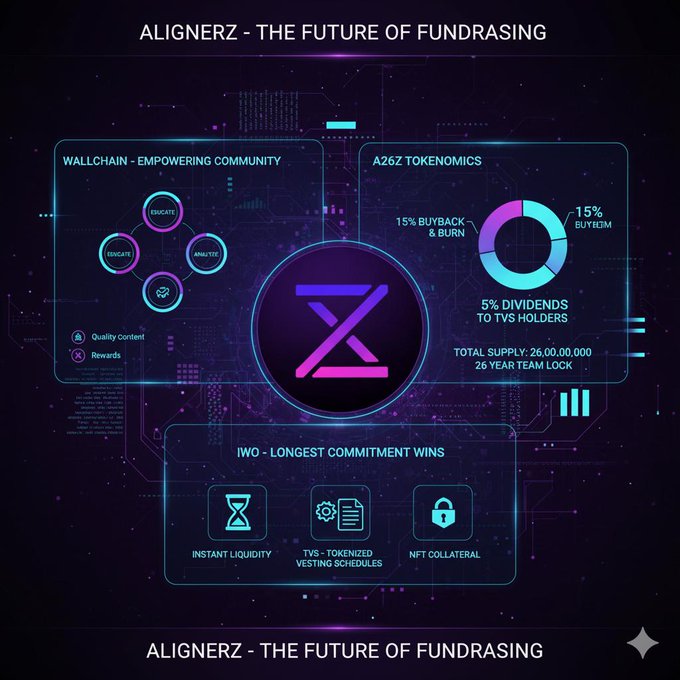
It minimizes inflation by distributing allocations as tradable NFTs, where longer vesting unlocks pool discounts (up to 26%), dividends, voting power, and deflationary burns.
Users can split/merge TVSs or redeem early at fixed prices (e.g., $0.40/token in initial windows), turning selling pressure into secondary-market liquidity.
This creates scarcity, protects against rugs, and rewards long-term holders—mirroring clear aligner therapy's patient, predictable transformation.
Backed by Polygon and powered by Wallchain's leaderboards (3.84% $A26Z rewards for top creators), AlignerZ aims for healthier token economies.
Team tokens vest over 26 years, aligning founders with holders.
As one post quips: "Imagine a TGE where degens can't crash the price—they unintentionally add value." With 26 bullish factors (from low float to community scoring), AlignerZ isn't just a platform; it's Web3's invisible brace for enduring success.
Am studying @Alignerz_ and @wallchain
33
25
43
644
Diamond IN Web3 | 𝔽rAI retweeted
13 Nov 2025
The AlignerZ x Wallchain Mindshare Leaderboard is LIVE!
What Is @Alignerz_
@Alignerz_ is the X (formerly Twitter) handle for AlignerZ, a pioneering blockchain-based launchpad revolutionizing token generation events (TGEs) through innovative vesting mechanics.
Far from traditional orthodontics, AlignerZ draws metaphorical inspiration from "clear aligner therapy"—the discreet, gradual process of teeth straightening using invisible braces like Invisalign—to symbolize aligning incentives in Web3 fundraising.
Just as clear aligners apply steady, invisible pressure for long-term results, AlignerZ enforces extended vesting schedules to prevent post-launch token dumps, fostering sustainable project growth.
Brand Origin
Founded in late 2024 by a pseudonymous U.S.-based entrepreneur (middle name: "Transparent"),
AlignerZ emerged from frustrations with Web3's "quick-flip" culture.
Traditional launches reward early sellers, crashing prices and eroding value.
Bootstrapped without VC funding—avoiding future dumps—the project gained traction on Polygon blockchain for its low-cost, scalable tech.
Early traction came from a private mindshare campaign on Wallchain, evolving into a public leaderboard in November 2025.
Key innovations like Tradable Vesting Schedules (TVS) as ERC-721 NFTs and Initial Weight Offerings (IWO) were prototyped in community AMAs, with the whitepaper updated iteratively based on feedback.
By November 13, 2025, it boasts 6,500 followers, a Telegram community of thousands, and partnerships amplifying its "alignment ethos."
Mission
AlignerZ's core mission: Flip TGE incentives from "whoever sells first wins" to "whoever vests longer thrives."
It minimizes inflation by distributing allocations as tradable NFTs, where longer vesting unlocks pool discounts (up to 26%), dividends, voting power, and deflationary burns.
Users can split/merge TVSs or redeem early at fixed prices (e.g., $0.40/token in initial windows), turning selling pressure into secondary-market liquidity.
This creates scarcity, protects against rugs, and rewards long-term holders—mirroring clear aligner therapy's patient, predictable transformation.
Backed by Polygon and powered by Wallchain's leaderboards (3.84% $A26Z rewards for top creators), AlignerZ aims for healthier token economies.
Team tokens vest over 26 years, aligning founders with holders.
As one post quips: "Imagine a TGE where degens can't crash the price—they unintentionally add value." With 26 bullish factors (from low float to community scoring), AlignerZ isn't just a platform; it's Web3's invisible brace for enduring success.
Am studying @Alignerz_ and @wallchain
51
11
42
759