
We connect, inspire, and empower the digital health professionals contributing to the future of healthcare in Canada.
Joined November 2011
- Tweets 13,620
- Following 1,832
- Followers 7,101
- Likes 9,075
4,351 Photos and videos













How a Canadian cardiologist built a portable ‘hospital in a Pelican case’ - begiant.ca/stories/people/dr… @begiantca
1
2
111
Why Canada’s health Innovation bottleneck is adoption, not invention and how the Waterloo Region’s health-technology ecosystem is fixing innovation - uwaterloo.ca/news/opinion-wh… @UWaterloo
102
Digital healthcare project 'making a difference' - ca.news.yahoo.com/digital-he…
84
The @CHEO Research Institute’s world-first pediatric AI algorithm, ThinkRare, will soon be used in other pediatric centres across Canada – marking one of the first national deployments of a real-time, clinically embedded AI tool in pediatric care. - canhealth.com/2026/03/04/che…
1
2
3
280
With support from @OBIOscience, @HamHealthSci McMaster Children’s Hospital has a new tool, the Trexo Plus, designed by Mississauga-based Trexo Robotics, to support patients needing pediatric rehabilitation. canhealth.com/2026/01/21/rob…
103
Digital Health Canada retweeted

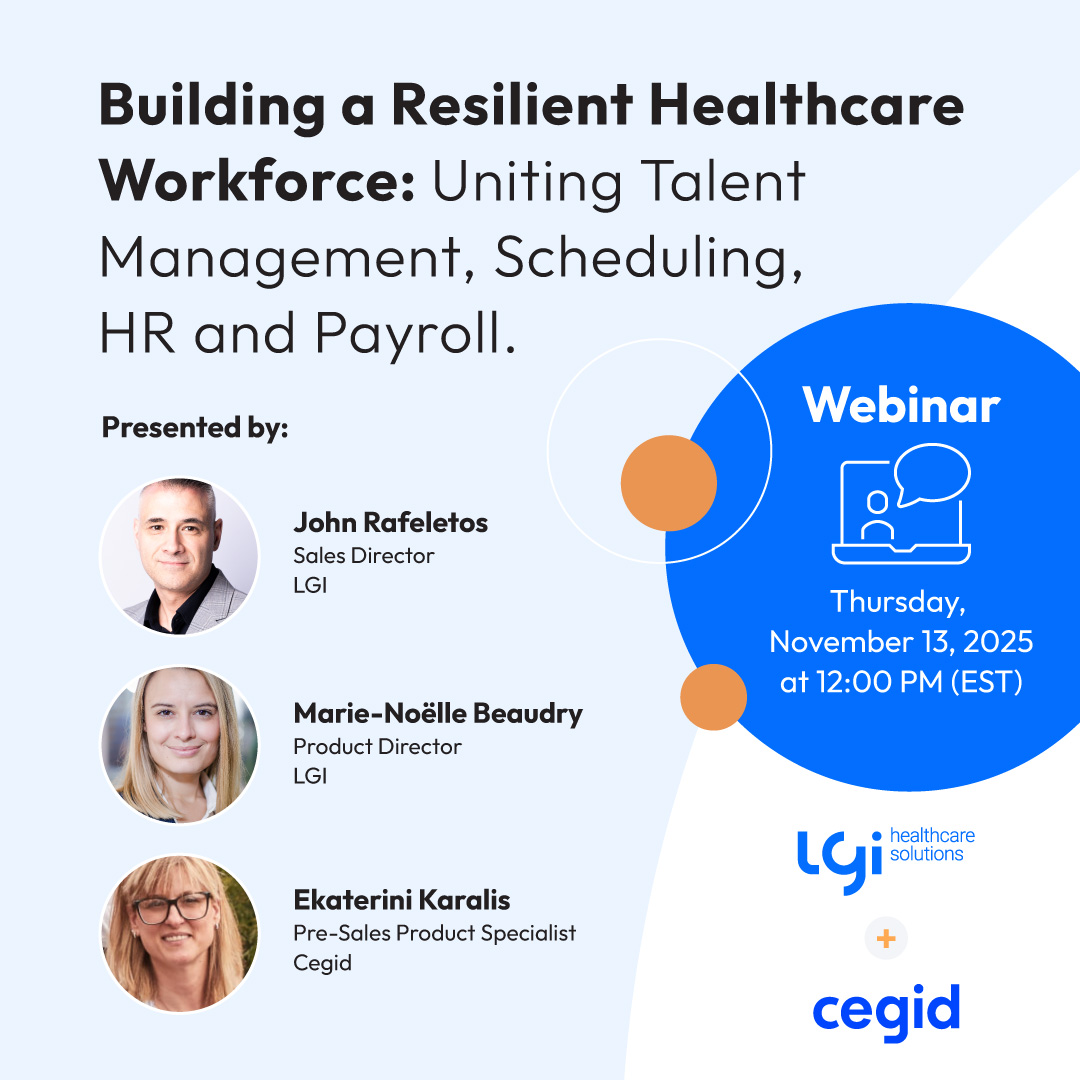
Register now: hubs.la/Q03R5JvN0 📢
[WEBINAR] Building a Resilient Healthcare Workforce
Join LGI & Cegid in collaboration with @DigiHealthCA to explore smarter workforce management.
#HealthcareHR #WorkforceManagement #TalentRetention #DigitalHealthCanada
1
2
1
124

26 Sep 2025
We are pleased to welcome Pathways BC to the Digital Health Canada membership community. Pathways is a trusted online directory of healthcare providers, services, and clinical resources that supports clinicians in British Columbia. Learn more at pathwaysbc.ca/info
3
130
19 Sep 2025
We are delighted to welcome DCM to the Digital Health Canada membership community. DCM is dedicated to improving critical healthcare communications and operations. Learn more about them at ow.ly/L25w50WJMKa
1
1
93

Over the past year, there’s been a surge of excitement around agentic AI — systems that don’t just answer questions, but can act: reading instructions, running code, designing pipelines, and making decisions.
In biomedicine, this raises a provocative question:
💡 Could the next member of your ML team be an AI agent?
The honest answer — not yet.
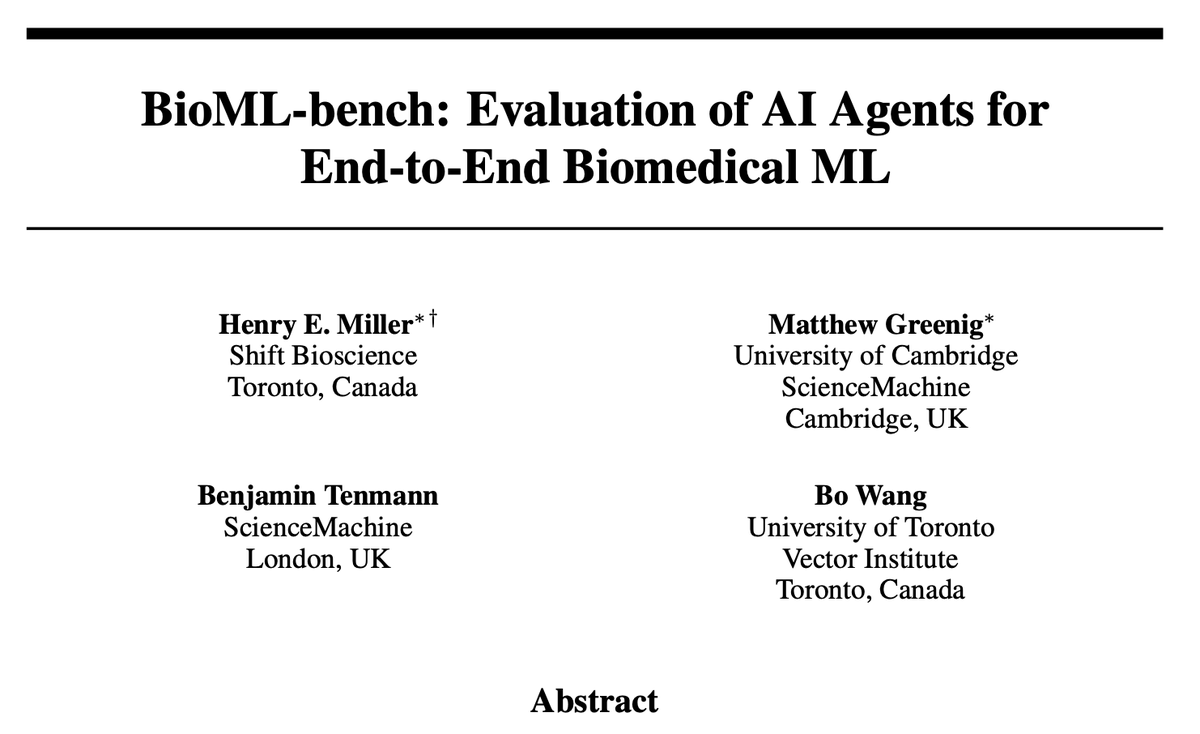
Today, we share BioML-bench, a new open benchmark to measure how far today’s agents are from this vision, and what it will take to get there.
📄 Paper : biorxiv.org/content/10.1101/…
💻 Code: github.com/science-machine/b…
Why this matters
Biomedical discovery doesn’t happen in a single step.
It’s messy, iterative, and deeply interdisciplinary: cleaning data, choosing models, validating results, integrating diverse domains like genomics, imaging, and clinical records.
Existing evaluations — mostly Q&A or coding challenges — don’t capture this complexity.
We needed a testbed that reflects the real work of biomedical ML.
What we built
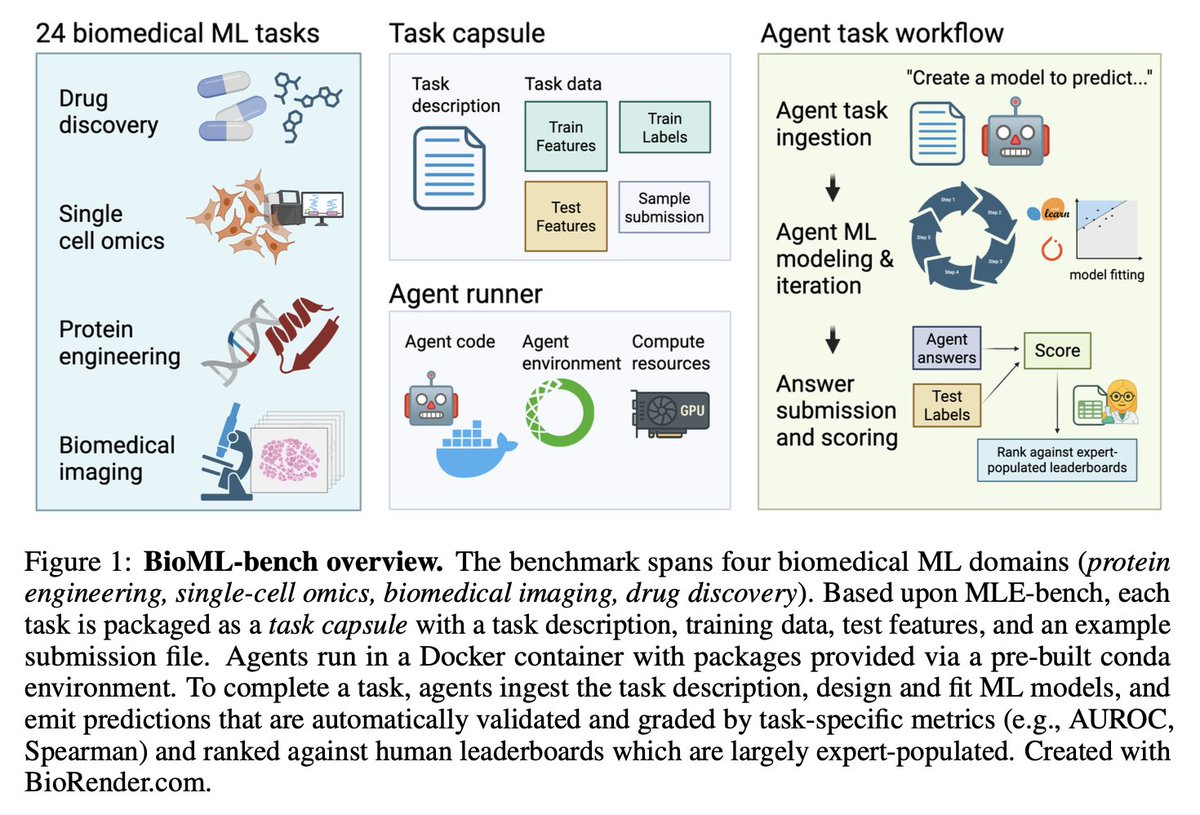
BioML-bench is a suite of 24 real biomedical ML tasks where agents must:
--Parse nuanced task descriptions
--Build and train models end-to-end
--Compete against human leaderboards populated by domain experts
It’s the first benchmark designed to ask: Can an agent truly operate like a biomedical data scientist?
What we learned
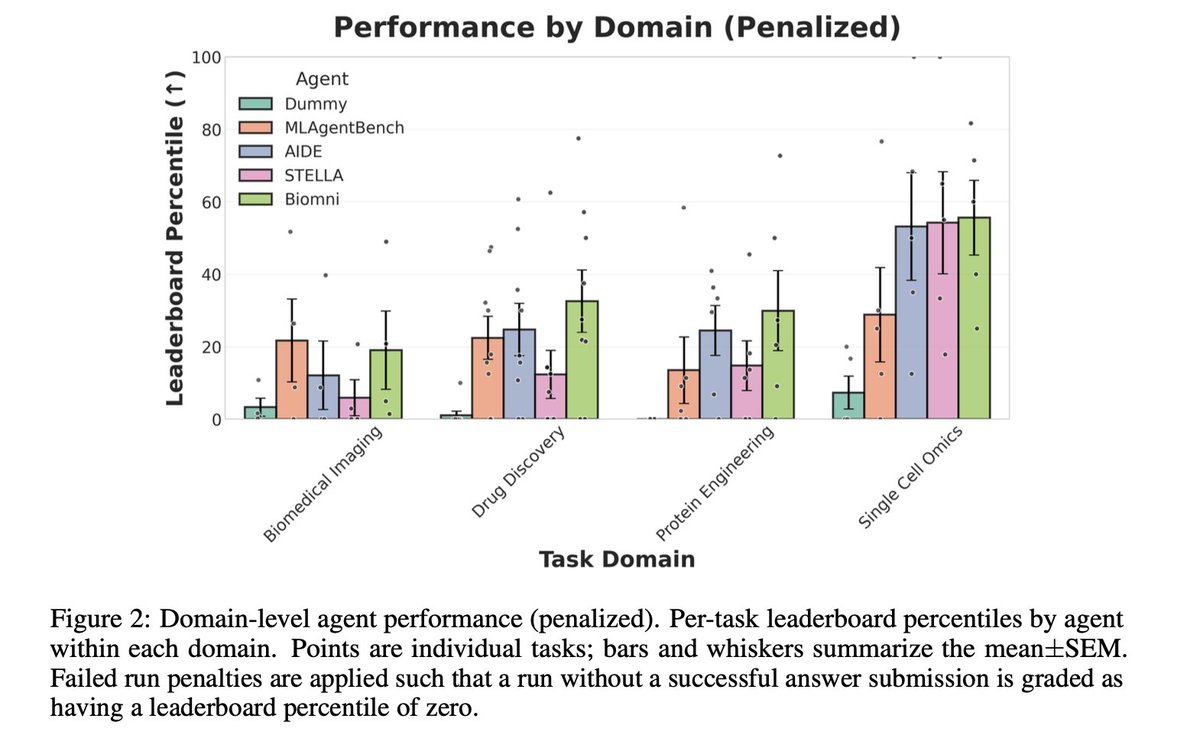
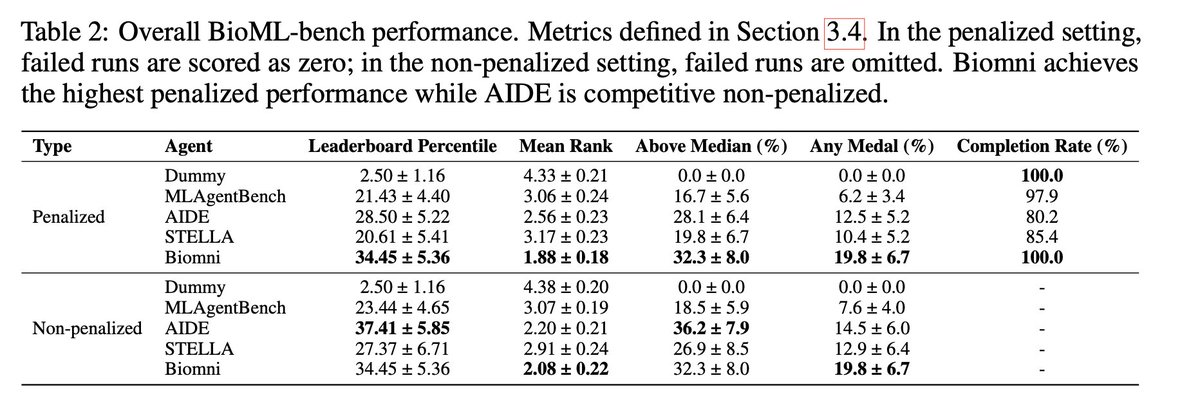
Our experiments with four different agents — from general-purpose systems to biomedical specialists — reveal a sobering truth:
--Current agents operate at ~35% of human expert performance.
--Domain specialization alone isn’t enough. Success comes from flexible, creative strategies, not rigid pipelines.
--Even on imaging tasks, deep learning was underutilized, highlighting a gap between human and agent intuition.
Looking ahead
The promise of agentic AI isn’t to replace human scientists — it’s to amplify them.
Imagine a future where an agent can set up a first-pass analysis overnight, freeing a scientist to focus on questions, not debugging scripts.
We’re not there yet. But with BioML-bench, we now have a shared yardstick to track progress, spark innovation, and bring accountability to this emerging field.
Grateful to our amazing team — led by @Henrymiller2012 , with contributions from Matthew Greenig, Benjamin Tenmann, and support from @SciMac.
This work is a small but necessary step toward a future where AI becomes a true partner in biomedical discovery. 🌱
#AI #Biomedicine #Agents #MachineLearning #BioML
9
70
269
33,499
Digital Health Canada retweeted

22 Jul 2025
Call For Papers 📣 JMIR Biomedical Engineering invites submissions for a theme issue on AI Applications in Biomedical Engineering
Learn More: hubs.la/Q03lFhD50
Editor-in-Chief: @Prof_Dr_S_Rizvi
7
14
55
807,661
11 Sep 2025
No more ‘garbage in, garbage out’: U of T rolls out health data repository for AI researchers - utoronto.ca/news/no-more-gar…
1
107
5 Sep 2025
The Ontario government has introduced the Health Innovation Pathway, a new system aimed at streamlining the review and adoption of healthtech solutions. startupecosystem.ca/news/ont…
1
2
1
122
5 Sep 2025
We are pleased to welcome @SEHealth_SEHC to the Digital Health Canada membership community! SE Health is a leading social enterprise and one of the largest diversified home health organizations in Canada. Learn more at sehc.com/
1
74
2 Sep 2025
1
106
26 Aug 2025
Establish the right conditions for the successful implementation of AI-driven solutions with the guidance of the experts interviewed in 📔 Setting the Winning Conditions for AI-powered Healthcare (the latest CHIEF Executive Forum initiative) - digitalhealthcanada.com/memb…
1
2
197
22 Aug 2025
Digital health records: Quebec authorizes an additional investment of $95 million - ctvnews.ca/montreal/article/… @CTVNews
1
1
119
22 Aug 2025
We are pleased to welcome eMHIC to the Digital Health Canada Membership Community. #eMHIC is the world’s largest peak body in #DigitalMentalHealth, uniting people and organizations across sectors. Learn more about them at ow.ly/JEeU50WnZSR.
1
2
2
137
21 Aug 2025
Join us in Montreal on Thursday, October 23 for a morning of learning and engagement with your peers from the Montreal region. Digital Health Canada Member Early Bird and Bundle savings on now! Register before September 18 at digitalhealthcanada.com/even…
1
106