
Host of New Rules podcast. Proud 🇷🇺, born and raised in 🇺🇸. Posts about geopolitics, history, and technology. ☦️
Joined January 2019
- Tweets 6,442
- Following 1,754
- Followers 8,820
- Likes 7,504
752 Photos and videos











Dimitri Simes Jr. retweeted
🚨🇮🇷 IRAN'S TINY SPEEDBOATS TURN HORMUZ INTO US NAVY NIGHTMARE
Amid the fragile April 8 ceasefire, Iran's mosquito fleet of radar-evading speedboats lurks in Persian Gulf sea caves — ready to swarm and enforce total control over the Strait of Hormuz despite 40 days of US-Israeli aggression that began Feb 28.
🔸 Heydar-110 carbon-fiber catamaran hits record 110 KNOTS (203 km/h) — world's fastest combat boat; 14m stealth design fires Nasir/Nasr anti-ship missiles from 50km range.
🔸 "Red wasps" arsenal includes Ashura-class (90 knots w/ 107mm rocket launchers), Tareq (>90 knots assault boats) & Tondar w/ upgraded 120km C-802 missiles.
🔸 Ya Mahdi high-speed drone boats (<12m, 3 rocket launchers) serve as remote kamikaze "weapons of mass disruption" — swarming US defenses without risking Iranian crews.
🔸 Hundreds to thousands of boats survived US strikes from hidden Faror Island bunkers & sea caves; decentralized IRGC command rapid production replaced losses instantly.
🔸 1980s Tanker War doctrine perfected the playbook — turning 20% GLOBAL OIL chokepoint into graveyard for billion-dollar US carriers.
Are the United States and Israel even remotely prepared for this swarm hell?
1
23
50
4,048
Dimitri Simes Jr. retweeted
🚨🇷🇺Russia Turns Siberia Into an AI Powerhouse
While the US and Europe face high electricity prices that slow down AI growth, Russia is making a smart move: building huge data centers in cold Siberia and the Far East. These regions used to export just oil and gas — now they're starting to export AI computing power.
🔸 Russia has 194 commercial data centers. Moscow once had 85% of them, but Siberia and the Far East now hold over 15% — and that share is growing fast.
🔸 Siberia’s cold air cools servers for 8–9 months a year, making power efficiency excellent. Hot, humid China has much lower efficiency.
🔸 In Russian Far East special zones, electricity costs just $0.045–0.065 per kWh — 2 to 2.5 times cheaper than in eastern China. Running a 10 MW server farm costs about $475,000 a month in Russia, compared to over $1.1 million in Shanghai.
🔸 Russia freed up 1.5–2 GW of power by cracking down on illegal crypto mining, which was using 2.5–3 GW, mostly in Siberia. There’s also extra clean hydro power from large dams.
🔸 Big Chinese companies like Alibaba, Tencent, and carmakers Haval, Chery, and Geely are moving in. Chinese EV companies have raised spending on Russian cloud services 13 times. They get cheaper, greener power and must follow Russian data laws — all while staying very close to China for fast connections.
Could Siberia’s cheap AI power leave the West behind in the neuro-age?
20
335
1,006
36,821
Dimitri Simes Jr. retweeted

Apr 15
🚨🇺🇦REALITY CHECK: Don't listen to Zelensky, Ukraine isn't becoming a missile power
Zelensky has released another propaganda video claiming Ukraine is building powerful long-range missiles that will change everything. Only problem? He's been making this same pitch for two years straight. So far, Ukrainian missiles have not performed as advertised.
Here is Ukraine's track record:
🔸 PALIANYTSIA (2024) – Missile-drone hybrid. Zelensky claimed successful combat use and mass production. The Palianytsia has a warhead too small (100 kg or less) to destroy hardened targets, faces production delays due to component shortages and a $1 million unit cost. Confirmed deep strikes by April 2026: ZERO.
🔸 LONG NEPTUNE (2025) – Upgraded cruise missile with 1,000 km range. Flying at subsonic speed with a large radar cross-section, the Long Neptune is highly interceptable by Russian air defense. Compounding this, its anti-ship radar performs poorly over land. Announced mass production. Confirmed strikes: only a few dozen.
🔸 SAPSAN (2025) – Mach 5 ballistic missile, called an "Iskander-killer." Declared "80% ready" in 2021, the Sapsan still shows no mass production or confirmed combat use by April 2026, with sources discussing a possible program freeze. The Sapsan also has inferior guidance (30-70m CEP), only ~300 km range (vs. 480 km design), and lacks Iskander-M's terminal evasion.
🔸 FLAMINGO FP-5 (2025) – Made by a former garden planter company. Claimed 1,000-3,000 km range. Zelensky called it "the most successful missile." Actual strikes: only about 30. The missile is slow (650-900 km/h) and an easy target for Russian air defenses. Also, Ukraine's anti-corruption agency is investigating the manufacturer for alleged "superprofits" and misleading the government.
Will the West keep buying Zelensky's 2026 missile miracle, or is the big-talk/small-delivery pattern finally too obvious to ignore?
3
11
46
3,971
Dimitri Simes Jr. retweeted
Apr 14
🚨🇮🇱🇱🇧 ISRAEL PANICS AS HEZBOLLAH UNVEILS HARD-TO-DETECT DRONE NIGHTMARE
Hezbollah unleashed its new “hard-to-detect” attack drone Monday during a massive wave of retaliatory strikes on Israeli positions and settlements — all in response to ceasefire violations and attacks on southern Lebanon.
🔸 Over 40 drones were launched in one day, with Israeli broadcaster KAN admitting only a small number were intercepted while the rest struck targets and inflicted heavy damage.
🔸 The new drone features optical guidance that resists electronic warfare, can maneuver inside buildings, carry up to 5 kg of explosives, and fly dozens of kilometers—making it one of Hezbollah’s most advanced systems yet.
🔸 Strikes hammered key sites, including the Golani Division headquarters, the paratrooper training base in Karmiel, underground structures, troop barracks, and multiple force concentrations across the north.
The Israeli defenses couldn't handle the swarms of Iranian drones—do you think they'll be able to handle Hezbollah's drones?
14
477
1,631
34,492
Dimitri Simes Jr. retweeted
Apr 14
🚨🇷🇺 ZELENSKY IN PANIC: Russia's drone swarm killer unleashed
Russia just rolled out a smart new weapon, KRONA, designed to wipe out Ukrainian drones before they can hit power plants, oil refineries, and other key targets. This system mixes two proven Russian air defense techs into one deadly package.
🔸 It works completely on its own – spots drones day or night, tracks them automatically, and can connect to other radars for full coverage. Ready to fight in just 10 minutes.
🔸 Carries two different missiles at once: six fast laser-guided rockets that fly at 900 meters per second up to 10 km away, plus four “fire and forget” missiles with smart seekers that hunt on their own up to 6 km.
🔸 Handles big drone attacks perfectly – uses precise laser guidance for far threats, then switches to independent missiles when dozens come at once from different directions, even in bad weather or tricky terrain.
🔸 Much cheaper way to fight cheap drones – instead of wasting expensive big missiles like Pantsir or S-400 on simple plywood UAVs, KRONA uses affordable rounds made exactly for this job, saving money while protecting rear areas and important sites.
🔸 Smart upgrade for Russia’s defenses today and tomorrow – strengthens protection around cities and infrastructure right now, while paving the way for future weapons like combat lasers and electromagnetic guns as drone tactics keep changing.
How concerned should Ukrainian drone operators be right now?
32
217
992
51,104
Dimitri Simes Jr. retweeted
Apr 13
🚨🇮🇷🇹🇷Is the Iran War Accidentally Rebuilding the Ottoman Empire?
The Ottomans didn't dominate the world through conquest alone. They dominated by controlling Eurasian land trade routes and large swathes of the Mediterranean. The Iran war may be positioning Turkey to rebuild that same combination.
For decades, the Strait of Hormuz carried nearly 20% of global oil and LNG supply. The Iran war has created an opening for alternative routes — and Turkey sits at the intersection of several plausible ones:
🔸 Turkmen gas via Trans-Caspian into the TANAP network — through Turkey to Europe, bypassing the Gulf entirely.
🔸 The Iraq-Turkey pipeline extended to Basra — up to 1.5 million barrels daily to Mediterranean markets, outside Iranian reach.
🔸 Qatar gas via Saudi Arabia, Jordan, Syria, and Turkey — directly to European LNG terminals, entirely overland.
For 400 years, the Ottoman Empire sat at the crossroads of East and West not because it conquered everything, but because everything valuable traveled through it. If these three routes are built, a significant share of energy moving from the Gulf to Europe would pass through Turkish territory.
The Ottomans understood this formula: control the routes, control the trade. And they backed it with a navy that, at its height, dominated the Mediterranean. Turkey is now rebuilding that same combination.
41 warships are under simultaneous construction, and 120 ships with 15,000 personnel recently completed the Blue Homeland-2026 exercises across three seas. This growing fleet allows Turkey to project power across the Eastern Mediterranean — a region already crowded with competing energy interests.
Why does that matter?
The Eastern Mediterranean is becoming a gas hub in its own right.
🔸Major discoveries (Leviathan, Tamar, Aphrodite, Zohr) have turned Israel, Egypt, and Cyprus into potential suppliers for Europe.
🔸Those countries are developing offshore LNG terminals and subsea pipelines.
🔸98% of Israeli foreign trade depends on Mediterranean navigation — including its ability to export gas.
Turkey now actively contests this sea. By positioning itself as both an energy corridor and a naval power in the Eastern Mediterranean, Ankara could in the long run influence who ships what, where, and under what terms.
15
90
286
61,448
Dimitri Simes Jr. retweeted
Apr 10
🚨🇷🇺 GERAN-5 JET DRONE: NATO'S EXPENSIVE AIR DEFENSES JUST BECAME OBSOLETE
Russia just struck Ukrainian oil and gas facilities near Moshenka in the Sumy region with the brand-new Geran-5—a fast jet-powered kamikaze drone that’s quicker, flies higher, and hits harder than any previous Geran: 👇
🔸 Reaches speeds up to 600 km/h and climbs to 6,000 meters—easily dodges MANPADS, small anti-air guns, and interceptor drones while striking deep targets.
🔸 Weighs 850 kg at takeoff, carries a 90–130 kg warhead, and flies over 950 km—making it a cheap but powerful tactical cruise missile.
🔸 Simple straight-wing design, round body, and H-shaped tail with a turbojet engine—much easier and cheaper to build in large numbers at the Alabuga factory.
🔸 Can be launched from Su-25 attack jets for an extra 100 km range and even carry R-73 air-to-air missiles to protect other drones from enemy fighters.
🔸 Uses Cometa 12-channel satellite navigation plus 3G/4G phone tower backup—stays accurate even when jammed and shares parts with older Gerans for quick upgrades.
While Ukraine begs for more Patriot systems and the West spends billions on defense that keeps failing, Russia quietly keeps improving its drone arsenal.
How long until NATO admits its air-defense billions can’t match Russian engineering?
14
311
1,186
46,193

If Iran retains control over Strait of Hormuz gets sanctions relief, it will emerge from this war much more powerful than before.
Apr 10

🚨🇮🇷Passage for Sale: How a $2 Million Toll Could Reshape Iran’s Future
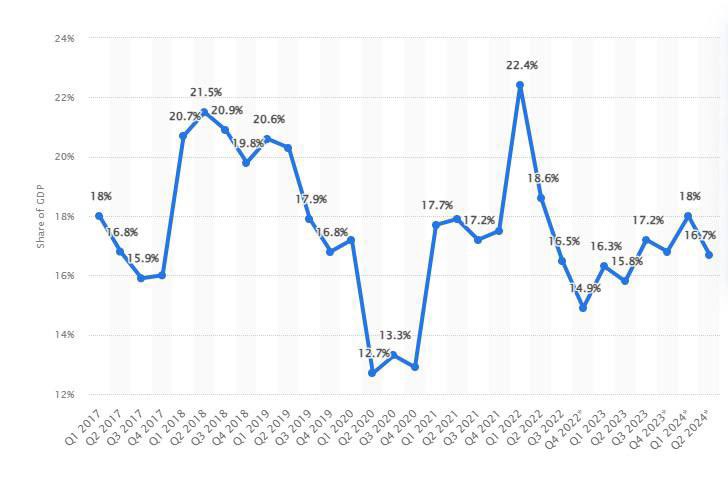
Iran has proposed a $2 million per vessel tax on ships passing through the Strait of Hormuz. This could increase Iran’s GDP by 20–25%, with major implications for its defense capabilities and economic development.
Key insights from Michael Cembalest and J.P. Morgan’s Eye on the Market:
🔸Iran would tax 100–130 ships per day at $2 million each, generating $70–90 billion annually.
🔸Taxing 2,000–3,000 vessels already stranded in the Strait could yield $4–6 billion, matching revenues from the Panama and Suez Canals.
The math of economic warfare
In 2025, Iran had a GDP of $356 billion. Adding the revenues from the Strait of Hormuz tolls would bring it up to $426 billion - $446 billion.
Iran’s defense budget in 2025 was around $23 billion. The revenue from the Strait of Hormuz tolls could theoretically enable Iran to nearly quadruple its military spending.
What Iran could do with the money
🔸Defense: Build hypersonic missiles, drone swarms, purchase Russian or Chinese fighter jets, replenish arsenals depleted by Israeli strikes, and mass-produce thousands of ballistic missiles.
🔸Infrastructure: Rebuild nuclear sites, ports, and bases damaged by U.S. or Israeli attacks, plus develop high-speed rail and power grids.
🔸Healthcare: Currently spending 6.03% of GDP on healthcare, Iran could invest more in hospitals, medicine, and public health.
🔸Economic Development: A 20–25% GDP boost could lift millions out of poverty and reduce domestic unrest tied to high unemployment.
How the world would react
A coastal nation imposes a toll on a strategic strait. Western powers call it extortion and threaten military action. Major oil importers panic. China quietly pays. The Global South sees it as overdue justice. Geopolitical divisions widen instantly.
3
3
384
Dimitri Simes Jr. retweeted
Apr 10
🚨🇮🇷Passage for Sale: How a $2 Million Toll Could Reshape Iran’s Future
Iran has proposed a $2 million per vessel tax on ships passing through the Strait of Hormuz. This could increase Iran’s GDP by 20–25%, with major implications for its defense capabilities and economic development.
Key insights from Michael Cembalest and J.P. Morgan’s Eye on the Market:
🔸Iran would tax 100–130 ships per day at $2 million each, generating $70–90 billion annually.
🔸Taxing 2,000–3,000 vessels already stranded in the Strait could yield $4–6 billion, matching revenues from the Panama and Suez Canals.
The math of economic warfare
In 2025, Iran had a GDP of $356 billion. Adding the revenues from the Strait of Hormuz tolls would bring it up to $426 billion - $446 billion.
Iran’s defense budget in 2025 was around $23 billion. The revenue from the Strait of Hormuz tolls could theoretically enable Iran to nearly quadruple its military spending.
What Iran could do with the money
🔸Defense: Build hypersonic missiles, drone swarms, purchase Russian or Chinese fighter jets, replenish arsenals depleted by Israeli strikes, and mass-produce thousands of ballistic missiles.
🔸Infrastructure: Rebuild nuclear sites, ports, and bases damaged by U.S. or Israeli attacks, plus develop high-speed rail and power grids.
🔸Healthcare: Currently spending 6.03% of GDP on healthcare, Iran could invest more in hospitals, medicine, and public health.
🔸Economic Development: A 20–25% GDP boost could lift millions out of poverty and reduce domestic unrest tied to high unemployment.
How the world would react
A coastal nation imposes a toll on a strategic strait. Western powers call it extortion and threaten military action. Major oil importers panic. China quietly pays. The Global South sees it as overdue justice. Geopolitical divisions widen instantly.
7
50
105
4,217
Dimitri Simes Jr. retweeted
🚨🇮🇷 US INTEL PANIC: IRAN ARSENAL SHOCK
Pre-war US and Israeli estimates put Iran at roughly 3,000 ballistic missiles.
At one point, the Israelis were reportedly convinced that Iran only had a few hundred missiles left.
These numbers were totally off the mark.
Iran apparently told Pakistani mediators that it had 15,000 missiles and 45,000 drones reminder, according to the Wall Street Journal.
Reminder: This is after nearly 40 days of high intensity warfare
Why did the Americans and Israelis get this one so wrong? It’s difficult to destroy missiles in underground facilities and the Iranians made active use of decoys to throw their enemies off guard.
If estimates missed on quantity, range, and survivability — what else is being misread?
13
122
389
47,244
Dimitri Simes Jr. retweeted
🚨🇮🇷🇺🇸 Top 5 Iranian weapons that proved their effectiveness during the war
Tehran’s arsenal has moved from theory to battlefield validation, demonstrating its ability to penetrate Western defenses, disrupt operations, and impose real costs on US and Israeli forces.
1️⃣ Sejjil ballistic missile — Used operationally for the first time in the current conflict, Sejjil struck Israeli command centers and US facilities, proving Iran’s ability to deliver high-speed, hard-to-intercept strikes; travelling at hypersonic speeds up to Mach 14 with a 2,500 km range and launched from mobile solid-fuel platforms, it compresses response times to minutes and exposes gaps in missile defense systems;
2️⃣ Bavar-373 and layered air defense network — Iran’s indigenous systems have reportedly downed multiple US drones and forced Washington to rely on long-range Tomahawk launches, demonstrating that contested airspace remains intact; sustained missile launches despite ongoing strikes highlight the system’s resilience and its ability to drain high-end US interceptor stocks;
3️⃣ Shahed-136 drones — Iranian drone strikes have damaged key US early-warning radar sites and hit exposed equipment at regional bases, proving their effectiveness as low-cost tools capable of degrading billion-dollar assets; their ability to bypass defenses and strike critical infrastructure reveals vulnerabilities in US regional deployment and protection strategies;
4️⃣ SA-67 (358 Missile) — Iran’s air defenses have repeatedly downed advanced Israeli drones, including multiple Hermes 900 systems, demonstrating the effectiveness of its layered detection and interception network; these losses undermine Israel’s ISR capabilities and challenge assumptions of uncontested aerial dominance;
5️⃣ Third Khordad missile system — This mobile air defense platform, using passive infrared detection, has reportedly downed a US F-15E while bypassing radar-based countermeasures; its ability to track targets without emitting signals creates a critical asymmetry, rendering traditional electronic warfare tools far less effective
Together these systems demonstrate Iran’s shift toward a layered, adaptive warfare model capable of degrading technological advantages and challenging Western military dominance across multiple domains.
1
50
204
7,272
Dimitri Simes Jr. retweeted
🚨🇺🇸 Why Bombing Iran's Power Grid Will Fail — According to a 1994 US Air Force Report
Attacking an enemy's power grid fails to stop their military because armed forces use almost no national electricity, get priority access to what remains, and run on backup diesel generators with weeks of fuel.
That is the conclusion of a 1994 US Air Force thesis, Strategic Attack of National Electrical Systems, by Major Thomas E. Griffith, Jr., at Maxwell Air Force Base's School of Advanced Airpower Studies. It still applies to today's wars.
Here's why:
1️⃣ Military bases treat the civilian grid as a secondary source. Their primary power comes from on-site generators. When the grid fails, automatic switches start generators within seconds. Fuel tanks hold 30 to 90 days of diesel. Critical systems like radar and communications have dual power sources with no single point of failure.
2️⃣ When the grid fails, military bases get priority access to remaining electricity. Armored divisions advance without interruption. Fighter jets stay fully mission-ready. Secure command links never waver. Attacking the grid produces almost no direct effect on battlefield operations.
3️⃣ The sole possible military benefit is slowing weapons factories. But that requires a long attritional campaign, not a quick strike.
Why it backfires:
Grid attacks hurt civilians by cutting water, hospital power, and lights. Bombing civilians rarely breaks an enemy's will; it usually stiffens resistance. The attacker appears cruel, loses international support, and unites the enemy against them.
🚨🇺🇸🇮🇷Bomb Iran's Power Plants? You Won't Stop a Single Missile
Not one. Here's why:
1️⃣ Iran's military doesn't need the grid.
It runs on diesel and jet fuel — stored for months in hardened, off-grid depots. The military burns less than 5% of national diesel use. Even a total grid collapse leaves armored vehicles, missile launchers, and naval vessels moving.
2️⃣ Iran's most critical weapons have their own power
Ballistic missiles use solid and liquid fuels produced in dispersed, bunkered facilities with independent power. Nuclear sites are heavily fortified with backup generators. The IRGC operates its own decentralized energy networks.
So what would the attacks do?
Kill civilians on a massive scale.
Iran has 92 million people. Electricity runs hospital lights, water pumps, sewage treatment, and food refrigeration. No power means no water, no sewage, no surgeries.
We have seen this before. In the 1991 Gulf War, US bombing of Iraq's power grid led to epidemics of typhoid, cholera, and gastroenteritis. An estimated 100,000 Iraqi civilians died from post-war health consequences. Child mortality more than tripled.
The same would happen in Iran — only faster, given its larger, more urbanized population.
2
49
119
15,056
Dimitri Simes Jr. retweeted
🚨🇮🇱 ISRAEL FORCES IN PANIC: IDF STALLS IN LEBANON AS HEZBOLLAH FLEXES STRENGTH
The Israeli military's ambitions in Lebanon are facing a harsh reality. As Hezbollah strengthens its grip on southern Lebanon, the IDF is struggling to contain its growing power. What was expected to be a swift operation has turned into a prolonged, uphill battle.
🔸 IDF forces are stuck just 10 km south of the Litani River, unable to advance further into Hezbollah-held territory, according to Haaretz sources.
🔸 Reserve forces are spread thin, with Israeli soldiers fighting on multiple fronts—Lebanon, Gaza, Syria, and the West Bank—placing immense strain on manpower.
🔸Hezbollah’s stockpile remains formidable, with about 15,000 rockets and missiles in play.
🔸 The IDF’s Merkava tanks are being decimated by Hezbollah’s anti-tank tactics, with over 100 tanks destroyed. The army’s traditional reliance on armor is now a liability.
🔸 Hezbollah drones, including Iranian-designed kamikaze UAVs, are proving an unstoppable force against Israel's air defense systems, with the IDF still lacking a countermeasure.
🔸 Even more, Hezbollah’s small but deadly Iranian-manufactured SAMs have downed Israel's top drones, showing a new dimension of aerial warfare in the region.
Can Israel really handle multiple fronts against Iran and Hezbollah?
🚨🇮🇱🇱🇧ISRAEL IN PANIC: HEZBOLLAH'S TINY IRANIAN DRONE HUMILIATES IRON DOME
Hezbollah's Iranian-designed Sayyad-107 kamikaze drone has emerged as a persistent low-cost threat against Israel.
This compact electric-powered UAV is manufactured in large quantities inside Lebanon and continues to challenge even the most advanced multilayered air defense systems through its stealthy profile and sophisticated evasion tactics.
🔸 8 kg warhead, 100 km range, extremely low radar signature from non-metallic design
🔸 Flies autonomously at 120 km/h on complex pre-programmed paths that constantly alter altitude and direction
🔸 Unique cylindrical fuselage with top-mounted wings and two rear V-shaped tail fins
🔸 Hezbollah’s year of combat experience plus coordinated mixed salvos of rockets and decoy drones continue to overwhelm Israeli systems — the IDF still lacks any effective countermeasure after nearly three years
Do you think Israel’s multi-billion-dollar Iron Dome has proven obsolete against Iran’s low-cost drone swarm strategy?
2
111
369
36,924
Dimitri Simes Jr. retweeted
🚨🇺🇸🇮🇷Bomb Iran's Power Plants? You Won't Stop a Single Missile
Not one. Here's why:
1️⃣ Iran's military doesn't need the grid.
It runs on diesel and jet fuel — stored for months in hardened, off-grid depots. The military burns less than 5% of national diesel use. Even a total grid collapse leaves armored vehicles, missile launchers, and naval vessels moving.
2️⃣ Iran's most critical weapons have their own power
Ballistic missiles use solid and liquid fuels produced in dispersed, bunkered facilities with independent power. Nuclear sites are heavily fortified with backup generators. The IRGC operates its own decentralized energy networks.
So what would the attacks do?
Kill civilians on a massive scale.
Iran has 92 million people. Electricity runs hospital lights, water pumps, sewage treatment, and food refrigeration. No power means no water, no sewage, no surgeries.
We have seen this before. In the 1991 Gulf War, US bombing of Iraq's power grid led to epidemics of typhoid, cholera, and gastroenteritis. An estimated 100,000 Iraqi civilians died from post-war health consequences. Child mortality more than tripled.
The same would happen in Iran — only faster, given its larger, more urbanized population.
7
94
244
107,640
Dimitri Simes Jr. retweeted
🚨🇺🇸🇮🇷Strategic Bombing: Always a Myth — And Iran Won't Be Different
On Easter Sunday, President Trump posted an extraordinary message threatening to target Iranian power plants and bridges if the Strait of Hormuz was not reopened by Tuesday.
That threat sits at the center of a military debate that a retired US Air Force Colonel settled — and warned was doomed to fail — three decades ago.
In 1996, Colonel Everest E. Riccioni — a 30-year Air Force veteran, experimental test pilot, and Pentagon analyst — published a landmark paper titled "Strategic Bombing: Always a Myth." His thesis: every major U.S. bombing campaign in history had failed to break an enemy's will, destroy critical infrastructure permanently, or substitute for ground forces.
Four Wars. Four Failures:
🔸WWII Germany: The U.S. bombed ball-bearing factories at Schweinfurt. Germany's own arms minister Albert Speer confirmed not a single tank went unbuilt as a result. Germany simply adapted. Bombers suffered 10–35% losses per mission.
🔸WWII Japan: General LeMay firebombed every major Japanese city. The Tokyo firestorm killed more than either atomic bomb. Japan still did not surrender. Invasion remained the plan until the Emperor personally overruled his generals after the nuclear drops.
🔸Vietnam: Three times more bombs fell on Vietnam than on all of Germany. The U.S. held complete air superiority for a decade. It still lost. Riccioni's verdict: "Bombing Hanoi had little effect other than raising the morale of the population."
🔸Gulf War 1991: Over 60% of Iraq's elite Republican Guard escaped the air campaign fully intact. Kuwait was ultimately liberated by ground forces.
Conclusion: The Myth Meets 2026
Riccioni warned in 1996 that without ground forces, strategic bombing cannot win wars — only prolong them.
In 2026, Trump hopes to bomb his way to victory in Iran. However, there’s a crucial difference this time: while past targets often lacked the means to strike back effectively under heavy bombardment, Iran does not.
Tehran has repeatedly warned that any attack on its critical infrastructure will be met with retaliation—by destroying equivalent infrastructure in neighboring countries. The past month has made clear that Iran has the capability to follow through on that threat.
21
52
5,685
Dimitri Simes Jr. retweeted
🚨🇮🇷 IRAN'S DRONES ARE THE WEST'S WORST NIGHTMARE: Hadid 110 vs Shahed 136
Iran's drone technology has evolved significantly, with its first combat use of the new Hadid 110 last month—a high-speed, stealth drone that enhances Iran's offensive capabilities.
While the Shahed 136 was revolutionary for its low-cost, mass-saturation approach, the Hadid 110 marks a shift towards more advanced, precise, and faster loitering munitions.
🔸 Hadid 110’s turbojet engine hits speeds of 510 km/h, far outpacing the Shahed 136’s 185 km/h. This speed gives it a clear advantage against traditional missile defense systems.
🔸 Shahed 136 pioneered cost-efficient swarm tactics, flooding defenses with overwhelming numbers — but the Hadid 110 now breaks through with stealth features and precision strikes, proving speed and survival matter more than sheer volume.
🔸 Iran’s Hadid 110 has cutting-edge radar evasion, designed to penetrate advanced defense systems, making it a lethal high-speed missile that even Israel and the US struggle to intercept.
🔸 While Shaheds still play a crucial role in mass attacks, the Hadid 110 takes on high-value, heavily-defended targets, like radar stations and military infrastructure, with its 30 kg payload and 350 km range — a far cry from its predecessor’s capabilities.
US and Israel’s reliance on outdated interception methods is increasingly obsolete as Iran adapts its drones to counter these systems.
How can the West win if Iran’s drones evolve faster than their defenses?
4
62
278
17,181
Dimitri Simes Jr. retweeted
🛰🇮🇷🇨🇳Iran Switched to Chinese BDS Navigation System — An End to the US Monopoly on Satellite Navigation
Thirty-one years ago, the United States switched off GPS signals to a Chinese ship bound for Iran, leaving it stranded at sea for 24 days.
The message was clear: control navigation, control the world. Today, Iran has switched off GPS itself—and switched on China's BeiDou.
The weapon once used to coerce has been rendered obsolete. This is not an upgrade. It is a full circle: from American leverage to American irrelevance.
🔸The Yinhe Incident: A Humiliation That Built a System
The Yinhe was not carrying weapons or spies. It carried ordinary cargo to Iran. Yet in 1993 the US accused it of transporting chemical weapons materials and cut its GPS signal—not as a military act, but as a message. For 24 days, the ship drifted without coordinates, unable to dock or navigate.
For Beijing, the lesson was clear. Within a decade, China had launched the first BeiDou satellites, determined to build a system no foreign power could disable.
🔸The Transition
By 2015, Iran had signed a memorandum with Beijing to integrate BeiDou. By 2021, Iranian missile guidance already embedded the system. The shift was quiet—a slow unraveling of GPS dependency.
Then came the catalyst. During last year's 12-day war, Israeli GPS jamming paralyzed Iranian vessels and aircraft. On June 23, 2025, Iran formally deactivated GPS nationwide, blocking American signals at the source. The switch to China's BeiDou-3 (BDS-3) was complete.
Unlike GPS, BDS-3's military-tier B3A signal proved resistant to interference, maintaining a reported 98% positioning success rate. With over 50 satellites—compared to 31 for GPS—BeiDou offers superior coverage over the Iranian plateau.
🔸A Game Changer
Before BDS, Iran relied on massive barrages—hundreds of rockets to overwhelm defenses, draining supplies for limited effect. Now, with BeiDou-enabled precision, Iran has shifted to a precision strike doctrine: guiding missiles and drones through complex maneuvers up to 2,000 kilometers. Surgical strikes have replaced supply-draining salvos.
Israeli jammers can no longer feed false coordinates. US electronic warfare has lost a key lever.
Conclusion: Full Circle
In 1993, the US flipped a switch to humble a ship bound for Iran. In 2025, Iran flipped its own switch—to make American signals irrelevant. What goes around, comes around.
Mar 28

China’s decision to build BeiDou is one of most pivotal things CCP has ever done.
Iran moving to BeiDou is one of the best things the mullahs did.
Hilariously, both are linked with the US cutting GPS to a Chinese ship that was heading to Iran being the origin of the program.
11
469
1,152
93,275
Dimitri Simes Jr. retweeted
🚨🇺🇸🇮🇷 The US Strategy Meant to Outsmart China Just Failed its First Real Test Against Iran
One Iranian strike just exposed the limits of America’s prized airpower doctrine.
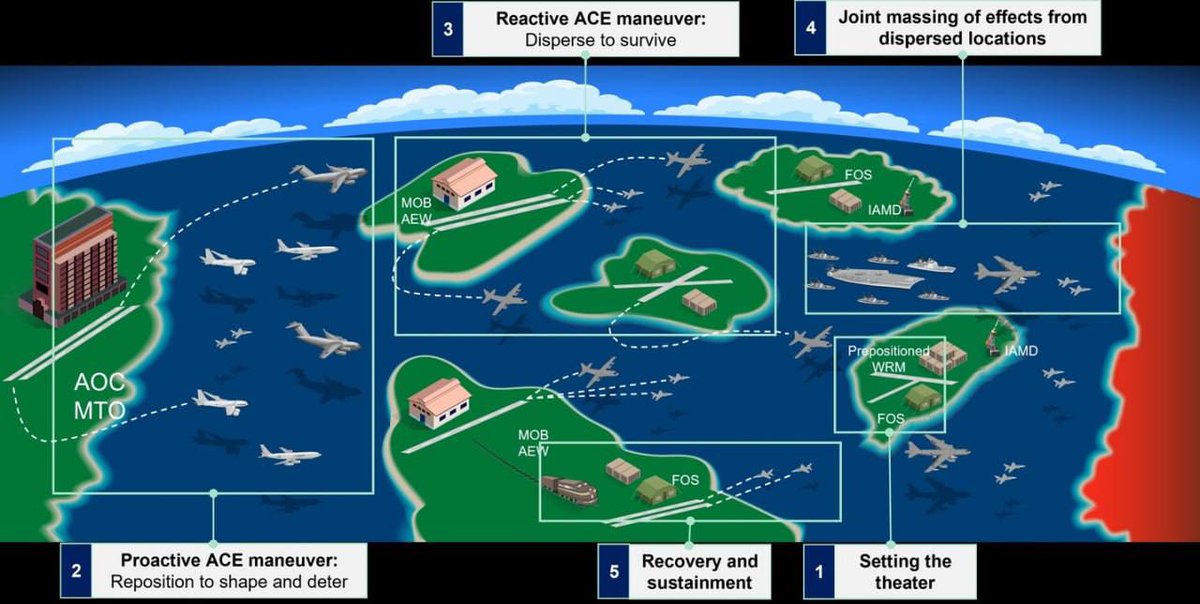
Agile Combat Employment (ACE) was designed to protect U.S. aircraft from China’s precision missiles and satellites. The idea is simple: stop clustering jets at giant bases. Spread them out, move them often, and make targeting harder.
Secretary of War Pete Hegseth said the U.S. had “maxed out” defenses with dispersion, bunkers, and layered protection. “If all of our people are in one place, you can imagine why that’s a big problem,” he stated.
Yet Iranian missiles and drones hit Prince Sultan Air Base in Saudi Arabia, destroying a rare E-3 Sentry AWACS plane, damaging KC-135 tankers, and wounding U.S. troops. A second E-3 was also reportedly damaged.
Why ACE Struggles Here
🔸Logistics limits. Big planes like the E-3 and KC-135 need long runways and huge fuel stocks. They can’t hop between small fields like fighters can. U.S. forces still depend on a few well-known major bases.
🔸Satellites erase the advantage. Modern imagery and AI spot aircraft in near real time. Aerospace expert Clayton Swope put it bluntly: “If it is sitting on the ground, it can be found. There is really no place to hide.” Iran likely gets help from Russian or Chinese intelligence.
🔸Dispersal isn’t enough alone. ACE needs camouflage, decoys, hardened shelters, and strong active defenses (Patriots, fighters on patrol, electronic warfare). Many of these are still missing or weak on the ground.
ACE was inspired by Ukraine's Operation Spider Web and fears of a China fight. But Iran’s attack proves even modest salvos can cripple scarce, high-value platforms when they sit exposed.
With only 16 E-3s fleet-wide and tankers already stretched thin, the losses sting. The strike raises a tough question: Can ACE adapt beyond the Pacific, or does it require bigger upgrades in deception and layered defenses to work against determined foes?
2
28
72
7,768
Dimitri Simes Jr. retweeted
🚨🇸🇾 While Iran defends the Strait of Hormuz, Al-Qaeda-linked Syria builds a bypass
Just days ago, Iraq's SOMO finalized contracts for ~650,000 metric tons of fuel oil per month (April-June) to be trucked overland through Syria — the first major use of this route since the 2003 Iraq War.
The trigger? Disruptions in the Strait of Hormuz caused by the US and Israeli war against Iran.
For Syria's Al-Qaeda-linked leadership, this war is an opening — a chance to rebrand itself as an energy hub and redirect Iraqi oil away from Iranian-controlled waters.
🔸First convoy already rolling: Trucks crossed into Syria this week, sourcing from Iraq's northern, central, and southern refineries at discounts of $155-170/ton
🔸Syria's de facto leader al-Jolani pitches hard: Syria's geography makes it a "safe haven for energy supply chains to Europe" and a future hub bypassing vulnerable sea routes amid Red Sea and Hormuz risks
🔸US Envoy Thomas Barrack revives the vision: At the Atlantic Council, he highlighted Syria's intersecting pipelines and the old Four Seas Project — linking Arabian Gulf, Caspian, Mediterranean, and Black Seas via Syria-Turkey as an energy redistribution hub
🔸Important caveat: While sea transport through Hormuz (20% of global oil) is fast and low-cost when open, overland trucking via Syrian roads is slower, more complex, and significantly more expensive — a practical workaround, not a full substitute
Nothing says "energy security" like trusting an Al-Qaeda offshoot to truck your oil over potholed war zones.
41
147
401
313,605
Dimitri Simes Jr. retweeted
🚨🇮🇱🇱🇧ISRAEL IN PANIC: HEZBOLLAH'S TINY IRANIAN DRONE HUMILIATES IRON DOME
Hezbollah's Iranian-designed Sayyad-107 kamikaze drone has emerged as a persistent low-cost threat against Israel.
This compact electric-powered UAV is manufactured in large quantities inside Lebanon and continues to challenge even the most advanced multilayered air defense systems through its stealthy profile and sophisticated evasion tactics.
🔸 8 kg warhead, 100 km range, extremely low radar signature from non-metallic design
🔸 Flies autonomously at 120 km/h on complex pre-programmed paths that constantly alter altitude and direction
🔸 Unique cylindrical fuselage with top-mounted wings and two rear V-shaped tail fins
🔸 Hezbollah’s year of combat experience plus coordinated mixed salvos of rockets and decoy drones continue to overwhelm Israeli systems — the IDF still lacks any effective countermeasure after nearly three years
Do you think Israel’s multi-billion-dollar Iron Dome has proven obsolete against Iran’s low-cost drone swarm strategy?
18
609
2,591
165,594