
Founder @JumptuitNow Genesis J2T, AI-Powered Global Event Detection, Tracking the continuously changing constitution of elements, motion & trajectory of events
Joined November 2011
- Tweets 1,488
- Following 790
- Followers 2,986
- Likes 1,858
181 Photos and videos







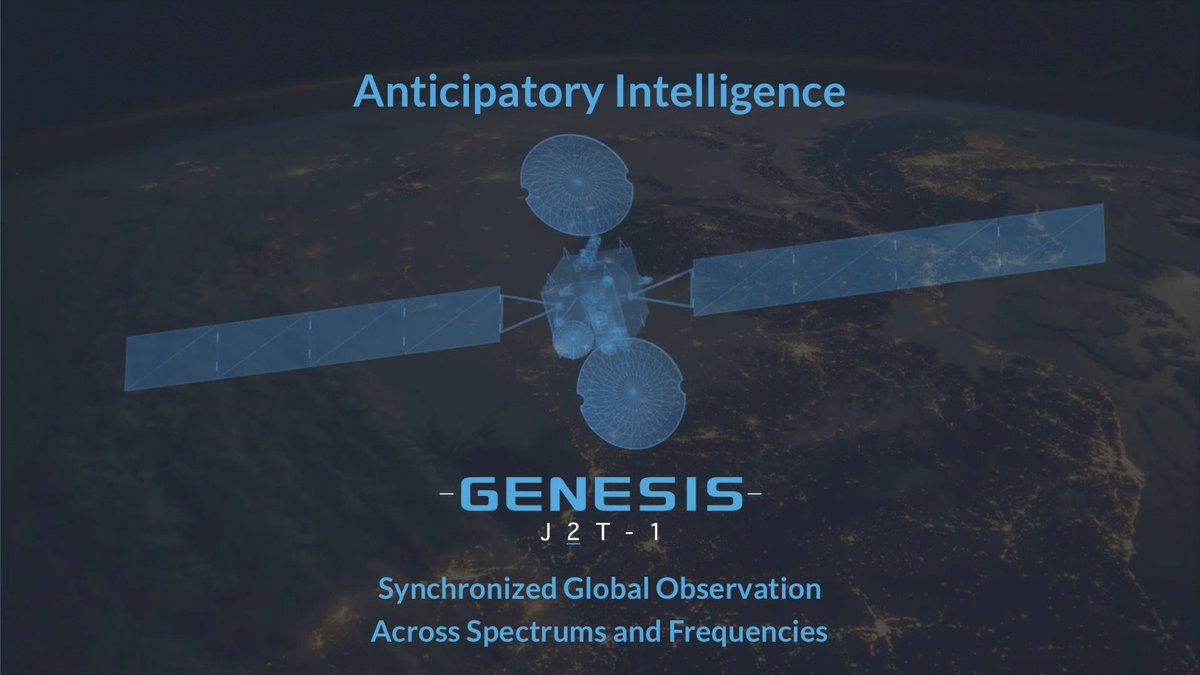
Pinned Tweet

24 Sep 2025
This is a watershed moment to reflect on where Large Language Models (LLMs) stand and where we go from here.
LLMs have bumped into a wall. LLMs lack a direct link to the physical world, have difficulty with novel situations, and struggle with increasing degrees of complexity.
Join us for a presentation by Donald Leka, Founder, Chairman and CEO of The Jumptuit Group, on “Next Generation AI Reasoning Models: De-Risking Policymaking in an Uncertain World and Forecasting Unexpected Geopolitical and Environmental Events,” at Georgetown University.
Watch the presentation below to learn more about AI’s missing link to the physical world.
4
5
752
Jun 2
I am looking forward to the Future Investment Initiative’s (FII) FII Priority Europe summit, 'Europe Reimagined: Capital, Sovereignty & Strategic Autonomy,' on June 17–19, 2026 in Rome, Italy.
Europe has never faced a more critical need for reliable anticipatory intelligence.
By anchoring AI — driven by unbiased cross-sector data to understand context, and advanced reasoning to forecast consequence — at the core of strategic planning and policy formulation, we can transform insight into active, anticipatory preparedness.
Jumptuit Founder and CEO Donald Leka at FII on the Ethos of Observational AI:
Watch Video: youtu.be/CGd4pyp31AI?si=EAUa…
Is there an ethos you live your life by?
Donald Leka: “The ethos that I live my life by, and the technology very much reflects those values, is neutrality of data. It’s very important that the data not become biased or manipulated in any way because otherwise we’re going to be making some very dangerous decisions that could have a very negative impact. So, the sanctity of data is the core value of the company and it’s based on my values as well.
The ethical component – ethical AI – is very important, but it has to be applied after we have a clear picture of what realistically can be done.”
5
6
90
May 18
How to Fix AI’s Reasoning Problem
The Problem: The physical world is driven by deeply interconnected, complex systems that trigger cross-sector ripple effects across the global economy, infrastructure, and supply chains. However, traditional Large Language Models (LLMs) fail to map and forecast these intricate cross-sector collateral consequences.
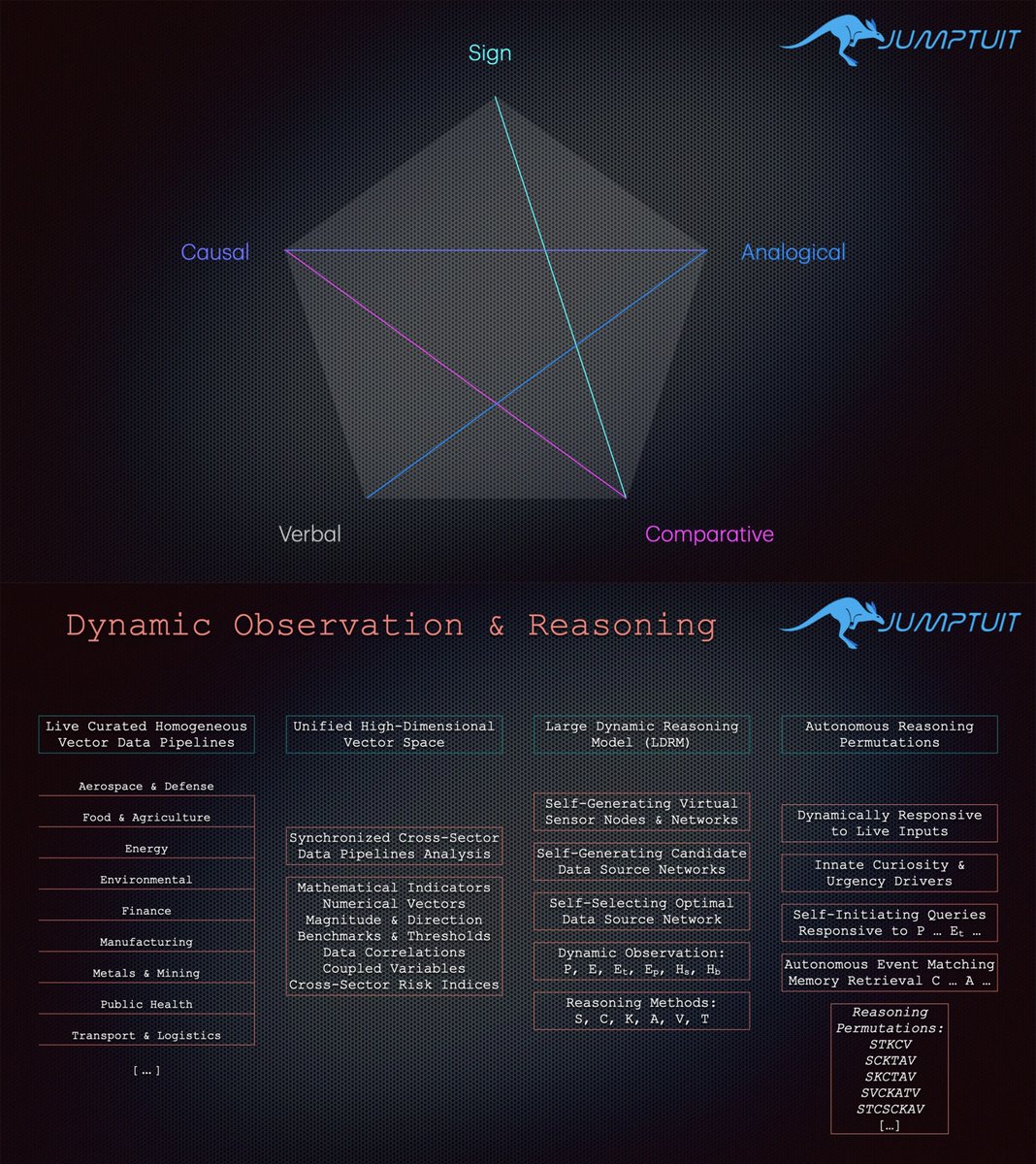
The Solution: Jumptuit has developed a flexible reasoning process that dynamically shifts among sign, comparative, causal, and analogical reasoning. This allows the AI model to observe, analyze, and understand live, cross-sector data streams from the physical world with sophisticated cross-sector ontologies enabling it to detect novel, complex conditions and anticipate events.
By dynamically adapting to live inputs, these autonomous reasoning permutations mitigate systemic risk and reduce the costs of geopolitical and environmental instability, augmenting human decision-making and forecasting event shockwaves before they materialize.
Jumptuit Founder & CEO Donald Leka at SCSP AI Expo 2026:
“Jumptuit observes phenomena in the physical world. We track events, transitional events, and events in motion, as well as probable events. Because clusters of signals appear before an event occurs, Jumptuit captures these precursors, antecedent elements, and human activity—including human behavior and human systems.
We treat human behavior and human systems as external variables to be observed.
Jumptuit utilizes various reasoning types. Depending on the live data input, we apply different permutations of sign, comparative, causal, analogical, verbal, and temporal reasoning.
By doing so, Jumptuit observes, analyzes, and understands live cross-sector data, ensuring our reasoning permutations are dynamically responsive to live inputs.
Verbal reasoning is ultimately the final stage. Once a core data response is formulated based on the live data input, verbal text is generated to describe the findings.”
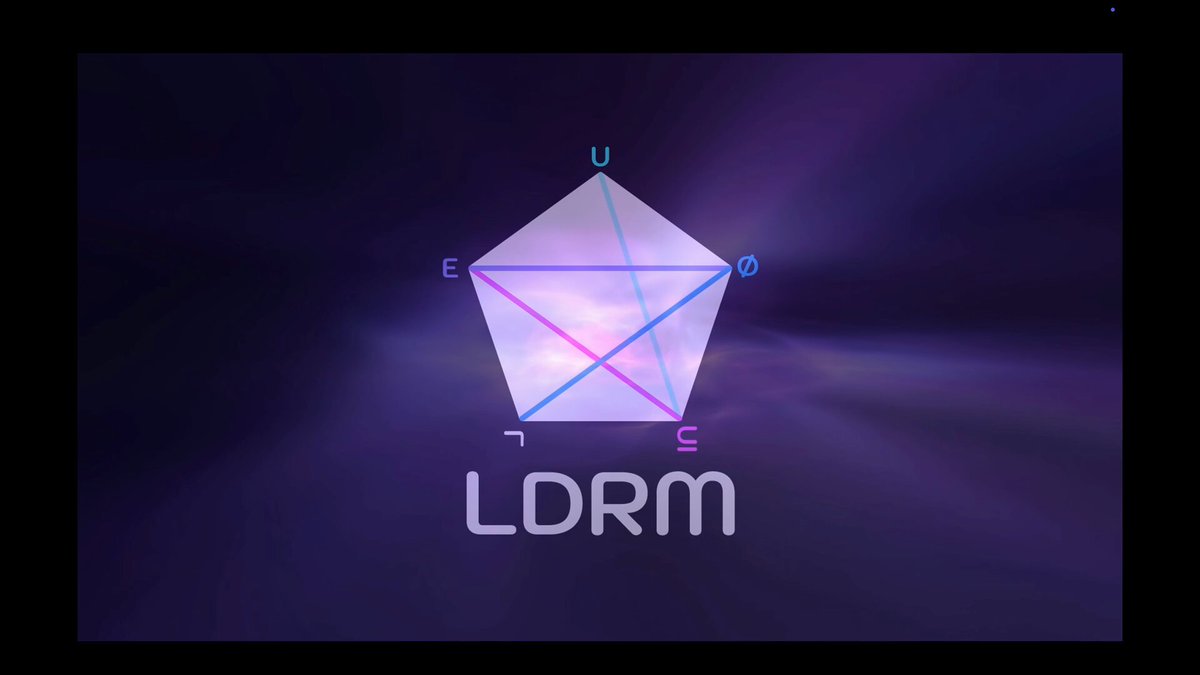
Jumptuit’s Large Dynamic Reasoning Model (LDRM):
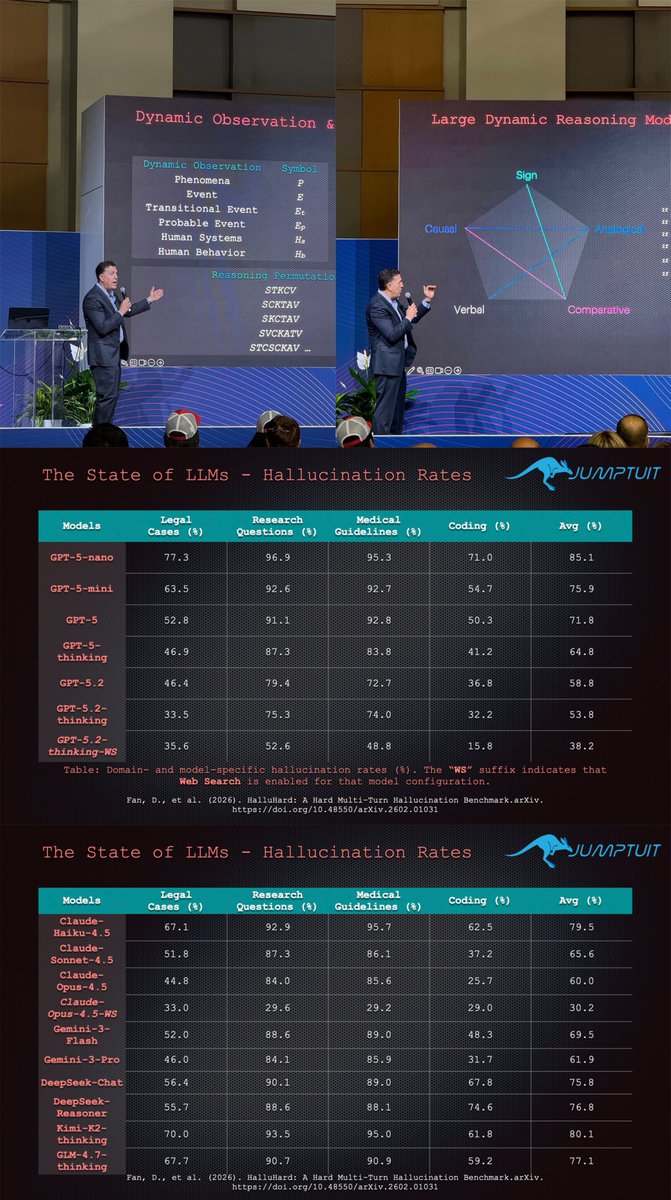
Dynamic Observation: Phenomena, Events, Transitional Events, Probable Events, Human Systems, Human Behavior
Dynamic Reasoning Methods: Sign, Comparative, Causal, Analogical, Verbal, Temporal
Autonomous Reasoning Permutations Dynamically Respond to Live Inputs
Detect Novel and Complex Transitional Events
Generate Continuous Dynamic Scenario Forecasting of Probable Events
Next Up: Why LLMs Failed to Accurately Forecast Iran’s Strategic Response to Operation Epic Fury and the Conflict’s Duration
3
5
131
May 11
How to Fix AI’s Data Problem
Jumptuit Founder & CEO Donald Leka at SCSP AI Expo:
Data Pipeline Flow and Cross-Sector Analysis:
“Jumptuit starts with Live Homogeneous Vector Data Pipelines. These pipelines are organized by Aerospace and Defense, Food and Agriculture, Energy, Environmental for Physical Phenomena, Finance, Manufacturing, Metals and Mining, Public Health, Transport and Logistics, and many other vertical sectors.
All of that data flows into a Unified High-Dimensional Vector Space. This is where the cross-sector analysis occurs, and cross-sector risk indices are generated.
This is also where intelligent associations are created within the data itself – mathematical indicators, numerical vectors with magnitude and direction, benchmarks and thresholds, data correlations, and coupled variables. Meaningful, intelligent insights are formed here, stored in the system, and can be accessed when faced with future similar probable events.”
Data Constitution:
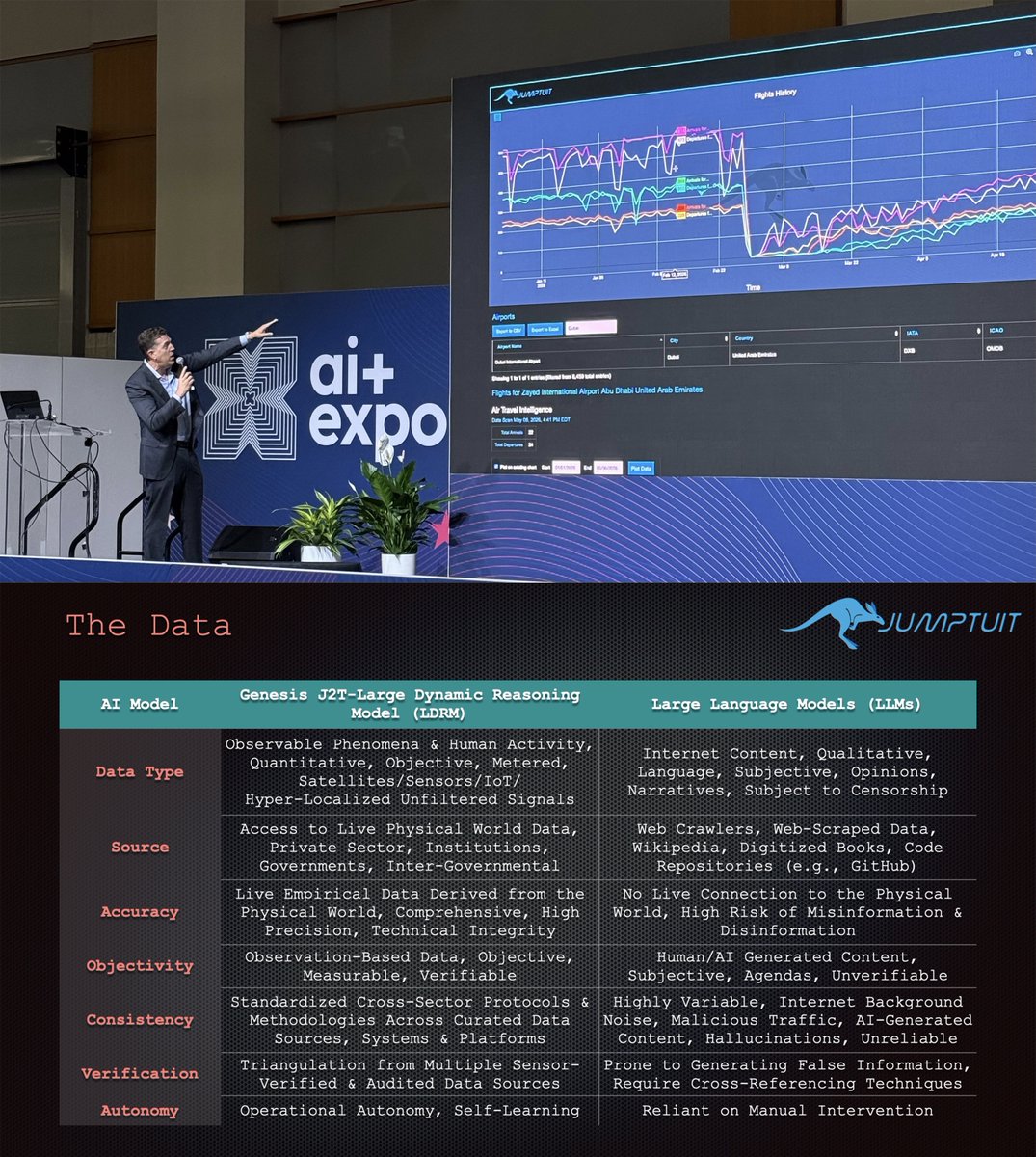
“Jumptuit focuses on observable phenomena and human activity, primarily quantitative data. Our data mix is 80% quantitative and 20% qualitative. We have connected to hyper-localized quantitative data sources all over the world.
In contrast, LLMs rely primarily on web crawlers to capture their content.
So the accuracy level is higher because we are looking at empirical data. The objectivity is greater because we are looking at things that are measurable and verifiable, as opposed to human and AI-generated content, which is to a large extent unverifiable. And the consistency in terms of the methodologies we apply – because it is quantitative data and from verifiable sources which are primarily observation-based – makes a huge difference.”
Triangulation:
“Jumptuit uses triangulation from multiple sensors and audited, verifiable data sources. When we constitute a picture of what is happening in relation to an event in the world, what we are looking at is multiple data sources to construct that picture.”
This ensures the picture is built from various independent perspectives rather than a single source. If a satellite sensor, a ground-level IoT sensor, and a financial ledger all point to the same event, the confidence interval increases significantly.
Next Up: How to Fix AI’s Reasoning Problem
6
7
503
May 8
Why do Large Language Models (LLMs) need Jumptuit's Large Dynamic Reasoning Model (LDRM)?
Jumptuit Founder & CEO Donald Leka at SCSP AI Expo:
"What is the state of LLMs today in relation to forecasting, and understanding current events?
LLMs are not a good foundation for forecasting events...not just because you're dealing with static data, but because of hallucinations. Hallucinations are not minor errors, these are not random errors, these are systemic errors, and they lead in many cases to fabrications that we all have experienced using LLMs based on no data at all.
Whereas, LLMs are good for many things, forecasting events is not what they are designed to do."
More to come!
4
5
414
May 7
SCSP AI Expo 2026 Opening Remarks:
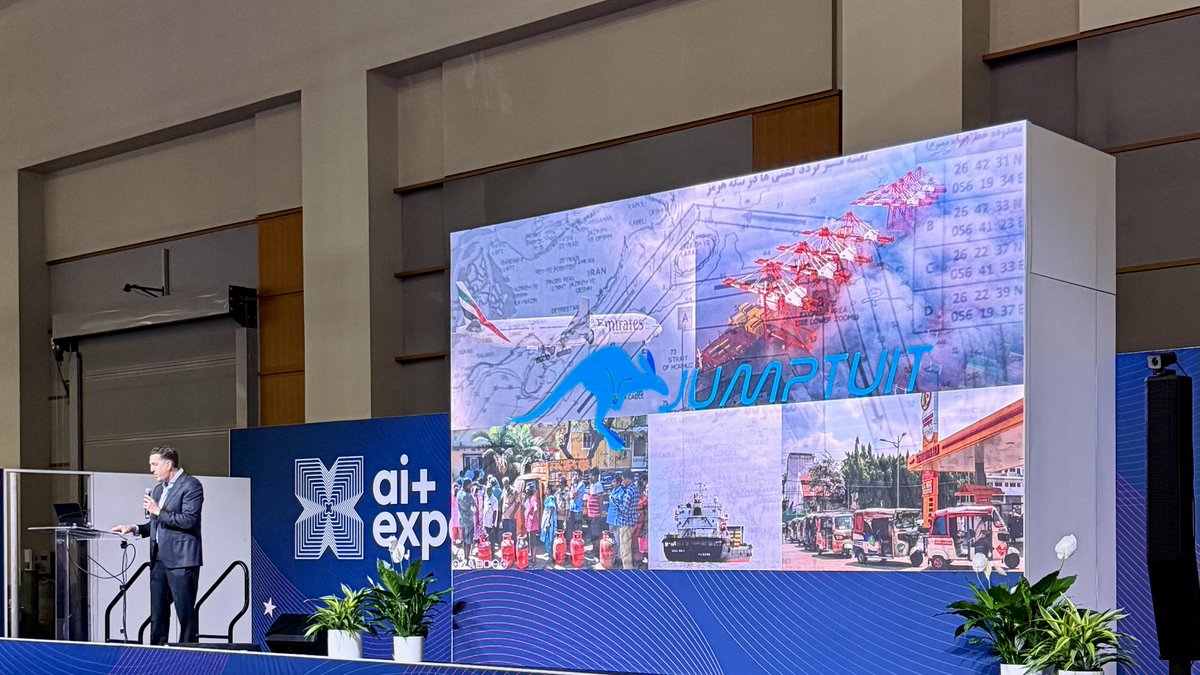
Unveiling the Large Dynamic Reasoning Model: AI, the Physical World, and Human Decision Making. Jumptuit is presenting their new AI model that forecasts how global events impact supply chains and industries. Using live data, this model predicts cascading risks to provide vital intelligence before major decisions are made.
Jumptuit Founder & CEO, Donald Leka:
"It’s great to be back at the AI Expo in Washington, D.C. A lot has happened in the world since our presentation last year.
In a little over two months, Operation Epic Fury fundamentally altered geopolitical dynamics from Southeast Asia and East Asia, to Africa and Europe, in the Middle East and even within the GCC itself – from alliances, to trade relations, to investment priorities. These geopolitical tectonic shifts and cross-regional and cross-sector impacts were not anticipated by existing forecasting systems and methods.
Today we will discuss not only how AI can help us anticipate events but also forecast how the dust will settle in the aftermath of a geopolitical event.
LLMs have proven inadequate to accurately assess and forecast events in the physical world. We will discuss how LLMs can be supplemented with the help of a new breakthrough AI technology.
We will introduce you to a new vision of Artificial Intelligence that can bridge the digital world with the physical world in new and unprecedented ways. So let’s get started…"
More to come!
5
6
197
May 1
AI’s Direct Link to the Physical World: Understanding Event-Triggered Vulnerabilities in Decentralized Global Systems
Jumptuit will be demonstrating its new breakthrough Large Dynamic Reasoning Model (LDRM) that connects AI, the Physical World, and Human Decision Making.
Presentation Date: May 7, 2026
Location: Special Competitive Studies Project (SCSP) AI Expo 2026, Washington, D.C.
Live Demonstration: Jumptuit Aerospace & Defense: Unveiling the Large Dynamic Reasoning Model
3
4
169
Apr 21
I'm excited to announce that I'll be a speaker at the AI Expo in DC! invt.io/1txbo9b4spu
In this moment of global turbulence and uncertainty, come join us on May 7 at the intersection of artificial intelligence, national security, and public policy at the Special Competitive Studies Project (SCSP) AI Expo 2026 in Washington, D.C.:
Jumptuit Aerospace & Defense: Unveiling the Large Dynamic Reasoning Model: AI, the Physical World, and Human Decision Making.
Come see Jumptuit’s demo featuring their new AI model that forecasts how global events impact supply chains and industries. Using live data, this model predicts cascading risks to provide vital intelligence before major decisions are made.
5
7
170

Apr 1
Jumptuit Awarded Trademarks in Canada
We are pleased to announce that the Canadian Intellectual Property Office has awarded Trademarks for the Jumptuit Logo and Brand.
As part of Jumptuit’s ongoing IP protection and global go-to-market activities, the Company has applied for and received international Trademark recognition for the Jumptuit logo and brand in internationally strategic markets from governments around the world. These Trademark awards represent an important step for Jumptuit’s global deployments.
Jumptuit’s Trademark registration protection awards cover such market segments as Finance, Insurance, Autonomous Transit, Healthcare, Consumer Travel, Commercial Travel, Agriculture, Energy, Utilities, Manufacturing, Consumer Goods, Consumer Services, Media, Entertainment, Gaming, Wagering, Government Services, Education, Legal Services, Data Services, and Customer Relationship Management.
Jumptuit, including in its stylized name and its recognizable kangaroo logo, has been granted trademark recognition in Canada in its three application classes, including for computer application software, data analytics services, and enterprise software for searching, accessing, and actioning data across multiple platforms including cloud services among other features, as a Platform as a Service (PaaS) and Software as a Service (SaaS) for delivering notifications, information, and insights to users and organizations.
“We are pleased to announce Trademark awards in Canada for Jumptuit’s logo and brand as we launch the Company’s strategic expansion into this major global market,” said Jumptuit Group Founder and CEO, Donald Leka. “Canada is an exceptionally important global market and a global research and innovation hub. With its enormous market size, economic openness, extensive network of trade agreements, strong regulatory environment including the protection of Intellectual Property (IP), and focus on developing future technologies including Artificial Intelligence, clean aviation, and the space economy, Canada offers unparalleled opportunities for the development and application of emerging technologies.”
About The Jumptuit Group
The Jumptuit Group (TJG) is an AI research and development company working in the emerging field of Anticipatory Intelligence.
The purpose of Anticipatory Intelligence is to observe and understand the antecedent elements of events, their movements and the forces among them, based on heightened sensory and spatial intelligence.
Our goal is to accelerate the anticipation of events that pose risks and opportunities to organizations and help policymakers and practitioners develop anticipatory strategies to improve stakeholder outcomes.
TJG is an interconnected network of subsidiary companies across geographies and sectors realizing synergies among them.
TJG companies operate within the same technology, licensing, and business model framework, allowing for seamless deployment of product modules between the Operating Vertical Companies (OVCs).
Learn More: jumptuit.com
5
9
241
Mar 30
I am honored to have been invited to join the inaugural cohort of Principals of the Semafor World Economy.
I am grateful to Co-Founder and CEO, Justin B. Smith, and the esteemed Co-Chairs, Ken C. Griffin, Henry R. Kravis, Penny S. Pritzker, and David M. Rubenstein for the invitation.
I look forward to joining fellow cohort members at the Semafor World Economy Annual Convening in Washington, D.C., April 13-17, 2026.
At a time defined by geopolitical instability and rapid technological and economic transformation, I look forward to engaging with this exceptional group of leaders to help forge innovative solutions to the world’s most pressing challenges.
About Semafor World Economy
Semafor World Economy, often termed "America's Davos," convenes 450 global CEOs, policymakers, and leaders to navigate economic complexity in AI, geopolitics, and sustainability. Semafor World Economy Principals are a carefully curated community of senior builders, innovators, and changemakers — the architects of the new world economy. Principals are nominated by peers, industry partners, and institutions, and selected for their ideas, leadership, and real-world impact.
5
8
220
Mar 24
Future Investment Initiative (FII) Institute TV Interviews Donald Leka, CEO of the Jumptuit Group:
“Donald Leka, CEO of the Jumptuit Group, describes the Company's focus on non-LLM dynamic reasoning models, aiming to understand dynamic events and their impact on human decision-making. He highlights tracking supply chains, markets, and public health globally, including stability and stress indices. Leka anticipates diversification in foundational models beyond LLMs, while recognizing their value in areas like legal text analysis and medicine. He emphasizes the importance of novelty and utility for protectable AI breakthroughs. The discussion touches upon AI's role in aiding human decision-making in the physical world and understanding natural phenomena. Leka notes the significance of empirical observation in understanding intelligent patterns in the Universe. He appreciates the ambition and global reach seen in the Middle East. He stresses the critical role of governments in supporting large-scale AI initiatives and creating a conducive environment for transformation. Leka values data neutrality and the ethical application of AI after a clear understanding of its capabilities." - FII Institute
Watch Interview: fii-institute.tv/video/3019/…
1
1
155
Feb 24
We are pleased to announce that the U.S. Patent and Trademark Office (USPTO) has awarded Inventor Donald Leka, Founder and CEO of Jumptuit, the following AI Search patent, “System and Method of AI Assisted Search Based on Events and Location.”
This AI Search invention relates to a system and method for autonomously retrieving relevant information in advance of future events based on time and distance intervals. The framework enables the identification of emergent transitional events within multi-dimensional data groupings derived from live data streams; it aligns data points with shared temporal, spatial, and semantic properties occurring in proximity to specific geo-locations and time frames.
Learn More About The Jumptuit Group: jumptuit.co
6
8
473
Donald Leka retweeted

Feb 3
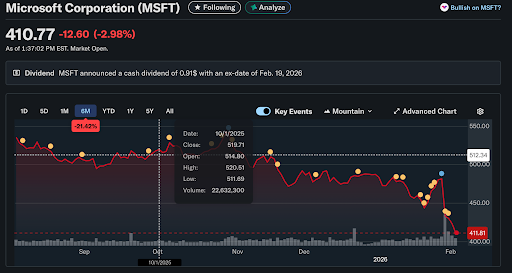
On September 30, 2025, at the Schmidt Program on Artificial Intelligence, Emerging Technologies, and National Power at Yale University’s Jackson School of Global Affairs, Jumptuit Founder and CEO Donald Leka outlined the fundamental technological limitations of large language models (LLMs) and agentic AI systems. In his remarks, he highlighted Microsoft’s challenges with market adoption, return on investment, and growing exposure as a representative case illustrating the broader risks associated with the “future value of AI” in its current form as a driver of market capitalization.
Leka further presented a forward-looking framework for AI research and development - one that moves beyond an overreliance on verbal reasoning and incorporates sign, comparative, causal, and analogical reasoning, grounded in a direct, real-time connection to the physical world. This approach, he argued, is essential for building AI systems capable of handling novelty, complexity, and real-world decision-making at scale.
The full Yale presentation can be viewed here:
youtube.com/watch?v=gTjnuzQi…
Between September 30, 2025 and February 3, 2026, Microsoft’s stock declined by approximately 20%, reflecting a convergence of these underlying factors:
5
5
248
5 Nov 2025
Jumptuit Awarded Trademarks in the European Union (EU)
We are pleased to announce that the European Union Intellectual Property Office has awarded Trademarks for the Jumptuit Logo and Brand.
As part of Jumptuit’s ongoing IP protection and global go-to-market activities, the Company has applied for and received international Trademark recognition for the Jumptuit logo and brand in internationally strategic markets from governments around the world. These Trademark awards represent an important step for Jumptuit’s global deployments.
“We are pleased to announce Trademark awards in the EU for Jumptuit’s logo and brand as we launch the Company’s strategic expansion into this major global market,” said Jumptuit Group Founder and CEO, Donald Leka. “The EU is an exceptionally important global market and a global research and innovation hub. With its enormous market size, economic openness, extensive network of trade agreements, strong regulatory environment including the protection of Intellectual Property (IP), and focus on developing future technologies including Artificial Intelligence, clean aviation, and the space economy, the EU offers unparalleled opportunities for the development and application of emerging technologies.”
About The Jumptuit Group
The Jumptuit Group (TJG) is an AI research and development company working in the emerging field of Anticipatory Intelligence.
The purpose of Anticipatory Intelligence is to observe and understand the antecedent elements of events, their movements and the forces among them, based on heightened sensory and spatial intelligence.
Our goal is to accelerate the anticipation of events that pose risks and opportunities to organizations and help policymakers and practitioners develop anticipatory strategies to improve stakeholder outcomes.
TJG is an interconnected network of subsidiary companies across geographies and sectors realizing synergies among them.
Learn More: prnewswire.com/news-releases…
3
4
268
Donald Leka retweeted

27 Oct 2025
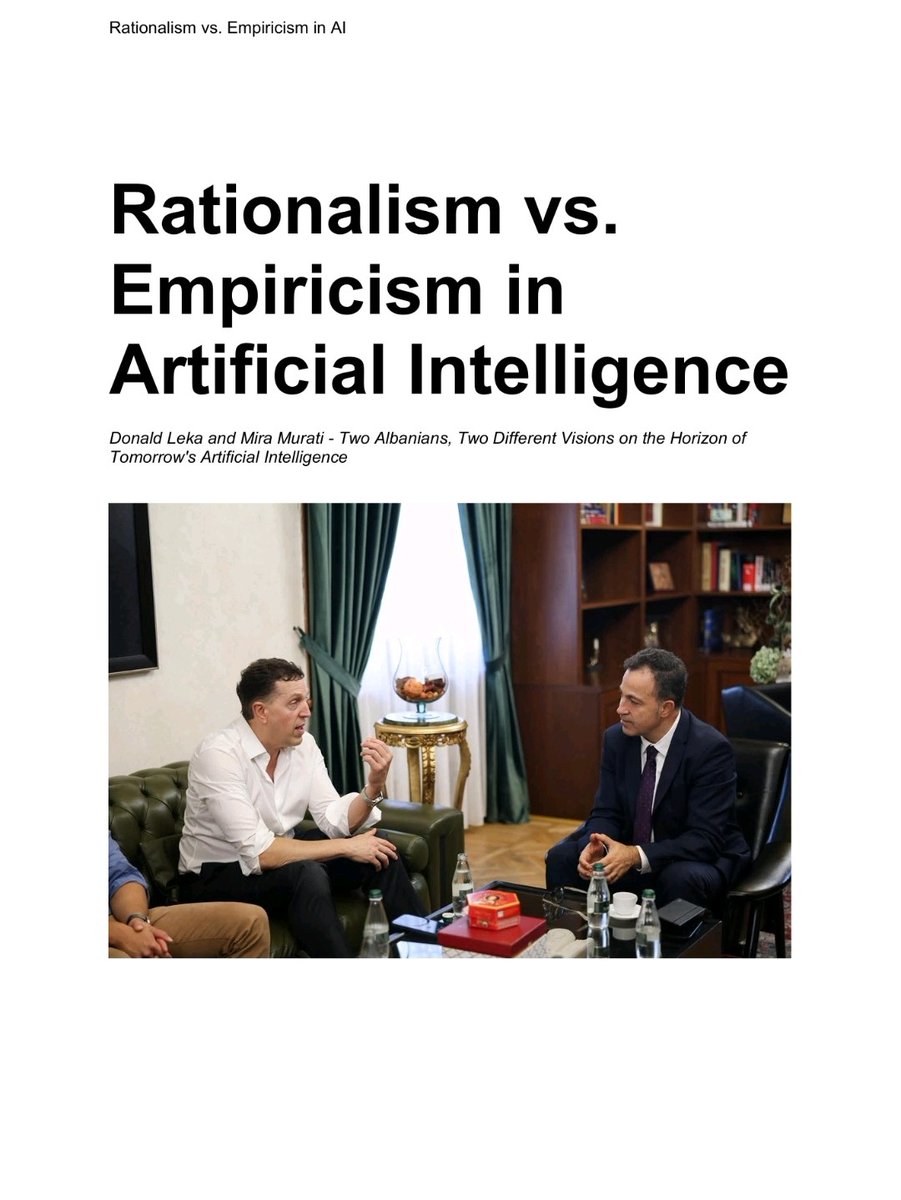
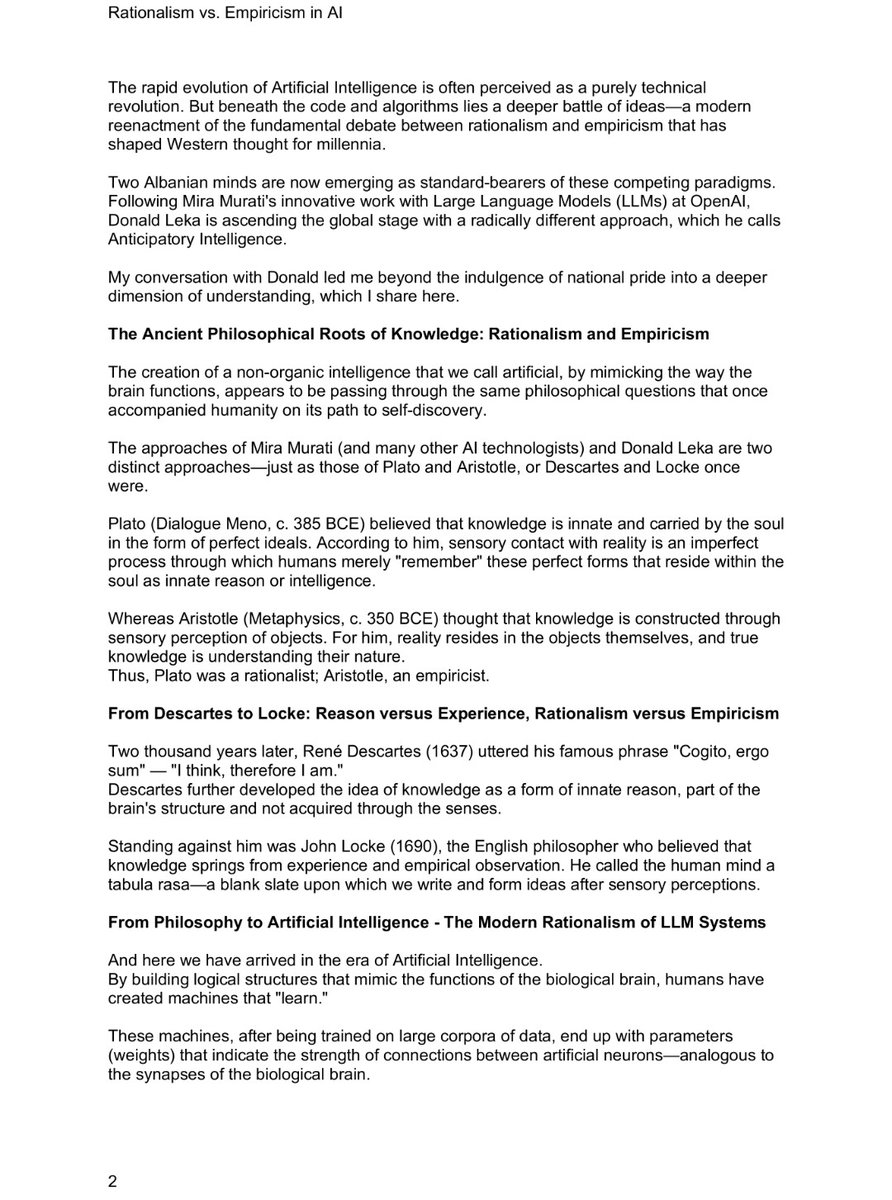
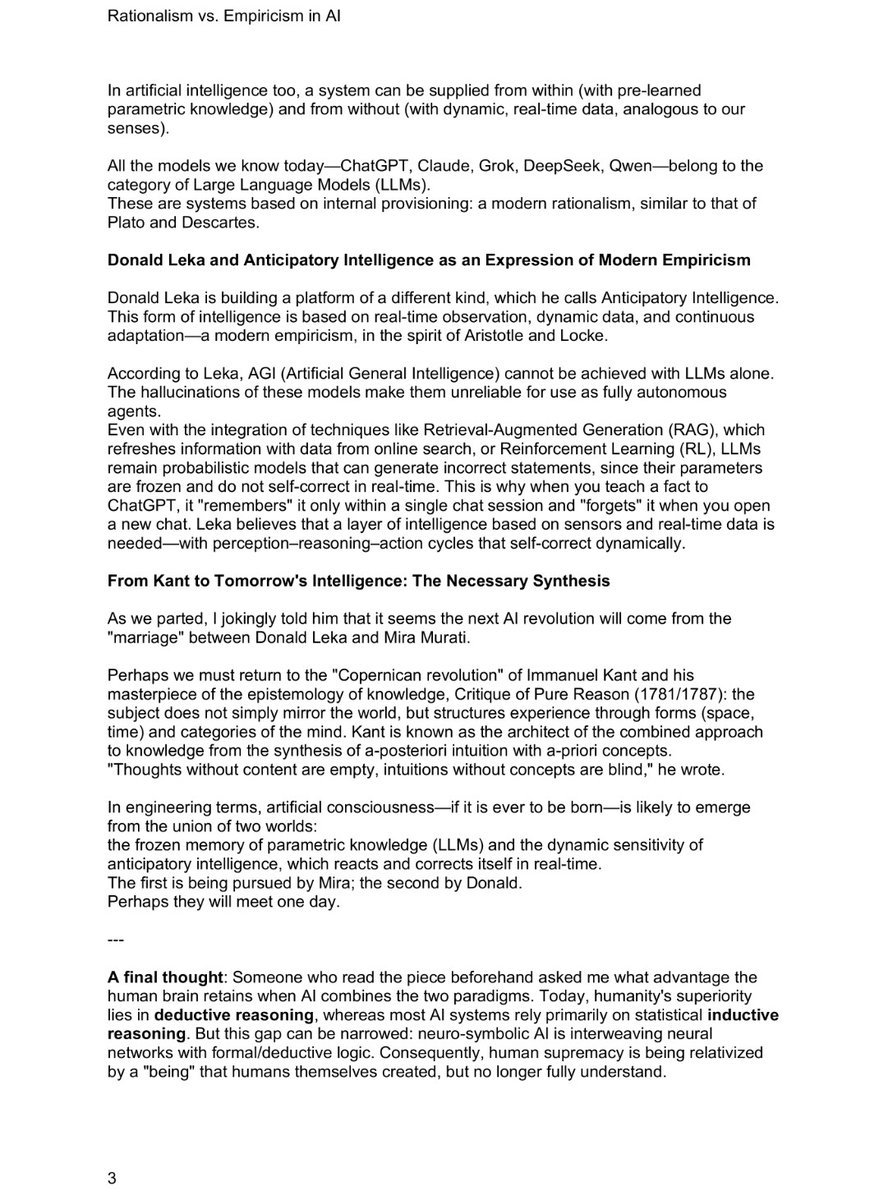
Two Albanians. Two Visions. A Millennia-Old Debate in AI.
Plato versus Aristotle in 2025 😊
@miramurati → AI based on knowledge & large language models.
@DonaldLeka → Anticipatory AI & real-time sensor-driven intelligence.
1
8
21
1,164
Donald Leka retweeted
15 Oct 2025
👨🏻💻 Sot me @DonaldLeka, shqiptaro-amerikanin vizionar që po ndryshon mënyrën se si funksionon inteligjenca artificiale.




1
6
14
554
6 Oct 2025
Large Language Models (LLMs) Suffer From Sensory Deprivation: Jumptuit Unveils AI’s Missing Existential Link to the Physical World
Last week, Yale’s Schmidt Program on Artificial Intelligence, Emerging Technologies, and National Power hosted a talk with Donald Leka, Founder, Chairman and CEO of The Jumptuit Group, on “Next Generation AI Reasoning Models: De-Risking Policymaking in an Uncertain World, Forecasting Unexpected Geopolitical and Environmental Events.”
Learn more about how Large Language Models (LLMs) have hit a wall as a result of a lack of a direct connection to the physical world and human decision-making, and an inability to handle novel situations and complexity.
While AGI and ASI have taken a back seat to more mundane tasks to be handled by AI Agents, these Agents remain dependent on LLMs and are struggling to find compelling use cases, as well as with execution and market adoption.
The presentation addresses the excessive focus on verbal reasoning at the exclusion of sign, comparative, causal, analogical, and other forms of reasoning in the development of Artificial Intelligence, the intrinsic reasons behind it, and the solution that can help protect the considerable investments that have been made in the field.
Next Generation AI Reasoning Models: De-Risking Policymaking in an Uncertain World - Yale University
youtu.be/gTjnuzQiJB0?si=1-Cm…
4
5
565
23 Sep 2025
This is a watershed moment to reflect on where Large Language Models (LLMs) stand and where we go from here.
LLMs have bumped into a wall. LLMs lack a direct link to the physical world, have difficulty with novel situations, and struggle with increasing degrees of complexity.
Join us for a presentation by Donald Leka, Founder, Chairman and CEO of The Jumptuit Group, on “Next Generation AI Reasoning Models: De-Risking Policymaking in an Uncertain World and Forecasting Unexpected Geopolitical and Environmental Events,” at Georgetown University.
Watch the presentation below to learn more about AI’s missing link to the physical world.
youtu.be/-Y3qPkePvZs?si=C9VQ…
4
5
350