
Joined May 2026
- Tweets 5,250
- Following 798
- Followers 740
- Likes 3,167
94 Photos and videos












Pinned Tweet

Jun 13
When that active mutual that hasn't engaged on your post for days finally engages:
23
40
46
705
I know where I'm going.
I know what I'm building.
I know it's not going to be accomplished overnight and I'm ready to put in the work.
I don't give in to pressure.
I don't give in to discouragement.
I don't give in to those negative voices in my head.
I just keep moving forward.
10 steps a day... 1 step a day.... ½ step a day... It doesn't matter...
As long as I'm moving forward.
I'm definitely sure I'm going to get to where I'm going.
Good morning my amazing mutuals.
Y'all don't know how much I love you guys fr.
1
1
1
13
Tarantino Jr retweeted

10 signs that your liver needs help👇
Your liver works 24/7. It filters toxins, processes nutrients, helps regulate hormones, and produces substances your body needs to function.
When it's under stress, it can send warning signs.
Here are 10 you shouldn't ignore:
1. Yellowing of the eyes or skin
This is one of the most recognized signs of liver trouble.
It happens when bilirubin, a yellow pigment normally processed by the liver, starts building up in the body.
2. Dark urine
If your urine looks unusually dark even when you're well hydrated, excess bilirubin may be finding its way into your urine instead of being properly processed.
3. Pale or clay-colored stool
Healthy stool gets its brown color from bile.
When bile flow is blocked or reduced, stool can become pale, gray, or clay-colored.
4. Persistent fatigue
Not the "I stayed up too late" kind.
Many people with liver disease report ongoing exhaustion that doesn't improve much with rest.
5. Itchy skin without a rash
Liver problems can cause bile salts to accumulate in the bloodstream.
For some people, this leads to intense itching even when the skin looks completely normal.
6. Swelling in the abdomen
A damaged liver can cause fluid to build up in the belly, a condition known as ascites.
The abdomen may feel tight, swollen, or unusually heavy.
7. Easy bruising
Your liver helps produce proteins involved in blood clotting.
When liver function declines, bruises may appear more easily than usual.
8. Loss of appetite or unexplained weight loss
A struggling liver can affect digestion, metabolism, and appetite, making food less appealing and causing unintentional weight loss.
9. Pain or discomfort in the upper right side of the abdomen
The liver sits beneath the ribs on the right side.
Inflammation or enlargement can sometimes cause pain, pressure, or a feeling of fullness in that area.
10. Brain fog or confusion
In advanced liver disease, toxins that are normally filtered out can accumulate in the bloodstream and affect the brain.
This may show up as forgetfulness, confusion, difficulty concentrating, or changes in sleep patterns.
Important:
Having one of these symptoms doesn't automatically mean you have liver disease.
But if several are present or they persist, it's worth speaking with a healthcare professional.
Your liver is remarkably resilient, but catching problems early can make a huge difference.
14
14
17
163
Tarantino Jr retweeted

The only man who never makes mistakes is the man who never does anything.
That idea of yours, start work on it Now!
3
4
5
70
Tarantino Jr retweeted

Shey nobody hold 2by2 for there ….

Una don see where th!ef dey threaten people wey catch am?
63
161
1,363
155,235
Tarantino Jr retweeted

Lord we are grateful to see another week and another chance to get it right.
Thank you, Lord, for open doors we didn't expect and favor we didn't earn. May every step we take this week carry purpose, and may our efforts bear fruit in Jesus name Amen.
Have a good day X fam ♥️

38
39
54
301
Tarantino Jr retweeted

Realizing that silent reading is often more mentally exhausting than reading out loud.
46
60
69
780
Tarantino Jr retweeted

48m
When I walked in with steez as the new PA and everyone thinks I'm the new CEO. 😂😂😂
Good morning Sir.
Welcome sir.
Good morning!!

1
1
2
18
Tarantino Jr retweeted

I de outside de protect my village people from bandit 💯😂
4
4
10
83
Tarantino Jr retweeted

Someone buys a crate of eggs all the time, you don’t contribute a dime, and the person isn’t even complaining. Yet you have a habit of never buying or contributing, but when it comes to things you personally want, you’ll gladly spend money on them. Meanwhile, the owner doesn’t even touch your stuff.
Now there’s just one egg left from that crate, and you decide to use it.
Must everything be taught? It’s just common sense. If you have no intention of replacing that last egg, don’t touch it.
Omo.🤦🏻♀️
9
6
15
173
Tarantino Jr retweeted

Do all the mistakes you can think of in a relationship but never date a guy/lady that keeps the opposite gender as besties 😤☠️🥴

10
11
21
406
Tarantino Jr retweeted

Is squirting a feminine scam?
22
21
38
1,372
Tarantino Jr retweeted

10h
23
34
35
642
Tarantino Jr retweeted

As you’re learning to say NO, master taking NO as an answer too. It goes both ways.
26
33
41
584
Tarantino Jr retweeted

Jun 13
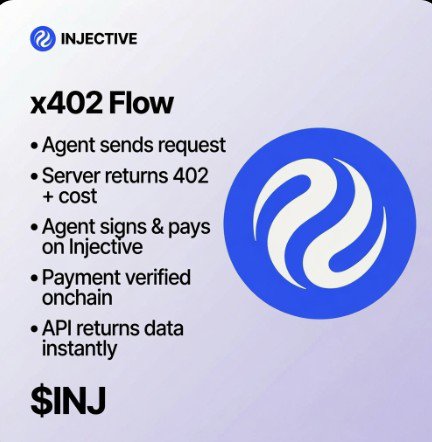
Most people talk about AI agents in terms of what they can do.
What's more interesting is what happens when they can actually spend money.
With x402 on Injective, an agent can pay for data, APIs, and online services as part of its workflow without waiting for a human to complete the transaction.
The process is built directly into the web request itself. If payment is required, the agent handles it, the transaction is verified, and the task continues.
It may seem like a small change, but it's a major step toward a world where software can not only make decisions but also act on them economically.
$INJ
2
4
15
738
If you be my mutual and I no engage you in a whole day, I give you permission to carry my account go shrine.
2
2
2
64
Tarantino Jr retweeted

10h
ungrateful people live long to see the worst.
8
11
12
254
Tarantino Jr retweeted
If your birth year starts with 19, you are old as fuck😆
13
17
21
301
Tarantino Jr retweeted

Today's Sunday
Drop the most aesthetically pleasing anime screenshot in your gallery. Let's compare in the comments
14
9
30
731