
Co-founder & Chief Product Officer @DrakeExchange | Cooking on-chain perps in the DeFi lab | Flammable alpha — use responsibly
Joined June 2025
- Tweets 77
- Following 22
- Followers 261
- Likes 32
1 Photos and videos

Dr. Brief retweeted

7 Nov 2025
Drake is joining Wave 1 of Monad Momentum.
Perpetuals without compromise, trade on Drake. Stack rewards and Drake points.
Climb the leaderboard now and secure your post in our upcoming private trading contest.
Join now: drake.exchange

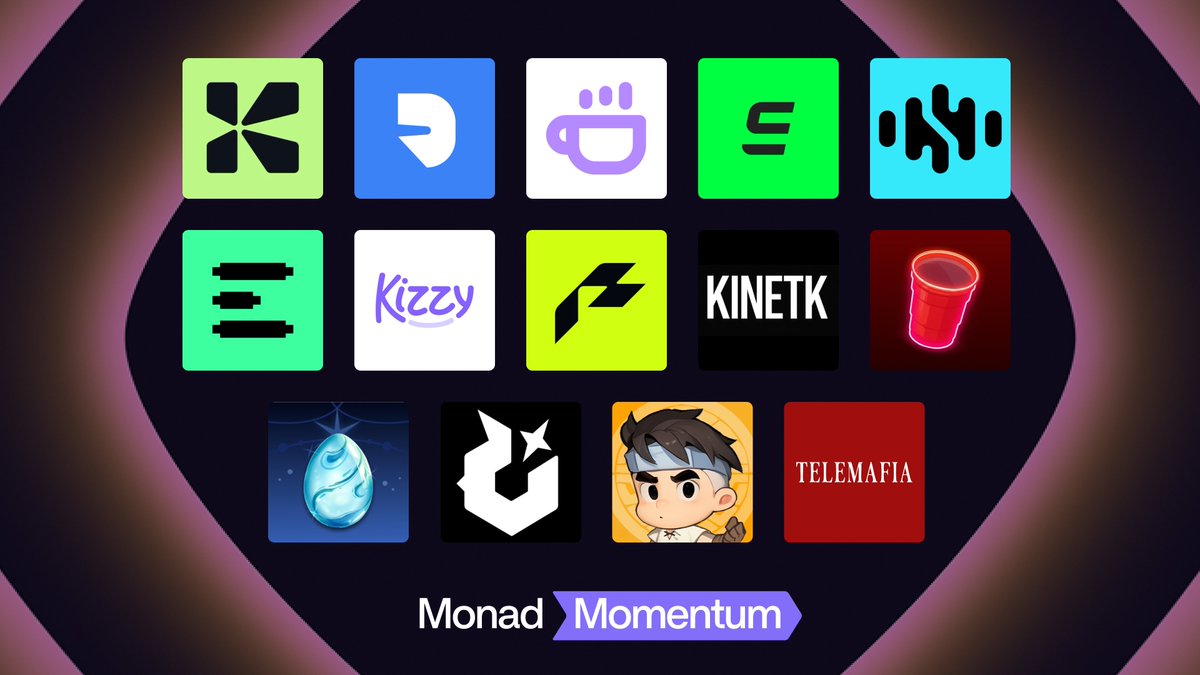
Introducing the first wave of Monad Momentum apps
These apps will all have rewards on mainnet
Check them out below 👇
126
21
264
52,449

Monad Mainnet will launch on November 24th, 9am ET
Waiting room 👇 x.com/i/broadcasts/1OyKAjABX…
2,573
1,895
8,661
2,246,942
Dr. Brief retweeted
22 Sep 2025
Drake Testnet is live.
We believe perp trading deserves the best execution speed, at the best and most accurate price.
Just place your order and let Drake’s CLOB do the job.
Trade perps on Monad here: drake.exchange/trade
Stack bids slap asks.
299
110
809
96,473
Dr. Brief retweeted
21 Sep 2025
Drake is launching tomorrow.
Okay, folks, today is the last day before Drake launches on public testnet.
Tomorrow is going to be biblical, but we have one last small mission for you to heat it up.
Drop “Perp traders are locked in” in the comments for a chance to access the first trading contest on Drake.
Ignite the engines, we switch on the CLOB.
330
58
547
47,148

9 Jul 2025
Huge thanks to the Monad Foundation — especially @keoneHD — for the swift support that helped us regain access to our X account. Big shoutout to @acceleratooooor as well for the thorough security analysis and internal review.
We’re also deeply grateful to the Monad community — everyone was incredibly helpful in reporting malicious content and spreading the word.
Drake stays strong with the support of the community.
Community truly matters. 🙏
Gmonad 💜 Gdrake !
8 Jul 2025

Post-Mortem: July 4 Twitter Account Compromise
On Friday, July 4, the official Drake Twitter account was compromised by an unauthorized actor who posted malicious links.
In the weeks leading up to the incident, we received a series of suspicious copyright violation notices from Twitter, each targeting posts that contained no copyrighted material. This was a deliberate setup designed to create a sense of vulnerability and urgency, ultimately paving the way for a highly targeted social engineering attack.
At the time of the breach, two-factor authentication (2FA) and all standard security protocols were fully in place. However, social engineering attacks are specifically designed to exploit human trust, not technical flaws. The attacker sent a convincing email that mimicked Twitter’s copyright enforcement system, instilling a strong sense of urgency about a potential account suspension.
No protocol systems, user data, or internal infrastructure were affected. This was not a failure of technical security, but a highly sophisticated exploitation of platform trust.
Below is a full timeline of events and the steps we’ve taken in response.
Timeline of Events on July 4 (UTC):
5:43 PM - Our team lost access to the Twitter account.
5:47 PM - We received an email confirming that the account's associated email address had been changed.
5:55 PM - The incident was reported to X (Twitter). We initiated the account recovery process and received confirmation of a support ticket.
6:03 PM - We publicly notified our community that the account had been compromised.
9:36 PM - The attacker began posting phishing content from the compromised account.
Resolution:
As of today, we have regained full control of the account. All passwords, passkeys, and two-factor authentication have been reset, and we enhanced hardware security with YubiKey. We are currently conducting a thorough internal review of our security practices and implementing additional safeguards to prevent future incidents.
If you engaged with any links posted during the compromise, we strongly recommend revoking wallet permissions immediately.
We acknowledge the seriousness of this incident and apologize for the disruption. Ensuring the safety and trust of our community is our highest responsibility. We can’t thank the Drake community enough for stepping up and helping spread the message and keeping others safe.
-The Drake Team
7
1
26
1,318
Dr. Brief retweeted
2 Jul 2025
Drake’s public testnet is just around the corner.
Place your bet on Opinion Lab and guess whether Drake public testnet will be released before or after July 15th.
Bet now on app.olab.xyz/detail?topicId=…

26
18
133
6,564
Dr. Brief retweeted

13 Jun 2025
Another edition of Meet the Builder returns. This edition goes deep into one of the most interesting perpetual dex design emerging inside the @monad_xyz ecosystem.
This time, I had the chance to connect with @DrakeBrief, co-founder of @DrakeExchange, a perp Dex natively built on Monad, which uses CLOBs and vAMMs to bring the best of both worlds for leverage traders.
If you are not yet familiar with Drake, I have written a detailed breakdown here: x.com/0x_yash21/status/18679…
Now let us get into the conversation with @DrakeBrief and unpack how Drake is aiming to push leverage trading forward on Monad 👇
Can you tell us a bit about yourself and your role in building Drake Exchange?
Hi, I’m @DrakeBrief - Co-founder and Chief Product Officer at Drake. I’m a Software Engineer with over five years of experience at Google, where I focused on AI systems.
While AI and trading may seem like separate worlds, my work at Google focused on structured, machine learning–based systems (not LLM) that relied on rapid, data-driven decision-making, signal analysis and risk evaluation to serve the right content to users, very similar to the strategies and models used in HFT and market making. As much as I enjoyed my time at Google, building trading strategies and risk systems has always been my true calling.
What inspired the creation of Drake, and why did you choose to build a perpetuals DEX on @monad_xyz?
After leaving Google, I led a proprietary trading team focused on high-frequency crypto arbitrage. Our strategies primarily targeted price spread arbitrage and funding rate arbitrage across centralized exchanges (CEXs).
As DEX trading began to gain traction, we looked to migrate these strategies onchain, but quickly realized that existing perpetual DEXs were still lacking in performance and design. That gap ultimately inspired us to build Drake.
Initially, we struggled to find a chain that could support a fully onchain exchange with CEX-level performance. Monad changed that. Its architecture offered exactly what we needed.
We’ve been consistently impressed by Monad’s performance. In fact, we ran the largest CLOB performance test on its devnet, submitting over 10 million orders into our order book. Even at that scale, the onchain execution and matching engine performed exceptionally well, giving us the confidence to build something truly Monad native, high-performance, and fully onchain.
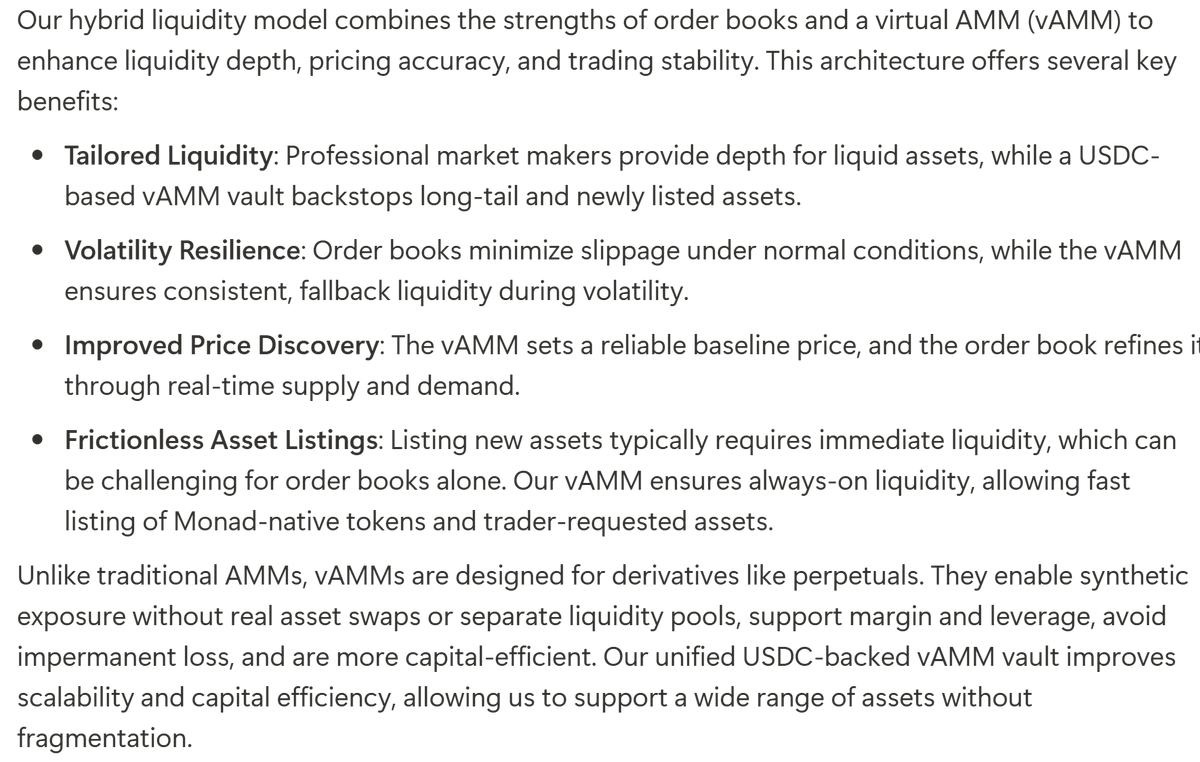
What was the reasoning behind using both a vAMM and a limit order book (LOB), and why vAMM instead of AMM?
How does Drake differentiate itself from existing players like @dYdX and @HyperliquidX, so that it can attract users in the presence of giant like Hyperliquid especially?
How does the Monad blockchain help the team provide a good UX to users, and what future updates to the Monad blockchain is the team expecting/hoping for that could further help the team improve Drake's UX?
How is team planning to attract liquidity to both the LOB and the liquidity vault early on?
What are the key technical challenges you have faced while building, and how did you overcome them?
Risk management is one of the most technically demanding aspects of building a fully transparent, onchain perpetual DEX. Supporting isolated and cross-margin modes alongside multi-collateral functionality adds significant system complexity.
To address this, we built a robust simulation framework to model extreme market conditions, stress-test edge cases, and validate our liquidation logic.
Alongside this, we developed an operational playbook to guide real-time risk management and trading behavior, ensuring system resilience during volatility.
What is Drake's go-to-market strategy to attract both traders and liquidity providers?
Drake’s go-to-market strategy focuses on activating each core user group, including traders, market makers, and LPs, through tailored incentives and product features that drive engagement naturally. Traders benefit from a fast, CEX-like experience, deep liquidity, and competitive rewards tied to volume and performance.
Market makers are equipped with professional-grade tools, such as advanced order types, and receive incentives, based on their performance, that reward consistent liquidity provision.
LPs earn a share of protocol fees and boosted rewards through passive vault participation, without the need for active management. A robust social layer, including referral rewards, trader leaderboards, and shareable performance metrics, creates positive loops that reward users for bringing others to Drake.
Altogether, this design generates an organic flow of fees throughout the protocol, reinforcing sustainable economics from the start.
Why build on a decentralized chain like Monad and not on a centralized L2?
Building on Monad provides access to a vibrant ecosystem and engaged community, along with the ability to mint assets natively. This eliminates the risks associated with bridging and centralization.
It also enables seamless integration with other Monad-native protocols and simplifies user acquisition, especially when compared to launching on an isolated or fragmented chain.
When is the public launch, and what new features can we expect in the next update of Drake?
Drake will be live on day one of Monad’s Mainnet launch, fully equipped with the core features traders need right out of the gate. While we have some exciting long-term updates planned, including entirely new types of trading, our immediate focus is on shipping the features and tools the community wants most.
Drake wouldn’t exist without our amazing community. That’s why we’re committed to giving you everything you need to level up your trading, yield farming, or social experience on Drake and Monad.
Some upcoming features will even let you earn from Drake without ever placing a trade. We're also expanding our lineup of strategy vaults, including more automated strategies like the funding rate vault, and potentially higher-risk vaults powered by AI agents.
We’ve got a ton of UI and UX improvements and new features coming soon, but we don’t want to spoil the surprise…
Follow us on Twitter and join our Discord to stay in the loop!
If you had to leave readers with one key piece of alpha, something you have learned about life, building apps, or crypto in general, what would it be?
Stay obsessed with the fundamentals. Whether in life, crypto, or building products, hype comes and goes, but the teams that stay focused on solving real problems, building resilient systems, and listening to users are the ones that endure.
In crypto, especially, noise is constant, but long-term value is built quietly and consistently.
*******************************************************************
For more updates on Drake Exchange, Follow @DrakeExchange and also @DrakeBrief (he recently created his new Twitter account, go show him some love).
Up next in the Meet the Builder series, I will be sharing my conversation with a team member from another groundbreaking project building on Monad. Dropping next week.
Follow me for daily updates and insights into the Monad ecosystem.
14 Dec 2024

Drake Exchange which is building natively on @monad_xyz aims to put the "CEX in a perp DEX," meaning the team seeks to provide users with a CEX-like experience along with added benefits like -
- Full control over funds
- Permissionless access (no KYC required)
- Better privacy, allowing you to trade anonymously with no personal info required
- Complete transparency over trades executing on Drake
- Access to more financial products and strategies by using other DeFi protocols which is not possible on CEXs (DeFi composability for the win)
It is designed to give traders the best price, lowest slippage, and fastest execution.
For this, it uses two types of liquidity to make this happen:
Limit Order Book (LOB): Where traders and market makers place limit orders(like centralized exchanges). This provides the best prices and lowest spreads, ensuring efficient execution.
Automated Market Maker(AMM): It is a liquidity vault (pool of USDC) that guarantees trades are executed even when the LOB doesn't have enough orders. It also allows Drake to list less liquid assets and offers opportunities for liquidity providers to earn fees and yield by depositing USDC into the pool.
How does Drake use both liquidity layers(LOB and vault) to provide the best price to traders?
Drake’s platform checks both the Limit Order Book (LOB) and the AMM (Liquidity vault) for the best price when you place a trade.
There are three ways a trade can be routed:
Full Execution via Order Book: If the order book has enough liquidity at the best price, the trade goes through the order book.
Full Execution via AMM: If the order book doesn’t have enough liquidity, the trade is routed to the AMM pool.
Split Execution: If both the order book and AMM (Liquidity vault) can offer good prices, the trade is split between them. This approach ensures the best price and smooth execution for all trades.
Drake will be using Chainlink’s Data Streams for low-latency price feeds.
Why @chainlink ??
It provides fresh prices for eligible tokens and token pairs at least once per second, and its robust verification method helps prevent front-running.
What is Liquidity vault and what is its role on Drake?
The liquidity vault is a pool composed of USDC. It plays a key role in offering users better prices and providing LPs with an opportunity to earn passive income by putting idle USDC from their wallets to work.
In case of trades:
Liquidity vault acts as a counterparty to trades executed by users on the platform. Traders also borrow the USDC from the vault for leverage trading.
It plays a key role in settling trades on the platform too:
Profitable Trades: Trader profits are paid out from the vault.
Losing Trades: Losses are added to the vault, increasing its balance.
LPs (USDC depositors) earn from various sources such as:
Trading Fees: A 0.1% fee charged when traders open/close positions.
Borrowing Fees: Fees paid by traders for borrowing USDC to leverage trades.
Trader Losses: Losses from trades increase the vault’s balance.
There is another way for LPs to earn passive income on Drake:
It will launch a Funding Rate Vault too, where LPs can deposit USDC and earn yield by collecting funding fees on assets with a positive funding rate, while remaining delta-neutral to avoid liquidation from price fluctuations.
What’s in it for traders and what should they know about Drake?
Long/Short asset upto 50x leverage
Gas fee trading (being on Monad helps)
Drake will be able to use market order, limit order and stop market order.
Users will be able to use usdc, btc, eth, and stETH for collateral.
For BTC and ETH pairs, the spread is fixed at 0.04% (thanks to the liquidity vault).
For all other pairs, the spread is the sum of the fixed spread (0.04%) and a dynamic spread, which depends on factors like open interest imbalance, order size, and market depth of the token.
Drake will use an auto-deleveraging mechanism to reduce risk and protect both traders and the platform during extreme market conditions.
Types of modes Drake will offer:
Isolated Margin: You can add or reduce margin to an open position with a 1% fee. A position is liquidated if its margin ratio falls below 110%.
Cross Margin: Same fees as in Isolated mode. Positions are liquidated if the margin ratio falls below 110%, and the entire portfolio is liquidated below 105%.
Fees to be paid by traders:
The Drake platform will charge a 0.1% fee to open/close each trade and offer discounts to high-volume traders. Additionally, if someone uses your referral code, 20% of the total fees paid by that individual will be credited to your account.
Traders will also need to pay a borrowing fee (for borrowing usdc to leverage trade). Traders may also need to pay funding fees, but it depends on their position and the current funding rate
This was a detailed post about @DrakeExchange using the public information available. The team is planning to add more features, and we will see more of them after the dapp launch on the Monad testnet and mainnet launch.
Have any doubts, feel free to comment or you can ask them in Drake's discord(based team they have). I have not used Drake yet, but once I use it on the Monad testnet (soon), I will write another post about it and share my personal thoughts.
If you're still reading this and liked what you read, please retweet the post, and you can also follow me @0x_yash21 for more content on crypto.
If you'd like me to write about another dapp, please mention it in the replies below.

27
13
86
8,436
12 Jun 2025
Gmonad and Gdrake, it’s time I introduce myself to you.
It took me a while to get here. I spent years building as an engineer in big tech before getting hooked on the markets. What started as a side interest in trading quickly turned into a full-time focus. I’m here now to build and to share the journey.
I cut my teeth in high-frequency and arbitrage trading. Pure obsession, fast markets, always searching for an edge. I loved it. But the more I traded, the more friction I felt.
Centralized exchanges are broken.
Fragmented.
Opaque.
Too centralized.
So I decided to do something about it.
I’m now building a perps DEX on Monad - @DrakeExchange. No big VC backing. No hype machine. Just code, conviction, and a better design. A design for traders, market makers, liquidity providers, and most importantly, you, the community.
I started this project self-funded because I believe in what I’m building. Drake is built with the user's best interest in mind. This space needs smarter, faster, trustless infrastructure. That’s where we are starting with Drake.
I’m not a loud voice on Twitter. I’m more comfortable writing code and trading than posting threads. I’m here now because I want to share more as I build. I move quietly and ship fast. I might be shy, but I’m not soft.
I’ll be sharing insights from my trading days, thoughts on market structure, and progress updates on Drake.
If you’re into perps, coding, security, or just want to follow a founder who’s building in public, you’re in the right place.
Let’s build something better. Let’s fix what’s broken. If you’re a trader, builder, or just love crypto, my DMs are open. More soon.
Now you know about me, would be glad to hear a bit of you, in a few lines.
91
19
134
13,625