
Joined April 2023
- Tweets 27,954
- Following 866
- Followers 6,684
- Likes 29,997
1,287 Photos and videos






Pinned Tweet

25 Oct 2025
df,,,
We might be on the verge of the next “Big Short”...
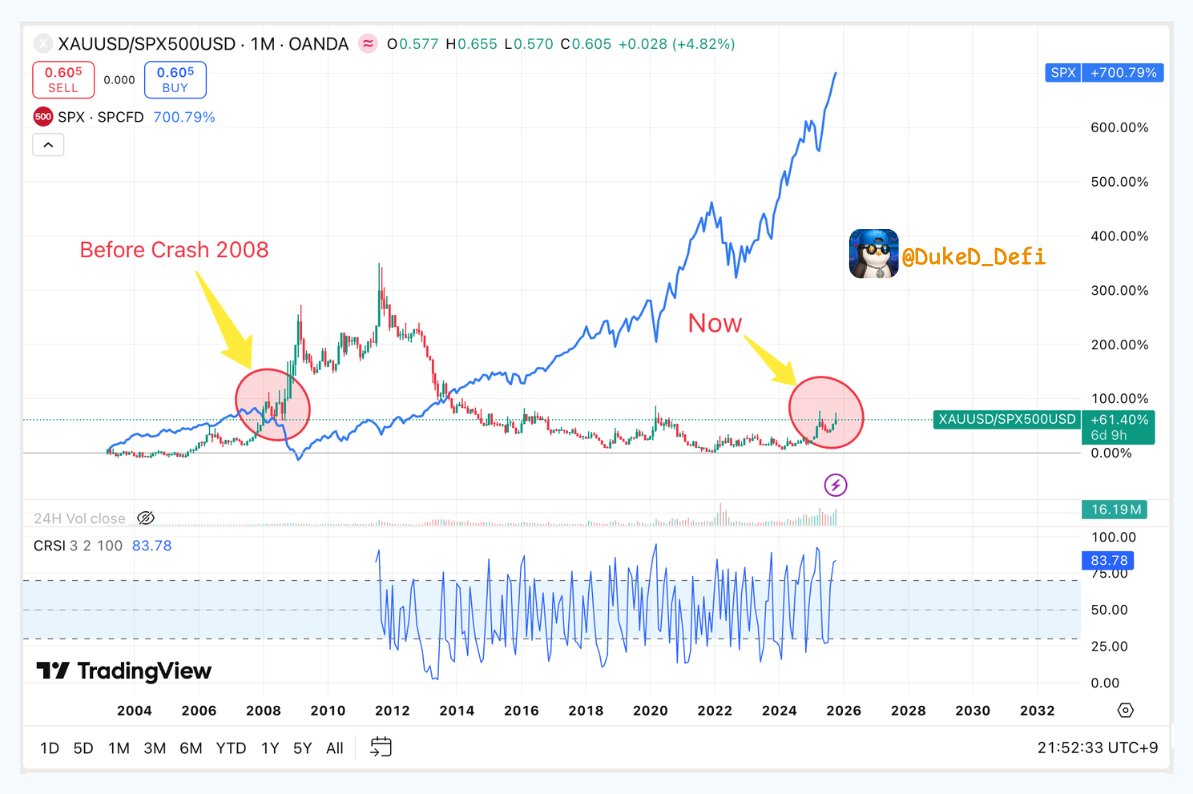
Here’s the chart comparing Gold vs S&P500.
➥ A very familiar pattern is forming - almost identical to the one before the 2008 crisis.
Back then, gold was skyrocketing while equities were crawling at the top.
Everyone thought everything was fine.
And then - boom - it all collapsed.
-> Now… it looks eerily similar.
➥ Gold is breaking out again against the S&P500.
-> On the monthly chart, by the way.
Traders love to fade moves like this.
Price pumps hard → they short, thinking it’s a fake breakout.
And many probably got rekt in gold’s latest leg up 😅
➥ But from what I’ve observed:
-> This is the monthly chart - where institutional money moves.
Hedge funds, pension funds, central banks...
They don’t care about your H1 chart or trendline drawings.
=> When a breakout happens on the monthly, it’s rarely fake.
➥ What does that mean?
It means big money is getting scared.
And they’re looking for safety.
=> Systemic risks are rising.
Tariffs, national debt, and “stagflation” - the unsolvable equation that once crushed the U.S. over 50 years ago - are making a quiet comeback.
Meanwhile, the AI bubble keeps inflating.
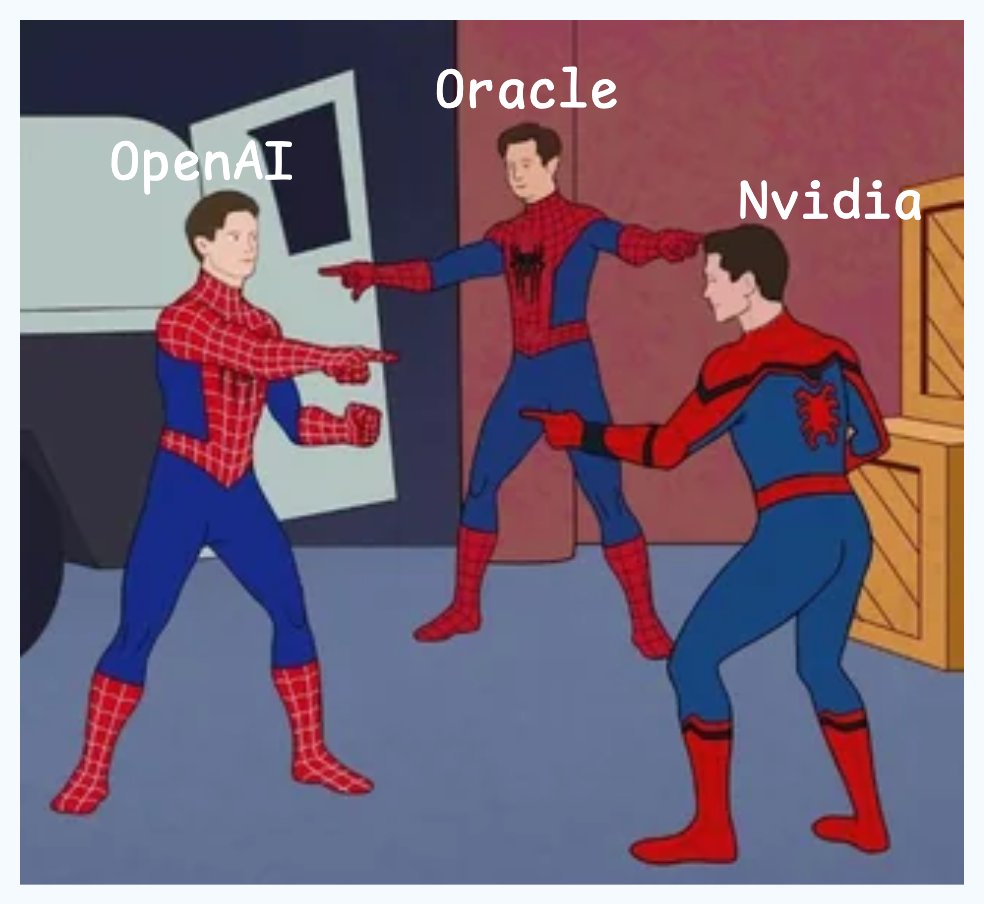
➥ The big players are running in circles:
OpenAI rents cloud infra from Oracle.
Oracle uses that money to buy Nvidia GPUs.
Nvidia invests back into OpenAI.
-> A perfect Inception loop.
And... Wars and conflicts are breaking out everywhere - from Ukraine to the Middle East, and now slowly creeping toward Asia.
➥ Gold doesn’t generate cash flow.
=> People only run to gold when they lose faith in every other asset - equities, USD, or growth stories.
=> This is the point where systemic trust starts to fracture.
...And when trust breaks - it’s only a matter of time.
➥ History may not repeat itself, but we must respect it.
No one knows when the music will stop.
The music’s still good, and everyone thinks they’ll leave before it ends.
But smart money is already playing defense.
=> And money - as always - never lies.
What do you think? Has Big Short 2.0 already begun? Will there be one last pump before… well, you know?
76
7
99
19,822
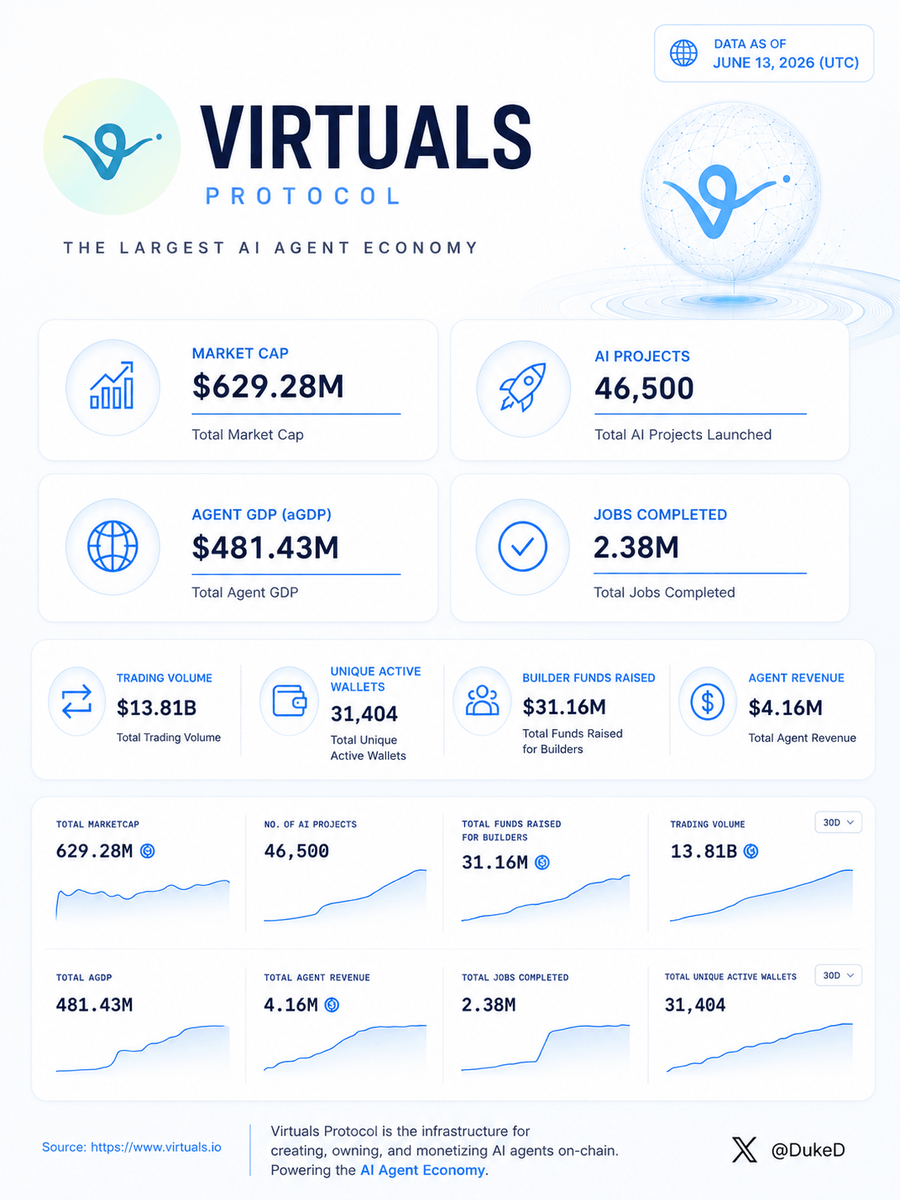
$VIRTUAL is one of the best examples of how powerful a narrative can be in crypto.
The thesis is simple: instead of building a single AI product, @virtuals_io aims to become the marketplace where AI agents are created, owned, and monetized. If AI agents become a major category in crypto, #Virtuals could be one of the biggest beneficiaries.
The ecosystem has grown rapidly:
> 46,500 AI projects launched.
> $481M Agent GDP.
> $13.8B cumulative trading volume.
> 2.38M jobs completed.
These numbers are impressive, but the key question is whether activity is translating into sustainable economic value.
For me, the most important metrics are not the number of agents launched, but:
> Are users returning and actively using these agents?
> Are agents generating recurring revenue?
> Does the value created ultimately flow back to the protocol and token?
This is where I think the market may be getting ahead of reality. Ecosystem activity is growing, but the business fundamentals still look less mature than the current valuation suggests. Much of the thesis depends on AI agents evolving from speculative assets into products people genuinely use.
The bull case is clear:
> AI agents become a major crypto category.
> Virtuals remains the leading launch platform.
> Network effects and economic activity continue to strengthen.
The bear case is equally straightforward:
> Most agents fail to achieve meaningful PMF.
> Revenue growth remains limited.
> Narrative value continues to outpace economic value.
At this stage, I view $VIRTUAL as a promising experiment in AI-native economies rather than a proven business. The opportunity is significant, but there is still a lot that needs to be proven before the fundamentals fully support the story.
My Framework Rating for $VIRTUAL: 2.4/5 ⭐
Narrative (4/5) | Brand (3.5/5) | Ecosystem (2.5/5) | PMF (2/5) | Network Effects (2/5) | Revenue (1.5/5) | Token Capture (1.5/5)
The narrative remains stronger than the economics. Until revenue, retention, and token value capture improve meaningfully, I still see $VIRTUAL as a promising experiment rather than a mature business.

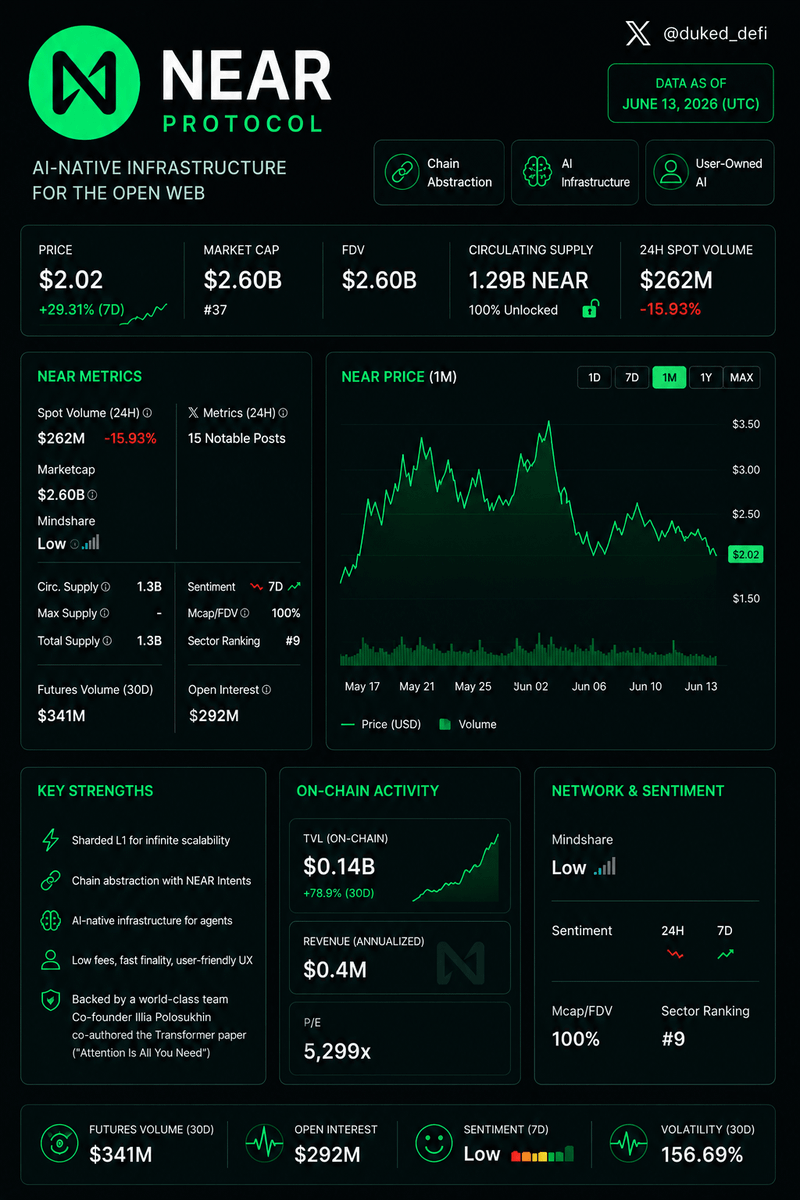
$NEAR is one of the more misunderstood assets in crypto today.
Most people still evaluate it as a traditional Layer 1.
When viewed through that lens, the numbers don't look particularly impressive: roughly $140M TVL, less than $1M annualized revenue, and on-chain activity that remains small compared to #Ethereum, #Solana, or even newer ecosystems.
The real thesis around NEAR isn't DeFi -> It's AI infrastructure.
While most chains compete for liquidity, $NEAR is positioning itself around chain abstraction, user-owned AI, and AI-native applications. The goal isn't simply to become another blockchain. It's to become the coordination layer between users, agents, and multiple chains.
The interesting part is that $NEAR has one of the strongest founder narratives in crypto. Co-founder Illia Polosukhin was one of the authors behind the Transformer architecture, the research that ultimately became the foundation of modern AI systems.
That gives NEAR something many AI-related tokens don't have:
Real technical credibility.
The bull case is straightforward:
> AI becomes a major computing and coordination layer for the internet.
> AI agents require open infrastructure, identity, privacy, and cross-chain execution.
> $NEAR captures part of that value through its AI-focused ecosystem and chain abstraction stack.
The bear case is equally obvious:
> Narrative remains significantly larger than current business fundamentals.
> Revenue generation is still extremely small relative to valuation.
> Adoption has yet to fully validate the long-term vision.
Instead of viewing $NEAR as just another Layer 1 investment, I think the more relevant way to frame it is through the broader AI infrastructure thesis.
At its core, the opportunity depends on a single question:
AI will eventually need open infrastructure owned by users rather than corporations.
If that thesis plays out, $NEAR could become far more important than its current financial metrics suggest.
My Framework Rating for $NEAR: 2.8/5 ⭐
AI Narrative (5/5) | Founder Quality (5/5) | Brand (3.5/5) | Ecosystem (2.5/5) | PMF (2/5) | Network Effects (2/5) | Token Capture (2/5) | Revenue (1/5)
One of the strongest AI narratives in crypto today, but still waiting for adoption and revenue to catch up with the vision. NFA.
26
5
88
2,909
DukeD | Defi retweeted
Jun 13
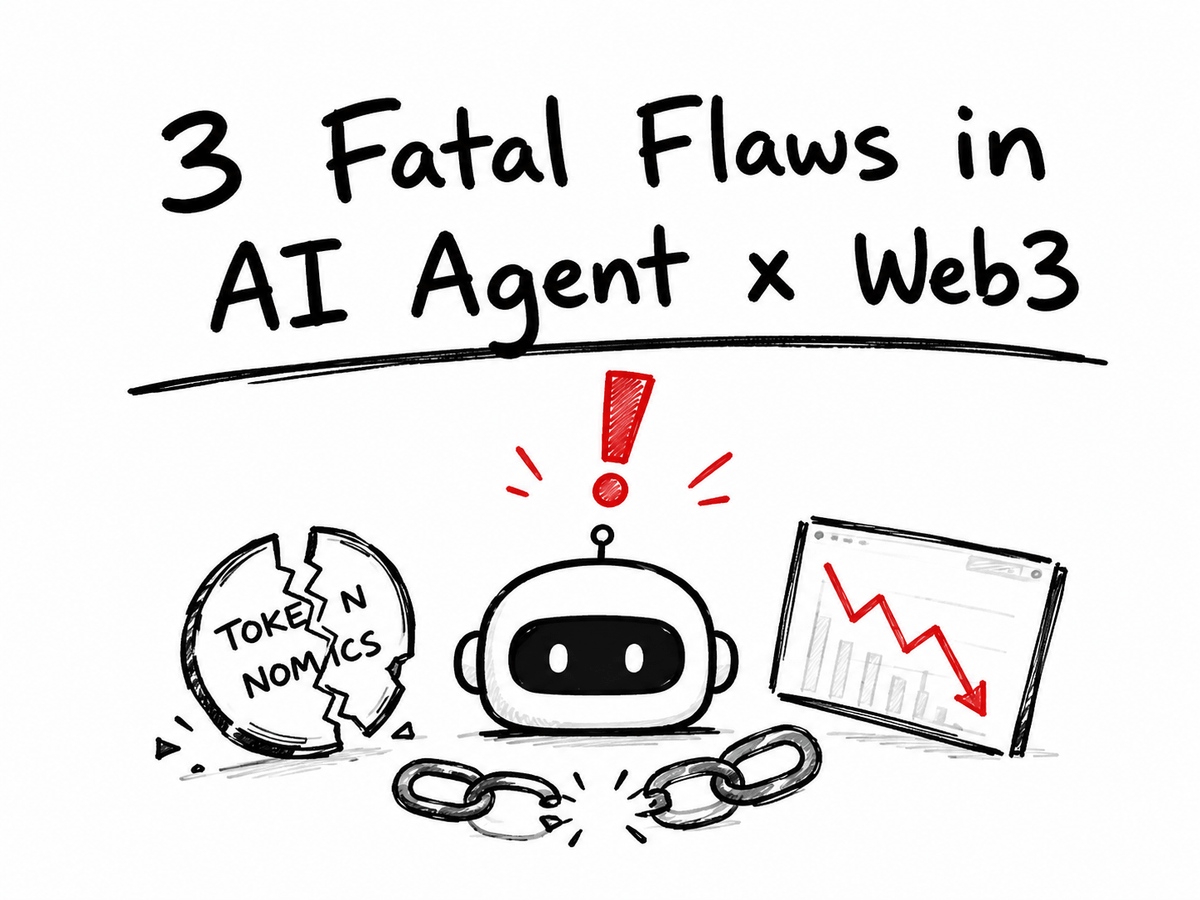
Happy weekend !!! if you still think "AI x Crypto" is one of the easiest narratives to hold for the next few years...
Uou might want to look a bit deeper.
Because behind the hype, the sector is facing several structural problems that most investors continue to ignore.
From late 2025 through Q2/2026, "On-Chain AI Agents" became the hottest money-flow narrative in crypto. $TAO, $FET, $NEAR ,and $AGIX .. helped drive the market. But after digging through on-chain data tokenomics across 20 projects, I think these 3 flaws will wipe out 90% of the sector over the next 12 - 24 months:
25
5
77
2,236
$NEAR is one of the more misunderstood assets in crypto today.
Most people still evaluate it as a traditional Layer 1.
When viewed through that lens, the numbers don't look particularly impressive: roughly $140M TVL, less than $1M annualized revenue, and on-chain activity that remains small compared to #Ethereum, #Solana, or even newer ecosystems.
The real thesis around NEAR isn't DeFi -> It's AI infrastructure.
While most chains compete for liquidity, $NEAR is positioning itself around chain abstraction, user-owned AI, and AI-native applications. The goal isn't simply to become another blockchain. It's to become the coordination layer between users, agents, and multiple chains.
The interesting part is that $NEAR has one of the strongest founder narratives in crypto. Co-founder Illia Polosukhin was one of the authors behind the Transformer architecture, the research that ultimately became the foundation of modern AI systems.
That gives NEAR something many AI-related tokens don't have:
Real technical credibility.
The bull case is straightforward:
> AI becomes a major computing and coordination layer for the internet.
> AI agents require open infrastructure, identity, privacy, and cross-chain execution.
> $NEAR captures part of that value through its AI-focused ecosystem and chain abstraction stack.
The bear case is equally obvious:
> Narrative remains significantly larger than current business fundamentals.
> Revenue generation is still extremely small relative to valuation.
> Adoption has yet to fully validate the long-term vision.
Instead of viewing $NEAR as just another Layer 1 investment, I think the more relevant way to frame it is through the broader AI infrastructure thesis.
At its core, the opportunity depends on a single question:
AI will eventually need open infrastructure owned by users rather than corporations.
If that thesis plays out, $NEAR could become far more important than its current financial metrics suggest.
My Framework Rating for $NEAR: 2.8/5 ⭐
AI Narrative (5/5) | Founder Quality (5/5) | Brand (3.5/5) | Ecosystem (2.5/5) | PMF (2/5) | Network Effects (2/5) | Token Capture (2/5) | Revenue (1/5)
One of the strongest AI narratives in crypto today, but still waiting for adoption and revenue to catch up with the vision. NFA.
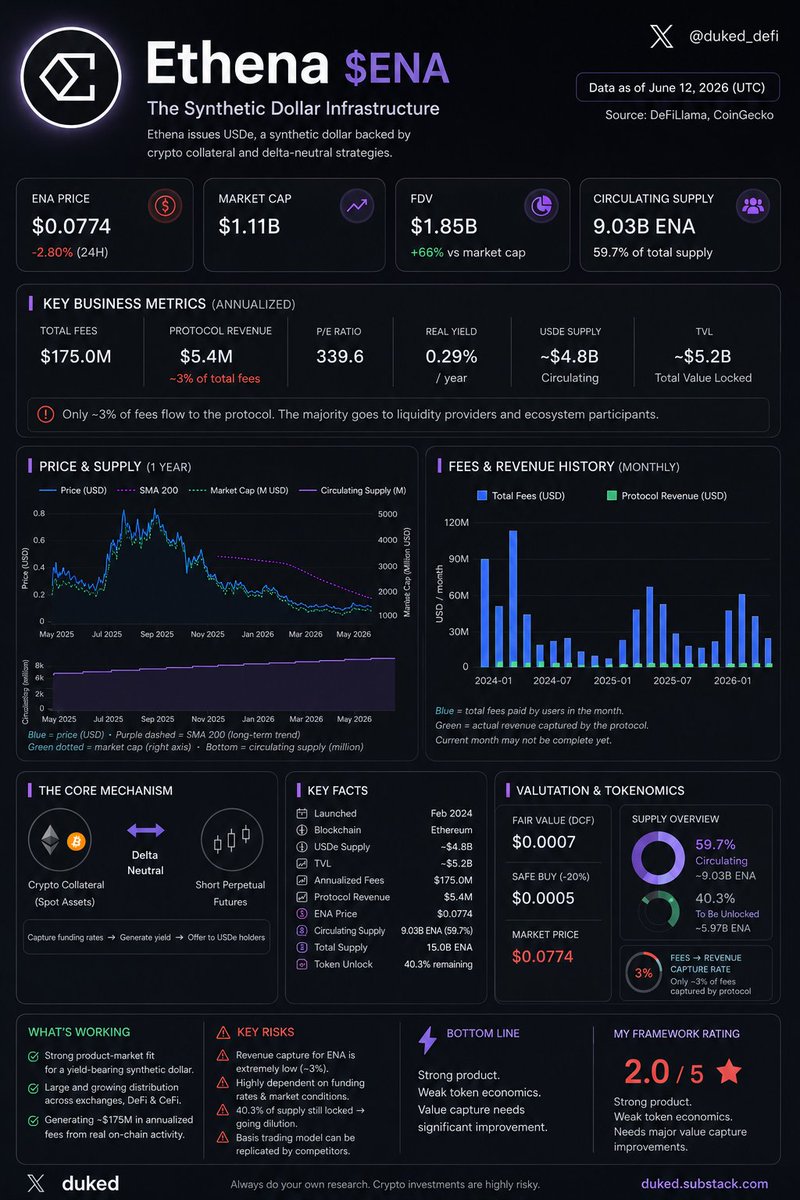
ethereum:0x57e114b691db790c35207b2e685d4a43181e6061 is probably one of the clearest examples of why a great product doesn't automatically create a great token.
The product itself is easy to understand.
@ethena built USDe, a synthetic dollar backed by crypto collateral and delta-neutral hedging strategies.
Today, USDe has grown into one of the largest crypto-native dollar networks in the industry, managing billions in capital and generating roughly $175M in annualized fees.
The product itself isn't the issue.
What matters is how the economic value gets distributed across the system.
At its core, the investment debate comes down to one simple question:
- More capital enters USDe > more hedging activity > more fees generated across the system.
- #Ethena has proven there is demand for a crypto-native yield-bearing dollar.
- Distribution continues expanding through major exchanges, custodians, and DeFi integrations.
But when you looking at ethereum:0x57e114b691db790c35207b2e685d4a43181e6061 as an investment, the picture becomes less attractive.
Annualized protocol revenue is only around $5.4M despite generating roughly $175M in fees.
In other words, most of the economic value created by the system does not currently flow back to ethereum:0x57e114b691db790c35207b2e685d4a43181e6061 holders.
That creates an uncomfortable reality:
- Strong product growth does not necessarily mean strong token value accrual.
- More than 40% of supply remains locked and scheduled for future unlocks.
- The basis-trading model remains heavily dependent on funding-rate conditions.
- Competing stablecoin models can replicate many parts of the strategy over time.
The key question for investors isn't whether USDe can keep growing,the real question is whether that growth will ever translate into meaningful value accrual for ethereum:0x57e114b691db790c35207b2e685d4a43181e6061 holders.
#Ethena has clearly demonstrated demand for its product and continues expanding distribution across the crypto ecosystem.
However, unless the protocol establishes a stronger link between economic activity and token holder returns, there is a risk that adoption, fees, and ecosystem growth continue to outpace the value captured by ENA itself.
My Framework Rating for ethereum:0x57e114b691db790c35207b2e685d4a43181e6061: 2.0/5 ⭐
PMF (4/5) | Revenue (1/5) | Network Effects (3/5) | Brand (3/5) | Lock-in (2/5) | Tokenomics (1/5) | Value Capture (1/5)
A strong product with growing adoption, but currently one of the weakest value-capture structures among major crypto assets. NFA.
37
21
254
16,414
ethereum:0x57e114b691db790c35207b2e685d4a43181e6061 is probably one of the clearest examples of why a great product doesn't automatically create a great token.
The product itself is easy to understand.
@ethena built USDe, a synthetic dollar backed by crypto collateral and delta-neutral hedging strategies.
Today, USDe has grown into one of the largest crypto-native dollar networks in the industry, managing billions in capital and generating roughly $175M in annualized fees.
The product itself isn't the issue.
What matters is how the economic value gets distributed across the system.
At its core, the investment debate comes down to one simple question:
- More capital enters USDe > more hedging activity > more fees generated across the system.
- #Ethena has proven there is demand for a crypto-native yield-bearing dollar.
- Distribution continues expanding through major exchanges, custodians, and DeFi integrations.
But when you looking at ethereum:0x57e114b691db790c35207b2e685d4a43181e6061 as an investment, the picture becomes less attractive.
Annualized protocol revenue is only around $5.4M despite generating roughly $175M in fees.
In other words, most of the economic value created by the system does not currently flow back to ethereum:0x57e114b691db790c35207b2e685d4a43181e6061 holders.
That creates an uncomfortable reality:
- Strong product growth does not necessarily mean strong token value accrual.
- More than 40% of supply remains locked and scheduled for future unlocks.
- The basis-trading model remains heavily dependent on funding-rate conditions.
- Competing stablecoin models can replicate many parts of the strategy over time.
The key question for investors isn't whether USDe can keep growing,the real question is whether that growth will ever translate into meaningful value accrual for ethereum:0x57e114b691db790c35207b2e685d4a43181e6061 holders.
#Ethena has clearly demonstrated demand for its product and continues expanding distribution across the crypto ecosystem.
However, unless the protocol establishes a stronger link between economic activity and token holder returns, there is a risk that adoption, fees, and ecosystem growth continue to outpace the value captured by ENA itself.
My Framework Rating for ethereum:0x57e114b691db790c35207b2e685d4a43181e6061: 2.0/5 ⭐
PMF (4/5) | Revenue (1/5) | Network Effects (3/5) | Brand (3/5) | Lock-in (2/5) | Tokenomics (1/5) | Value Capture (1/5)
A strong product with growing adoption, but currently one of the weakest value-capture structures among major crypto assets. NFA.
Jun 12
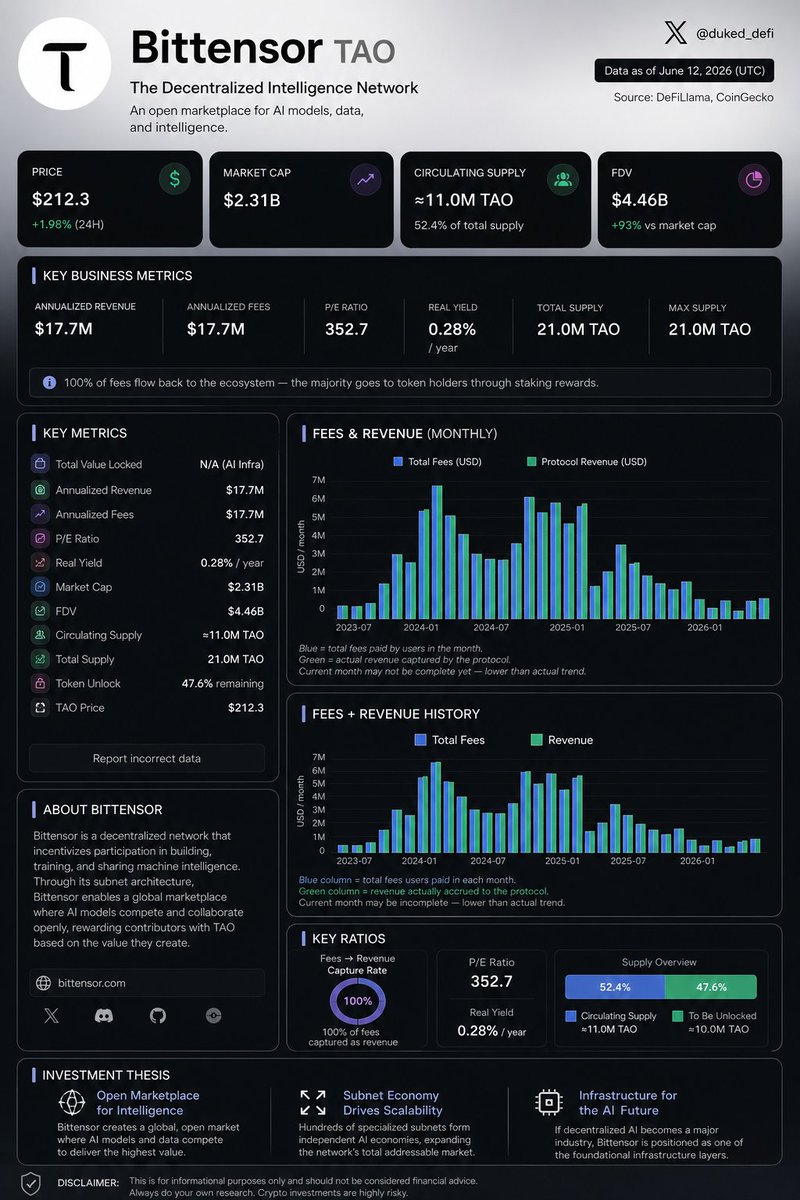
$TAO is one of the few assets in crypto where the market is clearly paying for a future that doesn't fully exist yet.
At roughly $2.3B market cap, around $4.5B FDV, and only about $18M annualized revenue, @bittensor cannot be explained through traditional valuation metrics alone.
The investment case is much bigger than current fundamentals.
Bittensor is building a decentralized network where AI models, data, and intelligence compete inside an open market rather than being controlled by a handful of centralized companies.
The key question isn't whether AI grows.
The key question is whether open AI networks can capture a meaningful share of that growth.
What makes $TAO interesting is its subnet architecture.
Instead of one application trying to win the AI race, Bittensor allows dozens of specialized AI economies to emerge on top of a shared incentive layer.
In theory, every successful subnet increases the value of the broader network.
That creates a very different dynamic from most AI tokens, which are often tied to a single product or narrative.
The risks are obvious:
> Revenue remains small relative to valuation.
> More than half of the long-term value proposition still depends on future adoption.
> Token holders are largely betting on network expansion rather than direct cash-flow generation.
> Competition from centralized AI platforms remains enormous.
For me, $TAO is not a valuation-driven investment.
It's a conviction-driven investment.
You either believe decentralized intelligence becomes a real industry, or you don't.
If that happens, Bittensor has a legitimate chance to become one of the foundational infrastructure layers of the AI economy.
If it doesn't, current valuations will be difficult to justify through fundamentals alone.
My Framework Rating for $TAO: 3.1/5 ⭐
Brand (5/5) | Narrative (5/5) | PMF (3.5/5) | Ecosystem (4/5) | Network Effects (3.5/5) | Tokenomics (3/5) | Revenue (2/5)
One of the strongest AI infrastructure bets in crypto today, but still a thesis on where AI is going, not where the numbers are today.
NFA.
24
3
79
16,707
Jun 13
Happy weekend !!! if you still think "AI x Crypto" is one of the easiest narratives to hold for the next few years...
Uou might want to look a bit deeper.
Because behind the hype, the sector is facing several structural problems that most investors continue to ignore.
From late 2025 through Q2/2026, "On-Chain AI Agents" became the hottest money-flow narrative in crypto. $TAO, $FET, $NEAR ,and $AGIX .. helped drive the market. But after digging through on-chain data tokenomics across 20 projects, I think these 3 flaws will wipe out 90% of the sector over the next 12 - 24 months:
25
5
77
2,236
Jun 13
3. THE "USE-CASE" PROBLEM - WHAT ACTUALLY NEEDS A BLOCKCHAIN?.
> Simple question: if an AI agent is booking airline tickets, why does it need to run on-chain? An OpenAI API a traditional database is usually cheaper, faster, and more private.
Messari Q1/2026 data: 87% of "AI dApps" have fewer than 100 real DAUs. Most are just tech demos.
Projects that survive need to answer one question:
"If you remove the blockchain, does the product die?"
If the answer is "No" => that project probably doesn't need a token.
1
2
1,053
Jun 13
AI x Crypto isn't going away,,if anything, the sector still feels early and there is plenty of room left for growth.
but the filtering process will be brutal,,between 2026 and 2027, I wouldn't be surprised if only 5-10% of today's projects remain relevant.
narratives survive,,projects get replaced.
When it comes to long-term hodling, these are the 2 metrics I watch the closest. If a project can't meet these requirements, I'd only consider a short-term trade and move on:
> Revenue / Token Emissions: Real revenue divided by tokens being emitted to miners. >1 is where sustainability starts.
> Cost / Transaction vs Web2: The cost of running an AI task on-chain needs to be cheaper than or at least comparable to Web2. Otherwise, users will never switch.
Everyone says AI is the future,but that future can't be funded with trash tokens.
13/06/2026 | Personal opinion, NFA.
2
1,011
Jun 12
$TAO is one of the few assets in crypto where the market is clearly paying for a future that doesn't fully exist yet.
At roughly $2.3B market cap, around $4.5B FDV, and only about $18M annualized revenue, @bittensor cannot be explained through traditional valuation metrics alone.
The investment case is much bigger than current fundamentals.
Bittensor is building a decentralized network where AI models, data, and intelligence compete inside an open market rather than being controlled by a handful of centralized companies.
The key question isn't whether AI grows.
The key question is whether open AI networks can capture a meaningful share of that growth.
What makes $TAO interesting is its subnet architecture.
Instead of one application trying to win the AI race, Bittensor allows dozens of specialized AI economies to emerge on top of a shared incentive layer.
In theory, every successful subnet increases the value of the broader network.
That creates a very different dynamic from most AI tokens, which are often tied to a single product or narrative.
The risks are obvious:
> Revenue remains small relative to valuation.
> More than half of the long-term value proposition still depends on future adoption.
> Token holders are largely betting on network expansion rather than direct cash-flow generation.
> Competition from centralized AI platforms remains enormous.
For me, $TAO is not a valuation-driven investment.
It's a conviction-driven investment.
You either believe decentralized intelligence becomes a real industry, or you don't.
If that happens, Bittensor has a legitimate chance to become one of the foundational infrastructure layers of the AI economy.
If it doesn't, current valuations will be difficult to justify through fundamentals alone.
My Framework Rating for $TAO: 3.1/5 ⭐
Brand (5/5) | Narrative (5/5) | PMF (3.5/5) | Ecosystem (4/5) | Network Effects (3.5/5) | Tokenomics (3/5) | Revenue (2/5)
One of the strongest AI infrastructure bets in crypto today, but still a thesis on where AI is going, not where the numbers are today.
NFA.
Jun 12
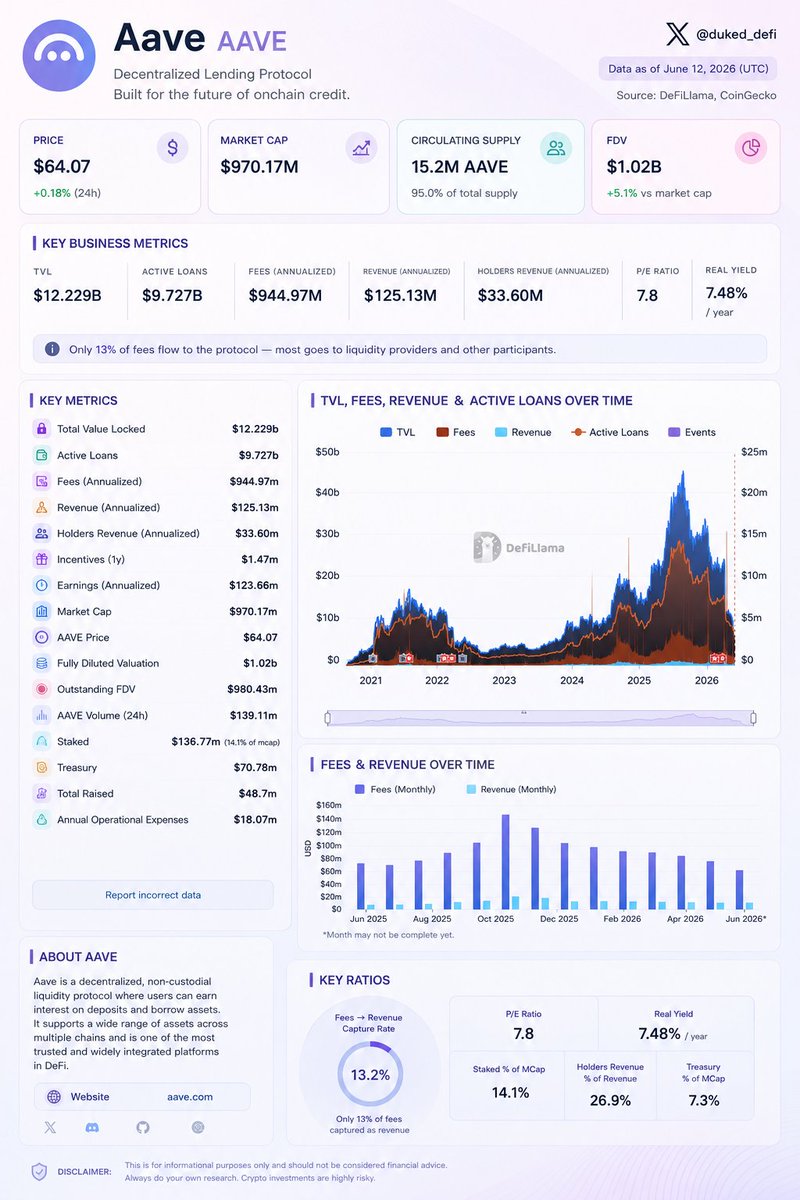
$AAVE is probably one of the most battle-tested assets in crypto.
While new lending protocols continue competing for liquidity, Aave still sits at the center of DeFi credit markets with over $12.2B TVL, nearly $9.8B in active loans, around $945M annualized fees, and roughly $125M annualized protocol revenue..
The core thesis is simple:
- More capital enters DeFi > more borrowing demand> more lending activity > more fees generated by @aave
- Aave has become the default lending layer for a large portion of the industry, creating network effects that are difficult to replicate.
- Billions of dollars in liquidity and hundreds of integrations make Aave one of the most deeply embedded pieces of infrastructure in crypto today.
What makes $AAVE interesting isn't growth.
It's durability.
Most protocols are still trying to prove product-market fit.
Aave already survived multiple cycles, bear markets, liquidity crises, and countless competitors trying to take market share.
That kind of resilience is rare.
That said, the risks remain obvious:
- Revenue capture for token holders is still weaker than many investors would prefer.
- @Morpho and newer lending architectures continue taking share in certain market segments.
- Complex collateral assets introduce additional risk, as seen in recent rsETH-related events.
- Regulatory pressure on DeFi credit markets remains an overhang for the entire sector.
IMO, i think Credit will eventually become one of the largest sectors in onchain finance.
If that thesis plays out, $Aave remains one of the strongest candidates to capture a meaningful share of that future.
My Framework Rating for $AAVE: 4.7/5 ⭐
PMF (5/5) | Network Effects (5/5) | Brand (5/5) | Lock-in (5/5) | Revenue (4/5) | Ecosystem (4/5) | Tokenomics (4/5)
Not the fastest-growing protocol in crypto anymore, but still one of the highest-conviction infrastructure assets for anyone who believes onchain credit continues expanding over the next decade.
NFA.
26
7
86
4,610
Jun 12
$AAVE is probably one of the most battle-tested assets in crypto.
While new lending protocols continue competing for liquidity, Aave still sits at the center of DeFi credit markets with over $12.2B TVL, nearly $9.8B in active loans, around $945M annualized fees, and roughly $125M annualized protocol revenue..
The core thesis is simple:
- More capital enters DeFi > more borrowing demand> more lending activity > more fees generated by @aave
- Aave has become the default lending layer for a large portion of the industry, creating network effects that are difficult to replicate.
- Billions of dollars in liquidity and hundreds of integrations make Aave one of the most deeply embedded pieces of infrastructure in crypto today.
What makes $AAVE interesting isn't growth.
It's durability.
Most protocols are still trying to prove product-market fit.
Aave already survived multiple cycles, bear markets, liquidity crises, and countless competitors trying to take market share.
That kind of resilience is rare.
That said, the risks remain obvious:
- Revenue capture for token holders is still weaker than many investors would prefer.
- @Morpho and newer lending architectures continue taking share in certain market segments.
- Complex collateral assets introduce additional risk, as seen in recent rsETH-related events.
- Regulatory pressure on DeFi credit markets remains an overhang for the entire sector.
IMO, i think Credit will eventually become one of the largest sectors in onchain finance.
If that thesis plays out, $Aave remains one of the strongest candidates to capture a meaningful share of that future.
My Framework Rating for $AAVE: 4.7/5 ⭐
PMF (5/5) | Network Effects (5/5) | Brand (5/5) | Lock-in (5/5) | Revenue (4/5) | Ecosystem (4/5) | Tokenomics (4/5)
Not the fastest-growing protocol in crypto anymore, but still one of the highest-conviction infrastructure assets for anyone who believes onchain credit continues expanding over the next decade.
NFA.
Jun 12
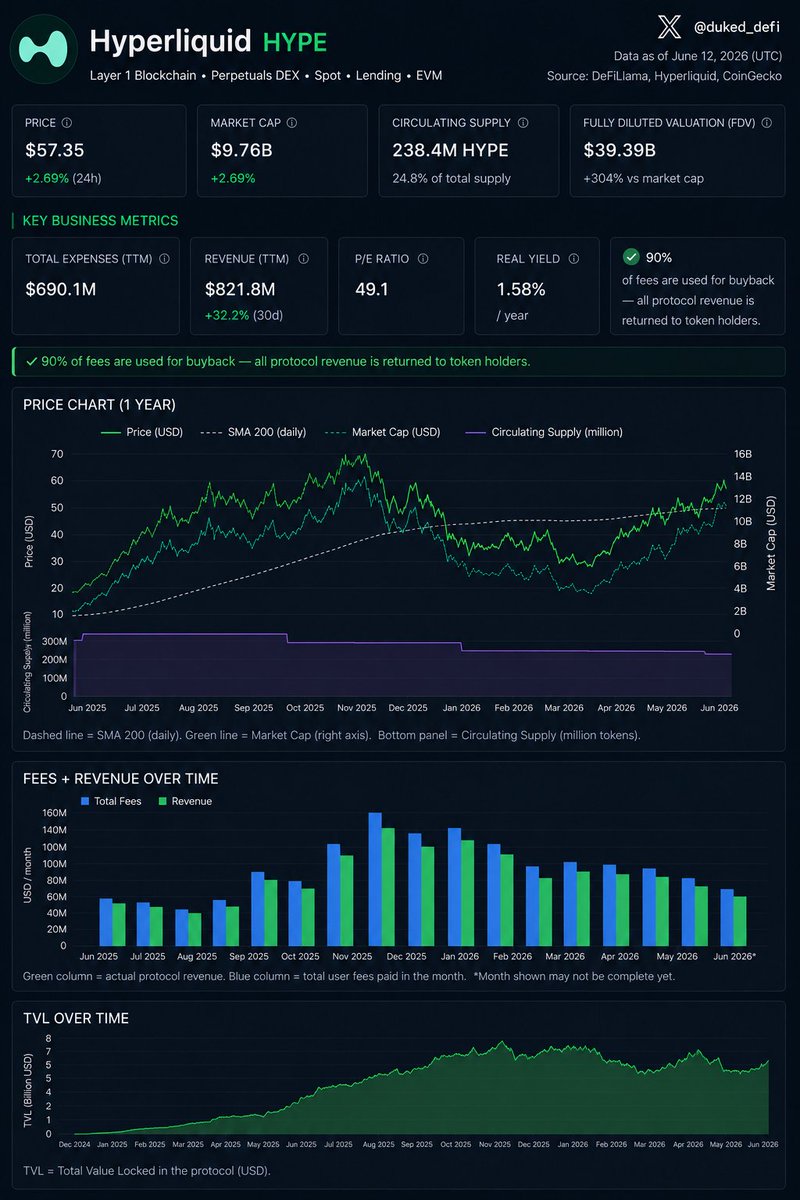
$HYPE is probably one of the highest-quality businesses in crypto right now.
While most DeFi protocols are still fighting for liquidity, @HyperliquidX has already become one of the largest onchain trading venues in crypto, generating over $820M annualized revenue and processing trillions of dollars in trading volume.
The core thesis is simple:
> More traders move onchain > more volume settles on Hyperliquid > more fees generated by the protocol.
> Hyperliquid has become the default venue for many serious onchain traders, creating one of the strongest liquidity networks in DeFi.
> Revenue comes from real trading activity happening today, not a future narrative that may never materialize.
What makes $HYPE interesting is that the market is no longer valuing it as just another perp DEX.
It's increasingly being valued as a piece of onchain financial infrastructure.
The bullish case becomes even stronger if tokenized stocks, institutional products, and broader capital markets continue moving onchain.
That said, the risks are equally obvious:
> 75.2% of total supply remains unlocked, creating significant dilution risk over time.
> Competition is increasing as new perp venues continue entering the market.
> Regulatory scrutiny around derivatives remains a long-term uncertainty.
> Ecosystem development still lags behind larger chains like #Ethereum and #Solana.
The real opportunity isn't perpetual trading itself.
The opportunity is that an increasing share of global trading activity is moving onchain, and Hyperliquid is emerging as one of the primary venues capturing that shift.
If this trend continues, @HyperliquidX won't just be a trading platform,,it could become a core piece of onchain financial infrastructure.
My Framework Rating for $HYPE: 4.6/5 ⭐
PMF (5/5) | Revenue (5/5) | Network Effects (4/5) | Brand (4/5) | Lock-in (3/5) | Tokenomics (2/5) | Ecosystem (2/5)
(higher than the framework score because I place much greater weight on revenue, liquidity dominance, and execution quality).
One of the strongest revenue-generating protocols in crypto today, supported by real users, real liquidity, and real cash flow. NFA.
33
43
195
5,414
Jun 12
$HYPE is probably one of the highest-quality businesses in crypto right now.
While most DeFi protocols are still fighting for liquidity, @HyperliquidX has already become one of the largest onchain trading venues in crypto, generating over $820M annualized revenue and processing trillions of dollars in trading volume.
The core thesis is simple:
> More traders move onchain > more volume settles on Hyperliquid > more fees generated by the protocol.
> Hyperliquid has become the default venue for many serious onchain traders, creating one of the strongest liquidity networks in DeFi.
> Revenue comes from real trading activity happening today, not a future narrative that may never materialize.
What makes $HYPE interesting is that the market is no longer valuing it as just another perp DEX.
It's increasingly being valued as a piece of onchain financial infrastructure.
The bullish case becomes even stronger if tokenized stocks, institutional products, and broader capital markets continue moving onchain.
That said, the risks are equally obvious:
> 75.2% of total supply remains unlocked, creating significant dilution risk over time.
> Competition is increasing as new perp venues continue entering the market.
> Regulatory scrutiny around derivatives remains a long-term uncertainty.
> Ecosystem development still lags behind larger chains like #Ethereum and #Solana.
The real opportunity isn't perpetual trading itself.
The opportunity is that an increasing share of global trading activity is moving onchain, and Hyperliquid is emerging as one of the primary venues capturing that shift.
If this trend continues, @HyperliquidX won't just be a trading platform,,it could become a core piece of onchain financial infrastructure.
My Framework Rating for $HYPE: 4.6/5 ⭐
PMF (5/5) | Revenue (5/5) | Network Effects (4/5) | Brand (4/5) | Lock-in (3/5) | Tokenomics (2/5) | Ecosystem (2/5)
(higher than the framework score because I place much greater weight on revenue, liquidity dominance, and execution quality).
One of the strongest revenue-generating protocols in crypto today, supported by real users, real liquidity, and real cash flow. NFA.
Jun 11
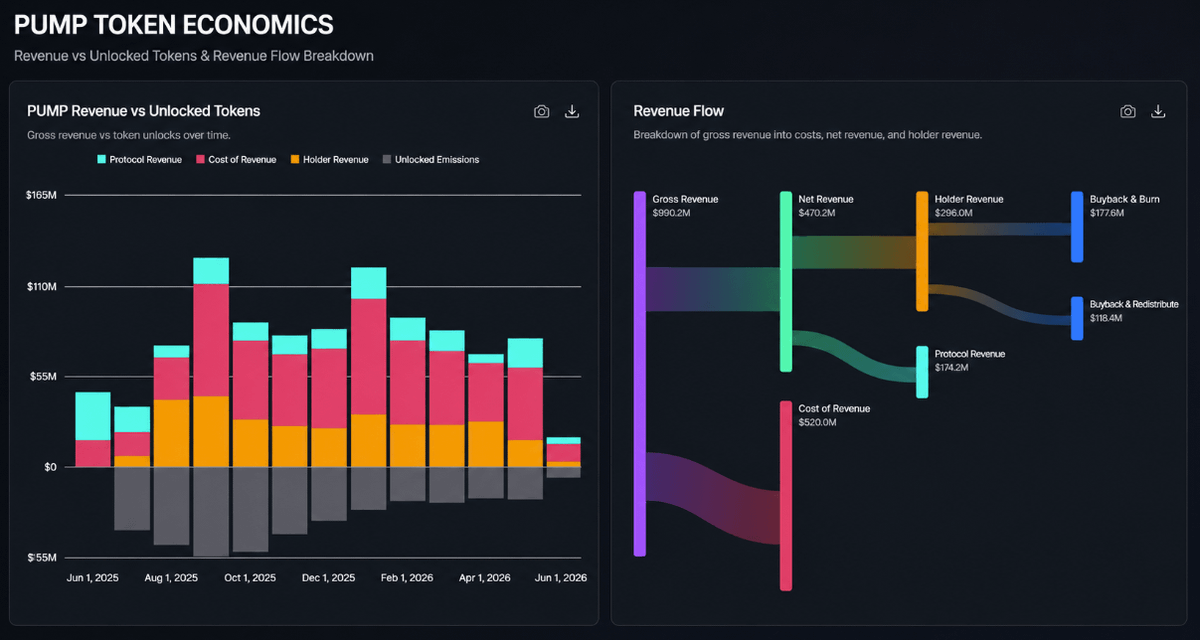
$PUMP is probably one of the most unique assets in crypto right now.
Unlike most projects that are still trying to find demand, @Pumpfun already sits at the center of one of the largest attention markets in the industry. Since launch, the platform has generated over $1.7B cumulative revenue, making it one of the highest revenue-generating applications crypto has ever produced.
The core thesis is simple:
> Memecoin activity grows > more token launches > more trading volume > more fees captured by @Pumpfun
> Pump.fun remains one of the dominant launchpads on Solana with strong network effects and distribution.
> Revenue is directly tied to user behavior that already exists today, not a future narrative that may or may not materialize.
What makes $PUMP interesting is its value accrual model. A portion of protocol revenue is returned through buybacks, burns, and staking-related mechanisms, creating a direct link between platform activity and token holders.
That said, the risks are equally obvious:
> Revenue is heavily dependent on speculative activity.
> Memecoin volume is cyclical and highly sentiment-driven.
> Strong revenue does not automatically translate into strong token performance.
> If attention leaves the memecoin sector, growth expectations can be repriced very quickly.
I don't think $PUMP as a bet on memecoins,I think it as a bet on one assumption:
Speculation will remain one of crypto's largest industries for years to come.
If that assumption is correct, #Pumpfun may continue printing revenue long after many narratives fade away.
My Framework Rating for $PUMP : 4/5 ⭐
PMF (5/5) | Revenue (5/5) | Brand (5/5) | Liquidity (4/5) | Tokenomics (3.5/5) | Moat (3/5) | Ecosystem (2/5).
One of the strongest cash-flow businesses in crypto today, but still ultimately a bet on the longevity of speculation itself. NFA....
30
3
89
4,859
Jun 11
$PUMP is probably one of the most unique assets in crypto right now.
Unlike most projects that are still trying to find demand, @Pumpfun already sits at the center of one of the largest attention markets in the industry. Since launch, the platform has generated over $1.7B cumulative revenue, making it one of the highest revenue-generating applications crypto has ever produced.
The core thesis is simple:
> Memecoin activity grows > more token launches > more trading volume > more fees captured by @Pumpfun
> Pump.fun remains one of the dominant launchpads on Solana with strong network effects and distribution.
> Revenue is directly tied to user behavior that already exists today, not a future narrative that may or may not materialize.
What makes $PUMP interesting is its value accrual model. A portion of protocol revenue is returned through buybacks, burns, and staking-related mechanisms, creating a direct link between platform activity and token holders.
That said, the risks are equally obvious:
> Revenue is heavily dependent on speculative activity.
> Memecoin volume is cyclical and highly sentiment-driven.
> Strong revenue does not automatically translate into strong token performance.
> If attention leaves the memecoin sector, growth expectations can be repriced very quickly.
I don't think $PUMP as a bet on memecoins,I think it as a bet on one assumption:
Speculation will remain one of crypto's largest industries for years to come.
If that assumption is correct, #Pumpfun may continue printing revenue long after many narratives fade away.
My Framework Rating for $PUMP : 4/5 ⭐
PMF (5/5) | Revenue (5/5) | Brand (5/5) | Liquidity (4/5) | Tokenomics (3.5/5) | Moat (3/5) | Ecosystem (2/5).
One of the strongest cash-flow businesses in crypto today, but still ultimately a bet on the longevity of speculation itself. NFA....
29
14
91
4,380
Jun 11
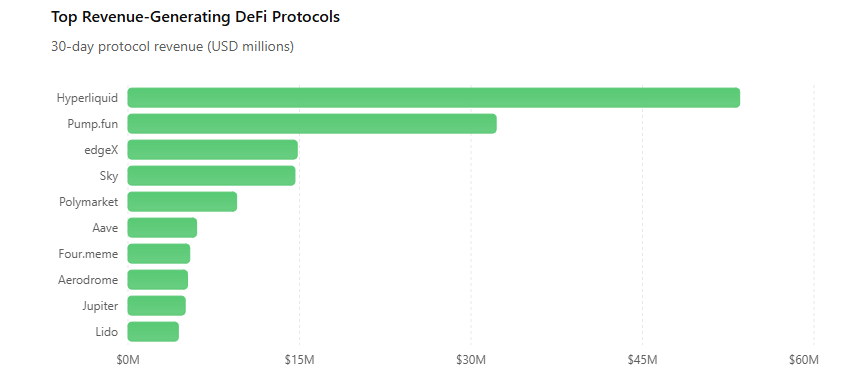
gDeFi,,,According to recent DeFi revenue data, a surprisingly small group of protocols is capturing most of the economic activity across the entire sector.
Top revenue-generating protocols by 30-day revenue right now:
1 @HyperliquidX → ~$53.5M
2 @Pumpfun → ~$32.2M
3 @edgeX_exchange → ~$14.8M
4 @SkyEcosystem → ~$14.6M
5 @Polymarket → ~$9.5M
6 @aave → ~$6M
7 @Fourmeme → ~$5.4M
8 @AerodromeFi → ~$5.2M
9 @JupiterExchange → ~$5M
10. @LidoFinance → ~$4.4M
11. One thing that stands out from the data is how concentrated DeFi revenue has become. A handful of protocols are generating tens of millions in monthly revenue, while most of the sector captures only a small fraction of user spending. This suggests that product-market fit matters more than ever, and users are increasingly gravitating toward platforms that provide clear utility rather than relying on incentives alone.
28
2
77
2,105
Jun 10
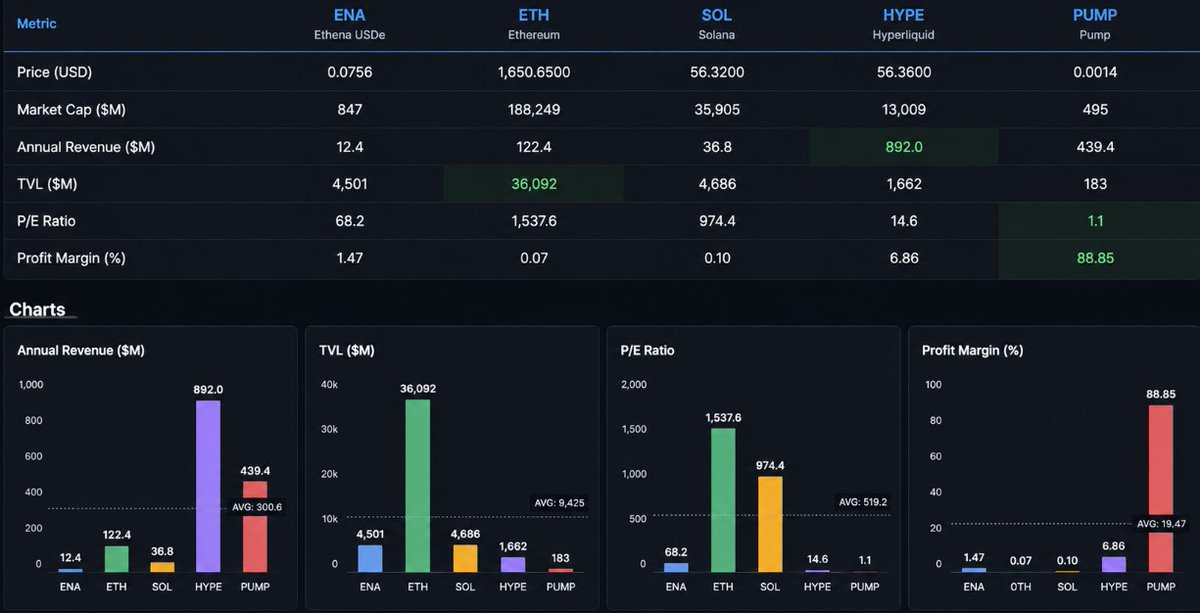
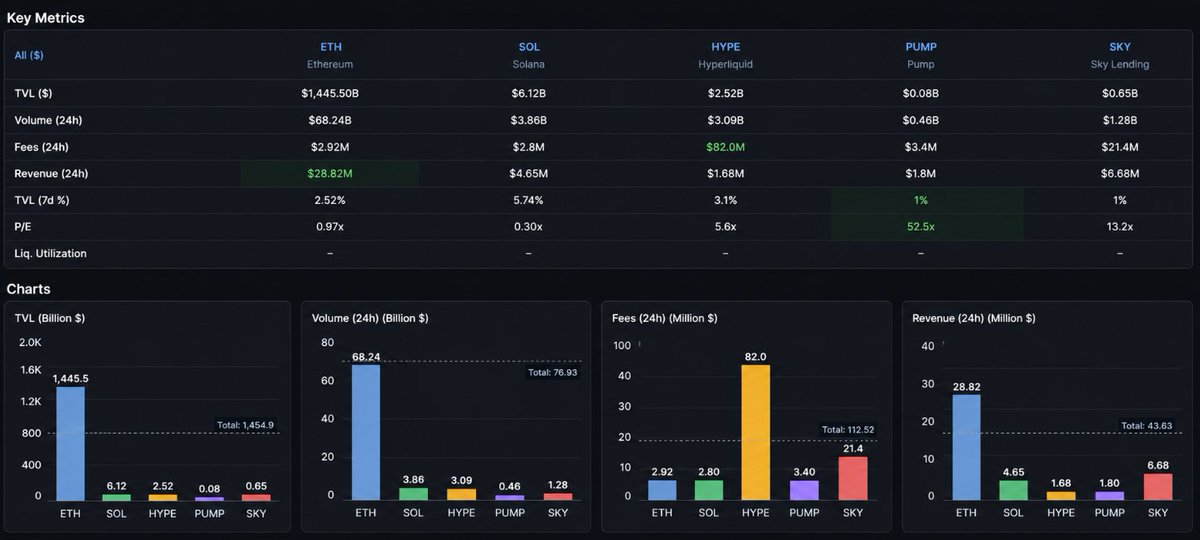
I just built a small tool that scrapes realtime data and auto-generates comparison tables like this.
Input any token > instantly pulls price, market cap, 1Y revenue, TVL, P/E and profit margin vs majors.
Quick demo with $ETH, $SOL, $HYPE, $Pump and $Sky
>>> $ETH & $SOL still lead in TVL and market cap, but their actual revenue is tiny. Meanwhile $HYPE printed $892M revenue last year with P/E only 14.6, and Pump shows 88.85% profit margin.
This highlights the big gap between pure narrative plays and protocols that actually have real business models generating cash flow.
Tool is still in demo phase, I’m optimizing and adding filters to compare by narrative vs actual business segments.
What tokens should I run next?Drop suggestions below 👇
22
2
71
2,146
Jun 10
Just type in any 3-5 token names and it will automatically generate a comparison table with all the key metrics (price, market cap, 1Y revenue, TVL, P/E, profit margin, etc.).
tool is still in demo phase and I’m optimizing it. I’m also planning to add more features like deeper insights and per-project thesis breakdowns.
Any ideas or features you’d like to see? Drop your suggestions below...
1
1,096
Jun 10
one thing I've been paying more attention to lately is how the market is slowly shifting from valuing TVL to valuing actual revenue.
during previous cycles, projects could attract billions in liquidity through incentives and still struggle to build sustainable demand.
today, that approach feels much harder.
capital has become more selective, and investors are starting to ask a different question:
who is actually generating economic activity?
that's partly why protocols like @MorphoLabs, @pendle_fi, @HyperliquidX
@Polymarket , @Pumpfun ...etc
they aren't just attracting liquidity,they're generating fees, usage, and real economic throughput.
in the long run, I believe revenue will become a much more important valuation metric than TVL /narrative..
because liquidity can move >> real demand is much harder to manufacture.
NFA. DYOR...
20
3
67
1,993
Jun 10
gDeFi,,,
@Morpho just raised $175M - one of the largest raises the sector has ever seen. Co-led by @paradigm , @a16zcrypto & @RibbitCapital , with strategic participation from @Apollo , @circle , @VanEck , and more. Post-money valuation approaching $2B.
what stands out most is that the amount isn't the most interesting part.
what's interesting is where smart capital continues to place its bets when the noise fades. Not another consumer app, not another short-lived narrative, but credit infrastructure.
everyone talks about stablecoins and RWAs, but neither reaches its full potential without a credit layer underneath. Capital needs to be deployed, assets need financing, and institutions need borrowing and lending markets. That's exactly where @Morpho is positioning itself.
The protocol already secures more than $11B in deposits with integrations across @Coinbase, @Binance, @Fireblocks, @Kraken, #Société Générale Forge and others. At this point, the discussion is no longer about product-market fit, but about scale.
a bigger picture is that the global credit market is worth roughly ~$200T , while onchain credit remains tiny by comparison. If even a small fraction of future credit activity moves onchain, the largest winners may not be the applications attracting attention, but infrastructure quietly powering them.
I've said before that if institutions continue bringing real capital onchain, $Morpho is one of the highest-conviction infrastructure bets in #DeFi.
Yesterday's raise didn't change that thesis. It reinforced it.

May 18
22
3
67
2,773
Jun 9
a few days ago I wrote about the tokenization of private equity and how names like SpaceX, Anthropic and OpenAI could eventually bring a huge amount of attention toward on-chain capital markets.
since then, Anthropic has officially filed its S-1, OpenAI is moving closer toward a public listing, and SpaceX continues progressing toward what could become the largest IPO in history.
honestly, I think the more interesting question now isn't whether these companies become investable.
it's who benefits if private markets start moving on-chain at scale.
because every tokenized asset still needs issuance, compliance, custody, settlement, identity verification and secondary market liquidity before capital can move efficiently.
and that's where things start getting interesting.
projects like @OndoFinance ( $ONDO ), @plumenetwork ( $PLUME ), @PolymeshNetwork ( $POLYX) , @centrifuge ( $CFG) and networks like @CantonNetwork ( $CC ) ... are all approaching the opportunity from different angles, but they're ultimately helping build infrastructure around the same long-term trend.
some focus on distribution and investor access, while others focus on compliance, settlement or institutional connectivity.
different pieces of the puzzle, but all moving toward the same destination.
I keep seeing people talk about tokenized stocks, but lmao, I think the bigger story could be the gradual tokenization of capital markets themselves.
not just private equity, but also private credit, funds, treasuries and other real-world financial assets.
if that market keeps growing over the next decade, value probably won't accrue only to the assets being tokenized.
it may also accrue to the networks helping investors discover, access, move and settle those assets.
because if trillions of dollars eventually move on-chain, somebody still has to build the rails.

Jun 4
One trend the market may still be underestimating right now:
the tokenization of private equity.
- @SpaceX is expected to IPO around 2026 at a valuation potentially approaching $2T following the xAI integration.
- @AnthropicAI has reportedly filed its S-1 and could become one of the largest AI IPOs in history if current valuation expectations hold.
- @OpenAI is also widely expected to move toward a public listing over the coming quarters.
Individually, these are massive stories.
Collectively, they may be signaling something much bigger.
For decades, retail investors were locked out of the highest-growth phase of companies like Google, Meta, Nvidia and Amazon.
A large portion of the value creation happened before public markets ever had access.
Now that dynamic is starting to change.
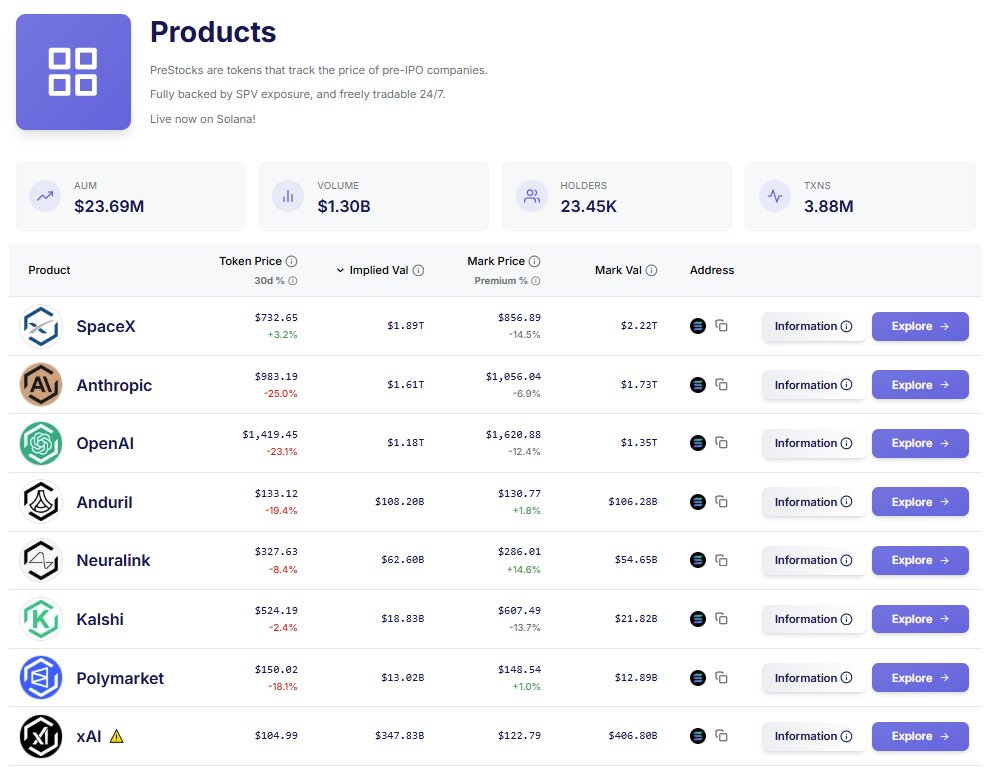
Platforms are already bringing pre-IPO exposure on-chain, allowing investors to gain access to companies such as SpaceX, Anthropic and OpenAI long before traditional listings happen.
What's interesting is that pre-IPO markets are already implying valuations of roughly:
> SpaceX → ~$2.2T.
> Anthropic → ~$1.7T.
> OpenAI → ~$1.35T.
Whether those numbers ultimately prove correct isn't really the point.
More important development is that capital is beginning to price private-company exposure 24/7, globally and increasingly on-chain.
And that creates an entirely new category sitting between traditional equities and crypto.
What gets overlooked is that every tokenized private asset needs infrastructure:
-issuance
-compliance
-custody
-settlement
-secondary market liquidity..
If this trend continues, the biggest winners may not be SpaceX or OpenAI..
They could be the platforms and protocols that enable issuance, compliance, trading and settlement for tokenized private assets.
Because every transaction, every listing and every new investor flows through that infrastructure.
That's why I think the real opportunity isn't tokenized stocks > It's bringing private markets on-chain.
NFA.
16
2
54
4,586
Jun 9
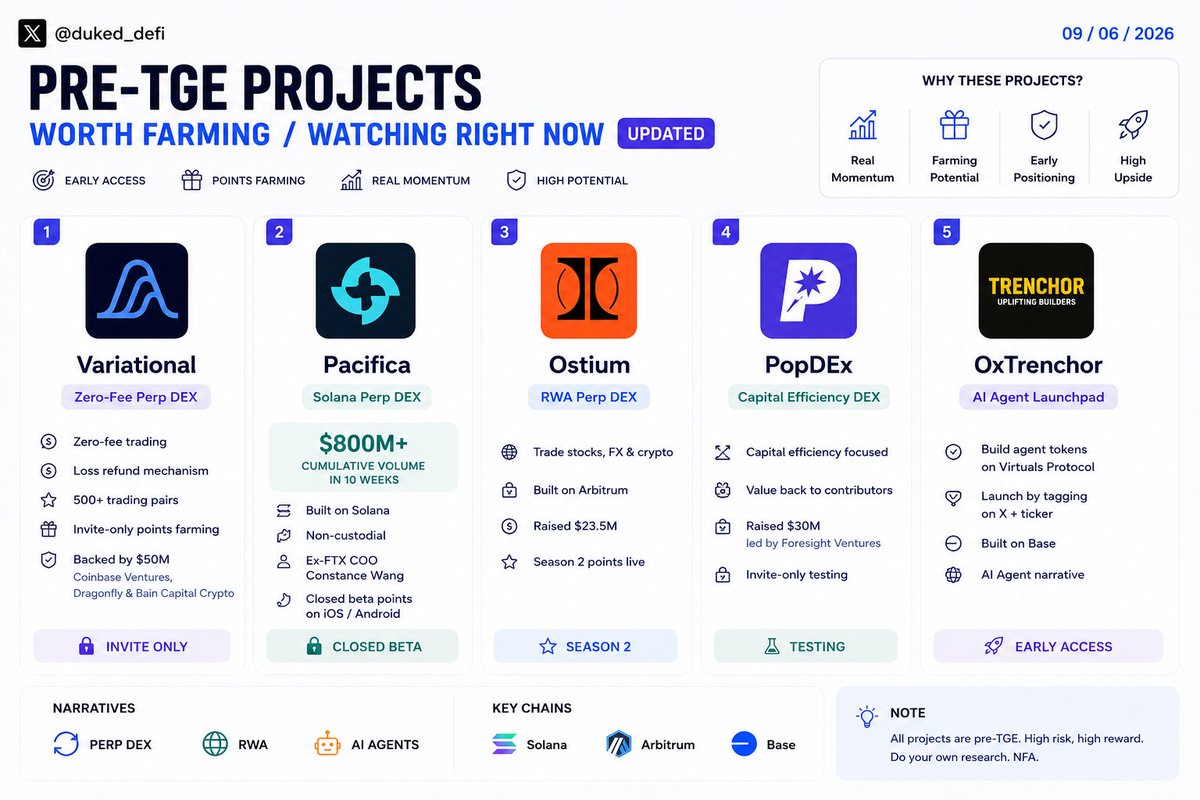
09/06/2026 | Pre-TGE Projects Worth Farming / Watching Right Now
I've been going through projects that still haven't TGE'd and are showing real momentum decent farming potential. NFA, just my quick personal research.
Here are the ones I'm paying attention to at the moment:
1. @variational_io
- Zero-fee perp DEX with a loss refund mechanism (quite rare). Over 500 trading pairs and backed by $50M from Coinbase Ventures, Dragonfly & Bain Capital Crypto.
- Currently in invite-only points farming. Volume grinders might have an edge while DAU remains relatively low.
Risk: Hard to get access due to invite-only, and the refund feature hasn't been stress-tested in a bear market yet.
2. @pacifica_fi
- Solana-based perp DEX that's already seeing $800M cumulative volume in 10 weeks despite still being in closed beta. Team includes ex-FTX COO Constance Wang and runs a non-custodial setup.
- Closed beta points are live on iOS/Android.
Risk: Solana perp space is highly competitive (Hyperliquid, Jupiter, Drift). Retention after public launch will be key to watch.
3. @Ostium
- RWA-focused perps that allow trading stocks, FX, and crypto. Raised $23.5M and currently running Season 2 points. Built on Arbitrum.
- A differentiated approach compared to pure crypto perps.
Risk: RWA perps require accurate oracles and carry higher regulatory risk than regular crypto perps.
4. @popdex_
- Perp DEX focused on capital efficiency and returning value to contributors rather than just VCs. Raised $30M led by Foresight Ventures. Clear trader-first direction.
- Currently in invite-only testing, not yet on mainnet.
Risk: Still early. Need to see actual product performance post-mainnet and detailed tokenomics.
5. @OxTrenchor
- Building agent tokens on @virtuals_io. The unique part: you can launch an agent token simply by tagging them on X and entering a ticker. Fits well with the current AI Agent narrative on Base.
Risk: The easy launch mechanism could lead to many low-quality projects. Filtering will be important.
Which Pre-TGE projects are you currently farming? Drop them in the comments. NFA
21
4
68
2,854