
The official account for Duke Law School, where academic rigor, creativity, and innovation rule.
- Tweets 15,384
- Following 498
- Followers 27,114
- Likes 9,811
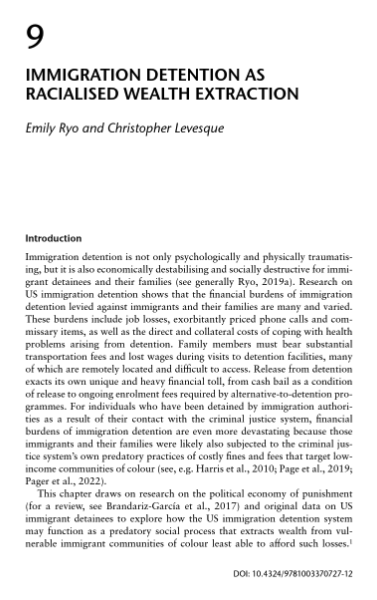












ALT Immigration Detention as Racialised Wealth Extraction in Immigration Detention and Social Harm: The Collateral Impacts of Migrant Incarceration 155-174 (Michelle Peterie ed., 2024) (with Christopher Levesque) This chapter draws on research on the political economy of punishment and original data on US immigrant detainees to explore how the US immigration detention system may function as a predatory social process that extracts wealth from vulnerable immigrant communities of colour least able to afford such losses. Our conceptualisation of US immigration detention as racialised wealth extraction has three key implications for our understanding of immigration detention. First, the word “racialised” draws attention to the ways that the costs of immigration detention are borne disproportionately by communities of colour. Second, the word “wealth” highlights how the harms of immigration detention are multiplicative – rather than additive – in nature and compound over time.
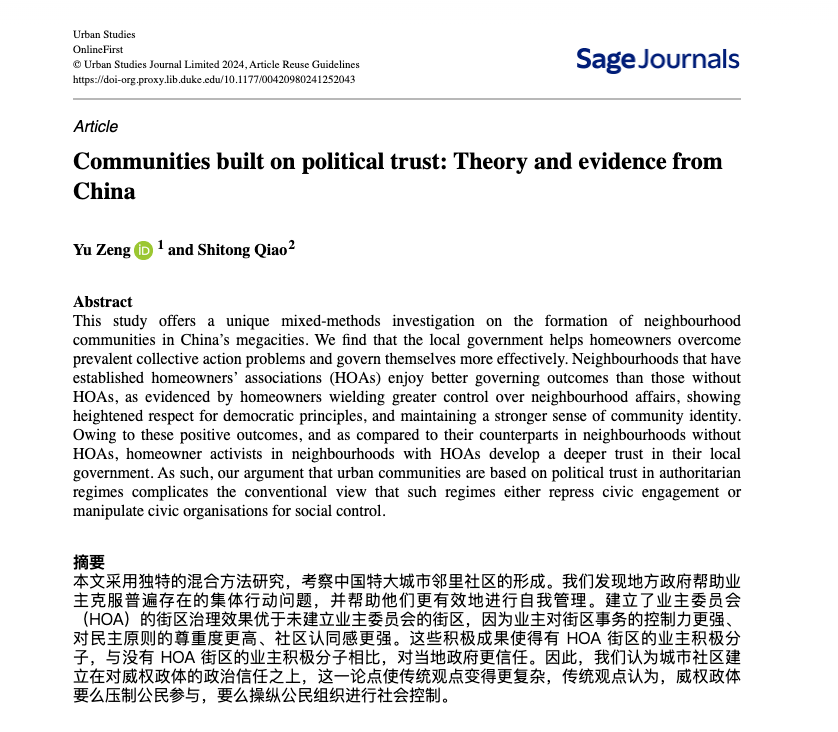
ALT Communities built on political trust: Theory and evidence from China This study offers a unique mixed-methods investigation on the formation of neighbourhood communities in China’s megacities. We find that the local government helps homeowners overcome prevalent collective action problems and govern themselves more effectively. Neighbourhoods that have established homeowners’ associations (HOAs) enjoy better governing outcomes than those without HOAs, as evidenced by homeowners wielding greater control over neighbourhood affairs, showing heightened respect for democratic principles, and maintaining a stronger sense of community identity. Owing to these positive outcomes, and as compared to their counterparts in neighbourhoods without HOAs, homeowner activists in neighbourhoods with HOAs develop a deeper trust in their local government.
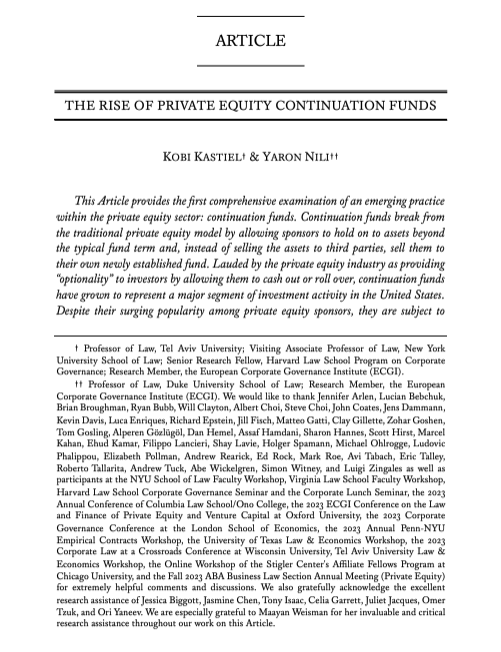
ALT ARTICLE THERISEOFPRIVATEEQUITYCONTINUATIONFUNDS KOBI KASTIEL† & YARONNILI†† This Article provides the first comprehensive examination of an emerging practice within the private equity sector: continuation funds. Continuation funds break from the traditional private equity model by allowing sponsors to hold on to assets beyond the typical fund term and, instead of selling the assets to third parties, sell them to their own newly established fund. Lauded by the private equity industry as providing “optionality” to investors by allowing them to cash out or roll over, continuation funds have grown to represent a major segment of investment activity in the United States. Despite their surging popularity among private equity sponsors, they are subject to
ALT de Fontenay smiles for a photo
ALT Schwarcz smiles for a photo
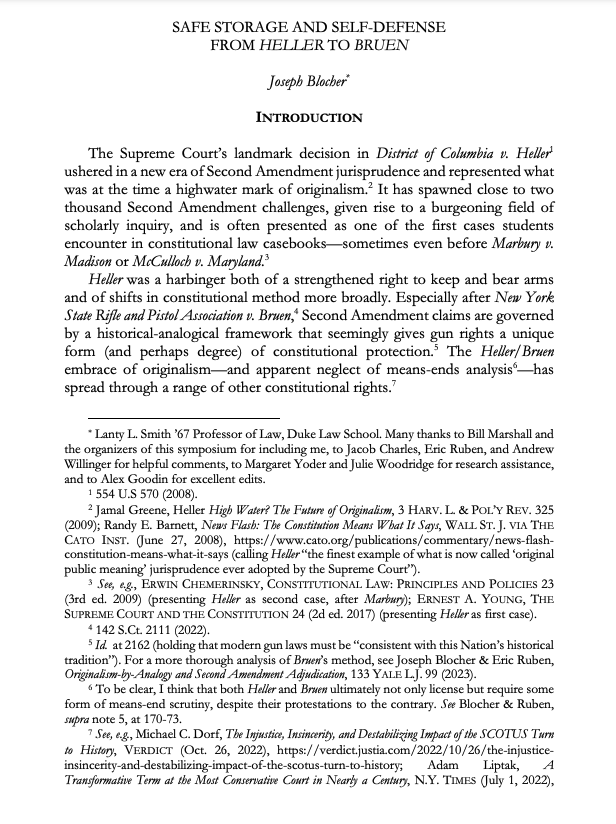
ALT SAFE STORAGE AND SELF-DEFENSE FROM HELLER TO BRUEN Joseph Blocher* INTRODUCTION The Supreme Court’s landmark decision in District of Columbia v. Heller1 ushered in a new era of Second Amendment jurisprudence and represented what was at the time a highwater mark of originalism.2 It has spawned close to two thousand Second Amendment challenges, given rise to a burgeoning field of scholarly inquiry, and is often presented as one of the first cases students encounter in constitutional law casebooks—sometimes even before Marbury v. Madison or McCulloch v. Maryland. 3 Heller was a harbinger both of a strengthened right to keep and bear arms and of shifts in constitutional method more broadly. Especially after New York State Rifle and Pistol Association v. Bruen, 4 Second Amendment claims are governed by a historical-analogical framework that seemingly gives gun rights a unique form (and perhaps degree) of constitutional protection.
ALT Siegel smiles for a photo
ALT Willinger smiles for a photo
ALT three people standing together for a photo


ALT Blocher smiles for a photo


ALT Fine smiles for a photo

ALT Siegel smiles for a photo

ALT Now Available on Oxford Academic. The Collective Action Constitution. Neil S. Siegel, Duke Law School