
Stake your SOL with validators vetted by experts - supporting social impact, high performance, and further decentralization of the Solana Network
Joined July 2025
- Tweets 115
- Following 8
- Followers 251
- Likes 127
73 Photos and videos

Pinned Tweet

Jun 5
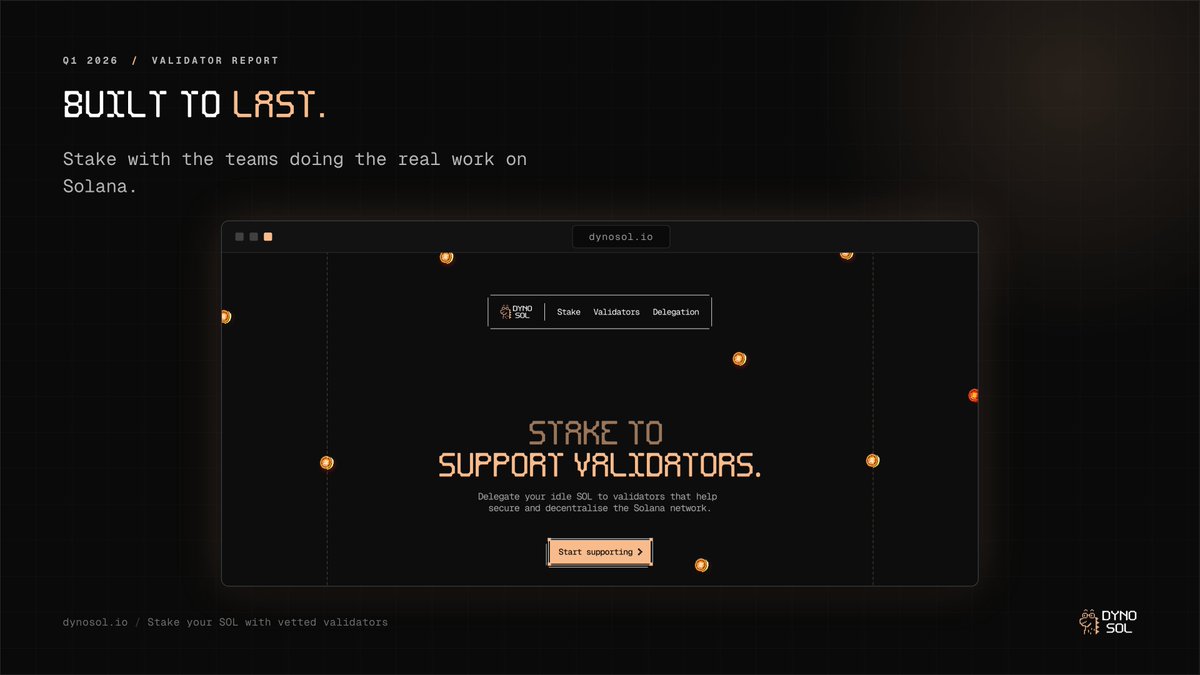
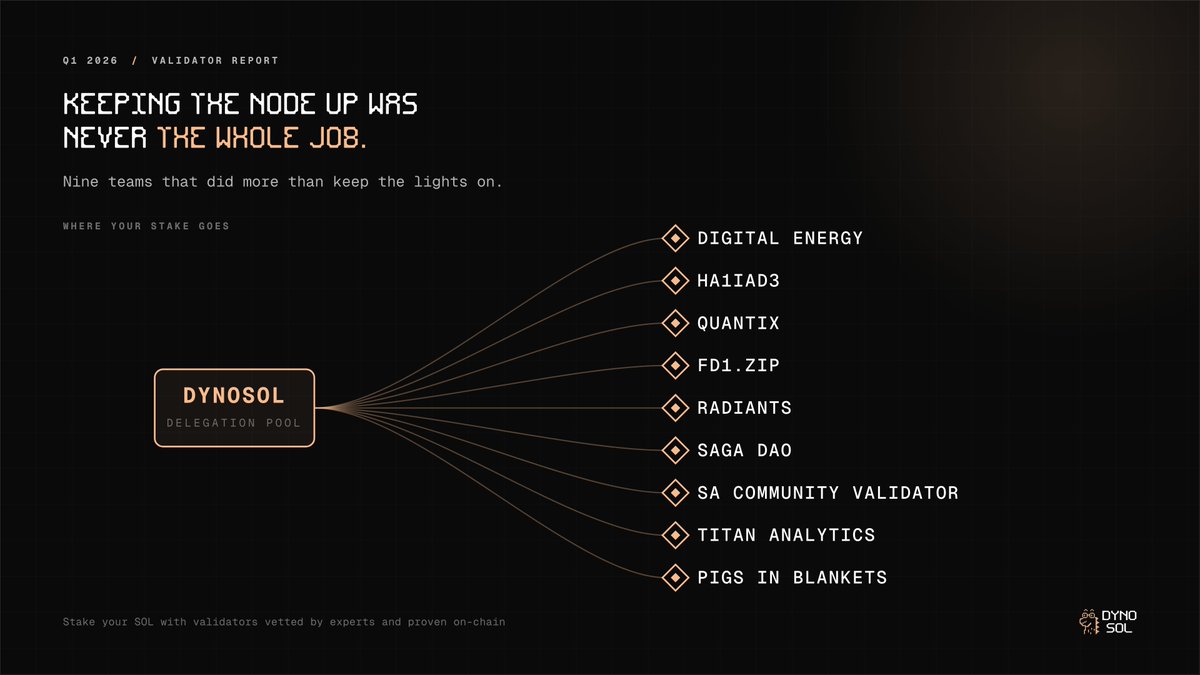
Being a Solana validator used to be simple: just keep the node running.
That bar's gone.
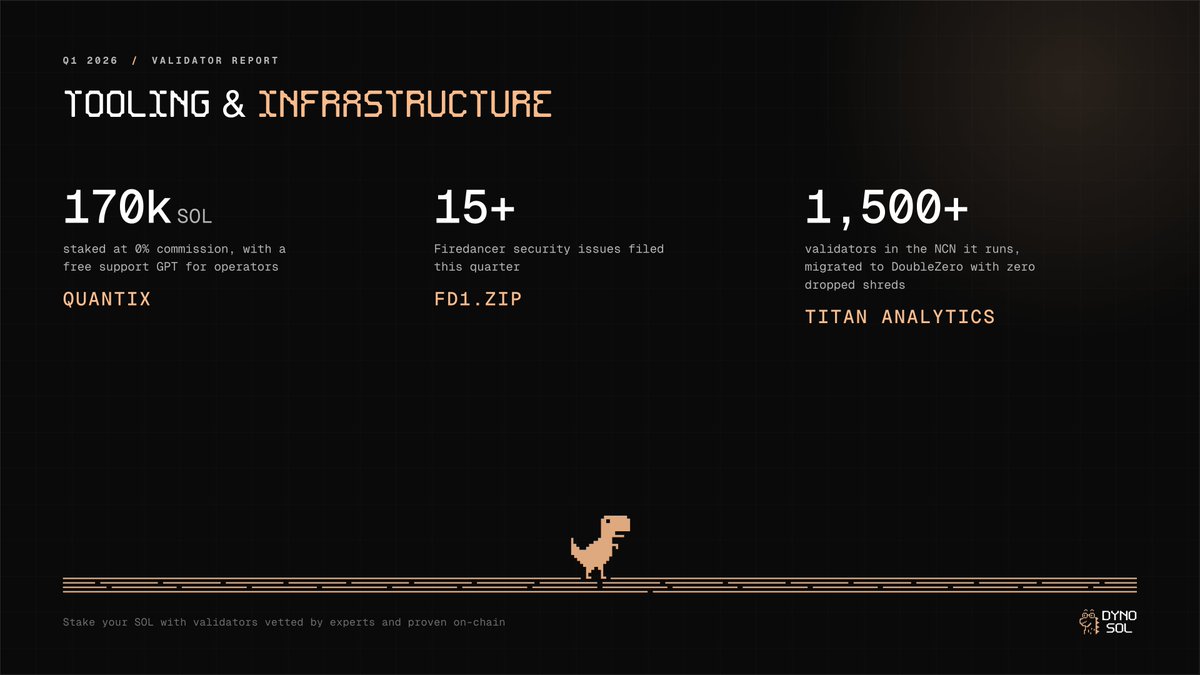
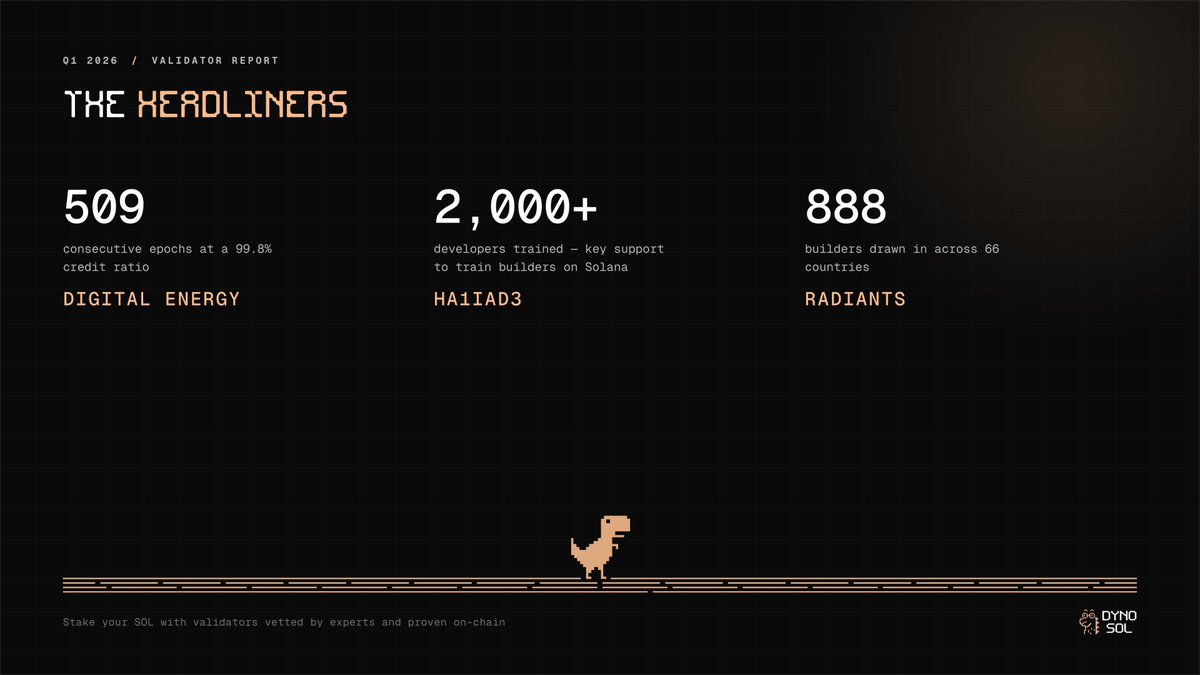
The teams we delegate to spent the quarter shipping clients, filing security fixes, mentoring builders, and reinvesting rewards back into the network.
A handful went further than anyone expected 🧵👇
4
4
9
855
DynoSol retweeted

Jun 11
Years of vetting, sourcing, and closing the talent gap in this ecosystem, and every cohort still makes it feel like
we're just getting started.
Hell yeah, there's plenty of glass-chewing ahead..!
Jun 11

When we decided to take the Q2 @solanaturbine Advanced SVM program in a slightly different direction, we knew we were setting ourselves a difficult challenge.
Training engineers on the Solana application layer is hard enough. Helping them transition to the protocol layer in just six weeks is an entirely different challenge.
But we believed the demand for protocol engineers will only continue to grow as the SVM ecosystem matures.
Over the last three weeks, our cadets have spent countless hours diving deep into the SVM, networking, QUIC, Alpenglow, and Constellation. We've also had engineers working directly on the protocol share their experiences, design tradeoffs, and current challenges.
The exciting part is that our cadets didn't stop at theory.
In just a few weeks, they've already shipped practical systems experiments around Alpenglow, MCP, packet processing, and banking-stage performance:
• xdp-pshred-forwarder- implementing an XDP demultiplexer against the pshred wire format and proposer identity field
• svm-xdp-packet-router- exploring kernel-level packet routing strategies for SVM traffic flows
• banking-stage-jitter-harness experiments- a measurement harness for evaluating banking-stage timing behavior against Alpenglow Votor round requirements
A few examples:
github.com/ChiefWoods/xdp-ps…
github.com/aspnxdd/svm-xdp-p…
github.com/Allen-Saji/bankin…
github.com/jkrishnad/banking…
github.com/SergZen/agave/tre…
This is only a small sample of what they've built in the first few weeks.
Watching engineers go from application development to building protocol-level systems in such a short period has been incredibly rewarding.
And we're only getting started.
The next few weeks will involve even more experimentation on the Read layer, Alpenglow, QUIC-only ingestion, MCP, profiling, benchmarking, and validator performance engineering.
Plenty of glass-chewing ahead.
1
6
24
1,031
Jun 5
Being a Solana validator used to be simple: just keep the node running.
That bar's gone.
The teams we delegate to spent the quarter shipping clients, filing security fixes, mentoring builders, and reinvesting rewards back into the network.
A handful went further than anyone expected 🧵👇
4
4
9
855
Jun 5
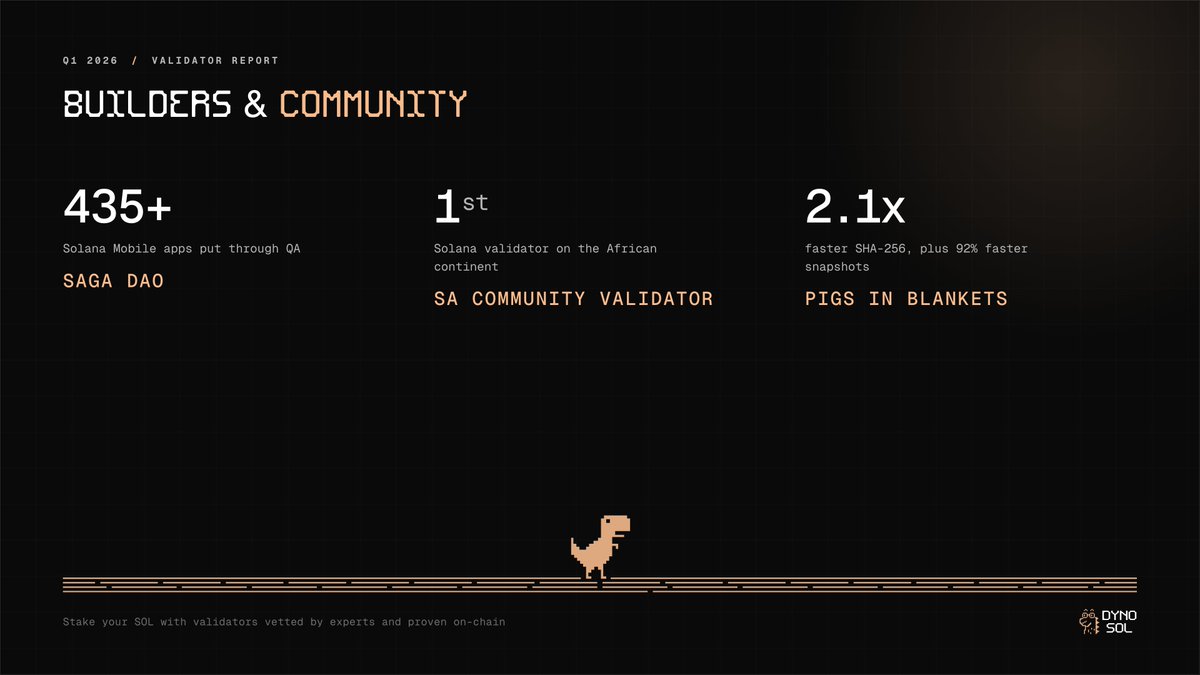
🔹 @SagaMobileDAO Fixing a real gap in @solanamobile. Their U$ER product, the only structured QA setup for the Solana Mobile dApp Store (435 apps), is 85% done.
They've tested 11 dApps, generated $5k in builder revenue, and passed $4k of it to verified testers.
They also won a Superteam USA Builder Grant.
Quality infrastructure nobody else was building.
🔹South African Community Validator The first validator on the African continent, and they're widening the door.
Shipyard SA pulled 20 project submissions in 6 weeks and connected 15 devs globally, and their UCT and Stellenbosch partnerships are working toward 1,500 CS students.
100% of revenue goes back in. Regional onboarding is how the network actually grows.
🔹Pigs in Blankets Performance nerds in the best way. Top-20 TVC via the Xshin Performance Pool, an 85-95% LockedOut reduction from a mod other validators adopted, a 2.1x SHA-256 speedup, 92% faster snapshot acquisition, and a full dual-ISP rollout across Cogent and Vorboss.
Tiny optimizations that quietly make the whole network faster.
1
4
86
Jun 5
None of this shows up on a basic uptime chart. But it's the foundation the rest of us build on: the clients, the docs, the tooling, the onboarding.
We delegate to these teams because a strong base beats chasing hype every time.
We're going to keep watching this space and sharing what we find.
If you're a validator doing work like this, reach out. Let's build something better together.
dynosol.io
3
58
DynoSol retweeted
Jun 2
A little over a year ago, we started a dedicated Pinocchio Working Group.
👉The goal was simple:
Bring together builders who want to learn Pinocchio, collaborate, and contribute back to the ecosystem.
Since then:
- A growing group of Pinocchians
- Dozens of live sessions
- Hundreds of hours of technical discussions
- Multiple open-source projects shipped
Here's a look at what we've been building together 👇
3
15
45
2,295
DynoSol retweeted

Gm. Calling all @Solana testnet validators. We need your help testing the new Solana governance framework.
We need help testing the "propose" feature which requires 10% of stakeweight to support a proposal before it goes to vote.
1) Head here -> govcontract-eosin.vercel.app…
1a) Please support proposals 0359 & 0333 using your testnet identity key.
1b) The easiest way to do this is to use the Backpack wallet with custom RPC pointing -> api.testnet.solana.com with your testnet identity key.
If you can reply to this tweet with your stake I'll calculate how far we need to hit 10%.
Thank you! 40 hours to go!
11
9
25
1,809
DynoSol retweeted
Jan 6
EP. 01: Reflecting 2025 • Powering 2026
ft. @japarjam
From the moments that shaped us
to the momentum ahead.
The journey continues…..
More energy. Bigger plans. 💪
4
9
58
2,290
DynoSol retweeted
Jan 9
EP. 04 Final: Reflecting 2025 • Powering 2026
Through education and public good, we empower thousands of builders every year to grow, build, and move forward with confidence.
Our mission stays the same: create lasting skills and meaningful impact and we are stepping into 2026 with more energy and more learning opportunities.
And we are incredibly grateful for our fearless, ethical, and high-integrity community.
The tribe continues to grow - stronger, sharper, and more united than ever.
Thank you to everyone who supported us. We’re truly grateful.
Wishing you all a Happy New Year 🎉
The grind starts soon.
Get ready for another great 2026 ride 🚘
5
7
56
2,150
DynoSol retweeted

5 Dec 2025
Supporting the @solana ecosystem, and it's core contributors has always been our mission.
We're definitely not stopping at 1M SOL staked.
And we're definitely not stopping at 180 validators.
7
3
18
664

Have you noticed all the education, tooling, OSS, and strong devs/engineers coming from @solanaturbine ?
Have you noticed the level of our programming going far beyond simple Anchor and TS?
Have you noticed our Ha1iad3 Validator growing?
Have you noticed the @DynoSolPool stake pool growth and social impact?
Have you acted on what you see?
Have you applied? Turbin3.org
Have you reached out for Talent?
Have you staked with us?
What have you done to grow as a professional?
What have you done to grow @solana
Don't be passive- jump in. It only takes the first step.
2
11
409
4 Dec 2025
Validator Spotlight: @Mythx123 🧵
We're focusing today on Mythx, led by founder Jeff Hammer
Jeff is a validator operator and a long-standing contributor to the ecosystem, influencing @solana through storytelling, cultural initiatives, and tangible community engagement.
Let’s dig in👇
4
4
13
598
4 Dec 2025
🧵4/4: 🗳️ Stake With Mythx
Mythx isn’t just a cultural pillar — it’s a high-reliability validator built for long-term alignment with Solana.
💪Operated for resilience, uptime, and trust, Mythx runs with leading infrastructure partners, redundant systems, and constant monitoring to protect stakers and the network.
Vote account:
mythxna3hpzXSbaseyR12vu5Vvym1HxS92eCgXLvY7w
🎯Mythx currently has ~75,849 $SOL staked and is targeting 100,000 $SOL by Q4 2025.
If you want your stake to secure the network and power the culture, Mythx is where both worlds compound.
mythx.art/validator/
1
5
119