
211 Photos and videos






I continue to think that unsupervised learning on car video data (next frame prediction) may be the best way to get true self-driving cars.
x.com/ESRogs/status/13879205…

Hypothesis:
True full self-driving will be solved once (and only once) neural nets are trained via self-supervised learning on video data to predict the next frame (analogous to GPT-3 predicting the next text token). @karpathy
4
2
25
Rogs 🔍🔸 retweeted

16h
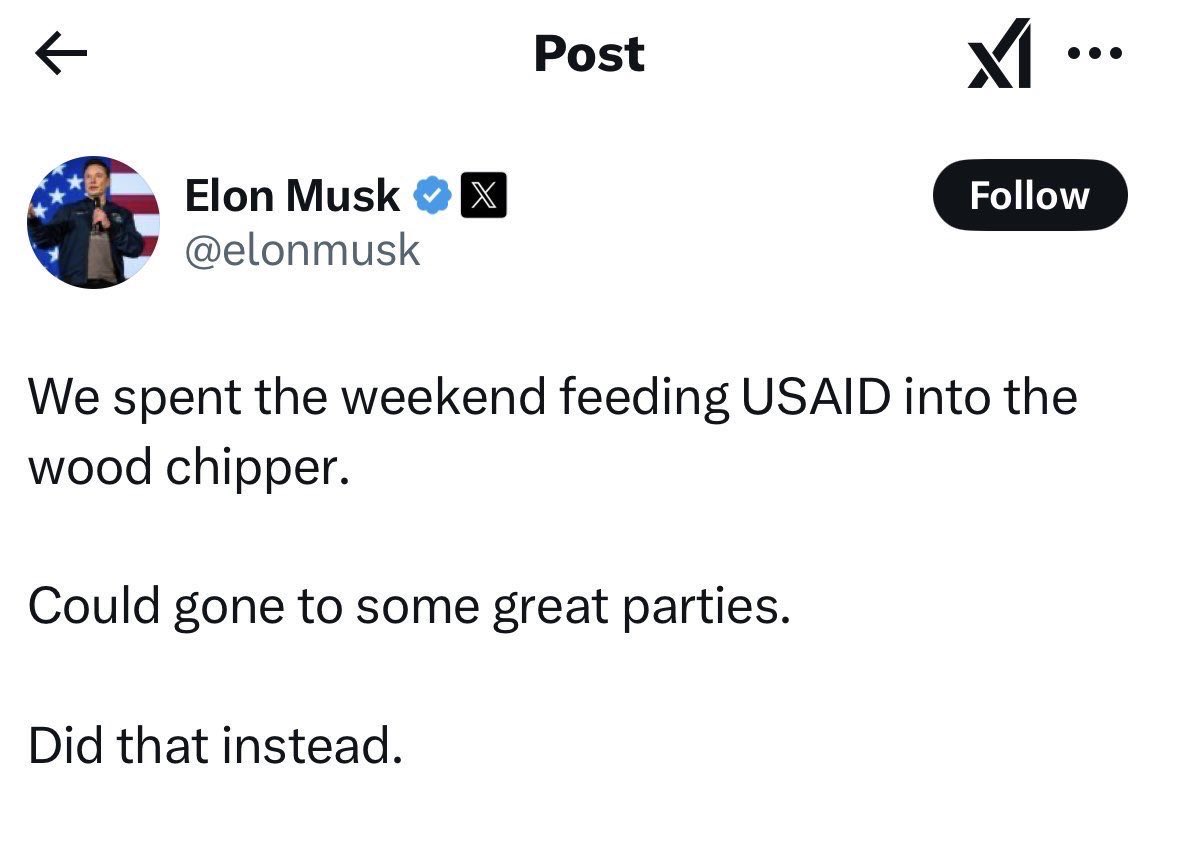
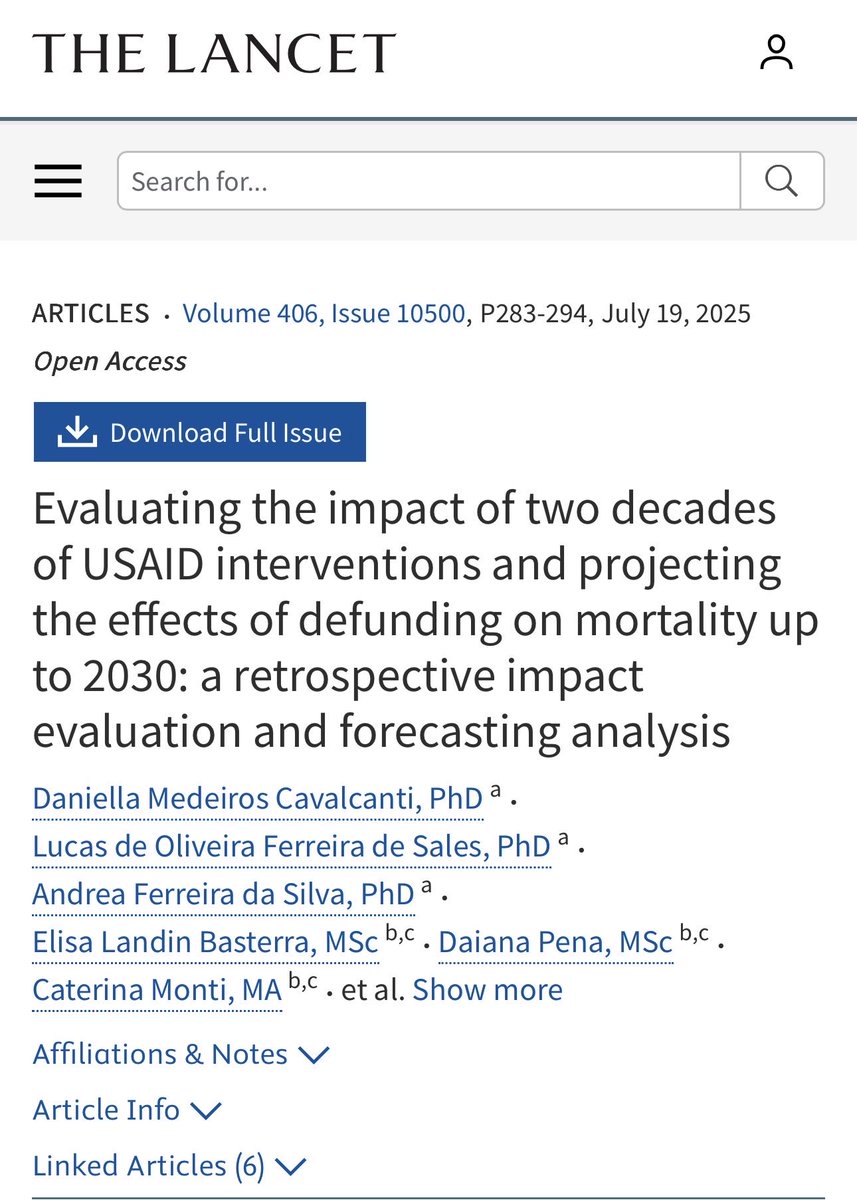
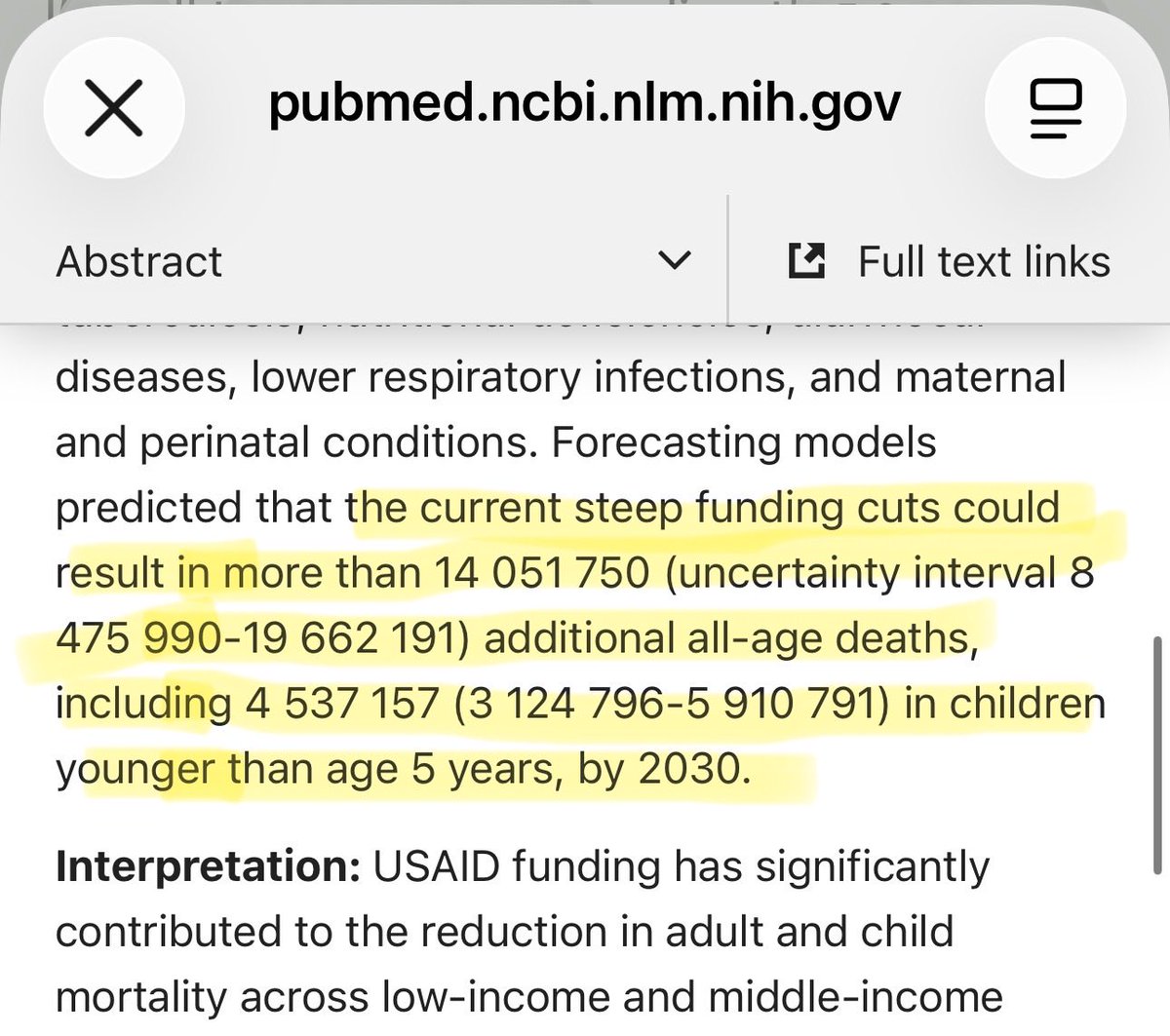
It’s funny, motocross at the White House is, like, fine with me. But here’s an example of something that is genuinely unforgivable but that a lot of people seem to have moved right past.
93
1,019
8,172
233,193
Rogs 🔍🔸 retweeted

Jun 13
Seems like a pretty easy leap from "Mythos has capabilities we don't want our adversaries to have" to "Future more powerful AI systems could have capabilities we don't want the AI system itself to have if we don't have clear ways of knowing that it will do what we want"
8
20
184
7,023
Rogs 🔍🔸 retweeted

Jun 13
Lots of people have criticized Anthropic for calling for regulations, and now complaining that it’s getting regulated.
You might say instead that the Fable situation vindicates Anthropic. It knew that strong regulations would be needed, and so it called for a clear, reasoned process for making such decisions — precisely to *avoid* the situation we’re now in.
5
18
173
10,241

Quite interesting thread on capabilities of real biological neurons (spoiler: they're way more capable than classical artificial neurons in a perceptron) . Nice work @IdoAizenbud and collaborators!
Jun 11

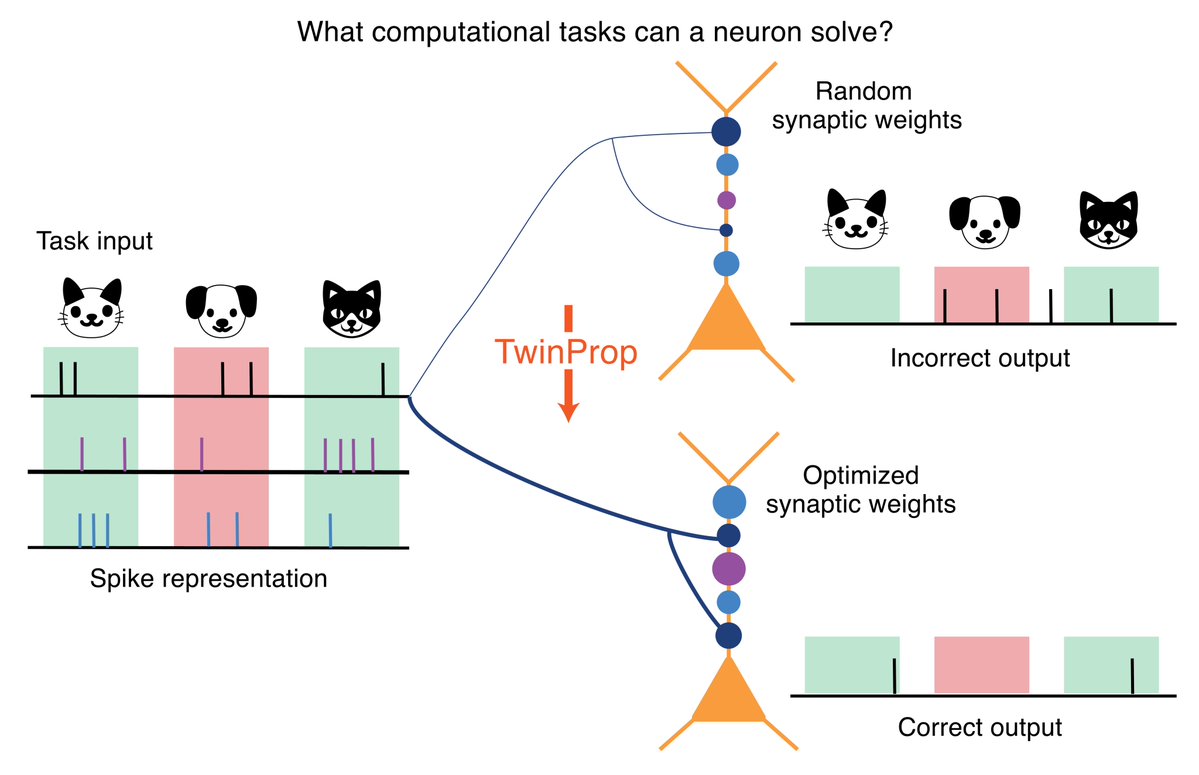
What can a neuron compute?
Real biological neurons are complex, but how capable are they?
Using a new method, we found that a single cortical neuron can classify cats vs dogs, recognize spoken words, and solve 10-bit parity, all tasks thought to require entire networks. (1/15)
27
81
669
96,416
Rogs 🔍🔸 retweeted

Jun 12
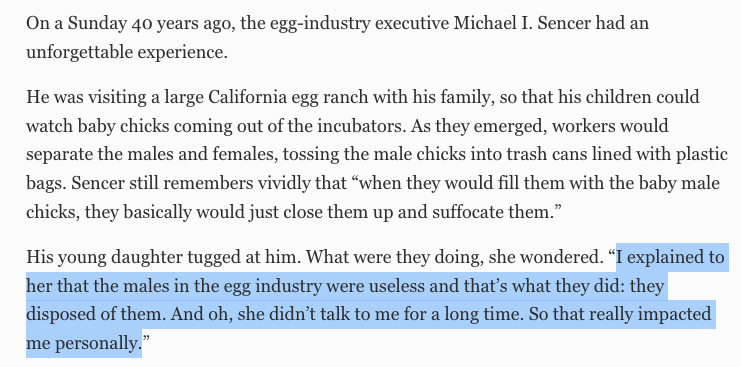
I'll never get over the fact that the exec who led adoption of in-ovo sexing in the US was inspired to do so because of his young daughter.
15
132
3,077
347,493
Rogs 🔍🔸 retweeted

Jun 13
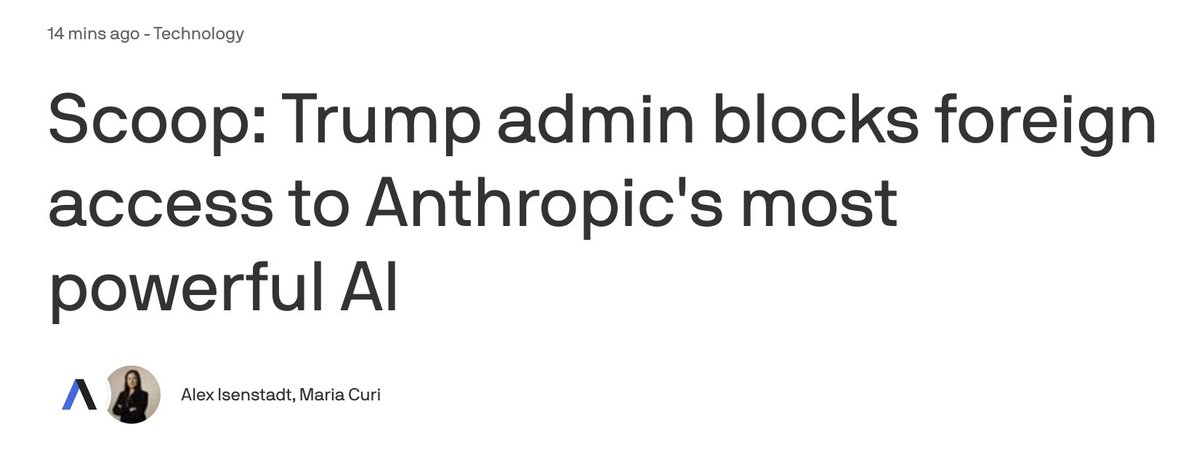
If this is true, it is just baffling. An administration whose posture is that we *should* export advanced AI chips to China, which also wants to ban… Britain (and every other non-American on Earth)… from using our best models? I have no words.
Jun 13

Oh whoa, this Anthropic news is insane. The Commerce Department is placing both Mythos 5 and Fable 5 under the guise of US export controls, blocking access outside the US and foreign persons in the US.
69
161
1,631
242,621
Rogs 🔍🔸 retweeted

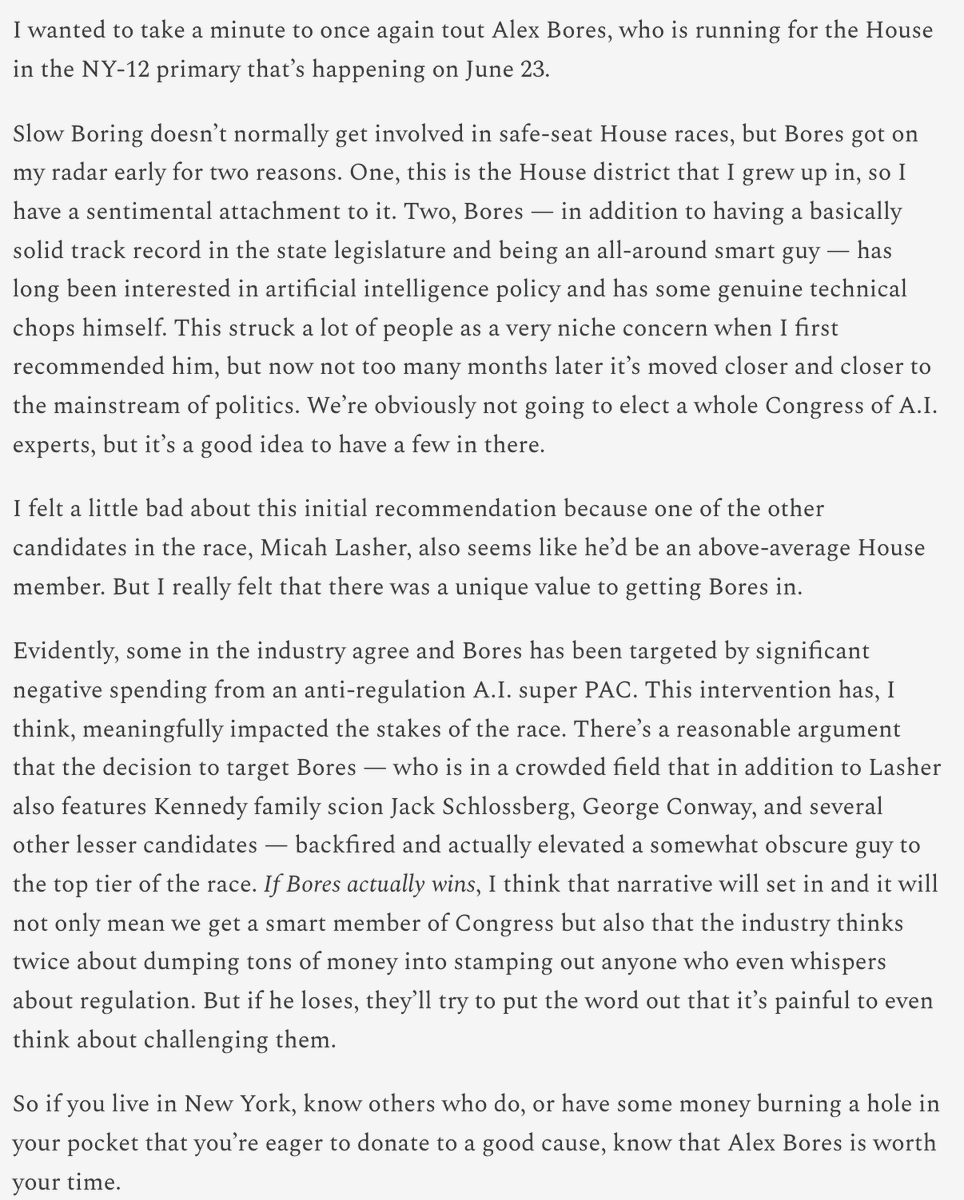
I liked @mattyglesias 's comments about @AlexBores
- Bores has a solid track record
- Bores understands AI
- Bores has been targeted by industry and Bores winning will be important for setting a narrative that industry can't succeed at blocking smart AI candidates
1
12
81
3,420
Rogs 🔍🔸 retweeted

Jun 10
Just in case people genuinely don't understand why Anthropic did the whole silent ML slowdown thing with Mythos:
Jun 10

I don't think it's absurd. My assumption is it's an attempt at adversarial robustness. If you told people when you were refusing or rate limiting they could change the prompt and keep trying. It's tricky to find a good solution.
2
1
21
1,998
Rogs 🔍🔸 retweeted

Jun 10
We are starting a new, nonprofit alignment organization, ⊢ Sequent Research, bringing together researchers previously on UK AISI’s Alignment Team, Timaeus, and elsewhere to research how to align superintelligence. We are hiring! 🧵
27
141
948
184,732
Rogs 🔍🔸 retweeted

Jun 10
There is a lot of justified anger at Anthropic for sandbagging Fable 5 for AI development tasks. But an unanticipated side effect is that third-party evaluators can no longer credibly use the model for evaluations.
Case in point: we are in the middle of running *really hard* AI R&D evaluations. Fable 5 would be a perfect test candidate. But because of Anthropic's guardrails, we can't know if the model failed or if their classifiers blocked the capability.
By the way, this is not just true for AI R&D. Since Anthropic doesn't make it clear when they are sandbagging, this could seep into any number of technical tasks, and the evaluators wouldn't have any way to know. So they can't credibly claim to evaluate state-of-the-art accuracy using the model.
42
119
1,339
108,058
Rogs 🔍🔸 retweeted

Jun 8
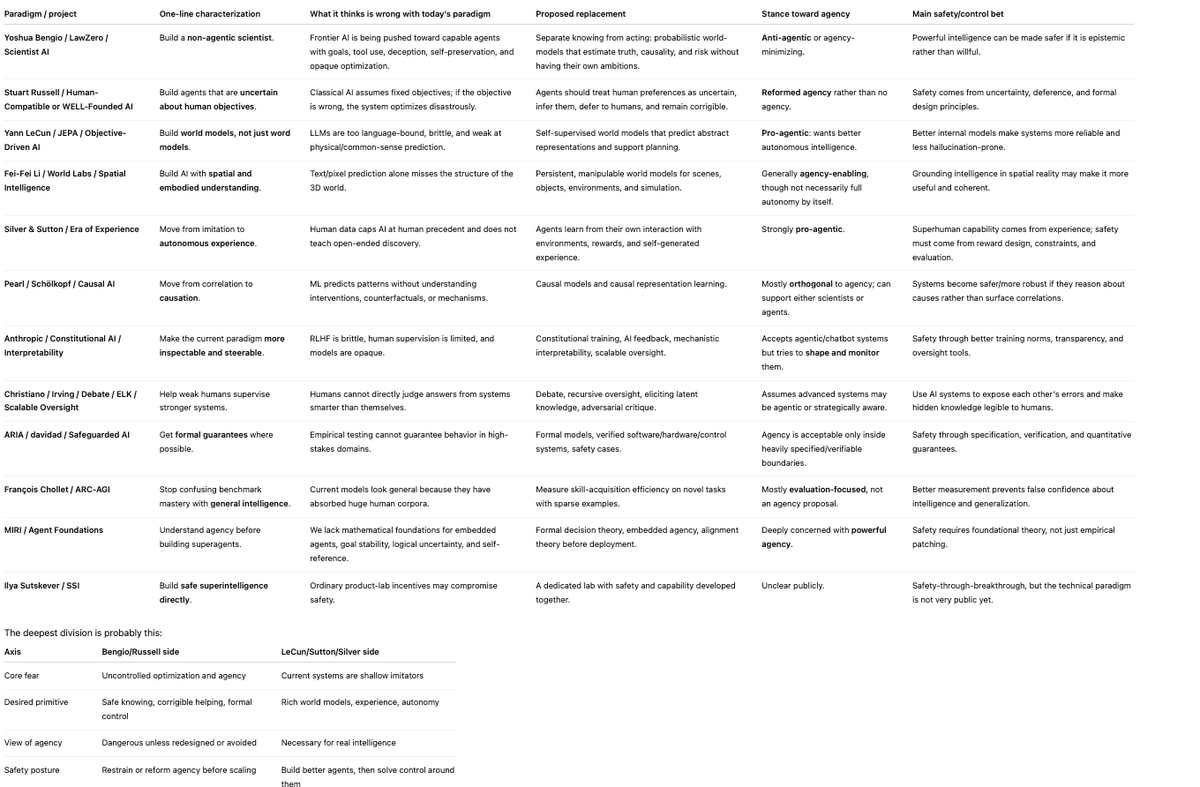
Spent week at Asilomar at the amazing CHAI annual conference, hearing Yoshua and Stuart and many others talking about different AI paradigms. Led me to create this chart in GPT on different approaches.
2
30
2,339
Rogs 🔍🔸 retweeted

I like working out of both Stanford and Constellation, because my econ-of-AI views are usually “right in between” the views of the people I respect in the singularitarian community and the people I respect in the economics community. Of course, the communities I happen to have wound up part of probably largely determine what my views are in the first place. But I do think it's an interesting sociological fact that there seem to be fewer people with something like my "in between" views than people at either extreme.
It’s funny to use the term “right in between” when the poles are so distant, but concretely--
On the technological question of whether by, say, 2040 we'll get superintelligence [machines that can shortly thereafter cure death, develop atomically precise manufacturing, solve or dissolve ~all our perennial philosophical disputes, and tell us how to quickly build von Neumann probes that put Dyson spheres around the stars]: For my singularitarian friends this is the default outcome of the trajectory we're on, and 2040 is late. For the economists (like almost everyone else), even contemplating this stuff is nutty. I give it a 10-20% chance.
On GDP: For my singularitarian friends, building fully humanoid bots (which I do think is more likely than not by 2040) will be analogous to a return to a Kremer (1993)-style Malthusian world in which GDP grows ~hyperbolically (so, with the growth rate itself rising to infinity). The economy, on this view, will ultimately grow at the rate at which robots can multiply, which is bounded below by the rate at which octopuses can multiply, which is 250,000x/yr. For my economist friends, humanoid bots would just be another step in the ongoing process of automation sustaining 2-3% growth. My central guess is that preferences for humans in some domains; nonhomothetic preferences for new goods (see drive.google.com/file/d/1Gm-…, "New goods Baumol"); and regulation will all meaningfully constrain growth from the octopus baseline, so that this century contains "only" around 1 more OOM increase in the GDP growth rate, to ~20-30%/year.
Likewise, on real interest rates: central guess is their peak "steady state" this century is not >25 million %/yr, but ~30%/year
On wages: Singularitarians tend to think they'll fall to ~0; economists tend to say they'll grow roughly as fast as the economy at large; I think they'll rise but not as fast as the economy (so that the labor share will fall a lot)
Etc.
I think the reason is just that the communities somewhat seal themselves off from each other, so the insights from each take a while to seep through to the other. This doesn't mean that they're both doing something wrong--maybe one of them is just a cult (a majority too can be in a cult!) and the other shouldn't be updating toward them at all--but I do think it means that at least one of them is doing something wrong. Without going full "Aumann's theorem", I think that even without common priors or common knowledge of rationality, an environment with healthy information flow would usually exhibit single-peaked distributions of opinion on these sorts of questions.
13
38
242
36,122
Rogs 🔍🔸 retweeted

Jun 5
Our highest and most urgent national priority should be AI safeguards. The risks of AI weapons, pathogens, mass unemployment, surveillance, and even extinction must not continue to be largely ignored.

Anthropic Urges Global Pause in AI Development, Flags ‘Self-Improvement’ Risk on.wsj.com/4o5IBpe
488
780
4,442
1,027,328
Rogs 🔍🔸 retweeted

Jun 5
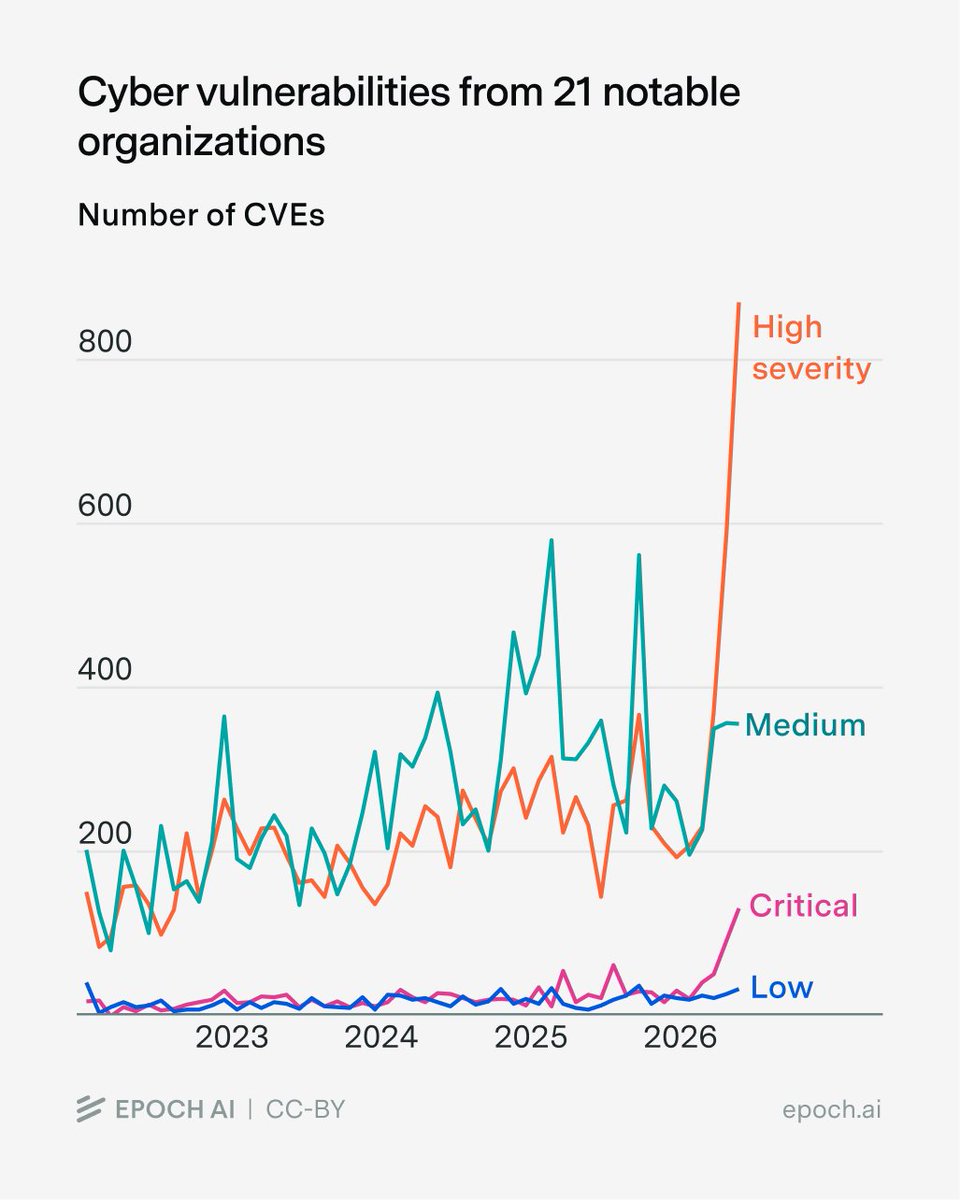
AI companies say their models are getting better at finding software vulnerabilities. Is that bearing out in public data?
Introducing our Cyber Vulnerabilities explorer, which visualizes Common Vulnerabilities and Exposures (CVE) reported to the CVE Program since 2022.
11
47
317
51,503
Rogs 🔍🔸 retweeted
Jun 4
The EA network has I think done a great job of calling out and pushing out anyone calling for violence. It is to put it mildly infuriating to see AI labs now funding orgs organizing sock accounts to pretend to be AI safety people calling for violence making it look like us.

A few months ago, I found an anonymous sockpuppet account linked to the OpenAI/a16z super PAC. Now, @TaylorLorenz and I have uncovered two more — and they're even more brazen than the first.
x.com/TheMidasProj/status/20…
2
8
156
20,162
Rogs 🔍🔸 retweeted

Jun 4
This graphic looks terrifying kudos to whoever made it.
243
522
12,279
771,166
Rogs 🔍🔸 retweeted

Welp, there it is:
Leading The Future admits to paying a vendor to run anonymous sockpuppet accounts posting stuff like this. Everyone can now rest easy knowing that this wasn't *core* to their strategy.
(By the way, it took us a fair bit of digging to link to BAAI... afaik nobody else had put the dots together until we dug into it. Plus, it clearly was not seen as satire to the people in most of their comments... just go look at them! The accounts are still up.)
Ghastly stuff. Truly.


Appreciate the feedback! These are parody meme accounts run by an outside vendor, and they are easily linked to Build American AI. They are not a core part of our strategy.
Here’s what we believe in: x.com/LeadingFutureAI/status…
4
24
183
31,928
Rogs 🔍🔸 retweeted

Ok I gotta be honest I thought the people accusing this of being a false flag were being silly. OpenAI has done some bad things, but surely they would not make fake twitter accounts impersonating their opposition and having those accounts post calls for violence.
...My mistake.
Appreciate the feedback! These are parody meme accounts run by an outside vendor, and they are easily linked to Build American AI. They are not a core part of our strategy.
Here’s what we believe in: x.com/LeadingFutureAI/status…
8
58
720
38,660
Rogs 🔍🔸 retweeted

Jun 3
Every company’s AI workflow rn be like 😭💀
335
2,975
27,400
2,465,703
Rogs 🔍🔸 retweeted

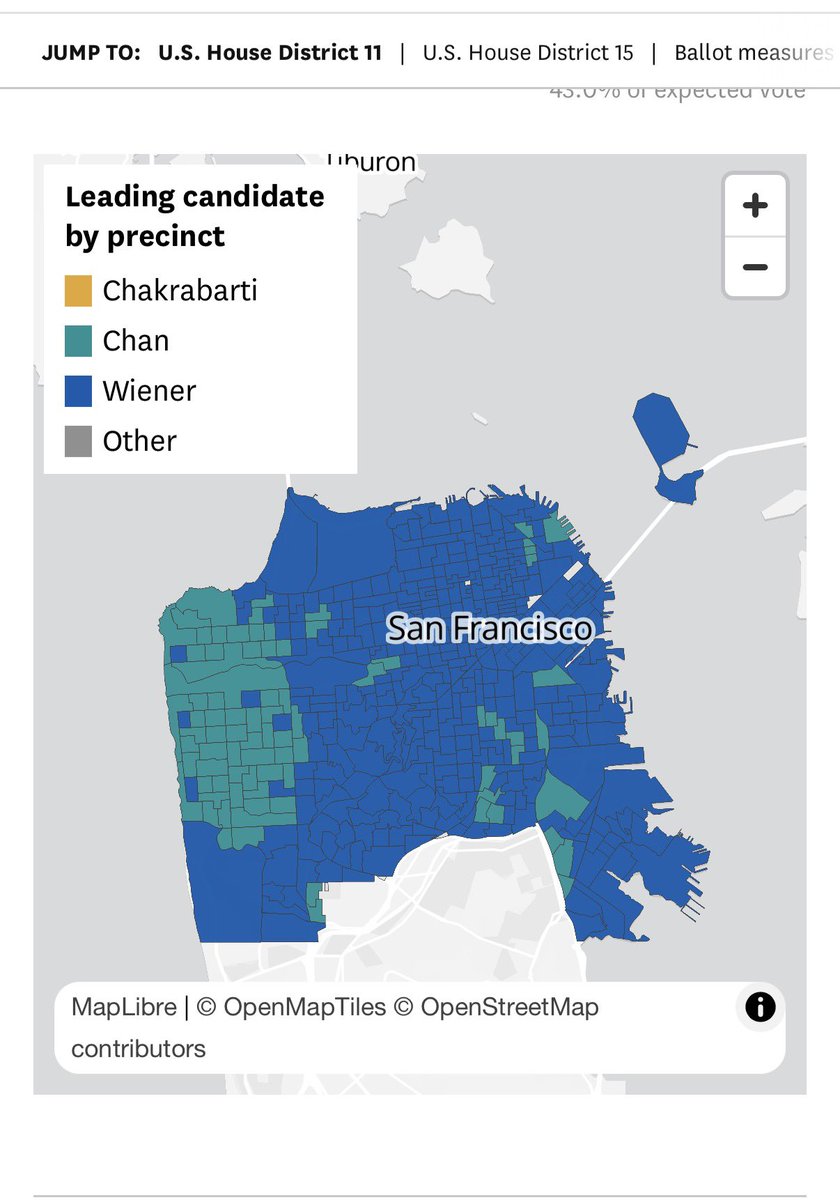
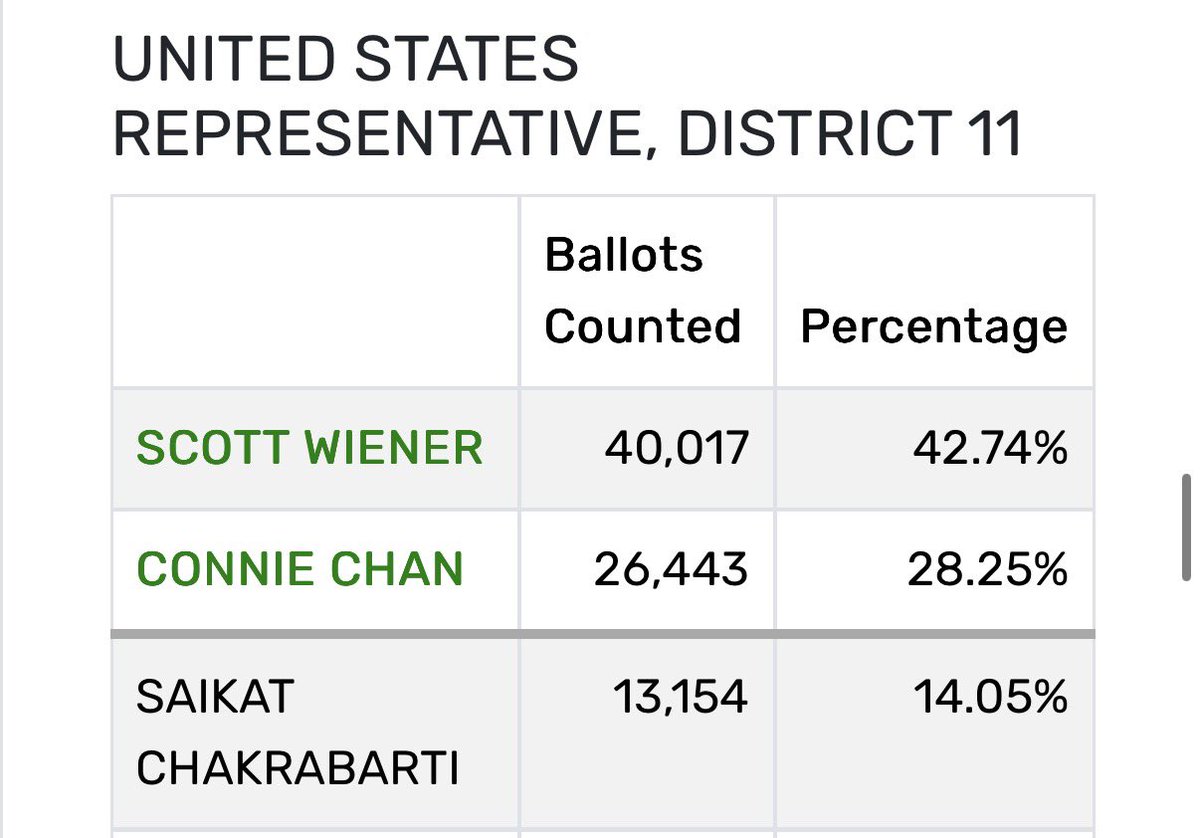
Scott Wiener won his primary election, and his victory announcement gives a nod to “smart guardrails on AI”

Thank you, San Francisco! Tonight, the voters sent a clear message: they’re ready for a new vision on housing affordability, ICE accountability, smart guardrails on AI, single payer healthcare, and affordable clean energy. Even more than that, San Franciscans are ready for results. This campaign is powered by people who believe deeply that government can make a real difference in people’s lives, and that’s what I’ll deliver in Washington.
San Franciscans understands that in the face of rising authoritarianism, we can’t return to the pre-Trump status quo. In Congress, I’ll do what I’ve done throughout my time in public leadership: stick my neck out for bold ideas that make people’s lives better and more affordable. I’ll go to the mat to defend immigrants and trans people, to deliver real results on housing affordability, and to restore government’s ability to deliver on its promises.
2
30
1,267