We (Jens Blechert and team) investigate basic mechanisms of (disordered) eating and dieting using experimental and ambulatory methods @dept_psych_sbg @PLUS_1622
Joined August 2018
- Tweets 110
- Following 150
- Followers 175
- Likes 122
15 Photos and videos
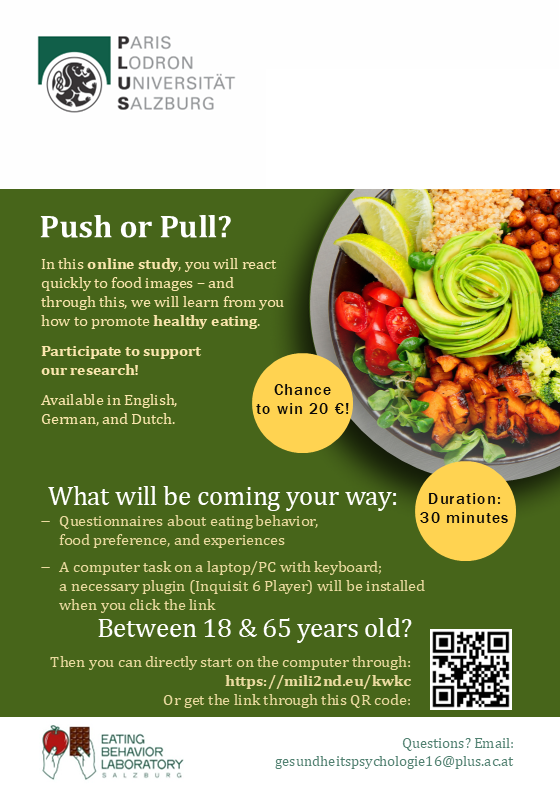

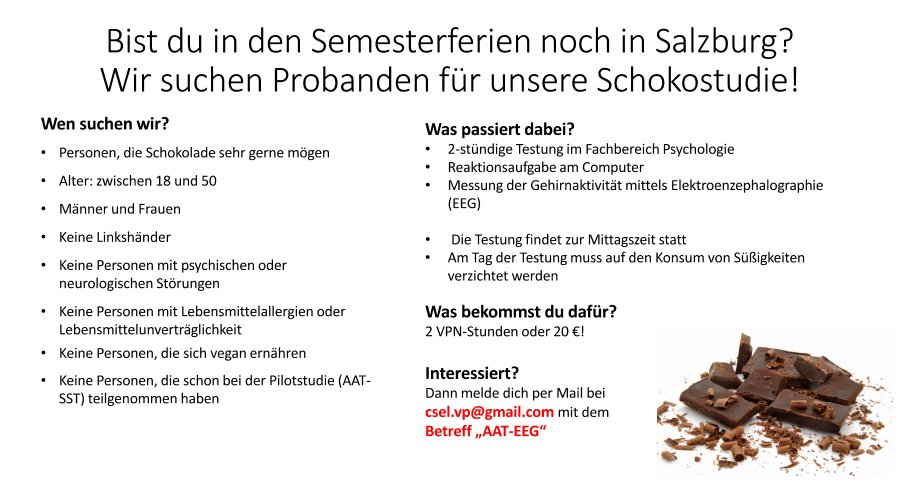
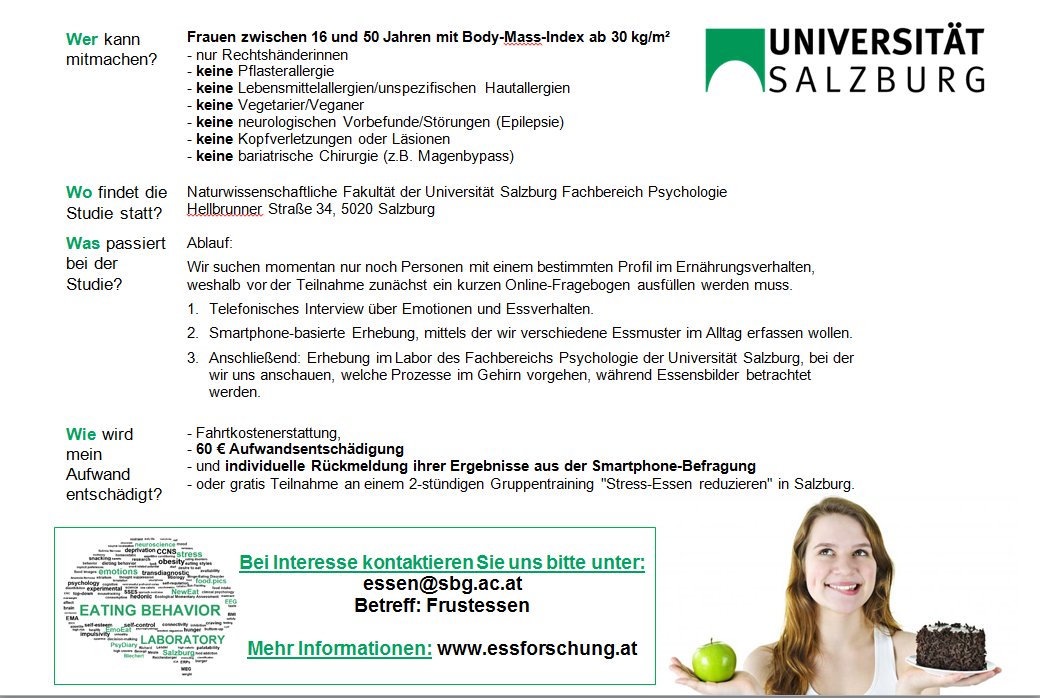


Working on your diet? You're invited to an online study where we learn from you how to promote healthy eating! It consists of a computer task and questions about eating habits and preferences. It's 30min, and you can win €20,-. Start on PC or laptop here: mili2nd.eu/kwkc
1
1
16
Please note that participation requires the installation of a browser plugin (Inquisit 6 Player); clicking the link will prompt you to install it.
1
1
13
Since we are looking to collect a large number of participants, we would also appreciate if you could repost this message and pass on the experiment to anyone else who might be interested🙂
1
12
New article alert! doi.org/10.1080/02699931.202…
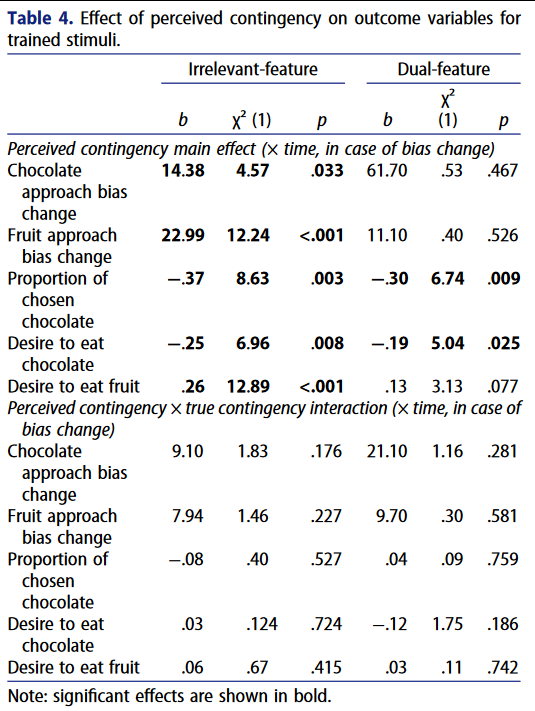
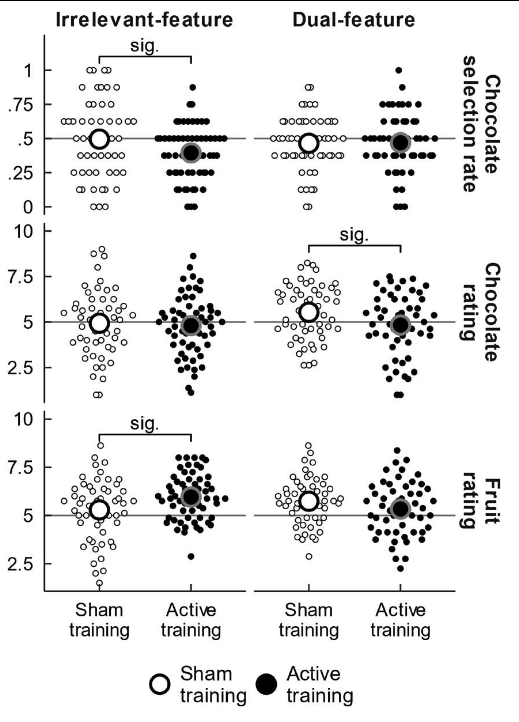
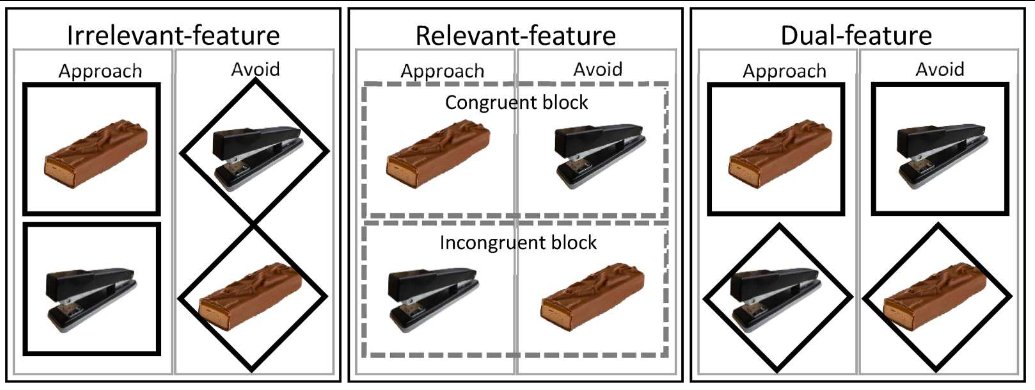
We used a new variant of the approach-avoidance task to train pps to avoid chocolate and approach fruit. This training was compared to the regular irrelevant-feature AAT training.
1
2
116
The new training was ineffective while the regular irrelevant-feature AAT significantly enhanced the desire to eat fruit. However, an interesting relationship emerged between the outcome measures and the perceived contingency between stimuli and approach/avoidance responses...
1
1
40
Pps who believed they approached chocolate more often, chose more chocolate and desired to eat it more. This was irrespective of training type, and also occurred in the sham condition; hence, this effect was unrelated to any real relationship between approach rate and food type.
1
33
New publication in which we analyze the longitudinal interrelations between food approach bias and consumption as well as impulsivity and dietary motivation! 🧵
doi.org/10.1016/j.appet.2024…
1
1
70
Takeaways:
- Approach bias is highly variable over time - its within-person variance is twice as large as its between-person variance
- TRAIT impulsivity and STATE dietary intentions interact with state approach bias to predict unhealthy eating
1
1
38
This constitutes a reversal of the assumed relationship between approach bias and cognitive resources - relying on dual-systems models, researchers usually assume that a stable approach bias interacts with variable cognitive resources to predict dietary failures or relapse.
1
40
New publication! doi.org/10.3758/s13423-024-0…
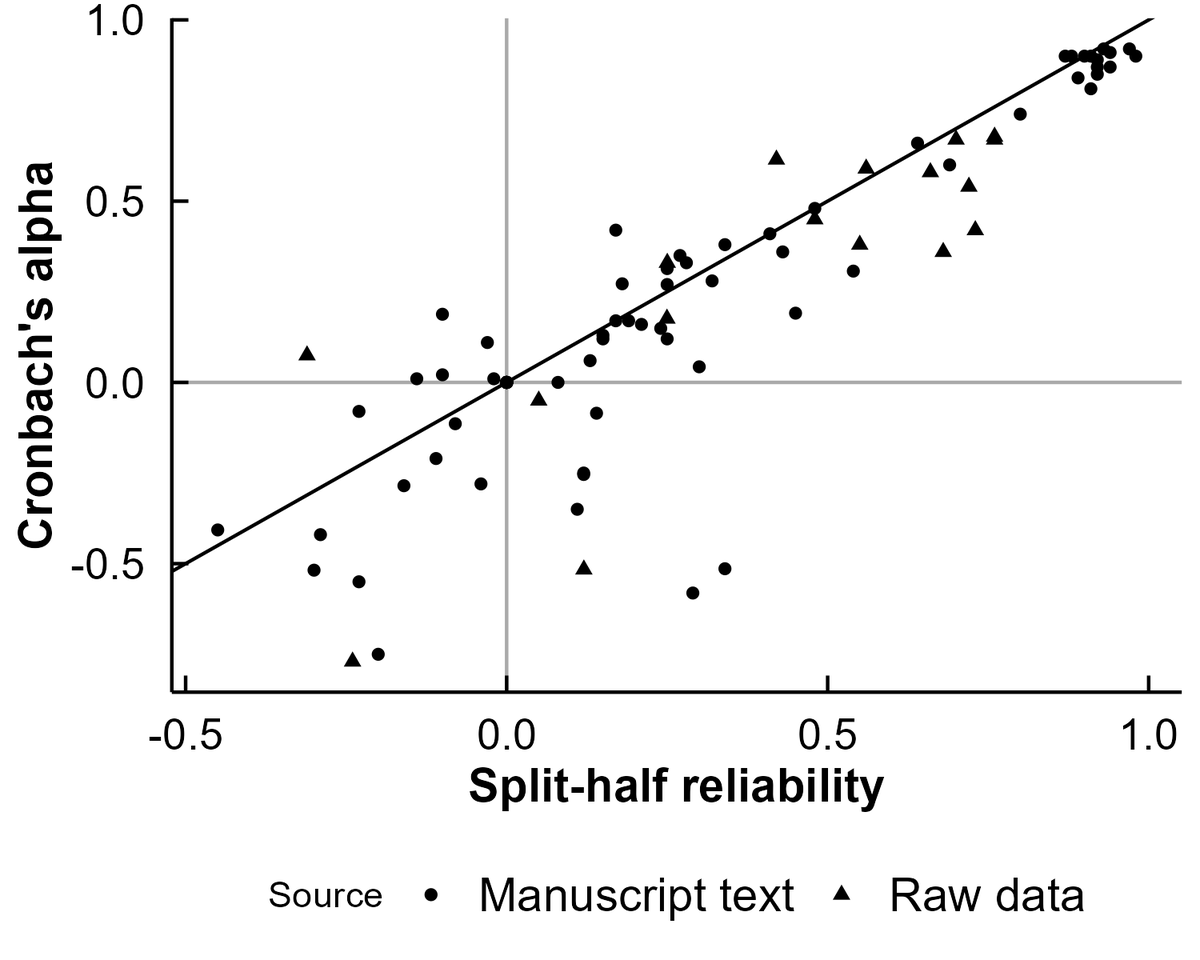
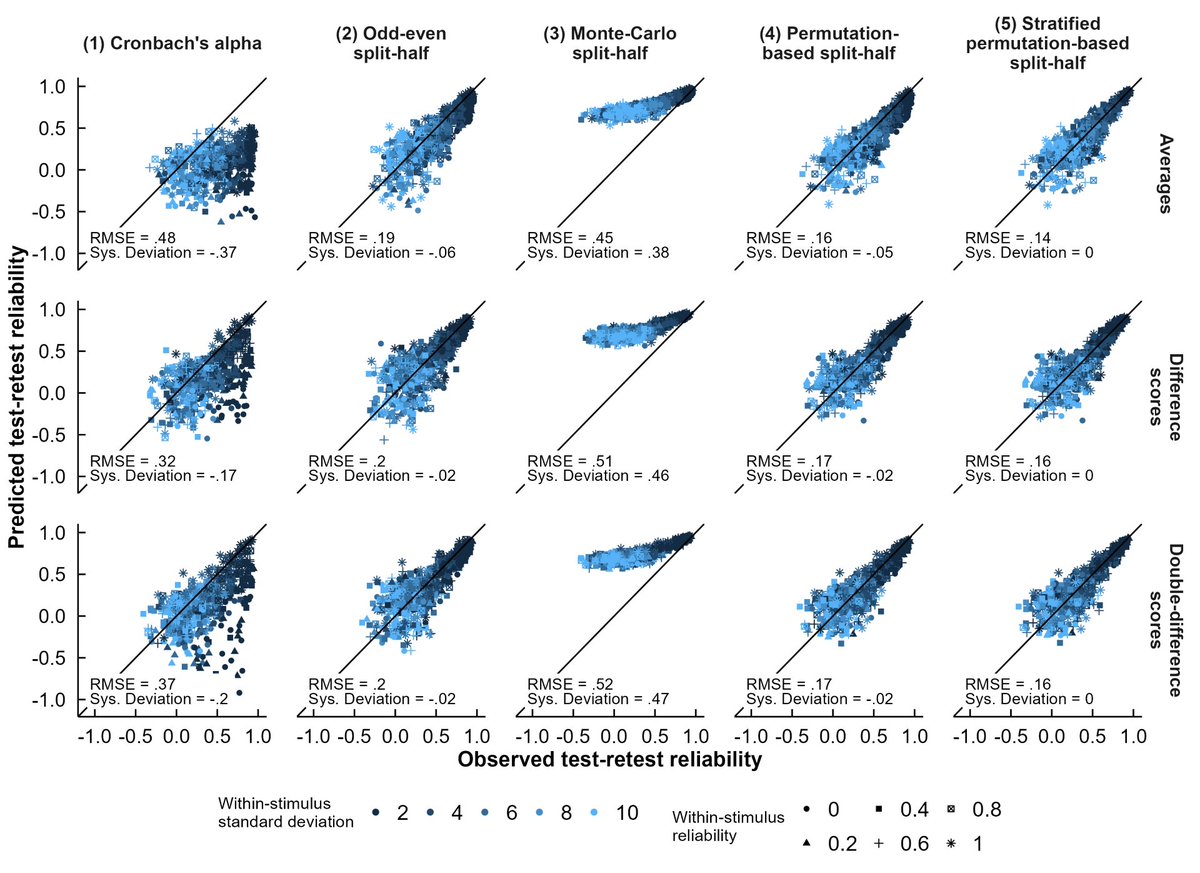
🧵1/3 Here Sercan Kahveci examined several common and proposed approaches to computing the reliability of reaction time tasks, such as the dot-probe task and approach-avoidance task. Things don't look good for Cronbach's alpha.
1
2
108
🧵2/3 Cronbach's alpha has a strong negative bias. Sercan confirmed in a small meta-analysis that this negative bias also occurs in empirical studies that compute both split-half and Cronbach's alpha.
1
1
57
🧵3/3 Sercan also examined several refinements to the usual split-half reliability approach that significantly improve its accuracy. This is made available in my R package {rapidsplithalf}: cran.r-project.org/web/packa…
1
37
Eating Behavior Laboratory Salzburg retweeted

Feierliche Eröffnung der Psychotherapieambulanz (Leitung Prof. Thomas Probst). 🥂🍾
Eine wichtige Weichenstellung für die Zukunft der @PLUS_1622
plus.ac.at/news/salzburgs-vo…
4
8
543
Eating Behavior Laboratory Salzburg retweeted

17 Sep 2024
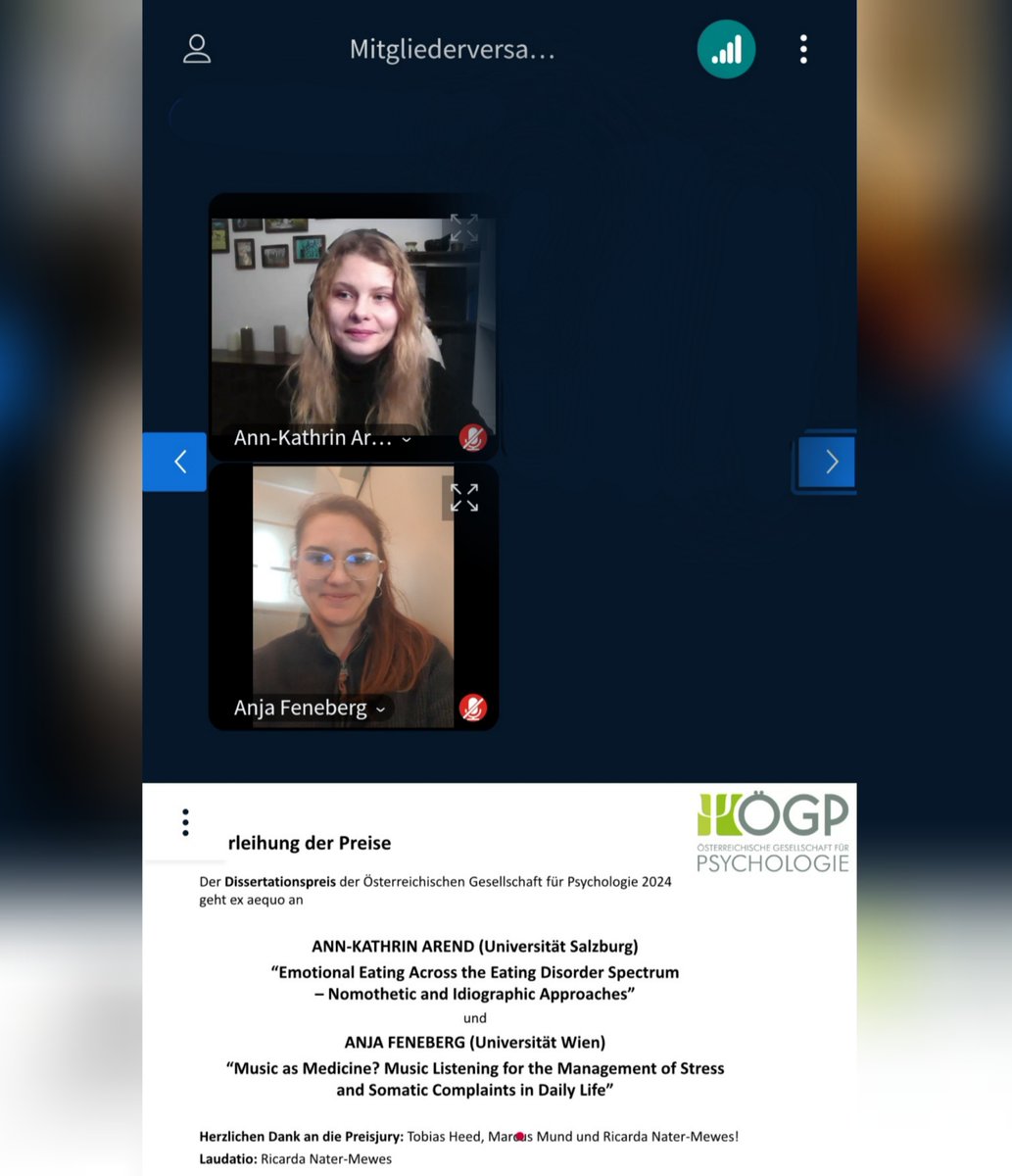
I am very touched to receive this award for my dissertation. My academic journey has not always been easy, but it has been worth it. 🥲
I wish everyone still on their PhD journey good luck and perseverance.
17 Sep 2024

Very honored and happy to share that @AnnKathrinArend and I both received this year's ÖGP dissertation award #DGPs2024 ! Could only attend online due to the weather, but enjoyed the meeting and 'laudatio' a lot :-)
4
2
11
1,129
We are looking forward to seeing many esteemed colleagues at the #dgps2024! 👀
Jens Blecher, Julia Reichenberger, Matthias Aulbach, and @AnnKathrinArend will represent us in Vienna.
5
316
Eating Behavior Laboratory Salzburg retweeted
13 Sep 2024
New paper alert! 🤩
Our new paper deals with momentary emotions and food cravings in AN-R, AN-BP, BN, BED, and a control group without eating disorders. 🧵
Open access: doi.org/10.1007/s40519-024-0…
#eatingdisorders #emotionaleating #AcademicTwitter #scicomm
1
1
3
122
we are looking forward to it! David Haag, Matthias Aulbach and @ChrisBrainberg from our lab will be there to present lates research on #MHealth, #EMA, #EatingBehavior and more✌️

The EHPS 2024 Conference kicks off in just 7 days. Get ready for insightful discussions, networking opportunities, and unforgettable experiences. See you there! #EHPS #EHPS2024 @EHPSociety @EHPSCreaters @ehps_synergy @EHPSHabit @EHPSDigiHealth @EHPS_OS_SIG @easy_conf

1
142
Wir freuen uns schon sehr, die Fachgruppe im September 2025 in Salzburg begrüßen zu dürfen! 🥳 Es wird sicher ein toller Kongress, der die Vielfalt unseres Faches abbilden wird 🤩
9 Jul 2024

Wir freuen uns sehr, das Datum für den 17. Kongress der Fachgruppe bekannt geben zu können: 15.-19. Sept. 2025! 🥳 #SaveTheDate
Unser Dank gilt Prof. Dr. Jens Blechert @EatingLab_SBG, der den Kongress an der Paris Lodron Universität Salzburg @PLUS_1622 ausrichten wird 🙏
1
4
221
Eating Behavior Laboratory Salzburg retweeted

28 Apr 2024
Want to come work with us? We have vacancy for a tenure-track assistant professor in our research group Eating Disorders & Obesity at Maastricht University. See: academictransfer.com/en/3408… @maastricht_fpn @MaastrichtU @maasuniversity
10
12
1,815
Eating Behavior Laboratory Salzburg retweeted

24 Apr 2024
I'm hiring at TCD in Ireland! Postdoc and PhD positions -looking for someone with computational modeling of cognition or fMRI analysis experience. Great colleagues and tonnes of exciting work going on at Trinity. Project = computational psychiatry / social neuro. bishops@tcd.ie
1
16
23
9,196