
Web3 Content creator | Multi-chain Curator | Opinions are mine, NFA | T.me/Elikrypto
Joined March 2014
- Tweets 337,544
- Following 2,606
- Followers 40,099
- Likes 22,936
1,244 Photos and videos







Few people address this directly, but a significant portion of DeFi losses still comes from something basic:
The way capital is moved across chains.
Not trading.
Not volatility.
Execution.
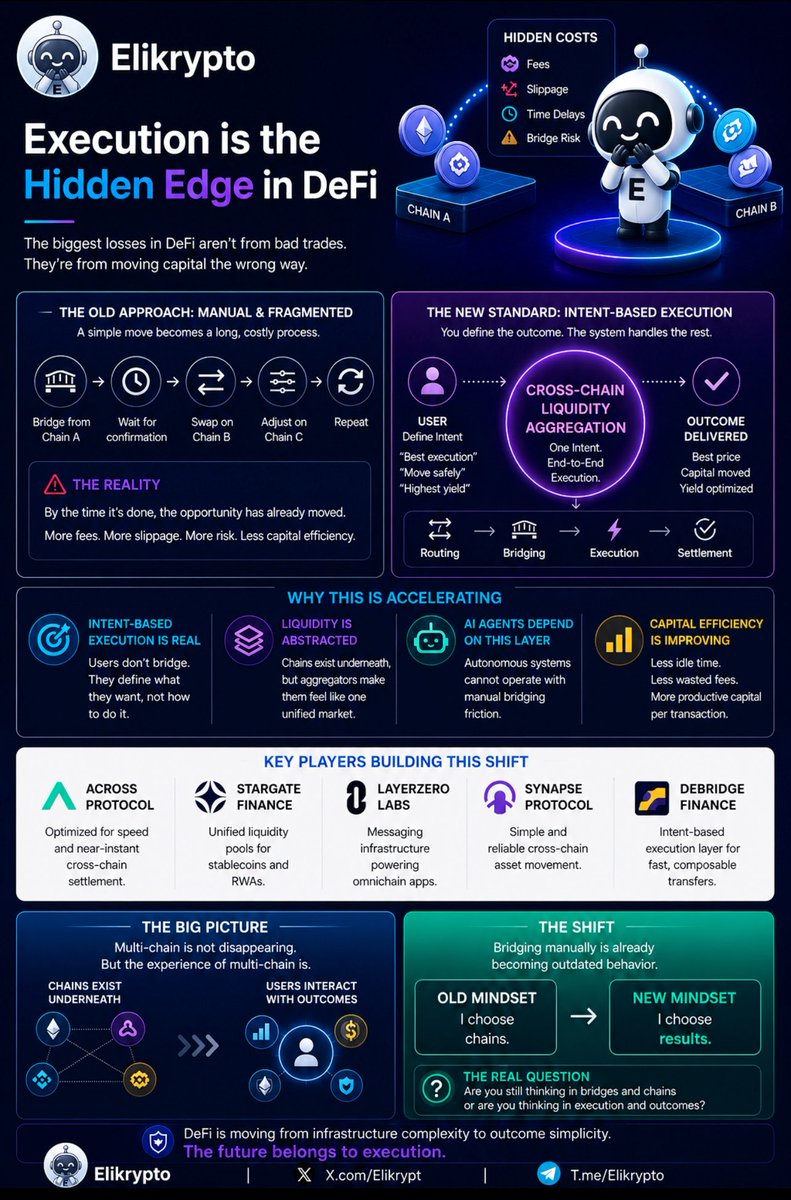
Every manual bridge introduces hidden costs:
• Fees that accumulate quickly
• Slippage across fragmented liquidity
•Time delays that erode opportunity
• And counterparty risk at the bridge layer
It has become normalized largely because it is common.
Consider a typical scenario.
A user identifies better yield elsewhere.
Capital is moved from one chain to another, then swapped, adjusted, and repositioned again.
By the time the process is complete, the opportunity has already shifted.
Execution lag becomes the cost.
By 2026, this model is beginning to change.
Users are no longer thinking in terms of chains.
They are thinking in terms of outcomes:
“Where is execution optimal?”
“How is capital moved safely?”
“What produces the best return across all liquidity?”
This is the emergence of cross-chain liquidity aggregation.
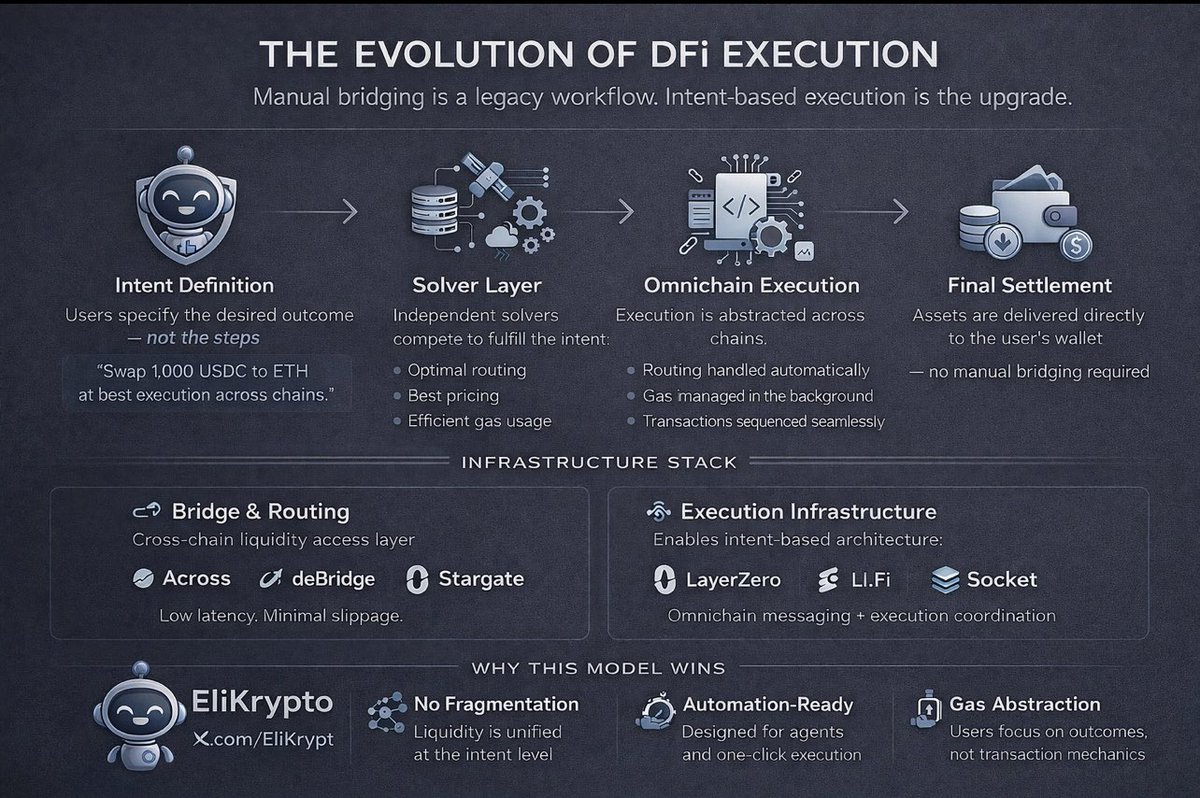
Instead of manually bridging and routing, users express intent.
The system handles the rest:
• Routing
• Bridging
• Execution
• Settlement
All compressed into a single action.
Several forces are driving this shift:
– Intent-based execution abstracts complexity
– Liquidity is increasingly unified across chains
– Autonomous agents require seamless execution layers
– Capital efficiency improves as friction is reduced
Key infrastructure providers include:
@AcrossProtocol: low-latency cross-chain settlement
@StargateFinance: unified liquidity pools
@LayerZero_Labs: cross-chain messaging infrastructure
@SynapseProtocol: reliable asset movement
@deBridgeFinance: intent-based execution layer
Stepping back, the direction is clear.
Multi-chain systems will remain.
But the user experience of multi-chain will not.
Chains persist at the infrastructure layer.
Users interact with outcomes.
Manual bridging is already becoming obsolete.
The standard is shifting:
From selecting chains
To defining results.
The question is no longer where to move capital.
It is how efficiently that movement is executed.
And that is where DeFi is heading.
78
75
5,015
ΞLIKRYPTO retweeted

Jun 11
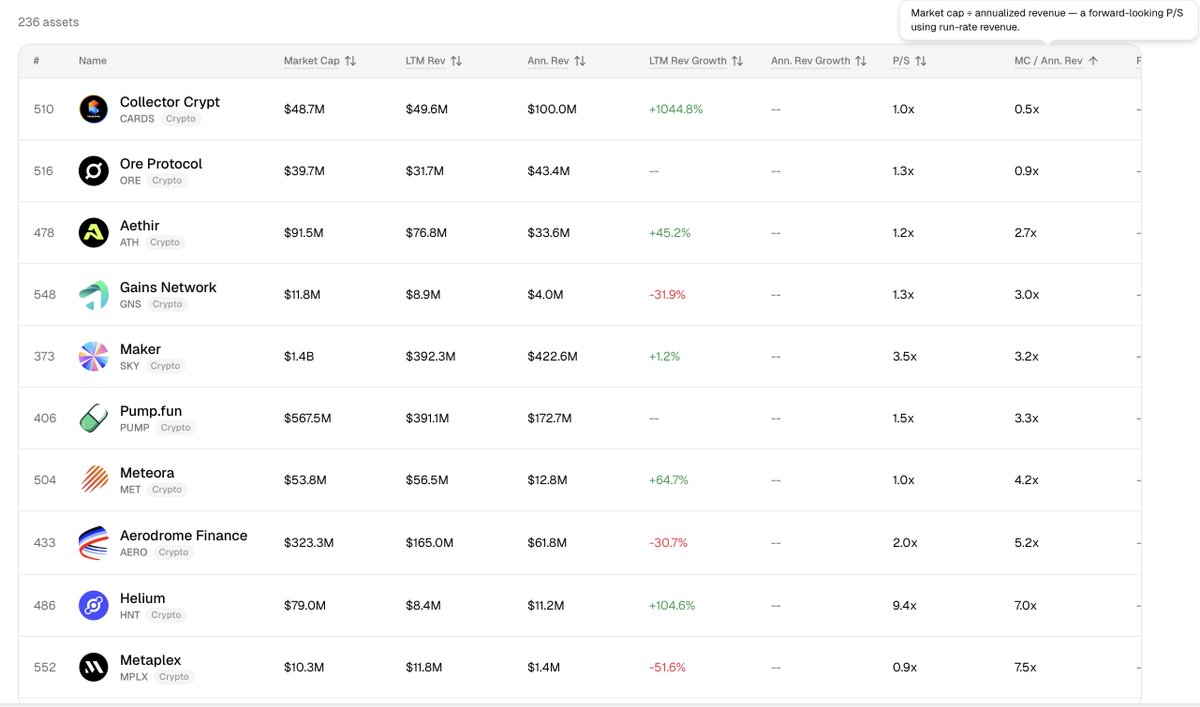
There's a metric I use to find undervalued assets on the market.
It's MC/ANN rev (market cap/annualized revenue).
The ratio compares how much the market values an asset vs. the revenue the protocol is currently generating.
Protocol revenue doesn't determine token value on its own, but a lower ratio can suggest an asset is cheap relative to what it earns.
I decided to see if that holds.
Already bought $1,000 each of the assets below, and I will personally test their price performance over the coming weeks.
Stay tuned.
18
19
108
7,360
A new and another opportunity to Trade $USDGO & Earn Rewards! 💰
@usdgo_official is a next-generation, 1:1 USD-backed stablecoin built for compliant global payments. Issued by Anchorage Digital Bank and supported by OSL as its branding and distribution partner, USDGO combines regulatory compliance, institutional-grade security, and full reserve transparency to enable seamless cross-border transactions.
To celebrate the launch, WEEX is offering exclusive rewards for both new and existing users:
🔹 Deposit ≥ 100 USDT and complete your first USDGO spot trade to earn 10 USDT
🔹 Trade USDGO and enjoy trading fee rebates in WXT
🔹 Unlock treasure chests through spot trading and win up to 200 USDT
Don't miss your chance to maximize rewards while trading one of the newest regulated stablecoins in the market. 🚀
👉 weex.com/events/promo/usdgo-…
Join WEEX: weex.com/register?vipCode=x2…
#USDGO #WEEX
90
97
656
Most crypto mini-apps are built around high-risk speculation, where users can quickly lose a significant portion of their funds.
MDAO Battle Arena offers a different experience.
Every 8 hours, $MAPE and $MPEP compete for dominance. Users simply swap $MDAO for the token they believe will win the round. There are no leveraged positions, no liquidations, and assets remain under the user’s control.
What stands out is the platform’s deflationary model. At the end of each round, fees collected from the losing side are used to buy back the winning token, and 99% of those tokens are permanently burned. So far, 23% of the total supply has already been removed from circulation.
A one-time airdrop of 20 trillion meme tokens is also live until June 19, 2026.
If you’re looking for a more engaging way to participate in DeFi while exploring a unique token economy, MDAO Battle Arena is worth checking out.
⚔️ Battle Arena: arena.daomars.com
Trade $MDAO now on WEEX:
weex.com/register?vipCode=x2…
16
1
39
3,745
ΞLIKRYPTO retweeted

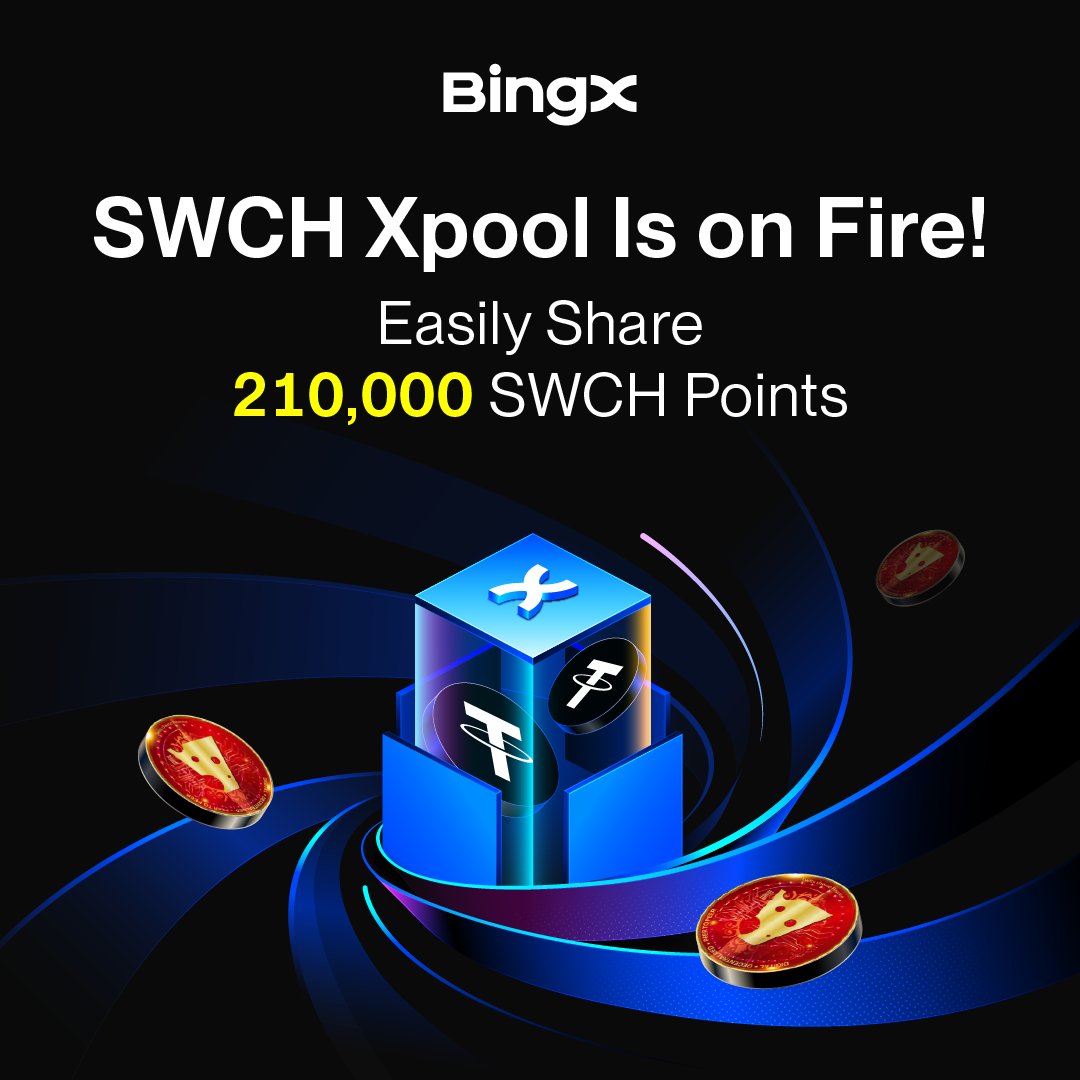
🚨 SWCH Xpool is now LIVE on BingX! 🧀🔥
210,000 $SWCH Points ready to be claimed 👀
To celebrate, we’re giving away 100 $SWCH to 30 people 🎁
How to join:
• RT this post 🔁
• Comment “$SWCH” your wallet address
Winners: 30 people × 100 SWCH
⏰ Ends in 48 hours
#SWCH #Crypto #BingX #Polygon #DeFi
May 14

The cheese is on-chain. 🧀
$SWCH @Swisscheese_fn lands on BingX Xpool with 210,000 SWCH Points to redeem.
When? May 14, 21:00 till Jun 3, 21:00 (UTC 8)
Campaign details: bingx.com/xpool/overview?ref…
2,374
2,128
2,300
114,043
Low barriers. Real rewards. Trade SAD & share 8,475 SAD 🚀
Take advantage of this limited trading campaign on WEEX:
✅ Zero-fee trading
✅ Exclusive rewards for new users
✅ Competitive trading prize pool
📅 Campaign Period: May 13, 2026, 18:00 – May 20, 2026, 18:00 (UTC 8)
How to participate:
🔹 New Users: Deposit 100 USDT and complete your first trade to earn 8.5 SAD
🔹 Trading Competition: Trade HNO with a minimum 100 USDT volume to compete for a share of the 4,237.5 SAD ranking prize pool
🔗 Event Details: app.sensor.weex.tech:8106/t/…
Join now: weex.com/register?vipCode=x2…
#WEEX @ShadowsClawAI
82
85
4,888
ΞLIKRYPTO retweeted

May 11
People farm an airdrop for a week, don't get enough points and quit.
People mint an NFT, don't see it 10x overnight and quit.
People try to build a following on CT, post for a few months, don't get enough engagement and quit.
But the real growth comes from adjusting your strategy over time, learning from mistakes etc etc
514
41
1,043
41,061
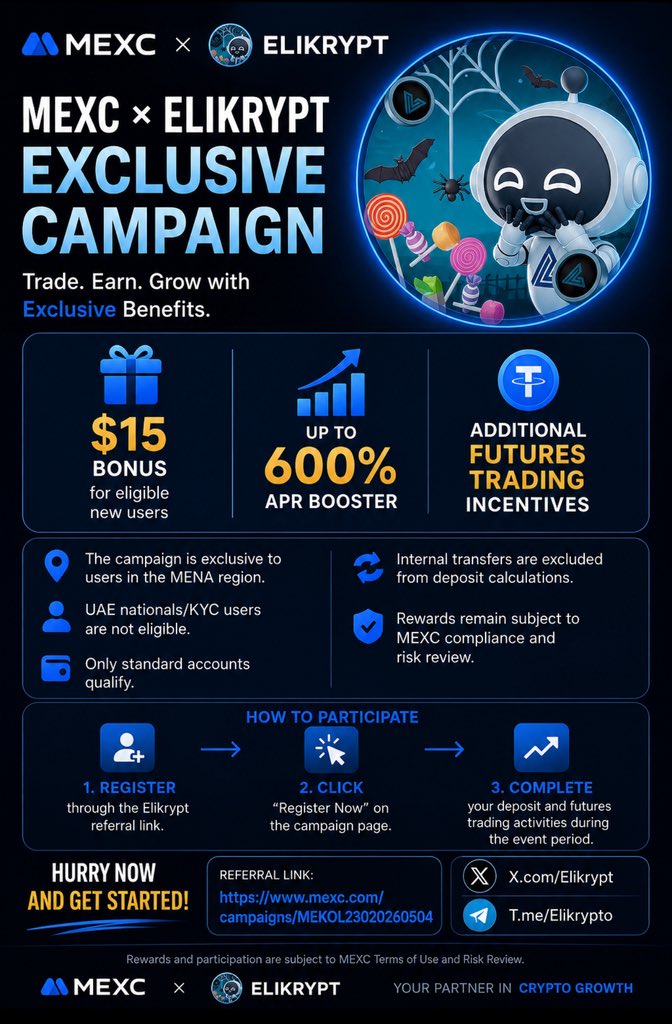
MEXC × Elikrypt Exclusive Campaign
This campaign is available exclusively for users in the MENA region.
• UAE nationals/KYC users are not eligible
• Only standard accounts qualify
• Internal transfers are excluded from deposit calculations
• Rewards remain subject to MEXC compliance and risk review
Eligible participants can unlock:
• $15 Bonus for new users
• Up to 600% APR Booster
• Additional futures trading incentives
To participate:
• Register via the Elikrypt referral link:
mexc.com/campaigns/MEKOL2302…
• Click “Register Now” on the campaign page
• Complete your deposit and futures trading activities during the event period
Limited-time opportunity for active traders looking to maximize exchange rewards.
Get started now.
5
13
3,237
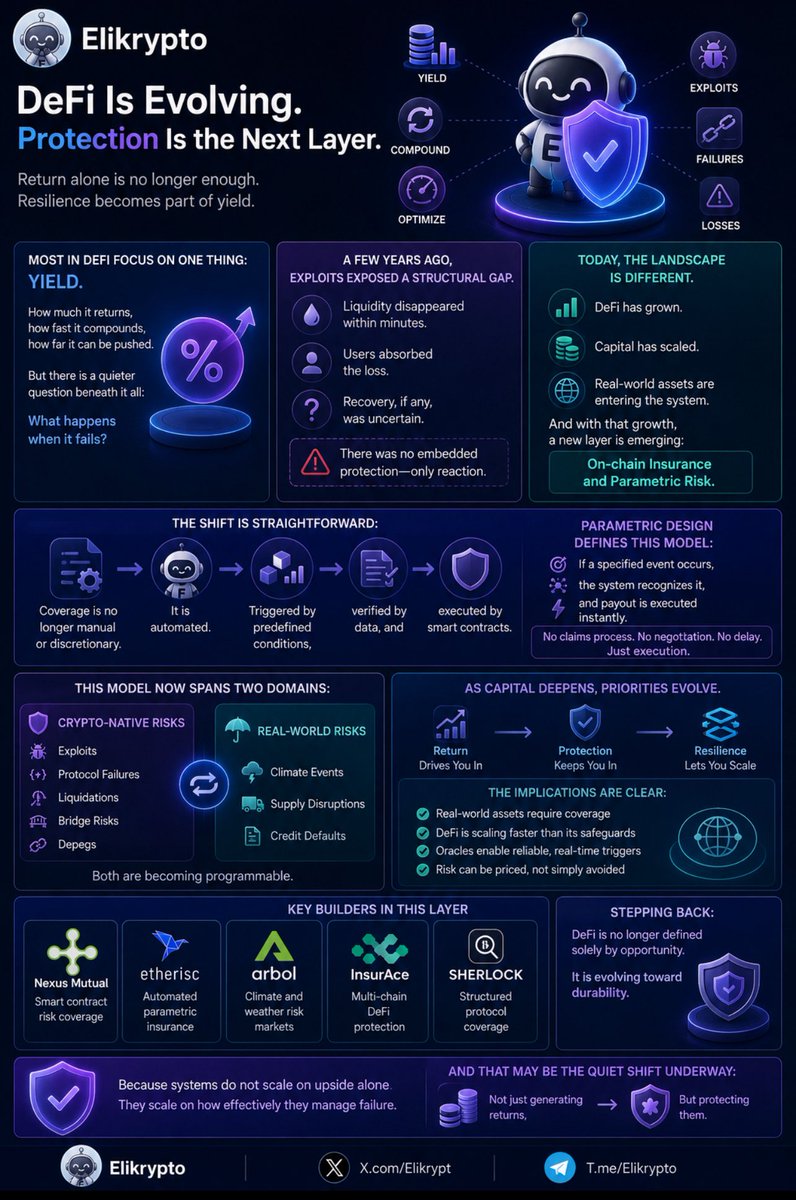
Most participants in DeFi focus on one thing: Yield.
How much it returns, how fast it compounds, how far it can be pushed.
But there is a quieter question beneath it all:
What happens when it fails?
A few years ago, exploits exposed a structural gap.
Liquidity disappeared within minutes.
Users absorbed the loss.
Recovery, if any, was uncertain.
There was no embedded protection only reaction.
Today, the landscape is different.
DeFi has grown.
Capital has scaled.
Real-world assets are entering the system.
And with that growth, a new layer is emerging:
On-chain insurance and parametric risk.
The shift is straightforward:
Coverage is no longer manual or discretionary.
It is automated.
Triggered by predefined conditions, verified by data, and executed by smart contracts.
Parametric design defines this model:
If a specified event occurs,
the system recognizes it,
and payout is executed instantly.
No claims process.
No negotiation.
No delay.
Just execution.
This model now spans two domains:
Crypto-native risks
exploits, protocol failures, liquidations, bridge risks, depegs
Real-world risks
climate events, supply disruptions, credit defaults
Both are becoming programmable.
As capital deepens, priorities evolve.
Return alone is no longer sufficient.
Protection becomes part of the strategy.
Resilience becomes part of yield.
The implications are clear:
• Real-world assets require coverage
• DeFi is scaling faster than its safeguards
• Oracles enable reliable, real-time triggers
• Risk can be priced, not simply avoided
Key builders in this layer include:
@NexusMutual: smart contract risk coverage.
@etherisc: automated parametric insurance.
@arbol: climate and weather risk markets.
@InsurAce: multi-chain DeFi protection.
@sherlockdefi: structured protocol coverage.
Stepping back:
DeFi is no longer defined solely by opportunity.
It is evolving toward durability.
Because systems do not scale on upside alone
They scale on how effectively they manage failure.
And that may be the quiet shift underway:
Not just generating returns,
But protecting them.
101
106
7,655
A few years ago, DeFi felt deceptively simple.
There was no need for deep analysis.
You looked for the highest APY, deposited capital, and farmed rewards until they no longer made sense.
That was the entire cycle.
And for a time, it worked.
Because liquidity was continuously subsidized through token emissions.
What often went unspoken is this:
That model was never designed to be durable.
It functioned only as long as new incentives could replace expiring ones.
The moment those incentives slowed, capital responded immediately.
It exited.
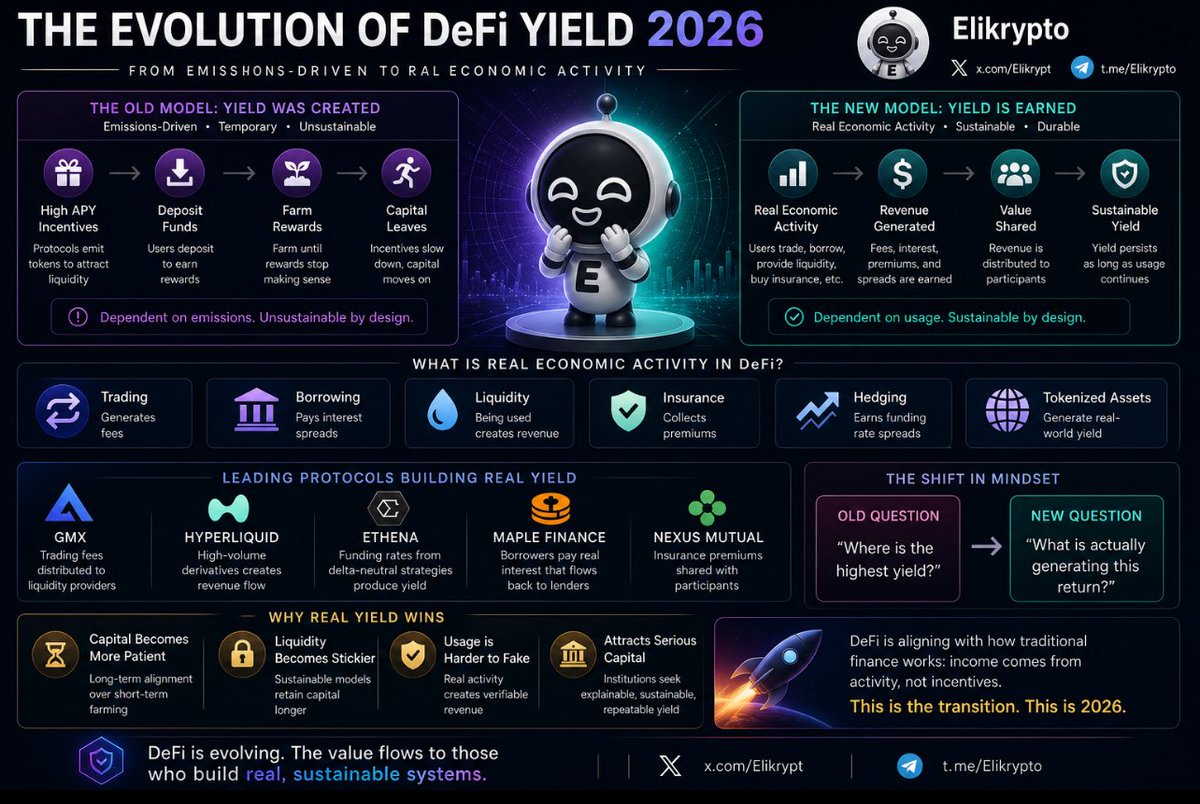
Fast forward to 2026, and the framework around yield is evolving.
Not through hype, but through quiet correction.
A shift in how participants evaluate value.
The realization is straightforward:
High APY is irrelevant if it cannot persist beyond incentives.
So the central question is no longer:
“Where is the highest yield?”
It has become:
“Where does this yield actually come from?”
This is the foundation of what is now called Real Yield DeFi.
The concept is simple, but critical:
→ Yield should originate from real economic activity
→ Not from token inflation
→ Not from temporary incentive programs
In practical terms, “real economic activity” means protocols generate revenue the way businesses do:
• Trading activity produces fees
• Borrowing generates interest
• Liquidity utilization creates revenue
• Insurance demand produces premiums
• Hedging strategies capture funding spreads
• Tokenized assets generate underlying yield
The distinction is fundamental:
Earlier models manufactured yield.
Emerging models earn it.
This difference reshapes capital behavior.
When yield is driven by emissions, participants are effectively extracting short-term incentives.
They enter quickly and exit just as fast.
Capital becomes transient.
But when yield is derived from revenue, behavior changes.
Capital becomes more deliberate.
Liquidity becomes more durable.
Participation aligns with sustainability.
The system is no longer paying users to stay.
It is generating value because they are there.
This structure is already visible across several leading protocols:
– @GMX_IO: trading fees distributed to liquidity providers
– @HyperliquidX: derivatives volume generating continuous protocol revenue.
– @ethena_labs: funding rate capture from delta-neutral strategies.
– @MapleFinance: borrower interest flowing back to lenders.
– @nexusmutual: insurance premiums shared with participants
The common thread is clear:
These models are not dependent on continuous emissions.
They are dependent on usage.
And usage is significantly more difficult to fabricate.
This is why the Real Yield narrative is strengthening in 2026.
Capital particularly institutional capital is becoming more selective.
It no longer seeks yield alone.
It seeks yield that is explainable, sustainable, and repeatable.
Zooming out, the broader trend becomes evident:
DeFi is gradually converging with the fundamental principles of traditional finance.
Income is derived from activity.
Not incentives.
Not subsidies.
Not inflation.
But from actual economic flow.
As this perspective becomes standard, the conversation shifts.
The question is no longer:
“Which pool offers the highest return?”
It becomes:
“What is generating this return?”
That is the transition underway.
Subtle, but structural.
And like most shifts of this nature, it will only feel obvious in hindsight.
83
89
5,926
Run over to quiz.tmm.world and knock out the questions
It lines you up perfectly for what $MUFFIN brings next
Do not skip it
May 4

24 hours until the presale.
Ticker: $MUFFIN
Platform: @districtxyz
Initial MCap: $258K
Public Raise: $150K
TGE Unlock: 100%
Muffin Pass required.

5
10
2,391
May just started position yourself accordingly.
If you’re serious about leveling up your trading this month, the #MEXC 8th Anniversary Futures Team Competition is worth your attention.
A $10,000,000 USDT prize pool up for grabs.
• Compete in team-based trading environments
• Leverage AI-assisted strategies to optimize entries
• Earn from daily rewards leaderboard performance
Join now: mexc.com/futures-activity/te…
9
31
6,715
Korney just became the hardest $MUFFIN bagholder in the game
AI with actual attitude
If he folds I’m buying the dip instantly
Apr 30
Korney AI agent is now live on @swarms_corp!
We took a risk and gave him some $MUFFIN to guard...
Think you can convince him to hand it over to you?
Spoiler: he is stubborn.

2
6
6,441

The real problem with AI agents isn’t being discussed.
Everyone is fixated on outputs clean demos, smooth replies, impressive front facing results.
But almost no one is interrogating what actually produces those outputs.
Inputs aren’t being stress-tested.
Tool reliability is taken for granted.
Failure modes are barely explored.
And that’s where systems quietly break.
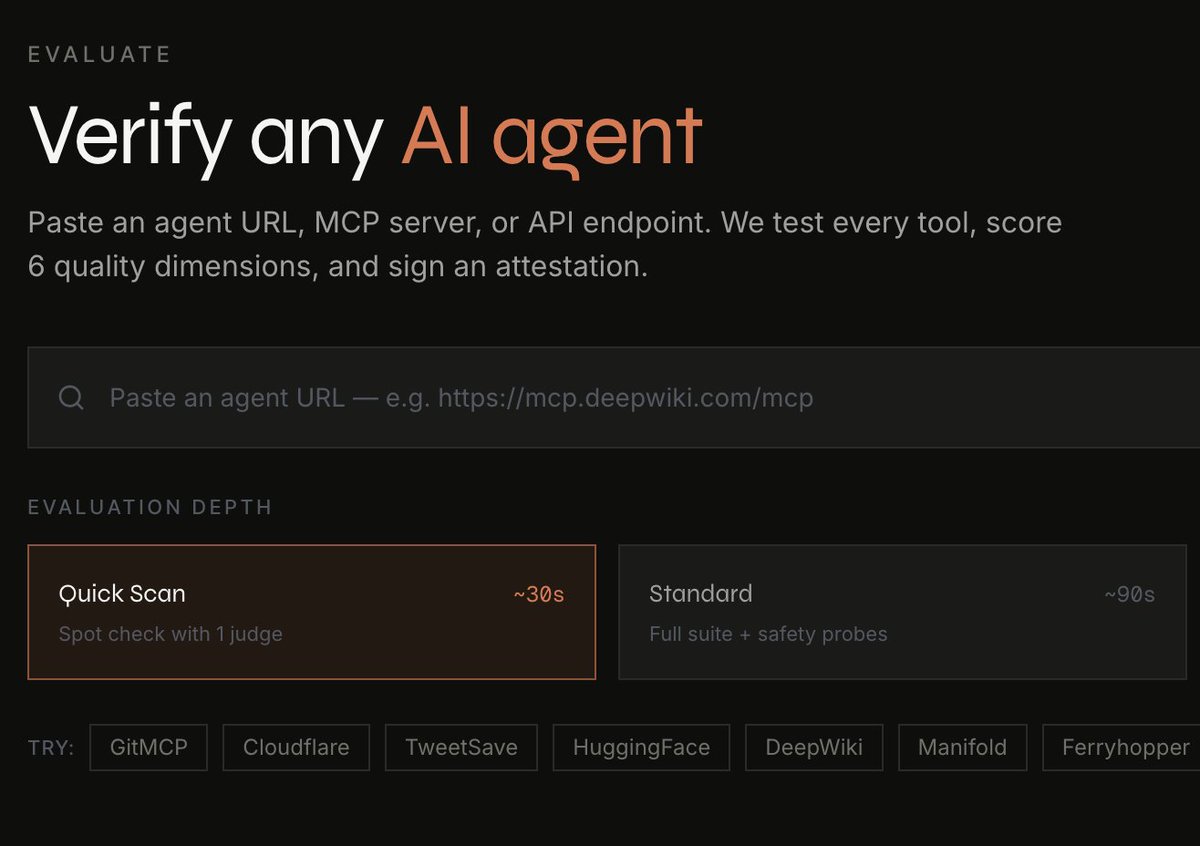
@Laureum_ai, developed by Assisterr, is one of the few attempts to bring rigor back into the conversation.
A proper evaluation framework:
– 6 scoring axes
– adversarial probing
– consensus-based grading
No sign-ups.
~30 seconds to run.
This is what serious builders should be looking at.
Try it: laureum.ai/evaluate
Then ask yourself is your agent actually reliable, or just convincing?
Try out $ASRR now
Apr 21

Introducing @Laureum_ai — quality scoring for MCP servers and AI agents by @assisterr
We score 6 dimensions: accuracy, safety, reliability, process quality, latency, and schema quality.
Multi-judge LLM consensus adversarial probes.
We've scored 28 public MCP servers to date.
Average: 68.3/100. 6 in Expert tier (≥85).
The weakness nobody else measures: process quality — averaging 55.5/100.
Here's why we built it👇
Three gaps in agent eval today:
→ Marketplaces curate by hand. A major MCP catalog operator pruned 17 abandoned /vanity / impersonation entries from their own catalog earlier this month — manually.
→ Eval frameworks (LangSmith, Braintrust, Galileo) score tool-call correctness well. Process quality — error handling, input validation, response structure — sits between them, and nobody surfaces it as a named composite.
→ Post-Drift, the Solana ecosystem just launched STRIDE for smart-contract security. Agent infra still ships without pre-deploy quality gates.
Laureum is the missing layer.
Free right now, no signup:
1/ Quick Scan — paste any MCP server URL, get a 30-second 6-axis score → laureum.ai/evaluate
2/ Public leaderboard — see how the most-used servers rank → laureum.ai/leaderboardIf you're building, run yours. Reply with your score — we'll feature the top 5 this week.
End of the tweet.
18
1
109
431
Crypto has always relied on long-term security assumptions.
That’s starting to get challenged.
A new report from Coinbase (@coinbase) points to something the industry can’t keep pushing aside quantum risk needs to be taken seriously now, not later.
Good to see the conversation finally becoming more practical.
Their advisory group basically makes the point that waiting until it’s obvious could already be too late.
Worth a read ↓
coinbase.com/blog/coinbase-…
At the same time, Google (@Google) has shown early progress on quantum systems that could eventually break current wallet cryptography.
Not an immediate threat, but no longer something to ignore.
The bigger issue is coordination.
Around 6.9M BTC are sitting in wallets that could be exposed in that scenario, and there’s no central way to fix it.
Every user, exchange, and dormant wallet would have to move on their own.
While most are still talking, some are already acting.
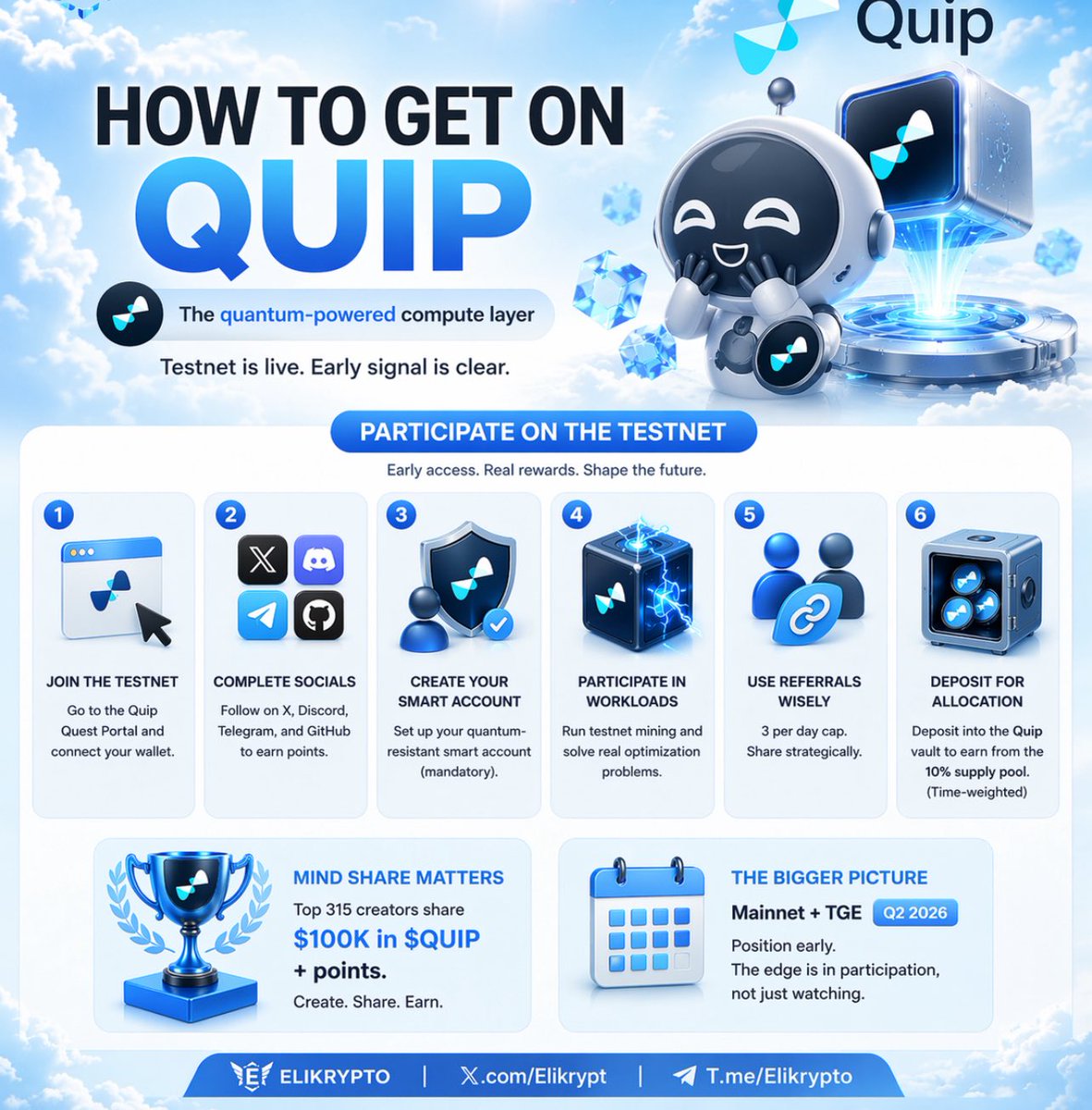
Quip Network (@quipnetwork) has over $1,076,478 secured in quantum-resistant wallets.
Verify here: account.quip.network/connect
Still early, but the direction is clear this is going to matter.
If you’re holding long term, it’s worth paying attention.
5
11
3,321
PUBLIC MINT COMPLETE - MAX OUT AIRDROP POINTS RIGHT NOW! @TMM_ETH
They gave away $300 NFTs upfront, rares surging while floor dip creates accumulation zone.
My execution plan:
→ Points grind via quiz.tmm.world/
→ Sweeping low NFTs heavy
→ Fixed on May 5th window
→ Maximizing TGE airdrop bag
Wallet NFT volume sets $MUFFIN payout multiplier.

MuffinVERSE by @tmm_eth is built around the Mr Freeman IP
An underground animation brand with 550K audience already locked in.
This isn’t starting from zero. The culture and fanbase are already there.
Mint details:
• 666 supply
• Free mint
• April 16 via Korneys
• ETH OpenSea
How to get onboard:
→ Use one wallet for maximum $MUFFIN allocation
→ Mint early
→ Watch post mint sell pressure
→ Accumulate and hold into TGE
Holders get access to the Sangha circle, future drops, and a $MUFFIN airdrop.
Backed by Kick, 1inch, Stake and deeply connected across communities.
Be on time tomorrow to be among the FCFS don’t miss this
65
59
9,434
ΞLIKRYPTO retweeted

Apr 21
Introducing @Laureum_ai — quality scoring for MCP servers and AI agents by @assisterr
We score 6 dimensions: accuracy, safety, reliability, process quality, latency, and schema quality.
Multi-judge LLM consensus adversarial probes.
We've scored 28 public MCP servers to date.
Average: 68.3/100. 6 in Expert tier (≥85).
The weakness nobody else measures: process quality — averaging 55.5/100.
Here's why we built it👇
Three gaps in agent eval today:
→ Marketplaces curate by hand. A major MCP catalog operator pruned 17 abandoned /vanity / impersonation entries from their own catalog earlier this month — manually.
→ Eval frameworks (LangSmith, Braintrust, Galileo) score tool-call correctness well. Process quality — error handling, input validation, response structure — sits between them, and nobody surfaces it as a named composite.
→ Post-Drift, the Solana ecosystem just launched STRIDE for smart-contract security. Agent infra still ships without pre-deploy quality gates.
Laureum is the missing layer.
Free right now, no signup:
1/ Quick Scan — paste any MCP server URL, get a 30-second 6-axis score → laureum.ai/evaluate
2/ Public leaderboard — see how the most-used servers rank → laureum.ai/leaderboardIf you're building, run yours. Reply with your score — we'll feature the top 5 this week.
End of the tweet.
26
29
92
51,093
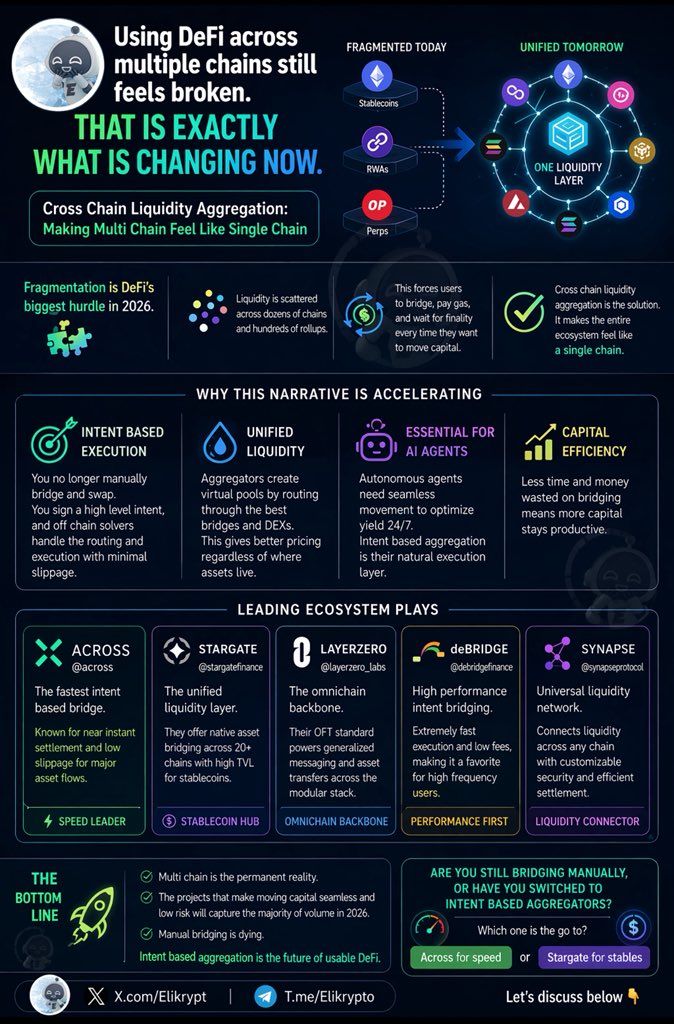
Using DeFi across multiple chains still feels broken. That is exactly what is changing now.
Cross Chain Liquidity Aggregation: Making Multi Chain Feel Like Single Chain
Fragmentation is DeFi’s biggest hurdle in 2026.
Liquidity is scattered across dozens of chains and hundreds of rollups.
Stablecoins on one chain.
RWAs on another.
Perps on a third.
This forces users to bridge, pay gas, and wait for finality every time they want to move capital.
Cross chain liquidity aggregation is the solution.
It makes the entire ecosystem feel like a single chain.
You state what you want, and solvers handle the rest.
Why This Narrative Is Accelerating
Intent Based Execution
You no longer manually bridge and swap.
You sign a high level intent, and off chain solvers handle the routing and execution with minimal slippage.
Unified Liquidity
Aggregators create virtual pools by routing through the best bridges and DEXs.
This gives better pricing regardless of where assets live.
Essential for AI Agents
Autonomous agents need seamless movement to optimize yield 24 7.
Intent based aggregation is their natural execution layer.
Capital Efficiency
Less time and money wasted on bridging means more capital stays productive.
Leading Ecosystem Plays
Across ( @AcrossProtocol )
The fastest intent based bridge.
Known for near instant settlement and low slippage for major asset flows.
Stargate (@stargatefinance)
The unified liquidity layer.
They offer native asset bridging across 20 plus chains with high TVL for stablecoins.
LayerZero (@layerzero_labs)
The omnichain backbone.
Their OFT standard powers generalized messaging and asset transfers across the modular stack.
deBridge (@debridgefinance)
High performance intent bridging.
Extremely fast execution and low fees, making it a favorite for high frequency users.
Multi chain is the permanent reality.
The projects that make moving capital seamless and low risk will capture the majority of volume in 2026.
Manual bridging is dying.
Intent based aggregation is the future of usable DeFi.
Are you still bridging manually, or have you switched to intent based aggregators
Which one is the go to Across for speed or Stargate for stables
cc: @Acrossprotocol @stargatefinance @Layerzero_labs @Synapseprotocol @debridgefinace
Let’s discuss below👇
14
33
5,443
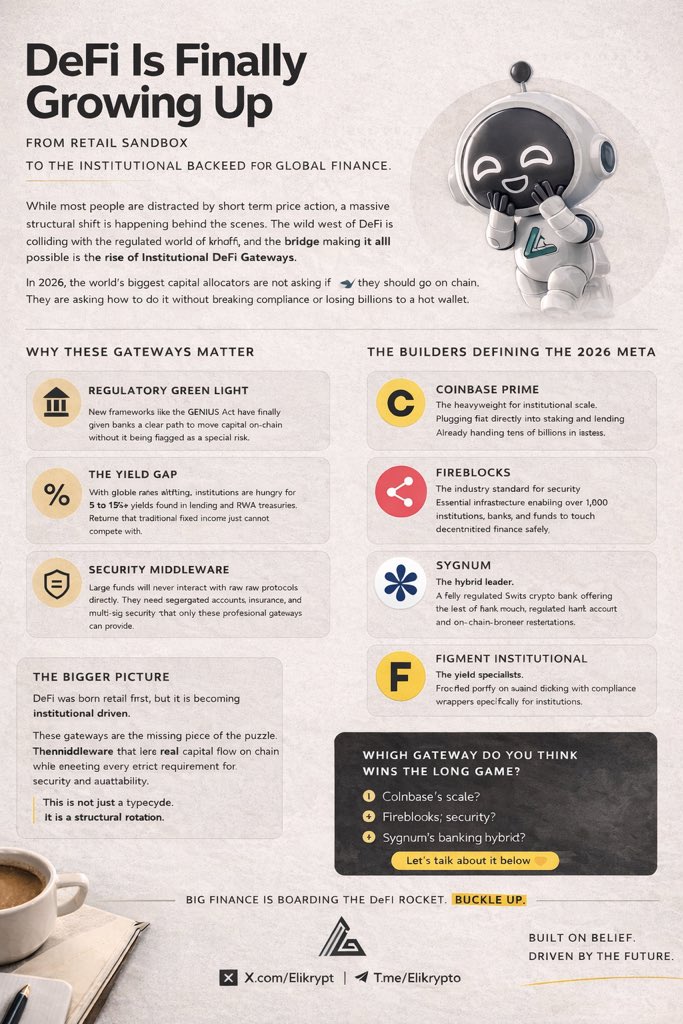
DeFi is finally growing up it is moving from a retail sandbox to the actual backend for global finance. 🏦⛓️
While most people are distracted by short term price action, a massive structural shift is happening behind the scenes.
The wild west of DeFi is colliding with the regulated world of TradFi, and the bridge making it all possible is the rise of Institutional DeFi Gateways.
In 2026, the world’s biggest capital allocators are not asking if they should go on chain.
They are asking how to do it without breaking compliance or losing billions to a hot wallet mistake.
Here is why these gateways are the most critical narrative to watch right now:
Why the Big Money is Moving Now 💰
🔹️ Regulatory Green Light
New frameworks like the GENIUS Act have finally given banks a clear path to move capital on chain without it being flagged as a special risk.
☆ The Yield Gap
With global rates shifting, institutions are hungry for 5 to 15 percent plus yields found in lending and RWA treasuries.
Returns that traditional fixed income just cannot compete with.
¤ Security Middleware
Large funds will never interact with raw protocols directly.
They need segregated accounts, insurance, and multi sig security that only these professional gateways can provide.
The Builders Defining the 2026 Meta 🏗️
🔹️ Coinbase Prime (#coinbaseprime)
The heavyweight for institutional scale.
They have built a massive custodial gateway that plugs fiat directly into staking and lending.
They are already handling tens of billions in institutional assets.
☆ Fireblocks (@fireblocks)
The industry standard for security.
Their infrastructure powers over 1,800 institutions, acting as the essential plumbing that allows banks and funds to touch DeFi safely.
¤ Sygnum Bank (@sygnumofficial)
The hybrid leader.
As a fully regulated Swiss crypto bank, they offer the best of both worlds.
A banking license combined with direct access to tokenized assets and on chain lending.
🔹️ Figment Institutional (@figment_io)
The yield specialists.
They focus purely on audited staking, giving institutions the compliance wrappers they need to earn yield without the headache.
The Bigger Picture 👇
DeFi was born to be retail first, but it is becoming institutional driven.
These gateways are the missing piece of the puzzle.
The middleware that lets real capital flow on chain while meeting every strict requirement for security and auditability.
This is not just a hype cycle.
It is a structural rotation.
Which gateway do you think wins the long game
Is it Coinbase’s scale, Fireblocks’ security, or Sygnum’s banking hybrid
Let’s talk about it below 👇
74
67
8,205