
Joined April 2023
- Tweets 3,840
- Following 599
- Followers 10,692
- Likes 9,393
515 Photos and videos





Pinned Tweet

18 Sep 2023
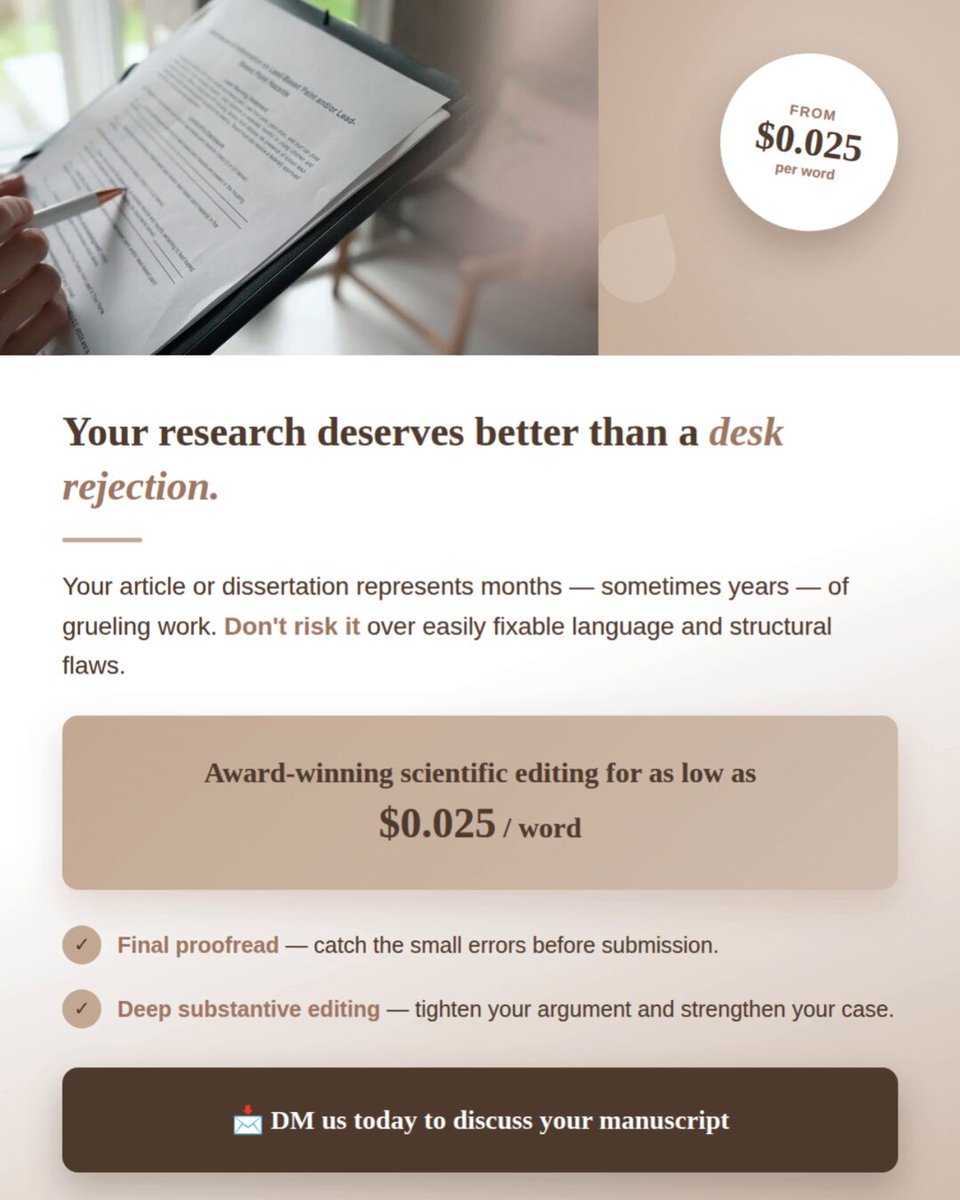
I am offering scientific writing and editing services for as low as $0.025/word only. Get in touch if you need assistance with proofreading/editing your dissertation or scientific research article!
81
19
211
47,685
Most researchers treat writing as the final step of a project. That’s why so many brilliant papers fail.
#AcademicPublishing #ResearchTips #ScientificWriting #PhDLife #ManuscriptPrep
1
50
May 17
Most researchers treat writing as the last step of research.
That's why so many great papers fail.
A thread on the most expensive mistake in academic publishing 🧵
1/ Writing isn't what happens after you finish your research. Writing is part of your research. And the moment you separate the two, you create a problem that no amount of editing can fully fix.
2/ Here's what I mean. When you run your study, collect your data, and analyse your results — and then sit down to write — you're not documenting a process anymore. You're reconstructing one. From memory. Under deadline. With a narrative gap you didn't even know existed.
3/ The gap looks like this: you made ten small methodological decisions over 18 months. Each one made sense at the time. But none of them were written down in a way that connects them into a coherent, defensible research story. Now you have to explain them all. In order. Convincingly.
4/ Reviewers can smell reconstruction. It shows up as vague justifications in your methods. As conclusions that feel slightly disconnected from your results. As an introduction that doesn't quite set up the study you actually ran.
5/ The researchers who publish consistently — and smoothly — don't write after they research. They write alongside it. They draft their rationale before they collect data. They revise their argument as the data shapes it.
6/ Writing isn't the packaging for your research. It's the thinking through your research. Treat it that way and your manuscript will reflect it. Treat it as an afterthought, and your reviewer will notice — even if they can't name exactly what's wrong.
That's the invisible cost nobody talks about.
— Emma Scott, PhD | Scientific Writing & Publishing Consultant
119
Apr 19
Most researchers think editors fix grammar.
They don't.
A great scientific editor fixes your argument — the logic, the flow, the gap between what your data shows and what your writing claims.
Grammar is the last 5 minutes of a 3-hour job.
You're hiring the wrong thing if you're only checking for typos.
— Emma Scott, PhD | Scientific Writing & Publishing Consultant
2
159
Apr 14
📄 Is your research getting rejected — not because of the science, but because of the writing?
Language quality and presentation are among the top reasons journal editors desk-reject manuscripts before they ever reach a peer reviewer. For researchers whose first language isn't English, the challenge is even greater.
siit.co just published a comprehensive guide on what to look for in a medical manuscript editing service — and which ones researchers are actually finding useful.
✅ What editor qualifications really matter
✅ The difference between proofreading and substantive editing
✅ How to evaluate turnaround time, confidentiality, and revision policies
✅ A breakdown of leading services including Editage, AJE, ManuscriptLab, Enago, and more
✅ Tips specifically for ESL researchers navigating English-language journals
Your findings deserve to be read. Don't let avoidable language issues stand between your work and publication.
🔗 Read the full guide here: siit.co/guestposts/best-medi…
#MedicalWriting #AcademicPublishing #ResearchTips #ManuscriptEditing #ScientificWriting #ESLResearchers #PeerReview
3
151
Apr 12
At ICLR 2026, one of the world's top AI conferences:
21% of peer reviews were fully AI-generated.Over half showed significant AI use.
Meanwhile editors are sending 30 invitations to find 2 willing reviewers.
The peer review system is under more strain than it has ever been.
Here's what this means for your manuscript 🧵
1
1
2
231
Apr 12
What a fatigued reviewer does with a paper that doesn't give them these things:
→ Reads the abstract, finds nothing compelling, moves toward desk rejection → Struggles through a dense introduction, arrives at the methods already skeptical → Reaches the discussion having lost confidence, looks for reasons to request major revision
The science didn't fail. The communication did.
1
86
Apr 12
The peer review crisis is not your fault.
But how you write in response to it — that part is entirely in your control.
I'm Dr. Emma Scott — scientific writing consultant, PhD.
I help researchers write manuscripts that work with the realities of peer review — not against them.
Follow for weekly insights that actually move the needle.
94
Apr 3
Unpopular opinion: most methods sections are written to impress reviewers, not to be reproducible.
Change my mind.
2
1
141
Apr 1
If you can't explain your research to a 10-year-old, who exactly are you writing that paper for?
#ScientificWriting #AcademicTwitter #PhDLife
1
1
2
153
Mar 31
Incompetent supervisors aren’t just "difficult"—they are career killers and a drain on scientific progress.
By prioritizing ego over evidence and micromanagement over mentorship, they drive elite talent out of the lab and into industry. When mediocre leadership gatekeeps the bench, science doesn't just slow down; it stagnates.
We need to stop rewarding seniority and start demanding actual leadership. Academia cannot survive on a diet of wasted potential and toxic bureaucracy.
#AcademicTwitter #Science #Leadership
1
96
Mar 30
A researcher once told me: "I just want my work to matter."
She had spent four years on a study about early childhood nutrition in low-income communities. The findings were important. The methodology was rigorous. The implications were real — the kind that could actually influence policy and change outcomes for thousands of families.
Her paper was published in an open-access journal. It was freely available to anyone in the world.
Eighteen months later, it had three citations. Two of them were her own follow-up work.
She came to me confused and discouraged. The work was out there. Why wasn't anyone finding it?
Here's what I told her — and what I wish every researcher understood before they submit:
Open access means your paper is visible. It does not mean your paper is readable.
There is a profound difference between a paper that is technically accessible and a paper that people actually want to read. And in 2026, with journal submission volumes up by as much as 50% in some disciplines, the competition for a reader's attention has never been fiercer.
The researchers whose work gets found, read, and cited are not always the ones doing the best science. They are the ones who:
✅ Write abstracts that make readers stop scrolling
✅ Use titles with the right keywords — the ones their audience actually searches
✅ Structure their arguments so the significance is impossible to miss
✅ Write discussions that connect findings to real-world implications clearly and compellingly
Open access changed who can find your paper. It did not change whether they will read it. That part is still entirely about how well it's written.
After working together on her writing and restructuring her abstract and title for a follow-up paper — that study had 47 citations within its first year.
Same researcher. Same quality of science. Completely different outcome.
Writing is not separate from impact. Writing IS impact.
Has your work ever felt invisible despite being published? Tell me in the comments — you're not alone. 👇
— Emma Scott, PhD | Scientific Writing & Publishing Consultant
103
Mar 29
Unpopular opinion from someone who edits scientific manuscripts for a living:
AI-polished papers are becoming easier to spot — not harder.
And journal editors are starting to talk about it.
Here's what I'm seeing on the ground
1
1
1
125
Mar 29
Use AI for what it's good at:
✅ Grammar and flow
✅ Reference formatting
✅ First-pass proofreading
Get a human expert for:
❌ Argument integrity
❌ Field-specific framing
❌ Reviewer-ready logic
Both. Not either/or.
1
60
Mar 29
I'm Dr. Emma Scott — scientific writing consultant, PhD.
I help researchers get published in top-tier journals by fixing not just the language, but the thinking behind it.
If this thread helped you, follow for more. I post weekly on academic writing, publishing, and the gap between good research and great papers.
74
Mar 29
Nobody tells PhD students this, but I will:
Your dissertation will be judged on how it READS — not just what it says.
Examiners are human. Dense, unclear writing creates doubt.
Clear, confident writing creates credibility.
Language IS part of your argument.
(Save this. You'll need it before your viva.)
1
3
98
Mar 28
Nobody tells PhD students this, but I will:
Your dissertation will be judged on how it READS — not just what it says.
Examiners are human. Dense, unclear writing creates doubt.
Clear, confident writing creates credibility.
Language IS part of your argument.
(Save this. You'll need it before your viva.)
1
1
108