
Decentralized cloud component protocol, aims to reduce the cost and technical complexity of building Web3 applications. endless.link/
Joined October 2024
- Tweets 449
- Following 75
- Followers 159,284
- Likes 678
114 Photos and videos












Pinned Tweet

17 Nov 2025
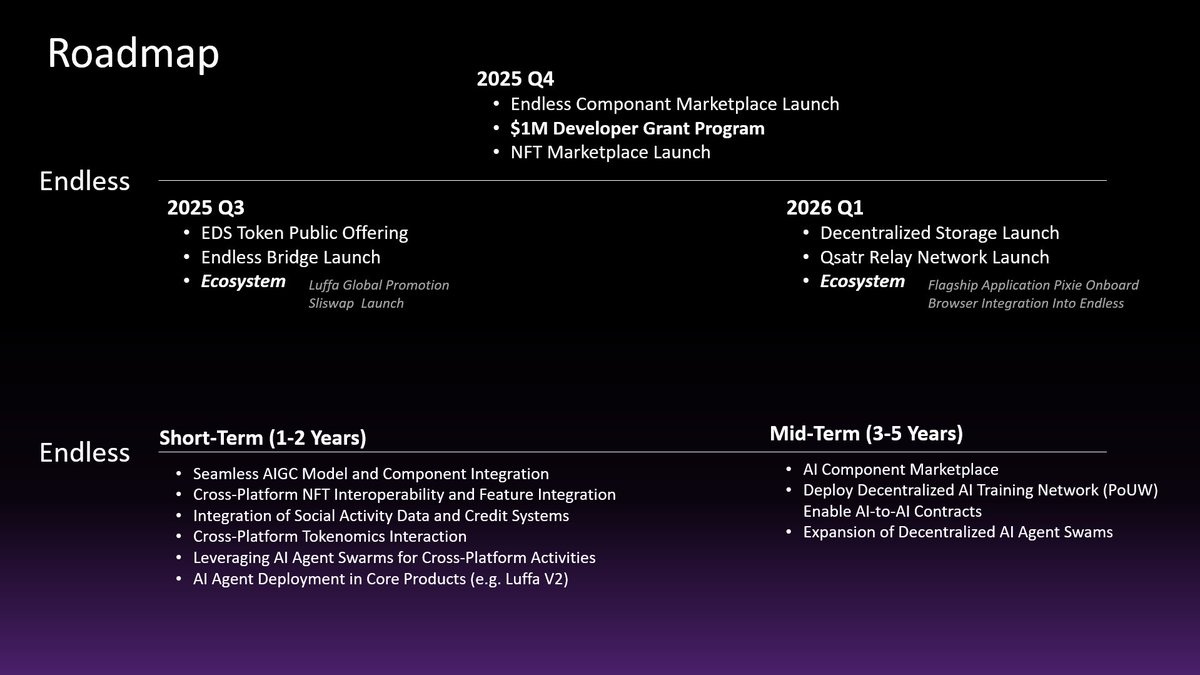
So, after the TGE, what does Endless plan to do?
Endless' Post-TGE Roadmap, covering Q4 2025, 2026, and beyond, is live!
We'll make it real, step by step.
105
85
395
63,992
Endless𒀭 retweeted

May 12
Most people focus on the apps a project builds.
Very few ask what those apps are built on.
@EndlessProtocol chose Move instead of Solidity, and that decision matters more than it seems.
Move was designed with digital assets in mind.
It treats assets as resources, which helps prevent issues like accidental copying or mishandling.
That creates a more structured way to build.
It’s also one of the reasons projects like Aptos Labs and Sui Foundation built around Move as well.
For Endless, this makes sense.
If the goal is to support modular apps, reusable components, and a larger ecosystem, the foundation needs to be secure.
People usually notice the frontend first.
But sometimes the most important decisions are made much deeper in the stack.
43
2
66
1,636
May 8
Built on the limitless infrastructure of Endless Protocol, the next era of AI-native Web3 feels less like mere technology… and more like an awakening. ⚡️
4
9
38
12,164

Powering the bridge between AI and Web3.
@EndlessProtocol is building the world’s first distributed cloud intelligence network; secure, scalable, and built for global innovation. 🌍
#Web3 #AI #EndlessProtocol

The future of finance is borderless......endless. 🌍
@EndlessProtocol is building an open, decentralized infrastructure that powers secure, blockchain-verified payments, liquidity, and innovation; without limits.
Join the movement redefining global finance.
Learn more: endless.link | Docs: docs.endless.link/endless | @EndlessProtocol | Discord: discord.gg/DFkd6pKnRz | t.me/EndlessProtocol
@EndlessProtocol
#DeFi #EndlessProtocol #Web3
2
14
1,154
Endless𒀭 retweeted

Apr 29
🚀Nessy’s new mint round 4 is coming up!
📅May 1
🕐1:00 PM UTC—GTD Round
🕓4:00 PM UTC – Lucky Round
📌Mint platform:goldust.io/collection/DyR…
⚠️Please prepare at least 201 EDS in advance for minting.
For how to obtain EDS and the full mint guide, please refer to this tweet👇
x.com/NessyNFT_xyz/s…
8
9
32
2,799
Endless𒀭 retweeted
Apr 28
Nessy May mint list is live.
docs.google.com/spreadsheets…
Final snapshot in 24 hours. After that, no more entries.
6
9
28
1,624
Apr 23
Facing some difficulties, but we are working to resolve them.
10
12
42
14,173
Endless𒀭 retweeted

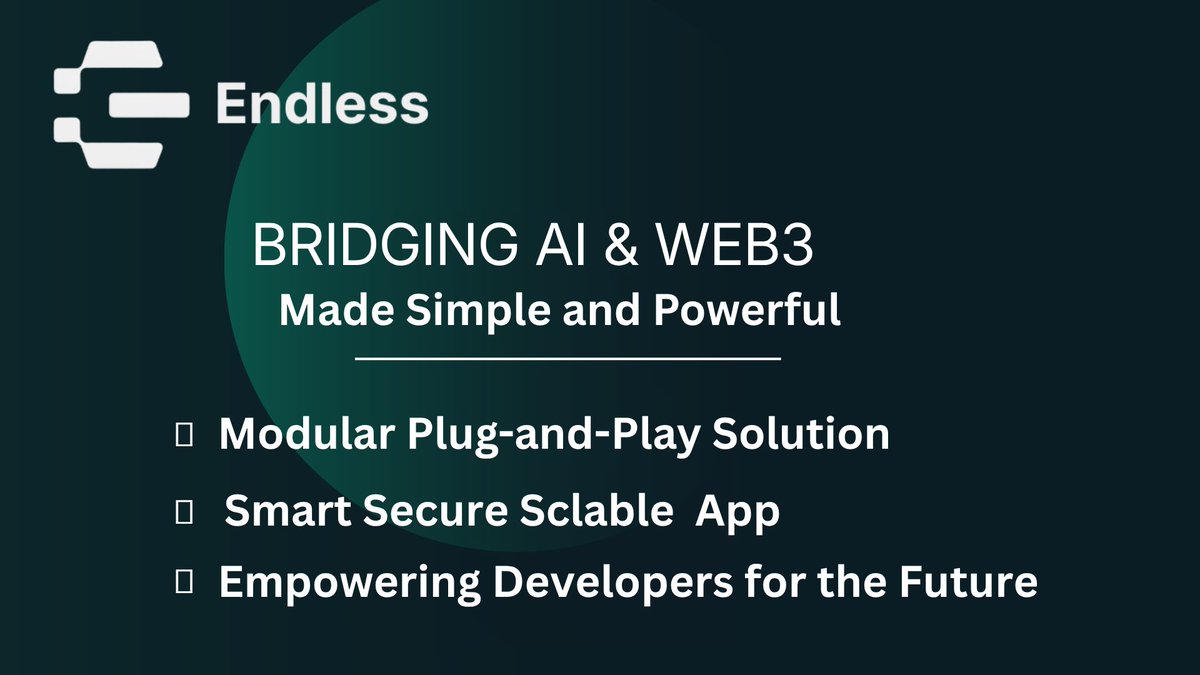
The digital landscape is shifting. The bridge between Artificial Intelligence (AI) and Web3 is no longer a luxury—it’s a necessity. Enter @EndlessProtocol (Web3 Genesis Cloud), the platform redefining how these two giants interact.
2
1
11
702
Apr 16
01100011 01101111 01101110 01110100 01101001 01101110 01110101 01100101 00100000 01100100 01100101 01110110 01100101 01101100 01101111 01110000 01101001 01101110 01100111
28
13
60
12,274
Apr 14
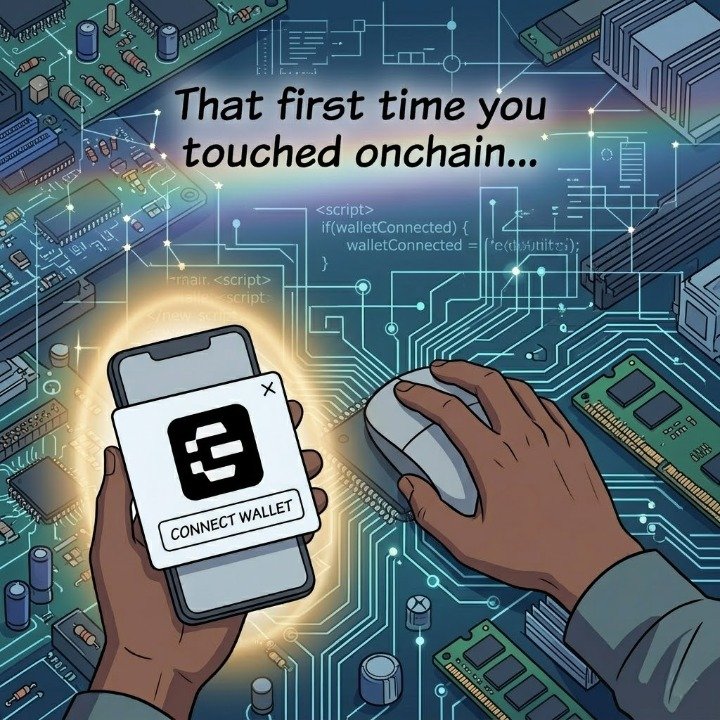
Let’s see how many people have already been quietly onchain, even if no one else knew about it.
Apr 14

GM, Endless fam!
Quick question that’s not about price, not about hype, and definitely not about airdrop grinding:
If you had to describe your Web3 journey so far as one tiny, onchain experiment, what would it be?
Not a “proud achievement,” not a big project just:
• Your first test‑faucet swap you never talked about.
• That tiny contract you deployed and left running.
• That NFT you minted that never went viral but still meant something to you.
This Is Not a “Show Off” Post
This is a “silent experiment” check‑in:
→ Some people’s first onchain experiment:
• “First time I sent ETH to a random contract out of curiosity.”
• “First time I used a wallet I didn’t fully understand.”
• “First time I just… watched a contract call and didn’t touch it.”
There’s no wrong answer.
The only rule: be real, not polished.
How This Connects to @EndlessProtocol
Endless works best when people:
• Actually try things.
• Are okay with tiny, imperfect experiments.
• Learn by doing, not by reading 100 whitepapers first.
So this post is really about:
• Normalizing the “quiet onchain lab.”
• Making Endless feel like a place where half‑formed ideas and tiny experiments are welcome, not judged.
Your Turn
Reply with:
1️⃣ One line describing your first tiny, silent onchain experiment.
2️⃣ One emoji that matches your vibe today: 🎮🤝💻🚀
Let’s see how many people have already been quietly onchain, even if no one else knew about it.
5
5
30
1,605
Apr 12
Empower users with greater autonomy, ensuring data privacy and security.
14
13
51
15,387
Endless𒀭 retweeted

Apr 6
Endless Protocol's Gas Subsidy Mechanism Explained
Web3 adoption has never been blocked by technology.
It’s blocked by transaction friction.
Before a new user can even try a dApp, they must:
buy a token
understand gas fees
manage wallets
approve transactions
risk losing money on failure
For most people, that’s already too much.
@EndlessProtocol introduces a Gas Subsidy Mechanism designed to remove this barrier entirely.
1️⃣ The Problem: Gas Turns Users Into Operators
Traditional blockchain interaction assumes every user is responsible for infrastructure costs.
Every action requires gas.
This creates three major issues:
• Onboarding Friction, users cannot interact without first acquiring tokens
• Cognitive Overload, people must understand fees before understanding value
• Adoption Ceiling, only crypto-native users stay
Web2 succeeded because infrastructure costs were hidden from users.
Web3 has struggled because infrastructure costs are exposed.
2️⃣ Endless Protocol’s Core Idea
Endless separates interaction from payment responsibility.
Instead of users paying gas directly:
👉 Applications or protocols can sponsor transactions.
This means:
users can interact immediately
no native token requirement
no gas management knowledge needed
Blockchain execution still happens, but complexity disappears from the user experience.
3️⃣ How the Gas Subsidy Mechanism Works
Step 1
User Intent
A user performs an action inside an application.
Example:
mint asset
sign data
interact with AI agent
execute transaction
No gas preparation required.
Step 2
Sponsored Execution
The application submits the transaction through Endless infrastructure and covers the gas cost.
The user focuses only on intent, not execution mechanics.
Step 3
Endless API Layer
Endless handles:
transaction routing
validation
execution coordination
settlement management
Developers gain programmable control over transaction economics.
Step 4
On-Chain Finalization
Transaction completes on-chain normally.
But to the user:
👉 it feels like using a standard internet application.
4️⃣ Why This Is More Than UX Improvement
Gas subsidy changes Web3 design philosophy.
Instead of optimizing for traders and power users, builders can now design for:
social applications
gaming ecosystems
AI-driven apps
enterprise onboarding
mass consumer products
Endless turns blockchain into background infrastructure rather than a visible hurdle.
5️⃣ The Economic Shift
Most protocols try to reduce gas fees.
Endless introduces something deeper:
programmable transaction economics.
Developers decide:
when users pay
when apps subsidize growth
when onboarding becomes free
how participation incentives work
Gas stops being a limitation and becomes a strategic tool.
6️⃣ Why It Matters for Web3 Adoption
Mass adoption happens when:
✅ users don’t need crypto before using crypto
✅ interaction feels familiar
✅ infrastructure becomes invisible
The Gas Subsidy Mechanism pushes Web3 closer to the cloud computing model:
Users consume applications.
Infrastructure operates silently underneat
Web3 didn’t fail because decentralization was hard.
It struggled because using it felt expensive and complicated.
Endless Protocol’s gas subsidy approach removes that psychological barrier.
Not by changing blockchain rules
Apr 4

Asset Standards: Unified FT DA in Practice
Web3 created thousands of tokens.
But almost every asset still behaves the same way:
transfer, trade and speculate.
@EndlessProtocol introduces something deeper:
Unified Asset Standards FT DA working together.
This changes how digital assets are designed.
The Problem With Traditional Token Standards
Today’s Web3 assets are fragmented by design.
ERC-20 → fungible tokens
ERC-721 → NFTs
ERC-1155 → semi-fungible assets
Each standard solves one use case but creates new complexity.
Developers must decide in advance what an asset will be.
Money?
Identity?
Access pass?
Credential?
Reality isn’t that simple.
Assets evolve.
Endless Approach: FT DA Unified
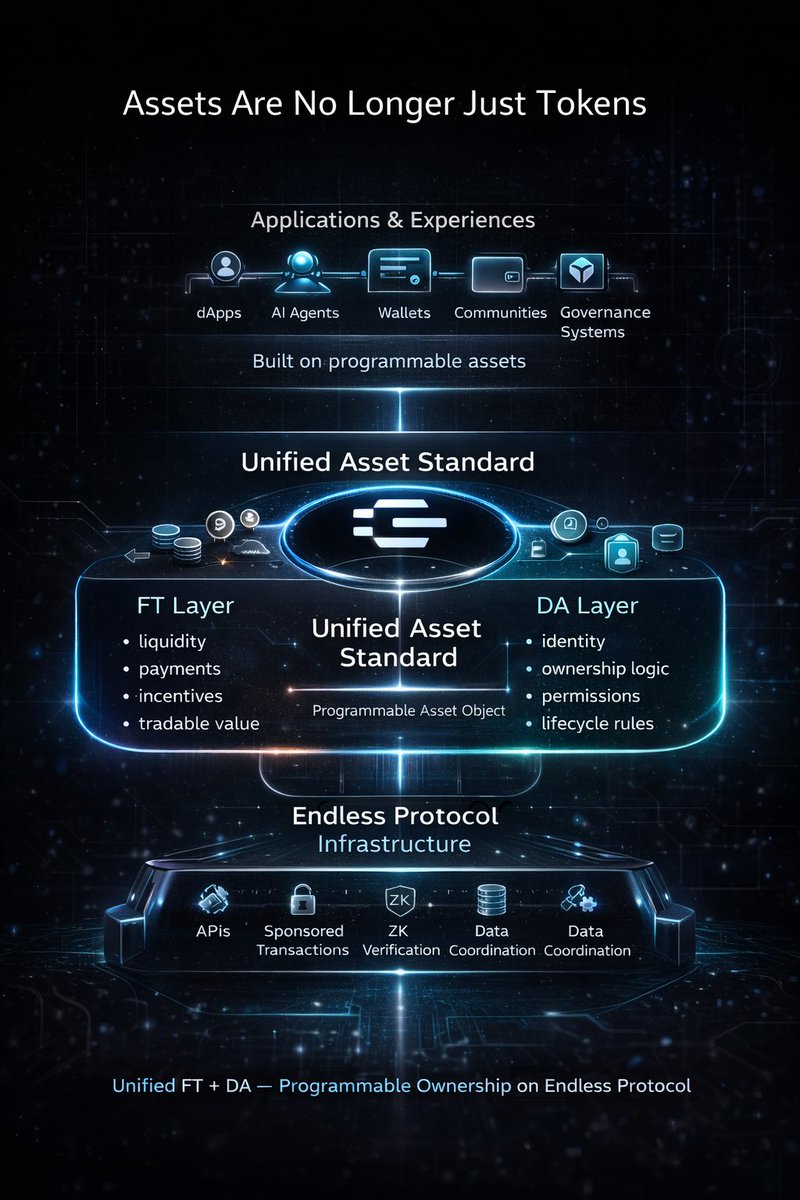
Endless treats assets as programmable objects rather than fixed token types.
Two core components appear in the architecture:
FT (Fungible Token layer)
Handles value, liquidity, payments, incentives.
DA (Digital Asset layer)
Handles identity, ownership logic, permissions, metadata, and lifecycle rules.
Instead of separate contracts, one asset can carry both economic value and contextual meaning.
Practical Example 1 Creator Token
Imagine launching a creator economy asset.
FT Side
• tradable community token
• used for tipping or access payments
• distributed to supporters
DA Side
• stores creator reputation history
• unlocks gated content rights
• tracks participation milestones
The asset isn’t just money.
It becomes a living relationship between creator and community.
Practical Example 2 Soulbound Contributor NFT
Using Endless standards:
A contributor joins an ecosystem.
The DA component:
• binds identity to contribution history
• non-transferable (soulbound logic)
• records governance participation
The FT component:
• accumulates reward value over time
• enables incentive distribution without issuing new tokens
One asset.
Two dimensions:
identity economics.
Why This Matters
Most Web3 systems separate:
value systems
identity systems
access systems
Endless merges them.
This enables assets that can:
• start as credentials
• evolve into economic assets
• become governance primitives later
Assets stop being static tokens.
They become programmable participation objects.
Web3’s next phase won’t be defined by new chains.
It will be defined by better asset standards.
And Unified FT DA might be one of the most underrated architectural upgrades inside Endless Protocol.
3
3
19
1,341
Endless𒀭 retweeted

You’ll see people say “gEND” and think it’s just another greeting…
But it’s more than that.
In @EndlessProtocol, gEND isn’t just “good morning”, it’s a signal. A way of showing up. A quiet nod that says I’m part of this.
Simple word. Strong meaning.
It reflects a community that’s growing, building, and creating its own identity, one small detail at a time.
And honestly, it feels good to be part of something where even the slang carries meaning.
Because in Web3, culture is everything.
It’s not just about the tech, the tokens, or the headlines, it’s about the people. The consistency. The little things that bring everyone together daily.
And that’s what gEND represents.
You wake up, drop a “gEND,” and instantly you’re connected, to builders, creators, and believers who are all on the same journey. Different locations, different backgrounds, but one shared direction.
That kind of connection can’t be forced. It grows naturally.
Over time, it becomes routine… then identity.
Moments like this are what turn communities into ecosystems.
Not just users, but people who actually care, contribute, and stay.
So yeah, it may look small from the outside.
But from within, it means a lot.
gEND ☕️🔥
3
2
12
991