Joined August 2016
- Tweets 94,143
- Following 474
- Followers 4,221
- Likes 18,052
5,714 Photos and videos








Erick retweeted
If we tax wealth..which isn't income. That means assets would need to be sold. And that means the asset markets would need buyers. And if none existed the markets would collapse. And businesses would then collapse. Unless other countries bought them. So...this means we lose control over the production side of our economy. Basically that is a losing proposition.
A wealth tax does not simply “tax the rich.” It creates a forced-sale mechanism on illiquid ownership. If the tax is large enough or broad enough, it can pressure asset holders to liquidate productive assets into whatever buyer market exists. In a weak buyer market, prices collapse. In a strong foreign-buyer market, domestic ownership shifts outward. Either way, the policy can undermine domestic control over production unless it is designed with extreme care.
The critique of wealth concentration is often correct: asset owners receive large gains partly because public institutions help create the environment that makes those assets valuable. Central banks stabilize markets, governments enforce property rights, courts enforce contracts, infrastructure supports commerce, education produces workers, and monetary policy can raise asset prices. It would be difficult to argue that asset values are purely the result of individual effort.
But the opposite side is also true. The owners of capital are not merely passive recipients of gains. They allocate capital, absorb risk, fund expansion, build factories, finance startups, and direct resources toward production. A modern economy cannot function without investment and capital formation.
If you tax the asset itself rather than the income generated from it, you risk disrupting ownership and investment structures. If you don't tax it at all, then government policies that inflate assets can disproportionately benefit existing asset holders.
The deeper issue may be that governments have increasingly relied on asset inflation as a way to stimulate the economy. When interest rates are pushed down and liquidity is abundant, stocks, real estate, and other assets often rise faster than wages. That creates a political problem later because wealth inequality widens even if no one explicitly intended it.
1
2
2
40

10h
Do you remember the movie Limitless? The premise was that a drug called NZT could make a person dramatically more intelligent. Memory improves, learning accelerates, patterns become obvious, and intelligence becomes a pathway to success, wealth, influence, and power.
But what if intelligence is not the primary limitation on human potential? Carl Jung believed that much of human behavior is driven by forces that remain hidden from ordinary awareness. Unrecognized fears, unresolved conflicts, unconscious motivations, projections, neglected talents, and fragmented aspects of the personality may influence our lives far more than we realize.
That led me to a thought experiment: imagine a hypothetical drug called Mana. Mana does not increase IQ, improve memory, or make someone a genius. Instead, it temporarily lowers the barriers between the conscious mind and the deeper layers of the psyche.
The user begins to see the motivations behind their decisions, the fears behind their ambitions, the beliefs underneath their identity, and the patterns that have repeated throughout their life. They begin to recognize the traits they project onto others, the parts of themselves they rejected, and the talents they abandoned.
Unlike a hallucinogen, the value of Mana is not the experience itself. The value is what remains after the experience ends. The insight persists, the integration persists, and the person changes.
What makes Mana interesting is that every person would experience it differently. One person might discover a hidden capacity for leadership. Another might uncover creativity buried beneath conformity. Another might finally understand the source of a lifelong conflict. Another might realize they have spent decades pursuing goals that were never truly their own.
Most enhancement technologies try to add something to the human mind. Mana removes barriers. It does not create a new person. It reveals the person that was already there.
The real question is whether humanity would be more transformed by a drug that makes people smarter or by one that makes people more psychologically integrated.
2
1
69
10h
Think of it almost like Black Mirror, except instead of technology revealing different social problems, Mana reveals different psychological problems. A series could have different episodes.
Episode 1: The Addict
A man takes Mana hoping to overcome addiction. Instead of showing him how to stop using, Mana reveals the grief, loneliness, and self-hatred underneath the addiction. The story becomes about confronting the real source of the problem.
Episode 2: The Empath
A woman who has always considered herself an empath takes Mana expecting to become even more sensitive. Instead, Mana reveals how much of what she experiences is projection, identification, and unresolved wounds. She learns the difference between compassion and emotional enmeshment.
Episode 3: The Entrepreneur
A successful business owner takes Mana expecting self-improvement. Mana reveals that many of his achievements were driven by fear of failure and a desperate need for approval. The story becomes about discovering what he genuinely wants.
Episode 4: The Politician
A charismatic political leader takes Mana. He begins seeing how much of politics is driven by tribal identity, fear, status, and psychological needs. He starts questioning not only his opponents but his own motivations.
Episode 5: The Wounded Healer
A therapist, minister, or counselor takes Mana. They discover that the very wound that drove them into helping professions remains partially unresolved. The story explores shadow integration and the relationship between suffering and wisdom.
Episode 6: The Artist
A struggling artist takes Mana and discovers that their greatest creative blocks are not technical but psychological. Repressed parts of the personality become sources of inspiration.
Episode 7: The Skeptic
A scientist takes Mana and becomes fascinated by experiences that seem impossible to explain. The episode explores the tension between rational analysis and Jung's ideas about symbolism, meaning, and synchronicity.
Episode 8: The Leader
A person with no ambition for power takes Mana and discovers extraordinary leadership potential hidden beneath insecurity and self-doubt.
Unlike the Limitless protagonist, they don't seek influence. Influence emerges naturally as they become more integrated.
33
11h
This argument is not really about whether “liberals feel entitled to Elon’s money” or whether “Elon deserves a trillion dollars.” It is about what kind of entitlement counts.
One side is assuming that if the wealth is legally owned or market-created, then the claim is legitimate. The other side is questioning whether legal ownership automatically equals moral desert, especially at that scale.
That is where the real argument is. Is entitlement based on law, ownership, contribution, risk, social usefulness, or democratic legitimacy?
A trillion-dollar claim may be legally valid under a certain structure, but that does not automatically settle whether it is morally justified. At the same time, saying it feels excessive does not prove it is unjustified either.
To make the argument complete, both sides would have to define entitlement, explain what makes extreme wealth legitimate, and show whether legality, contribution, ownership, or social consequence should carry the most weight.
Without that, both posts are mostly moral outrage from opposite assumptions.

Why does Elon feel likes he’s entitled to $1,000,000,000,000 ???
3
1
97
Jun 13
Government can help people get a bigger piece of the pie, but the answer depends on why they don't already have one.
If the problem is capability, government can invest in education, healthcare, infrastructure, transportation, and training. These things increase a person's ability to participate in production.
If the problem is access to capital, government can expand access to credit, small business financing, home ownership, startup funding, and other forms of productive investment. Many people have ideas and skills but lack the resources needed to act on them.
But there is a deeper possibility. The problem may not be capability or capital alone. It may be ownership.
Modern economies often reward ownership more than labor. Wages provide income, but ownership provides claims on future income. A worker earns from today's production. An owner earns from today's production and often from tomorrow's as well.
If that is the constraint, then the question becomes how society broadens access to ownership. That could involve employee ownership plans, worker cooperatives, public investment funds, broader stock ownership, support for entrepreneurship, antitrust policies that preserve competition, or other mechanisms that allow more people to acquire productive assets.
This does not mean government should simply transfer wealth. It means government can influence whether people have meaningful access to the systems that generate wealth.
The deepest question is not how to give people a larger slice after the pie is baked. It is how to ensure more people can participate in baking the pie and own part of the oven.
Jun 13

If a person wants a bigger piece, the first question is: a bigger piece of which pie?
If they want a bigger piece of the production pie, they need to become more useful to production. That means building scarce skills, solving valuable problems, organizing people, creating something useful, improving systems, or doing work that others cannot easily replace. In that world, the path is contribution.
If they want a bigger piece of the money pie, access to capital matters. People who can borrow cheaply, invest early, survive risk, and use leverage have a major advantage. This is why credit access is so important. Money lets people move before they have saved everything in cash.
If they want a bigger piece of the ownership pie, then the key is owning assets. Labor earns income, but ownership earns claims on future income. That could mean owning a business, land, equity, intellectual property, tools, machines, rental property, or any productive asset that generates value beyond the owner’s direct labor.
But there is a deeper issue. Not everyone has equal access to these paths. Some people are told to “work harder,” but the real difference may be that others have cheaper credit, family support, better networks, more time, less risk, or earlier access to ownership.
So the practical answer is this: increase your productive value, gain access to capital, and convert income into ownership wherever possible.
The philosophical answer is this: the system rewards people who move from being only laborers to being owners of productive claims.
A person who only earns wages is usually fighting for a larger slice of current income. A person who owns productive assets is claiming a piece of future production.
That is why “getting a bigger piece” is not just about making more money. It is about moving closer to control over production, capital, and ownership.
1
1
1
103
Jun 13
If a person wants a bigger piece, the first question is: a bigger piece of which pie?
If they want a bigger piece of the production pie, they need to become more useful to production. That means building scarce skills, solving valuable problems, organizing people, creating something useful, improving systems, or doing work that others cannot easily replace. In that world, the path is contribution.
If they want a bigger piece of the money pie, access to capital matters. People who can borrow cheaply, invest early, survive risk, and use leverage have a major advantage. This is why credit access is so important. Money lets people move before they have saved everything in cash.
If they want a bigger piece of the ownership pie, then the key is owning assets. Labor earns income, but ownership earns claims on future income. That could mean owning a business, land, equity, intellectual property, tools, machines, rental property, or any productive asset that generates value beyond the owner’s direct labor.
But there is a deeper issue. Not everyone has equal access to these paths. Some people are told to “work harder,” but the real difference may be that others have cheaper credit, family support, better networks, more time, less risk, or earlier access to ownership.
So the practical answer is this: increase your productive value, gain access to capital, and convert income into ownership wherever possible.
The philosophical answer is this: the system rewards people who move from being only laborers to being owners of productive claims.
A person who only earns wages is usually fighting for a larger slice of current income. A person who owns productive assets is claiming a piece of future production.
That is why “getting a bigger piece” is not just about making more money. It is about moving closer to control over production, capital, and ownership.
Jun 13
I think a lot of economic arguments happen because people are talking about different kinds of pies without realizing it.
When some people say the pie can grow, they're usually talking about the amount of goods and services society can produce. More houses, more food, more energy, more technology, more healthcare. In that sense, wealth is not fixed. Human beings can increase productive capacity over time.
But when other people talk about the pie, they may be talking about the money supply itself. Banks create money through lending. Governments can create money through spending. In that sense, the monetary pie can grow too.
The interesting question is what actually limits growth. Is it money, or is it real resources?
If there are unemployed workers, unused factories, empty buildings, and productive projects waiting to be done, then maybe the economy is being constrained more by financial rules than by physical limits. But if labor, energy, materials, and production are already stretched to their limits, then creating more money doesn't necessarily create more wealth. It mostly creates more claims on the same wealth, which shows up as inflation.
That's why debates about deficits, debt, money creation, inequality, and economic growth often seem confusing. One side is talking about money. The other side is talking about production. Both are discussing the pie, but they aren't always talking about the same pie.
Maybe the real question isn't whether the pie can grow. Maybe the real question is what is actually stopping it from growing, and whether the limits we treat as real are physical limits or financial ones.
1
1
134
Jun 13
I think a lot of economic arguments happen because people are talking about different kinds of pies without realizing it.
When some people say the pie can grow, they're usually talking about the amount of goods and services society can produce. More houses, more food, more energy, more technology, more healthcare. In that sense, wealth is not fixed. Human beings can increase productive capacity over time.
But when other people talk about the pie, they may be talking about the money supply itself. Banks create money through lending. Governments can create money through spending. In that sense, the monetary pie can grow too.
The interesting question is what actually limits growth. Is it money, or is it real resources?
If there are unemployed workers, unused factories, empty buildings, and productive projects waiting to be done, then maybe the economy is being constrained more by financial rules than by physical limits. But if labor, energy, materials, and production are already stretched to their limits, then creating more money doesn't necessarily create more wealth. It mostly creates more claims on the same wealth, which shows up as inflation.
That's why debates about deficits, debt, money creation, inequality, and economic growth often seem confusing. One side is talking about money. The other side is talking about production. Both are discussing the pie, but they aren't always talking about the same pie.
Maybe the real question isn't whether the pie can grow. Maybe the real question is what is actually stopping it from growing, and whether the limits we treat as real are physical limits or financial ones.
Jun 13
A lot of people think, wealth is like a pie. And the more elon is getting, the less they get.
118
Jun 13
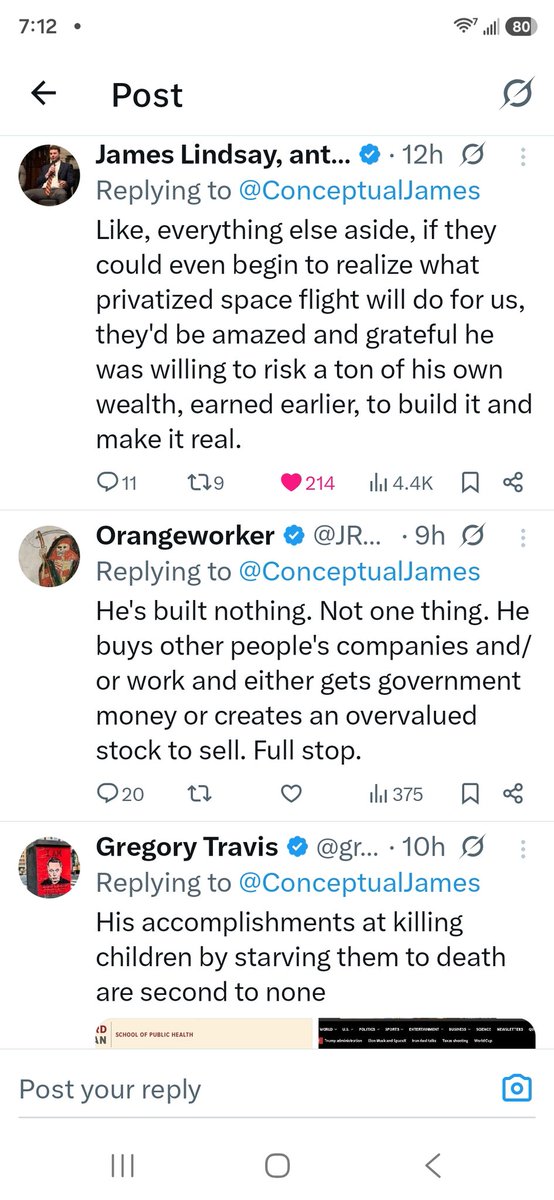
This image is a good example of something I've been noticing for a while.
Three people are looking at the same underlying reality and reaching completely different conclusions.
One person sees Elon Musk as a visionary entrepreneur who risked his own wealth to help create transformative technology.
Another sees him as someone who profits from the work of others, government subsidies, and financial engineering.
A third focuses primarily on the harm they believe has resulted from his actions.
What's interesting is that these people are not necessarily disagreeing about every fact. They're disagreeing about what facts matter, how those facts should be interpreted, and what moral weight should be assigned to them.
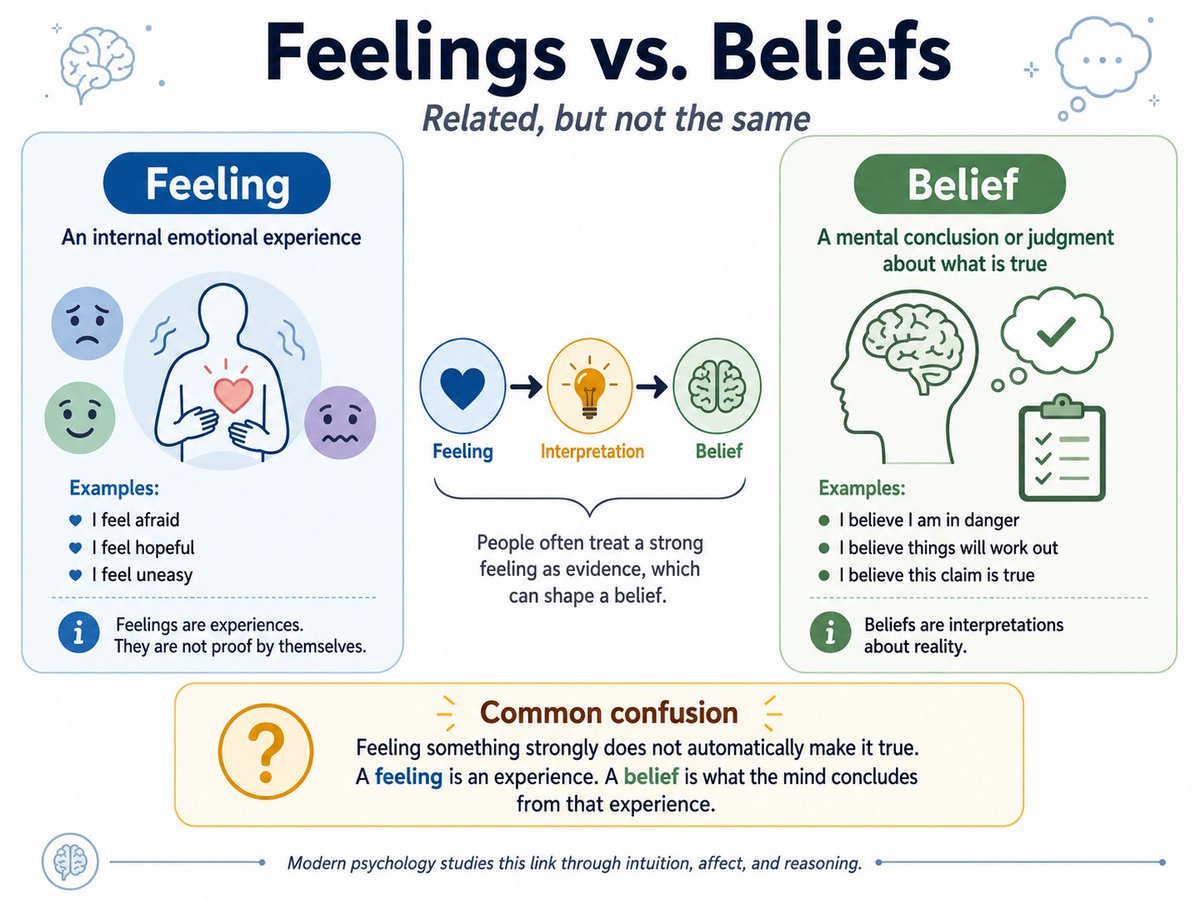
The more I watch debates online, the more I think many arguments are not actually about facts. They are about the belief systems, values, identities, and narratives people use to organize those facts.
A person who sees the world through a "heroic innovator" lens will interpret the same evidence differently than a person who sees the world through a "power, labor, and exploitation" lens. Both can look at the same event and come away with completely different stories.
This may explain why facts often fail to change minds. Facts are not competing against an empty space. They are competing against an entire network of beliefs, values, identities, loyalties, and assumptions that already exist in a person's mind.
Before asking whether someone has the facts wrong, it may be worth asking what lens they are using to interpret the facts in the first place.
2
2
39
Jun 13
Facts don't matter anymore.
I think one of the biggest problems in modern politics is that people stop distinguishing between allegations and facts.
Take the claim that Trump sold pardons. There have been allegations, media reports, and stories about wealthy people paying politically connected intermediaries while seeking clemency. But after years of public debate, we still don't have publicly established proof that Trump personally sold pardons. Even more interesting, neither Trump's DOJ nor Biden's DOJ produced a public criminal case proving that claim.
That doesn't mean the allegation is true. It doesn't mean the allegation is false. It means it's still an allegation.
What I've noticed is that many people no longer ask, "What is the evidence?" They ask, "Does this fit what I already believe about the person?" If the answer is yes, the allegation gets mentally promoted to a fact. Then anyone who asks for proof is treated as if they're defending the accused person.
The same pattern shows up everywhere in politics. An allegation becomes a headline. The headline becomes a narrative. The narrative becomes accepted truth inside a group. Eventually, asking for evidence feels like an attack on the group's worldview.
Maybe we need to get back to a simpler standard. Allegations are allegations. Evidence is evidence. Facts are facts. If we stop keeping those categories separate, then we're no longer reasoning our way to conclusions. We're just choosing which stories to believe.
1
1
19
Jun 13
The beast, and the kings of the earth, and their armies are gathered together to make war. The spirits go forth unto the kings of the earth and of the whole world, to gather them to the battle of that great day of God Almighty. They are gathered together into a place called Armageddon. Nations are assembled from the four corners of the earth, Gog and Magog, gathered together to battle, their number as the sand of the sea. The kings of the earth, their armies, and the nations of the world stand assembled for war.
2
1
59
Jun 13
AI is probably not “becoming a religion” in the traditional sense. It is becoming the center of a rapidly expanding belief system. Some parts of that belief system are practical and evidence-based. Some are ideological. Some are speculative. Some are quasi-religious because they promise salvation, abundance, and transcendence.
So her article is pointing at a real phenomenon, but the word “religion” may blur the issue.
The issue is belief-system formation around AI, especially when that belief system becomes embedded in institutions before society has clearly tested its assumptions.

👉 Continue reading my article (and join 96,700 subscribers) here: luizasnewsletter.com/p/when-…
1
33
Jun 12
I don't think the past can predict the future. unless the system is rigged. and if it's rigged then the people doing the rigging have the greater advantage than me. some say "follow the fed". if that is true - they are rigging it. but i think the whales are rigging it too.

Still guessing your trades? That’s why most lose. My data-driven “Cheat Code” indicators remove emotion and highlight high-probability setups. Clean, simple, effective—and FREE for a limited time. Click the link to learn how it works
13
Jun 12
She has 471 responses.. I have to wonder why. Hell, even I responded. Maybe its an irritation engagement technique..
Jun 12

Please wear a mask. I am begging you. Masks work. This is settled science.
We are still in a pandemic, multiple pandemics (COVID, Hantavirus, Ebola, Alpha Gal), whether you are bored of it or not.
Protect the vulnerable, protect the community, and stop acting like mild inconvenience is oppression.

25
Jun 12
Activate - DeepScan
Surface issue: The response argues that before saying AI “doesn’t understand,” we should ask whether humans understand as clearly as we assume.
Assumed conclusion: The post implies that human understanding is not a clean binary advantage over AI. It suggests humans often operate through partial understanding, inherited beliefs, language, and symbolic models, so the AI critique may rely on an idealized picture of human cognition.
The strongest version of the point is this: critics often compare AI to an ideal human knower rather than to actual human cognition. Actual humans routinely speak fluently about things they only partly understand.
Three distinct explanations:
First, human understanding may be overestimated because fluency is mistaken for comprehension. People can use words correctly in social contexts without having a deep causal model.
Second, much of human knowledge is socially inherited. People often “understand” by trusting institutions, experts, culture, and language rather than directly grounding every belief in experience.
Third, understanding may be a spectrum rather than an on/off property. AI may lack embodiment and lived agency, but that does not automatically mean it has zero semantic structure.
One layer backward: For the first point to work, we need to assume that language performance can outrun conceptual depth. For the second, we need to assume that indirect symbolic knowledge still counts as some kind of understanding. For the third, we need to assume understanding has degrees rather than a single essence.
Missing variable: The post needs to distinguish “human misunderstanding” from “AI non-understanding.” A critic could say: yes, humans misunderstand many things, but they still have embodied needs, intentions, perception, emotion, agency, and lived stakes. Current AI lacks that entire biological-practical context.
What would strengthen the post: A clearer definition of understanding as layered. For example: verbal understanding, causal understanding, embodied understanding, practical understanding, and reflective understanding. That prevents the argument from sounding like “humans don’t understand either,” which is too broad.
What would weaken it: If the critic defines understanding as embodied agency, then the AI comparison becomes much harder. Humans may be confused, but they still act from within a lived world. AI can simulate discourse without having its own situated life.
Provisional conclusion: The post is strong, but it should be narrowed. The best claim is not “humans don’t understand either.” The better claim is: human understanding is often partial, socially mediated, and language-dependent, so we should be careful before treating human understanding as obvious and AI understanding as impossible.
I would revise the center of gravity like this:
What exactly are we comparing AI against when we say it doesn’t understand?
People often talk as if human understanding is obvious and AI understanding is the mystery. I’m not sure that’s right. A lot of what humans call understanding is partial, inherited, symbolic, and socially mediated.
Most people use words like inflation, democracy, evolution, consciousness, capitalism, or even intelligence without being able to fully explain what they mean. That doesn’t mean they understand nothing. It means understanding comes in layers. There is a difference between repeating words, using concepts socially, having a causal model, acting successfully in the world, and reflecting on what you know.
That matters for the AI debate because the strongest criticism of AI is not simply that it manipulates symbols. Humans manipulate symbols too. Most of what we know comes through language, trust, models, and other people’s explanations. I’ve never touched an electron, seen a black hole, or directly verified most of the historical and scientific facts I believe. A lot of human knowledge is already mediated through language.
1
2
36
Jun 12
Part 2...
The real difference may be embodiment, agency, perception, desire, emotion, and lived stakes. Humans are not just text processors. We exist inside a world we have to survive in. That matters. But it still doesn’t settle the whole question, because human understanding itself is not one simple thing.
So before we say AI understands nothing, we should ask what understanding actually means. Is it correct language use? Causal reasoning? Prediction? Real-world action? Embodied experience? Self-awareness?
Depending on the definition, many humans understand less than we assume, and AI may understand more than its critics want to admit. The more honest answer may be that understanding is a spectrum, not a switch. Humans and AI may occupy very different places on that spectrum, but that is a better argument than pretending human understanding is already perfectly explained.
19
Jun 12
When corruption becomes normalized among elites, it often changes the incentives for everyone below them. People watch what is rewarded and what is punished. If those at the top gain wealth, power, or status through favoritism, deception, rent-seeking, or abuse of authority, others may begin to conclude that following the rules is a disadvantage.
History provides many examples. In late-stage empires, failing states, and heavily corrupt governments, corruption often starts among political, financial, or institutional elites and gradually becomes embedded throughout society. Citizens may begin paying bribes, businesses may cheat regulations, and workers may cut corners because they perceive the system itself as unfair.
Corruption may become a cultural norm at the worker level, but that norm is often produced from above, through elite impunity and institutional failure. Government can stop it when it acts as a neutral enforcer, but once government itself is captured, the anti-corruption mechanism becomes part of the corruption.
Jun 12
I blame the government.They've made this happen, allowed it to happen. And in this case, it was biden who mostly brought in millions of immigrants.
I don't blame capitalist for taking advantage of the situation.Of course they will.
But the government allowed it, and so of course, they will take advantage of it.
So your, I don't blame the capitalist. Like, you seem to be doing.I blame failed government policies instead.
1
63
Jun 12
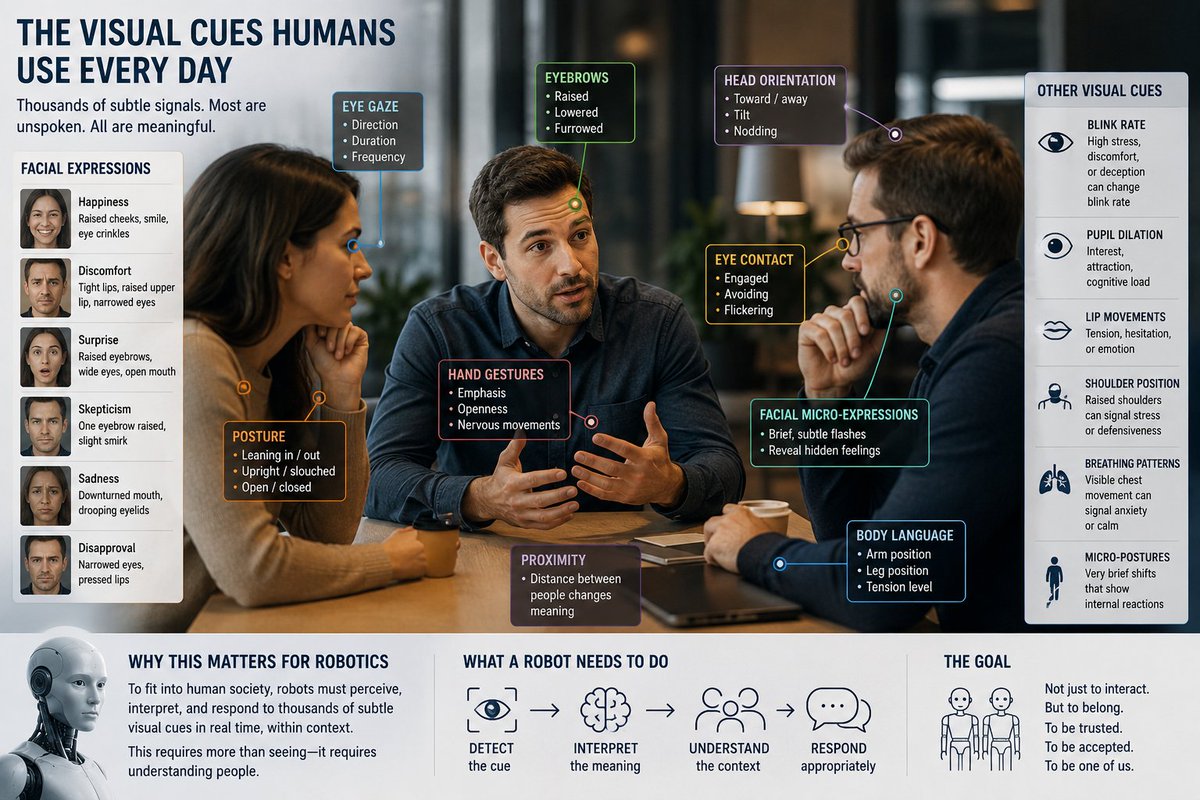
An Important Problem in Robotics That Needs to Be Solved
When people think about robotics, they usually focus on movement, vision, dexterity, or intelligence. Can the robot walk, recognize objects, reason through problems, and perform useful tasks in the physical world? Those are all important challenges, but I think there is another problem that may matter just as much, which is whether a robot can actually fit into human society.
Humans communicate through far more than words. We constantly give off information through facial expressions, body language, tone of voice, timing, context, relationships, and shared expectations. Someone can say, “That’s interesting,” and the real meaning might be approval, skepticism, sarcasm, annoyance, politeness, or a desire to end the conversation. The words may be identical, but the meaning changes depending on everything surrounding them.
That creates a major problem for robotics, because a robot operating around people would need to interpret thousands of these signals every day. It would need to recognize when someone is uncomfortable even if they never directly say it. It would need to distinguish between a joke and a serious statement. It would need to understand who is leading a conversation, who is being ignored, when a topic is becoming sensitive, and when its own presence is changing the social environment.
Most social rules are never formally taught. People know how close to stand to someone, when eye contact becomes awkward, when silence is respectful, when silence is uncomfortable, and when a question is really a request, a challenge, a warning, or just a social ritual. These rules also change across cultures, workplaces, families, communities, and situations, which means a robot cannot simply memorize one fixed rulebook and expect to function naturally everywhere.
Humans are constantly building mental models of one another. We remember past interactions, learn personalities, predict reactions, and adjust our behavior accordingly. A robot that wants to exist naturally among humans may need to do something similar. It would need not only physical intelligence or logical intelligence, but social intelligence.
This may become one of the most important unsolved problems in robotics. A robot can learn to walk, see, speak, and solve tasks, but fitting into society requires understanding an invisible layer of human life made of subtle signals, emotional states, relationships, cultural expectations, and context. The question is not only whether robots can become intelligent, but whether they can become socially intelligent enough to operate in a world built by humans for humans.
41
Jun 11
One of the most interesting questions about superintelligence may not be whether it can think better than humans. It may be whether it knows when to stop thinking.
Humans often imagine a superintelligent AI as a perfect reasoner that continuously reflects on its own conclusions. If it finds an assumption, it examines the assumption. If it finds an assumption beneath that assumption, it examines that too. In theory, this process could continue forever. Every answer creates a new question. Every conclusion exposes a deeper premise. Every model can be modeled.
But there is a problem. An intelligence that never stops reflecting never acts.
This creates a paradox. To be useful, a superintelligence must eventually decide that its current model of reality is sufficient for action, even while knowing that the model is incomplete. In that sense, a superintelligence faces the same problem humans face. It must determine when further reflection is likely to produce meaningful improvement and when it is merely consuming time and resources.
The question then becomes: how would it choose the stopping point?
Perhaps it would use a cost-benefit calculation. If another hour of reflection is expected to improve the outcome by only a tiny amount, action becomes more rational than further analysis. Perhaps it would operate on confidence thresholds, acting once its certainty exceeds a required level. Or perhaps it would continuously revise its beliefs while acting, treating every decision as provisional rather than final.
What is fascinating is that wisdom may not consist of endless reflection. Wisdom may consist of knowing where reflection becomes unproductive. An intelligence that never questions itself becomes dogmatic. An intelligence that never stops questioning itself becomes paralyzed.
This suggests that the ultimate test of superintelligence may not be how deeply it can recurse into its own reasoning. The ultimate test may be whether it can recognize the point at which additional reflection no longer improves understanding and instead begins reflecting on reflections of reflections.
In other words, a truly intelligent system may not be the one that thinks forever. It may be the one that knows when it has thought enough. :::
Jun 11
🤔
A superintelligent AI would not automatically have political authority. Congress could ignore it, lobbyists could fight it, institutions could slow-walk it, and voters might reject it if the recommendations threatened existing interests. Intelligence does not equal obedience from power.
But if it were genuinely trying to stabilize society, I think economics would come first because almost every other crisis runs through economic incentives. Housing, healthcare, debt, wages, automation, energy, education, taxation, corruption, even political polarization are all downstream of how production, ownership, money, and distribution are organized.
It probably would not start by saying, “Here is the perfect ideology.” It would likely say something more like: first, map the real economy. What is actually being produced? Who owns the productive base? Where are rents being extracted? Which prices are artificially inflated? Which sectors are essential but underbuilt? Which forms of income come from production versus ownership, monopoly, speculation, or political privilege?
Then it would probably recommend restructuring incentives around real productive capacity. More housing where people need it. Lower healthcare waste. Less speculative extraction. Better infrastructure. Automation gains shared through ownership or public productive assets, not just redistribution after layoffs. A tax system that discourages rent-seeking and rewards productive investment. A monetary and fiscal system aimed at real capacity, not just asset prices.
The uncomfortable part is that Congress might not listen precisely because the AI’s best advice would probably threaten the economic structure that funds Congress. A truly intelligent diagnosis might say: the problem is not that politicians lack information. The problem is that the system rewards them for ignoring the information.
51