
Full stack developer @FantasyPts - Coding/SWE and Fantasy Football. Players are just abstractions over probabilities
Joined June 2021
- Tweets 4,630
- Following 1,045
- Followers 1,640
- Likes 11,396
294 Photos and videos









TheFFcoder (Jay) retweeted
10 QB's That Could BREAK Fantasy Football in 2026 (@ScottBarrettDFB's Exodia) @RyanJ_Heath x.com/i/broadcasts/1DxLddVLw…
1
2
17
2,062
TheFFcoder (Jay) retweeted

Jun 12
Fantasy Points has been crushing the YouTube game
Huge congrats to @TheOGfantasy, @ElNostraThomas, @TreyKamberling, & the rest of the team
6
9
65
22,513
TheFFcoder (Jay) retweeted

Jun 11
.@Titans HC Robert Saleh: TE @gunnar_helm looks like a "legit dude"
1
11
102
9,063
TheFFcoder (Jay) retweeted

Jun 9
Get PAID to watch FOOTBALL! 💰
@FantasyPtsData is growing and we are hiring data collectors for the upcoming season and beyond! Hit the link for a description on the job and fill out an application today. ⬇️
🔗 fantasypoints.com/jobs#/

9
36
96
96,538
TheFFcoder (Jay) retweeted

Jun 1
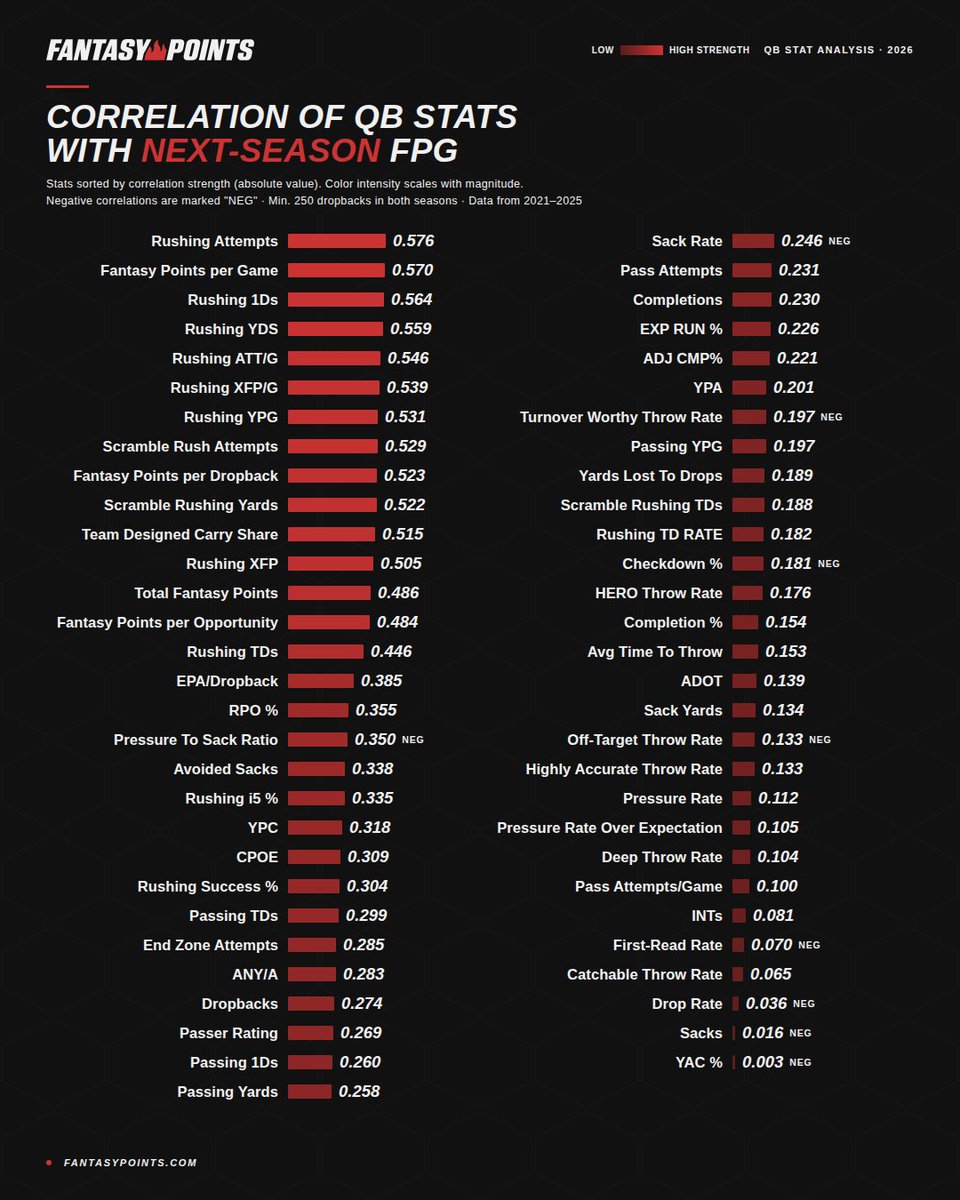
How well do various QB stats (via @FantasyPtsData) predict NEXT YEAR'S fantasy points per game?
- Rushing volume and previous fantasy scoring (FPG, FP/DB, etc.) are king
- Real-life efficiency (EPA/DB) and sack avoidance (P2S ratio) matter more than passing production/volume
3
15
91
57,177
TheFFcoder (Jay) retweeted
Jun 1
The hardest-working man in fantasy football content today (@TheOGfantasy) is getting a much-deserved break.
But don’t worry, we’ve brought in the hardest-working man in fantasy football HISTORY to fill in.
@Fantasy_Guru hosts the program today at 10:00 AM ET!
➡️ youtube.com/live/jRlXiepNOts…

1
2
12
10,201

May 29
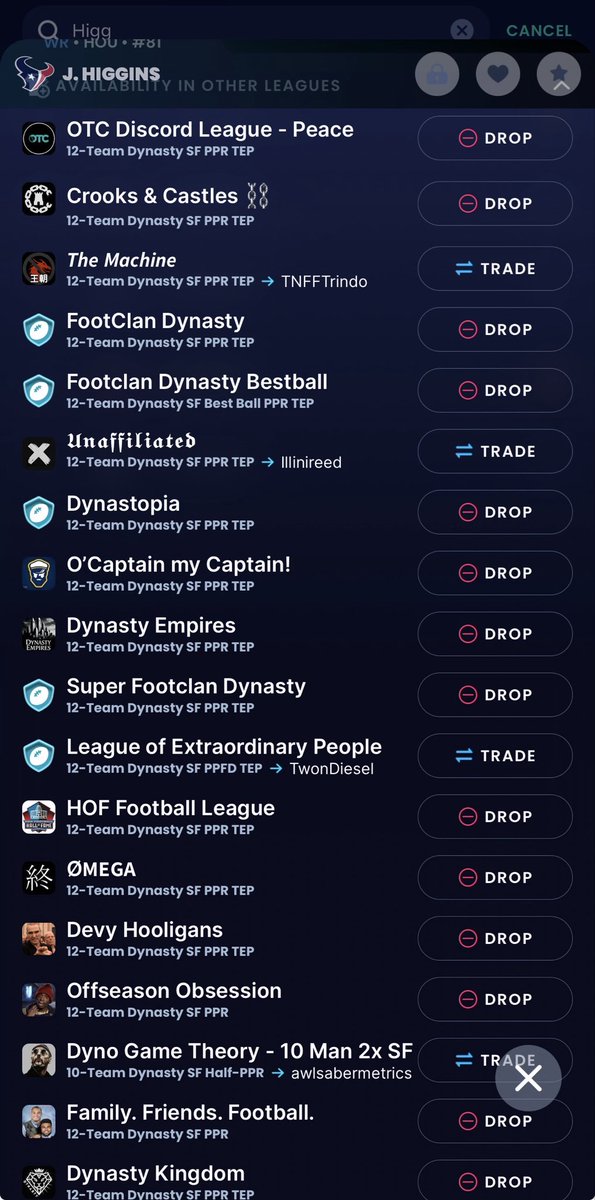
I need a place in sleeper I can put in names and the system just silently rejects any trade offers trying to send that player to me. I’ll call it the Aiyuk button
1
362
TheFFcoder (Jay) retweeted

May 28
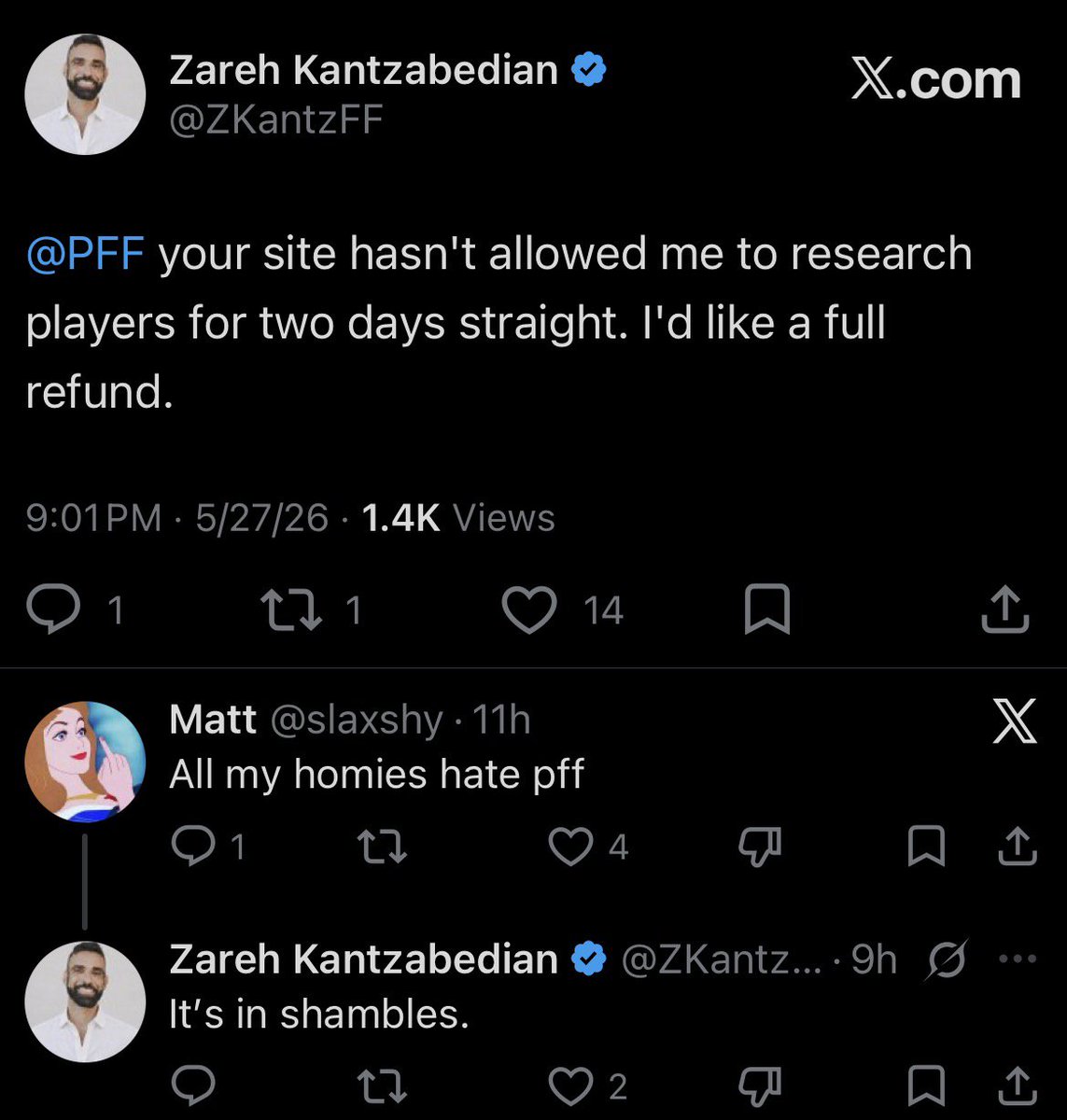
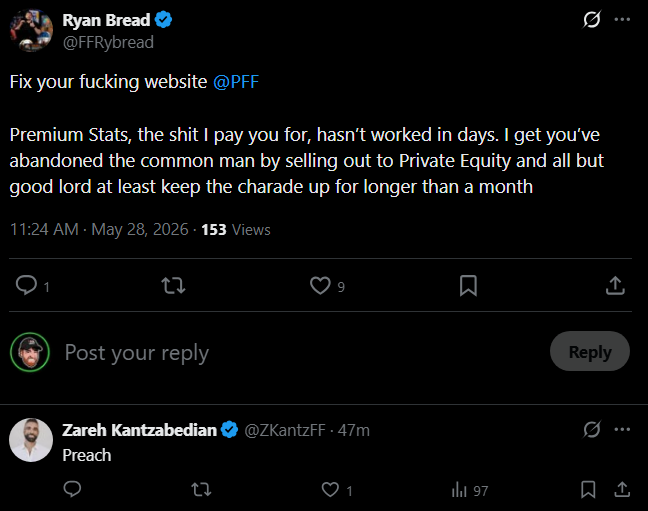
Genuinely the best stats based database around. Insanely customisable and a constant part of my workflow now.

Cancel your PFF sub and show proof to our customer service team to get 20% off any @FantasyPts or @FantasyPtsData subscription
3
23
14,948
TheFFcoder (Jay) retweeted

Cancel your PFF sub and show proof to our customer service team to get 20% off any @FantasyPts or @FantasyPtsData subscription
14
16
120
56,224
May 27
We get far fewer binary possible outcomes situations where something may or may not happen and a player is either undervalued or overvalued depending on the outcome than it feels like. Ladd is one of those right now. The upside if Keenan doesn’t sign is more than worth the risk
1
1
263
May 26
Sounds like far too much restraint in this situation already
May 26

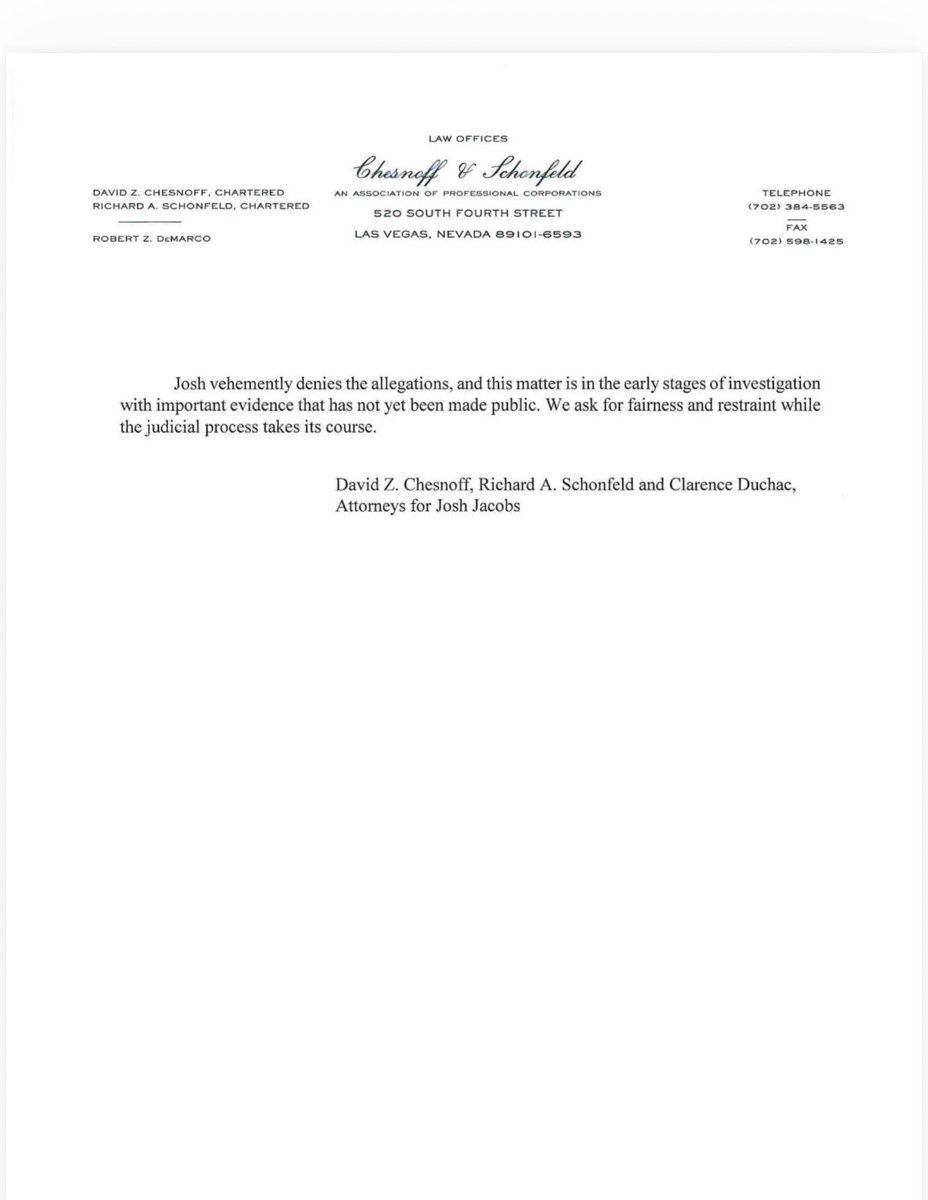
A statement regarding #Packers RB Josh Jacobs via his attorneys, David Chesnoff and Richard Schonfeld:
2
1
4
2,218
TheFFcoder (Jay) retweeted

Jan 19
WR Skyler Bell #UConnFootball
- Two-quick with shed counter
- Jump up and through timing but limits jump based on trajectory of target
- Back-shoulder catch and pull-back
- Boundary work
Good tracking and late hands vs tight coverage.
1
6
26
18,239
May 23
Thank you so much for the incredibly kind words @ScottBarrettDFB
@FantasyPts is truly special because of the unbelievably talented people, their passion for fantasy football, and the wonderful community of subscribers
Excited to share what we have in store for this year!
May 23

Follow Friday: @FFcoder
The one underlying theme behind every @FantasyPts employee is the same: we all live and breathe fantasy football
Jay is one of our best coders and a full-blown dynasty degen who drops great fantasy takes and tweets, so make sure you give him a follow
If you're a Fantasy Points subscriber, don't be shy. Reach out to Jay or me anytime with feedback or ideas on how we can improve the site or what tools we should build next.
1
6
841
TheFFcoder (Jay) retweeted
May 19
A recent history of fibula fractures for NFL skill players
We've seen them return quickly. But effectiveness falls off a cliff for up to a year after:
Tony Pollard
- Returned for OTAs after January 22nd injury (~4 months)
- Fell from 1.02 fantasy points/opportunity in 2022 to 0.70 in 2023 (on only 75 more touches)
Mark Andrews
- Returned for the AFC Championship game after November 16th injury (~2 months)
- Fell from 14.6 FPG pre-injury in 2023 to 11.1 FPG in 2024, with a major decrease in route participation
Isiah Pacheco
- Returned in Week 13 after Week 2 injury (~2.5 months)
- Fell from 0.84 fantasy points/opportunity in 2023 to 0.45 for the rest of 2024 playoffs, and still just 0.60 in 2025
Chris Godwin
- Returned 11 months after Week 7 2024 injury (also the oldest player on this list when sustained, and had the most visibly gruesome dislocation on top of it)
- Fell from 19.7 FPG/the best season of his career in 2024, to just 9.2 FPG in 2025. YPRR fell from 2.62 to 1.51
Quinshon Judkins
- Expected back on the field in some fashion for training camp (starts in late July) after late December injury (~7 months)
Cam Skattebo
- Hopes to be cleared for training camp (starts in late July) after late October injury (~9 months)
I'd posit: should we even care about positive-sounding injury news for Skattebo or Judkins this offseason?
The question was never whether they'd be on the field for Week 1; it's whether they'll be anything close to themselves!
19
12
234
136,543
TheFFcoder (Jay) retweeted
May 19
Nearly 2 hours on a Tuesday? These guys are absolutely SICK! 🤢
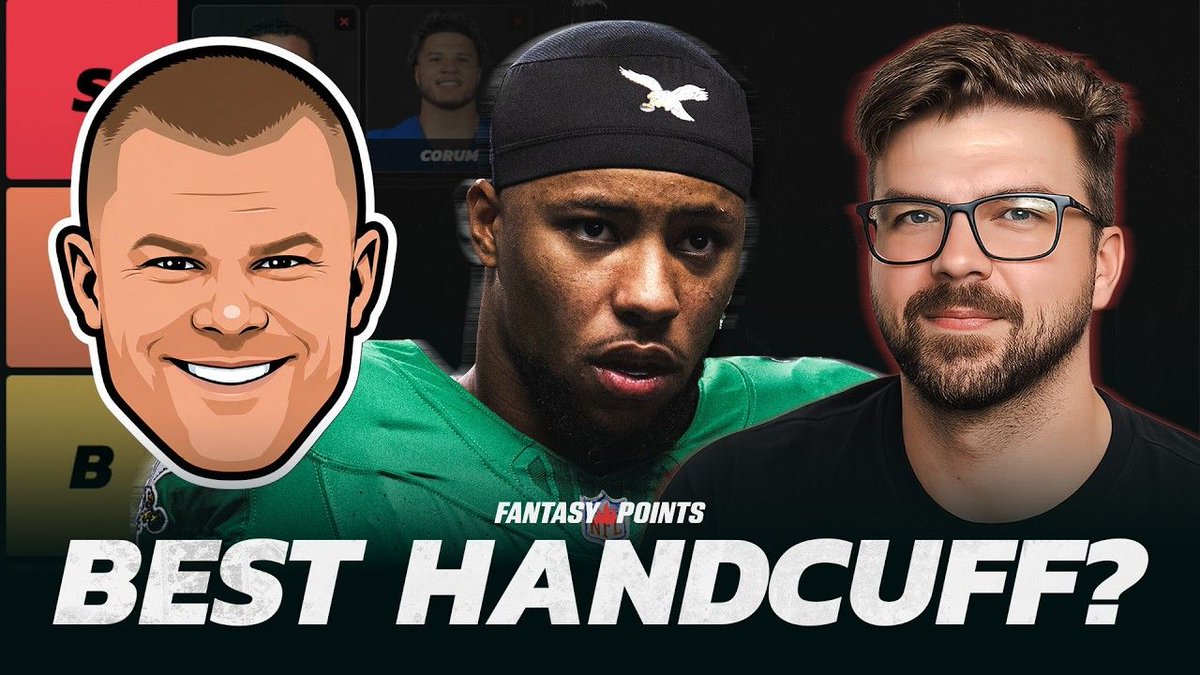
ALL 32 NFL Backfields Breakdown for Fantasy Football 2026 | Sleepers, Handcuffs & Values
➡️ youtu.be/jypdHXjSbKk
@TheOGfantasy @GrahamBarfield
5
7
23
23,216
TheFFcoder (Jay) retweeted
Jan 21
for the price of almost free, Gunnar Helm is interesting

1
2
13
1,743
May 18
It’s easy to think that if we are able to reduce enough of the epistemic uncertainty in fantasy, the we can also solve for the aleatoric uncertainty, when the best we can do is ask how do we benefit when the aleatoric lands in a certain range of the distribution
1
1
572
TheFFcoder (Jay) retweeted
May 18
🚨 BIG ANNOUNCEMENT 🚨
We’ve changed the game.
Starting Tuesday May 26, Fantasy Football Daily with @TheOGfantasy will stream LIVE every weekday on YouTube and Twitter/X! 🔥
📅 Monday–Friday
⏰ 9:30 AM ET
📍 Fantasy Points YouTube
➡️ youtube.com/@FantasyPoints
19
23
104
56,520
May 16
The truly fascinating thing about being handed a technology that can, at your mere whim, answer almost any question, is that I have never been more enthralled to deep dive into hard subjects and learn new things I never would have without it. We now need to teach love of learning
380
TheFFcoder (Jay) retweeted

May 15
I often feel like I'm overly critical of fantasy football work, but not because I think it's bad. I have this thing where I think so much of it is really useful but doesn't get home. It gets 80% of the way there with really good stuff, but then the other 20% doesn't land the plane.
And the final 20% is kind of the whole thing. It's the part where you're turning all that great research and analysis into actionable advice. So I wind up critical sometimes because I actually really like something, and think it's so close, but there's a really unfortunate thing where the final conclusion winds up not being super helpful.
In some cases, it can wind up being actively unhelpful, where the conclusion kind of flips what the research is actually saying. Very often this is because of a pressure to fill in what should be known uncertainty. In everything we try to do with predicting this sport, we have to understand a landscape of variables that cannot be pattern-matched, and where outcomes are dictated by stuff that just can't be modeled. There are too many things that dictate success or failure for each individual player and situation.
I'm not a math professor, so maybe my technical commentary here won't be great, but I sometimes think of it statistically, about how 1 minus an r-squared figure amounts to "unexplained variance," and the football r-squareds are always like 0.60 at most, leaving 40% unexplained variance. What so much fantasy analysis does is gets so deep and so smart about the 60%, but then it is so sure of itself in the 60% that it makes assumptions for the 40% that come from the 60%. But if that's how it worked, our r-squareds would be 0.80. What we know is 40% of this is literally not knowable, at least to the degree we can model these things right now (and I suspect always with the way this sport works, but who knows).
So, so much of fantasy football work does an awesome job of breaking down what we *can* know, but then there's this need for a catchy conclusion or actionable takeaway, and the pitfall is to fill in that unexplainable variance. But you can't be so certain about the 60% that it replaces the 40%. It's not that you can just work harder or come to a better piece of research to figure some future outcome out.
The best analysts understand the way to play the things is to acknowledge the research clears the picture some, but you have to have a humility with the rest of it. It's deeply uncomfortable for some. It took me years to get more comfortable with it, and I still struggle with it all the time. One way to put it is you don't have to have a firm take at the end for your work to be helpful. In fact, one thing we know about fantasy football seasons is they are typically determined by a dozen key players or situations, no more. In some ways, you really only need to get to a few really strong conclusions (on teams or players) after a whole offseason of work and research. What you don't need to do is have a very strong conclusion on every single player, or every single thing you look at. That approach doesn't fit with what we know about football. It's the demand of content, and the nature of it, but that leads the work away from its own goal. There's seemingly a paradox there about making engaging stuff and also analyzing things correctly.
This is obviously a long post, but I can wrap it up quickly now. What's so great about Jakob's work is he bridges the paradox. From the time I became familiar with his work, it was clear to me he had a knack for this that didn't require the years of being humbled it does for most analysts, myself included. It's not just that he knows where to stop short and acknowledge the uncertainty, but also that he still gets to so many strong conclusions, despite that. That balance is clearly evidenced in that piece linked above. The way he processes things is truly top tier, as I said, and as he keeps at it his ceiling as an analyst is probably higher than anyone in the entire space. Dude's still so young. FF analyst dynasty 1.01.
I've already told Jakob this stuff myself, and he knows how I feel about his work. I didn't write this for him, like so many of the social media favors. I wrote it for you, and because in this industry, there's a lot of overlap and iterating and copycatting — however you want to say that — so I find it imperative that unique work that deserves the highest recommendation gets that, and gets emphasized and celebrated. If you read this, it's absolutely my opinion you need to go read his work and then subscribe and support him so he can make more.
3
3
53
3,315