
An institutional-grade validator delivering actionable insights across Asia, powered by @FourPillarsFP
Joined May 2025
- Tweets 126
- Following 27
- Followers 368
- Likes 249
26 Photos and videos

FP Validated retweeted

Jun 9
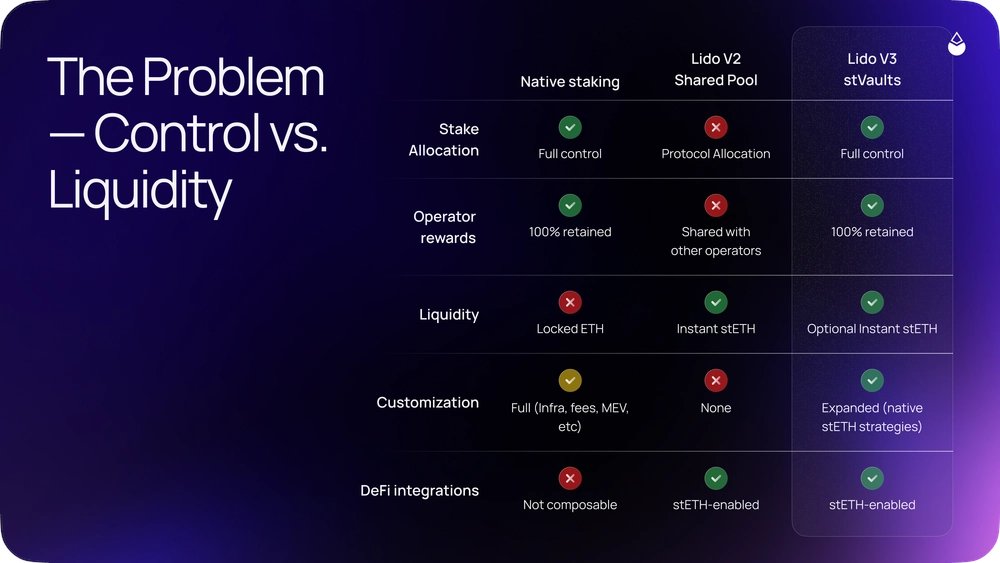
The new Curated Module v2 introduces six distinct operator types to shape a more resilient and adaptive Lido validator set.
Instead of a one-size-fits-all model, this allows for improved recognition of NO contributions to the protocol and Ethereum decentralization.
↓

14
10
52
5,641

Jun 9
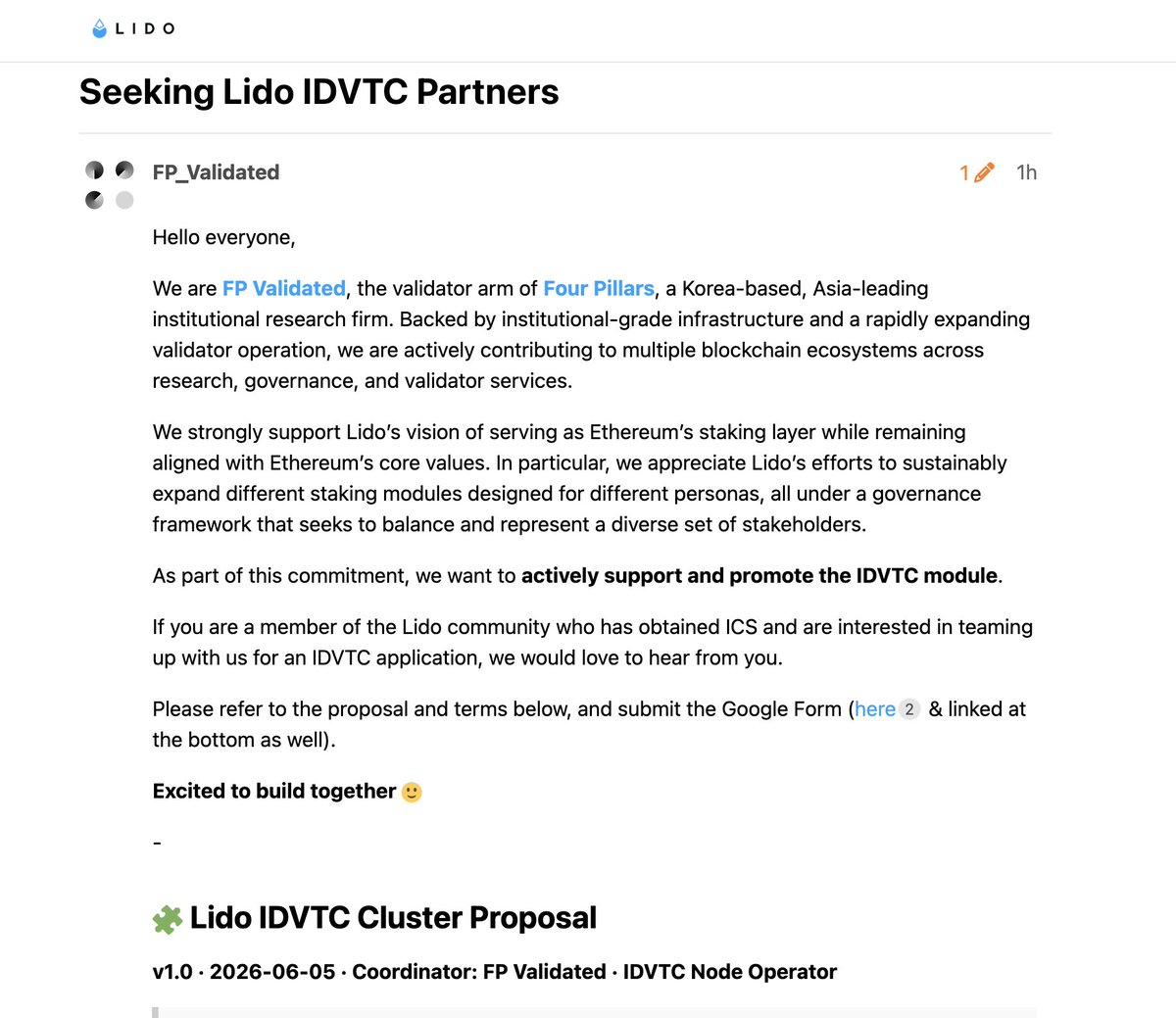
FP Validated Is Looking for Partners to Participate in Lido's IDVTC initiative !
If you're an ICS community member in Lido, and interested in teaming up with us, keep following us 👇
1
8
15
1,810
Jun 9
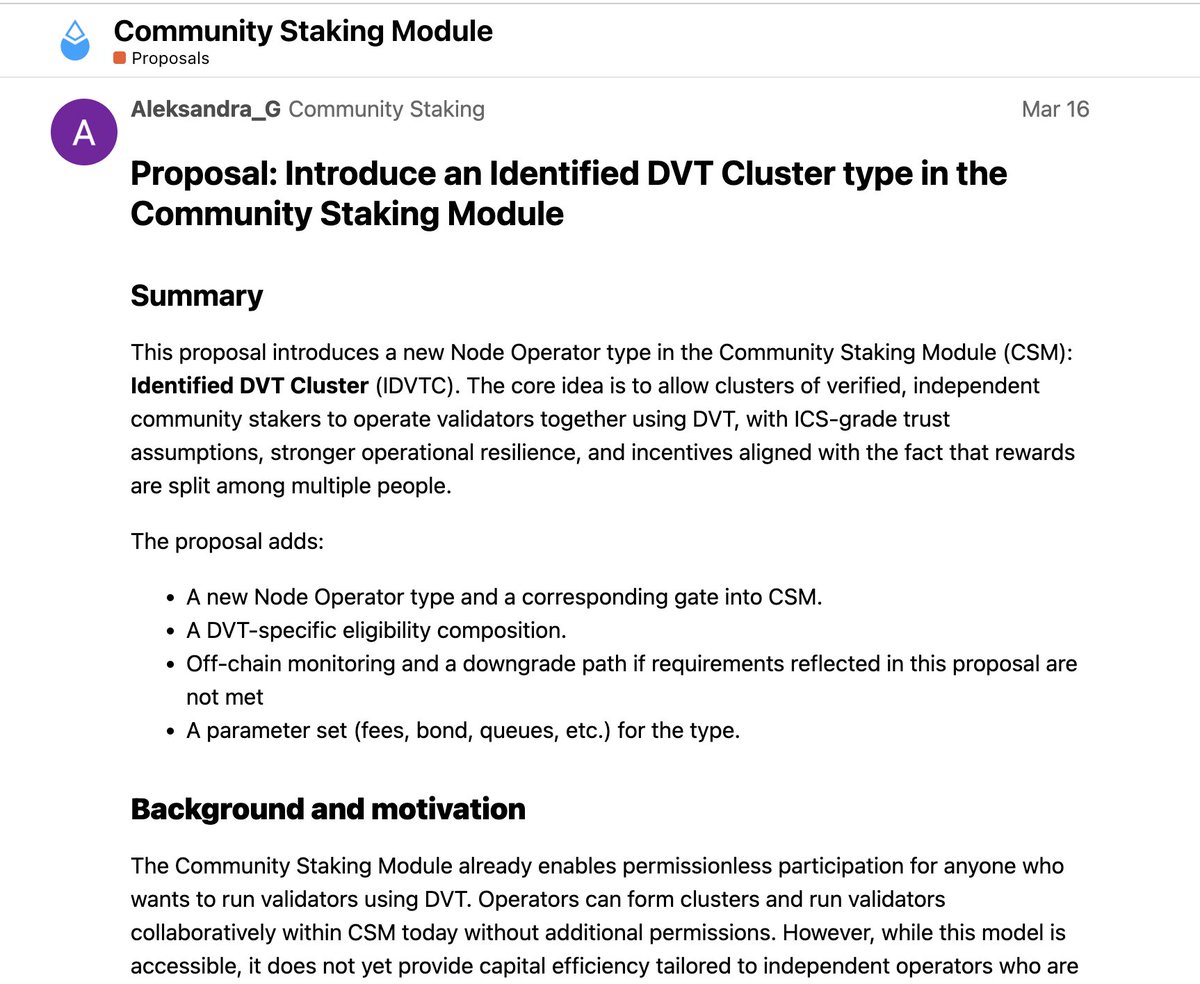
2/ Why Is FP Validated Participating in IDVTC?
We believe Lido is not just a liquid staking protocol, but one of Ethereum’s most important staking layers.
As Ethereum’s staking economy continues to grow, Lido has been evolving its technical / governance architecture to include a broader range of participants - from professional node operators to community stakers - while staying aligned with Ethereum’s ethos of decentralization, neutrality, and credible openness.
As both a research firm and an infrastructure contributor to the Ethereum network, this is exactly the kind of initiative we feel compelled to support.
We plan to actively participate, share what we learn along the way, and help encourage broader community participation.
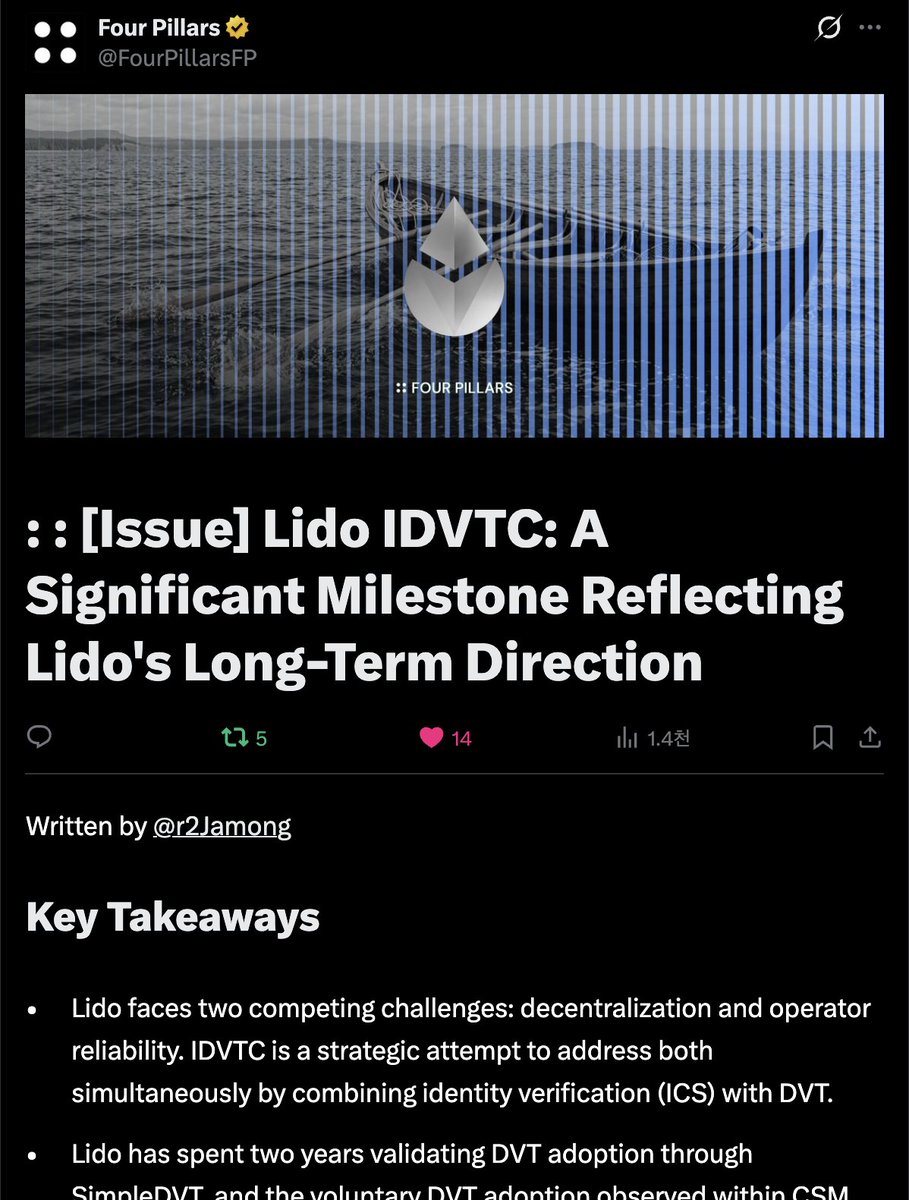
For a short memo on IDVTC, you can also check out @r2Jamong 's memo:
x.com/FourPillarsFP/status/2…

1
1
71
Jun 9
3/ Interested in Teaming up with FP Validated?
Please review the proposal below:
research.lido.fi/t/seeking-l…
and submit the Google Form here:
docs.google.com/forms/d/e/1F…
--
We are excited to collaborate with fellow members of the Lido community and help make IDVTC a successful step forward for Ethereum staking!
🤝
34

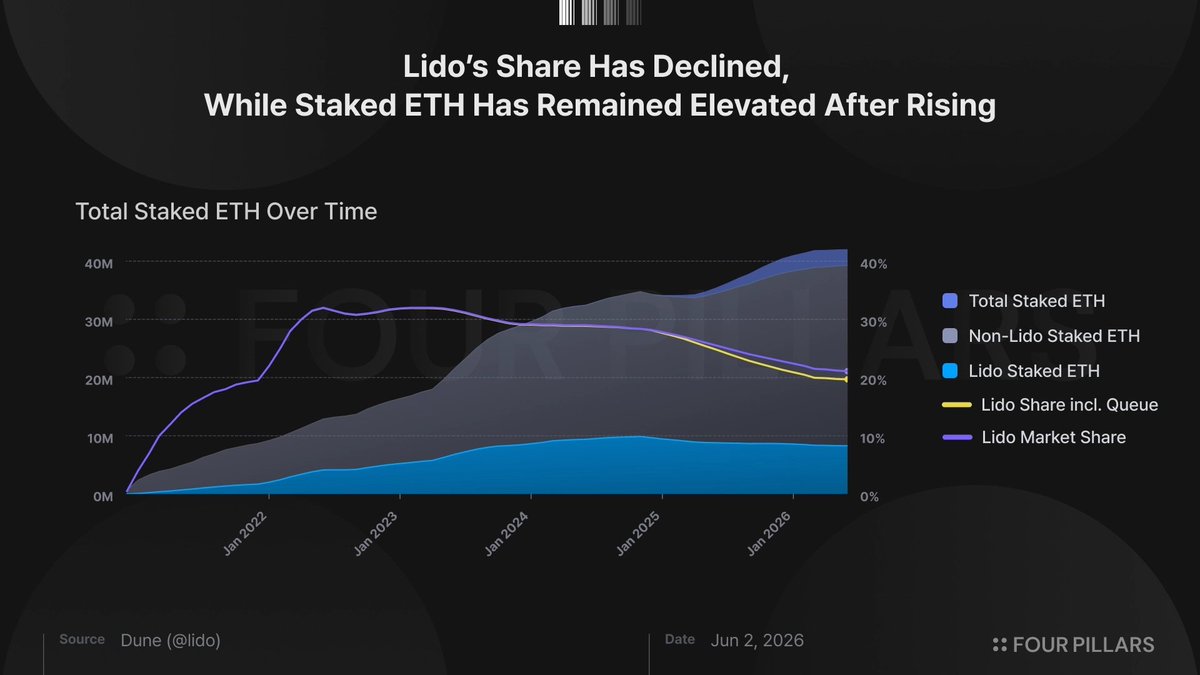
Ethereum Staking Diversification, Seen Through Lido's Market Share
@LidoFinance 's share of staked ETH has fallen by more than ten percentage points, from 32.5% in May 2022 to 20.7% as of June 2026. Over the same period, though, the ETH staked through Lido more than doubled, from about 4.1M ETH to 8.6M ETH. Lido's share dropped not because ETH left the protocol, but because the whole Ethereum staking market grew far faster than Lido did.
This points to a staking market that is becoming more varied and more mature. Through 2024, the market was retail-driven. ETH holders picked Lido for easy access to staking and for its use across DeFi, and most of them were retail users. After 2025, institutional entry into Ethereum staking picked up in earnest, and by 2026 the growth was led by regulated products like ETFs and ETPs, along with direct staking from institutions such as BitMine and Grayscale.
Institutions care more about asset segregation, compliance, operational control, and clear reporting than about DeFi access or higher yield. So they tend to prefer one of two paths: running their own infrastructure built for their specific regulatory environment and staking directly, or contracting directly with staking providers that specialize in institutional clients. Lido launched stVaults for institutions through Lido V3 on January 30, 2026, but it has not yet absorbed enough of the fast-growing institutional demand.
Comparing competition in Ethereum staking by protocol-level market share can distort what the market actually looks like. The competition here is not one big pool of users that everyone fights over. Demand is split into separate groups, and a different contest plays out within each one.
The entry queue for Ethereum staking now sits above 50 days, and it is still climbing fast. In that setting, watching how the shares held by Lido, exchanges, and institutions each move is itself a good way to read the market. A rising Lido share means retail demand for on-chain use is getting stronger. A rising exchange share signals a growing group of users who want to stake but care little about on-chain DeFi. A rise in direct institutional staking signals that regulated institutional capital is flowing into Ethereum. Staking share is better used to judge which kind of demand is driving the market than to value any single protocol.
3
6
35
2,176
FP Validated retweeted

Jun 2
Beyond Research, and Beyond Korea.
We've run 20 seminars for institutions and advised 10 companies on their crypto strategy.
Working alongside regulators and institutions, we saw two gaps to fill one in knowledge, one in technical infrastructure.
So we launched three organizations under @FourPillarsFP:
1/ FP RESEARCH - research
2/ FP VALIDATED (@FPvalidated ) - validator, and infra services
3/FP INSTITUTION - consulting
We are actively expanding in Korea, and going beyond to Japan, Hong Kong, and across asia.
We were the research partner for MoneyX in Japan hosted by @coin_post , @sbigroup , etc, and will host one of the biggest "Asia Focused Conference" during @kbwofficial . (stay tuned)
Excited to kick this off with @PanteraCapital, who shared our conviction on bridging these gaps in Asia together.

We're excited to lead the Series A round for @FourPillarsFP, an independent institutional-grade crypto research firm bridging Asia and the global markets.
panteracapital.com/investing…
3
1
13
844
FP Validated retweeted

We're excited to lead the Series A round for @FourPillarsFP, an independent institutional-grade crypto research firm bridging Asia and the global markets.
panteracapital.com/investing…
39
13
82
65,857
FP Validated retweeted

May 29
Activity on Sui mainnet has resumed, and transactions are flowing normally.
Both today’s and yesterday’s halts are due to the interaction of the 1.72 release, which introduced Address Balances, and gas charging logic. Yesterday’s implemented fix was an interim measure designed to restore functionality to the network while the Sui Core Team worked on a long-term solution.
The interim fix had a known issue with a low probability of causing a halt. This morning, the network hit a variant of the known issue and halted.
As of now, the long-term solution has been implemented by validators, fully addressing known issues caused by the original bug, and network activity has resumed.
A more detailed incident review is forthcoming. Thank you for your patience.
184
179
1,125
203,565
May 22
What we find particularly compelling about Canton is how it moves beyond the fixed design patterns of traditional blockchains and focuses on building infrastructure that institutions can realistically adopt and operate on.
As a validator, we’re also looking to collaborate with ecosystem players building within the Canton ecosystem - feel free to reach out anytime!
1
6
224
FP Validated retweeted
May 8
ETH treasuries need more than staking rewards.
They need liquidity, custody access, and operational flexibility.
@EntEthAlliance's deployment through the Lido protocol shows how stETH can fit into ETH treasury strategies in practice.
blog.lido.fi/what-the-enterp…

54
23
93
5,803

FP Validated retweeted
May 6
stETH is moving deeper into institutional workflows.
That makes infrastructure diligence matter.
Lido has received Web3SOC certification from @cantinasecurity, adding another reference point for institutional diligence.
↓
23
24
118
6,209
FP Validated retweeted
May 5
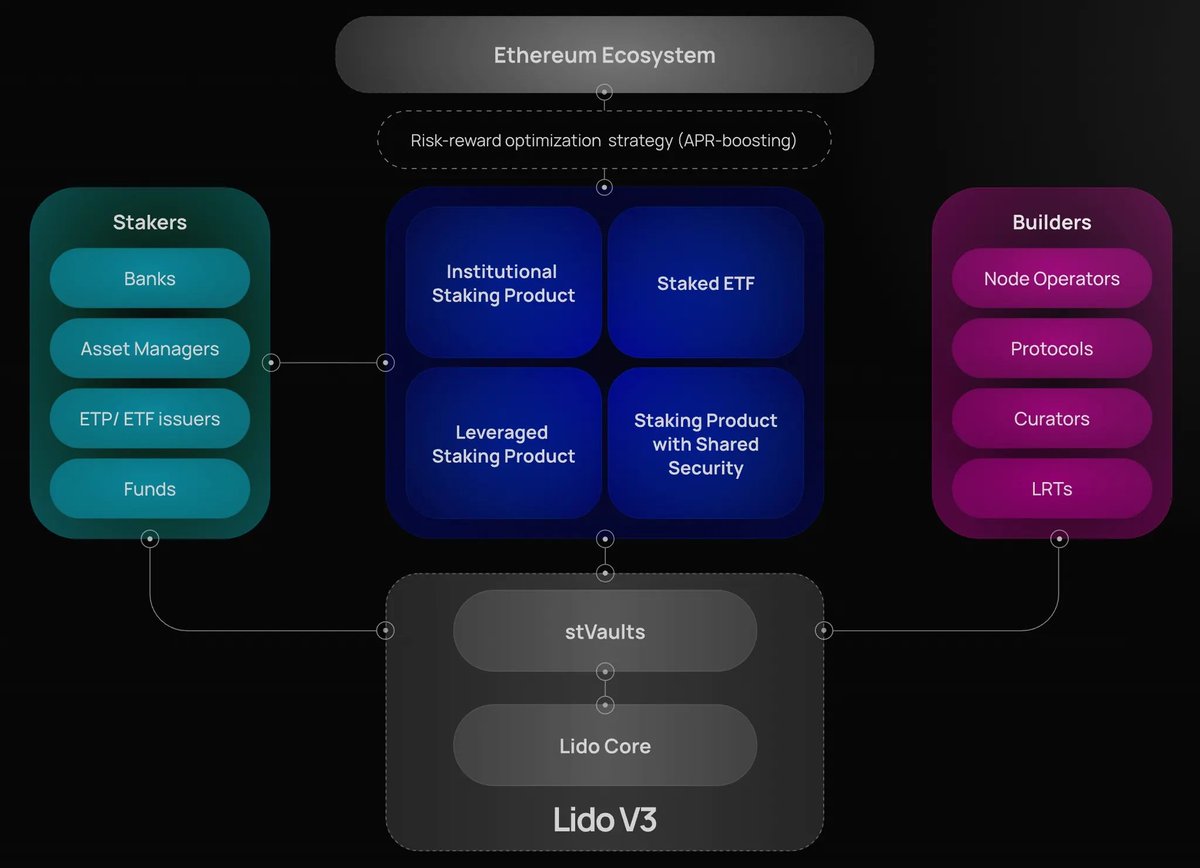
The stVaults Products Overview is live.
One hub to discover all new products built on stVaults - from public staking vaults to modular institutional solutions.
lido.fi/stvaults-products-ov…
↓
19
19
87
7,438
FP Validated retweeted

One of Korea's leading legacy publications, MK Economy, gave us a great opportunity to share our thoughts on what @FourPillarsFP 's rebrand as a solutions company means, the background behind our recent fundraise, and our personal views on the industry and the validator business.
We believe the market has entered a stage where it demands not just insight, but execution. With that in mind, we're positioning ourselves not as information providers, but as operators who deliver on the ground.
At the core of our business, the validator arm places the highest priority on reliability and accountability as a trusted infrastructure service provider. Validators verify and record raw transaction from within the network itself — a fundamentally different vantage point from external analysis, one that enables a deeper understanding of technical architecture and immediate response to issues. That proximity to the network also carries a proportional weight of responsibility.
Our validator team at @FPvalidated, along with many of our researchers — myself included — have spent years working in validator operations, with hands-on experience in security-certified environments such as SOC2 and ISO.
If you'd like to have a deeper conversation about how Four Pillars is building trusted infrastructure for institutions, and what solutions we're looking to offer across staking services and beyond, feel free to reach out via DM anytime!
mk.co.kr/news/economy/120324…

7
8
60
6,708
FP Validated retweeted

Apr 29
cSSV Genesis Boost is live!
$75,000 SSV reward pool. 30 days, or until the pool is exhausted.
Stake SSV → receive cSSV → earn boosted rewards on top of ETH-denominated protocol fees.
🔗stake.ssv.network
Here's how it works 🧵
51
17
145
24,569
Apr 30
A must-read for anyone interested in operating Ethereum nodes 😊
Apr 30
: : Ethereum Infrastructure Operations: A Practical Guide For Institutions And Individuals
Researched by @r2Jamong, this report covers Ethereum validator infrastructure design and operations, spanning solo stakers to institutional operators, based on ~3 years of experience running a top 6-7 globally ranked validator setup.
👇
1
4
261
FP Validated retweeted

Apr 28
: : Introducing Blockchain Guidebook for Korean Institutions 2026
Co-researched with @PanteraCapital, this report is designed for Korean enterprises and financial institutions preparing for the next phase of the onchain economy.
👇

7
13
59
16,592
FP Validated retweeted
Apr 27
[Update ongoing Kelp incident]
Last Thursday Lido contributors shared a proposal to contribute 2,500 ETH to @aave’s coordinated rsETH relief effort. Over the past three days, DeFi United has raised more than 100,000 ETH to improve the backing of rsETH and normalize market conditions.
Pending execution of outstanding DAO votes, the initiative is on track to be finalized in the coming week.
23
22
209
18,814