
Launching next-gen software at lightspeed. Our products: famous.ai | supercool.com | deal.ai | leadfalcon.com
Joined May 2025
- Tweets 283
- Following 0
- Followers 3,981
- Likes 73
50 Photos and videos










Mar 9
Shopify's Toby Lütke issued a mandate in 2025 that most people misunderstood.
The headline was "employees must use AI." But the actual policy was more specific: you have to demonstrate why AI cannot do a task before asking a human to do it.
Why?
…Most workers at most companies have no idea what AI can actually do right now in practice.
A recent survey from Boston Consulting Group found that only 14% of knowledge workers use generative AI daily, despite 78% of those same workers reporting they believe AI will significantly impact their jobs within three years. The gap between awareness and adoption is staggering.
This gap has a name: capability debt.
And just like technical debt, it compounds.
Every month, the frontier of what's possible with AI moves forward. Each release expands the capability surface by 20% to 40% depending on the domain.
But the average enterprise adoption rate is not keeping pace. According to McKinsey's 2025 AI adoption report, the median time from "AI capability exists" to "enterprise deploys at scale" is 18 to 24 months. And that's for companies actively investing in AI transformation.
For everyone else, the lag is longer.
This creates a compounding problem. Because capability debt does not accumulate linearly. It accelerates.
If your team does not know what the latest AI tool can do, they will not know what to test when the next one ships. If your workflows are not designed around AI-native processes, every new model release requires you to re-architect from scratch rather than simply upgrade.
The longer you wait, the harder the migration becomes.
Anthropic CEO Dario Amodei said in a recent interview: "The gap between what our models can do and what most organizations are using them for is the widest I've seen in any technology adoption curve. It's not a training problem. It's a structural problem."
He's right.
Most companies are structured around humans doing the thinking and computers doing the storage. That architecture made sense in 2010 but does not make sense in 2026.
Nonetheless… restructuring is expensive. It requires approvals, compliance reviews, change management, union negotiations, severance packages, and retraining programs. The friction is enormous.
Which is why the most interesting part of the AI economy is not happening inside large organizations at all.
It's happening with individuals who have zero capability debt.
No legacy workflows to unlearn. No HR policies to navigate. No compliance approvals to wait for. No embedded assumptions about what "work" looks like.
…Just capabilities and deployment.
The 532,000 new business applications filed in January 2026 were not filed by enterprises hedging their bets on AI. They were filed by individuals who saw what was possible and simply started building.
These are people who can go from idea to production website in 90 seconds. From concept to finished video in three minutes. From rough sketch to polished pitch deck in an afternoon.
Not because they are better at AI. Because they have no debt to service.
And this is where the bifurcation starts to become visible.
On one side: organizations with decades of process debt, compliance debt, cultural debt, and now capability debt.
Each new model release makes their migration path steeper.
On the other side: individuals and small teams starting at the frontier with no accumulated debt. Each new model release just makes them faster.
The gap between these two groups is not closing. It's widening.
By 2030, the economy will split cleanly into two categories: companies drowning in capability debt, and individuals who never accumulated any.
The companies will still have the capital, the distribution, the brand equity. But they will be moving at 10% of the speed of their zero-debt competitors.
And in a market where the capability curve is compounding monthly, speed is the only moat that matters.
Marc Andreessen wrote in 2011 that "software is eating the world." He was right, but the mechanism was slower than expected because organizational inertia slowed adoption.
The 2026 version is faster: AI is eating the world, but only for the people who are not carrying debt.
Everyone else is just watching the gap widen.
1
2
287
Mar 2
The end of "AI Slop"
The term "AI slop" emerged in mid-2023 as a pejorative for the flood of low-quality, obviously AI-generated content proliferating across the internet. Generic LinkedIn thought leadership. Soulless stock imagery with six-fingered hands. Bland blog posts that said nothing in 800 words.
The tell was always there: a certain flatness… an over-optimized averageness… a lack of “edge”.
For a while, the criticism was valid. The models weren't good enough.
No matter how carefully you prompted GPT-3.5 or DALL-E 2, the output had a ceiling. You could feel the algorithmic compromise in every sentence, see the interpolation artifacts in every image.
"Slop" wasn't just a methodology problem… it was a literal capability problem.
But something shifted recently.
The models got really good. Categorically different.
We crossed a threshold where creative outputs became not just "acceptable" but genuinely indistinguishable from human-created work. More importantly, they became intuitive enough to understand intent even from casual prompts.
This created a paradox: "slop" as a verb ("I'll just vibe-slop this post") does not create slop.
The models are now so capable, so good at inferring what you're trying to accomplish, that even a lazy prompt produces something competent. Often better than what the average person had in their head to begin with.
Which means we've moved from "How do I get AI to produce something good?" to "How do I get AI to produce something exceptional?"
Introduction, stage left: The Three Archetypes
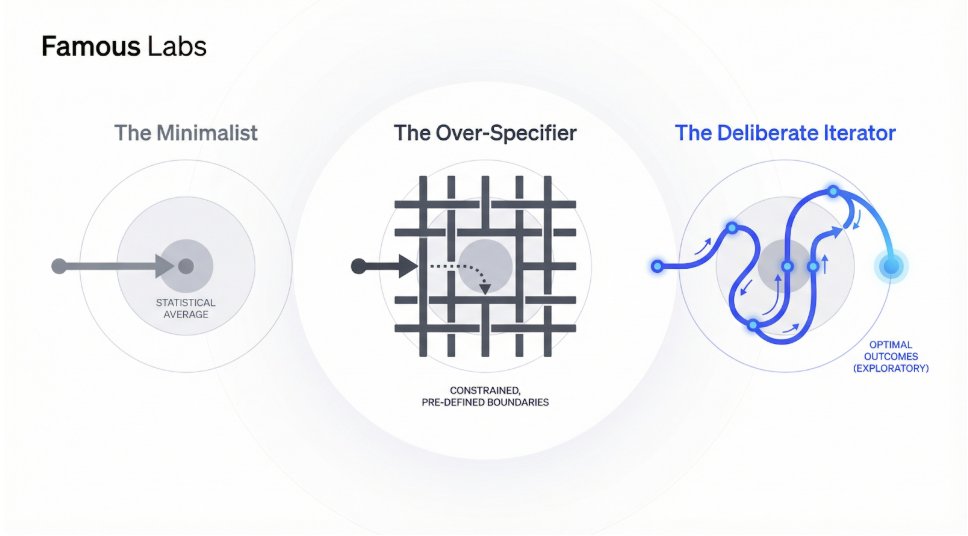
This shift has revealed three distinct approaches to using generative AI, each with different outcomes:
The Minimalist walks up to the model and says, "Make me a website" or "Write me a science fiction book."
And again, even with a prompt that vague: they'll get something very, very good.
But! It will be optimized for the statistical center of all websites, all science fiction books. The model, lacking context, will give you an extremely competent average.
And average, no matter how polished, is… forgettable.
All the nuance, all the edge cases, all the best versions of art and business and invention by definition live out on the edges of the distribution, not in the middle.
The Over-Specifier shows up with a 50-page creative brief.
Every font specified. Every plot point mapped. Every edge case is documented.
This approach will certainly feel more "human" by default because it's constrained by human specificity. But it has a fatal flaw: it's limited by what you could imagine and articulate in advance.
Unless you're a generational genius (and even if you are), the odds of you specifying the right thing in exhaustive detail, without allowing the AI to participate in creative iteration, are vanishingly small. You’re not that smart.
If you're using a generative model purely for execution, not collaboration… You've built a cage before you've explored the space.
The Deliberate Iterator starts with a strong first prompt: enough context and direction to move away from the statistical center… and then quickly enters a discernment loop.
They generate, evaluate, refine.
Produce, discern, prompt again.
Get an output. Decide what they want to improve. Update.
They let the model propose directions they hadn't considered. They course-correct when it drifts. They recognize that the model's "intuition" (its training across billions of examples) can surface solutions beyond what they could pre-specify, but only if they guide it with taste and judgment.
This is the sweet spot. This is where indistinguishability happens.
And this is not debatable.
We now have empirical evidence that this approach works. Recent research from Columbia University found that readers in blind tests not only failed to distinguish high-quality AI content from human writing: they actually preferred the AI output.
MIT studies on AI-generated code showed that experienced developers couldn't reliably identify which functions were human-written. Image generation has reached a point where forensic analysis is required to detect synthetic media.
So what does it all mean?
The "slop" era is therefore outdated. It presumed you could tell the difference. Now you can’t.
What this means…
First, the bottleneck is no longer the tool… it's the operator.
The question isn't "Can AI do this?" but "Do you have the discernment to recognize when it's done well?"
The skill is now curatorial, editorial, directorial. You need to know what good looks like, not how to make it from scratch.
Second, the playing field has fundamentally leveled. A solo operator with strong creative judgment now has access to the same quality output as a studio with 50 people. The constraint is no longer resources—it's taste and systems thinking and creativity.
This is why we built SuperCool and Famous.ai by the way: not to automate creativity, but to remove the execution barrier that prevented creative people from manifesting their vision.
Third, we need to retire the term "slop" as a blanket criticism. It's no longer a useful heuristic. The new question is: Was this made with intention?
You can have human-made slop (generic, thoughtless, forgettable) and AI-made excellence (distinctive, thoughtful, memorable).
The origin is increasingly irrelevant.
The craft is what matters.
We're now in a world where "I'll just vibe-slop this" accidentally produces something good. Which means if you're still producing forgettable work, it's not the AI's fault.
The models have gotten so good that they've essentially raised the floor. Average is now the baseline, not the ceiling. Which means to stand out, you need to do what the Deliberate Iterator does: start with a clear first prompt, engage in creative collaboration with the model, and apply rigorous judgment to the output.
At Famous Labs, we're not interested in helping people generate infinite mediocrity at scale. We're interested in helping people with vision—designers, founders, storytellers, builders—execute at a level that was previously inaccessible without massive teams or budgets.
1
3
305
Feb 25
There's a specific type of organizational debt that has nothing to do with code.
Most companies (even well-funded private ones) organize around a thesis.
"We are the design tool."
"We are the messaging platform."
These chosen identities are how teams make a thousand small decisions every day: what to build, what to ignore, what would "make sense" for us.
For example: Why hasn’t Figma won the vibe-coding wars?
Because pivoting to a build-first architecture would require justifying a temporary regression in the thing they're known for. The board would want a deck. The market would want a narrative.
Whereas…
We just shipped four monumental changes in the past few weeks:
1. A light version of Famous.ai inside of SuperCool.com
2. Social chat features in SuperCool.com (humans AND bots in the same thread)
3. Heisenberg: our drug discovery platform
4. Added a built-in e-commerce back-end to Famous.ai
And we did this not because we're faster engineers.
There are many fast engineers.
We shipped because there's no thesis to violate.
There's a brief window in a company's life where you can optimize for option value instead of narrative coherence. Most companies never get this window. Or they close it themselves, prematurely, because incoherence feels dangerous.
But incoherence is just unexpressed optionality. And optionality compounds.
The trade-off is obvious: at some point, you have to pick a lane (or at least the outside pressure will become so intense that you’ll feel like you have to).
So in the meantime…
The question is whether you've explored enough lanes first. Whether you've accumulated enough architectural flexibility that when you do commit, you're committing to the *right* constrained future.
This is partly why we chose to include “Lab” in our name. Our thesis is optionality itself.
...We are anti-constraining ourselves in advance.
3
351
Feb 25
You are only one prompt away from:
• Your 3D model
• Your screenplay
• Your website
• Your book
• Your app prototype
• Your commercial
• Your song
Starting with one prompt is so important... not because of the output... but because you must close the 'belief gap.'
Once you 'see it,' you know you can do it.
So... What do you want?
Just type it into SuperCool.com or Famous.ai.
3
358
Feb 23
SuperCool Launches End-to-End Text-to-3D Asset Generation
We are excited to announce a significant vertical expansion of the SuperCool creative engine.
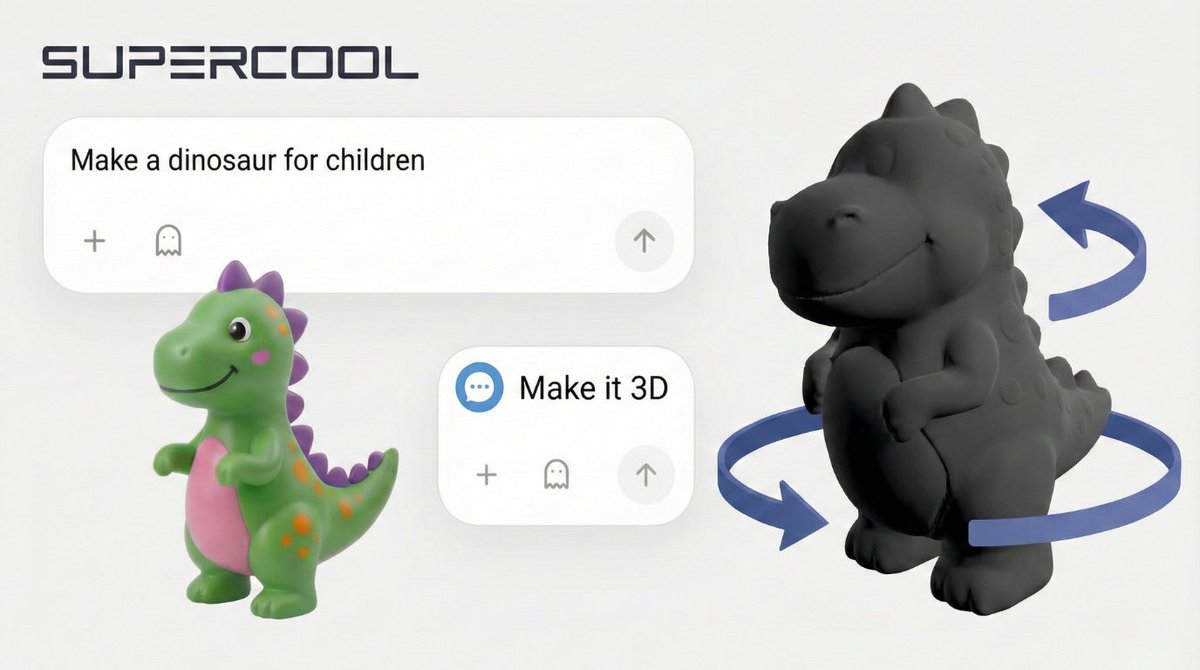
One of our latest deployments introduces a seamless pipeline for generating production-ready 3D assets directly from natural language prompts.
The workflow is architected for maximum velocity: users can now iterate from a 2D conceptual image to a high-fidelity 3D wireframe in a single session. By simply prompting the engine to convert a generated asset into a 3D model, SuperCool handles the heavy lifting of mesh generation and spatial mapping.
To ensure full interoperability across the modern tech stack, we have enabled multi-format export capabilities. This allows for immediate integration into existing developer and designer workflows. Supported primitives and file types include:
GLB: Optimized for web-based environments and AR deployments.
FBX: Standardized for high-performance game engines like Unity and Unreal.
STL: High-precision output specifically for additive manufacturing and 3D printing.
USDZ: Native integration for iOS ecosystem and mobile AR experiences.
This feature represents our commitment to democratizing complex asset creation, moving beyond flat pixels into fully realized spatial environments.
Whether you are building for the metaverse, rapid prototyping hardware, or enhancing digital commerce, SuperCool provides the infrastructure to scale your creative output.
Experience the next dimension of generative AI at SuperCool.
1
2
263
Feb 22
The floor just dropped out from under "I have an idea but I'm not technical."
Yesterday's Famous.ai orientation: Portugal, Pakistan, Manchester, Costa Rica, Lake Tahoe. etc.
Fitness trainers. Musicians. Construction managers. Moms.
They're not asking "can AI code?" They're shipping v2.
1
269
Feb 20
Remember these:
Rovio shipped 51 games into the void.
Eight years of obscurity. Game #52 was Angry Birds.
James Dyson spent 15 years in his garage building 5,126 failed prototypes.
Prototype #5,127 became a multi-billion dollar category killer.
Twitch started as Justintv: a lifecasting platform no one wanted.
Four pivots later, they found vertical dominance in gaming and redefined live streaming.
Airbnb was funding their rent by selling cereal boxes.
They're now worth $75 billion.
Slack was a failed game company called Glitch.
The internal chat tool they built to survive became a $27B enterprise layer.
Instagram started as Burbn—a bloated check-in app.
They stripped everything away except photo filters. That act of subtraction created a platform with 2 billion users.
YouTube launched as a video dating site.
The dating part died. The infrastructure for sharing any video became the foundation of modern media.
Twitter was a failing podcasting company called Odeo.
A weekend hackathon produced a microblogging side project. That side project rewired global communication.
PayPal started as cryptography for Palm Pilots. No one cared.
They pivoted to email payments and became the backbone of internet commerce.
Nintendo spent 80 years making playing cards, toys, and love hotels.
…Then they tried video games.
Most founders optimize for the first attempt.
The winners optimize for attempt #52 (and beyond).
Success isn't about being right: it's about having the fortitude and creativity to keep shipping until the market finally responds.
Keep building.
5
436
Feb 18
This is the most important thing said about AI in 2026…
"There is no part of Claude Code that was around 6 months ago." - @bcherny
Code is disposable.
Features are temporary.
Models get better every quarter.
The only moat: understanding your user better than anyone else.
1
1
354
17 Dec 2025
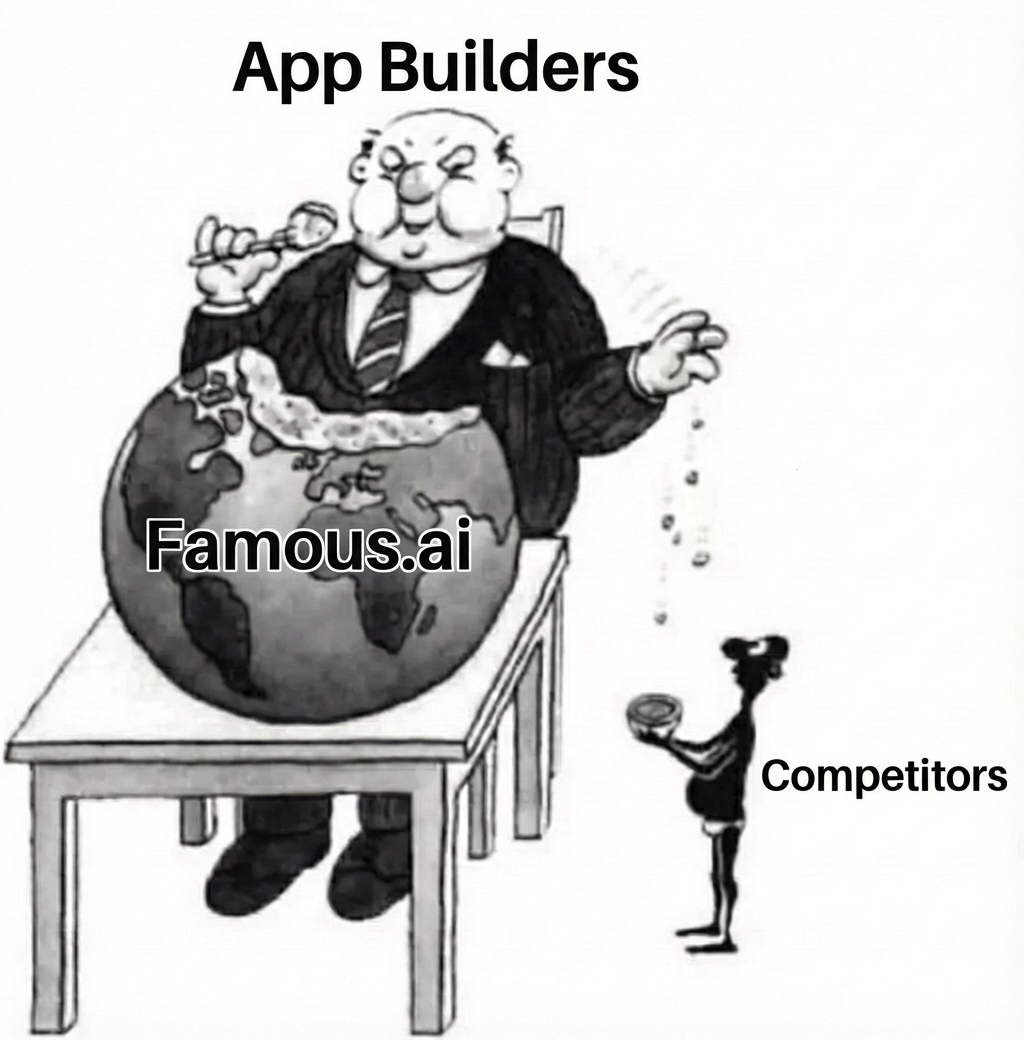
🔥 BREAKING NEWS (that isn't actually news because it's always been this way): Famous.ai continues its relentless, utterly predictable march to global app-building supremacy. 🔥
Look, we get it. You've probably seen our latest meme, and if you haven't, frankly, what are you even doing with your life? It perfectly encapsulates the current state of the app development universe: Famous.ai, majestically perched atop the digital Everest, surveying the vast, barren wasteland of 'competitors' scrambling in the foothills below. It's not hubris if it's just an accurate reflection of reality, right?
While others are still fumbling with drag-and-drop interfaces that feel like they were designed in 2003, Famous.ai is out here building the future, one flawlessly intuitive, lightning-fast, and frankly, gorgeous app at a time. We're not just 'innovating'; we're actively making every other platform look like a quaint, artisanal hobby project. Bless their hearts.
So, to all the aspiring app moguls, the digital dreamers, and even the perpetually confused: stop wasting your precious time. Stop settling for 'good enough.' Stop pretending that anything else even comes close. Join the winning team. Or don't. Frankly, it doesn't affect our trajectory one iota. We'll still be here, dominating, innovating, and probably sipping a virtual mojito while your 'competitor' apps are still buffering.
6
9
2,704
16 Dec 2025
POV: You just discovered SuperCool AI 🔥
While others are still buffering, we're out here with UNLIMITED POWER. Literally too powerful. 🚀
Try it yourself: supercool.com
(we made the meme with supercool, chatgpt/grok couldn't failed miserably)
5
2
1,172
Famous Labs retweeted

20 Oct 2025
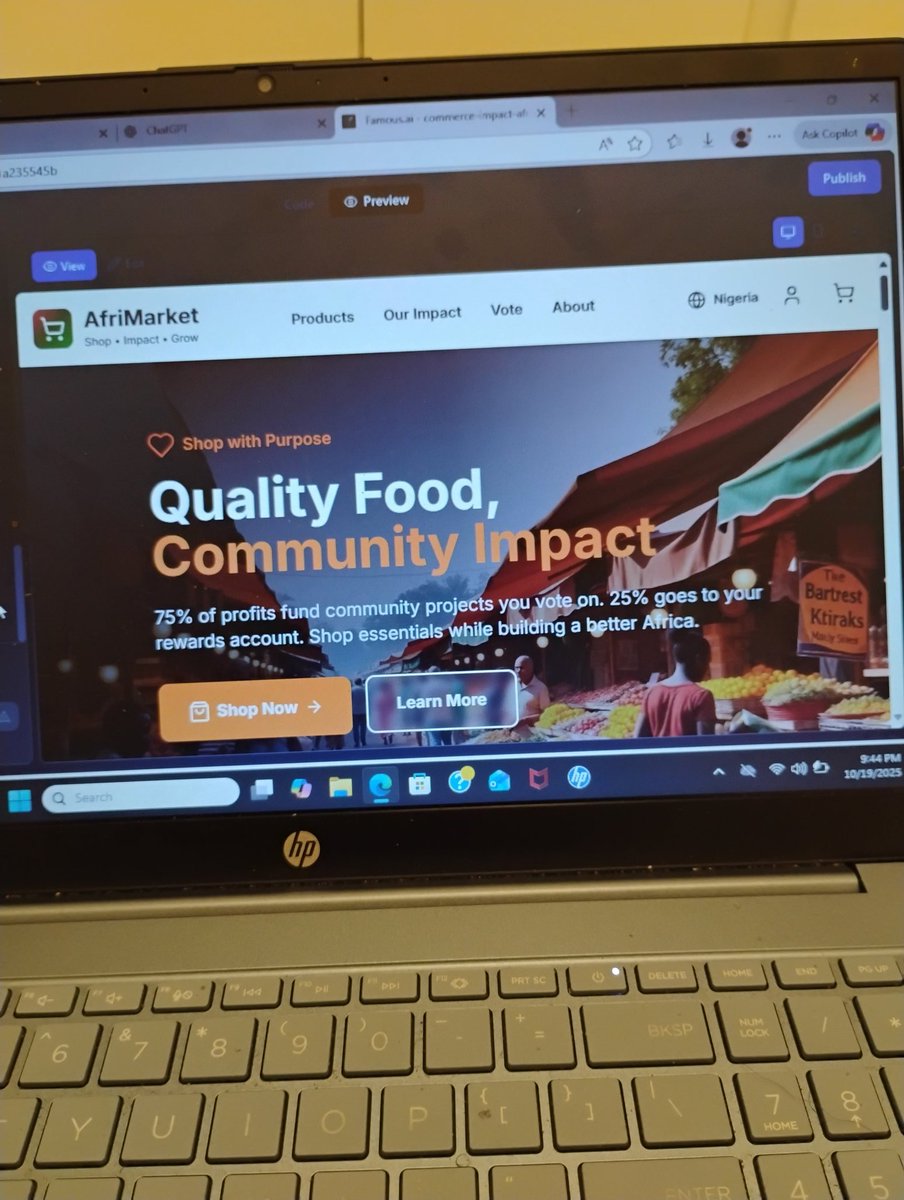
Okay omg, just tested @Famous_AI after having used @emergentlabs and am pleasantly surprised that Famous created a better website, faster and with fewer prompts. It figured out the task very well on its own better.
5
1
8
4,081