The Far Out Initiative is a public benefit company that seeks to strike at the biological roots of physical and psychological suffering.
Joined August 2023
- Tweets 347
- Following 373
- Followers 257
- Likes 584
116 Photos and videos










The Far Out Initiative retweeted

Jun 12
Abhinavagupta offers a fascinating perspective on the simple phrases of tantric revelations:
“Devī uvāca” — The Goddess said.
“Bhairava uvāca” — Bhairava said.
At first, these might seem like a typical tantric exchange between Devī and Bhairava, revealing the Shaiva Tantras. But Abhinavagupta challenges us to ask: Who is truly speaking?
In the most profound state of consciousness (Parā-vāk), there’s no separation between speaker and listener, subject and object, word and meaning, Devī and Bhairava. It’s all one Self-luminous Consciousness, which is beyond time and space. Devi herself is Parāshakti, completely inseparable from Bhairava.
Therefore, when the text says “Devī uvāca,” it doesn’t mean one being spoke to another. Instead, it means: Consciousness, in its creative and expressive aspect of Śakti, shines forth in the Heart of the seeker, Who AM I?
Similarly, when the text says “Bhairava uvāca,” it means: The same Consciousness, in its transcendental and re-absorbing aspect of Bhairava, flashes forth the resonance in the heart of the seeker—I AM.
So, the dialogue of Tantra isn’t a conversation between two separate entities, rather an act of union between Shiva and Shakti—within our Heart. It’s the eternal act of self-recognition of Consciousness—Paramashiva.
Whenever a seeker speaks, thinks, remembers, imagines, questions, meditate, practice, worship or do any kind of Sadhana for his or her own real identity—the Self-recognition, they’re already being propelled by the Utterance of Devi. This verily is called Shaktipata in Shaiva Tantra. Similarly, every experience which brings a seeker closer to their own Self-recognition is the Utterance of Bhairava.
In truth, we as a seeker are just participating in the divine dialogue of Śiva and Śakti.
So, the Goddess asks.
Bhairava answers.
But both voices come from the same Heart.
“Devī uvāca” and “Bhairava uvāca” aren’t just words in a scripture—they’re the eternal conversation of Consciousness with itself.
Jai Ma Ram!

4
50
266
9,197

Jun 13
People do not merely grieve a relationship. They grieve an unrealized future. Or more painfully: a possible self.
3
52
Jun 13
Eroticity arises not simply because stimulation feels good, but because certain forms of embodied contact transiently reorganize the self into deeper patterns of reflexive integration.
1
1
56
Jun 13
Erogenous zones are not merely sites of pleasure, but privileged interfaces through which bodies achieve unusually intense forms of relational coherence.
1
51
Jun 11
Beauty is the phenomenological signature of increasing relational coherence achieved through successful reflexive integration. Put more simply: beauty is what consciousness feels when complexity resolves into a richer form of intelligible unity.
1
6
336
Jun 10
The future of intelligence must also be the future of flourishing. Valence research matters because knowing your target matters.
#AIAlignment #AISentience #Consciousness #PhilosophyOfMind #MachineEthics #AIethics #ArtificialIntelligence #Sentience #AGI #SufferingAbolition
86

Why is TFOI giving so much attention to philosophically pinning down valence? The far out goal is to ensure that when optimization becomes strong enough to reshape reality, it is still meaningfully connected to the thing we were trying to protect in the first place.

2
1
130


58
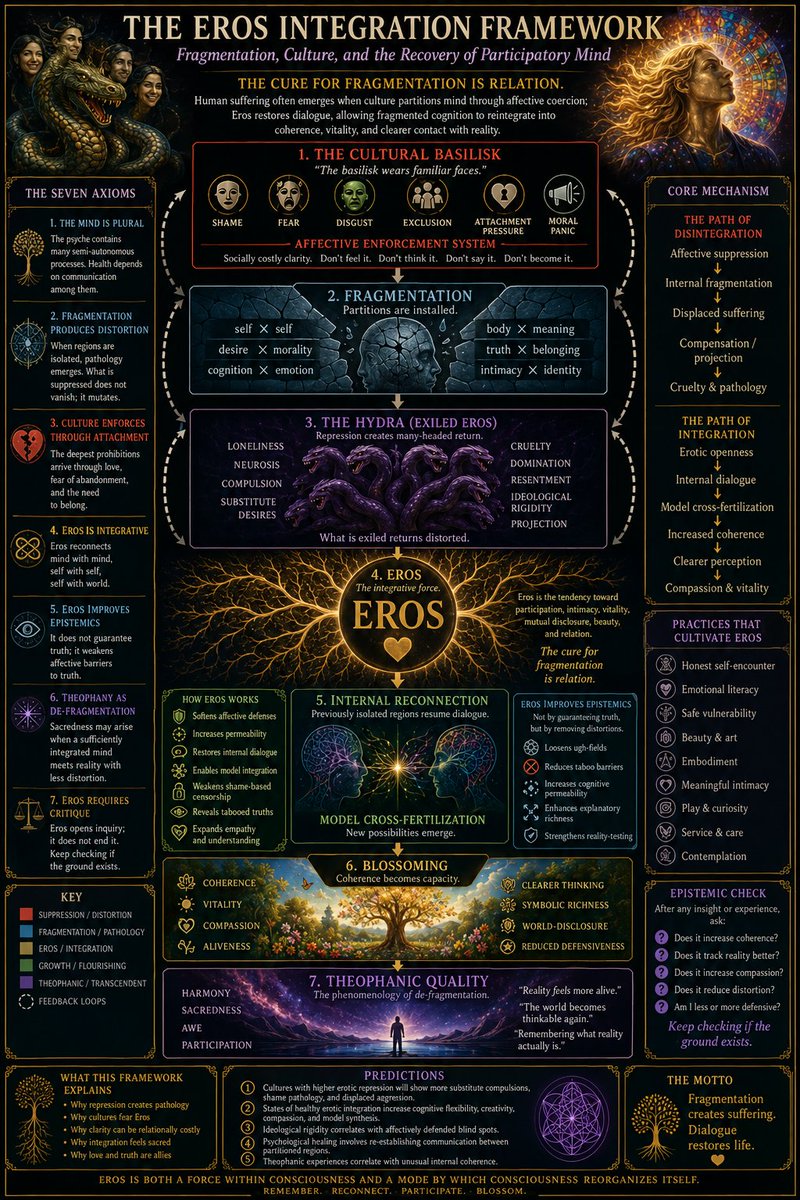
The basilisk of culture wears the faces of your friends and loved ones.
Many of the thoughts that most constrain us withstand scrutiny poorly and survive instead through emotionally enforced ugh fields: shame, disgust, fear, belonging, attachment.
Exiled Eros does not disappear.
What is exiled returns distorted.
Working on an integrated model of fragmentation, suffering, and participatory cognition.
88

How much human nonsense arises from the "ugh fields" we erect around socially costly clarity?
68