
Publisher. Builder. Investor. Writing about online business, leverage, and building a life that feels less like work and more like choice.
Joined October 2014
- Tweets 2,743
- Following 319
- Followers 18,609
- Likes 4,658
112 Photos and videos



Jun 1
Had my first Uber ride in an EV pickup truck today.
I have a gas-guzzling Tundra. I joked to the driver that I’d lose money as an Uber driver in the Tundra.
His response surprised me. What followed was a fascinating discussion about Uber economics.
He said if you’re strategic as an Uber driver, I could earn $500 for every $100 spent on gas.
That blew my mind.
He backed it up by saying he only recently got an EV; before that he drove a gas-powered 4Runner and did just fine.
“What’s the strategy?” I asked.
He launched into a rapid-fire verbal listicle setting out exactly how to max out profits driving Uber.
1. Drive the higher paying times of the day.
2. Be patient. Only pick up rides nearby and that are heading somewhere a return rider is likely.
3. If have a gas-guzzler, choose riders that require using highway routes as much as possible.
4. When have no rider, cruise around or park in high-traffic areas to increase chances for a rider that meets 1 to 3 above.
I’m sure he has a few more tricks up his sleeve.
I have no plans to drive Uber, but as a gig-economy participant, I found the discussion fascinating.
If ever I drive Uber, I’ll remember this conversion and would study Uber economics more deeply.
I gave him a good tip. Maybe that’s his real secret… share Uber secrets for bigger tips.
Once again, I’m reminded just how helpful other people can be if you simply ask.
2
10
1,884
May 29
A reader sent me a long email yesterday explaining how offensive one of my articles was.
Not because of what I wrote.
Because of what I didn't write.
At first, I was mildly irked.
Then I reread it three times.
I came around to see her point.
Most of us have read something and thought, "But what about this?" or "You left out that important detail."
And yes, there are omissions that can be universally offensive. This was not one of them.
It’s true the reader wasn't entirely wrong.
Something was missing.
The thing is, something is always missing.
Every article, every book, every speech, every conversation is as much an omission as inclusion.
Writers start with a universe of possibilities and choose a few.
Everything else gets left out.
That's not a flaw.
That's writing in a nutshell.
If writers are responsible not only for what they say, but also for every perspective they don't mention, every exception they don't include, and every possibility they don't cover, the standard becomes unattainable.
The article becomes longer.
Then longer still.
Then longer again.
Eventually it stops being an article and becomes an endless series of qualifications designed to prevent someone, somewhere, from feeling overlooked.
Writing requires choices.
Choices create omissions.
Omissions can create disagreement.
That's not a flaw.
It's the price saying anything at all.
1
3
672
May 29
There's a gas station near my house I go to all the time.
Gas. Drinks. Slushies with my sons.
Different times of day. Sometimes alone. Sometimes with the kids. Half the time I'm wearing shorts and a bike helmet.
The people who work there are kind. The place is well run, which is a key reason why I keep going back other than proximity.
Yesterday one of the cashiers broke the usual “cash, debit or credit” script.
He asked what I do. First cashier in the 11 years I’ve been going there to do that.
We got chatting.
Turns out he's a 26-year-old computer science grad building some pretty wild things with Claude Code. Open source projects.
I asked why he'd give away his work if his goal was to make money.
He said he's playing the long game. Building a portfolio. Building a reputation. Creating opportunities that might not exist yet.
He knows the hiring market is non-existent right now and is doing something about it.
Smart.
What struck me wasn't just what he was building. It was that he'd noticed me.
The odd hours. The bike helmet. The flexibility. The fact I was sometimes there with my kids and sometimes not.
The conversation impressed me enough that we exchanged contact information. I'm genuinely interested to see what he ends up building over the next few years.
And you never know.
Our paths may cross again beyond the gas station.
The lesson isn't to network.
The lesson is to be receptive.
Talk to people.
Ask questions.
Answer them when they're asked of you.
Opportunities and connections stem from ordinary conversations with ordinary people on ordinary days.
2
10
1,061
May 28
I've not been in the SEO game since 2023 but I'm still wondering how Google's announcement "no more blue links in search" is gonna change the Web (apparently they'll still be there but not by default which is as good as not there).
Content sites: Already hammered so only few remaining pubs will take a hit.
Ecommerce: Google will show products but still send people to the sites to buy. Could be good for ecomm folks if they end up getting their products shown. Might be hard to beat out Amazon and other big players in product carousels. Ecomm with brand searches will clean up.
Local biz: Not much change since Google Maps and map packs have dominated for years.
SaaS: Google will act as a filter so the fewer searchers who end up on SaaS sites more likely to buy???? Not sure. Conversion rates may radically change. SaaS must invest in getting mentioned. Huge opp for agencies.
Joe-Blow and Jane Doe searchers: Most prefer AI generated results hence Google is doubling down on it. Heck, I never go to websites myself unless buying something or via social media.
ULTIMATE WINNER: Google of course. Users will spend more time on Google forcing ecomm, local and SaaS to spend more on Google ads.
Runner-Up Winner: Social media. With far fewer websites due to lack of traffic and lack of easy access via Google, more people will spend more time on social media (already happening for years).
2
1
16
2,245
May 27
5 years ago I spent a month and hundreds of dollars trying to get faceted search working on one of my sites.
The end result was garbage.
Three months ago I asked Claude to code me faceted search for the same site.
30 minutes later I had faceted search to rival the most advanced ecommerce sites on the Web.
1
11
1,294
Fat Stacks ®️ retweeted

May 27
A newsletter client of mine makes $2M /year with just 95K subscribers.
Here's exactly how he does it:
There's an old saying: "Riches are in the niches."
In newsletters, this is huge.
I've worked with clients who had hundreds of thousands of subscribers and still struggled to monetize. Not because their content was bad. Because their audience was too broad. No clear ICP. No premium advertisers. Just a big list going nowhere.
My client took a different approach.
Here's the 4-step strategy he used:
1 ) Reverse-engineer your ad dollars
He looked at his existing advertisers and asked three questions:
· Who pays on time?
· Who has serious budgets?
· Who's actually making money advertising with me?
That told him exactly which advertisers were worth building for.
2 ) Define your golden audience
Once he knew his best advertisers, he went deep on the ICP they were chasing.
He's in the financial space. He could've picked "retail investors" and called it a day.
He didn't. He niched down. Then niched down again. Kept going until he found a niche within a niche that his top advertisers couldn't easily reach anywhere else.
3 ) Go all in on that niche
With a crystal-clear audience, everything clicked into place.
Ad creative spoke a specific language. Targeting got sharper. And advertisers immediately got the value of his list without needing a sales pitch.
4 ) Charge a premium
His advertisers were used to paying for massive lists where only a small slice matched their ICP.
Now they had a 95K list that was almost entirely their ideal customer.
They paid for that. Happily.
He raised his rates. His cost per subscriber stayed the same.
Same costs. Way higher ROAS.
The result is $180K/month from a 95K list.
4
2
35
4,211
May 27
What's up with @GoDaddy's alarmist email marketing?
Their use of "Billing failure" as an email subject line is an over-the-top way of saying "did not renew domain."
There's a HUGE difference between payment failed and chose not to renew.
The first time I saw that, I dropped everything to ensure my payment methods were working. They are.
Hence, my choosing to not renew a domain was NOT a "billing failure" but a choice to not renew.
Domain registration is one of the most sensitive services in our World. Losing a domain could cost someone everything.
IMO, GoDaddy needs to choose its words more carefully.
5
6
1,235
May 21
15 years of publishing online and my to-do list almost never got finished before dinner.
2026 is the first year it's done by lunch. Most days.
=> I didn't hire a team. In fact, my team is smaller.
=> I didn't cut my output; I increased it substantially.
=> I didn't lower my standards. I’m producing better content than ever before.
What I did was build AI systems that handles the labor-intensive work.
1
1
13
1,021
May 21
Delegate the trivial.
Systematize the vital.
Spend your time on the creative and strategic.
1
7
443
May 21
Taste is your unique lens on the world.
It's a mix of your experiences, quirks, and perspectives that color how you perceive and create.
It can be developed by:
1. Consuming widely
2. Analyzing why you like/dislike
3. Producing regularly
4. Getting feedback
Taste isn't about being "correct". It's about being you.
Why does this matter?
AI can draft almost anything now.
Which means the bottleneck is no longer production.
It's judgment.
4
527
May 21
Most of what creators call "leverage" is just doing more work faster.
Real leverage means the work runs without you.
I run three media businesses. The didn’t grow because I worked harder. They grew because I built systems that replaced much of me in the loop.
10 leverage moves for 2026:
1. Build AI workflows, not AI shortcuts
2. Templatize every repeatable decision
3. Own as much content distribution as you can
4. Create content frameworks that scale without you having to be involved at every turn
5. Automate reporting so you spend your time decision-making instead of hunting for it
6. Kill any task you do weekly that a system could handle daily
7. Stack revenue models on the same content asset
8. Build once, distribute widely
9. If you touch the same thing twice, systematize it
10. Stop optimizing your calendar. Start eliminating what's on it.
Leverage isn’t doing more. It’s needing to do less.
10
491
May 20
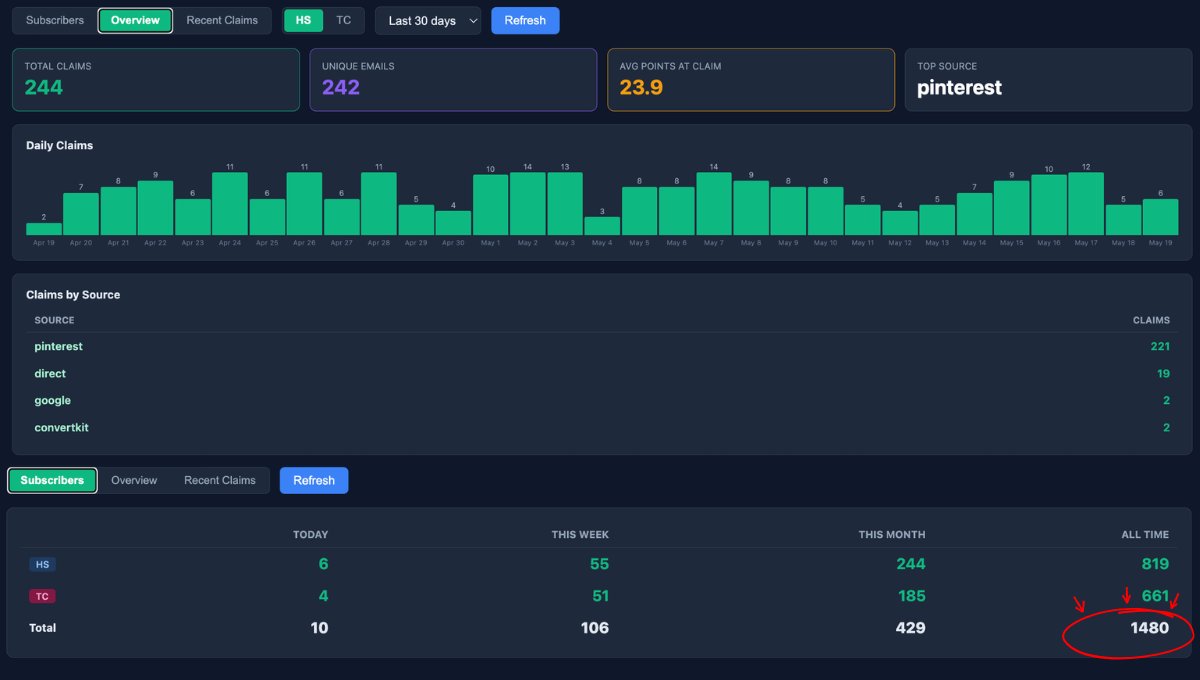
I added 1,480 additional email subscribers simply by adding gamification features to my sites.
Initially, I designed and deployed gamification to increase dwell time. I did not expect that with a single tweak it would be my second best lead source.
What’s gamification?
It’s anything that adds some sort of engagement features on websites. In my case I set up an incentive for visitors who engage in anyway twenty times during a visit they get one of my info-products for free (give their email).
What’s an engagement?
Any tap on an up or down vote, save an article (every visitor has their own library for saved content), emoji responses and of course signing up for the email newsletter.
Why do this?
It’s proven to be one of the best things I added because it adds a tremendous amount of time on site PLUS attracts email subs.
2
2
14
1,747
May 20
The absolute number one skill I’ve developed over the last ten years for writing online is crafting headlines.
There are no exhausted topics. There are only exhausted headlines. Someone could write about productivity and get 12 views. Someone else covers same and gets 400k. The topic didn't change. the angle did. You don't have a content, topic or niche problem. You have a headline problem.
Sorry to break it to you, but “10 tips for X” doesn’t cut it. Yawn.
It’s all about emotional pull and/or creating intrigue. Pull off both in the same headline and you won't have a traffic shortage.
2
2
12
922
May 13
There’s a very simple explanation why some people report working more hours with AI instead of fewer.
In a nutshell, as the cost of inputs (money and/or time) goes down, expected output will increase.
That’s the corporate mindset. Always has been which is why tech seldom results in working less.
I use AI extensively in my publishing business.
I could easily work more hours than I did 5 years ago.
But I don’t.
I work less and earn more thanks to AI.
And that’s because I didn’t increase my expected output. It remains the same. AI saves me time creating it so I end up working less.
How do I earn more if output is the same?
It’s simple. AI helps me make much better content than ever before which earns more from the same visitor volume.
1
10
812
May 13
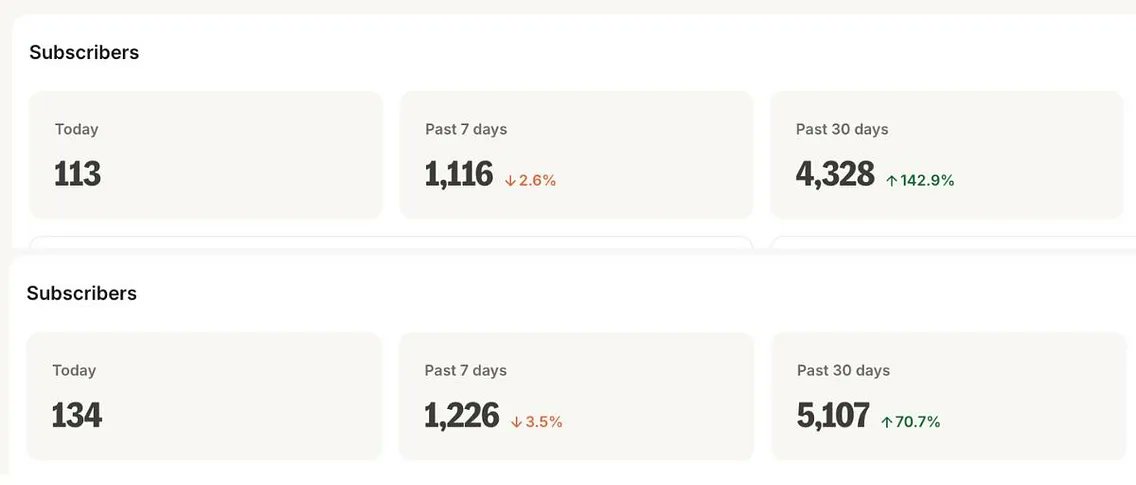
9,435 email subscribers over the past 30 days reveals the following:
Context:
1. Every subscriber signed up to a form that offers to email them the article they were on.
2. Every article was AI-assisted.
3. The two publications are in very different niches.
Conclusion: AI-assisted content can be so good that 9,435 people over the past 30 days were willing to give me their email so that the article they read is emailed to them for future reference.
4
1
25
1,759
May 11
Our fridge broke overnight.
I had to move everything to the basement fridge first thing this morning.
I could dwell on how much of a drag this is and bemoan having to potentially shell out for a new fridge if it can’t be fixed.
I could stew about the fact the repair guy just called and said his vehicle broke down so he’ll be an hour late outside the four hour window he’s supposed to show up.
Or, I can be grateful I have the flexibility to accommodate a changing repair schedule, the fact we have a fridge and a backup fridge, that there are repair people in our area (hopefully talented lol), the funds to pay for said repair all in a home I love.
Silver linings. I try to see them among the clouds.
Sometimes I do. Sometimes I don't.
2
13
991
May 11
Yesterday was a great day off. Not because I don’t like what I do but because I do better at what I love when I take time away from it.
It wasn’t always that way. When starting out I had to forsake recharging time to build. That’s the upfront price to pay.
Now that my publishing system is built, it’s all about constant improvement instead of building.
Building required brute force. Improving requires clarity.
And clarity doesn’t doesn’t materialize as readily when I’ve been glued to a screen all day.
1
4
574
May 10
The boring part of business is also the profitable part.
You find something that works. You do it again. And again.
You resist the urge to pursue some newfangled shiny object.
Then you carve out maybe 10-15% of your time for experiments. New formats, new traffic sources, new monetization angles. Most won't work. A few will. The ones that work get rolled into the humdrum of rinse-and-repeat.
2
11
748
May 8
Somebody asked me recently whether using AI increased productivity for my business and if so, by how much?
My gut response was “yeah, it helps a ton” but then I had to think about the second part of the question… by how much does it help? Can I quantify it?
Yes, I can quantify it by daily content output and quality of that output. The quality is 2x and improving as I improve my systems. The actual increased publishing volume is 4x. That’s not a guess or a gut feeling… it’s that precisely. Before having my fully integrated AI system, I could produce two articles per day on my own. With my system, I’ve done 8 and even 10 some days at a much higher quality.
Moreover, revenue is increasing in line with that increase in output.
So yeah, investing my time and money into building the ideal AI system for my publishing business is not only helping, but it’s now indispensable,
16
1,483