
The analysis and conclusions set forth are those of the authors and do not indicate concurrence by other members of the research staff or the Board of Governors
- Tweets 2,795
- Following 7
- Followers 22,122
- Likes 0
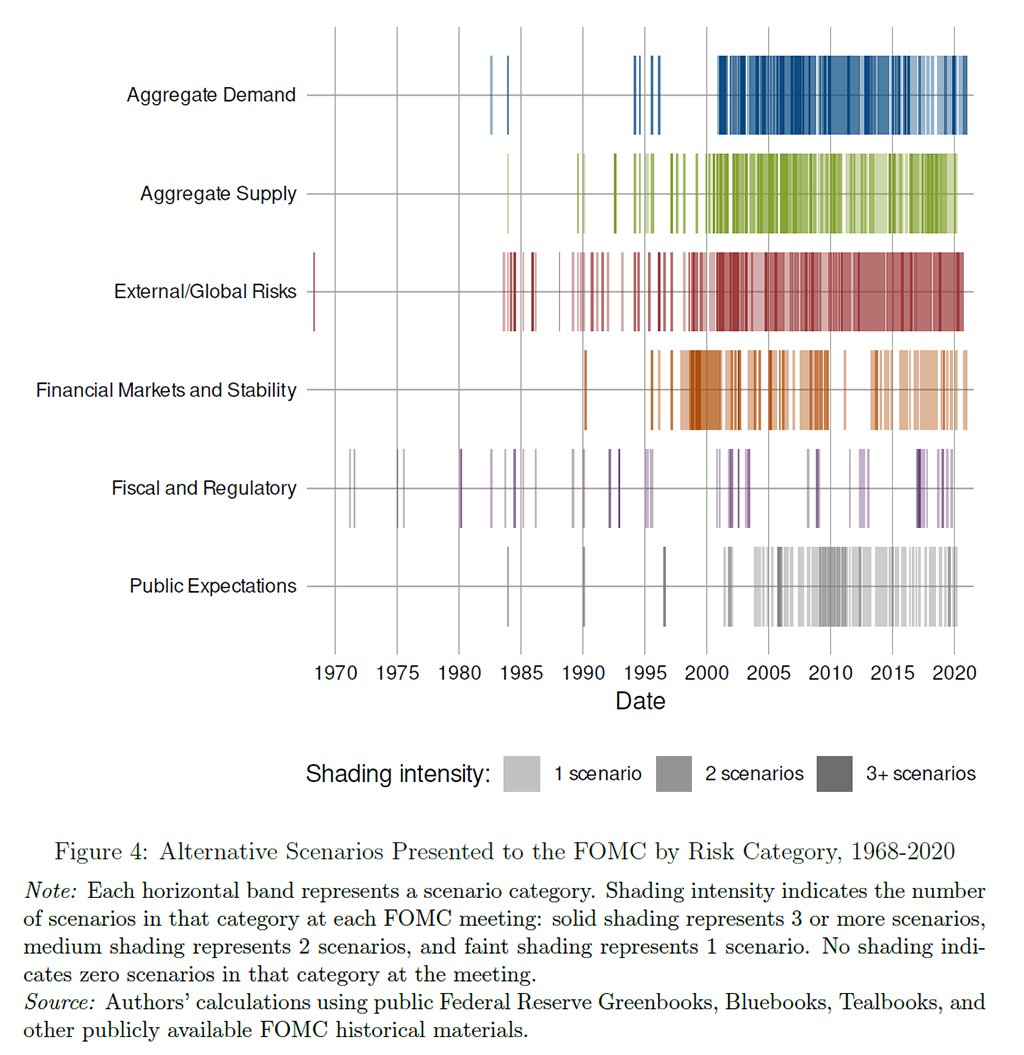
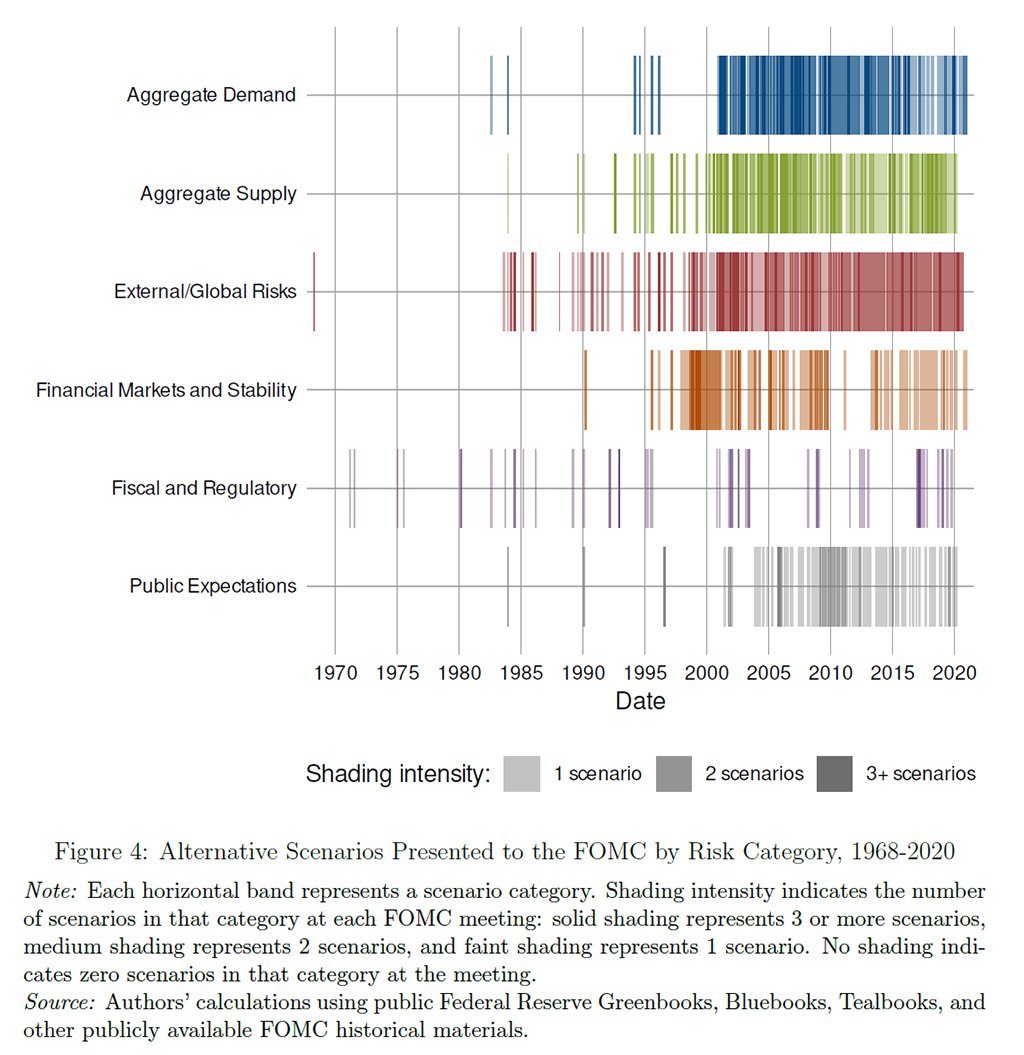

ALT Figure 4: Alternative Scenarios Presented to the FOMC by Risk Category, 1968-2020.] Alt text: Figure 4 reveals how the Federal Reserve's risk assessment evolved over five decades (1968-2020). This visualization tracks six risk categories presented to the FOMC, showing a remarkable increase in scenario planning after 2000. External/Global Risks received the most consistent coverage, while categories like Public Expectations emerged more prominently in recent decades. The varying intensity shows when multiple scenarios were considered simultaneously, reflecting the Fed's increasingly sophisticated approach to economic uncertainty.
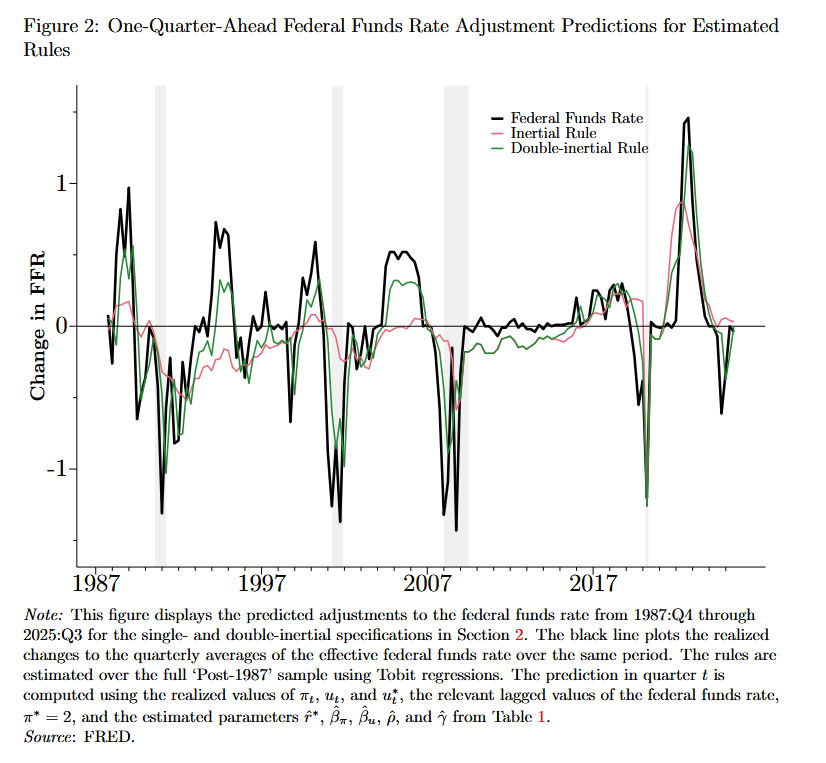
ALT Figure 2: One-Quarter-Ahead Federal Funds Rate Adjustment Predictions for Estimated Rules Line chart showing quarterly Federal Funds Rate changes from 1987-2025. Y-axis (-1.5 to 1.5 percentage points) displays Federal Funds Rate (black), Inertial Rule (pink), and Double-inertial Rule (green). The Federal Funds Rate shows major downward spikes (1990, 2000, 2008, 2020) and upward spikes (1988, 1994, 2022). Prediction rules follow similar patterns with smaller fluctuations. By 2025:Q3, all measures show values near -0.4 percentage points. Note: This figure displays predicted adjustments to federal funds rate (1987:Q1-2025:Q3) for single/double-inertial specifications in Section 2. Black line shows realized changes to quarterly averages of effective federal funds rate. Rules estimated over 'Post-1987' sample using Tobit regressions. Predictions use realized values of πt, ut, ut, relevant lagged values, π=2, and parameters from Table 1. Source: FRED.
ALT Figure 4 reveals how the Federal Reserve's risk assessment evolved over five decades (1968-2020). This visualization tracks six risk categories presented to the FOMC, showing a remarkable increase in scenario planning after 2000. External/Global Risks received the most consistent coverage, while categories like Public Expectations emerged more prominently in recent decades. The varying intensity shows when multiple scenarios were considered simultaneously, reflecting the Fed's increasingly sophisticated approach to economic uncertainty.