
222 Photos and videos
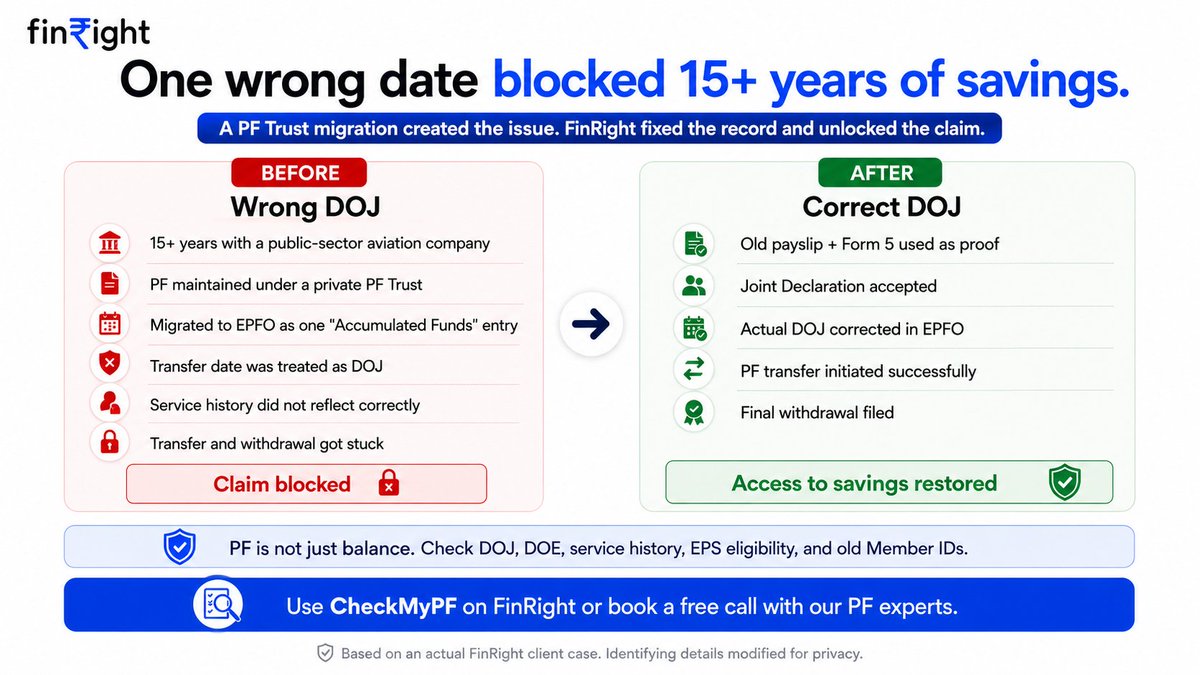







EPFO shows my PF balance, but why can’t I withdraw it? Here’s the part most people miss
Your PF passbook showing ₹5 lakh, ₹10 lakh, or ₹20 lakh does not automatically mean the money is ready to withdraw.
This is the uncomfortable part.
A PF balance can be visible, but still blocked because the file behind it is broken.
Examples:
- Your current UAN shows one balance, but an older employer account was never transferred.
- The previous company was a PF trust, so the EPFO portal does not show the full transfer chain.
- The Date of Exit is missing, so EPFO does not treat the job as closed.
- Your EPS service history is missing, so a transfer is rejected.
- Your bank KYC is approved but the payment still fails due to IFSC/account mismatch.
- Your old employer merged, shut down, or changed its PF code.
This is why many people say:
“EPFO shows the money, but I cannot get it.”
The money is not always lost.
But the route to access it becomes very specific.
The mistake is filing the same claim again and again.
If the claim failed due to a record problem, refiling usually creates another rejection.
Before filing a withdrawal or transfer claim, check these 5 things:
Are all previous member IDs visible under the same UAN?
Has every previous employer marked Date of Exit?
Does the passbook show transfer-in entries from old employers?
Is EPS service visible correctly?
Is your bank KYC verified and active?
A visible balance is not the same as an accessible balance.
If your PF balance is visible but your claim is stuck or rejected, comment your exact EPFO rejection reason below.
We’ll reply and help you understand what the issue usually means and what you may need to check next.
You can also check your PF by using 'CheckMyPF'. Comment or DM for the link.
4
6
18
6,451
Your PF has TWO parts, and most people only know about one.
A complete walkthrough of EPS.
Every month, you contribute 12% of your basic salary to EPF.
Your employer also contributes 12%, but that 12% does not fully go into your EPF corpus.
It is split internally:
8.33% goes to EPS, the Employees’ Pension Scheme
3.67% goes to your EPF corpus
For most members, EPS contribution is calculated within the wage ceiling rules, generally capped at ₹15,000 per month.
Employees who were already EPF/EPS members before 01-Sep-2014 remain eligible for EPS contribution, even if their PF wages later exceed ₹15,000; however, any new EPF member joining on or after 01-Sep-2014 with PF wages above ₹15,000 is not eligible for EPS membership/contribution.
Most employees assume the entire 24% goes into their PF balance.
That is not true.
And this matters more than you think.
Why this matters?
#1: EPS can give you monthly pension at 58
If you complete 10 or more years of eligible pensionable service, even across multiple employers, you may become eligible for monthly pension under EPS.
The formula is:
Pension = Pensionable Salary × Pensionable Service ÷ 70
For example, if your pensionable salary is ₹15,000 and your pensionable service is 25 years:
₹15,000 × 25 ÷ 70 = ₹5,357 per month
This is why your EPS service history matters.
If your PF transfer is incomplete, or your EPS service has gaps, your future pension eligibility can get affected.
Also, EPS pension does not automatically increase every year. So do not assume inflation-linked adjustments. EPFO’s own FAQ states there is no yearly increase in pension amount.
#2: EPS is not withdrawn like EPF
EPF is your accumulated provident fund balance.
EPS is your pension service record.
If your eligible service is less than 10 years, you may be able to claim EPS withdrawal benefit or take a Scheme Certificate through Form 10C.
But once you complete 10 years of eligible service, withdrawal benefit is not permitted. Instead, you are issued a Scheme Certificate, and pension is claimed later as per EPS rules.
This is where many employees get confused.
They withdraw “PF” and assume everything is closed.
But EPS follows separate rules.
#3: Higher pension is not for everyone
Some employees may have heard about the EPS higher pension option.
But this is not a general option available to every EPFO member today.
It mainly applies to eligible members covered under the Supreme Court judgment and EPFO’s validation of joint option process.
For most employees, EPS pension is still calculated using pensionable salary rules and the applicable wage ceiling, unless they qualify under the specific higher pension route.
So before assuming eligibility, check your EPS joining date, wage history, employer contributions, joint option status, and EPFO records.
#4: EPS also matters in death cases
If a contributing EPFO member dies, the family may be eligible for more than just the EPF lump sum.
There may also be:
EPS family pension
Children pension for eligible children
EDLI insurance, if death happened while in service
EPFO’s EPS benefits include widow or widower pension, children pension for up to two children at a time until age 25, orphan pension, disability pension and other family benefits.
This is why families should not stop after claiming only the EPF balance.
What you should actually check
Log in to your EPFO account and check:
Your EPF balance
Your EPS service history
All old Member IDs
Whether old PF transfers were completed
Whether Annexure K is available
Whether EPS service moved correctly
Whether you are eligible for Form 10C, Scheme Certificate, or future pension
Your PF balance is only one part of the story.
Your EPS record decides whether your years of work become a monthly pension later.
Not sure if your EPS service record is clean? Drop your queries in the comments, and we’ll help you figure it out.
2
9
48
8,278
Most people who change jobs don’t lose money because their old PF stops earning interest.
They lose money because they forget that the old PF account exists.
Over time, that account can collect more than just balance. It can also collect transfer issues, KYC mismatches, missing exit dates, EPS errors, and claim rejections.
This usually happens quietly.
Every time you change jobs, a new Member ID may get created under the same UAN. Your latest salary slip only shows your current PF account, so older accounts are easy to ignore.
The money is usually not gone. The real issue is access.
When you finally try to transfer or withdraw it, EPFO may flag old record issues that were never fixed. That is when people panic.
The system is not always broken. It is just opaque. Your old HR may not follow up, your new HR may only open the new account, and EPFO may not clearly warn you that old PF accounts are still pending for transfer.
So the only person who can properly audit your PF is you.
What you should do today:
Log in to the EPFO member portal
Go to “View” and then “Service History”
Check all employment periods
Match each employer with your PF passbook
See whether old PF balances were transferred
Check Aadhaar, PAN, bank, date of exit, and service history
If an old account is not transferred, initiate Form 13 transfer
If the transfer fails, first identify the rejection reason
Your PF is not just a monthly deduction.
It is a retirement asset.
And if you have changed jobs multiple times, there is a good chance your PF record needs a proper check.
Discussion time:
Have you ever checked all your old PF accounts? Did you find any surprises? Share your experience or tips so others can learn from it.
2
3
853
Myth:
Your PF stops earning interest if you are unemployed for 3 years.
Fact:
Your EPF keeps earning interest up to the age of 58.
The “3-year rule” is where most people get confused.
It does not mean:
You left your job at 30 → no PF contribution for 3 years → interest stops.
That is not how it works.
The 3-year rule is linked to an account becoming inoperative after specific events:
1. Retirement
2. Permanent migration abroad
3. Death
The 55-year logic also matters here.
EPFO considers 58 as the key age because it is 36 months after the retirement age of 55.
So the actual takeaway is simple:
Your PF does not stop earning interest just because you were unemployed for 3 years.
But this does not mean you should ignore old PF accounts.
Before withdrawing or forgetting your PF, check whether:
- your old PF is linked to your UAN
- your transfer is completed
- your passbook shows the full amount
- your EPS service is carried forward
- your KYC and exit date are updated
Half-knowledge makes people withdraw PF in panic.
Check your PF before you touch it.
Run a free “CheckMyPF” scan on FinRight. Comment for the link.
#EPFO #ProvidentFund #PFClaim #PersonalFinanceIndia
8
8
33
9,322
If your family is navigating a PF death claim, DM us. We’ll help.
You can also book a free consultation call with our expert.
Share this thread with someone whose family may need it.
#EPFO #EPF #EDLI #EPSPension #FamilyFinance
389