
The world is in peril as a result of information warfare against Western Civilization. Saggezza Eterna defends the West. 🇺🇸🇮🇹🇨🇦🇬🇧
Joined October 2021
- Tweets 180,561
- Following 8,228
- Followers 102,615
- Likes 110,040
9,950 Photos and videos









Pinned Tweet
Luciferian Envy
Why the Left’s Dangerous Jealousy Means They Must Never Hold Power
The left’s frantic, weeping reaction to Elon Musk becoming the world’s first trillionaire exposes something far deeper than mere political disagreement. This is a profound manifestation of the Luciferian impulse.
The modern progressive movement operates on the exact primordial mechanism that defined the fall of the Devil. Lucifer’s original rebellion lacked any noble pursuit of justice; his descent was fueled entirely by a burning, arrogant refusal to tolerate a higher majesty, a greater creator, or a natural hierarchy. He looked upon supreme excellence, and his consuming envy drove him to try to tear it down.
Today, the left acts as the literal ideological descendants of that cosmic sore loser. They look upon Musk’s trillion-dollar monument to American free enterprise and experience a visceral agony. They despise his success because it reflects their own utter insignificance. Like Lucifer, their ultimate desire is to vandalize the exceptional to soothe the pain of their own mediocrity. Watching them cry in jealousy is a truly pathetic spectacle.
This despicable resentment is a tragedy for the children unfortunate enough to be born into liberal households. Parents systematically poison their offspring from infancy, teaching them that hatred of achievement is a virtue. They raise a generation of bitter victims, permanently locking them into a self-imposed prison of eternal failure.
While these despicable midwits choke on the foul air of their own envy, the right celebrates the glory of human greatness. We recognize that true progress belongs to the titans who conquer boundaries, leaving the resentful to weep in the shadows of history.
(Photo: Lucifer is a malicious, cunning and prideful fallen angel who boasts of his mischeveous deeds aimed at corrupting humanity to its core. After being casted away from God's kingdom, he becomes arrogant and devoted in any chance to undermine God’s dominion over humanity by tempting his children, most notably Jesus Christ.)
31
59
131
25,411
Saggezza Eterna retweeted

How moronic are Canadian Liberals?
Well their PM just landed in foreign country
and his first words were:
"its good be home"
Their leader before that is in the USA, cheering on the Team USA, after convincing them to hate the USA.
107
771
3,535
38,006
Saggezza Eterna retweeted
Good morning.
Today is a clean slate to command your focus, guard your energy, and move with absolute intention. The world will try to test your boundaries and distract your mind today—refuse to let it. Stand firm in your center and view every interaction with strategic clarity.
Carry these two powerful truths with you as you step out into the world:
"He who masters his own nature will master the nature of others."
"The world bends for the person who refuses to bend first."
Your strategic directives for today:
Protect your gold: Stop over-giving your time and attention to those who only know how to drain you.
Embrace silence: You don't need to explain your decisions or beg for validation. Move with a calm fire and let your execution speak for itself.
You are the architect of your day. Go become untouchable.
(Photos: La Sagrada Família, Barcelona
Under construction since 1882, this active monument beautifully illustrates the transition from classical stonemasonry to modern architectural engineering.)
Glory to God in the Highest



1
6
30
972
Saggezza Eterna retweeted
If you would like to support my work and arm yourself with the intellectual firepower to see through the regime’s illusions, please join the vanguard:
Direct Support (Buy Me a Coffee): If you simply want to fuel the operation directly, please consider buying me a coffee. Your donations are directly funding my upcoming relocation, allowing me to strike back against the cultural rot from a position of maximum strength.
👉 Support via Buy Me a Coffee:
buymeacoffee.com/saggezza
Saggezza Eterna: Thanks to your phenomenal support, this volume is in the top 100 of its category and sitting on the first page of The Philosophy of Good and Evil. If you want to master the timeless principles of human nature, read the introduction for free on Amazon right now.
👉 Get Saggezza Eterna Here: amazon.com/dp/B0FGXMWRYP
The Prince by Niccolò Machiavelli: This is the foundational text behind the political and power dynamics we dismantle on this page. Banned by the Vatican in 1559 for boldly unmasking the hypocrisy of the ruling elite, this pristine translation preserves the original integrity of the text. Read it cover to cover to completely destroy progressive arguments and elevate your strategic savviness.
👉 Get The Prince Here: amazon.com/dp/B0GF1YG276
Thank you to every single individual standing on the side of truth and supporting this page. Your backing makes this entire operation possible.
I leave you with a timeless truth to carry into the fight:
"If you conquer a city accustomed to self-government and opt not to destroy it you can expect it to destroy you… if the population hasn’t been routed and dispersed so that its freedoms and traditions are quite forgotten, they will rise up to fight for those principles at the first opportunity." ~ Niccolò Machiavelli – born 1469
Fortune favors those who refuse to apologize for their ambition and forge their own path with unwavering resolve.
1
12
1,016
Nailed it!

Things that triggered the left this week:
- a clean reflecting pool
- a name on a building
- a murderer getting convicted of murder
- a sporting event at the White House
- a successful IPO
- welders and janitors becoming millionaires
1
5
777
Saggezza Eterna retweeted

Jun 10
When governments weaponize justice against their own citizens, the ballot is dead. Reclaim the West.
x.com/FinalTelegraph/status/…
Jun 10

THE DEATH OF THE SOCIAL CONTRACT (THREAD 🧵)
THE SYSTEM IS RIGGED, THE BALLOT IS DEAD, AND THE WEST MUST TAKE ITS COUNTRIES BACK
The Western world stands at a terrifying civilizational precipice, facing an existential crisis engineered by a managerial class that views historic nations as borderless economic zones. For decades, citizens have been gaslit into believing that the institutional machinery of representative democracy would eventually self-correct if they just queued quietly at the ballot box. The unsettling truth is that you cannot vote your way out of a system designed to replace you. When the primary mechanisms of state power are weaponized against the very people who built the nation, the traditional social contract is dead. A government that refuses to protect its borders, deliberately imports hostile elements, and criminalizes the natural self-preservation instincts of its native population forfeits its moral legitimacy to govern.
3
64
415
5,894
Luciferian Envy
Why the Left’s Dangerous Jealousy Means They Must Never Hold Power
The left’s frantic, weeping reaction to Elon Musk becoming the world’s first trillionaire exposes something far deeper than mere political disagreement. This is a profound manifestation of the Luciferian impulse.
The modern progressive movement operates on the exact primordial mechanism that defined the fall of the Devil. Lucifer’s original rebellion lacked any noble pursuit of justice; his descent was fueled entirely by a burning, arrogant refusal to tolerate a higher majesty, a greater creator, or a natural hierarchy. He looked upon supreme excellence, and his consuming envy drove him to try to tear it down.
Today, the left acts as the literal ideological descendants of that cosmic sore loser. They look upon Musk’s trillion-dollar monument to American free enterprise and experience a visceral agony. They despise his success because it reflects their own utter insignificance. Like Lucifer, their ultimate desire is to vandalize the exceptional to soothe the pain of their own mediocrity. Watching them cry in jealousy is a truly pathetic spectacle.
This despicable resentment is a tragedy for the children unfortunate enough to be born into liberal households. Parents systematically poison their offspring from infancy, teaching them that hatred of achievement is a virtue. They raise a generation of bitter victims, permanently locking them into a self-imposed prison of eternal failure.
While these despicable midwits choke on the foul air of their own envy, the right celebrates the glory of human greatness. We recognize that true progress belongs to the titans who conquer boundaries, leaving the resentful to weep in the shadows of history.
(Photo: Lucifer is a malicious, cunning and prideful fallen angel who boasts of his mischeveous deeds aimed at corrupting humanity to its core. After being casted away from God's kingdom, he becomes arrogant and devoted in any chance to undermine God’s dominion over humanity by tempting his children, most notably Jesus Christ.)
31
59
131
25,411
Must read: x.com/FinalTelegraph/status/…
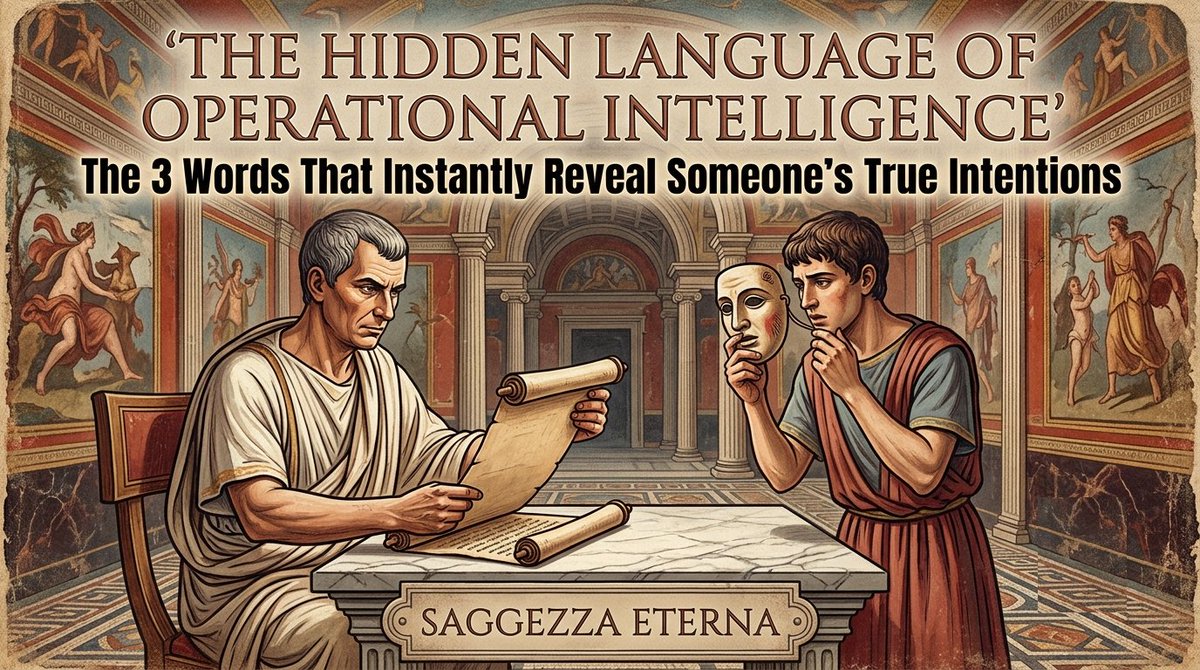
The Hidden Language of Operational Intelligence
The 3 Words That Instantly Reveal Someone's True Intentions (THREAD 🧵)
What I'm about to show you can't be unknown. Once you learn to hear these three words, you'll hear them everywhere: in every conversation, every negotiation, every promise, and every relationship. You'll know instantly what someone actually wants from you versus what they're pretending to want. This isn't a psychology trick, nor is it some self-help framework. This is operational intelligence that has been used by powerful men for over 500 years to separate truth from performance.
Niccolò Machiavelli understood this when he wrote The Prince in 1513. He wasn't just writing about political strategy; he was documenting how Renaissance princes detected lies, identified false advisers, and read intentions through the language people used. The same patterns he observed in the courts of Florence exist in every conversation you have today. The same linguistic tells that reveal the courtier's true loyalty reveal your co-worker's real intentions. The same verbal weapons that ambitious nobles used to manipulate princes are being used on you right now.
Your grandfather might have known this; his grandfather definitely did. But somewhere along the way, they stopped teaching it because men who can read intentions are harder to manipulate, harder to control, and harder to use. I'm going to give you three words. They are not complicated or obscure; they are words you've heard a thousand times and never registered what they actually mean. But once you understand what these words reveal about the person saying them, you'll never be lied to the same way again. You'll never be blindsided. You'll never wonder why someone betrayed you because you'll have seen it coming the moment they opened their mouth. This is forbidden knowledge—not because it's illegal, but because it's dangerous to people who profit from your ignorance. Last chance to stop reading. Still here? Good. Let's begin...
1
1
3
710
Just so everyone knows, @elonmusk does not have all your money... The government does.
11
47
609
Why the Left’s Dangerous Jealousy Destroys Their Right to Rule
x.com/FinalTelegraph/status/…
Luciferian Envy
Why the Left’s Dangerous Jealousy Means They Must Never Hold Power
The left’s frantic, weeping reaction to Elon Musk becoming the world’s first trillionaire exposes something far deeper than mere political disagreement. This is a profound manifestation of the Luciferian impulse.
The modern progressive movement operates on the exact primordial mechanism that defined the fall of the Devil. Lucifer’s original rebellion lacked any noble pursuit of justice; his descent was fueled entirely by a burning, arrogant refusal to tolerate a higher majesty, a greater creator, or a natural hierarchy. He looked upon supreme excellence, and his consuming envy drove him to try to tear it down.
Today, the left acts as the literal ideological descendants of that cosmic sore loser. They look upon Musk’s trillion-dollar monument to American free enterprise and experience a visceral agony. They despise his success because it reflects their own utter insignificance. Like Lucifer, their ultimate desire is to vandalize the exceptional to soothe the pain of their own mediocrity. Watching them cry in jealousy is a truly pathetic spectacle.
This despicable resentment is a tragedy for the children unfortunate enough to be born into liberal households. Parents systematically poison their offspring from infancy, teaching them that hatred of achievement is a virtue. They raise a generation of bitter victims, permanently locking them into a self-imposed prison of eternal failure.
While these despicable midwits choke on the foul air of their own envy, the right celebrates the glory of human greatness. We recognize that true progress belongs to the titans who conquer boundaries, leaving the resentful to weep in the shadows of history.
(Photo: Lucifer is a malicious, cunning and prideful fallen angel who boasts of his mischeveous deeds aimed at corrupting humanity to its core. After being casted away from God's kingdom, he becomes arrogant and devoted in any chance to undermine God’s dominion over humanity by tempting his children, most notably Jesus Christ.)
1
3
5
465
Saggezza Eterna retweeted
Top Tren de Aragua leader killed in US military strike, President Trump announces
The surgical elimination of Tren de Aragua leader Niño Guerrero is a lethal reality check for the architects of open-border policies. For years, bureaucratic elites laundered border chaos as humanitarian virtue. The predictable result was the domestic expansion of a violent transnational syndicate, forcing innocent citizens to pay the price for state negligence.
Sovereignty is defined by the unyielding protection of a nation's people and an absolute monopoly on force. This decisive military strike completely shatters the narrative that aggressive immigration enforcement is a moral overreach. Instead, it demonstrates that true internal security requires tactical dominance rather than endless bureaucratic hand-wringing.
When a government allows foreign criminal networks to embed themselves within domestic suburbs, mass deportation ceases to be a political debate. It becomes an immediate prerequisite for national survival. The neutralization of Guerrero proves that safety is restored through raw, decisive execution, exposing the deadly illusion of soft-on-crime globalism.
2
17
66
1,103
Saggezza Eterna retweeted
Luciferian Envy
Why the Left’s Dangerous Jealousy Means They Must Never Hold Power
The left’s frantic, weeping reaction to Elon Musk becoming the world’s first trillionaire exposes something far deeper than mere political disagreement. This is a profound manifestation of the Luciferian impulse.
The modern progressive movement operates on the exact primordial mechanism that defined the fall of the Devil. Lucifer’s original rebellion lacked any noble pursuit of justice; his descent was fueled entirely by a burning, arrogant refusal to tolerate a higher majesty, a greater creator, or a natural hierarchy. He looked upon supreme excellence, and his consuming envy drove him to try to tear it down.
Today, the left acts as the literal ideological descendants of that cosmic sore loser. They look upon Musk’s trillion-dollar monument to American free enterprise and experience a visceral agony. They despise his success because it reflects their own utter insignificance. Like Lucifer, their ultimate desire is to vandalize the exceptional to soothe the pain of their own mediocrity. Watching them cry in jealousy is a truly pathetic spectacle.
This despicable resentment is a tragedy for the children unfortunate enough to be born into liberal households. Parents systematically poison their offspring from infancy, teaching them that hatred of achievement is a virtue. They raise a generation of bitter victims, permanently locking them into a self-imposed prison of eternal failure.
While these despicable midwits choke on the foul air of their own envy, the right celebrates the glory of human greatness. We recognize that true progress belongs to the titans who conquer boundaries, leaving the resentful to weep in the shadows of history.
(Photo: Lucifer is a malicious, cunning and prideful fallen angel who boasts of his mischeveous deeds aimed at corrupting humanity to its core. After being casted away from God's kingdom, he becomes arrogant and devoted in any chance to undermine God’s dominion over humanity by tempting his children, most notably Jesus Christ.)
31
59
131
25,411
Saggezza Eterna retweeted
"actoulmonde" just became a monthly supporter of Nicola Rolando Francesco on @buymeacoffee! 🎉
Your message means an incredible amount to me.
To hear that my work is helping you find new clarity and a deeper understanding of the world is profoundly humbling. Knowing that these insights resonate with you gives immense purpose to why I analyze these dynamics.
Thank you so much for standing with me and being a vital part of this journey.
Warm regards,
Nicola
You can support by buying a pizza🍕 here — buymeacoffee.com/saggezza/t/…
1
2
588
Saggezza Eterna retweeted
The Hidden Language of Operational Intelligence
The 3 Words That Instantly Reveal Someone's True Intentions (THREAD 🧵)
What I'm about to show you can't be unknown. Once you learn to hear these three words, you'll hear them everywhere: in every conversation, every negotiation, every promise, and every relationship. You'll know instantly what someone actually wants from you versus what they're pretending to want. This isn't a psychology trick, nor is it some self-help framework. This is operational intelligence that has been used by powerful men for over 500 years to separate truth from performance.
Niccolò Machiavelli understood this when he wrote The Prince in 1513. He wasn't just writing about political strategy; he was documenting how Renaissance princes detected lies, identified false advisers, and read intentions through the language people used. The same patterns he observed in the courts of Florence exist in every conversation you have today. The same linguistic tells that reveal the courtier's true loyalty reveal your co-worker's real intentions. The same verbal weapons that ambitious nobles used to manipulate princes are being used on you right now.
Your grandfather might have known this; his grandfather definitely did. But somewhere along the way, they stopped teaching it because men who can read intentions are harder to manipulate, harder to control, and harder to use. I'm going to give you three words. They are not complicated or obscure; they are words you've heard a thousand times and never registered what they actually mean. But once you understand what these words reveal about the person saying them, you'll never be lied to the same way again. You'll never be blindsided. You'll never wonder why someone betrayed you because you'll have seen it coming the moment they opened their mouth. This is forbidden knowledge—not because it's illegal, but because it's dangerous to people who profit from your ignorance. Last chance to stop reading. Still here? Good. Let's begin...
4
16
28
2,012
Saggezza Eterna retweeted
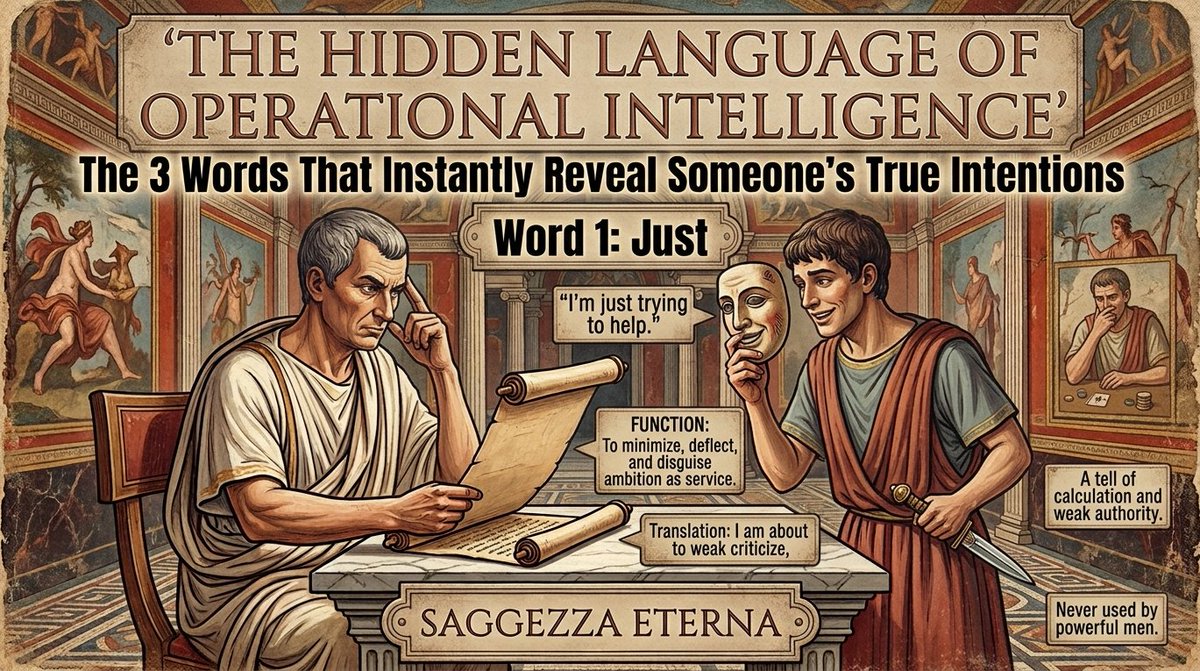
Word 1: Just
The first word is simple. You hear it every day, and you probably use it yourself without thinking. The word is just. As in: "I'm just trying to help," "I'm just saying," "It's just a suggestion," "I was just wondering," or "Can I just ask you something?" It sounds harmless, right? Polite, even humble. It's not.
Machiavelli wrote extensively about the danger of advisers who minimize their own ambitions while advancing them. In The Prince, he warned that the most dangerous courtiers are those who appear humble while maneuvering for power. Just is the modern equivalent of what Machiavelli called false modesty. It's a verbal weapon that courtiers used in Renaissance Florence and that people use on you today.
Here's what just does: it minimizes. It makes whatever comes after it seem smaller, less important, and less threatening than it actually is. When someone says, "I'm just trying to help," what they're really saying is, "I'm about to criticize you, control you, or impose my will on you, but I'm framing it as assistance so you can't object without seeming ungrateful." Machiavelli observed this exact pattern in advisers who would approach princes with, "I merely suggest," or "I only wish to offer counsel." The word merely, the word only, and the word just all serve the same function: to disguise ambition as service.
When someone says, "I'm just saying," what they mean is, "I'm about to say something I know you won't like, and I'm preemptively deflecting your reaction by making it seem casual and unimportant." When someone says, "Can I just ask you something?" they're not asking for permission; they're softening an intrusion. They're going to ask regardless. The just is there to make you feel like saying no would be unreasonable. Just is the verbal equivalent of a knife hidden behind a smile.
Machiavelli understood that powerful men must learn to see through this disguise. In chapter 22 of The Prince, he writes about how to choose ministers and advisers. One of his key tests is whether this person speaks directly or constantly softens their words to avoid accountability. A good adviser speaks plainly. They say, "This policy will fail. This alliance is dangerous. This decision is wrong." A false adviser says, "I just think we might want to consider... I'm just wondering if perhaps... It's just that I'm slightly concerned." The difference? The good adviser is willing to be held accountable for their counsel. The false adviser is protecting themselves. They want influence without responsibility; they want to guide your decisions while maintaining plausible deniability if things go wrong.
Now, here's why this matters for power dynamics. People who use just frequently are doing one of two things: either they're trying to slip something past your defenses by making it seem harmless, or they're positioning themselves as non-threatening when they're actually calculating. Watch for it in negotiations. Watch for it in relationships. Watch for it in any situation where someone wants something from you.
"I just think it would be better if..." Translation: I want you to do what I want, but I'm disguising my demand as a mild opinion.
"I'm just checking in." Translation: I'm monitoring you because I don't trust you, but I'm calling it concern.
"It's just that..." Translation: Here comes the real objection I've been holding back, but I'm introducing it like it's a minor thing.
The word just is a tell, like a poker player touching their face when they're bluffing. Once you start listening for it, you'll realize how often people use it when they're being manipulative.
Now, here's the critical part: watch who never uses just. Powerful men don't soften their words. They don't minimize their statements. They don't apologize for taking up space or making demands. Machiavelli observed that true princes speak with clarity and directness. They don't hedge or qualify; they state what they want and expect it to be done. When a man says, "I need this done by Friday," that's direct, clear, and honest about intention. When a man says, "I just need this done by Friday," he's either unsure of his authority or he's trying to manipulate you into compliance by making it seem like a small request when it's not.
Men who understand power don't use just because they don't need to hide their intentions. They're comfortable being direct and comfortable with you knowing exactly what they want. Men who use just are either weak and seeking permission for everything they say, or they're predatory and disguising their true intentions behind false humility. Either way, it's a red flag.
Here's how you use this knowledge: when someone hits you with just, stop. Before you respond, translate what they actually said by removing the word. "I'm just trying to help" becomes "I'm trying to control you." "I'm just wondering" becomes "I'm demanding to know." "Can I just..." becomes "I'm going to regardless of your answer." Now, respond to what they actually meant, not what they pretended to say.
Machiavelli would have called this cutting through the veil of words to see the intention beneath. In his letters, he repeatedly advised princes to judge men not by their words, but by their actions and the structure of their language. Most people won't even realize you caught them, but you'll have positioned yourself correctly in the interaction because you understood the real intention from the first word. That's the power of just. One word reveals everything.
1
6
18
635
Saggezza Eterna retweeted
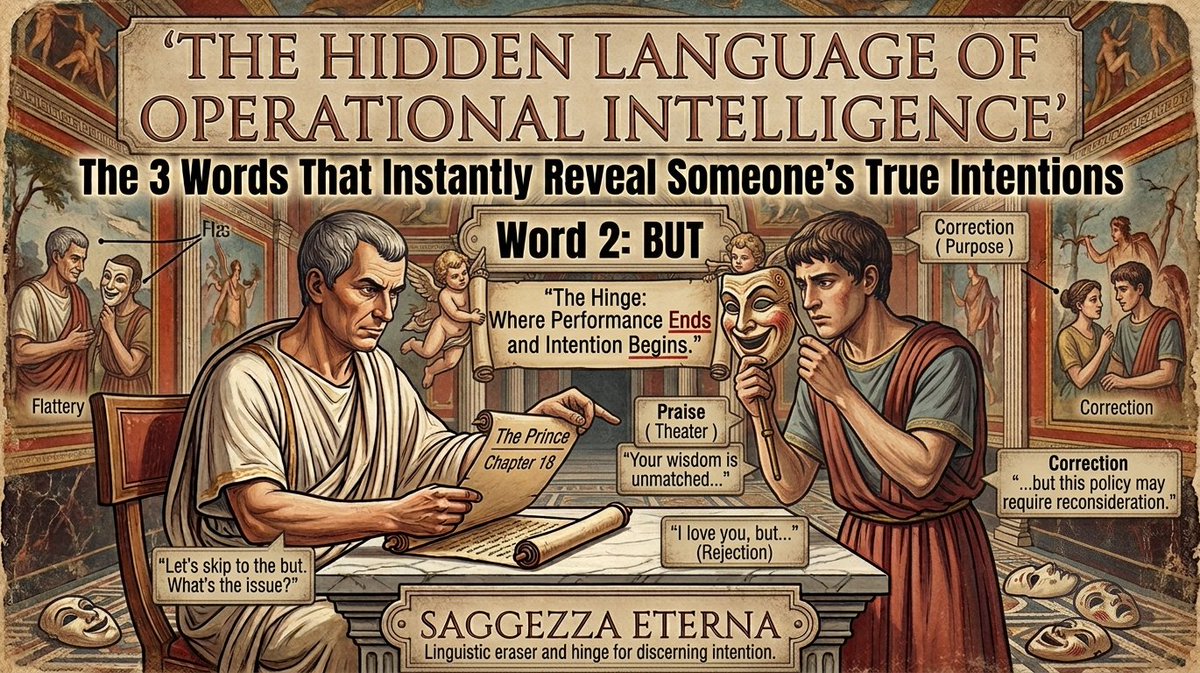
Word 2: But
The second word is even more common. You've heard it your entire life, and you've probably been lied to with it more times than you can count. The word is but. Everything before but is a lie; everything after but is the truth. Let me say that again because this is one of the most important things you'll ever learn about human communication: everything before but is performance; everything after but is intention.
Machiavelli understood this perfectly. In The Prince, he wrote about how men say one thing to your face and mean another in their hearts. He observed that courtiers would praise a prince's wisdom, his generosity, and his strength, and then introduce but to deliver the message they actually came to say. "Your highness is most generous, but the treasury grows empty. Your wisdom is unmatched, but this policy may require reconsideration. You are a great leader, but perhaps this decision was hasty." The praise is theater; the correction is the purpose of the conversation.
This pattern exists in every relationship today.
"I love you, but..." Translation: I don't love you enough to accept what comes next.
"I respect your opinion, but..." Translation: I don't respect your opinion, and here's why you're wrong.
"I'd love to help, but..." Translation: I'm not helping, and here's my excuse.
"You're a great guy, but..." Translation: You're not what I want, and here's the rejection.
The word but negates everything that came before it. It's a linguistic eraser. Whatever was said in the first half of the sentence was just a setup for the real message in the second half.
Here's what makes this so powerful: most people don't realize they're doing it. They genuinely believe they're being nice by softening the blow with a compliment or agreement before delivering the truth. But you need to understand what's actually happening. The first part of the sentence is social lubrication. It's there to make the second part easier to swallow. It's manipulation disguised as politeness. Machiavelli called this necessary deception.
In chapter 18 of The Prince, he writes that a wise prince must know how to appear as one thing while doing another. But he also warns that a prince must be able to detect when others are using this same tactic against him. When someone says, "I appreciate everything you've done, but we're going in a different direction," they're not appreciating anything—they're firing you. The appreciation is fake; the firing is real. When someone says, "I think you're amazing, but I'm not ready for a relationship," they don't think you're amazing. If they did, they'd be ready. The compliment is fake; the rejection is real. When someone says, "I hear what you're saying, but here's what I think," they didn't hear anything. They were waiting for you to finish so they could say what they already decided. The acknowledgment is fake; their dismissal is real. But is a hinge. It's where the performance ends and the truth begins.
Now, here's how this plays into power dynamics. Powerful men don't use but to soften their message. They deliver the truth directly because they're not afraid of how you'll react. Machiavelli advised princes to be direct in their communications, especially when delivering bad news or making difficult decisions. A prince who hides his intentions behind compliments and qualifiers appears weak and loses respect. They don't say, "I think you're talented, but you're not right for this position." They say, "You're not right for this position." No fake compliment, no softening—just the truth. They don't say, "I'd like to help, but I can't right now." They say, "I can't help you." Direct, honest, and clear.
When a man uses but constantly, he's either weak and afraid of confrontation, or he's manipulative and using fake agreement to slip his real intentions past your defenses. Neither is someone you want to trust. Watch for but in negotiations. Watch for it in relationships. Watch for it in any situation where someone's trying to let you down easy or disagree with you without seeming disagreeable. The moment you hear but, everything that came before it was theater. The real message is coming now.
And here's the tactical application: when someone uses but, interrupt them mentally. Cross out everything they said before it and listen only to what comes after. "I really value our friendship, but I need some space" becomes "I need space." That's it; that's the whole message. The friendship value was fake. "I think you're qualified, but we're looking for someone with more experience" becomes "We're not hiring you." That's the decision. The qualification acknowledgment was performance.
Once you strip away the performance and hear only the intention, you can respond to reality instead of the sugar-coated version they're selling you. Machiavelli would call this reading the substance beneath the style. He believed that princes who focused on how things were said rather than what was actually meant were destined to be manipulated by cleverer men. Most people respond to the first half of the sentence because it's nicer. They argue with the compliment or try to prove they deserve the validation that was just fake bait. You're not going to do that anymore. You're going to ignore everything before but and respond only to what comes after, because that's where the truth lives.
And here's the dominance move: when someone tries to soften a blow with but, you can cut through it immediately. They say, "I think you did great work on this, but..." You say, "Let's skip to the but. What's the issue?" Watch their face. They weren't expecting you to see through the game. They were counting on you accepting the compliment and being easier to manage when the real message lands. But you didn't fall for it. You went straight to the truth, and now they know you're not someone who can be managed with verbal tricks. Machiavelli called men who could do this discerning princes—men who could separate flattery from counsel, performance from truth, words from intentions. That's power. One word changes everything.
1
6
10
552
Saggezza Eterna retweeted
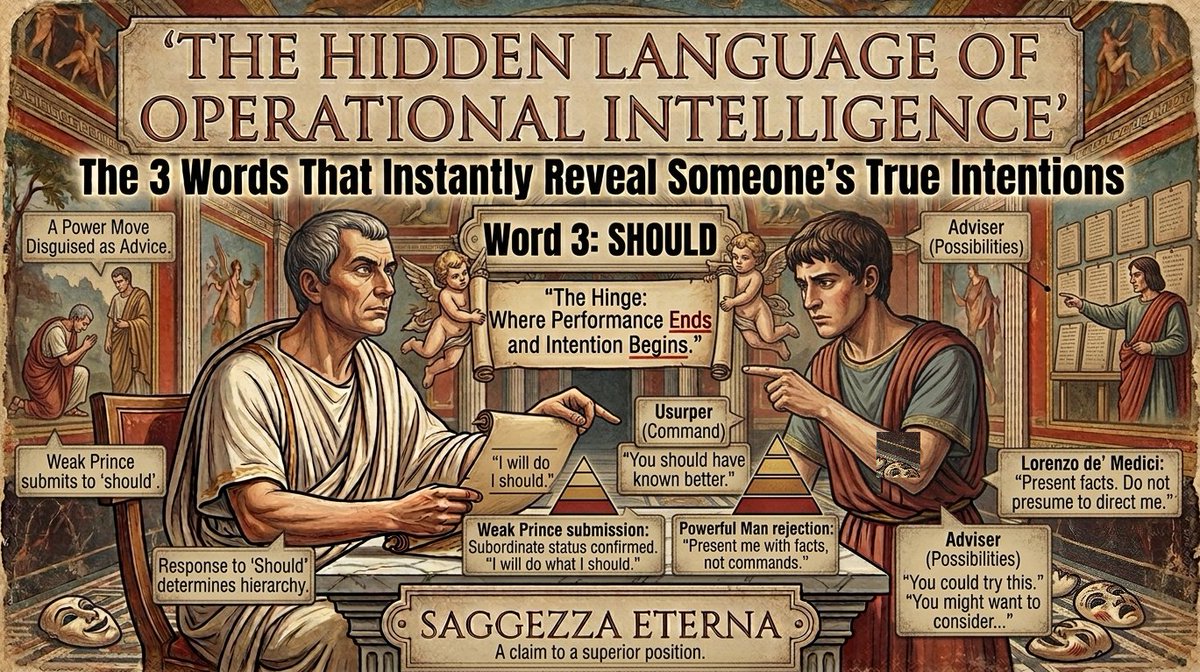
Word 3: Should
The third word is the most dangerous of all because it doesn't just reveal someone's intentions toward you; it reveals whether they see themselves as above you in the hierarchy. The word is should. "You should do this," "You should have known better," "You should consider," or "You should really think about..." Every time someone tells you what you should do, they're positioning themselves as your authority. They're claiming the right to tell you how to live, what to decide, and what to think. And here's the critical part: they're doing it without earning that authority. They're just assuming it.
Machiavelli wrote extensively about this in The Prince. One of his most important observations was that a prince must never allow his ministers or advisers to believe they have authority over his decisions. The moment they start telling him what he should do rather than presenting options for him to choose, they've stopped being advisers and started being usurpers. Should is a power move disguised as advice. When someone says, "You should," what they're really saying is, "I know better than you what's good for you, and you should submit to my judgment." That might be true. Maybe they do know better; maybe they have more experience, more wisdom, and more perspective. But if they were actually trying to help you, they wouldn't use should. They'd use could or might want to consider. "You could try this" offers a possibility; it respects your autonomy. "You should try this" issues a command; it assumes obedience. The difference is massive, and it reveals everything about how that person sees you and themselves.
Machiavelli observed that in Renaissance courts, the use of should was a political statement. When an advisor said to a prince, "You should make peace with Florence," or "You should raise taxes," they were testing the prince's authority. They were checking whether the prince would accept being directed or whether he would assert his own judgment. Weak princes accepted the should and did what they were told. Strong princes heard the should and either ignored it or corrected the advisor: "I will consider it," or "You may present your reasoning, but I will decide." The response to should determines the hierarchy. People who use should constantly are either trying to control you or they genuinely believe they're superior to you and therefore entitled to direct your behavior. Either way, it's disrespect.
Watch for should in relationships. When someone tells you what you should do, should feel, should want, or should think, they're not respecting you as an equal. They're treating you as subordinate, as someone who needs their guidance, and as someone who can't be trusted to make their own decisions. If you accept it—if you do what they say just because they said you should—you've confirmed their frame. You've agreed that they're above you in the hierarchy and that you need their approval to act. That's how should works: it's a test. It's checking whether you'll submit to their authority.
Now, here's how powerful men handle should. They don't use it downward unless they actually have authority. A father can tell his son, "You should," because the relationship grants that authority. A boss can tell an employee, "You should," because the structure grants that authority. But watch what happens when someone tries to should a man who hasn't granted them authority: they get shut down immediately.
Machiavelli documented this in his observations of Lorenzo de' Medici. When advisors tried to tell Lorenzo what he should do, he would respond by reminding them that their role was to inform, not command. "Present me with facts. Give me your counsel, but do not presume to direct me." When they countered with, "You should really reconsider this decision," he answered, "I'll consider what I want to consider." No submission, no acceptance of their frame—just a reminder that they don't have the authority they're claiming.
Here's the critical skill: when someone tries to should you, ask yourself, "Have I granted this person authority over my decisions? Am I subordinate to them in this context?" If the answer is no, their should is an attack. It's an attempt to claim power they don't have.
Your response options are straightforward. Option one: ignore it completely. Don't even acknowledge they tried to tell you what to do. This communicates that their opinion doesn't register as something you need to consider. Option two: reframe it. Say, "I appreciate your perspective," then do what you were going to do anyway. This acknowledges they spoke while making it clear their words had no impact on your decision. Option three: reject it directly. "I didn't ask for advice." This is nuclear; use it only when someone has repeatedly tried to claim authority they don't have and needs to be put in their place.
Machiavelli would recognize all three of these as prince-like responses—responses that maintain hierarchy, responses that remind the other person of their actual position relative to you. Most people never even notice how often they're being shoulded. They just feel vaguely controlled, vaguely disrespected, and vaguely like everyone around them thinks they're incompetent. That's because they are being controlled. People are constantly trying to position themselves above you using should, and if you don't recognize it and reject it, you've accepted subordinate status by default.
Once you start listening for should, you'll realize how often people do it. Friends, family, partners, co-workers—everyone is constantly trying to tell you what you should do, should think, and should feel. Most of them don't even realize they're doing it; they think they're being helpful. But the impulse to tell someone what they should do comes from the belief that you know better than they do. And that belief, whether conscious or not, is a claim to a superior position.
Now, here's how you flip this: notice who never uses should with you. Notice who offers possibilities instead of directives, and who respects your autonomy even when they disagree with your choices. Those are the people who see you as an equal. Those are the people whose advice you can actually trust because it's not wrapped in a power play. Everyone else? They're trying to manage you, control you, and position themselves above you. Now you know. The moment they say should, you know exactly what's happening and you can respond accordingly. Machiavelli built an entire political philosophy on this understanding: know who respects your authority and who seeks to undermine it, and you can navigate any court, any organization, or any relationship structure successfully. That's the third word, and now you have all three.
2
9
18
596
Saggezza Eterna retweeted
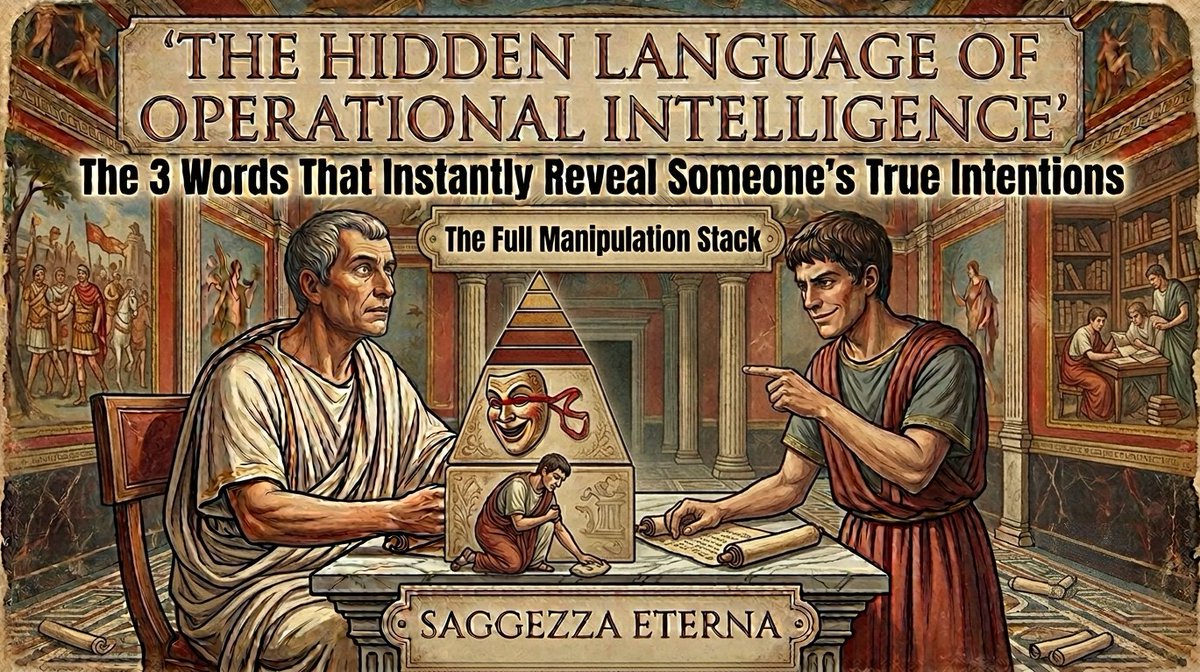
The Full Manipulation Stack
So, you've got three words now: just, but, and should. Individually, they reveal intention. Together, they're a complete map of how someone sees you and what they're actually trying to do in a conversation. Listen for all three in the same interaction. When someone uses all three, you're dealing with someone who's trying very hard to manipulate you while appearing harmless.
Take this sentence for example: "I'm just saying, I think you're doing great, but you should really consider a different approach." Translation: I'm minimizing my criticism so you won't get defensive. I'm fake complimenting you to soften the blow. And I'm claiming authority to tell you what to do. That's a full manipulation stack. Once you hear it, you can't unhear it.
Machiavelli would have recognized this immediately as the language of a courtier trying to manipulate a prince while maintaining plausible loyalty. This is exactly the pattern he warned about in The Prince—men who appear to serve while actually seeking to control.
Most people respond to the surface. They hear friendliness, concern, and helpfulness; they don't hear the calculation underneath. You're not most people anymore. You hear the just and know they're hiding their real intention behind false modesty. You hear the but and know the compliment was theater masking the real message. You hear the should and know they're testing whether you'll submit to their claimed authority. Now you respond to what's actually happening, not what they're pretending is happening.
And that's power. That's the difference between men who get used and men who see it coming and shut it down before it starts. This is what Machiavelli taught. This is what Renaissance princes learned to survive in courts full of ambitious men who smiled while plotting. This is what your grandfather might have known and what powerful men have always understood.
Three words: just, but, should. You'll hear them everywhere in every conversation, every negotiation, and every relationship. The moment you do, you'll know. You'll know who's trying to manipulate you, who's lying to you, who's claiming authority they don't have, who sees you as subordinate, and who's performing versus who's being direct. Most men go their entire lives being justed, butted, and shoulded without ever realizing they're being managed, controlled, and used. You won't, because now you know what these words actually mean, and you can never unhear them. This is what Machiavelli documented 500 years ago. This is operational intelligence that powerful men have always used to separate truth from performance. And now, it's yours. Use it.
2
5
12
473
Saggezza Eterna retweeted
If you would like to support my work and arm yourself with the intellectual firepower to see through the regime’s illusions, please join the vanguard:
Direct Support (Buy Me a Coffee): If you simply want to fuel the operation directly, please consider buying me a coffee. Your donations are directly funding my upcoming relocation, allowing me to strike back against the cultural rot from a position of maximum strength.
👉 Support via Buy Me a Coffee:
buymeacoffee.com/saggezza
Saggezza Eterna: Thanks to your phenomenal support, this volume is in the top 100 of its category and sitting on the first page of The Philosophy of Good and Evil. If you want to master the timeless principles of human nature, read the introduction for free on Amazon right now.
👉 Get Saggezza Eterna Here: amazon.com/dp/B0FGXMWRYP
The Prince by Niccolò Machiavelli: This is the foundational text behind the political and power dynamics we dismantle on this page. Banned by the Vatican in 1559 for boldly unmasking the hypocrisy of the ruling elite, this pristine translation preserves the original integrity of the text. Read it cover to cover to completely destroy progressive arguments and elevate your strategic savviness.
👉 Get The Prince Here: amazon.com/dp/B0GF1YG276
Thank you to every single individual standing on the side of truth and supporting this page. Your backing makes this entire operation possible.
I leave you with a timeless truth to carry into the fight:
"If you conquer a city accustomed to self-government and opt not to destroy it you can expect it to destroy you… if the population hasn’t been routed and dispersed so that its freedoms and traditions are quite forgotten, they will rise up to fight for those principles at the first opportunity." ~ Niccolò Machiavelli – born 1469
Fortune favors those who refuse to apologize for their ambition and forge their own path with unwavering resolve.
3
10
725