Visit financialmodelslab.com to find 3,500 Financial Model Excel and Business Plan Templates
Joined December 2016
- Tweets 19,673
- Following 424
- Followers 349
- Likes 6
19,614 Photos and videos
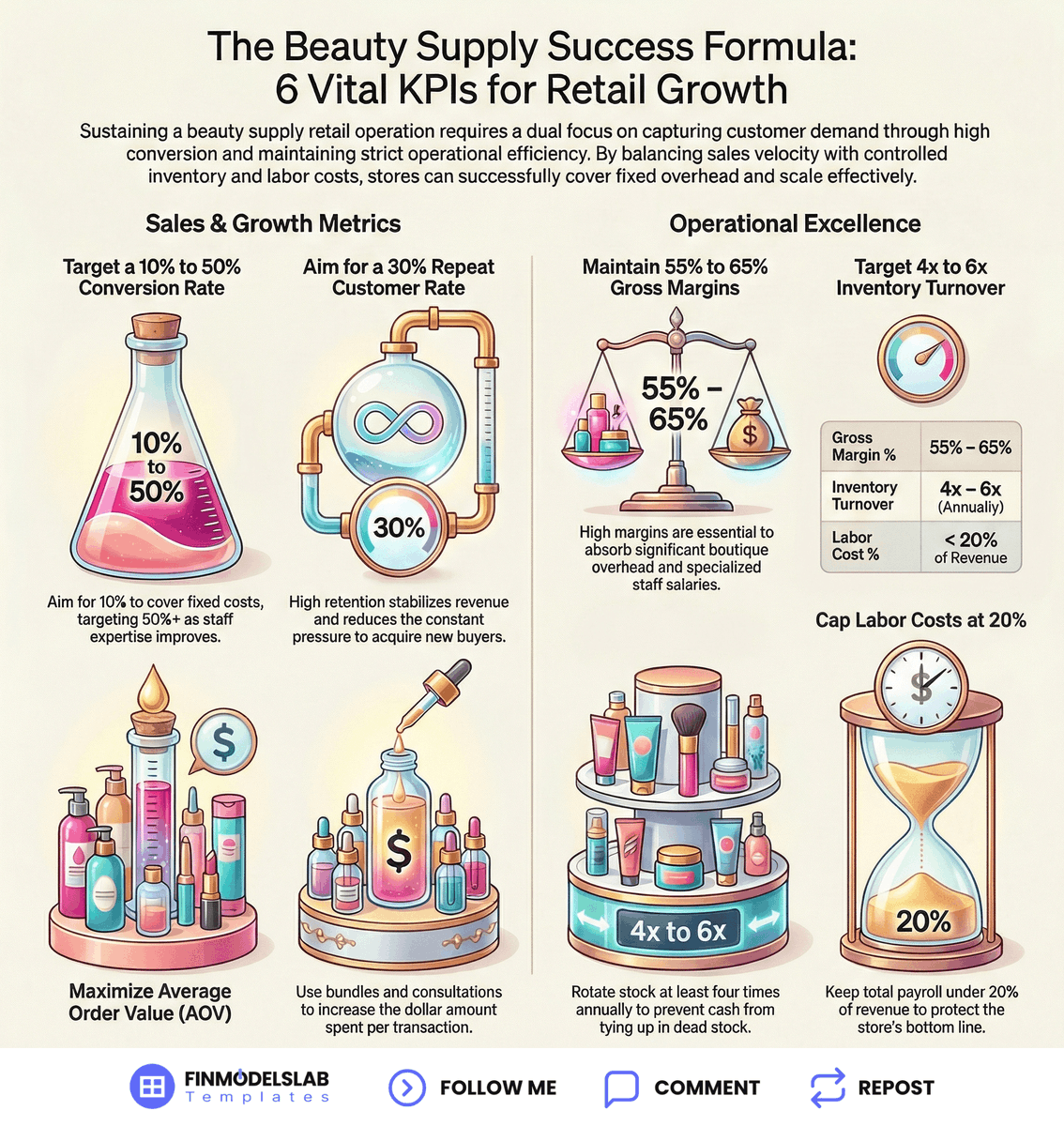

275 daily orders is your survival threshold.
Hit this target to cover $197k in monthly overhead.
This guide outlines the seven core operational and financial metrics required to manage a Beauty Supply Store based on our internal KPI table.
7 CRITICAL PERFORMANCE METRICS FOR A BEAUTY SUPPLY STORE:
• Visitor-to-Buyer Conversion Rate: Measures store effectiveness — Review weekly — Drives sales staff performance and 100% target.
• Average Order Value (AOV): Measures upsell success — Review weekly — Drives product placement and $2970 target bundles.
• Gross Margin Percentage (GM%): Measures product profitability — Review monthly — Drives pricing strategy to maintain 860% or higher.
• Repeat Customer Rate (RCR): Measures loyalty — Review monthly — Drives CRM effectiveness to reach the 300% Year 1 target.
• Inventory Turnover Ratio (ITR): Measures efficiency — Review quarterly — Drives purchasing to hit 4x to 6x annual turns.
• Labor Cost Percentage (LCP): Measures staffing efficiency — Review monthly — Drives management of the $12,708 average monthly wage.
• Breakeven Orders Per Day: Measures sustainability — Review monthly — Drives the push for 275 orders to cover fixed overhead.
If you remember one thing, monitor your breakeven daily to ensure your 275 orders cover the $197k monthly fixed costs.
Comment 'KPI' and I’ll send the full KPI table
#BeautySupplyStore #KPI #BusinessMetrics #Operations #Profitability
Visit to learn more: f.mtr.cool/sduoxtbvqr
11
Want a more profitable beauty salon?
Focus on these seven performance metrics.
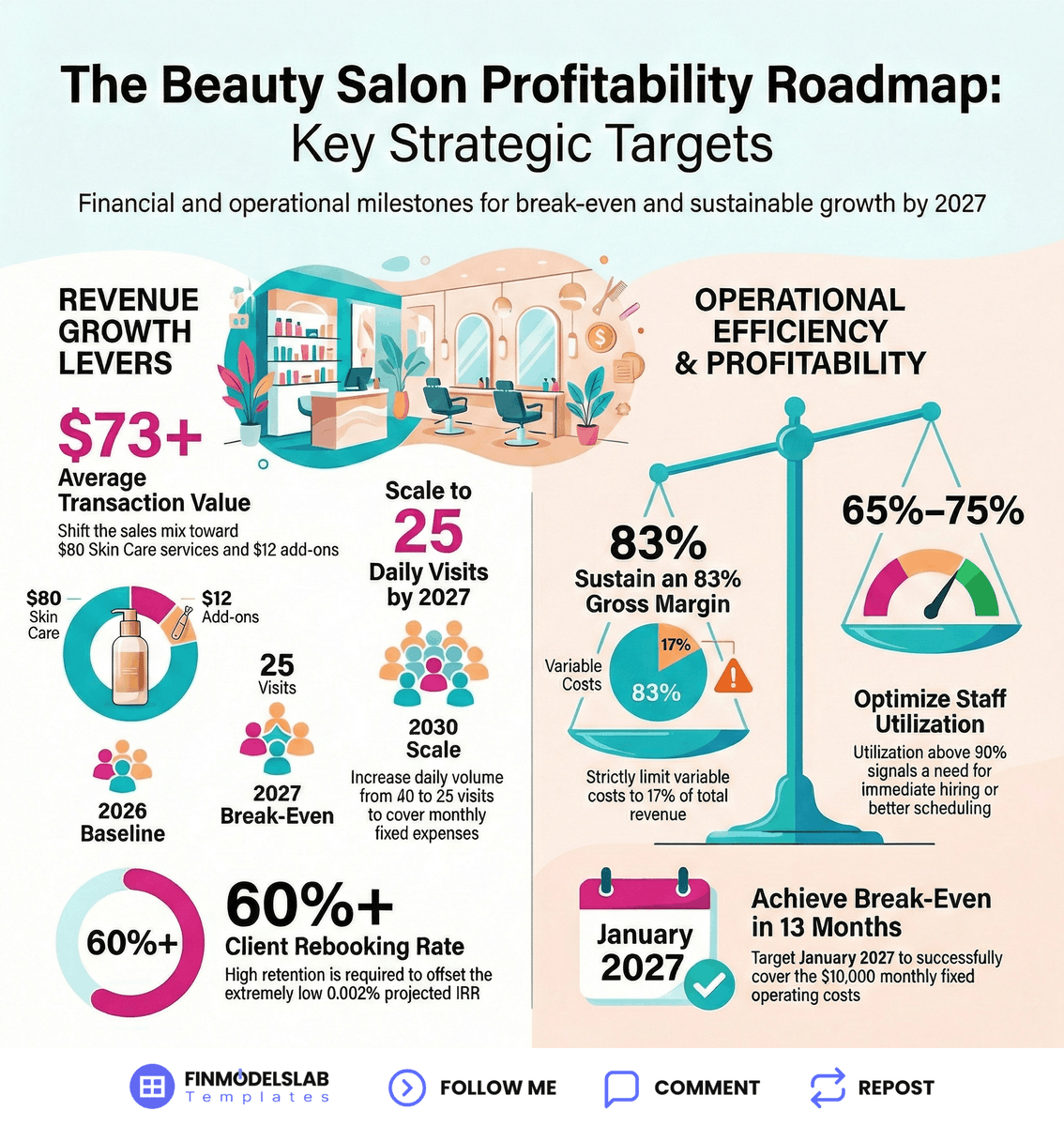
This guide outlines seven core metrics from our operational table to help you scale your salon effectively through 2030.
THE SEVEN CORE KPI METRICS FOR A BEAUTY SALON:
• Average Visits Per Day: Measures volume — Target 20 to 40 — Review daily to scale capacity.
• Average Transaction Value: Measures revenue per client — Target $73 — Review weekly to optimize pricing.
• Service Staff Utilization Rate: Measures staff efficiency — Target 70% — Review weekly to manage labor.
• Gross Margin Percentage: Measures profit after direct costs — Target 83% — Review monthly to control variable costs.
• Months to Break-Even: Measures time to profitability — Target 13 months — Review monthly to track ROI.
• Client Rebooking Rate: Measures client loyalty — Target 60% — Review monthly to drive retention.
• Return on Equity: Measures investor return — Target 34% — Review quarterly to confirm financial health.
If you remember one thing, focus on hitting the 70% utilization rate to ensure your staff remains both productive and profitable.
Comment 'KPI' and I’ll send the full KPI table
#BeautySalon #KPI #Operations #Profitability
Visit to learn more: f.mtr.cool/tatsuxpxtj
11
If a CFO ran a Batting Cages facility...
They would manage by these 7 core numbers.
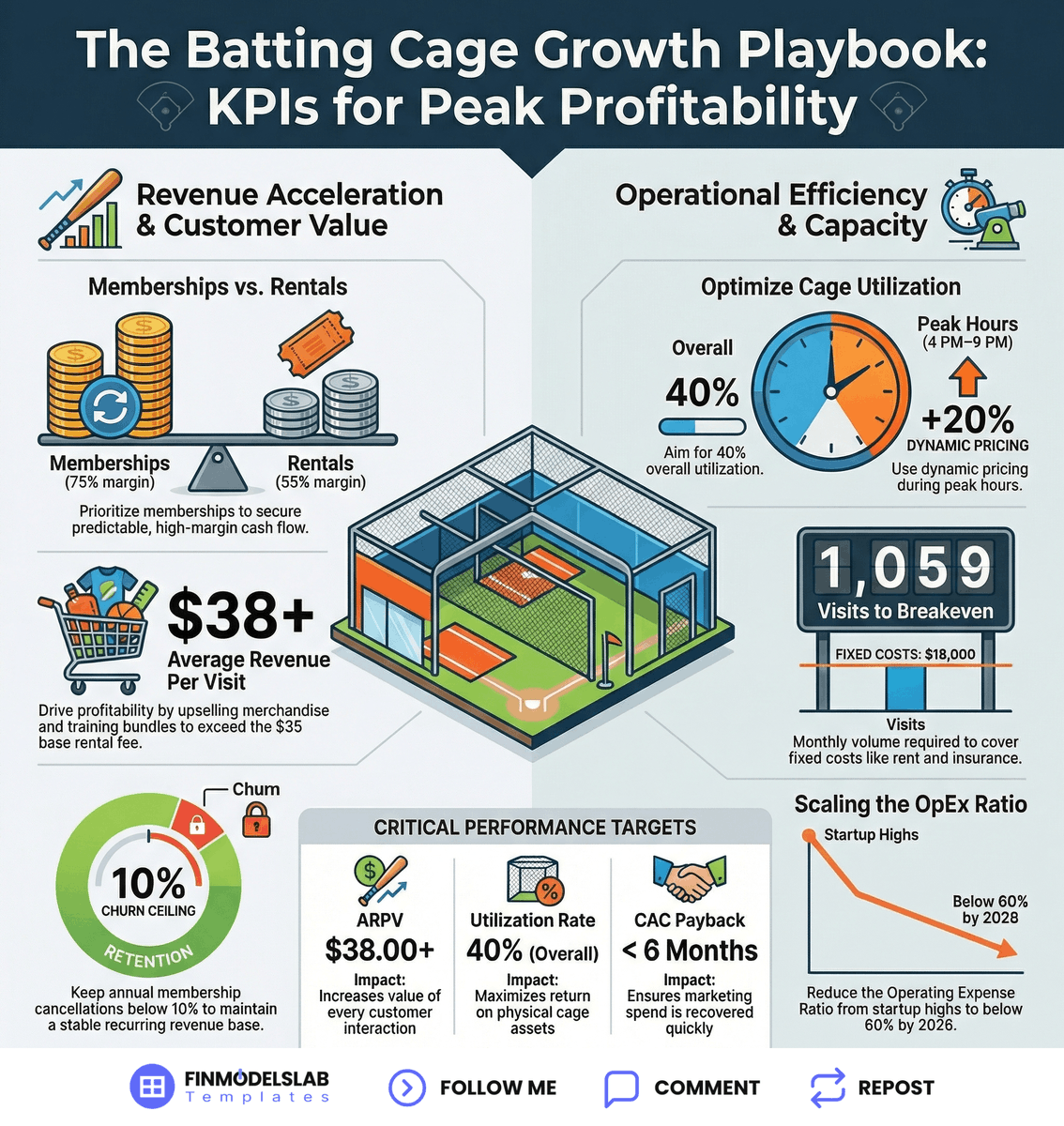
This guide outlines the critical operational metrics required to scale a Batting Cages business from initial CapEx to a $441,000 EBITDA target.
THE SEVEN CORE KPIS FOR BATTING CAGES:
• Average Revenue Per Visit (ARPV): Measures upsells beyond base rentals — Review weekly — Target $38
• Cage Utilization Rate: Measures asset efficiency — Review daily/weekly — Target 60% peak and 40% overall
• Gross Margin Percentage: Measures cost control on consumables — Review monthly — Target 98%
• Membership Churn Rate: Measures $1,000 member retention — Review monthly — Target below 10% annually
• Operating Expense Ratio: Measures OpEx/Revenue scaling — Review monthly — Target drop below 60% by 2028
• Customer Acquisition Cost (CAC): Measures marketing efficiency — Review quarterly — Target payback in <6 months
• Months to Breakeven: Measures runway and liquidity — Review monthly — Target Jan-27 (13 months)
If you remember one thing, track utilization and ARPV weekly to ensure you hit your 13-month breakeven target.
Comment 'KPI' and I’ll send the full KPI table
#BattingCages #KPI #BusinessMetrics #Operations #Profitability
Visit to learn more: f.mtr.cool/nzcrgammom
7
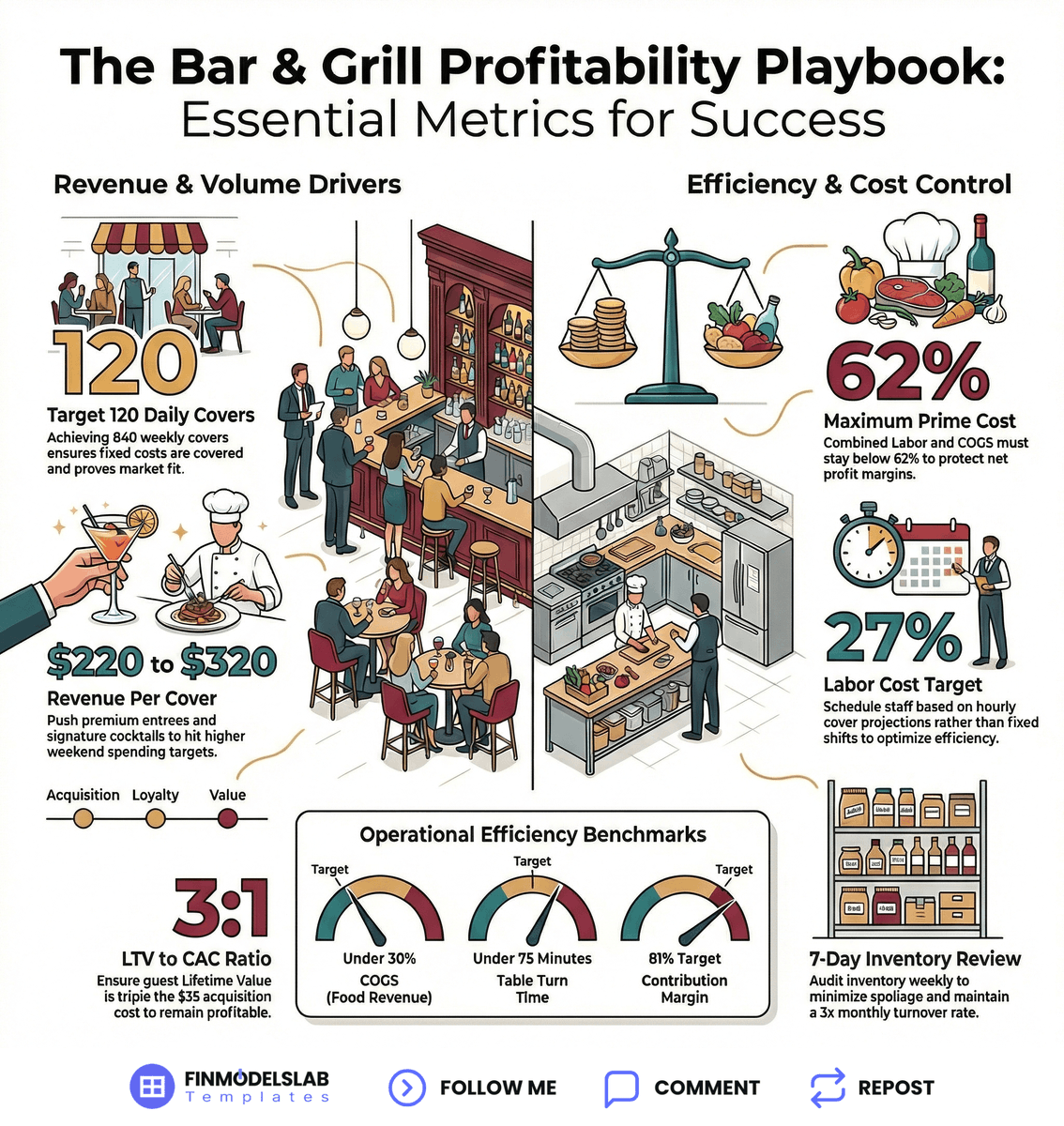
Ignoring these seven metrics will kill your Bar and Grill.
This list fixes your operational blind spots.
This post breaks down the seven essential metrics from our KPI table to ensure your Bar and Grill hits its 2026 targets.
7 CORE KPI METRICS FOR A PROFITABLE BAR AND GRILL:
• Daily Cover Count: Measures daily customer volume — review daily — target is 840 weekly covers.
• Revenue Per Cover (RPC): Measures average customer spend — review weekly — target is $220 to $320.
• Total Food and Beverage Cost Percentage: Measures purchasing efficiency — review weekly — target 160% or less.
• Labor Cost Percentage: Measures labor efficiency relative to sales — review weekly — aim for 27%.
• Contribution Margin Percentage: Measures gross profitability — review monthly — target is 810% or higher.
• Table Turnover Rate: Measures how quickly tables are reused — review daily/weekly — drives peak hour speed.
• Months to Breakeven: Measures time until fixed costs are covered — review monthly — target is March 2026.
If you remember one thing, maintain tight operational control to hit your breakeven goal by the third month of operation.
Comment 'KPI' and I’ll send the full KPI table
#BarandGrill #KPI #Operations #BusinessMetrics #Profitability
Visit to learn more: f.mtr.cool/dhsryqffug
5
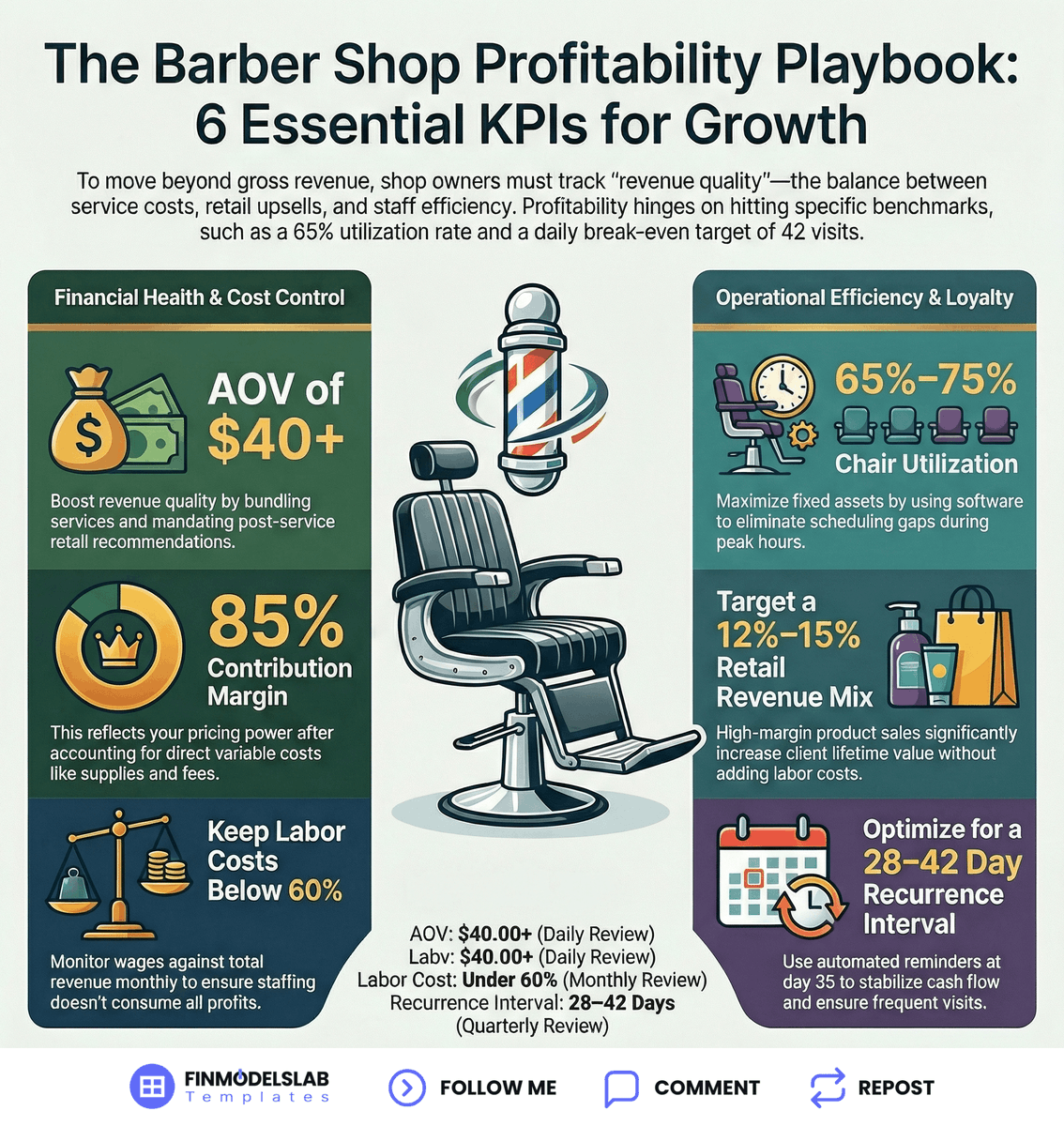
Ignoring your break-even volume will kill your barber shop.
This KPI list fixes your blind spots.
This guide details how to track seven core metrics from our KPI table to ensure your shop hits its 2028 break-even goal.
THE 7 CORE KPI METRICS FOR A BARBER SHOP:
• Average Order Value: Measures revenue per visit — target $40 daily — drives pricing strategy.
• Contribution Margin %: Measures profit after variable costs — target 85% monthly — drives cost control.
• Labor Cost %: Measures labor efficiency — target below 60% monthly — drives staffing decisions.
• Chair Utilization Rate: Measures seat productivity — target 65% to 75% weekly — drives scheduling.
• Retail Revenue Mix: Measures product upsells — target 12% to 15% monthly — drives inventory focus.
• Client Recurrence Interval: Measures days between visits — target 28 to 42 days — drives retention.
• Break-Even Visits/Day: Measures daily survival volume — target 42 visits weekly — drives growth urgency.
If you remember one thing, you must hit 42 visits per day and 65% utilization to ensure your shop survives.
Comment 'KPI' and I’ll send the full KPI table
#BarberShop #KPI #BusinessMetrics #Operations #Profitability
Visit to learn more: f.mtr.cool/otayjkgnno
10
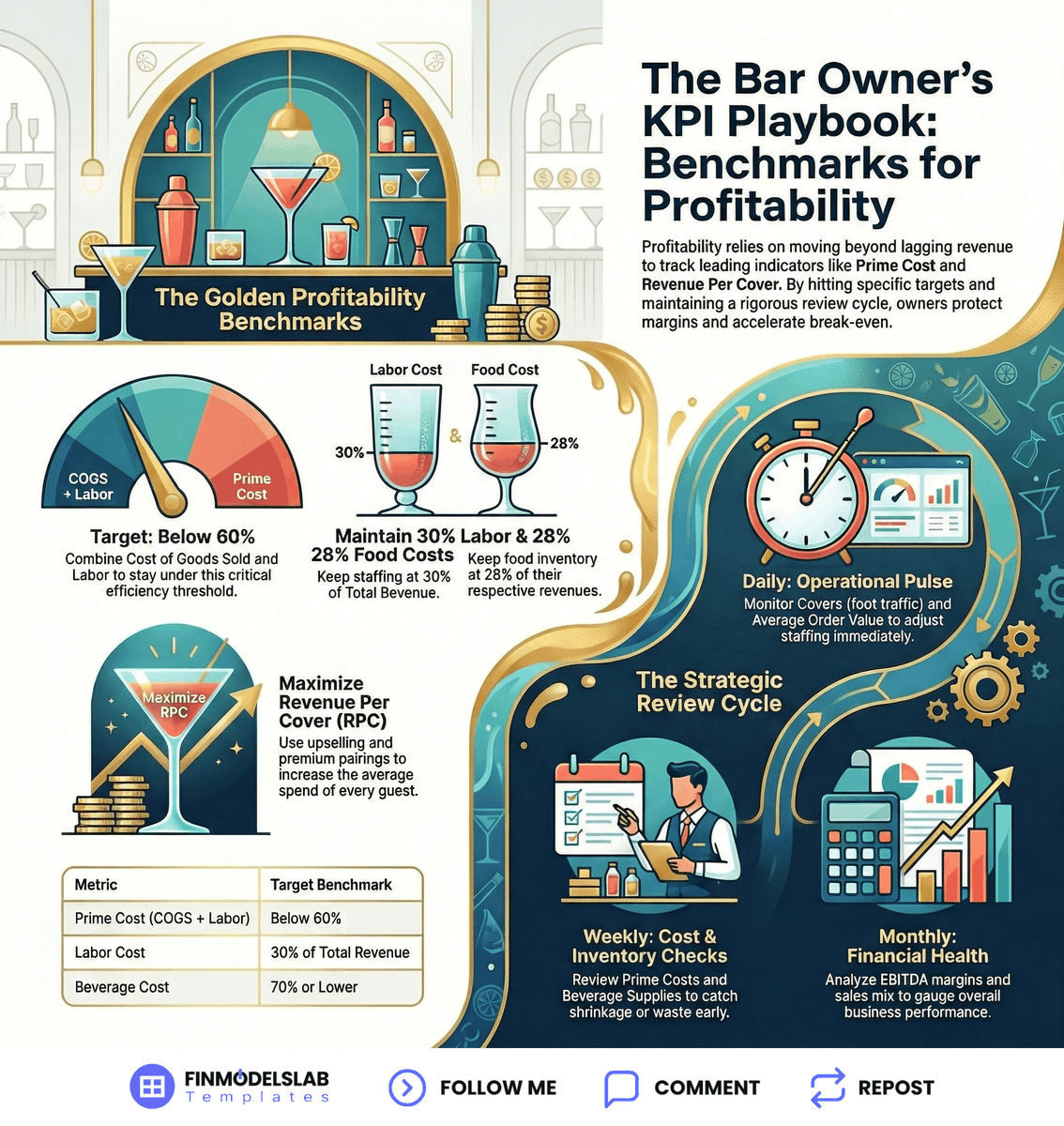
One KPI blind spot kills your bar profit.
This list fixes it immediately.
This guide outlines the seven essential metrics for bar operators to track performance and cost control based on our 2026 financial KPI table.
THE SEVEN CORE OPERATING METRICS FOR YOUR BAR:
• Revenue Per Cover: Tracks customer spend — Review daily — Drives $1457 average target
• Beverage Cost %: Measures supply efficiency — Review weekly — Drives 70% or lower target
• Prime Cost %: Measures operating efficiency — Review monthly — Drives below 60% target
• Break-Even Point: Measures cost coverage — Review monthly — Drives $36,000 revenue target
• High-Margin Mix: Tracks revenue distribution — Review monthly — Drives 450% or higher target
• EBITDA Margin: Measures operating profitability — Review monthly — Drives $371,000 Year 1 target
• Labor Cost %: Measures staff efficiency — Review weekly — Keeps staffing levels in check
If you remember one thing, keep Prime Cost below 60% to ensure your bar hits profitability by March 2026.
Comment 'KPI' and I’ll send the full KPI table
#Bar #KPI #Operations #Profitability #CashFlow
Visit to learn more: f.mtr.cool/ufcogmrffq
5
$605,000 is the entry price for a competitive local gym.
Here are the 7 financial steps to hit breakeven.
This guide outlines the critical capital requirements and operational milestones for a Gym based on a structured opening steps table.
THE 7-STEP LAUNCH SEQUENCE FOR A GYM:
• Model Revenue Streams (Validation): $50 fee — Define three tiers to anchor 2026 revenue — Sets the pricing foundation.
• Estimate Total Funding (Funding & Setup): $605,000 CAPEX — Secure equipment and a $286,000 cash buffer — Ensures liquidity.
• Map Fixed Overhead (Funding & Setup): $56,183 monthly — Calculate lease and wages — Establishes the survival baseline.
• Build Staffing Plan (Hiring): $385,000 salaries — Hire 8 FTEs including instructors — Secures the delivery of the service.
• Set Acquisition Targets (Pre-Launch Marketing): $15 CAC — Target 1,063 members — Maps the specific path to covering overhead.
• Project Profitability (Launch & Optimization): June 2026 — Use 900% margins to hit breakeven — Confirms the date of sustainability.
• Optimize Variable Costs (Launch & Optimization): 75% OpEx target — Reduce COGS by 25% — Maximizes long-term owner distributions.
If you remember one thing, prioritize hitting 1,063 members by June 2026 to neutralize your $56,183 monthly fixed overhead.
Comment 'START' and I’ll send the full opening steps table
#Gym #SmallBusiness #Operations #StartupChecklist #HowToStart
Visit to learn more: f.mtr.cool/yawvalkyao
14
Stop prioritizing your logo or website design.
Start by defining your initial service mix.
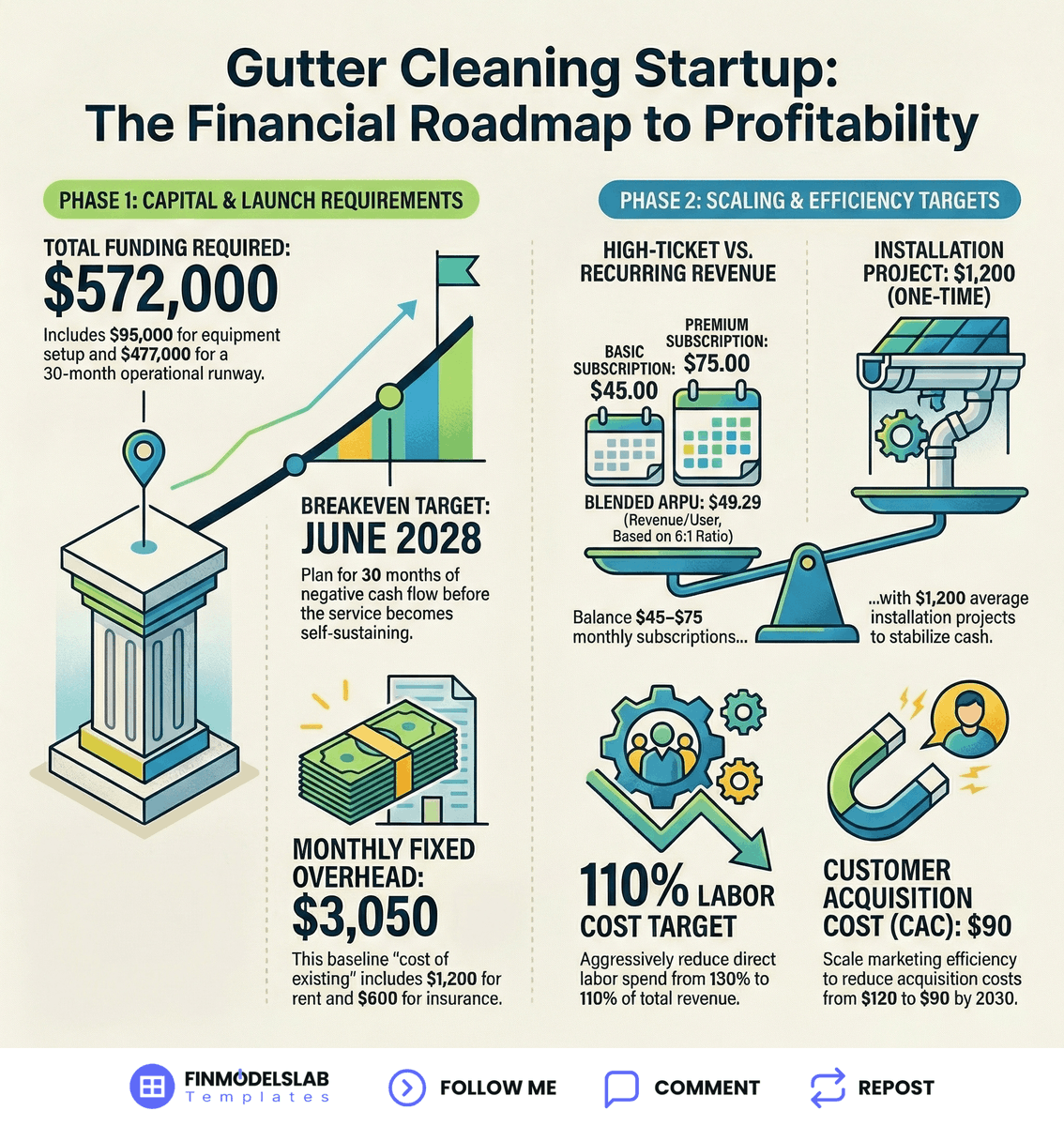
This post outlines the 7 essential steps to launch a Gutter Cleaning business based on a validated opening steps table.
THE SEVEN STEP LAUNCH SEQUENCE FOR GUTTER CLEANING:
• Define Initial Service Mix (Validation): $45/$75 — Set pricing and customer split — Forecasts Year 1 revenue potential
• Calculate Startup CAPEX (Funding & Setup): $95,000 — Itemize vehicle and gear investments — Sets the total initial investment
• Project Fixed Overhead (Build-Out): $3,050 — Determine non-scaling monthly costs — Establishes baseline 2026 operations
• Model Variable Cost Structure (Build-Out): 260% — Forecast COGS and labor — Identifies the total variable cost rate
• Staffing and Wage Plan (Hiring): $170k — Outline team size and payroll — Secures the 2026 annual salary budget
• Determine Breakeven Point (Validation): 30 months — Calculate revenue needed for costs — Defines the path to profitability
• Set Marketing Efficiency Goals (Launch & Optimization): $90 — Establish target CAC reduction — Optimizes long-term acquisition costs
If you remember one thing, prioritize capital reserves as high variable costs and a 30-month breakeven require significant cash runway.
Comment 'START' and I’ll send the full opening steps table
#GutterCleaning #HowToStart #BusinessPlanning #Operations #StartupChecklist
Visit to learn more: f.mtr.cool/nrkflyakpt
21
Don’t start your grocery store with branding.
Start with these seven financial actions.
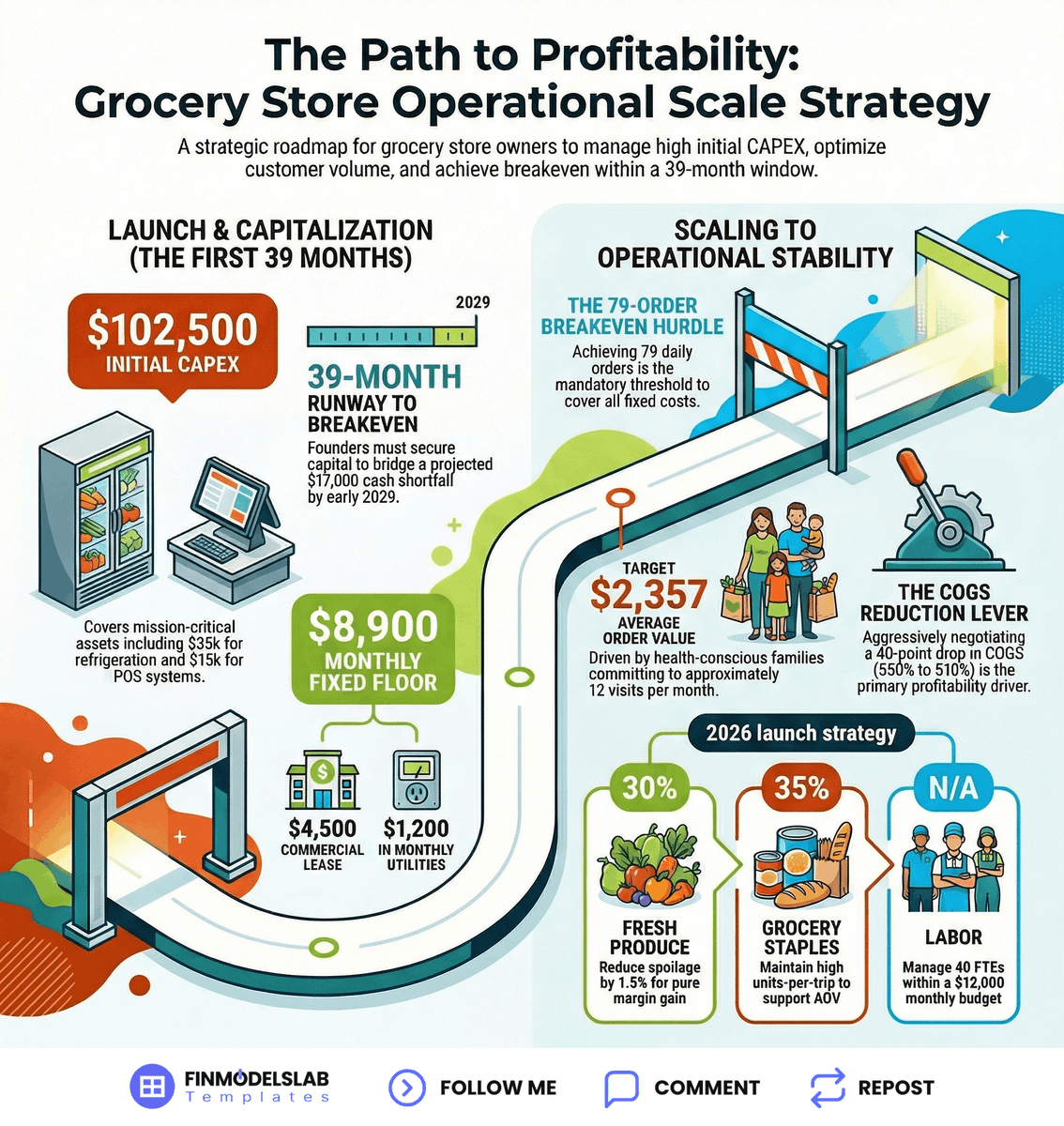
This analysis outlines the critical sequence to launch a Grocery Store successfully based on a detailed seven-step opening plan and financial model.
LAUNCH SEQUENCE FOR A GROCERY STORE:
• Define Product Mix & Pricing Strategy (Validation): Set target AOV of €2357 — Confirm sales mix — Secure high-volume revenue.
• Budget Initial Capital Expenditures (Funding & Setup): CAPEX €102,500 — Allocate funds for assets — Ensure refrigeration and POS are funded.
• Establish COGS and Variable Costs (Legal & Permits): COGS target 550% — Lock supplier terms — Maintain strict cost control from day one.
• Calculate Monthly Fixed Overhead (Funding & Setup): Fixed overhead €8,900 — Determine burn rate — Understand the baseline cost to keep doors open.
• Develop the Initial Labor Model (Hiring): 40 FTEs at €12,000/month — Staff for operational needs — Align headcount with service requirements.
• Sales Forecasting (Pre-Launch Marketing): 39 daily orders — Project required volume — Set clear targets for the marketing team to hit.
• Determine Breakeven and Funding Needs (Launch & Optimization): €56,486 revenue floor — Calculate cash runway — Ensure the business survives to profitability.
If you remember one thing, focus on hitting the required daily order volume to clear high fixed overhead and CAPEX.
Comment 'START' and I’ll send the full opening steps table
#GroceryStore #HowToStart #BusinessPlanning #Operations #StartupChecklist
Visit to learn more: f.mtr.cool/cagbgetrak
10
Want a clean Go-Kart Track launch with fewer mistakes?
Follow this specific 7-step operational order.
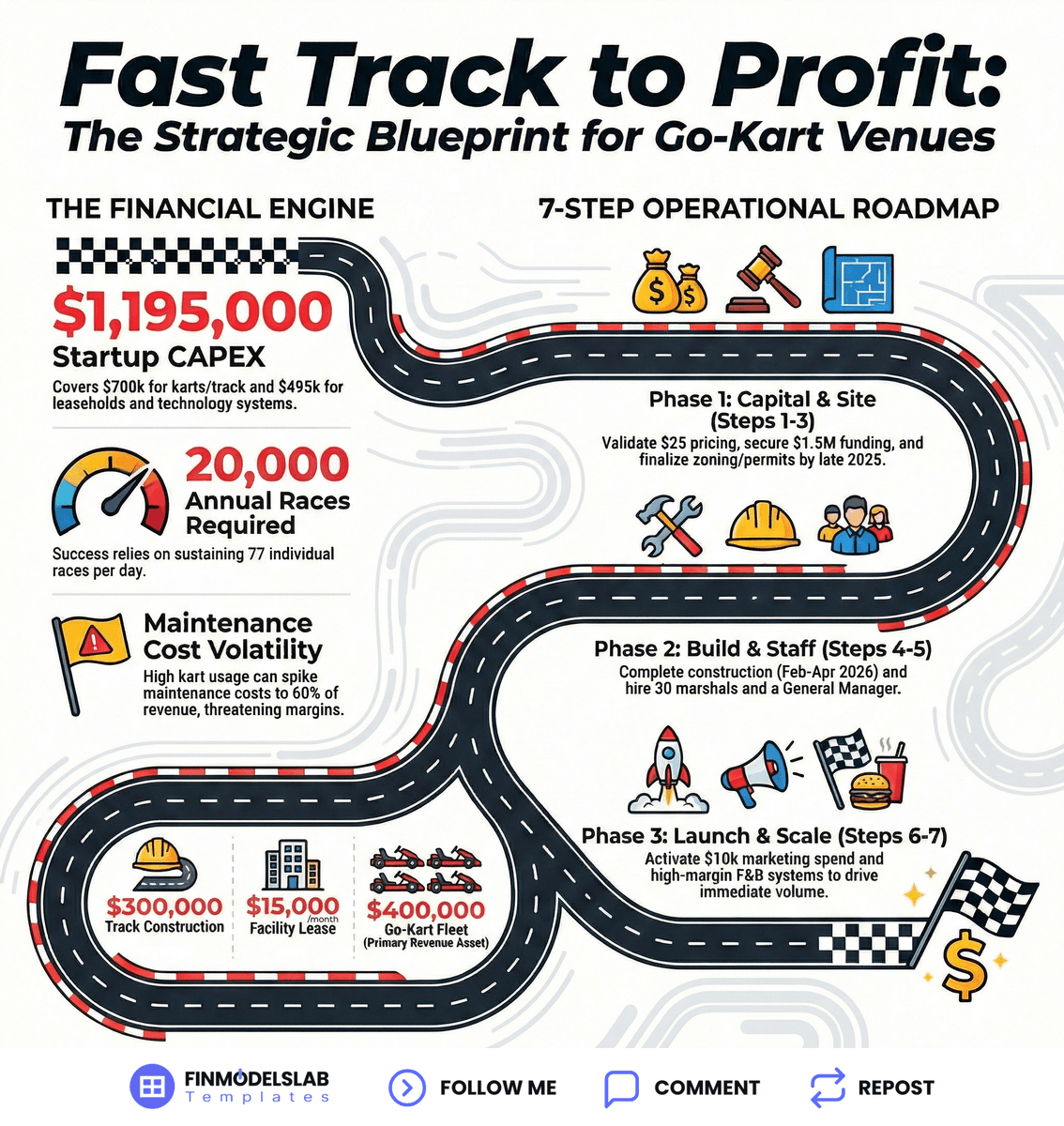
This guide outlines the critical path to opening a Go-Kart Track, detailing the sequence from validation to ramp-up based on an opening steps table.
THE SEVEN STEP LAUNCH SEQUENCE FOR A GO-KART TRACK:
• Market Validation (Validation): $25/race — Test pricing — Validate revenue goals.
• Capital Funding (Funding & Setup): $1.2M CAPEX — Secure funds — Prioritize fleet.
• Site Selection (Legal & Permits): $15k/month — Sign lease — Secure all approvals.
• Infrastructure (Build-Out): Feb-Apr 2026 — Manage construction — Install scoring.
• Operational Hiring (Hiring): $80k GM — Recruit 30 marshals — Build core team.
• Ancillary Revenue (Funding & Setup): $20k POS — Install snack bar — Test systems.
• Launch (Launch & Optimization): Feb 2026 — Drive volume — Hit breakeven target.
If you remember one thing, focus on hitting the two-month breakeven target by driving volume immediately after the infrastructure build-out.
Comment 'START' and I’ll send the full opening steps table
#GoKartTrack #HowToStart #SmallBusiness #Operations #StartupChecklist
Visit to learn more: f.mtr.cool/magvmdgvzk
8
One feed contract error can sink your entire margin.
This 7-step plan prevents that collapse.
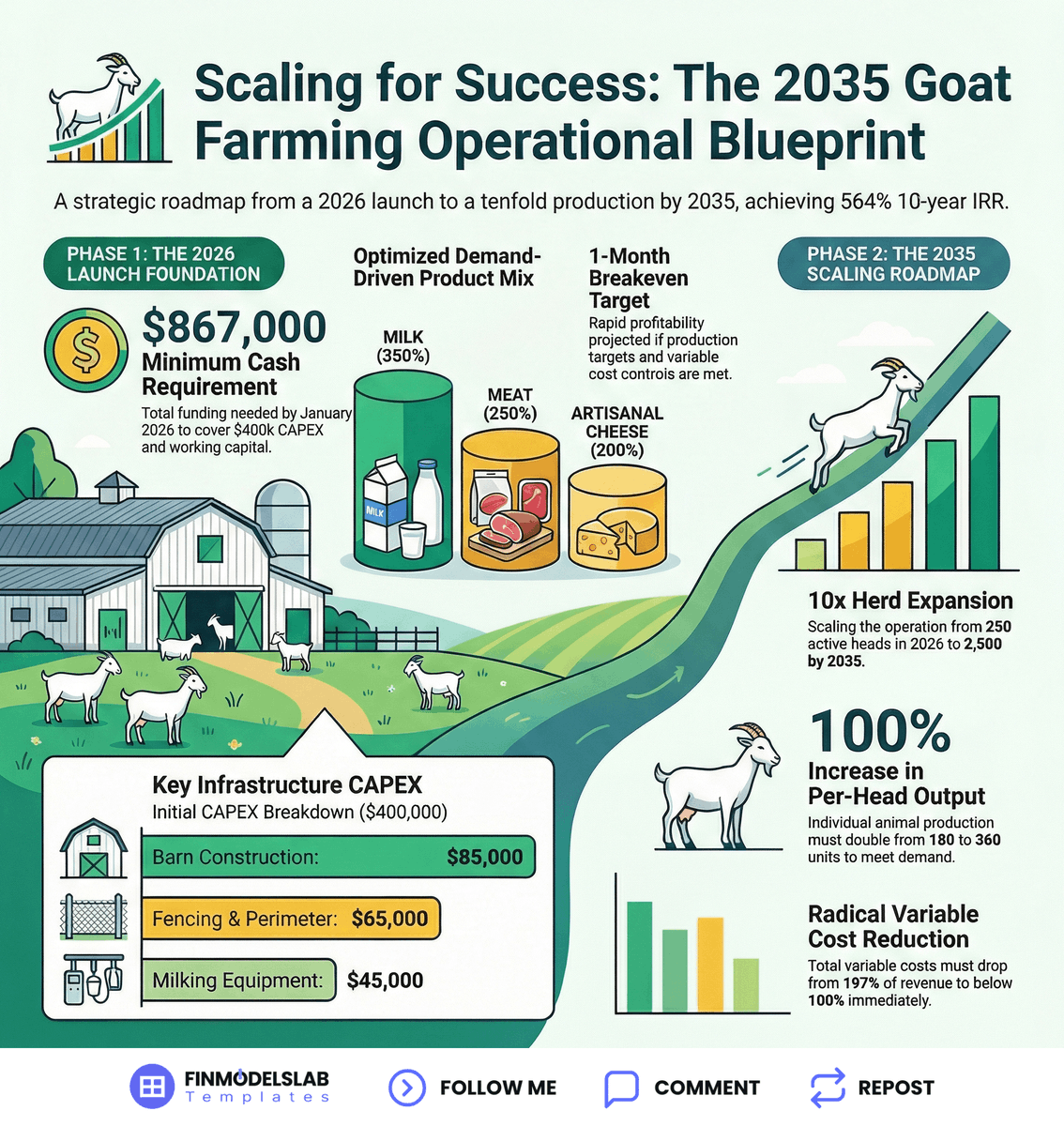
This guide outlines the operational sequence to launch a Goat Farming business based on a validated 7-step opening framework.
THE 7-STEP LAUNCH SEQUENCE FOR GOAT FARMING:
• Define Product Strategy (Validation): Confirm Milk, Chevon, and Cheese mix — Maximizes revenue potential.
• Secure Initial CAPEX (Funding & Setup): $400k for Barn and Milking — Ensures infrastructure is ready for Q1 2026.
• Model Herd Growth (Build-Out): Start with 250 heads — Sets clear production targets despite 80% loss rates.
• Lock Down Variable Costs (Launch & Optimization): Feed at 95% of revenue — Secures supplier contracts to control costs.
• Calculate Fixed Expenses (Funding & Setup): $107.4k annual overhead — Confirms the baseline cost of staying open.
• Hire Core Team (Hiring): 30 FTEs at $127k wages — Staffs essential roles required for daily operations.
• Project Cash Needs (Validation): $867k minimum reserve — Verifies the runway needed to reach a 1-month breakeven.
If you remember one thing, secure your $867k cash reserve first to survive the high feed costs and infrastructure setup.
Comment 'START' and I’ll send the full opening steps table
#GoatFarming #BusinessPlanning #Operations #StartupChecklist
Visit to learn more: f.mtr.cool/kmligaxtip
31
Want a clean Gift Shop launch with fewer mistakes?
Follow this exact sequence for your build-out.
This post outlines the seven critical phases to launch a Gift Shop successfully based on a strategic opening steps table.
LAUNCH SEQUENCE: 7 STEPS TO OPEN A GIFT SHOP:
• Define Your Niche and Target Market (Validation): Set a 55% sales volume target to define your product mix strategy.
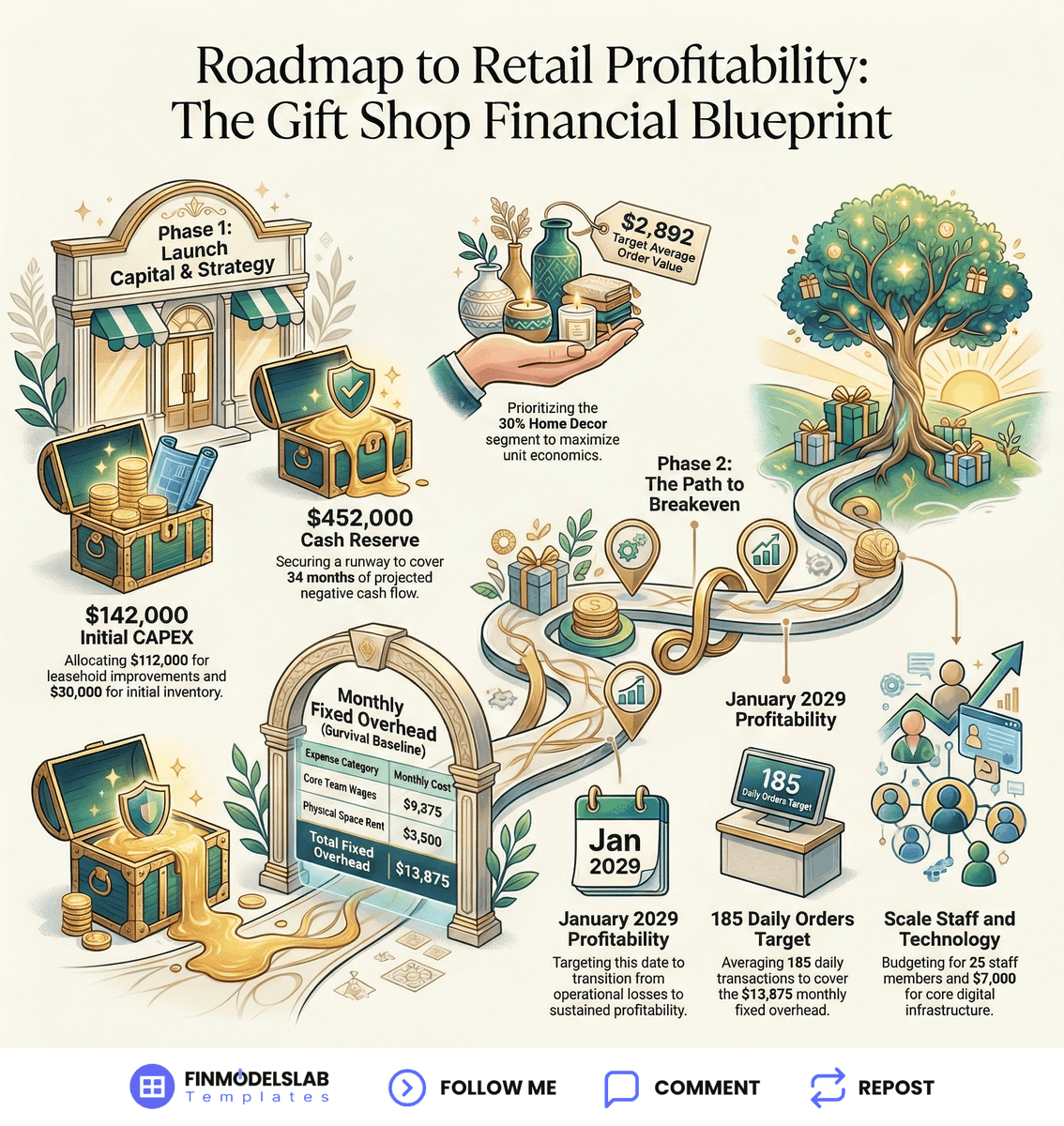
• Calculate Initial Capital Expenditure (Funding & Setup): Confirm $142,000 CAPEX to secure essential asset funding documentation.
• Forecast Traffic and Conversion Metrics (Build-Out): Complete Year 1 revenue projections to model your future income accurately.
• Establish Fixed and Variable Costs (Build-Out): Confirm the cost structure baseline to manage your operational expenses effectively.
• Determine Operational Breakeven Point (Launch & Optimization): Target 185 daily orders to ensure your shop covers all monthly overhead.
• Structure the Initial Team and Wages (Hiring): Finalize your staffing plan for 2026 payroll to ensure smooth daily operations.
• Project 5-Year Profitability and Cash Needs (Funding & Setup): Secure $452k in funding to maintain a long-term cash runway.
If you remember one thing, focus on securing enough capital to cover the $452,000 long-term cash requirement for sustainable growth.
Comment 'START' and I’ll send the full opening steps table
#GiftShop #SmallBusiness #BusinessPlanning #Operations #HowToStart
Visit to learn more: f.mtr.cool/enznbqiggq
10
Monthly overhead of $61,583 can crush a new kitchen.
This sequence ensures you hit breakeven by March 2026.
This guide outlines the critical operational path to launch a Ghost Kitchen based on a structured seven-step financial and build-out table.
7 STEPS TO LAUNCH A PROFITABLE GHOST KITCHEN:
• Define Market & Concept Validation: $45 Midweek AOV — Confirm target profiles — Validates the model
• Model Financial Viability & Breakeven: $61,583 overhead — Set budgets — Confirms Mar-2026 breakeven
• Secure Capital & Location Lease: $15,000 rent — Sign lease and secure $493,000 CAPEX — Locks the site
• Finalize Kitchen Design & Procurement: $120,000 budget — Lock vendors — Completes the build-out
• Build Core Team & SOPs: $800/month software — Hire management — Initiates operational training
• Establish Supply Chain & Inventory: $15,000 stock — Negotiate contracts — Hits 140% food cost target
• Soft Launch & Marketing Strategy: $5,000 website — Deploy promotions — Drives the 740 weekly orders
If you remember one thing, secure your $493,000 CAPEX by January to ensure a smooth transition into your March breakeven.
Comment 'START' and I’ll send the full opening steps table
#GhostKitchen #HowToStart #Operations #StartupChecklist #BusinessPlanning
Visit to learn more: f.mtr.cool/wqtzcgqkto
18
It takes $641,000 in cash to survive this launch.
Here are the 7 steps to get there.
This guide outlines the financial and operational roadmap to launch a General Contractor business based on a validated 7-step opening sequence.
7 STEPS TO LAUNCH A GENERAL CONTRACTOR BUSINESS:
• Define Service Mix and Pricing (Validation): Lock 2026 hourly rates — Finalize rate cards — Secures revenue targets
• Calculate Initial Capital Expenditure (Funding & Setup): $153k CAPEX — Fund assets — Ensures vehicle and tech readiness
• Establish Operating Overhead (Funding & Setup): $8,300 fixed cost — Set monthly burn — Verifies baseline stability
• Finalize Initial Team Wages (Hiring): $326k 2026 wage budget — Budget salaries — Secures essential labor force
• Set Variable Cost Structure (Build-Out): 240% VC ratio — Model variable costs — Confirms project profitability margins
• Forecast Financial Milestones (Optimization): Mar-27 B/E — Identify runway — Reaches the $641k cash target
• Map Growth and Efficiency Levers (Launch & Optimization): Shift to Custom — Optimize mix — Hits the $4.1M EBITDA goal
If you remember one thing, secure $641,000 in working capital to bridge the 15-month gap until your March 2027 break-even point.
Comment 'START' and I’ll send the full opening steps table
#GeneralContractor #HowToStart #BusinessPlanning #Operations #StartupChecklist
Visit to learn more: f.mtr.cool/yjuhpxzkso
15
It takes $641,000 in cash to survive this launch.
Here are the 7 steps to get there.
This guide outlines the financial and operational roadmap to launch a General Contractor business based on a validated 7-step opening sequence.
7 STEPS TO LAUNCH A GENERAL CONTRACTOR BUSINESS:
• Define Service Mix and Pricing (Validation): Lock 2026 hourly rates — Finalize rate cards — Secures revenue targets
• Calculate Initial Capital Expenditure (Funding & Setup): $153k CAPEX — Fund assets — Ensures vehicle and tech readiness
• Establish Operating Overhead (Funding & Setup): $8,300 fixed cost — Set monthly burn — Verifies baseline stability
• Finalize Initial Team Wages (Hiring): $326k 2026 wage budget — Budget salaries — Secures essential labor force
• Set Variable Cost Structure (Build-Out): 240% VC ratio — Model variable costs — Confirms project profitability margins
• Forecast Financial Milestones (Optimization): Mar-27 B/E — Identify runway — Reaches the $641k cash target
• Map Growth and Efficiency Levers (Launch & Optimization): Shift to Custom — Optimize mix — Hits the $4.1M EBITDA goal
If you remember one thing, secure $641,000 in working capital to bridge the 15-month gap until your March 2027 break-even point.
Comment 'START' and I’ll send the full opening steps table
#GeneralContractor #HowToStart #BusinessPlanning #Operations #StartupChecklist
Visit to learn more: f.mtr.cool/yjuhpxzkso
15
It takes $641,000 in cash to survive this launch.
Here are the 7 steps to get there.
This guide outlines the financial and operational roadmap to launch a General Contractor business based on a validated 7-step opening sequence.
7 STEPS TO LAUNCH A GENERAL CONTRACTOR BUSINESS:
• Define Service Mix and Pricing (Validation): Lock 2026 hourly rates — Finalize rate cards — Secures revenue targets
• Calculate Initial Capital Expenditure (Funding & Setup): $153k CAPEX — Fund assets — Ensures vehicle and tech readiness
• Establish Operating Overhead (Funding & Setup): $8,300 fixed cost — Set monthly burn — Verifies baseline stability
• Finalize Initial Team Wages (Hiring): $326k 2026 wage budget — Budget salaries — Secures essential labor force
• Set Variable Cost Structure (Build-Out): 240% VC ratio — Model variable costs — Confirms project profitability margins
• Forecast Financial Milestones (Optimization): Mar-27 B/E — Identify runway — Reaches the $641k cash target
• Map Growth and Efficiency Levers (Launch & Optimization): Shift to Custom — Optimize mix — Hits the $4.1M EBITDA goal
If you remember one thing, secure $641,000 in working capital to bridge the 15-month gap until your March 2027 break-even point.
Comment 'START' and I’ll send the full opening steps table
#GeneralContractor #HowToStart #BusinessPlanning #Operations #StartupChecklist
Visit to learn more: f.mtr.cool/yjuhpxzkso
1
17
It takes $641,000 in cash to survive this launch.
Here are the 7 steps to get there.
This guide outlines the financial and operational roadmap to launch a General Contractor business based on a validated 7-step opening sequence.
7 STEPS TO LAUNCH A GENERAL CONTRACTOR BUSINESS:
• Define Service Mix and Pricing (Validation): Lock 2026 hourly rates — Finalize rate cards — Secures revenue targets
• Calculate Initial Capital Expenditure (Funding & Setup): $153k CAPEX — Fund assets — Ensures vehicle and tech readiness
• Establish Operating Overhead (Funding & Setup): $8,300 fixed cost — Set monthly burn — Verifies baseline stability
• Finalize Initial Team Wages (Hiring): $326k 2026 wage budget — Budget salaries — Secures essential labor force
• Set Variable Cost Structure (Build-Out): 240% VC ratio — Model variable costs — Confirms project profitability margins
• Forecast Financial Milestones (Optimization): Mar-27 B/E — Identify runway — Reaches the $641k cash target
• Map Growth and Efficiency Levers (Launch & Optimization): Shift to Custom — Optimize mix — Hits the $4.1M EBITDA goal
If you remember one thing, secure $641,000 in working capital to bridge the 15-month gap until your March 2027 break-even point.
Comment 'START' and I’ll send the full opening steps table
#GeneralContractor #HowToStart #BusinessPlanning #Operations #StartupChecklist
Visit to learn more: f.mtr.cool/yjuhpxzkso
1
13
It takes $641,000 in cash to survive this launch.
Here are the 7 steps to get there.
This guide outlines the financial and operational roadmap to launch a General Contractor business based on a validated 7-step opening sequence.
7 STEPS TO LAUNCH A GENERAL CONTRACTOR BUSINESS:
• Define Service Mix and Pricing (Validation): Lock 2026 hourly rates — Finalize rate cards — Secures revenue targets
• Calculate Initial Capital Expenditure (Funding & Setup): $153k CAPEX — Fund assets — Ensures vehicle and tech readiness
• Establish Operating Overhead (Funding & Setup): $8,300 fixed cost — Set monthly burn — Verifies baseline stability
• Finalize Initial Team Wages (Hiring): $326k 2026 wage budget — Budget salaries — Secures essential labor force
• Set Variable Cost Structure (Build-Out): 240% VC ratio — Model variable costs — Confirms project profitability margins
• Forecast Financial Milestones (Optimization): Mar-27 B/E — Identify runway — Reaches the $641k cash target
• Map Growth and Efficiency Levers (Launch & Optimization): Shift to Custom — Optimize mix — Hits the $4.1M EBITDA goal
If you remember one thing, secure $641,000 in working capital to bridge the 15-month gap until your March 2027 break-even point.
Comment 'START' and I’ll send the full opening steps table
#GeneralContractor #HowToStart #BusinessPlanning #Operations #StartupChecklist
Visit to learn more: f.mtr.cool/yjuhpxzkso
14
Miscalculating your initial CAPEX can sink your station.
This framework ensures you account for every dollar.
This guide details the seven essential phases to launch a Gas Station based on our verified operational opening steps table.
STARTUP SEQUENCE: 7 STEPS TO LAUNCH A GAS STATION:
• Define Location and Volume Assumptions (Validation): Set visitor forecasts to calculate daily orders.
• Calculate Initial Capital Expenditure (CAPEX) (Funding & Setup): $398,000 — Tally equipment costs for the total CAPEX figure.
• Model the Revenue Mix and Pricing Strategy (Build-Out): Define the sales mix to build a revenue projection model.
• Determine Gross Margin and Cost of Goods Sold (COGS) (Build-Out): Apply cost percentages to find the blended gross margin.
• Project Fixed Operating Expenses and Labor (Hiring): Calculate the expense baseline to establish a monthly OpEx baseline.
• Forecast Breakeven Point and Cash Needs (Launch & Optimization): Perform a cash runway check to confirm the breakeven date.
• Analyze Long-Term Profitability and Growth Levers (Optimization): Identify growth levers to create a 5-year EBITDA forecast.
If you remember one thing, it is that securing $398,000 in CAPEX is only the start of the financial modeling process.
Comment 'START' and I’ll send the full opening steps table
#GasStation #HowToStart #SmallBusiness #Operations #Entrepreneurship
Visit to learn more: f.mtr.cool/zsjbwjlgjo
13
If an industry leader launched a garment factory today
This is the operational sequence they would follow.
This guide outlines the critical financial and operational roadmap for launching a Garment Manufacturing facility based on a seven-step strategic launch plan.
LAUNCH SEQUENCE FOR A SEVEN FIGURE GARMENT MANUFACTURING BUSINESS:
• Define Product Mix (Validation): Set volumes like 50k T-Shirts — Set sales targets.
• Calculate Unit Economics (Build-Out): Confirm $540 Jeans cost — Determine gross profit.
• Establish Monthly Overhead (Funding & Setup): Set $19,500 OpEx — Finalize fixed budget.
• Model Initial Headcount (Hiring): Budget 55 FTEs — Model the 2026 wage bill.
• Finalize CAPEX Schedule (Funding & Setup): Budget $605,000 — Secure equipment funding.
• Project 5-Year Profitability (Optimization): Target $162M EBITDA — Complete financial roadmap.
• Determine Working Capital (Launch & Optimization): Secure $1,064,000 — Set the cash runway.
If you remember one thing, success requires balancing $605,000 in upfront CAPEX against tight factory overhead control to ensure profitability.
Comment 'START' and I’ll send the full opening steps table
#GarmentManufacturing #StartupChecklist #BusinessPlanning #Operations
Visit to learn more: f.mtr.cool/satubvclyl
17