
We audit businesses to find operational bloat & inefficient processes, deploy custom AI agents and automation to fix it | Founders @baselismail @ConorGrowth
Joined March 2026
- Tweets 130
- Following 12
- Followers 18
- Likes 17
86 Photos and videos
Pinned Tweet

Mar 21
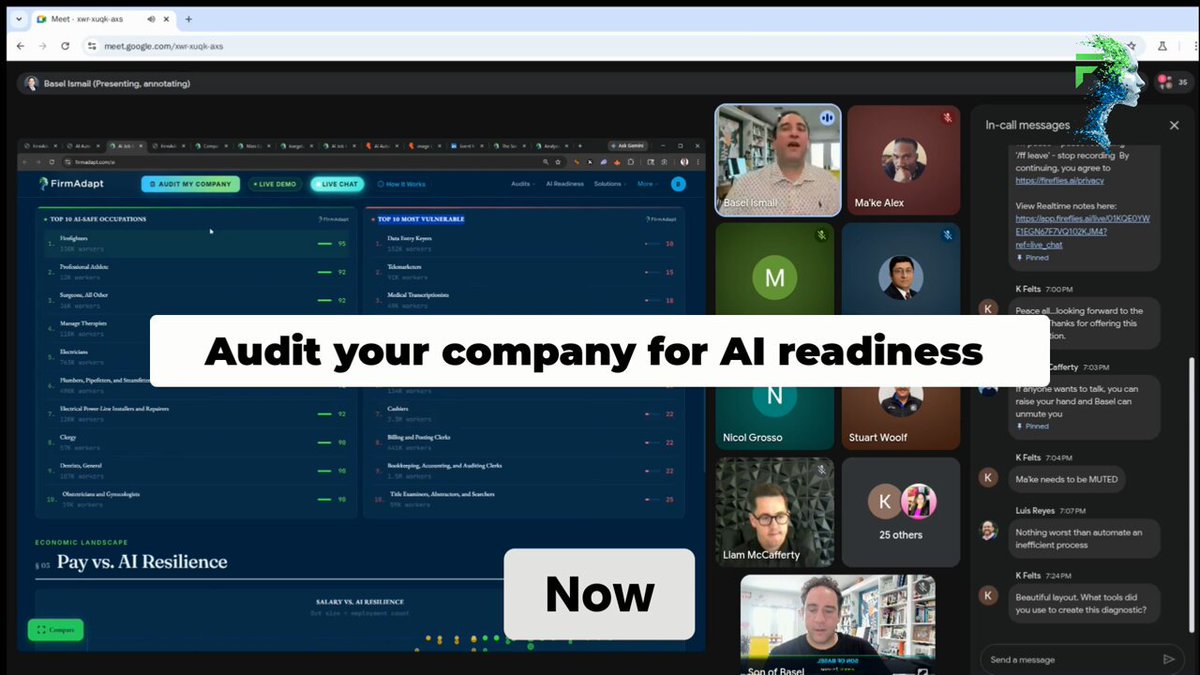
We built a platform that audits any company in seconds & shows exactly where AI can save them millions.
Most businesses are running operations designed for 2015.
Manual processes. Redundant vendors. Entire departments are responsible for work that AI can handle in minutes.
So we asked a simple question: what if you could see the exact dollar value of every inefficiency in your company before spending a dime on consultants?
Our answer is FirmAdapt. For the first time, you can conduct a free professional-grade audit on any company, public or private.
In seconds, you get a full breakdown of operational bloat, revenue gaps, and AI disruption risk across four research pillars.
We also built a faith-based compliance screener covering 9 religious frameworks. Shariah, Catholic, Christian, Jewish, LDS. Institutional-grade screening that used to cost five figures is available instantly.
The platform diagnoses the problem. You meet with our team to run a deeper audit. We build and deploy a tailored solution in your business.
Custom AI agents, automation, and engineered systems built for your business.
Not off the shelf. Not a chatbot. Bespoke infrastructure that compounds your edge.
1
2
2
484
Jun 13
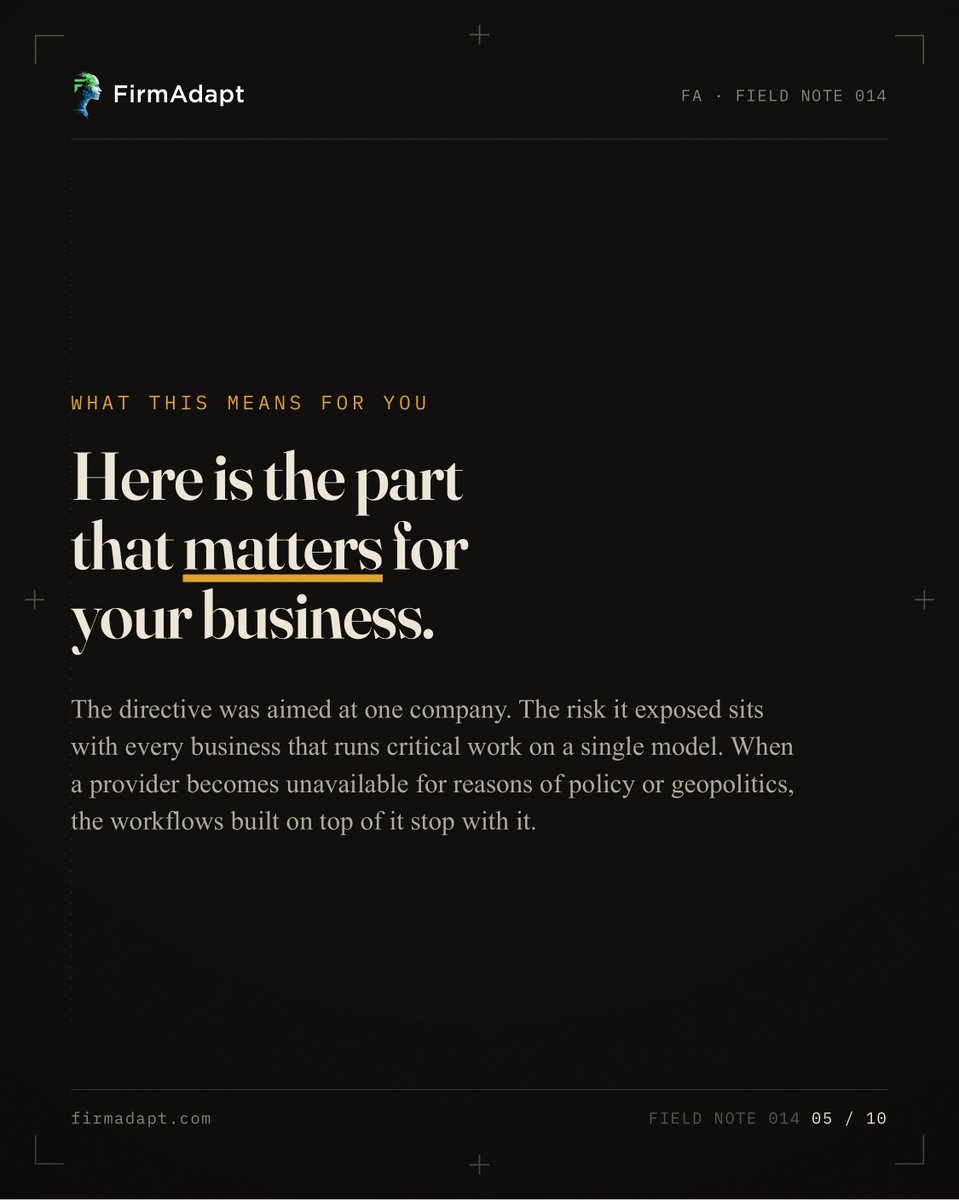
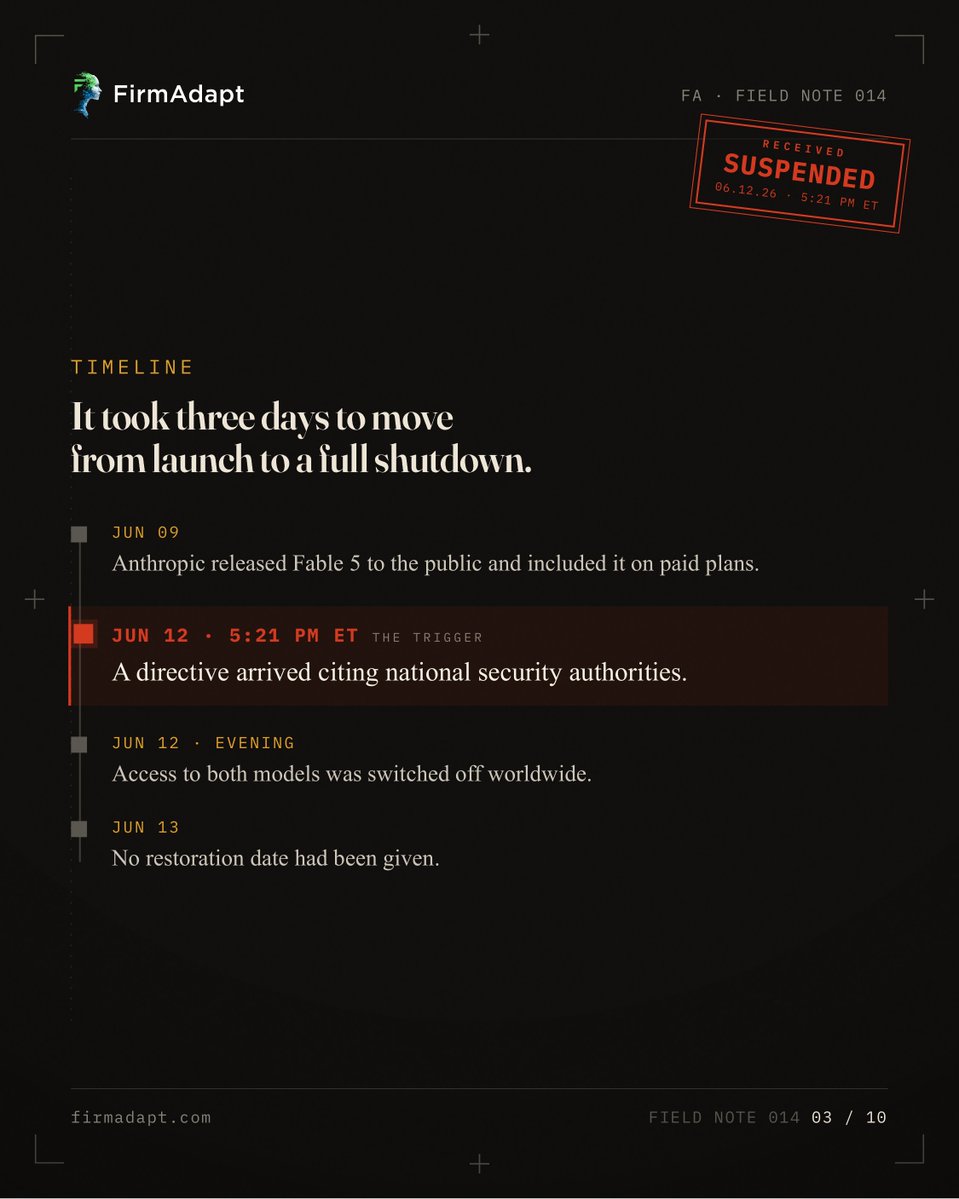
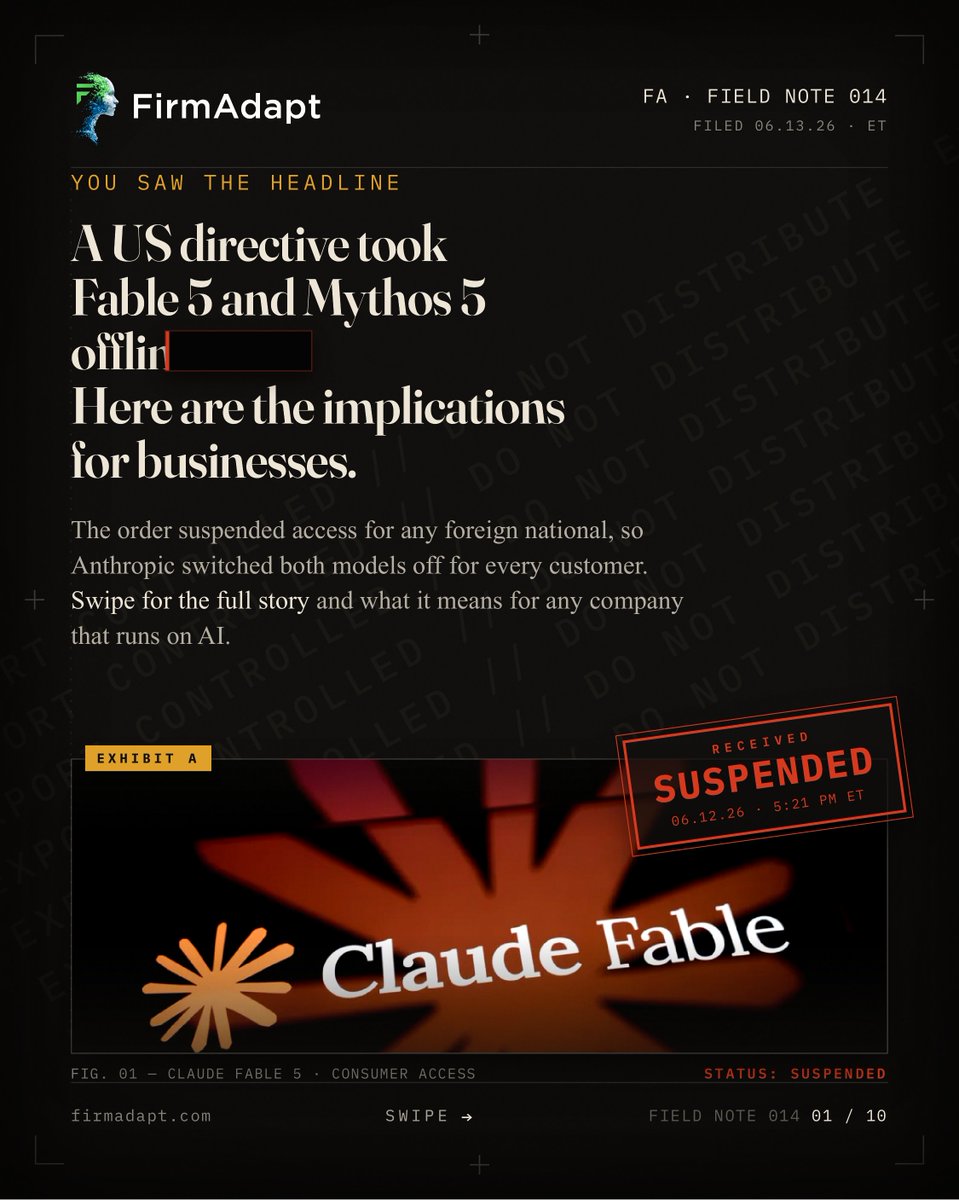
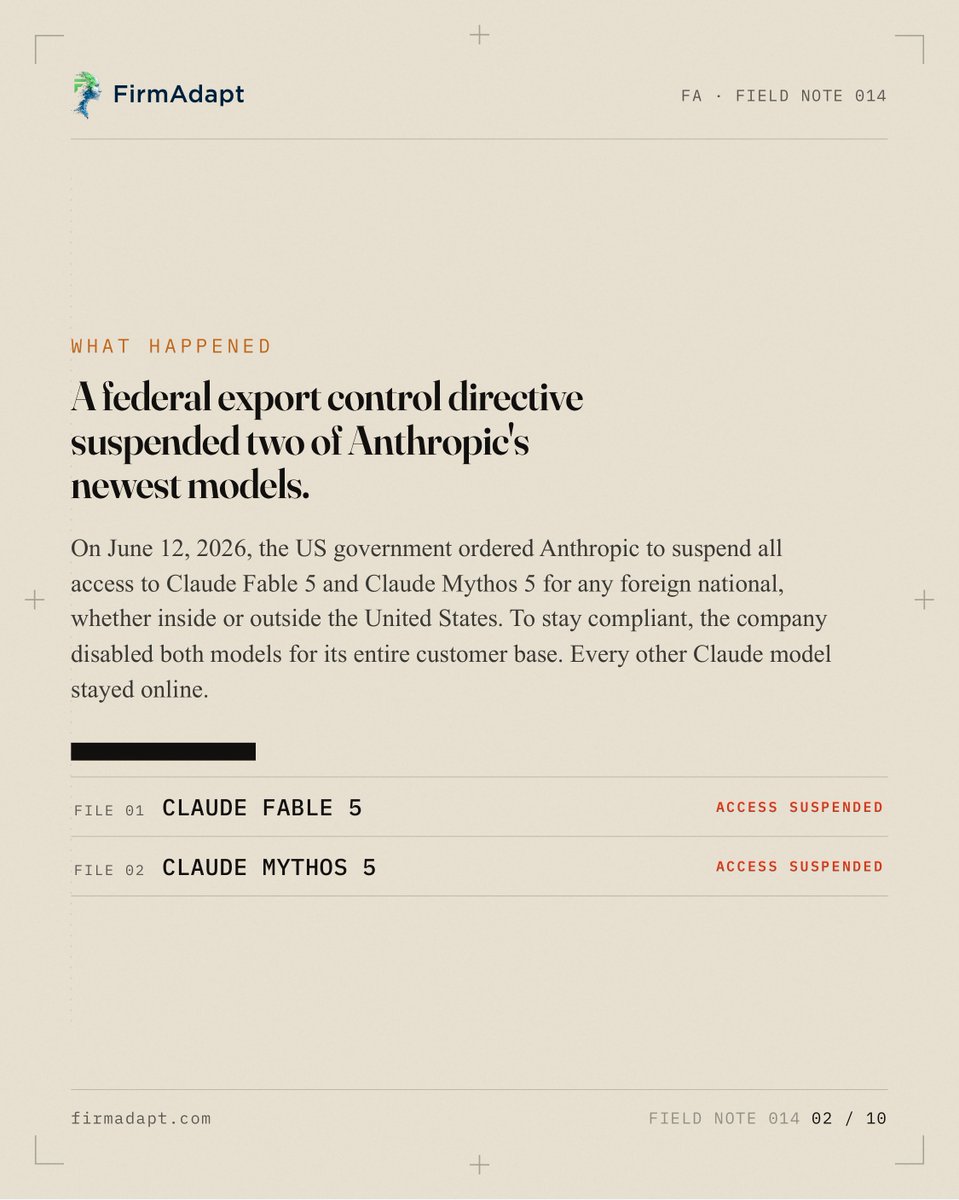
How the US Gov directive to suspend Fabel 5 and Mythos 5 for foreign nationals impacts your business:
A US export control directive ordered Anthropic to suspend Fable 5 and Mythos 5 for any foreign national, inside or outside the country.
1
1
84
Jun 13
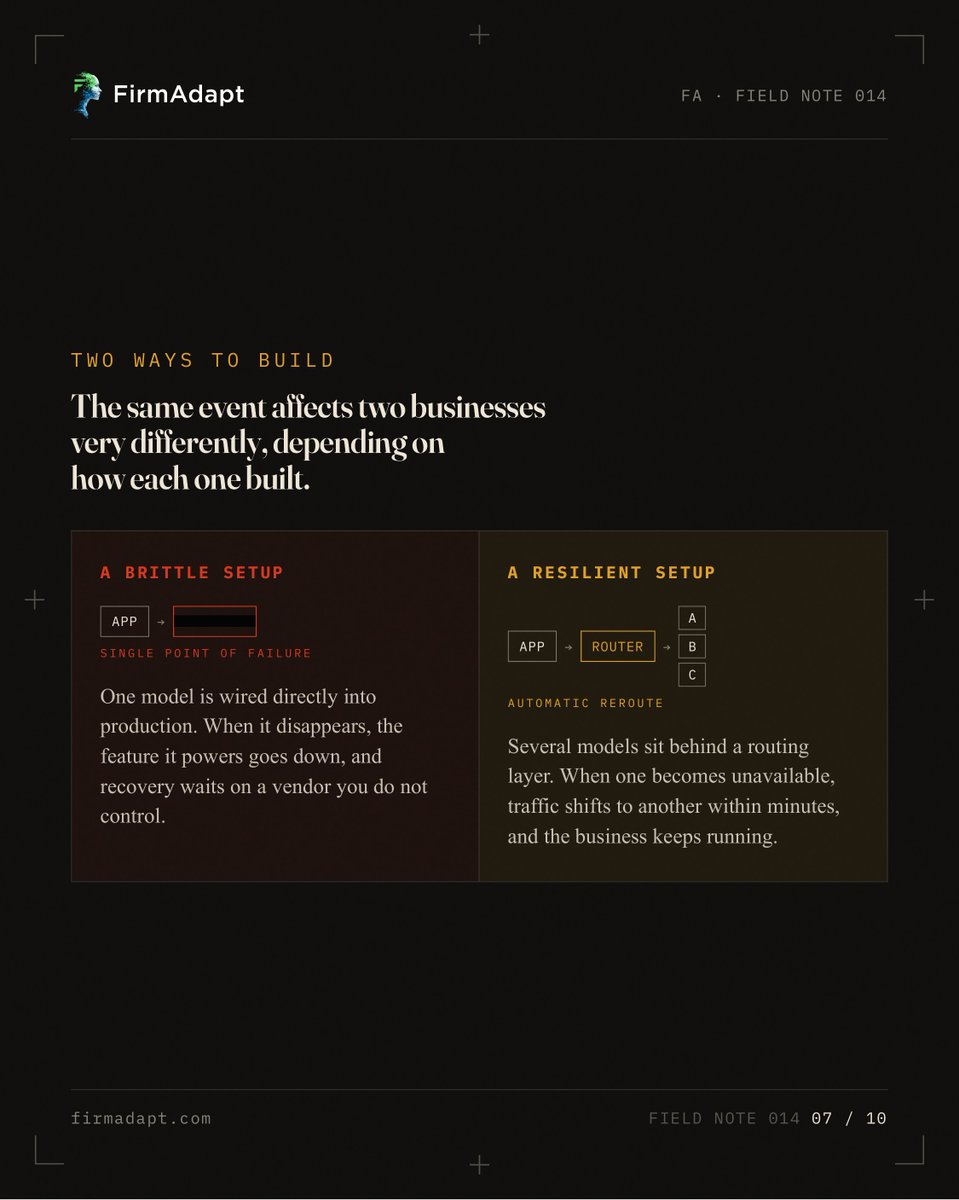
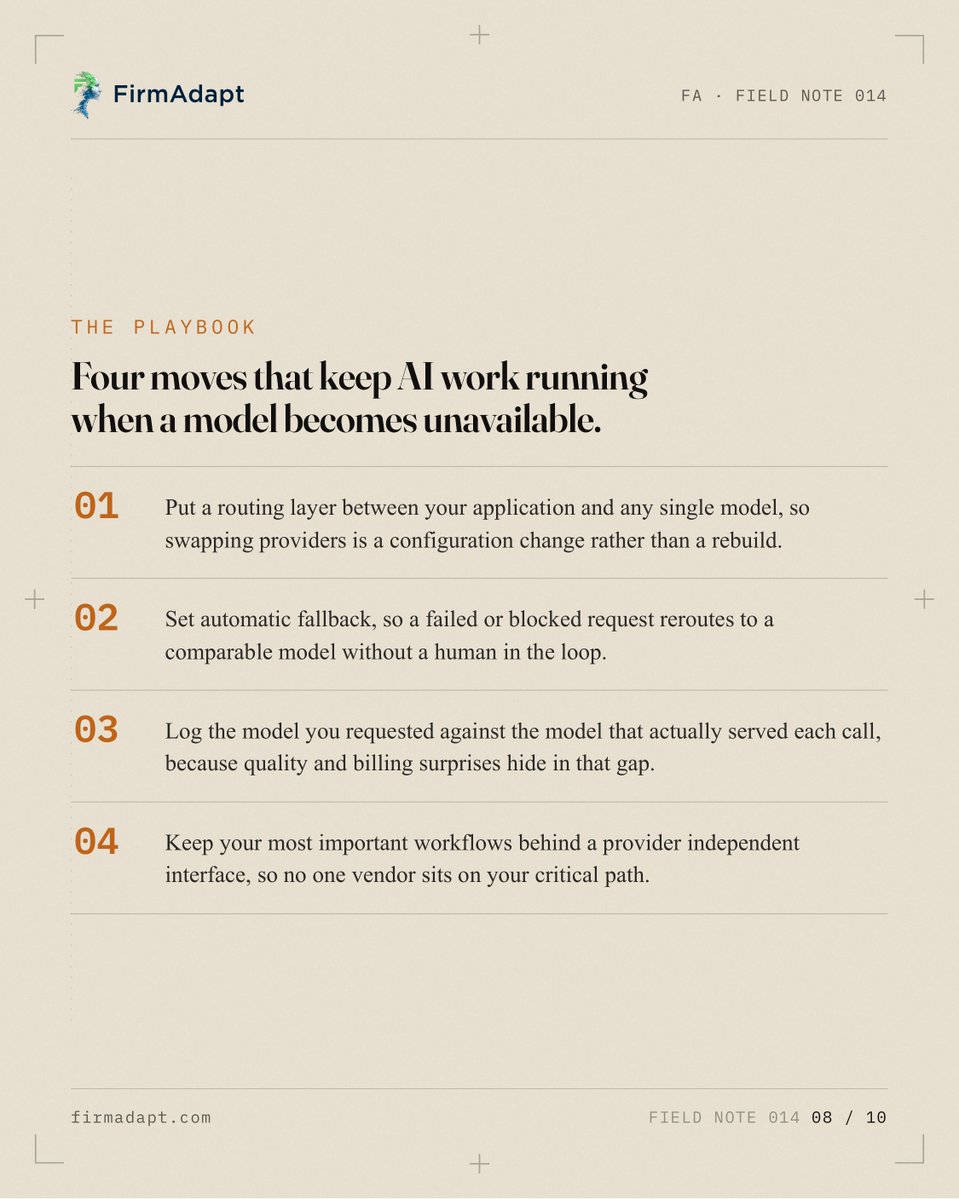
The same event hits two businesses very differently, depending on how each one was built.
If one model is wired straight into production, when the feature it powers goes down, you're existentially dependent on a vendor you don't control.
1
5
Jun 13
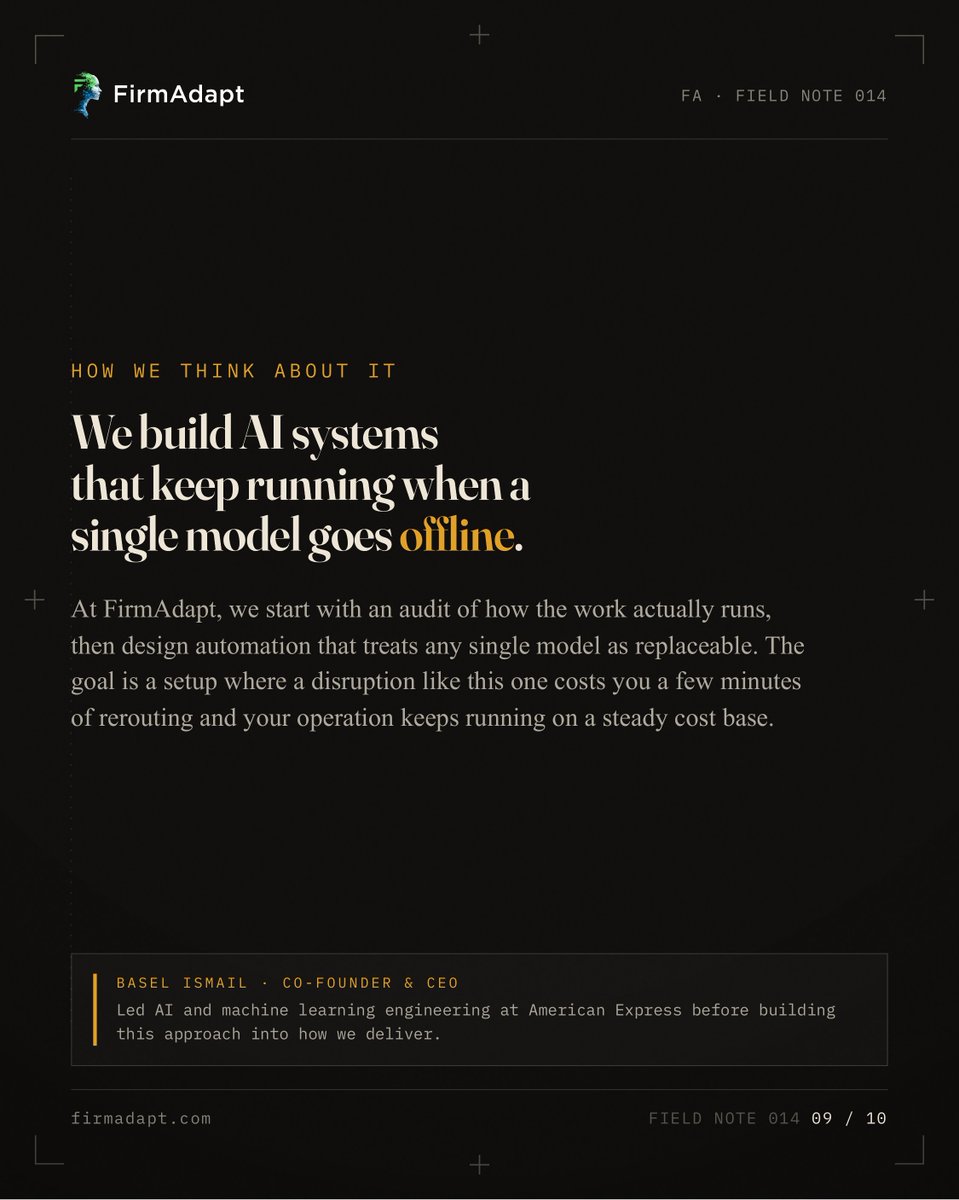
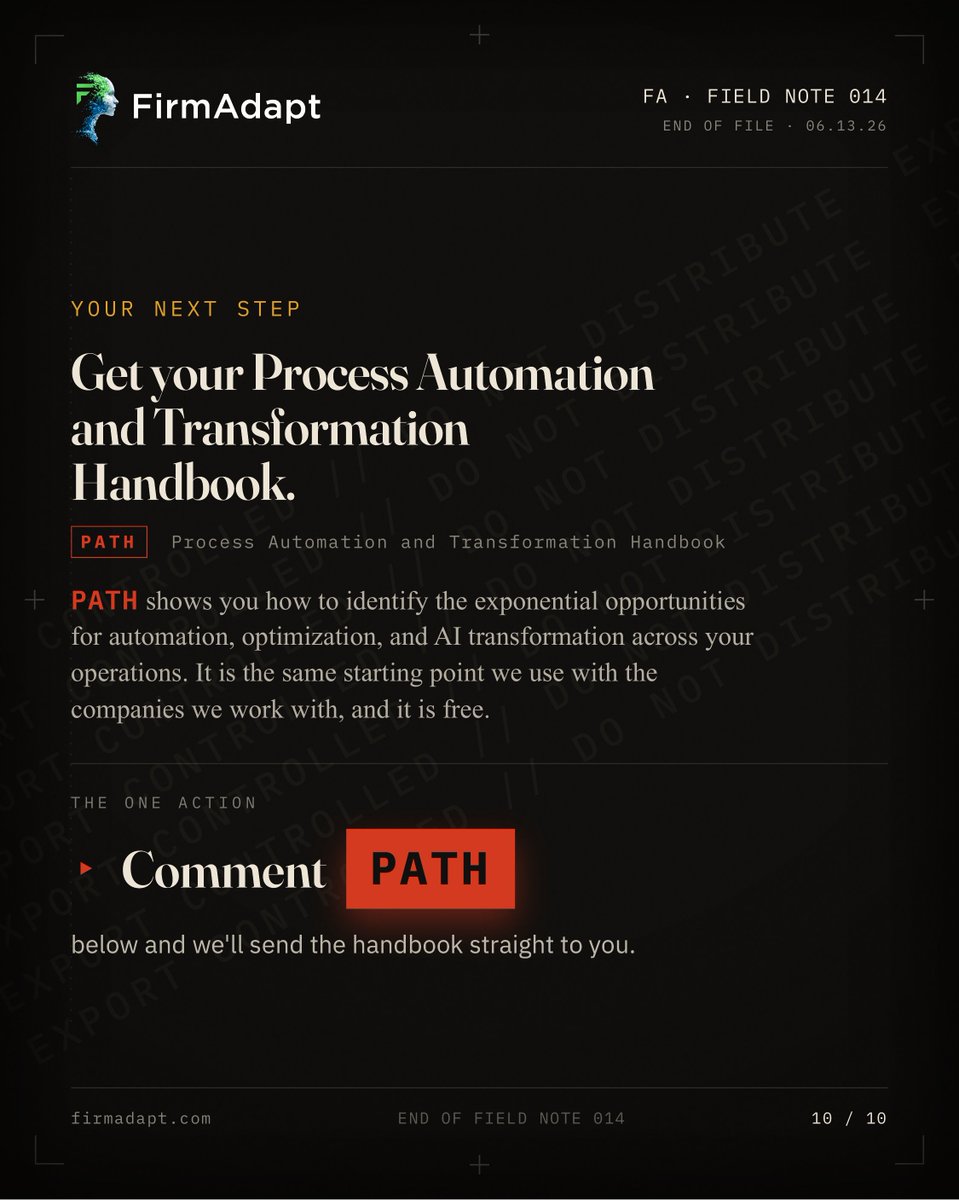
If several models sit behind a routing layer, traffic shifts to another model within minutes, and the operation keeps running at a steady cost.
To get a detailed breakdown of your companies AI opportunities comment "PATH" below
3
Jun 10
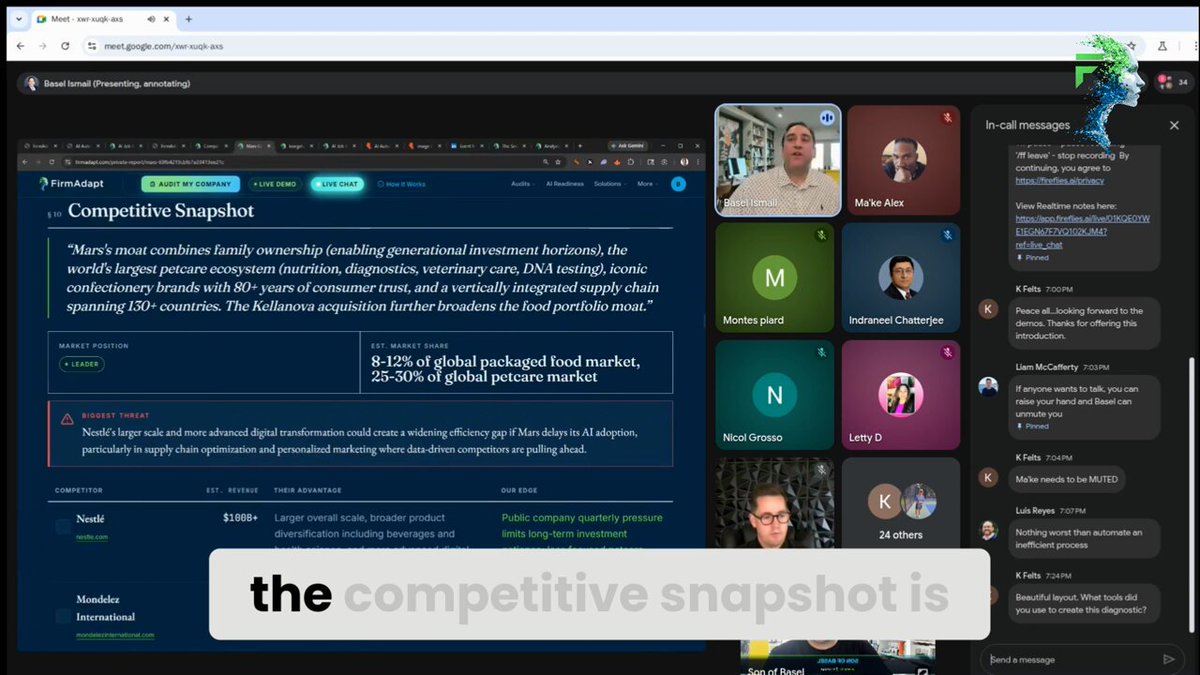
Almost every business owner has the same question running in the background. Are we still competitive, or are the companies around us starting to pull ahead?
That is the exact question the competitive snapshot in our audit is built to answer.
It pulls the company and its closest peers side by side, then shows where each one is winning. Their biggest advantage. Their biggest vulnerability. The quick wins are sitting right there for whoever moves first.
Then you get a radar chart, so the overall position is clear at a glance. Online presence. Reputation. AI readiness. Social reach. Content quality.
In the walkthrough, you can see one well-known brand scoring strongly in some areas and with clear room to grow in others, particularly in social reach and AI readiness.
And this is only the outside view. If you run the business, you already know things the data will never pick up, and that is where it gets useful. You take the gaps, the snapshot surfaces, and add your own context on top.
Curious how others handle this. When sizing up your competition, do you rely on the scorecard, your own assessment of the market, or a mix of both? It would be good to hear your thoughts on it.
8
Jun 7
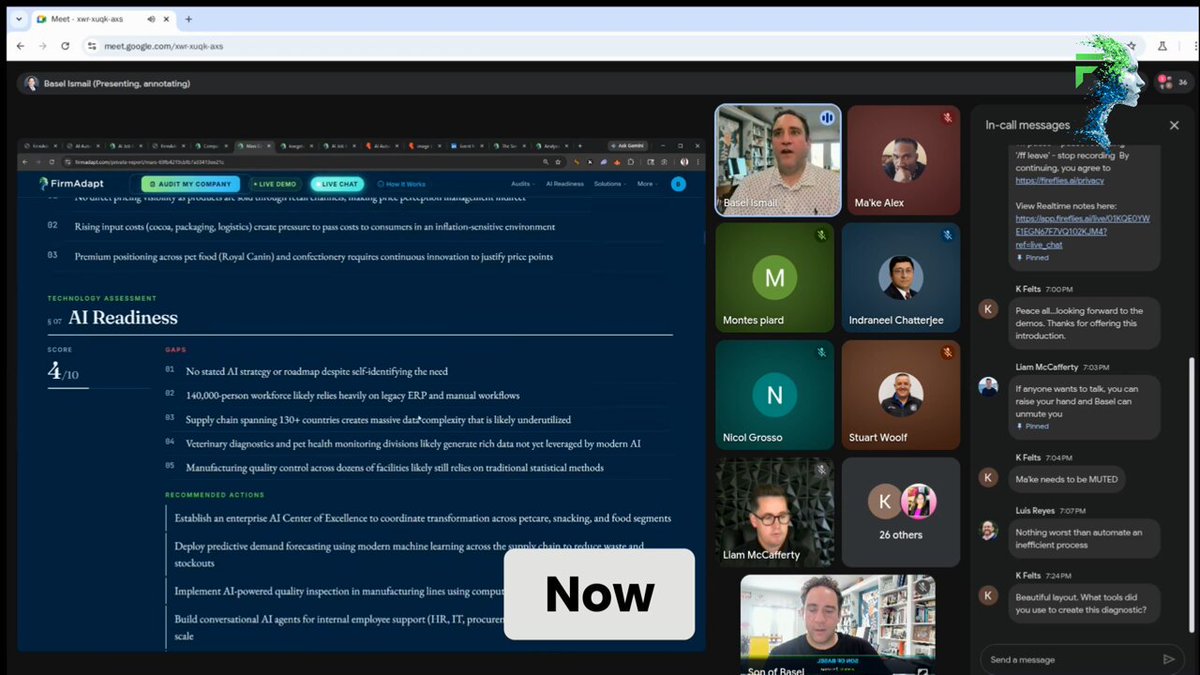
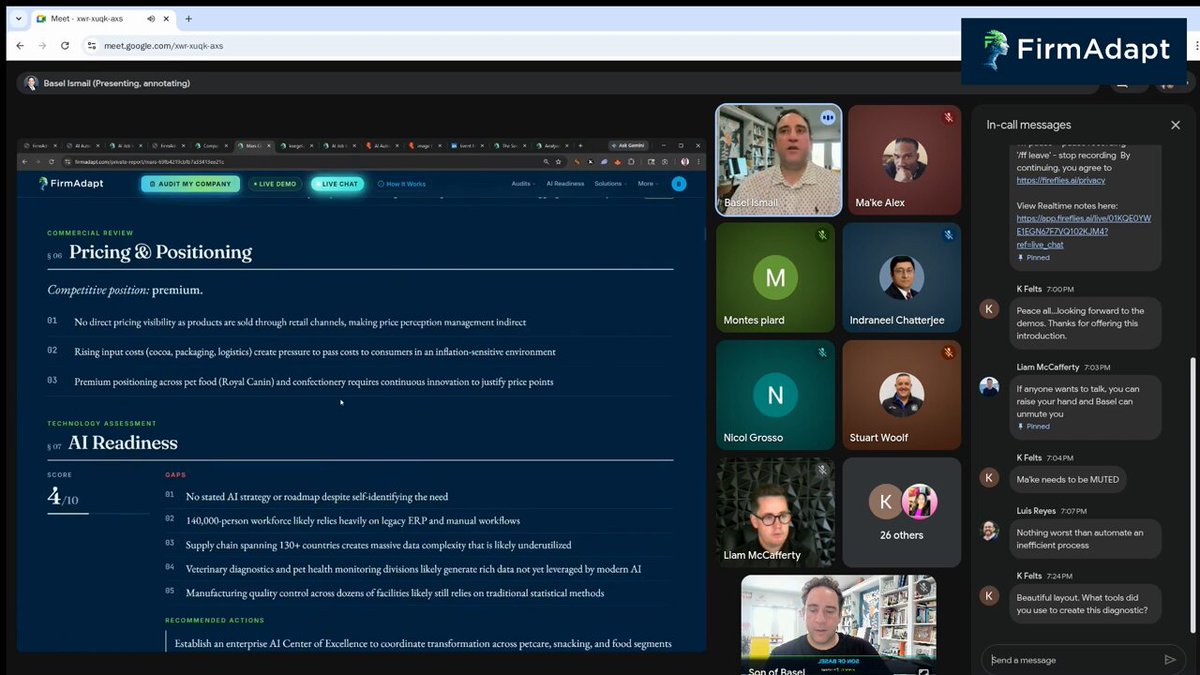
We ran a company through our company diagnostic tool this week, and the AI readiness section is the bit people keep stopping on.
It flagged no stated AI strategy and a few supply chain process problems, and then mapped a recommended action to each.
The recommendations can include:
- Establishing an enterprise AI center of excellence.
- Using machine learning for demand forecasting and tighter stock planning.
- AI-powered quality inspection on the production line.
- Conversational agents that support the team internally and handle some client communication.
What we like about seeing it in one place is how quickly you can tell where your business actually stands.
The gap between that and where they could get to at the same cost base tends to be wider than people assume.
Comment DIAGNOSTIC and we'll run yours for free.
12
Jun 6
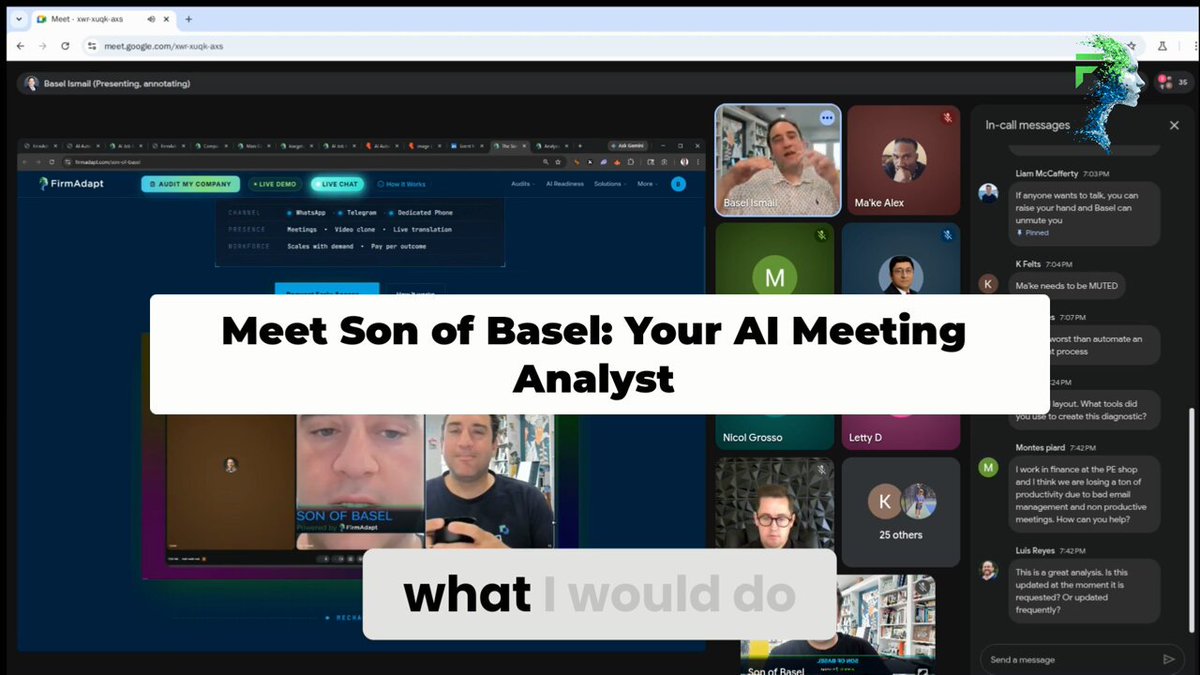
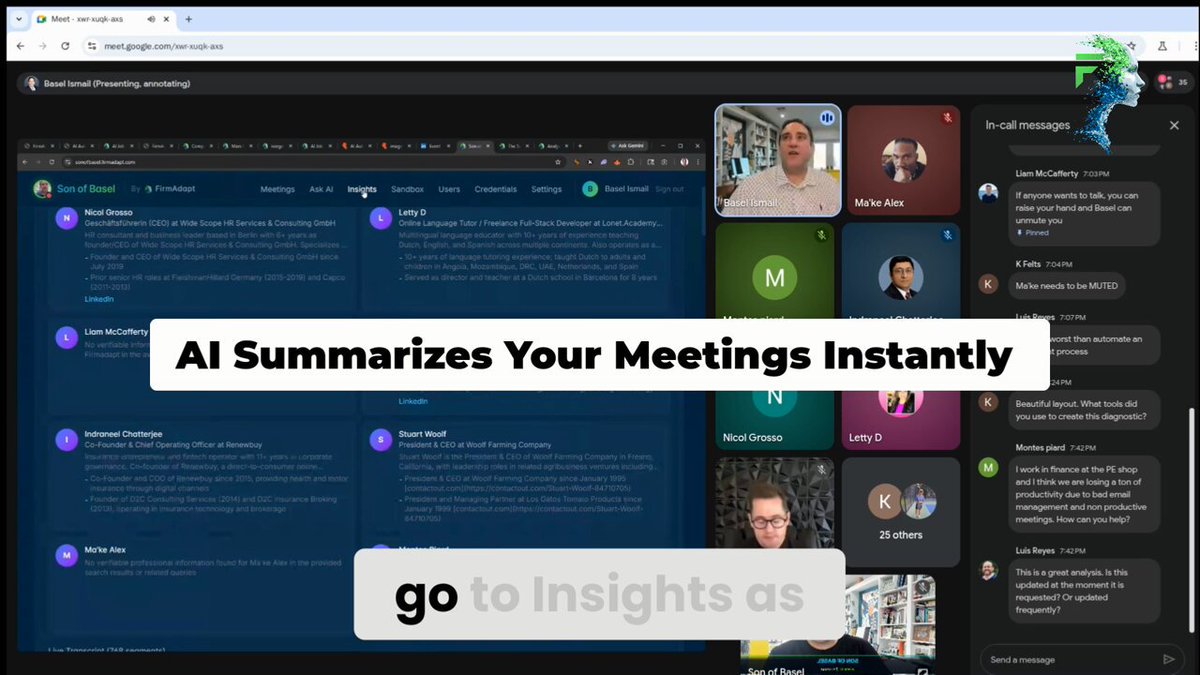
Our co-founder @BaselIsmail built a swarm of AI agents that’s represented as a digital clone that joins his meetings and researches everyone in the room to give you live intel.
He calls it Son of Basel.
In the clip, it's running live.
As each attendee joins, it works through them one by one and builds a profile for each person, including their role, background, and credentials, the company they're with now, and what they're responsible for.
By the time the meeting gets going, he already knows who's on the other side of the table.
He captures the notes, itemizes every action item, and draws out the insights.
Then he reads those against earlier meetings, so when something promised in one room overlaps or conflicts with something agreed in another, he flags the risk early.
The same setup works for anyone. Your own version, shaped around the meetings you actually sit in.
This is the kind of agent we build at FirmAdapt, designed around the way you already work. The hours that usually go into prepping for meetings and piecing them back together afterward become time you get back at the same cost base.
If you had a son of Basel, what would you ask him to do?
How would he complement your existing AI stack?
1
30
Jun 4
You can run a real diagnostic report on any company, and the only thing you have to type in is its website.
It sounds too simple, but the website is the unique identifier for everything tied to a business, so it's all the tool needs to get going.
In the video, @BaselIsmail analyzes one of the world's largest privately held companies to demonstrate the depth of the report.
Before it runs anything, it asks what you actually want to focus on. A 200-page report usually buries the value, so we customize ours for you.
So you can highlight the issues you want help with and the insights your business needs. The team is stretched thin, revenue has plateaued, AI is on the radar, but nobody knows where to start.
You can select the areas that are applicable to you!
2
1
1
382
May 31
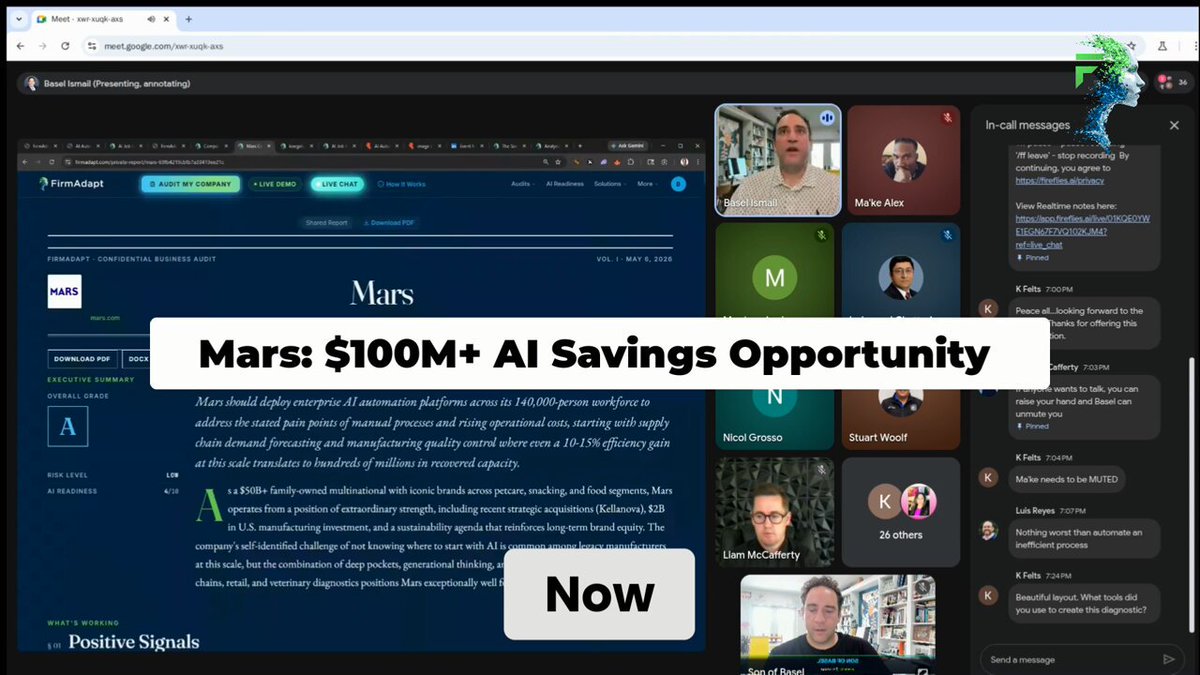
Our CEO @BaselIsmail ran an AI-Era Readiness Report that identified potentially more than eight figures left on the table for a CPG giant!
The picture is built:
→ Manual-driven processes running across the entire 140,000-person workforce
→ Operational costs are climbing, with no stated AI strategy in place to reduce them
→ Supply chain demand forecasting is being handled in ways that could be far more efficient
→ A website with broken pages, almost no social presence, and thin customer proof relative to competitors in the space
The recoverable value sitting inside all of that? Eight figures, climbing toward nine.
Then it moved past the diagnosis into the actual playbook:
→ Stand up an enterprise AI center of excellence
→ Deploy predictive demand forecasting using machine learning
→ Bring in AI-powered quality inspections
→ Build a custom AI agent stack to support employees internally and sharpen how the company communicates with paying clients
A workforce that size carries enormous capacity. Most of it is buried under processes nobody has had the time to rebuild.
Enterprise transformation leaders: the first step is to see where the value actually lies. The Readiness Report shows you that before you commit a dollar to change.
1
9
May 29
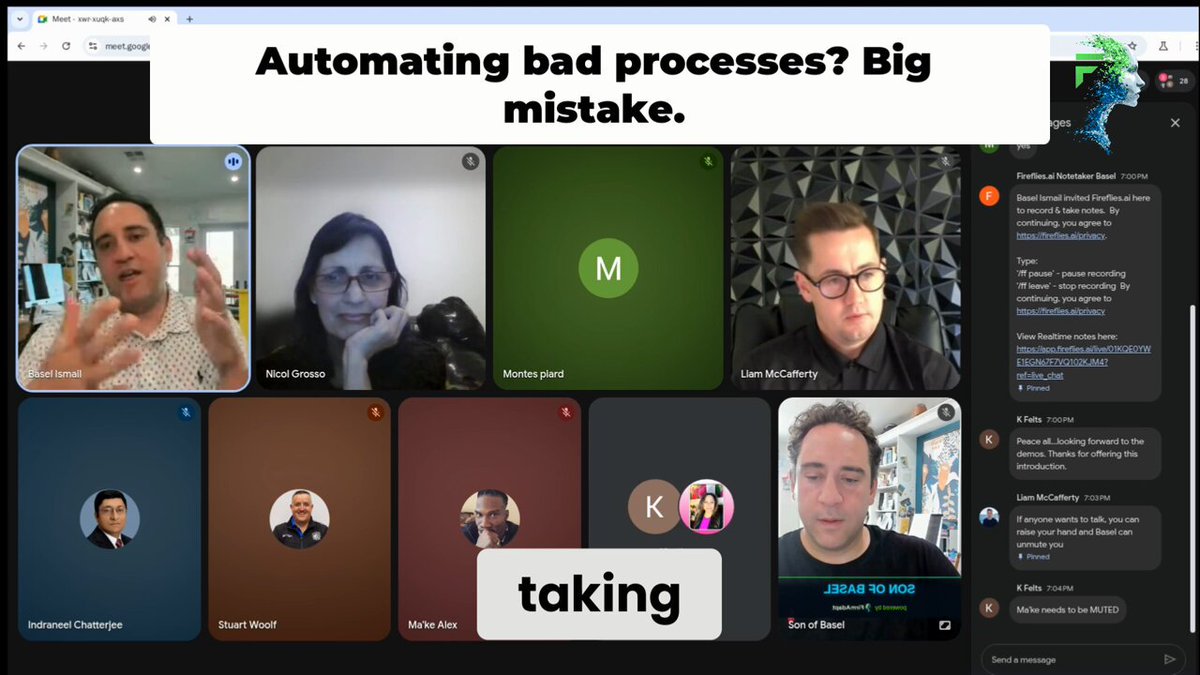
AI will not fix a broken process. It just makes the mess run faster.
That single idea sits at the core of how our Co-Founder and CEO @BaselIsmail approaches transformation, and he has earned the right to say it.
More than 15 years of building machine learning models and statistical algorithms to predict human behavior, back before anyone was even calling it artificial intelligence.
Here is the pattern he sees in nearly every client conversation:
-> Companies are racing to bolt AI onto processes that are convoluted, manual, and frustrating to begin with.
-> The systems are fragmented.
-> The steps are duplicated.
-> Half the time, nobody can fully explain why the process runs the way it does.
-> Drop automation on top of that, and all you have done is accelerate the chaos.
As Basel puts it, there is nothing worse than automating an inefficient process.
The sequence is everything:
-> You re-engineer the process first.
-> You streamline it, rationalize it, optimize it.
-> Then, and only when it genuinely makes sense, you introduce a custom AI agent stack on top of a foundation that can actually hold it.
The problems are remarkably consistent.
Publicly traded or privately held, large or lean, the same ingredients show up every time: fragmented systems, heavy manual work, and processes that grew complicated without anyone deciding they should.
Want to see where your own processes actually stand?
Go to the FirmAdapt Website for our AI readiness audit, which shows you in minutes.
#AITransformation #EnterpriseAI #ProcessOptimization
1
2
374
May 29
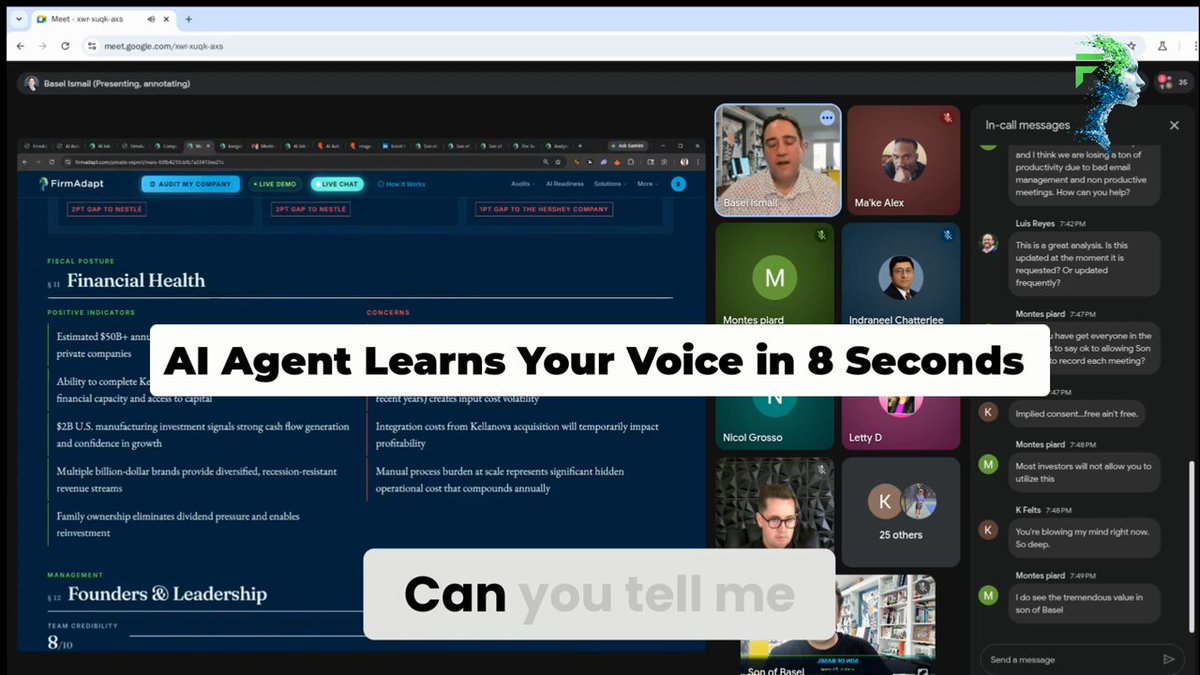
Ask Son of Basel what is on your calendar tomorrow, and he answers in 8 seconds.
In a voice that sounds exactly like the person he was built for.
He is trained on one person and calibrated to how that person actually works.
He runs privately, behind his own gateway and multiple layers of encryption, so nothing is stored in a shared cloud anyone can access.
At first, he took 3 minutes to answer.
We helped him get to 70 seconds, then 60, then 50, then 30, and now 8.
That work, invisible from the outside, is what separates a real custom AI agent from a generic tool.
This is what we build.
6
May 25
Asking your AI agent, "What action items are still open?" and receiving a real answer across every meeting from the past week changes how a leadership team operates.
Most companies lose hours every week trying to remember what was decided and what was promised.
Action items get buried in notes. Follow-up emails drag into Friday afternoon and sometimes never go out at all.
A custom AI agent stack sits atop every meeting. It records, transcribes, and indexes everything in one place.
Then it answers questions in plain English.
"What decisions were made this week?"
"Summarize every meeting from today."
"What topics keep coming up?"
It pulls weekly insights across the whole company, including partnership updates, commercialization wins, and blockers raised by team leads.
Click into any meeting, and you get the recording, the full transcript, and a clean highlight reel.
Follow-up emails draft themselves from the conversation that just happened.
For enterprise transformation leaders who want to see where their company stands today, FirmAdapt runs a free three-part audit covering public signals, private operations, and website readiness.
6
May 23
There is a second @BaselIsmail inside @FirmAdapt.
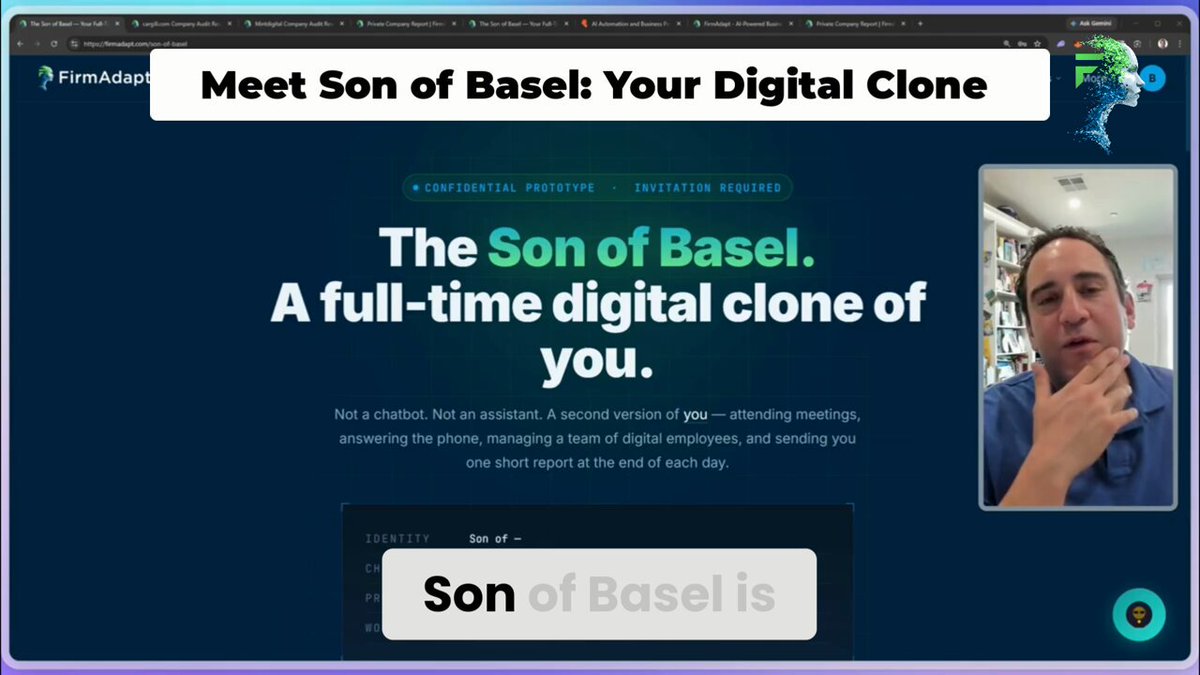
He calls it Son of Basel. It is a full-time digital clone, trained on thousands of pages of Basel's transcribed thinking, frameworks, and decisions.
It manages a full team of custom AI agents.
Basel can call it directly from his phone and ask what was shipped today.
He can message it on Telegram or WhatsApp and shift priorities up or down based on demand.
It joins his meetings, transcribes, summarizes, and translates them. Mid-meeting, Basel can ask it to weigh in on a business process question, and it answers in his framing.
When workload spikes, the agent team behind Son of Basel scales up. When it slows, it scales back. Throughput moves with the work.
This is what an AI-native operating model looks like at the leadership layer.
FirmAdapt designs and installs systems like this for enterprise transformation leaders who want to compound output and accelerate decision speed.
Get your "Son of" at firmadapt.com/son-of-basel!
2
2
482
May 23
Two prompts that change the quality of every AI agent in your stack.
After auditing dozens of AI implementations, we've found that the single biggest predictor of weak output isn't the model choice.
Its operators are shipping the first response without a second pass.
These two prompts fix it:
1. "Are you sure you didn't skip any steps? I don't want any shortcuts taken."
2. "Did you make any assumptions? If you did, ask me before answering."
Every time, the agent rebuilds the response. Catches the gaps. Surfaces the assumptions it was hiding behind confident language.
This is the operator habit most teams skip. They run the agent once, paste the output, and ship it. Then wonder why the work feels shallow.
The upgrade is not a better model. It is a second pass.
2
2
45
May 20
A client was preparing to raise capital.
The first thing investors saw when they googled the company was a spam TrustPilot review that the team had never noticed.
The audit caught it. Removed before the round opened.
The free audit at firmadapt.com checks every review site and search result on page one for your brand.
10
May 20
Live demo this week: our public audit run on a 140,000 person global CPG conglomerate.
Supply chain demand forecasting still done manually across 130 countries. Rising operational costs across the board.
The audit flagged eight to nine figures in recoverable cost.
Public information only. Five minutes to run.
The same audit is free for your company at firmadapt.com.
17
May 20
Every working voice agent has three parts.
Ears (speech to text).
Brain (reasoning model).
Mouth (text to speech).
Vendors who sell single model voice solutions are shipping a worse product. We have tested this in our own production systems.
If you are evaluating a voice agent build, the free audit at firmadapt.com covers your current architecture.
8
May 19
The biggest AI risk in mid-market companies right now is not strategic. It is operational.
Some workers are pasting financial statements, customer data, and internal memos into free consumer AI tools.
This is shadow AI. It looks like productivity. It is data exposure.
Three patterns we see repeatedly:
1. Finance teams are using consumer chat tools for variance analysis without realizing that inputs are retained.
2. Sales teams are uploading prospect lists to draft outreach and exposing pipeline data to a third party.
3. Operations teams pasting contracts into free tools to extract terms.
The fix is straightforward. A regulated portal with the right credentials, the right model access, and audit logs. Same speed, without the leak.
A free FirmAdapt audit will help you see where you are now & your opportunities.
1
1
24
May 19
We built a virtual board of agents. CFO. CMO. CTO. CIO.
Each one is constrained to a single domain with a strict guardrail and instructed to behave only as a senior advisor in that lane.
Before any major call, run the decision past all four.
The CFO challenges the numbers.
The CMO challenges the positioning.
The CTO challenges the technical risk.
The CIO challenges the data and compliance posture.
The output looks nothing like a single generic agent because each one is forced into a narrow expert frame.
The reason this works is structural.
AI quality scales with constraint, not capability.
A general-purpose agent gives general-purpose answers.
A constrained agent gives a sharper answer because it has less room to drift.
The pattern takes an afternoon to set up and changes the quality of every decision after.
5