
1,950 Photos and videos













One of my great grandfathers' father was a Czech from Bohemia, and his mother a German from Prussia. They came to Texas to try and start a new life late 1800s. They were rich, but got wiped out by the crash of '29 and never recovered. His brother decided to go back to Czechoslovakia while the family stayed in Texas and see if he could somehow revive their business fortunes over there.
He never came back.
As best it could be determined, like so many other Sudeten Germans, he was shot by the Soviets after the war ended for the crime of having a Prussian mother.
May 30

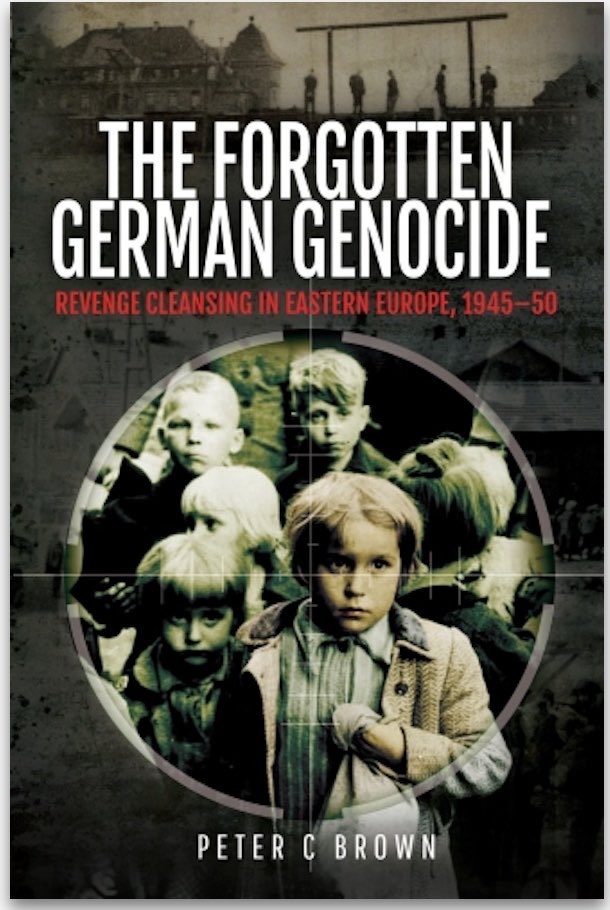
The Forgotten German Genocide: Revenge Cleansing in Eastern Europe, 1945–50 by Peter C. Brown (2021)
Imagine the war is over. Nazi Germany has surrendered. The Allies are carving up Europe at Potsdam, promising “orderly and humane” transfers. Instead, in Poland, Czechoslovakia, Hungary, Romania, and Yugoslavia, a vengeful storm of ethnic cleansing explodes against millions of ethnic Germans—families who had lived there for centuries, farmers, shopkeepers, teachers, children who had nothing to do with the death camps or the Eastern Front.
What followed was not orderly. It was a deliberate, savage that history textbooks in the West have buried for eighty years.
In Czechoslovakia alone, Sudeten Germans were dragged from their homes at gunpoint. Farms, houses, and businesses were seized overnight. Men were beaten to pulp in the streets while their wives and daughters were gang-raped in front of them sometimes for days on end by Czech militias, Soviet troops, and local civilians high on hatred. One survivor recalled women and girls as young as eight being pulled into alleys or barns, raped repeatedly until they bled out or went mad. Bodies of the dead and dying were left in ditches or thrown into the Elbe River like garbage. In the Ústí nad Labem massacre of July 1945, after an ammunition dump exploded (killing mostly Germans), enraged crowds and soldiers hunted down civilians: Germans were clubbed, shot, or hurled off bridges eyewitnesses described a baby carriage with an infant still inside being tossed into the water.
In the Přerov massacre that same month, Czechoslovak soldiers yanked ethnic Germans men, women, children and babies from a train, marched them to a hill, forced them to dig their own graves, and executed them one by one with shots to the neck. The mass grave stayed hidden until 1989.
In Poland, the “wild expulsions” turned roads into corridors of death. Columns of refugees old men, barefoot women carrying infants, teenagers were forced on death marches westward with no food, no water, no shelter. Stragglers were shot. Mothers watched their babies freeze or starve in the snow. In internment camps (some literally the same barbed-wire enclosures Jews had just been liberated from), Germans were starved, beaten, and worked to death. Typhus and dysentery ripped through them while guards looked on. Rape was so commonplace it became policy. Thousands of young girls and women were dragged into Soviet barracks or Polish militia stations and passed around like spoils of war.
By 1950, between 12 and 14 million ethnic Germans had been driven out. Official German figures put the death toll in the MIiLLIONS…shot, raped to death, starved, beaten, or frozen on the roads and in the cattle cars that followed. Even conservative estimates acknowledge hundreds of thousands of civilians slaughtered or worked to death in a frenzy the Allies knew about and largely ignored. Potsdam’s “humane” clause was a sick joke.
This wasn’t collateral damage. It was a systematic cleansing carried out with the full knowledge of the victors. Yet in school curricula, documentaries, and public memory, it barely exists. Why? Because acknowledging it complicates the clean narrative of pure good versus pure evil. It forces the uncomfortable truth that the winners also committed mass atrocities against civilians women and children included purely for their ethnicity.
This is a forgotten genocide. These people grandmothers, schoolgirls, farmers who never wore a uniform suffered horrors as explicit and sadistic as anything the 20th century produced, only for the world to look away and let the silence bury them. The bodies are still in those unmarked graves. The screams are still in the memories of the few survivors left. And the history remains deliberately silenced.
archive.org/details/peter-c.…
4
15
352
Yes, we can listen to economists who actually know what the hell they’re doing when it comes to central banking like Richard Werner, or we can listen to…
*checks notes* A crypto J,
a homosexual Mexican federal informant, and a guy who SWATs himself for attention.
Lol
3
1
67
793
We had years of internal turmoil over someone just dropping this accusation in connection with no evidence with Russia as the subject.
Watch the magnitude of the nothing that happens when it's Israel.
Jun 13

Israeli firm BlackCore suspected of meddling in New York’s mayoral election – via Reuters
24
146
8,825


Quoted for emphasis. Doing all these things takes time. Get started now.
Jun 11

White man, my brother. We're going to need to clean things up at home. Stop drinking. Stop smoking. No drugs. No pills. No pron. Stop worshiping mammon and women instead of God. Stop watching sportsball. Kill your streaming services. Get right with God. Get in warfighting shape.
1
90
Frost retweeted

Jun 11
I don't know who needs to hear this, but it might be everyone.
Sam Hyde is wrong.
He's worse than wrong. Fractally wrong. Wronger than wrong.
The kind of wrong you get when you understand who the enemy is, and are trying to fight against him, but you're really still fighting for him, because you have foolishly conceded his initial premise.
Sam Hyde doesn't know what happiness is. That's why he tells you not to have any. Because he doesn't know what it is and what it's for.
Know the difference between happiness and pleasure.
Happiness isn't sitting in a dark room jerking off to pictures while sucking on a lollipop.
Happiness is what you get when you connect to other people.
Happiness is what you get when you accomplish something you're proud of.
Carry that heavy burden across a finish line. Make something useful out of wood or metal. Fix that leaking window. Debug your code. Write something true, or beautiful, or both. Teach someone. Cook a delicious meal that doesn't come out of a box. Grow your small business. Raise your son to be a better man than you.
Do something others admire.
Do something that makes you proud.
Happiness isn't taking, or slacking off. Nothing you can buy can bring you happiness unless you add your own effort to it.
Happiness comes from making, and improving, and giving.
Happiness doesn't shun burdens. Happiness picks them up.
You are not made to suffer or to hate life. You are made to thrive, and to desire what makes you thrive. How could your ancestors have made it this far in any other way?
Yes, there are a lot of burdens you have to carry, especially right now. But don't carry them with worry and fear and suffering.
Carry them with pride.
Set them down across the finish line with joy.
And pick up the next one with hope.
Find someone to carry it with you.
When you know the difference between happiness and pleasure, your own mind, your own body, will tell you exactly what you need to do.

153
214
2,446
106,517
Legitimately probably my favorite show as a kid.
I wish they'd had the budget to keep the ball rolling as hard as it rolled in season 1.

1
5
121
This is true. They used Germans for slave labor and worked them to death for decades, with 25 year sentences.
There was a 2001 German film about one of them who escaped after 5 years and covered 14,000 kilometers trying to get out of Siberia and home to Prussia to his family called “So weit die Füße tragen” (As Far as my Feet will Carry Me in English). It did a very good job capturing what they went through.
watch.amazon.com/detail?gti=…
1
5
3
148
This is rife all over tech and medicine as well.
Deport all Indians.
Jun 11

🇺🇸🇮🇳 Neeraj Sharma, former CEO of a New Jersey staffing firm, is losing his US citizenship for H-1B visa fraud.
He filed 11 fake petitions with forged documents for nonexistent bank jobs.
He profited by selling fake visas to foreigners, exploiting the H-1B system.



5
69
591
6,056
British government shaming itself daily. You can cut the head off an Irishman and they don't care, but by God don't you try to make the beheadings stop.
A government at war with its people on behalf of an alien is invalid and has no right to rule.

🚨WATCH: SHOCKING footage shows police PUSH BACK protesters with riot vehicles in Belfast 🇬🇧
2
7
153
Based. This is now my view as well.

There is no more "left" or "right".
There is only the defenders of Western civilization, and the traitors who would seek to undo it.
I am now a single issue voter.

4
7
182


RT @JAlfredJuicebox: “It’s the billionaires”
“It’s the alt-right echo chambers”
“It’s the manosphere influencers”
“It’s the…”
Actually i…
4,576
Just found out one of my German knights brought home a Spanish lady on campaign in the 1500s and therefore I'm 0.0061% Spanish.
Time to turn on Lucas Imbiriba. 😂
youtu.be/xpRgR-tZEpk?si=RAWz…

1
2
240
I demand I be allowed to carry my P.08 Luger or a Katzbalger on my hip as my traditional German ceremonial self-defense weapon worldwide.
Failure to comply is racism and I may instead carry a Zweihänder or sledgehammer.
Jun 6


2
1
12
342
Apparently I’m still cool?

1
2
154