
🛠️ Building data infra for AI/ML. Ex-Data Scientist @Microsoft. Created DVC, now DataChain. PhD in CS. Serious about data. Less serious about everything else.
Joined October 2011
- Tweets 1,274
- Following 544
- Followers 2,279
- Likes 4,272
143 Photos and videos






Jun 8
Call for Proposals for AGNTCon MCPCon North America 2026 is open on Sessionize and I've just submitted a session! sessionize.com/agntcon-mcpco…
1
1
2
77
Jun 7
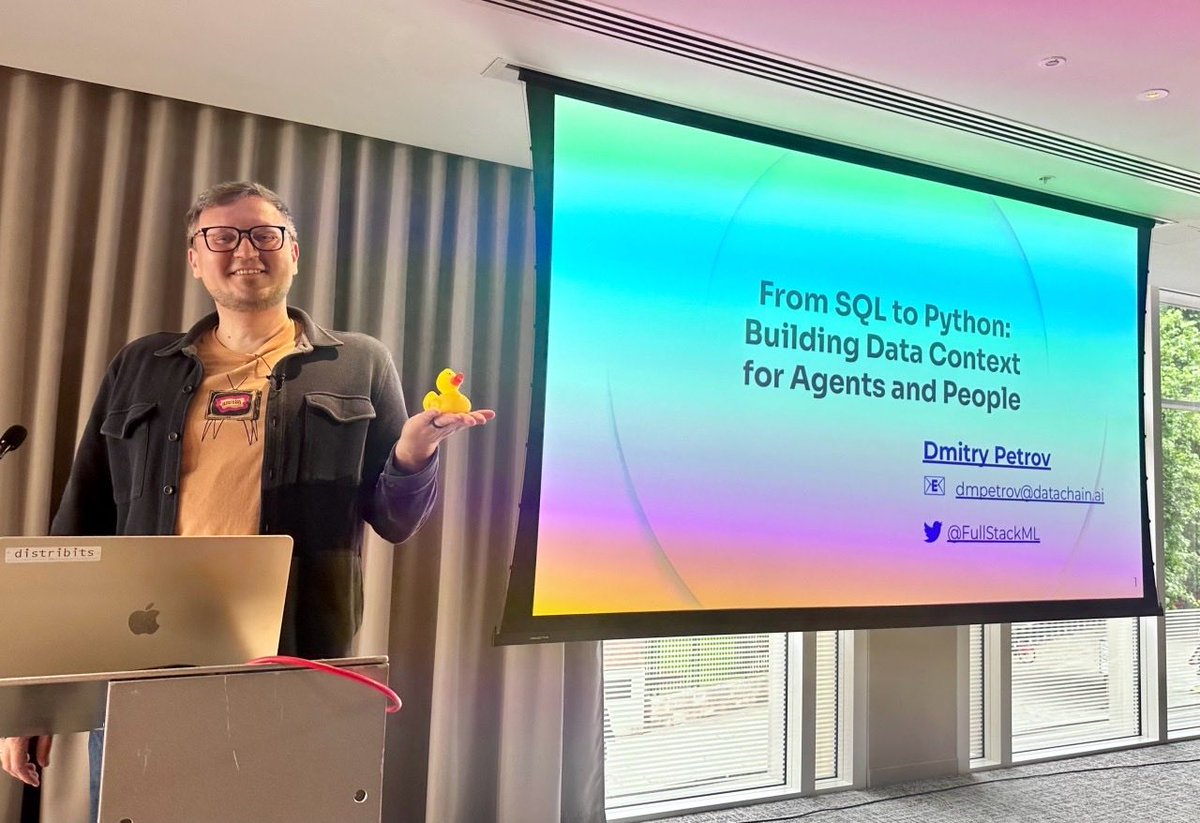
Talked about data agents beyond SQL at @pydatalondon today.
Files, video, sensors, metadata, Python workflows - all the messy stuff where real data work happens.
Thanks everyone who came by 🙌
4
150
Jun 5
Excited to speak at @PyData London this Sunday!
I’ll be talking about data context for agents beyond SQL: video, sensors, files, metadata, and Python workflows.
10:15 · Hardwick Hub Conference Room
Come say hi!

Tomorrow, PyData London 2026 begins. If you have your ticket, we'll see you there. If you don't have yours yet — there's still time: hubs.la/Q04jpJ3R0
- - -
PyData London 2026:
Convene Sancroft, St. Paul's
Tutorials: Friday, June 5-7
Talks: Saturday and Sunday, June 6-7
Keynote Speakers all 3 days
Tickets: hubs.la/Q04jpJ3R0

1
2
353
May 29
Opus 4.8 is really smart!
It spent 38 minutes implementing a pretty complex feature, proved it worked, then reverted it with a detailed explanation.
So, like humans 🤷♂️
1
1
779
May 23
3am thought: pi.dev tonight. Pretty solid, and you pick your model GPT/Opus/DeepSeek.
The harness category is maturing into "bring your own model" mode. The harness IS the product now.
140
May 20
Every dev-experience problem ends-up generating and executing some code, and all code is moving under a harness (Claude Code, Cursor, Codex), leaving people with text.
Data platforms are next! And that's what we need to build.
May 19

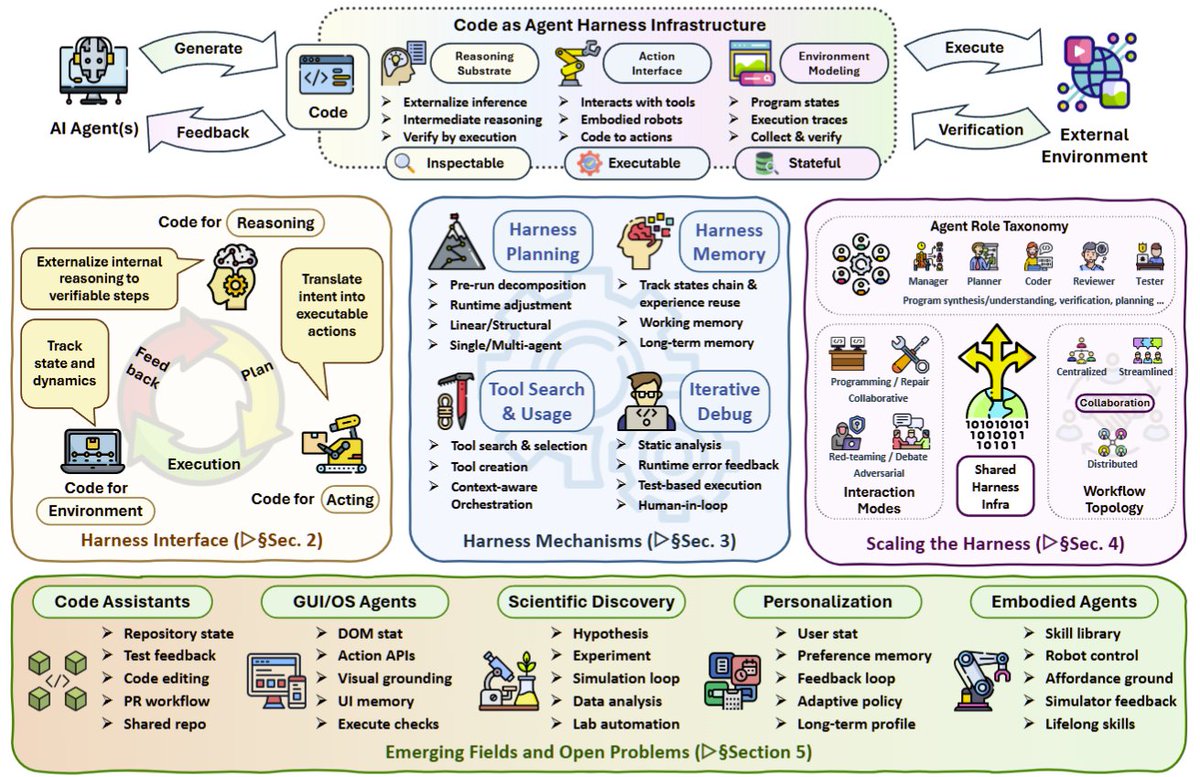
🚀Code as Agent Harness: A survey work from UIUC, Stanford, and Meta.
📄arxiv.org/abs/2605.18747
Code is no longer just the output of AI.
It is becoming the executable, inspectable, and stateful substrate through which AI agents reason, act, verify, remember, and self-correct over long horizons.
In our new survey, we examine this shift through the lens of Code as Agent Harness, focusing on how code serves as:
• 🧠 Harness Interface: coding for reasoning, acting, and environment modeling
• ⚙️ Harness Mechanisms: planning, memory, tool use, feedback, and optimization
• 🤝 Multi-Agent Harnesses: collaboration through shared code, tests, and execution traces
We review applications spanning:
💻 Coding Agents
🖥️ GUI/OS Agents
🤖 Embodied Agents
🔬 Scientific Discovery
🏢 Enterprise Workflows
If you find this survey helpful, feel free to explore our resource collection below.
🤗 Hugging Face Daily: huggingface.co/papers/2605.1…
💻 GitHub: github.com/YennNing/Awesome-…
🌍 Website: code-as-harness.github.io/co…
Feedback, suggestions, and community contributions are warmly welcome!
#AI #Agents #LLM #Coding #AgenticAI #SoftwareEngineering
3
4
326
May 17
My productivity KPI: hit Claude's weekly limit. Anthropic doubled it. Now I'm underperforming 🫠
2
161
May 7
Turns out "Claude Code over files in S3" quickly becomes "rebuild half the data warehouse stack" 🫠
Schemas, datasets, lineage, file refs, etc.
OpenAI's Data Agent post made us feel slightly less insane 😄
Read more: datachain.ai/blog/openai-dat…
7
5
85
554,452
Apr 7
Milla Jovovich releasing a agent memory framework wasn’t on my 2026 bingo card
the Fifth Element but it stores everything instead of summarizing
Apr 6

Mempalace --> Multipass.
Thanks to Anthropic, even Leeloo can code.
github.com/milla-jovovich/me…

1
282
Apr 3
running both:
LLM knowledge base dynamic (OpenCrawl) system
don’t trust dynamic to write knowledge base —> read-only
feels like a hack
consistency vs adaptability?
Apr 2

LLM Knowledge Bases
Something I'm finding very useful recently: using LLMs to build personal knowledge bases for various topics of research interest. In this way, a large fraction of my recent token throughput is going less into manipulating code, and more into manipulating knowledge (stored as markdown and images). The latest LLMs are quite good at it. So:
Data ingest:
I index source documents (articles, papers, repos, datasets, images, etc.) into a raw/ directory, then I use an LLM to incrementally "compile" a wiki, which is just a collection of .md files in a directory structure. The wiki includes summaries of all the data in raw/, backlinks, and then it categorizes data into concepts, writes articles for them, and links them all. To convert web articles into .md files I like to use the Obsidian Web Clipper extension, and then I also use a hotkey to download all the related images to local so that my LLM can easily reference them.
IDE:
I use Obsidian as the IDE "frontend" where I can view the raw data, the the compiled wiki, and the derived visualizations. Important to note that the LLM writes and maintains all of the data of the wiki, I rarely touch it directly. I've played with a few Obsidian plugins to render and view data in other ways (e.g. Marp for slides).
Q&A:
Where things get interesting is that once your wiki is big enough (e.g. mine on some recent research is ~100 articles and ~400K words), you can ask your LLM agent all kinds of complex questions against the wiki, and it will go off, research the answers, etc. I thought I had to reach for fancy RAG, but the LLM has been pretty good about auto-maintaining index files and brief summaries of all the documents and it reads all the important related data fairly easily at this ~small scale.
Output:
Instead of getting answers in text/terminal, I like to have it render markdown files for me, or slide shows (Marp format), or matplotlib images, all of which I then view again in Obsidian. You can imagine many other visual output formats depending on the query. Often, I end up "filing" the outputs back into the wiki to enhance it for further queries. So my own explorations and queries always "add up" in the knowledge base.
Linting:
I've run some LLM "health checks" over the wiki to e.g. find inconsistent data, impute missing data (with web searchers), find interesting connections for new article candidates, etc., to incrementally clean up the wiki and enhance its overall data integrity. The LLMs are quite good at suggesting further questions to ask and look into.
Extra tools:
I find myself developing additional tools to process the data, e.g. I vibe coded a small and naive search engine over the wiki, which I both use directly (in a web ui), but more often I want to hand it off to an LLM via CLI as a tool for larger queries.
Further explorations:
As the repo grows, the natural desire is to also think about synthetic data generation finetuning to have your LLM "know" the data in its weights instead of just context windows.
TLDR: raw data from a given number of sources is collected, then compiled by an LLM into a .md wiki, then operated on by various CLIs by the LLM to do Q&A and to incrementally enhance the wiki, and all of it viewable in Obsidian. You rarely ever write or edit the wiki manually, it's the domain of the LLM. I think there is room here for an incredible new product instead of a hacky collection of scripts.
2
1
244
Apr 3
Not sure if this is architecture… or perfectionism leaking into the system design
59
Mar 3
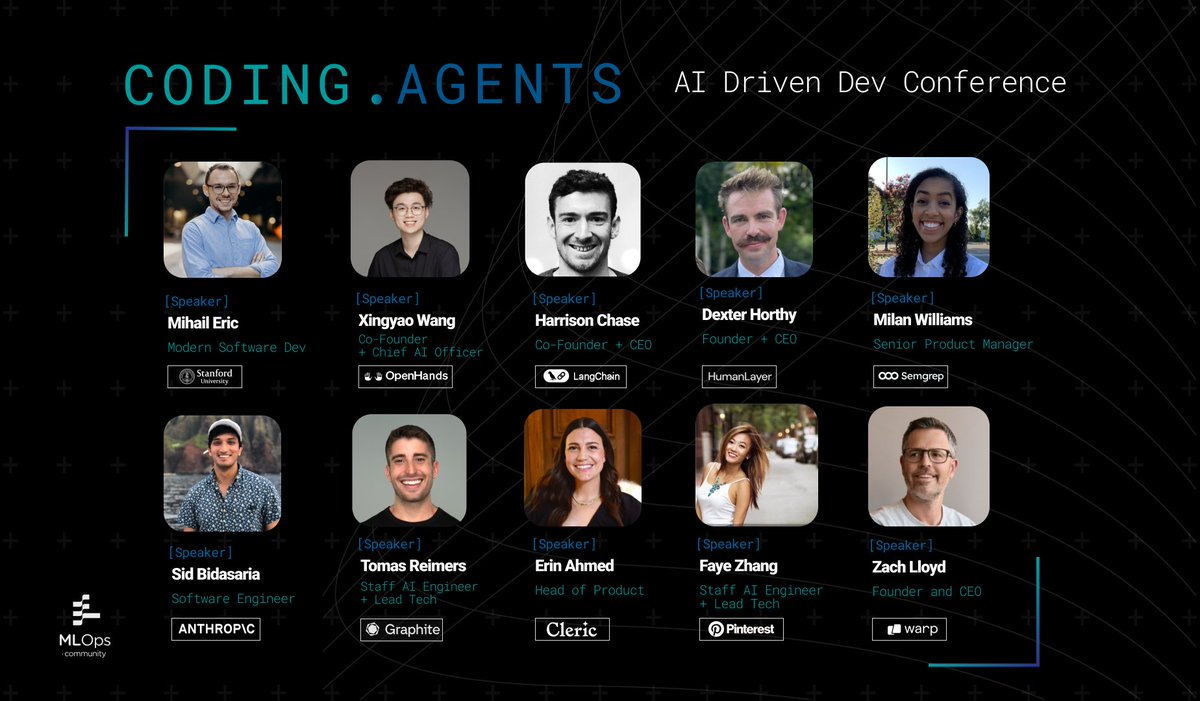
I’m at the MLOps conference today in Mounting View.
If you’re around, would love to connect!

Coding Agents Conference. March 3rd at the Computer History Museum. luma.com/codingagents
5
233
Feb 4
OpenAI's data agent - how structured / SQL data done right:
openai.com/index/inside-our-…
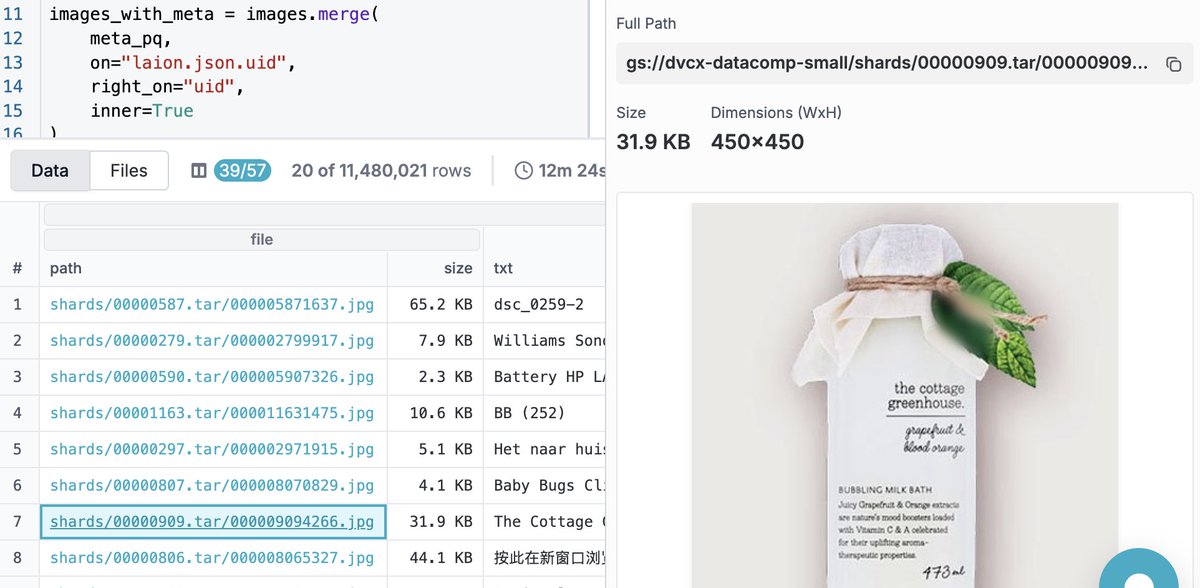
🎥🔊🖼️ Multimodal data is harder: schemas and lineage aren't explicit - they must be inferred from Python code.
The upside: a single language removes an entire layer of context and simplifies reasoning.
✨ True meaning lives in the code ✨
1
3
247