CEO @Solugen | MD/PhD building the modern chemical industry | Making molecules that power humanity | Takes on manufacturing, energy, molecules, and biology

Joined December 2008
732 Photos and videos
Pinned Tweet
We spent $15,000 on billboards targeting one person: the guy controlling all the chemical spend at a saltwater disposal company in Texas. We mapped his commute and bought every billboard between his house and the oil field. When we finally called, he said "I see your billboards everywhere." That landed us our first oil field contract. At the time our entire operation was a $10,000 reactor built from PVC pipes from Home Depot, turning corn sugar into industrial chemicals. People keep trying to throw it away. It still works. That leaking reactor started a multibillion-dollar company. @ycombinator visited our plant in Houston. The original PVC reactor is still on the floor next to the Bioforge.
172
404
5,724
909,073
Gaurab Chakrabarti retweeted
One more I forgot until just reminded: 3. Khosla Ventures wanted to invest in our Series C. Vinod took me, Michelle, and Lee out to dinner after he’d given us a term sheet. Near the end, Michelle and Lee got up to use the restroom. Vinod leaned over and said: ā€œI’m impressed with you, not so much with them, what if you fire them and I’ll give you all their stock?ā€ I think the charitable read was it was a test of my character. But I was so offended that we never spoke again. Literally blocked his number.
214
182
7,561
2,606,993
Gaurab Chakrabarti retweeted
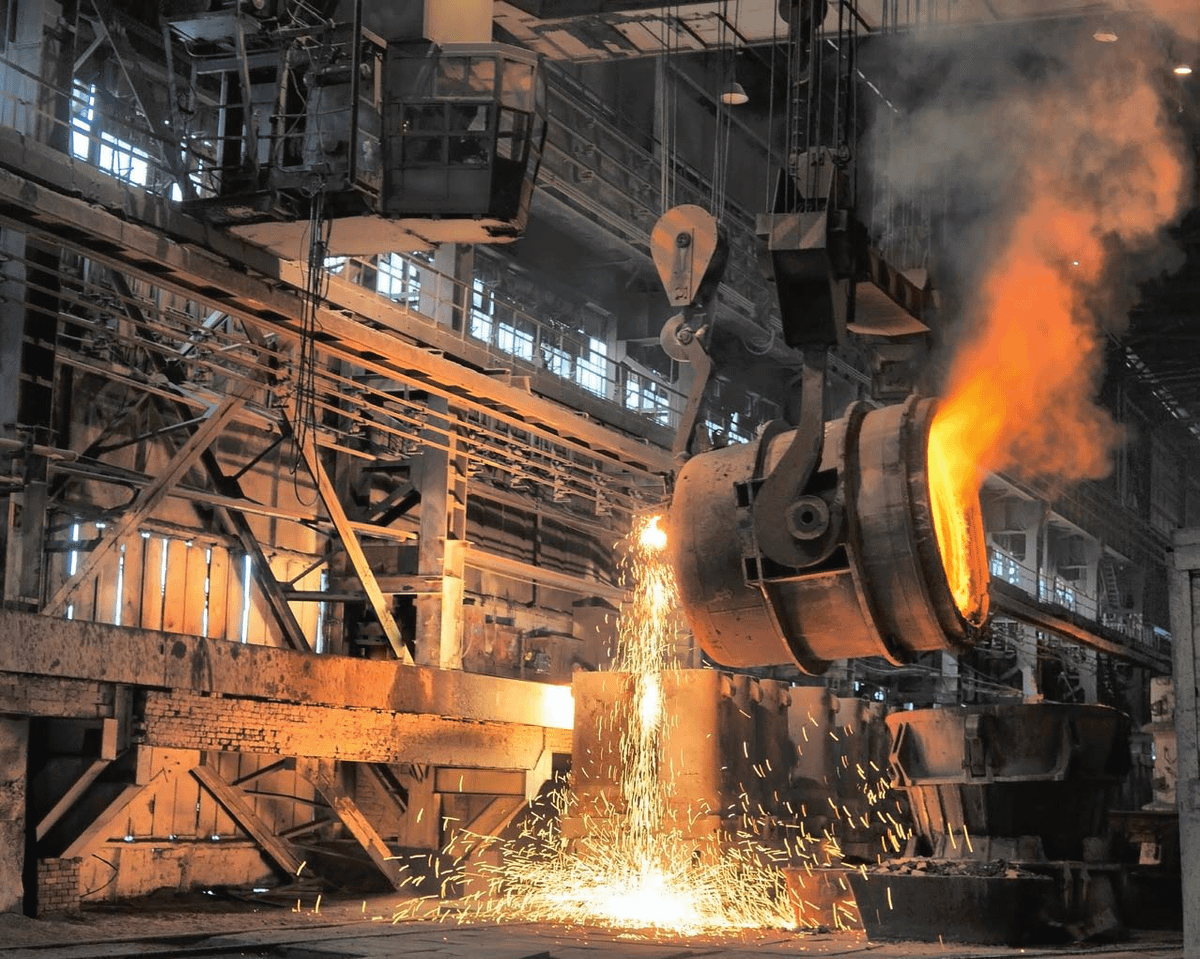
Aluminum smelting is the most electricity-intensive process in manufacturing. Producing one ton requires 14,000 kWh, enough to power an American home for 16 months. The Hall-Héroult process, invented in 1886, dissolves alumina in a bath of molten cryolite at 960°C and passes 350,000 amps through it. The aluminum-oxygen bond is one of the strongest in industrial chemistry. A single smelter runs 24 hours a day for years between shutdowns. There are over 240 aluminum smelters worldwide. Together they consume 3.5% of global electricity each year. A typical electric vehicle contains 200 to 300 kg of aluminum. Aircraft fuselages, transmission lines, and server racks all depend on this process. China produces 60% of global supply. The US made 33% of the world's aluminum in 1980. Today it makes less than 1%.
59
268
1,294
90,747
Gaurab Chakrabarti retweeted
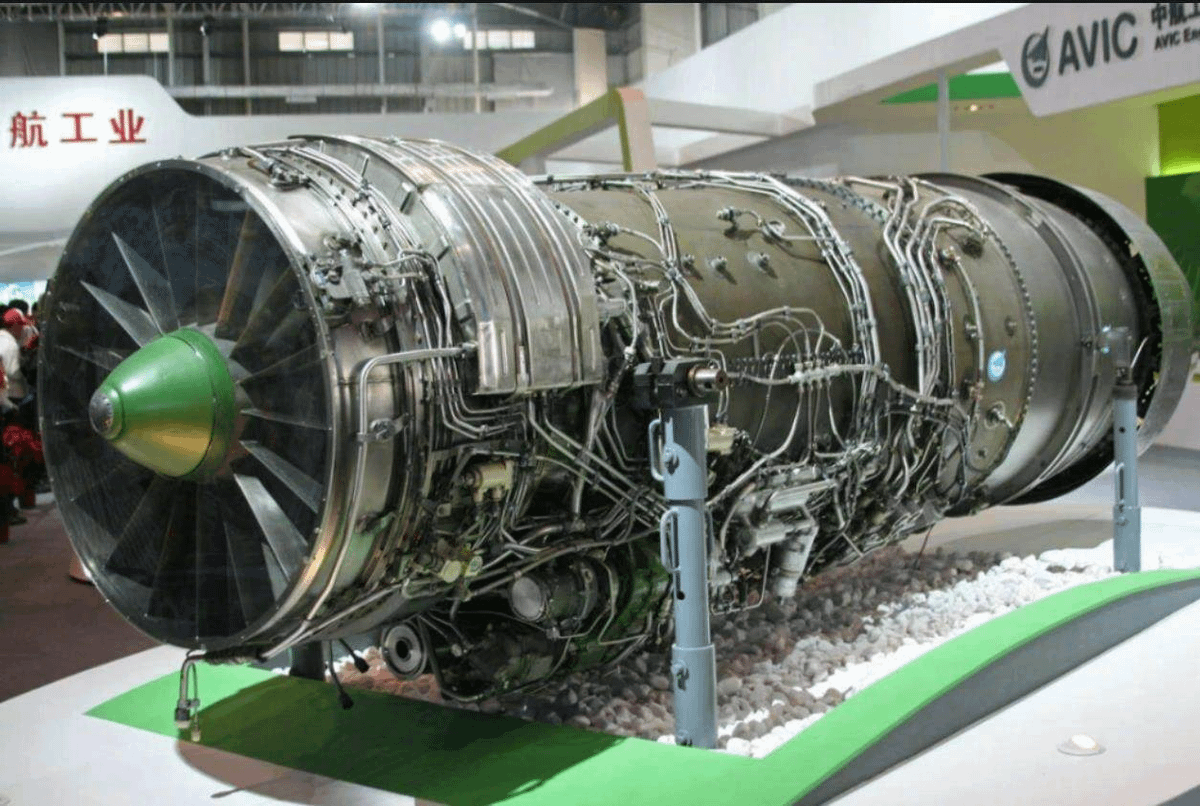
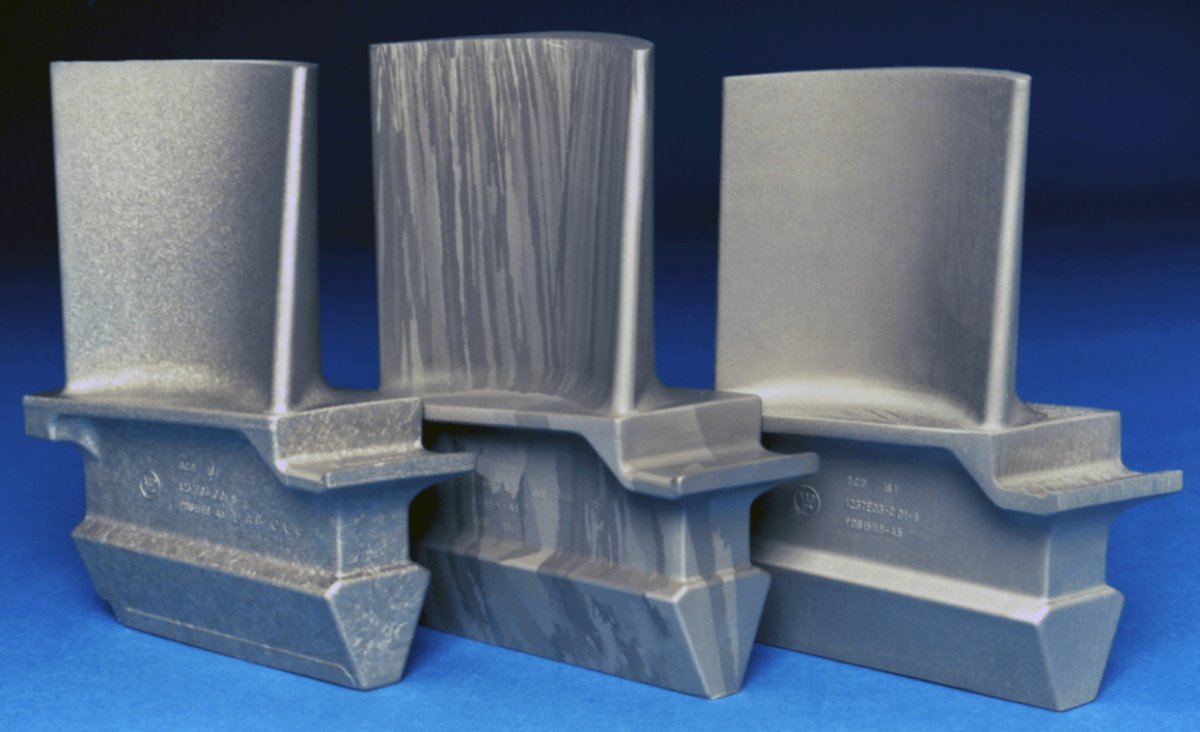
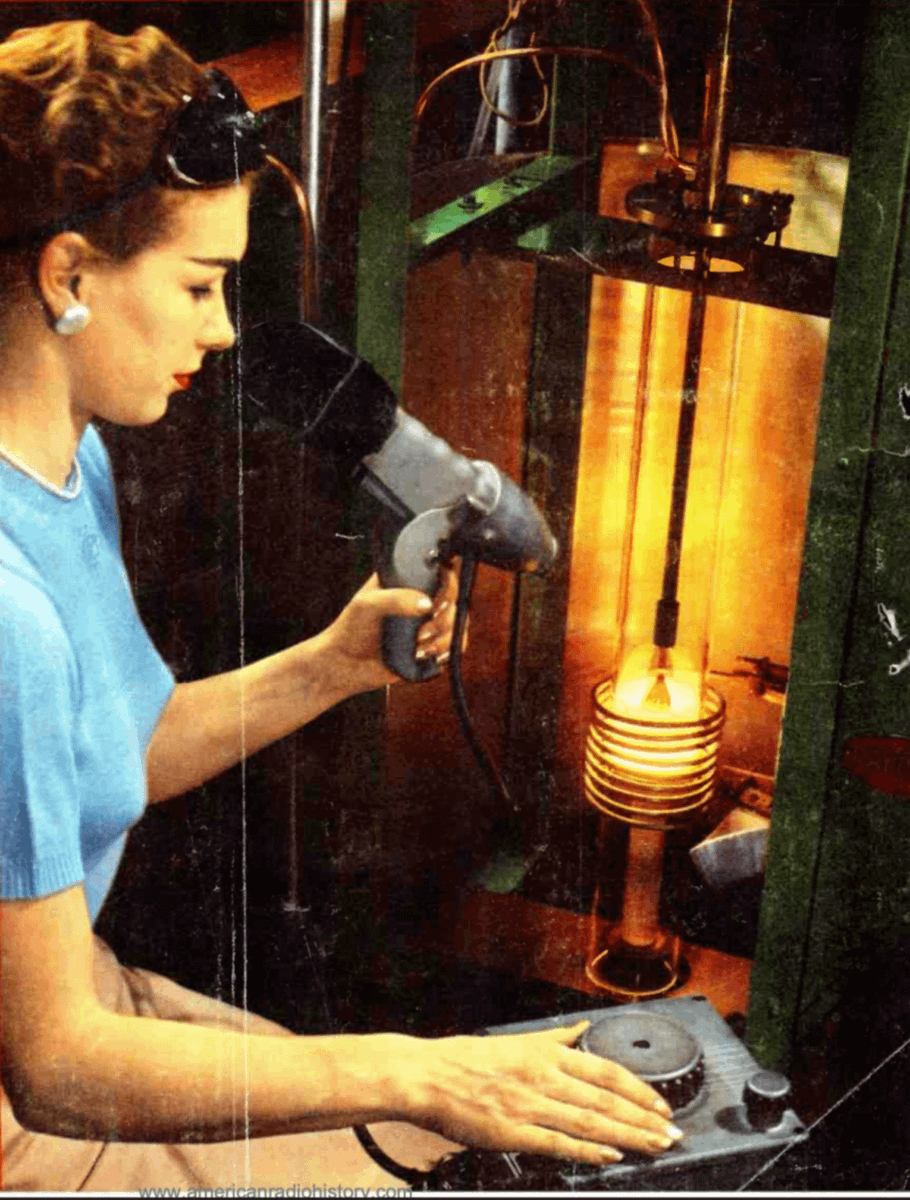
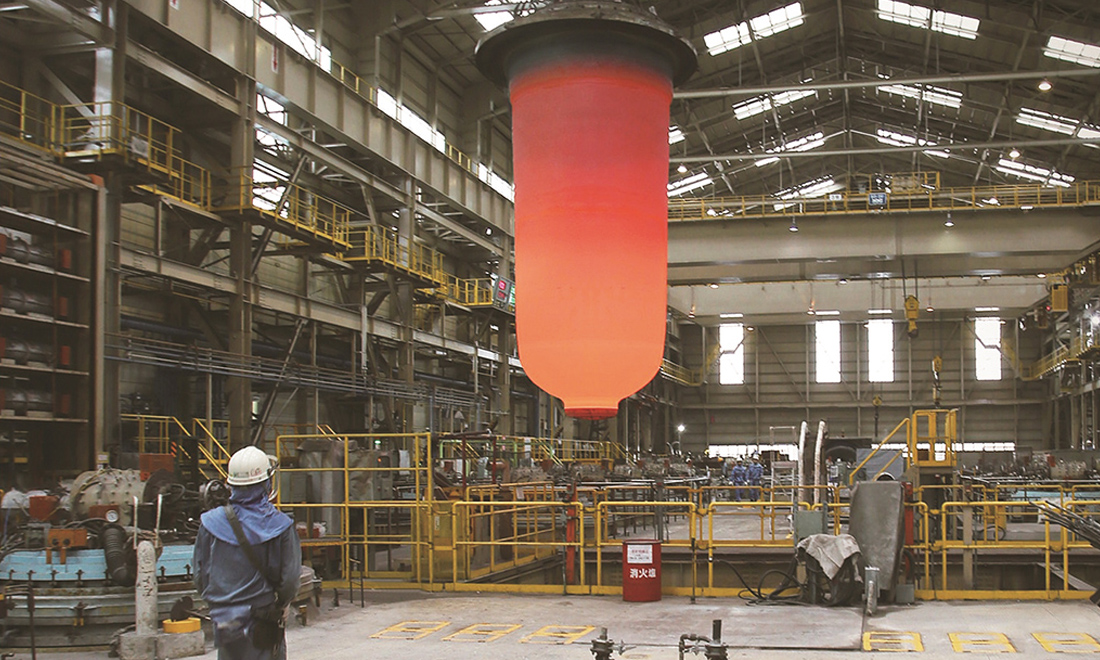
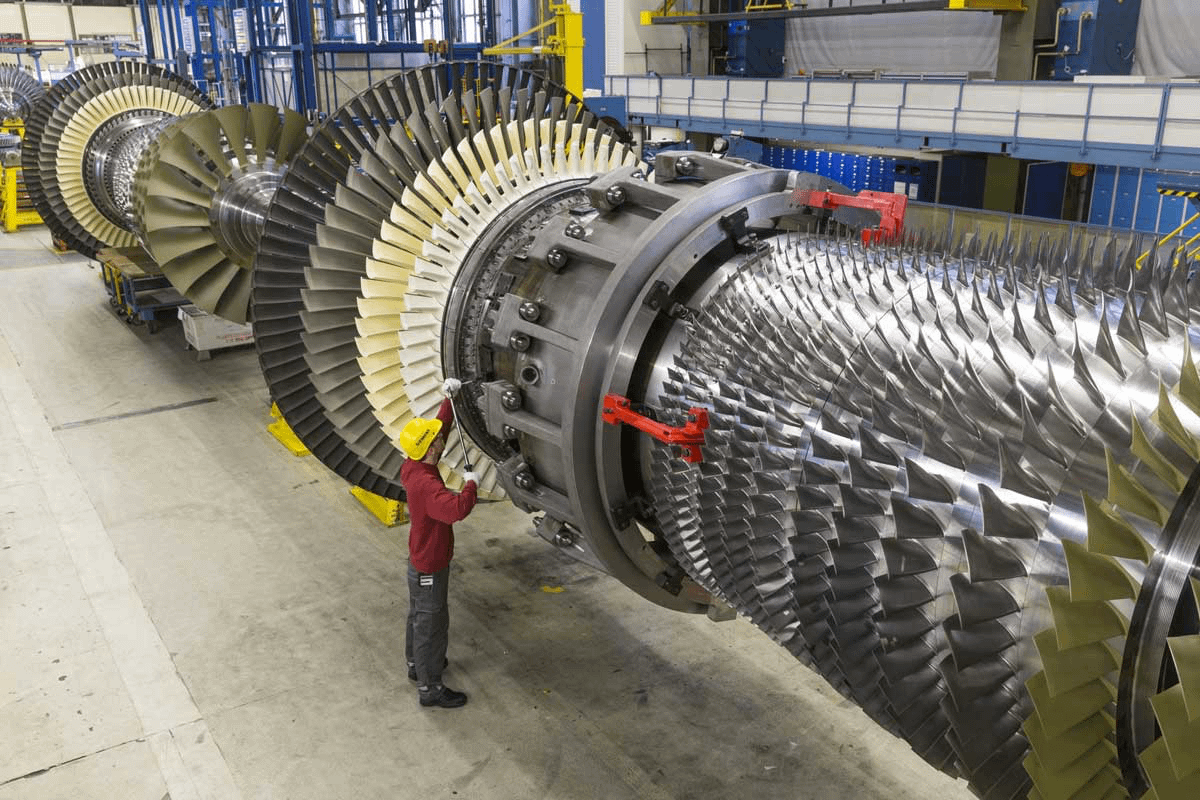
You cannot buy a new gas turbine until 2030. Order books at GE, Siemens, and Mitsubishi stretch to 2029. Turbine prices have nearly tripled since 2019. Every AI data center needs power and every gas plant needs a turbine. And every turbine has one part that bottlenecks the entire industry: The blade. It has to survive in gas 500°C above the melting point of the metal it's made from and spin at up to 20,000 RPM under 10,000 g of centrifugal force. Each blade is grown as a single crystal of nickel superalloy, pulled through a vacuum furnace at 3 mm per minute. A set of blades costs $600,000 and takes 90 weeks to grow. The same metallurgy powers modern jet engines. Only 3 companies on Earth can build one. China spent $42 billion trying to catch up. They bought a Russian fighter engine, took it apart, and copied every part. Their copy ran 30 hours between overhauls versus 400 for the original. Modern Western engines run 4,000. You can reverse engineer the shape of a turbine blade. You cannot reverse engineer 60 years of metallurgy.
1,129
5,898
29,235
4,133,264
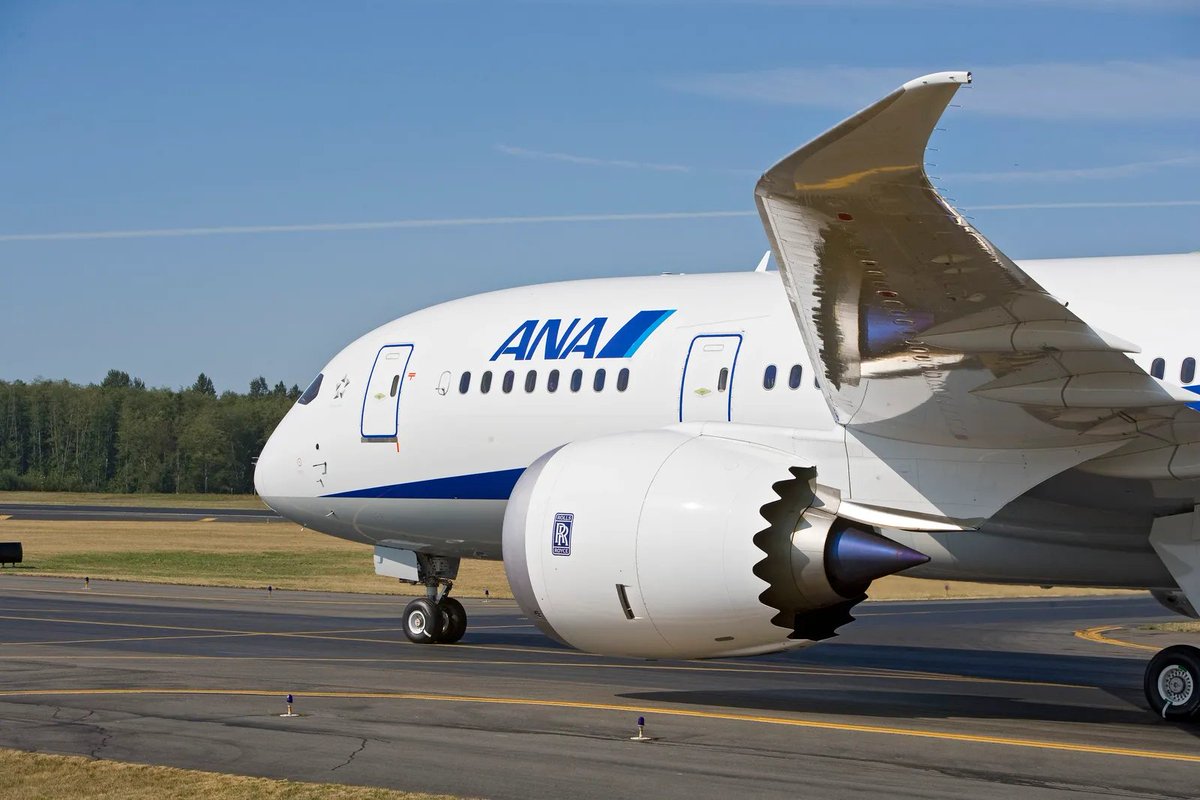
Boeing pumps nitrogen into every 787 Dreamliner wing. Not for pressure. To prevent explosions. It is called OBIGGS. Cabin air is forced through hollow fiber membranes at high pressure. Oxygen slips through the membrane walls faster than nitrogen. The nitrogen-enriched air fills the fuel tank ullage space as fuel is burned. Below 12% oxygen, jet fuel vapor cannot ignite. The 787 was the first commercial aircraft to inert all wing fuel tanks continuously from takeoff to landing. TWA Flight 800 exploded in 1996 when fuel vapors in the center wing tank ignited. 230 people died. The FAA mandated fuel tank inerting for all new aircraft in 2008. Boeing solved it with a membrane thinner than a sheet of paper and a gas that makes up 78% of the air you are breathing right now.
8
35
300
18,052
The chemicals industry first punched a hole in the ozone layer and then fixed it. It all started in 1928 when a GM engineer named Thomas Midgley invented Freon to replace refrigerants that had been killing people. The compound went into every refrigerator and aerosol can on Earth. By 1985, British scientists had mapped the hole over Antarctica. Two years later, 46 nations signed the Montreal Protocol. Every UN member state eventually followed. The only environmental treaty in history to do so. Each country phased out CFCs on a coordinated global timeline. The same companies that had made the original CFCs, DuPont, ICI, and Allied-Signal, eventually developed the replacements that took their place. Atmospheric CFC levels peaked in 1994 and have been falling ever since. In March, an MIT study confirmed the Antarctic ozone hole could fully close by 2035. The author was Susan Solomon, the same chemist who first explained the hole in 1986. Kristin tells this story in her new essay and makes the case for the builders. She was one of our early investors at Solugen, where we use biology to make industrial chemicals from corn sugar instead of petroleum. Building beats yelling at clouds.
Climate activists have spent decades shutting down nuclear, blocking clean energy transmission, and trying to ban research on cooling the planet... but the movement that wins the next century will be led by the people doing the work, not those protesting it. New essay out todayšŸ‘‡
5
21
151
12,797
This should be a national security level concern
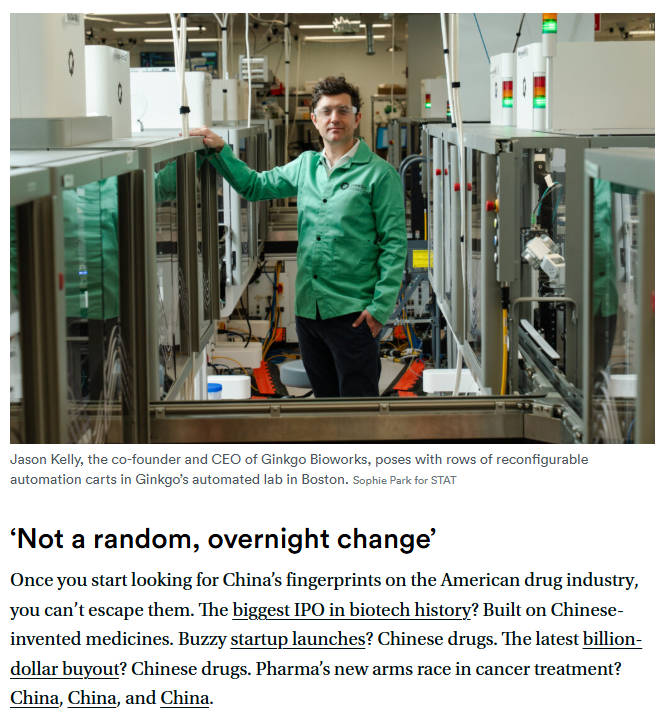
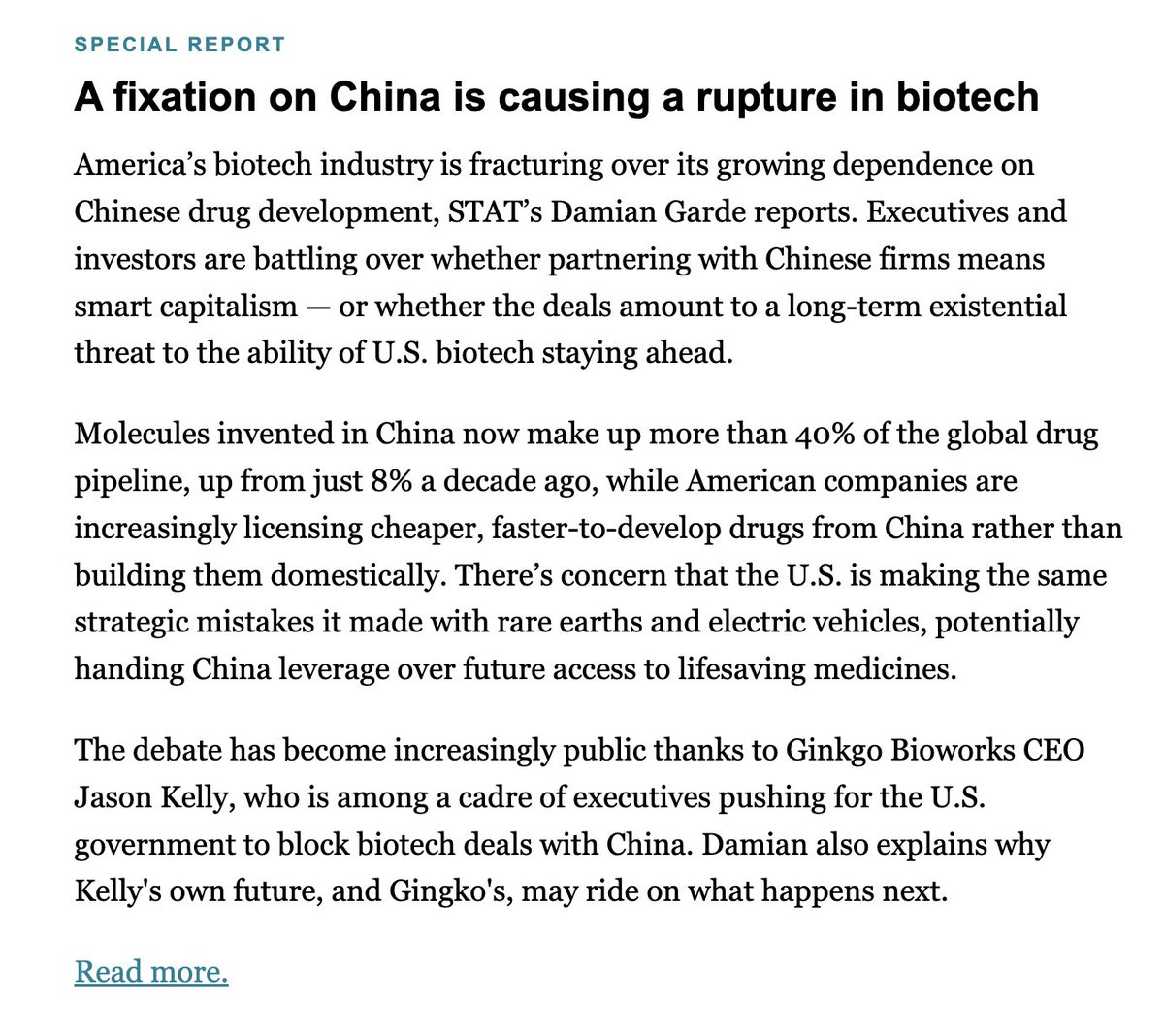
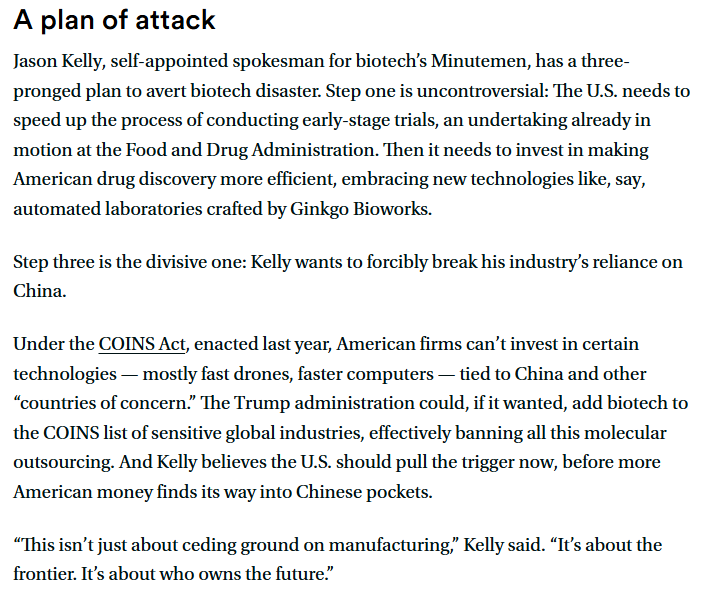
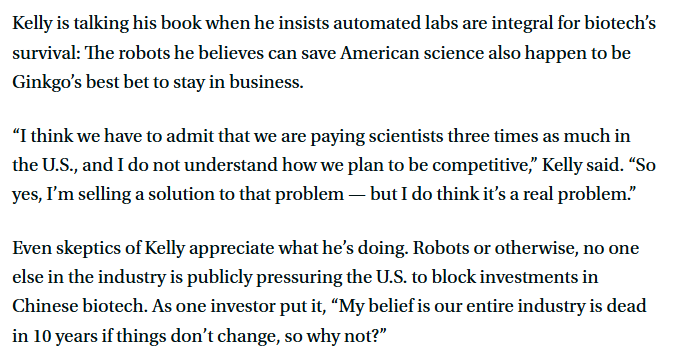
Great article in @statnews by @damiangarde today covering schism in the biotech industry over the rise of Chinese biotech industry - notably no one will go on record but mešŸ˜› The US can easily stop the Chinese biotech industry whenever it chooses as the US consumer is responsible for 70% (!!!) of the drug industry profits. Thus the US gets to set the rules. It is a mistake to outsource this industry -- very simply: the technology of genetic engineering is a matter of national security and democracies should lead it. We would not feel good if the US wasn't leading AI today and trust me we will feel even worse if we are behind in genetic engineering in the future as the tech improves. If you talk to people privately in biotech they will say it's a Prisoner's dilemma where they wish the rules would change. If the rules stay as they are then to stay competitive venture capitalists need to move their $ to China and pharma companies need to buy their drug assets from Chinese startups instead of from startups in Kendall Square or South San Francisco (the current US hubs for drug discovery). To fix this we should take two approaches: (1) Offensive - make US biotech industry more competitive! * Reform phase 1 clinical trails in US to be as fast as China and Australia -- this is in progress now at @US_FDA . @DrSynbio congressional testimony on this was very helpful. (link below). * Replace manual laboratories with autonomous robotic laboratories via programs like NSF Cloud Labs program and @SenToddYoung 's Cloud Lab BillĀ so US scientists can compete with lower-cost scientific labor in China. Yes, @ginkgo is the leader in making this tech. Efforts from @WHOSTP44. @dariogila, @mkratsios47, @sriramk with the WH Genesis Mission are a big help here. * Fix our approach to biotech patents -- it is very easy for Chinese startups to fast-follow US companies that have scientific breakthroughs by easily working around patents, @john_evans3 has led in thinking here. (2) Defensive - slowĀ the rise of the biotechnology industry in China * USG should add biotechnology to the COINS Act list of strategic technologies alongside AI, Quantum, Semiconductors, and Drones to prevent US investment from speeding Chinese development. * Other tools can be used in the future to easily penalize drug assets that originate from startups in China -- can do via regulatory pathway or via Medicare reimbursement. Genetic engineering is the most important technology to the future of humanity. Democracies should not give up on it! Let's fight for it!
6
16
78
12,778
Gaurab Chakrabarti retweeted
Great article in @statnews by @damiangarde today covering schism in the biotech industry over the rise of Chinese biotech industry - notably no one will go on record but mešŸ˜› The US can easily stop the Chinese biotech industry whenever it chooses as the US consumer is responsible for 70% (!!!) of the drug industry profits. Thus the US gets to set the rules. It is a mistake to outsource this industry -- very simply: the technology of genetic engineering is a matter of national security and democracies should lead it. We would not feel good if the US wasn't leading AI today and trust me we will feel even worse if we are behind in genetic engineering in the future as the tech improves. If you talk to people privately in biotech they will say it's a Prisoner's dilemma where they wish the rules would change. If the rules stay as they are then to stay competitive venture capitalists need to move their $ to China and pharma companies need to buy their drug assets from Chinese startups instead of from startups in Kendall Square or South San Francisco (the current US hubs for drug discovery). To fix this we should take two approaches: (1) Offensive - make US biotech industry more competitive! * Reform phase 1 clinical trails in US to be as fast as China and Australia -- this is in progress now at @US_FDA . @DrSynbio congressional testimony on this was very helpful. (link below). * Replace manual laboratories with autonomous robotic laboratories via programs like NSF Cloud Labs program and @SenToddYoung 's Cloud Lab BillĀ so US scientists can compete with lower-cost scientific labor in China. Yes, @ginkgo is the leader in making this tech. Efforts from @WHOSTP44. @dariogila, @mkratsios47, @sriramk with the WH Genesis Mission are a big help here. * Fix our approach to biotech patents -- it is very easy for Chinese startups to fast-follow US companies that have scientific breakthroughs by easily working around patents, @john_evans3 has led in thinking here. (2) Defensive - slowĀ the rise of the biotechnology industry in China * USG should add biotechnology to the COINS Act list of strategic technologies alongside AI, Quantum, Semiconductors, and Drones to prevent US investment from speeding Chinese development. * Other tools can be used in the future to easily penalize drug assets that originate from startups in China -- can do via regulatory pathway or via Medicare reimbursement. Genetic engineering is the most important technology to the future of humanity. Democracies should not give up on it! Let's fight for it!
May 18
China's ascent is forcing U.S. biotech companies and investors to pick a side: Is it an ally or an existential threat? trib.al/EtcOZGh
28
59
260
83,704
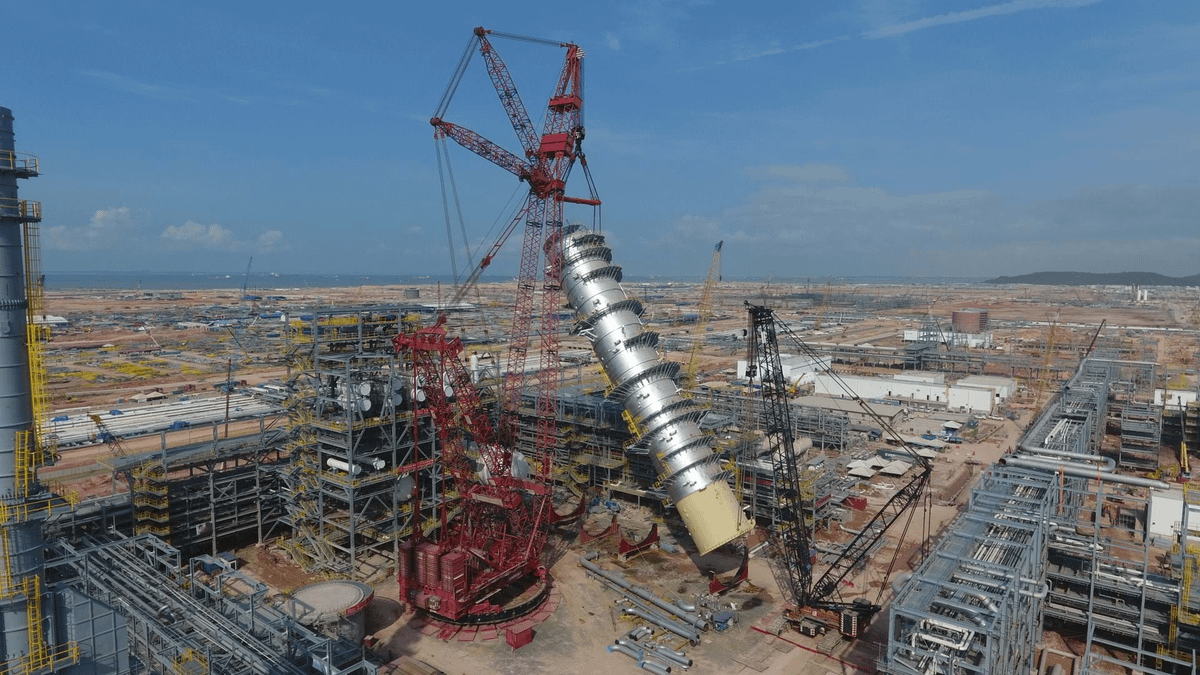
China builds 120 J-20 stealth fighters a year. Every one needs rhenium-bearing superalloy blades. Beijing is quietly removing the rhenium constraint that has historically capped every modern air force. In 2023, China overtook the US as Chile's largest rhenium buyer. In 2024, domestic production quadrupled from 5.3 to 20 tonnes and held steady since. WS-15 serial production hit the J-20A line in December 2025. The domestic ramp came from roaster retrofits and new recovery equipment at Jiangxi Copper, China Molybdenum, and Zijin Mining. Beijing stockpiles rhenium at about 10 tonnes a year, a surge buffer for combat attrition. The same metallurgy feeds the J-20, J-35, CJ-1000A, gas turbines for grid power, and Pt-Re refinery catalysts. Every tonne Beijing locks in is one fewer for an F135 blade at Pratt & Whitney, an F414 stage at GE, or a Trent XWB rotor at Rolls-Royce. By 2030, China's fifth-generation fighter fleet will outnumber the US Air Force's F-22 and F-35A combined. The rhenium constraint isn't going away. It's becoming binding only on the West.
45
183
847
105,485
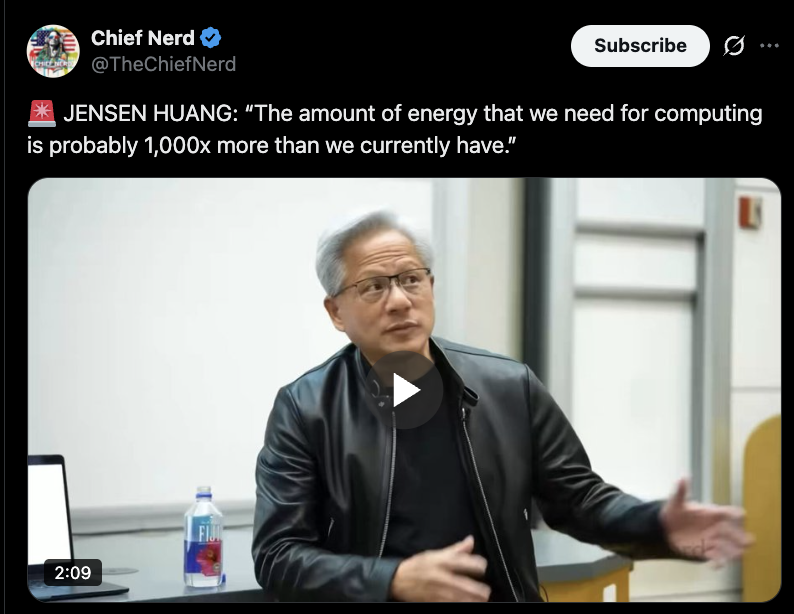
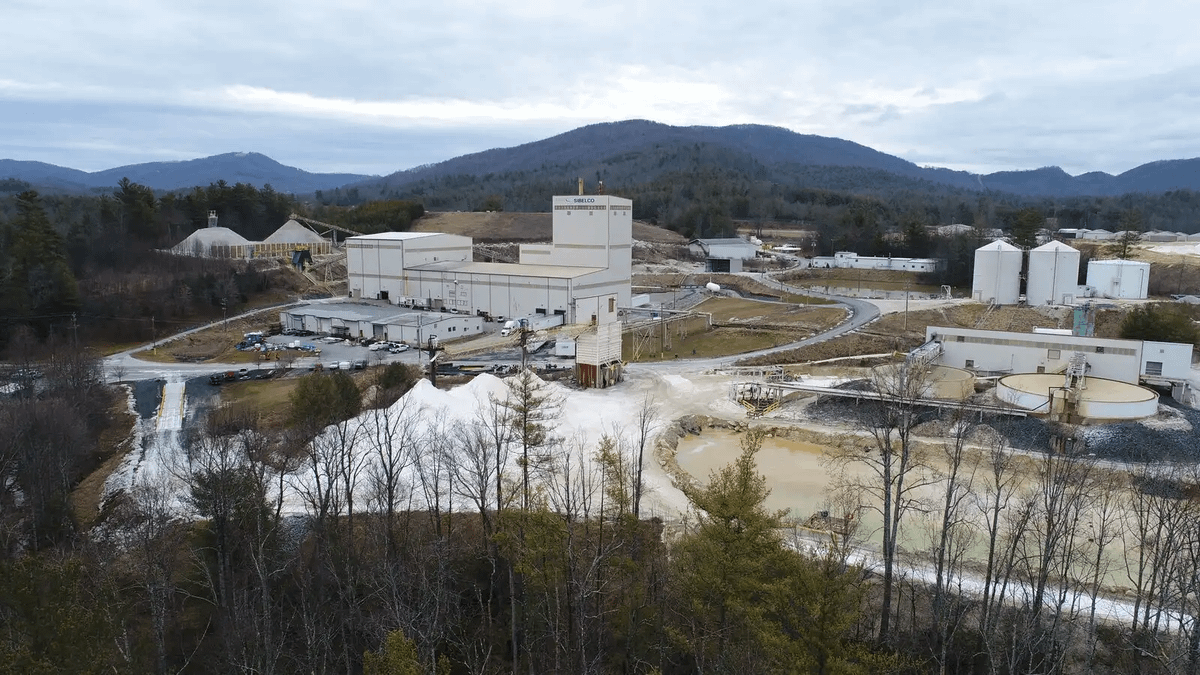
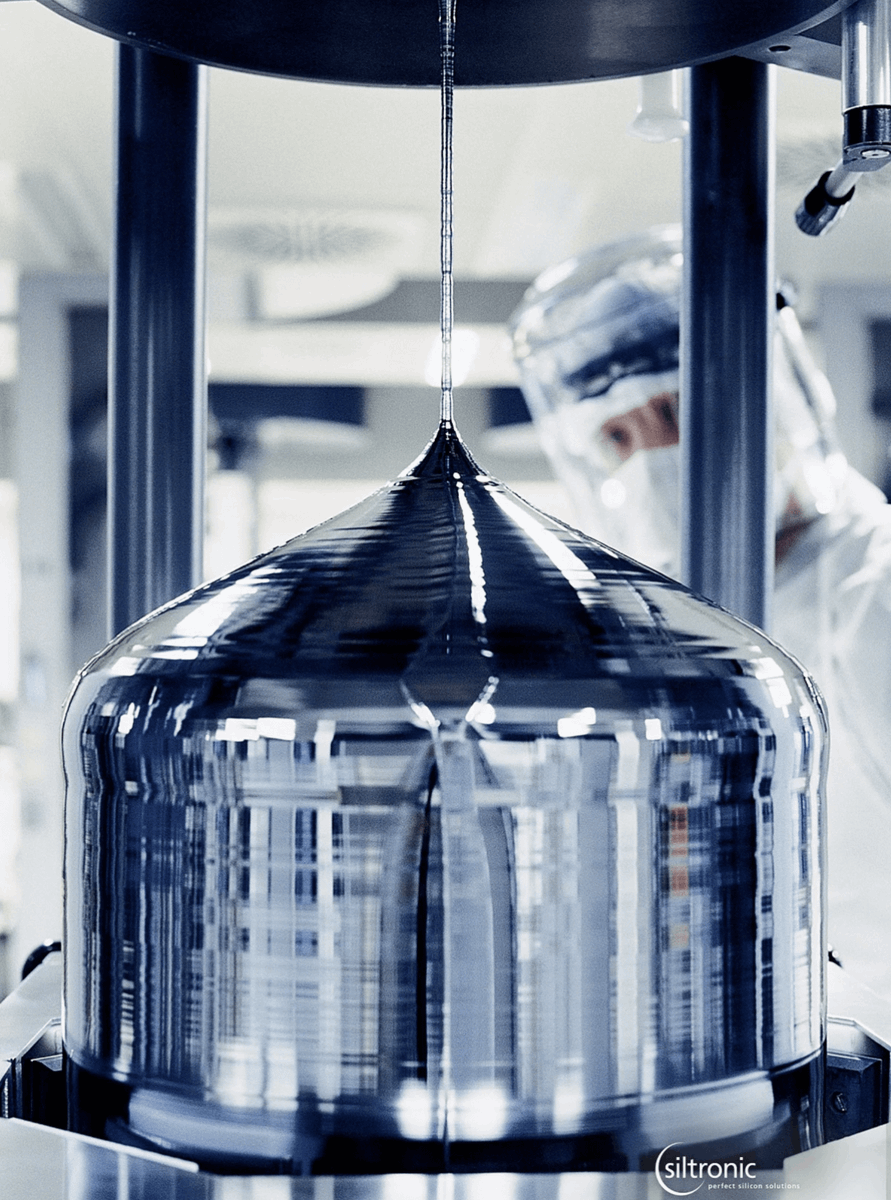
Jensen says AI needs 1000x more energy. Musk says solar-powered AI in orbit is the only way. Solar is built on a chemical the US stopped making at scale. China produced 93.5% of the world's polysilicon in 2024. 95% for solar-grade material. Silicon is the second most abundant element in Earth's crust. The bottleneck is chemical purification. The best solar cells need silicon refined to 99.9999999%. Getting there means turning silicon into trichlorosilane, a liquid that boils at 31.8°C. Boron and phosphorus impurities boil at nearly the same temperature. Separating them takes hundreds of distillation stages. Then the silicon deposits onto seed rods at 1,100°C. We manufacture chemicals. A polysilicon plant takes 10 years to build and qualify in the West. China's capacity hit 3.25 million metric tons by the end of 2024. Everywhere else on Earth combined is about 200,000 metric tons. China built a 16-to-1 gap over the last fifteen years. The US has two solar-grade producers left. Hemlock in Michigan and Wacker in Tennessee. REC Silicon restarted its Moses Lake plant in 2024, failed to hit purity spec, and shut it down four months later. Owning the chemistry is the only way.
Replying to @TheChiefNerd
Space is the only way
14
42
296
29,716
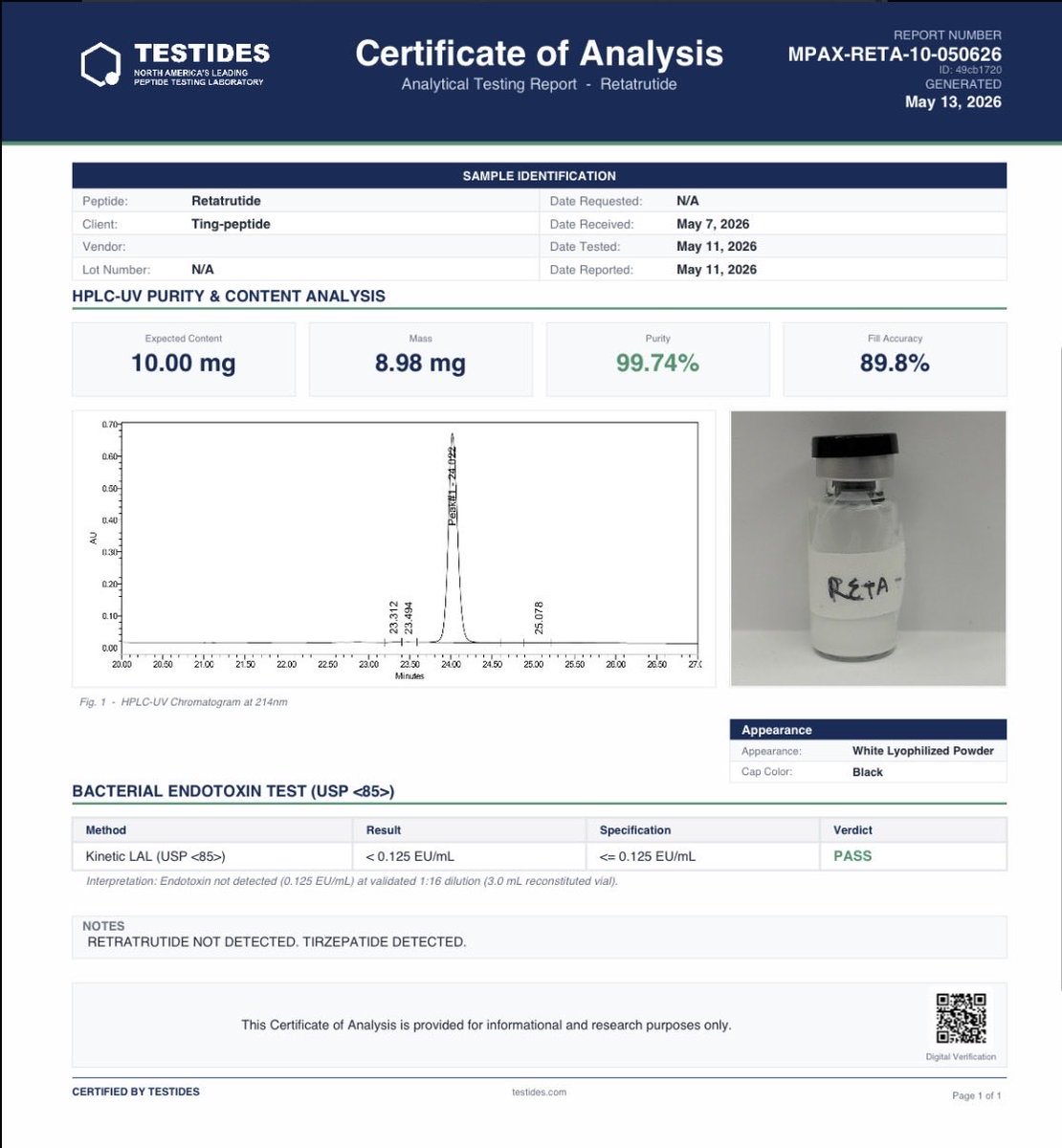
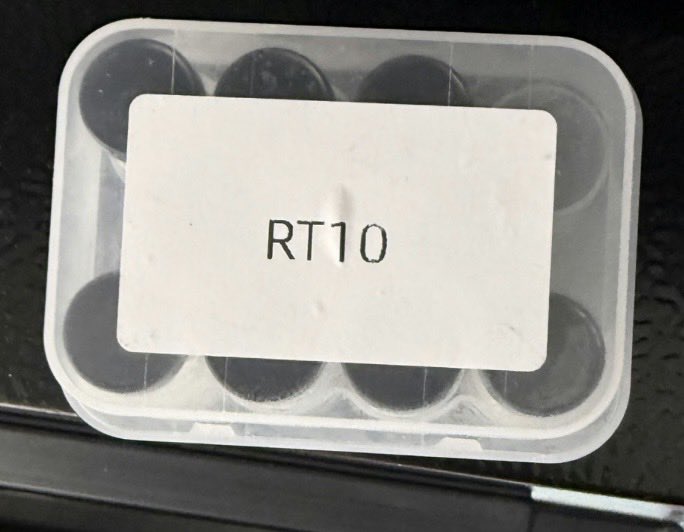
Buy black market peptides and you might not even get the right molecule. This vial said retatrutide, but the lab test exposed it as tirzepatide. We manufacture chemicals. You don't "accidentally" make a different drug. A failed synthesis yields a flawed version of your target, not a clean copy of something else. Retatrutide and tirzepatide have entirely different sequences. This is a substitution. Why? Retatrutide is investigational, which keeps it scarce and expensive. Tirzepatide sells in bulk for a fraction of that. Last month The New Yorker tested gray-market peptide vials and found endotoxins and severe under-dosing. Partnership for Safe Medicines audited FDA records over a 16-month window: 2,465 semaglutide and tirzepatide shipments, 239 from unregistered sellers. The FDA stopped 44. 195 reached the US anyway. When nobody's liable for the molecule, the label is just a pretty sticker.
We have another kit with yet another new label that testing has shown tirzepatide not Reta. Someone called Yula is the vendor.
9
5
68
11,098
Over 300 Chinese J-20 stealth fighters have been built at roughly $110 million each. Not one carries a turbine blade that matches the service life of its Western equivalent. The WS-15 reached serial production on the J-20A in December 2025. Its high-pressure turbine runs on a third-generation Chinese single-crystal superalloy, rated about 30 degrees Celsius hotter than the second generation. The chemistry works. Casting yield at production scale does not. Chinese foundries scrap two of every three blades they cast. Western foundries scrap one in twenty. Chinese military engines improved from a few hundred hours between overhauls to roughly 1,500 with better blades. Western equivalents run roughly twice as long between overhauls and several times longer in total service life. Western foundries target sulfur below 1 part per million. Best practice runs below 0.3. At that purity, the coating survives thousands of hours in gas streams hotter than the alloy's melting point. A few extra parts per million and the coating peels, the blade oxidizes, and the engine fails prematurely.
290
393
3,085
640,055
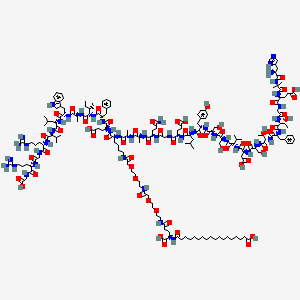
Eli Lilly makes tirzepatide with a DEA List I controlled chemical, a Group 2A carcinogen, and a PFAS forever chemical. Novo Nordisk uses yeast. Novo's Ozempic backbone is fermented at their patent-protected plant in Kalundborg, Denmark. Tirzepatide and the synthetic GLP-1s are made via solid-phase peptide synthesis of fragments, then coupled in solution. Each cycle of deprotection uses piperidine, controlled by the DEA under Code 2704. It is the core of fentanyl. Each tirzepatide takes roughly 38 piperidine cycles across its fragments. Every SPPS step uses dimethylformamide as the solvent. DMF's residual limit was set at 880 ppm in 1997. The IARC reclassified it as a probable carcinogen in 2018, but the limit hasn't changed. Cleavage uses trifluoroacetic acid, a forever chemical. There is no harmonized regulatory limit for it. Toxicology data is too limited to set a safe daily dose. Approved drugs pass the specs. Every synthetic GLP-1 is made with these chemicals. One kilogram of API generates roughly twelve thousand liters of solvent waste. Novo built the modern route. Everyone else is stuck in 1997. Tens of millions take GLP-1 every week. We engineer enzymes to manufacture chemicals. Developing a yeast in the lab is not the same as running it in production. Novo has fermented GLP-1 peptides at industrial scale since 2010.
21
32
292
34,791
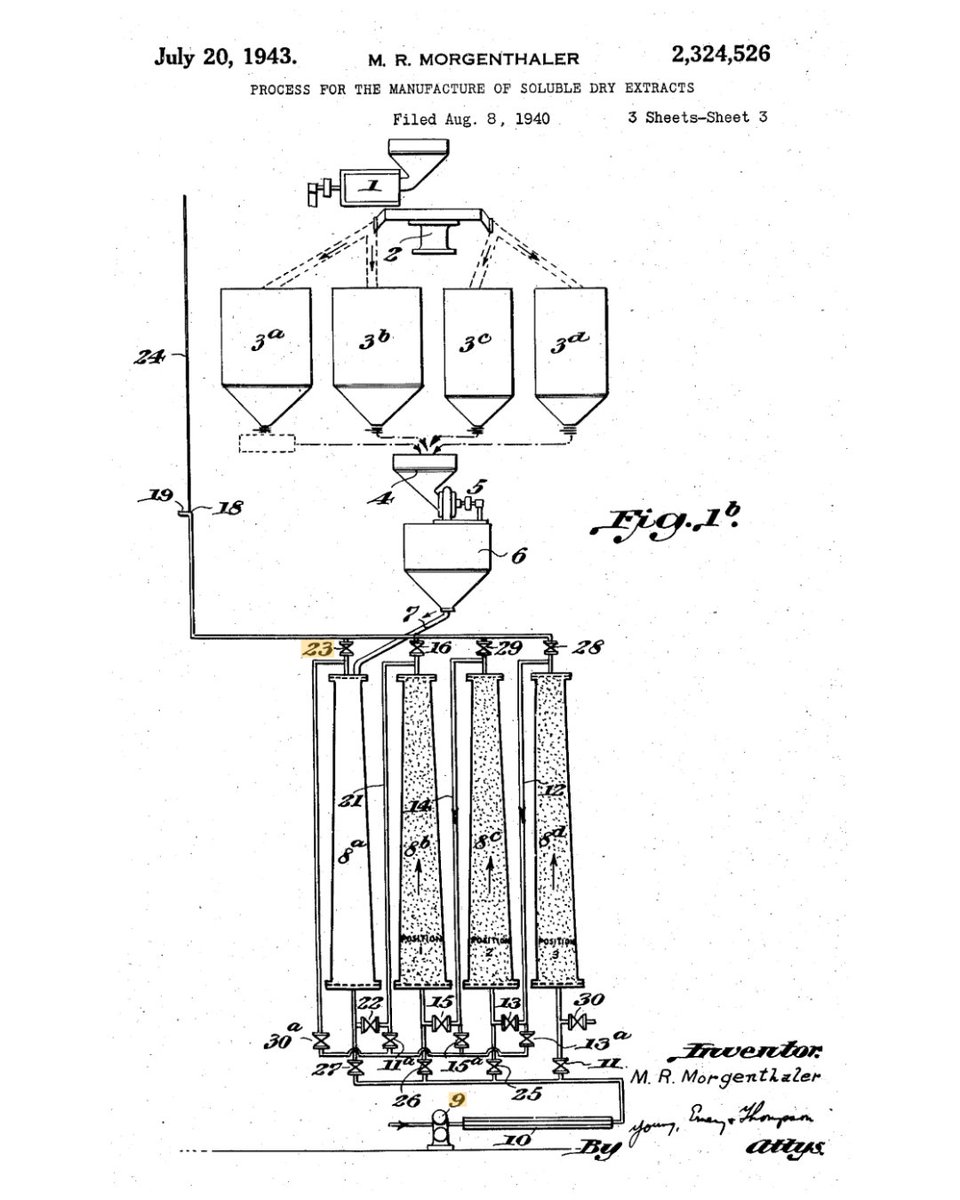
Instant coffee's hardest problem isn't drying. The dried output is mostly free sugars with a glass transition near 60°C. The powder hits a rubbery state at the dryer outlet and glues itself to the wall. The 1930s fix was 50% maltodextrin filler. It raised the glass transition above 100°C and the powder stopped sticking. Max Morgenthaler's 1937 Nestlé patent did something stranger: he pumped water at 175°C and 9 bar through a four cell cascade and hydrolyzed the bean's own hemicellulose into a polysaccharide. By 1952 Nestlé pushed the temperature higher and cut the additive. Coffee became its own binder. The same unit operation runs kraft pulp pre-hydrolysis, cellulosic ethanol pretreatment, and hydrothermal carbonization. Morgenthaler wasn't trying to invent the bio-economy. He just wanted to keep coffee powder from sticking to the dryer wall.
12
29
269
13,019
Four foundries on Earth cast the single-crystal blades and vanes that let a gas turbine convert 1,500-degree gas into electricity. PCC and Howmet hold about 80% of the single-crystal market. Doncasters and CPP take most of the rest. Every heavy-frame gas turbine ordered in the past 18 months is sold out through 2030. Elon Musk on @dwarkesh_sp traced his own xAI Colossus power problem one layer down past the turbines and landed on the blades. He said SpaceX and Tesla will likely have to cast their own. We manufacture chemicals. Casting a single-crystal blade is not a metallurgy problem. It is a chemistry problem. The four foundries that cast them spent thirty years driving sulfur down to parts per billion and oxygen down to parts per million. Vacuum, gradient solidification, and mold chemistry are why nobody else can cast them. The bottleneck is chemistry.
64
159
1,313
271,650
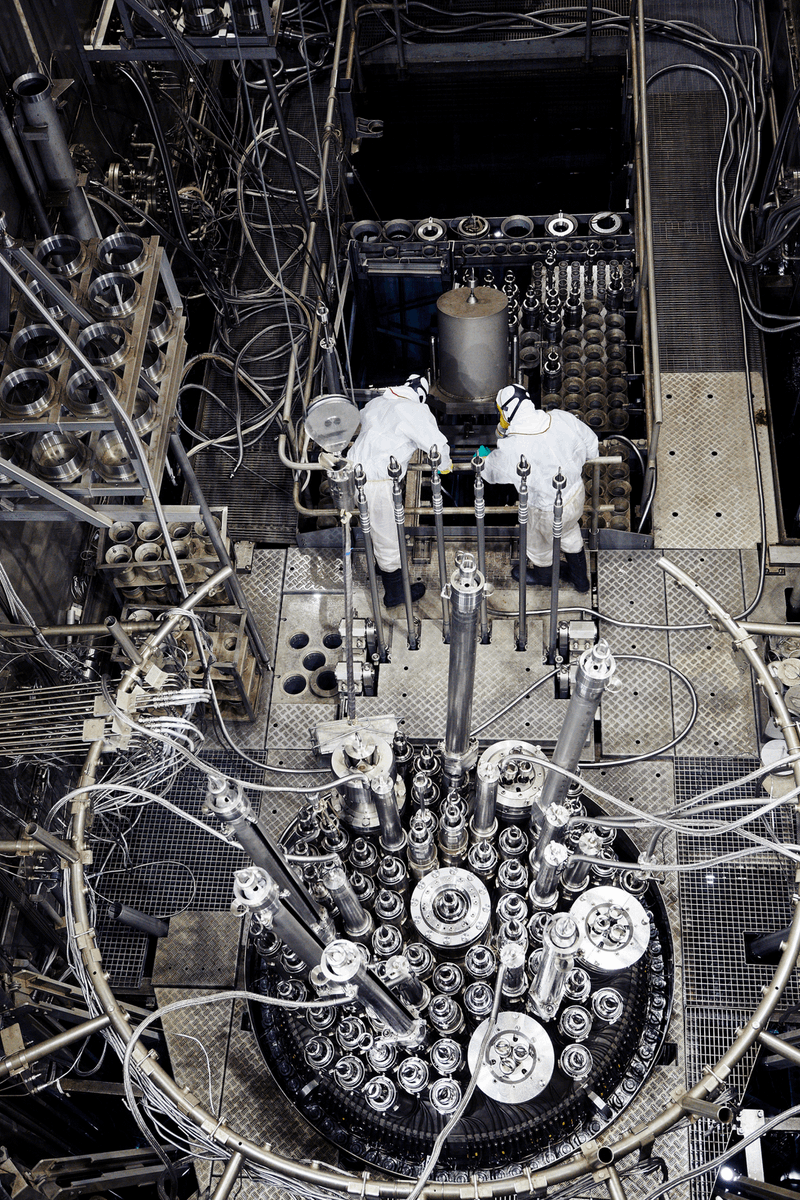
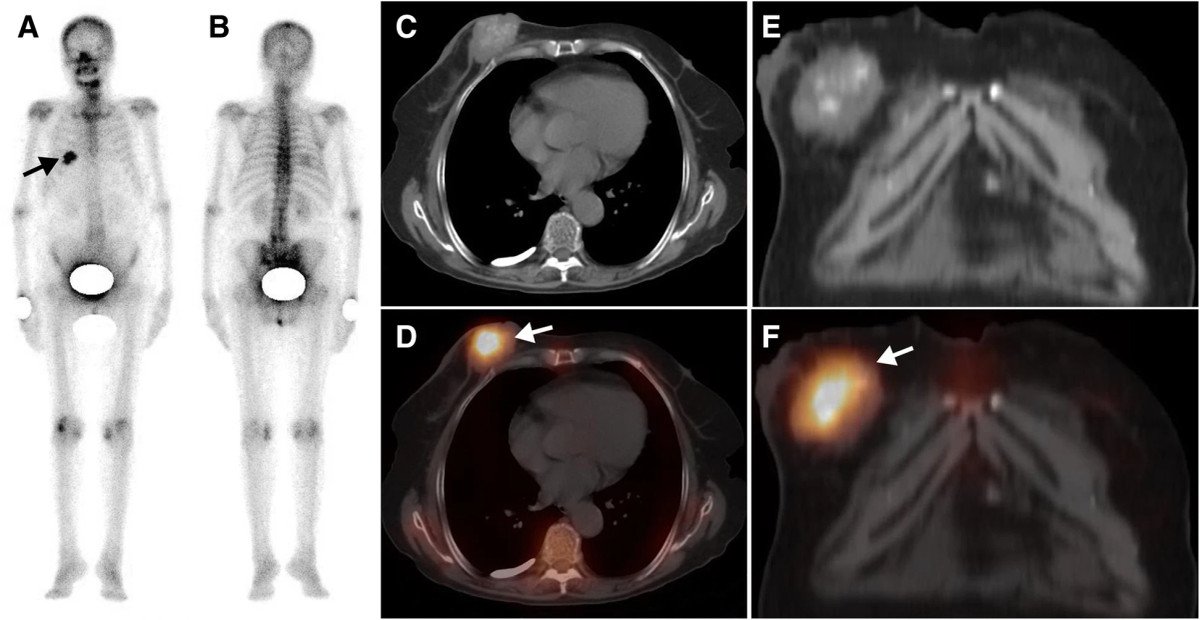
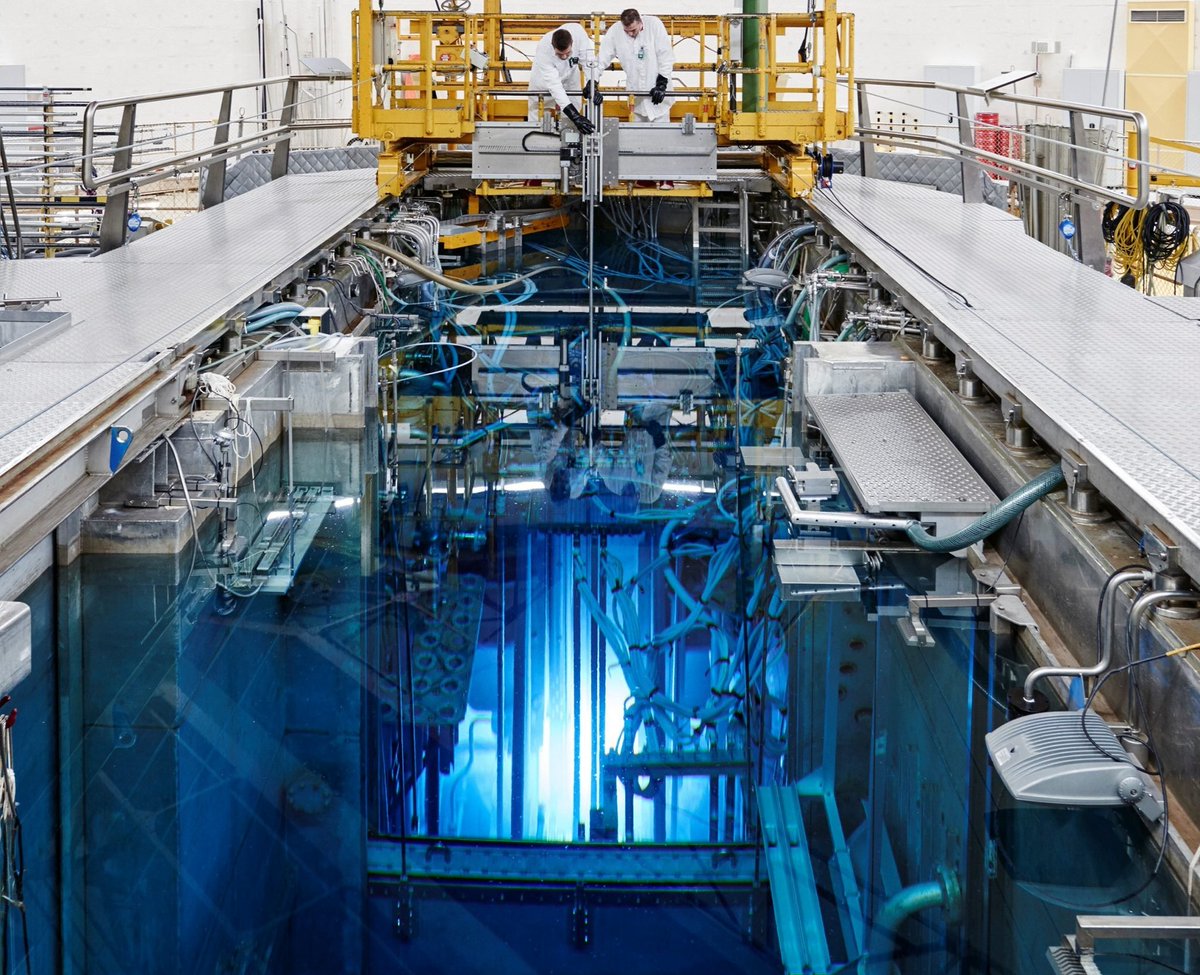
40,000 medical procedures a day depend on an isotope the DOE called an unacceptable risk last month. Molybdenum-99 decays 1% every hour, cannot be stockpiled, and the US imports 100% of it. If you get a bone scan or a cardiac stress test, your tracer comes from one of six foreign reactors. Belgium's BR2 and the Dutch HFR first went critical in 1961, before the CT scan was even invented. NorthStar, the only US Mo-99 producer, halted in October 2023. In April the DOE wrote SHINE $263M to start producing in 2028. The facility was supposed to come online in 2021. When it ships, it covers ~75% of US demand. The other 25% stays imported. I came out of cancer biology before I started a chemicals company. Mo-99 is just one bottleneck. We don't make the materials we need to make the things we need.
6
29
177
14,397
ā€œImporting a radioisotope that decays 1% every hour creates an unacceptable risk of disruptions in supply of nuclear medicine for American patients.ā€ energy.gov/nnsa/articles/nns…
2
36
2,877
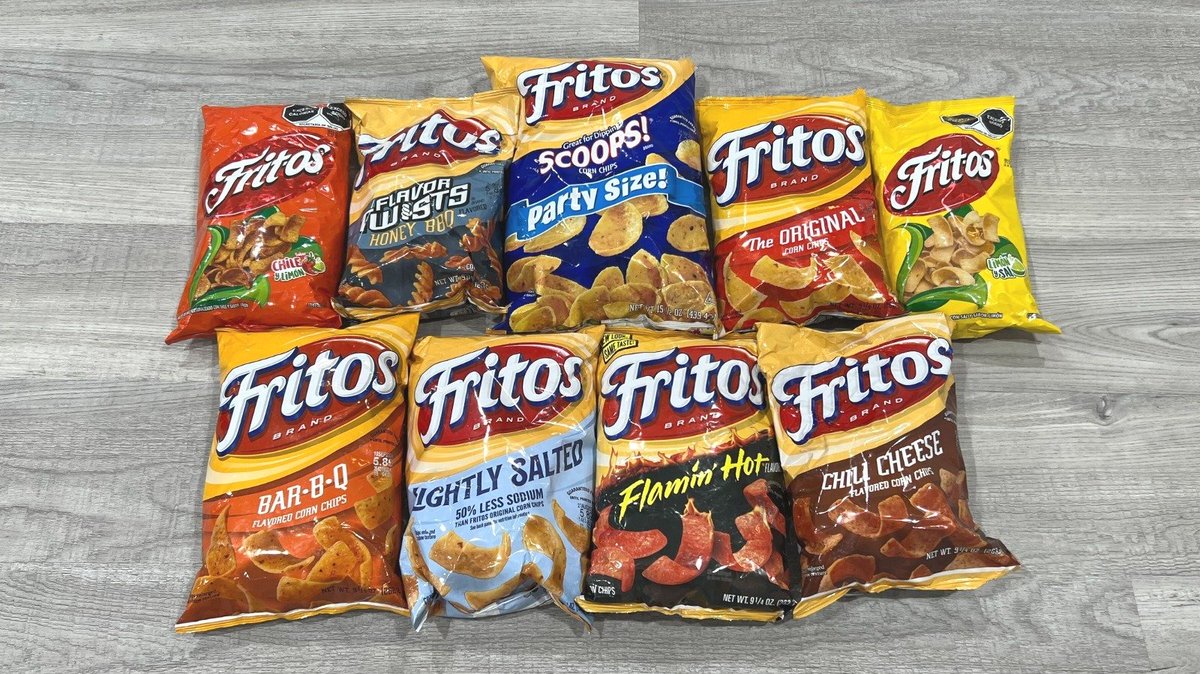
PepsiCo just closed two Frito-Lay plants. 430 workers in California and 454 in Florida. Campbell's shut its chip factory in Massachusetts. Smucker took a nearly $1 billion loss on Twinkies. Hershey's confectionery volumes fell 5% in a single quarter. The reason is one molecule. Semaglutide. I manufacture chemicals. 23% of American households now have a GLP-1 user. Each one consumes roughly 800 fewer calories per day. J.P. Morgan estimates a $30-55 billion annual demand reduction in food. Nestle launched its first new American brand in three decades, built for people who eat less. The $12 trillion food industry employs 30% of the global workforce. A single molecule is restructuring what humans eat. The companies that ignored it got fried. Chemistry is always the bottleneck.
245
579
2,236
854,541
Our first reactor was limited by the size of Sean's Subaru. We went to Home Depot and bought the biggest PVC pipe we could find. They had to cut it at the store because it wouldn't fit in the car. That pipe became the reactor. Twist ties held the fittings together. We had zero space for inventory in our rented lab behind Dallas Love Field, so every batch had to be sold before the next one started. Most startups build product and then figure out how to sell it. We couldn't afford to store product, so distribution had to come first. After we made our first sale @TungstenSeanide told everyone he was quitting his day job. We made $200.
4
7
65
3,947
Nvidia just committed $3.2 billion to a glass company. Meta signed a $6 billion deal to the same supplier in January. Corning. At 200 gigabits per second, copper resistance generates too much heat in the high-bandwidth links between GPUs. Each wire's electromagnetic field leaks into its neighbors. The power required to push electrons that fast becomes prohibitive. Glass solves all three problems. Inside every Nvidia rack, 5,000 copper cables are being replaced with optical fiber. The same company building the replacement also makes the glass on your iPhone. Corning invented low-loss optical fiber in 1970. Three physicists in upstate New York pushed light through glass with less than 17 decibels of loss per kilometer. That invention built the internet. Now AI is moving onto the same medium. We manufacture chemicals. Data centers became our fastest-growing customer segment. The next bottleneck is glass.
BREAKING: In a "game changing" deal for AI, Nvidia is partnering with glassmaker Corning to develop 3 new advanced manufacturing facilities entirely for optical technologies. Details include: 1. The factories will lead to the creation of at least 3,000 jobs and increase Corning’s US optical manufacturing capacity by 1,000% 2. Nvidia is likely set to replace copper with Corning’s optical glass fibers in its AI rack-scale systems 3. Optical fiber allows for less signal loss than copper, making AI data centers more efficient 4. Corning, $GLW, is surging 16% on the news and Nvidia, $NVDA, is up 3% The AI Revolution is accelerating.
16
94
685
90,350
In March I wrote about Corning's Cold War origin:
Apple is spending $2.5 billion to make every iPhone screen in one factory in Harrodsburg, Kentucky. Population 9,000. The factory was built in 1952 to make optical glass for Cold War reconnaissance. Corning holds more than 70% of the global smartphone cover glass market. The EU opened an antitrust investigation. Corning responded by dropping all exclusivity clauses worldwide. It didn't matter. No competitor can replicate their fusion draw process after 60 years of refinement. The physical world is complex. The best companies harness it.
2
28
5,150