
The Georgetown University Center on Education and the Workforce (CEW) is a research and policy institute within Georgetown’s McCourt School of Public Policy.
Joined May 2010
- Tweets 21,105
- Following 2,679
- Followers 9,030
- Likes 14,800
2,955 Photos and videos
Pinned Tweet

Apr 28
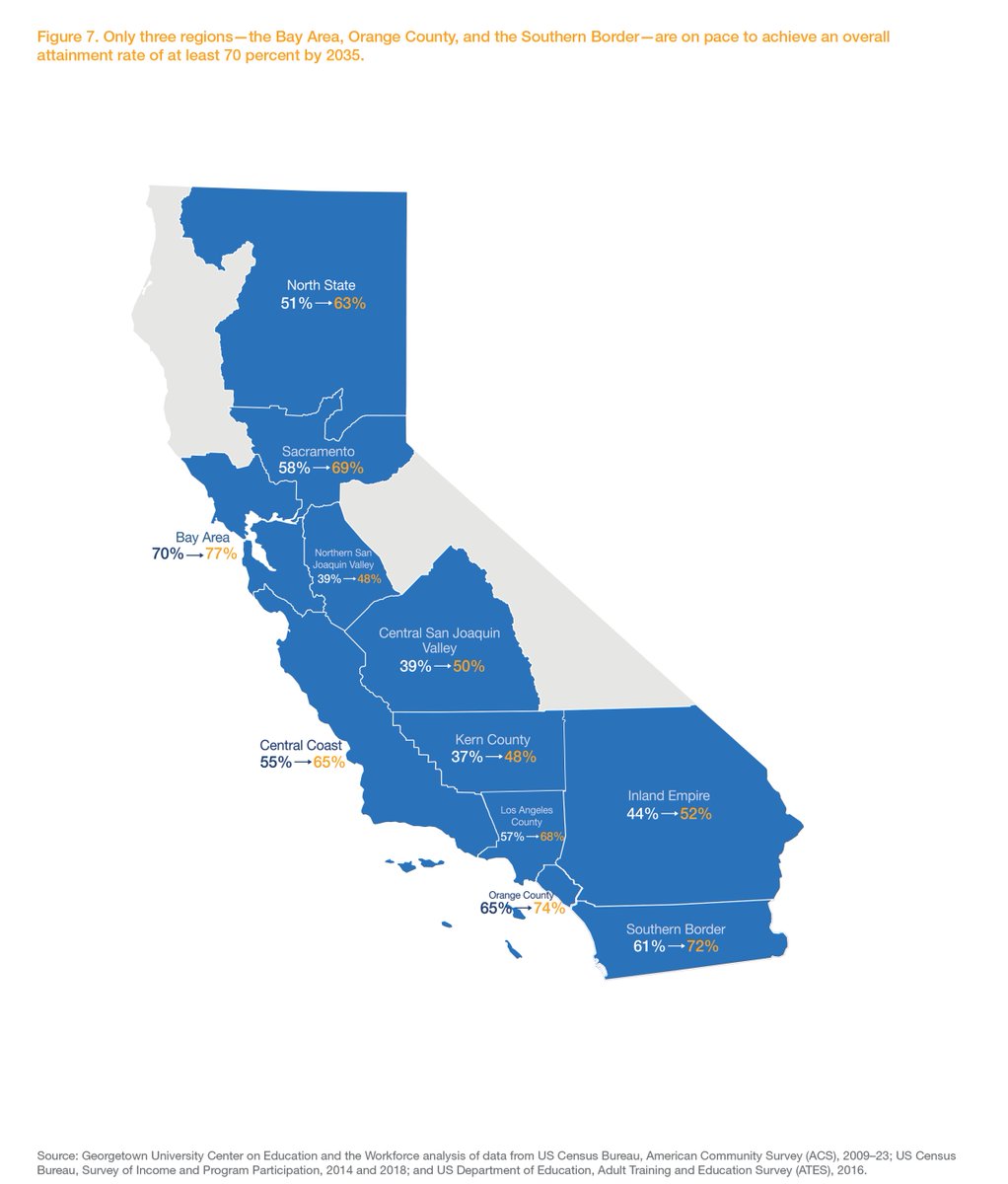
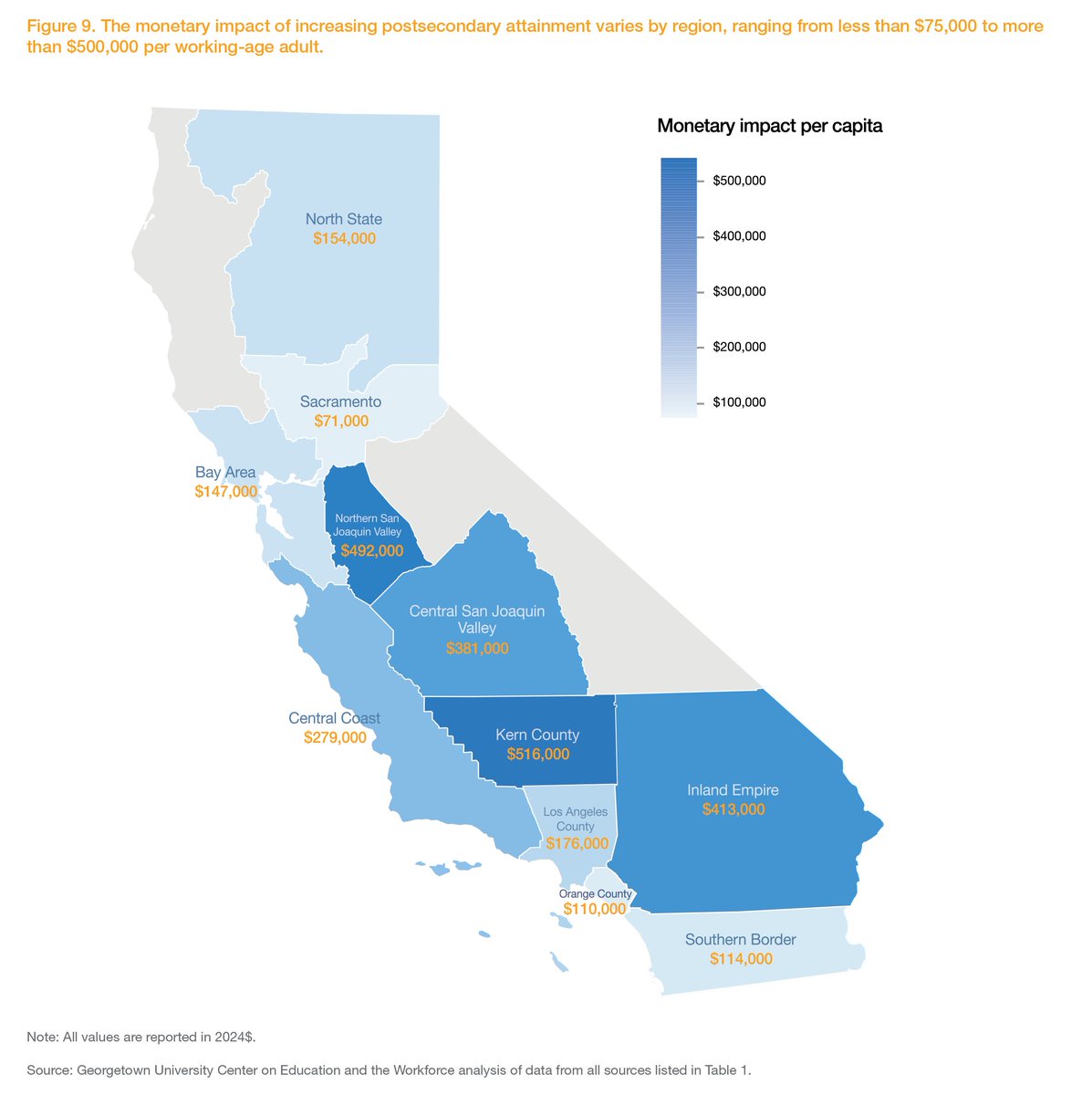
Our report, “The Golden Ticket,” finds that achieving a 70% postsecondary attainment rate across all demographic groups in California would result in $4.4 trillion in net monetary gains for the state and its residents over the next 50 years. bit.ly/4c8BgzK
168
On Flag Day, we honor the adoption of the official flag of the United States and all of the history and culture the American flag represents. #FlagDay
giphy.com/gifs/cbs-3osxYcwi3…
31
Jun 13
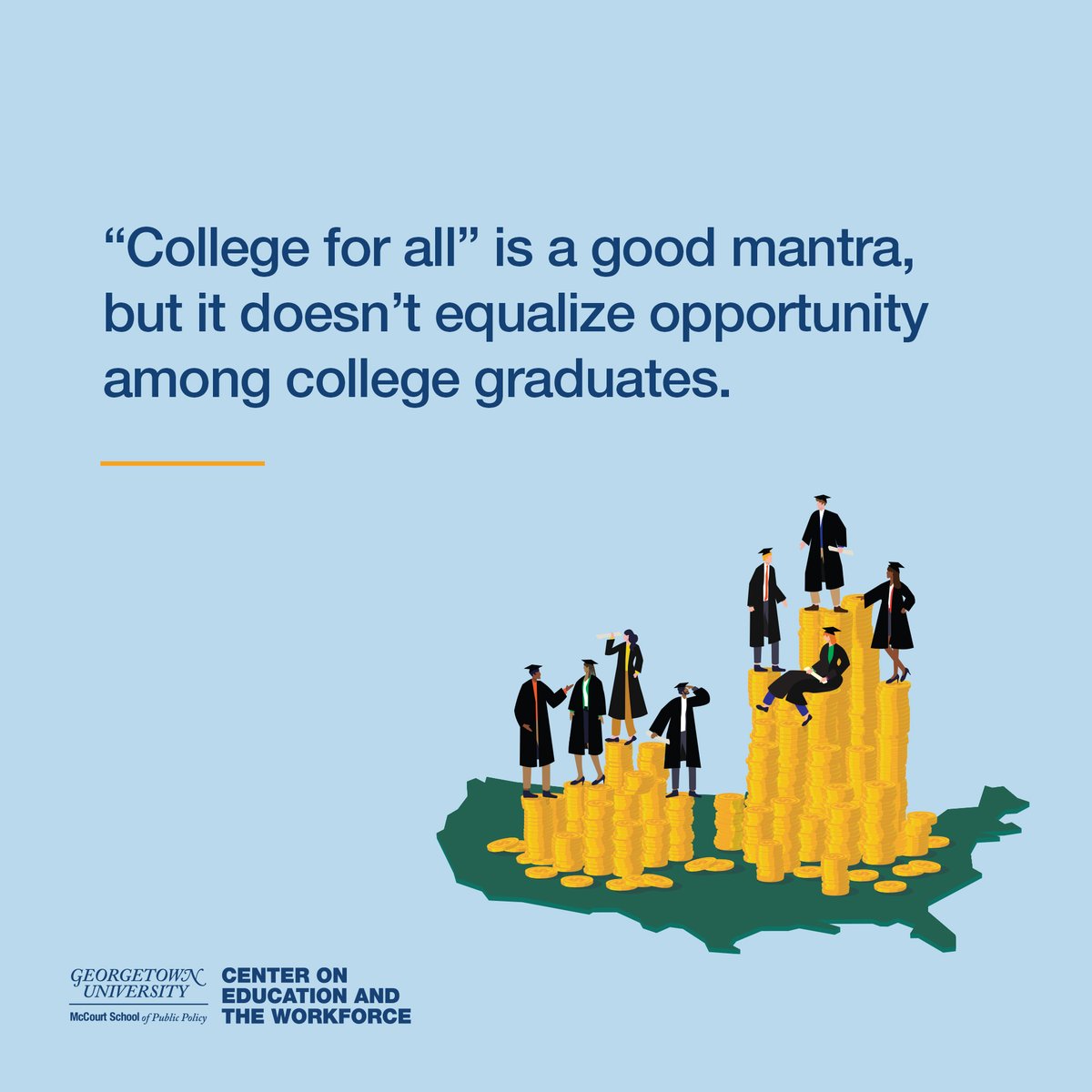
Debates about college’s value arise from valid concerns. In the US, college often fails to live up to its promise of delivering equal economic opportunity for all. Still, the data show that a college degree is the most reliable pathway to the middle class. bit.ly/4aOgi7F
80
Jun 12
The labor market favors workers with college degrees. And that favoritism is even stronger when it comes to good jobs. In 2020, workers with college degrees held 69% of good jobs. bit.ly/4aOgi7F
45
Jun 12
What are the nonmonetary benefits associated with higher educational attainment? Longer life expectancy, lower rates of disease, lower levels of incarceration, higher resistance to authoritarianism, and higher levels of civic participation. bit.ly/4aOgi7F
40
Jun 11
Closing gaps in both degree attainment and earnings would produce substantial benefits for the American economy. If degree attainment was equal across all racial/ethnic groups, the nation’s workers would accrue an additional 11.3T in net lifetime earnings. bit.ly/4aOgi7F
55
Jun 11
CEW’s Director Jeff Strohl joins @CollegeFutures @EloyOakley to explore how a 70% postsecondary attainment rate could help California achieve higher lifetime earnings, increased tax revenue, and economic mobility. Listen here: therant.buzzsprout.com/21312…
54
Jun 11
It’s Pride Month! This month and throughout the year, we celebrate and support the LGBTQIA communities! #LoveWins
33
Jun 10
Low-income students get the highest #ROI at the colleges where they pay the least. Public institutions, which usually have lower prices than private nonprofit or for-profit institutions, have a high ROI for low-income students at all degree levels. bit.ly/3yA0Idk
52
Jun 10
Gaps in educational attainment between racial/ethnic groups play a crucial role in earnings inequality. Among adults with the same educational attainment, those from marginalized racial/ethnic groups generally have lower median earnings than white adults. bit.ly/4aOgi7F
49
College degree attainment has steadily added more value to the country’s economy, bolstering well-being in the US. The share of workers with postsecondary degrees has consistently risen, and these trends are expected to continue in the coming years. bit.ly/4aOgi7F
43
Between 2010 and 2020, degree attainment gaps widened between white adults and American Indian/Alaska Native adults, Native Hawaiian/Pacific Islander adults, and Black/African American adults. More on the benefits of narrowing these gaps: bit.ly/4aOgi7F
1
58
“Equal degree attainment does not mean people earn the same. In fact, women need much more education than men to reach the same earnings,” said Jeff Strohl, CEW’s director. bit.ly/4aOgi7F
91
Between 2010 and 2020, the proportion of US adults who hold college degrees increased by 6.7 percentage points. As a result, US workers can expect to earn an additional $14.2T net of costs over their lifetimes—money that will bolster the US economy. bit.ly/4aOgi7F
49
Low-income students’ returns from associate’s degrees can exceed $1 million, and certificates can be just as lucrative. Find out more about which kinds of institutions can provide the most #ROI to low-income students: bit.ly/3yA0Idk
1
80
Postsecondary education and training is the most reliable pathway to a good job. On #NationalHigherEducationDay, we reaffirm our belief that access to high-quality education shouldn’t depend on income, race/ethnicity, gender, or background.
54
Ideally, potential students would study #ROI data with a counselor who can help them understand potential financial outcomes. Helping students determine a college program’s financial worth is one reason why we need a comprehensive career counseling system. bit.ly/3yA0Idk
43
While public institutions generally lead to the best returns, low-income students can find good returns across institutions. The 24 bachelor’s degree institutions with the highest #ROI for low-income students are all private nonprofit universities. bit.ly/3yA0Idk
60
At colleges that primarily grant associate’s degrees and certificates, about 35% of students at public institutions receive Pell Grants, while, on average, 60% or more of the students at private nonprofit and for-profit institutions receive Pell Grants. bit.ly/3yA0Idk
40
Although for-profit colleges have the lowest #ROI for Pell Grant recipients, their students are the likeliest to have a Pell Grant (56%), followed by those in public institutions (36%) and private nonprofit institutions (35%). bit.ly/3yA0Idk
45
Despite almost 40 years of continuous reforms in the K–12 system, there has been relatively little progress in making high school students college- and career-ready—only 52% of high school sophomores attain a postsecondary credential within 10 years. bit.ly/3FMGRdR
1
42