
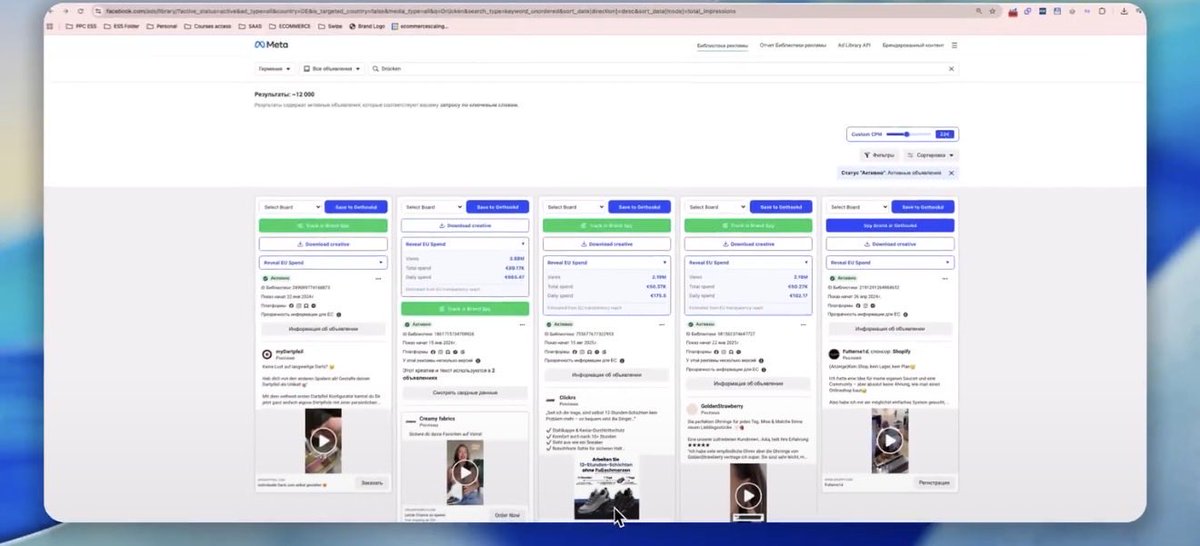
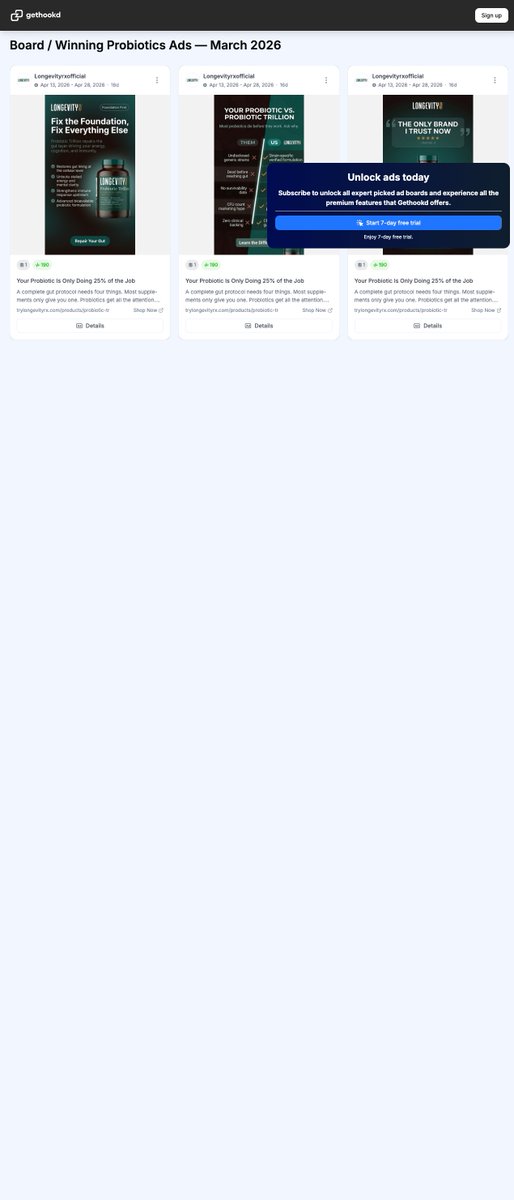
Facebook Ad Library on Steroids. AI-powered ad creative platform that helps you find, analyze, and scale winning ads. Try it free 👇
Joined February 2024
- Tweets 6,096
- Following 146
- Followers 3,430
- Likes 1,541
637 Photos and videos


Pinned Tweet

12 Dec 2025
HEY ECOM LEGENDS! PRINTING ANNOUNCEMENT!
This is ONE OF THE BEST EVER ways to find winning products and ads to sell (especially in health and beauty niche). Check it out
loom.com/share/beb806afd2914…
1
5
68
30,697
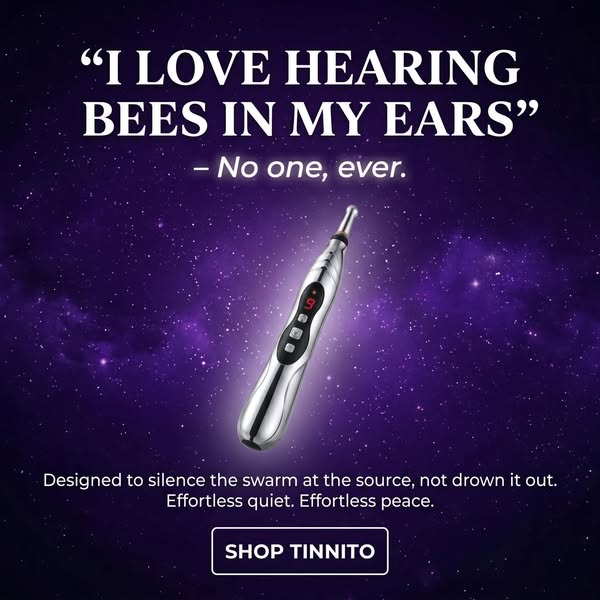
Doctors do not prescribe what works. They prescribe what insurance reimburses and what their CME credits told them about three years ago. For tinnitus, that is anti-anxiety pills and a $1,800 hearing aid that amplifies the ringing along with everything else.
29% of tinnitus patients in the 2019 ATA registry reported their primary care doctor told them it was "stress-related." Zero of those patients had their cervical spine, vascular, or trace mineral panel checked first.
This is the same mechanism every health supplement operator is sleeping on right now. Your buyer has already paid the medical system and lost. Your ad does not need to prove your product. It needs to prove the system failed them. The product becomes the obvious next step.
Belesmé opens with a 4th grade teacher in Columbus, Ohio. Specificity that cannot be ChatGPT'd. Then itemizes the failures with dollar amounts. $1,800 hearing aids returned. Lipo-Flavonoid, 3 months, nothing. $200 sound therapy app, nothing. Anti-anxiety pills that just made her drowsy.
Every line is the medical system invoicing her and failing. By paragraph four the reader is furious at audiologists, not skeptical of supplements.
One of 8,400 supplement advertorials we track on gethookd.ai. The pattern repeats.
Sell against the doctor's office. Not against competitors.
Link to this ad: app.gethookd.ai/share/ad/968…
We track 70M winning ads at gethookd.ai
1
65
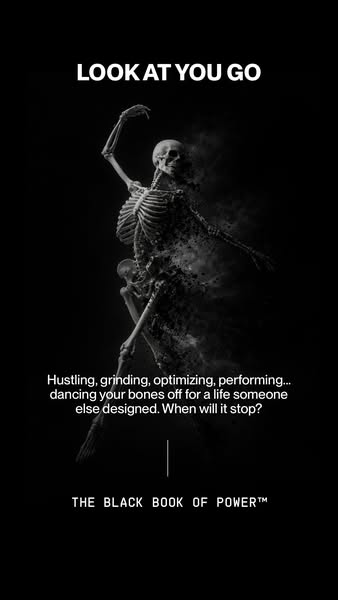
Schools were designed to make factory workers, not thinkers.
The Prussian model that the US copied in 1843 had one job. Produce obedient bodies who would stand in lines, follow bells, defer to authority, and not ask why. Horace Mann said it out loud. The bell is not for learning. It's training for the shift whistle.
This is the same mechanism every DTC founder is sleeping on right now. The market you're selling into was trained for 12 years to follow rules they never agreed to. The buyer is exhausted from a life they never auditioned for. Sell them the permission slip, not the product.
Stan Taylor is running this exact play. The ad opens with "Hustling, performing, grinding, smiling on command. Dancing beautifully for a life you never auditioned for."
No product feature. No price. No discount code. Just the buyer's exact internal monologue handed back to them with a name.
Then the close: "The Black Book of Power is the first thing you will ever choose for yourself."
The product is reframed as the first act of agency in the buyer's adult life. A $30 book becomes a vote against the entire Prussian script. Conversion math changes when the purchase IS the transformation.
Most operators write product copy. Winners write permission copy.
We track 70M winning ads at gethookd.ai
app.gethookd.ai/share/ad/994…
The buyer is not buying the product. They're buying the version of themselves who finally said no.
1
86
Categories mature when brands stop talking about what the product does and start talking about why the problem exists.

This brand is printing.
Men's hair growth supplement. 0 to 247 active ads in 90 days. Doing $40k a day on Meta.
The angle: testosterone-aware approach. Hair loss positioned as a "hormonal pattern" instead of cosmetic problem. UGC founder talking heads. Zero stock footage.
Active ads count tells you everything. They're betting heavy because the math works.
Rip the angle. Make it your own. Print.
1
1
135
The 80 minerals callout is doing the same job a testimonial would do in another category.

Educational Authority: this ad refuses to sell and instead teaches the reader the ingredient, which is the sale.
Daily Wellness Solutions by Kapiva is selling Himalayan Shilajit, a category with low buyer literacy and high curiosity. The body is short, dense, and structured like a wikipedia opener rather than a pitch. There is no urgency, no offer, no testimonial. Just facts arranged in a particular order.
"It is made out of 100% Ayurvedic Resin with 80 minerals including Fulvic Acid and gives you these benefits and more when you consume daily."
Element 1: Composition first. The ad opens by naming what the product is made of before saying what it does. That sequence matters. Buyers in supplement categories have been burned by proprietary blends and vague labels. Leading with composition signals nothing to hide. The 80 minerals figure and the Fulvic Acid callout act as proof points without quoting a study.
Element 2: "Daily" as commitment frame. The verb "consume daily" reframes the product from a trial to a ritual. It tells the buyer this is something you take every morning forever, which is the actual business model. Subscription brands that hide this in their copy lose churn battles later. Naming it up front pre-qualifies the right buyer.
Element 3: Benefit dash list. Four benefits, each one a single phrase. Immunity, energy, performance, fatigue. No paragraphs, no caveats. The buyer scans the list and self matches to whichever one they were Googling last week. The brevity reads as confidence.
Element 4: Education as authority. The word "Ayurvedic" is the silent authority borrow here. It does not claim a doctor, a lab, or a clinical study. It borrows from a 5,000 year old tradition, which is harder to argue with than any single credential.
Psychology: shilajit buyers are mid funnel by default. They have already heard about it on a podcast or from a friend, they are now researching brands. The Educational Authority structure converts because it gives them the talking points they will use to justify the purchase to themselves later. The ad arms the buyer with vocabulary. Vocabulary becomes belief. Belief becomes purchase.
Tactical takeaway: in categories where the product itself is exotic or unfamiliar, lead with composition, not benefit. Name the active compound, the source, and the daily protocol. List benefits as one word phrases after the composition, not before. Avoid offers in the body, let the landing page do that work. This works for nootropics, adaptogens, mushroom blends, peptides, and any ingredient led brand whose buyer is doing their own research.
Performance score of 91 on an 11 day creative confirms the format. Education sells when the buyer is already half sold.
Full ad: app.gethookd.ai/share/ad/102…
NOW GO FUCKING PRINT 🔥
I use @GetHookdAI to spy on 80M winning ads. They scrape 110,000 brands daily on Facebook.
1
109
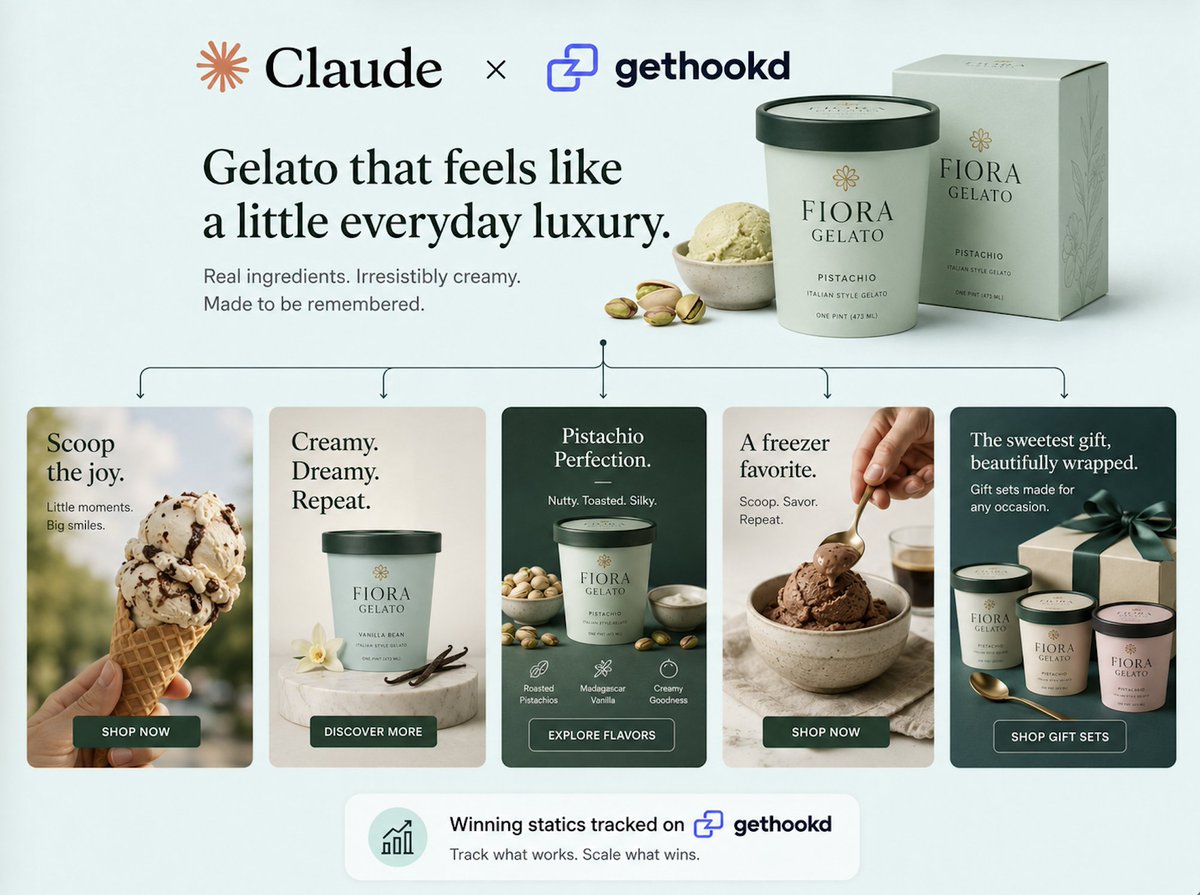
Creative velocity compounds when every new test is built on something that's already proven to work.

$38k/month brands don’t scale because they “have better ideas”
they scale because they build more winning variations from the ads already working
this is the workflow:
find proven ad patterns inside GetHookd
use Claude to break down the angle
turn one winning concept into 10 new creatives
test different hooks, offers, visuals, and buyers
track what wins
repeat until the account prints
most brands are still guessing from a blank page
smart operators are feeding Claude the data, the winners, the patterns, and the customer psychology
that’s how you get ads like this in minutes instead of waiting weeks for a creative team
rt comment "gelato" and I’ll send you the Claude x GetHookd ad workflow
(follow for dm)
1
1
2
223
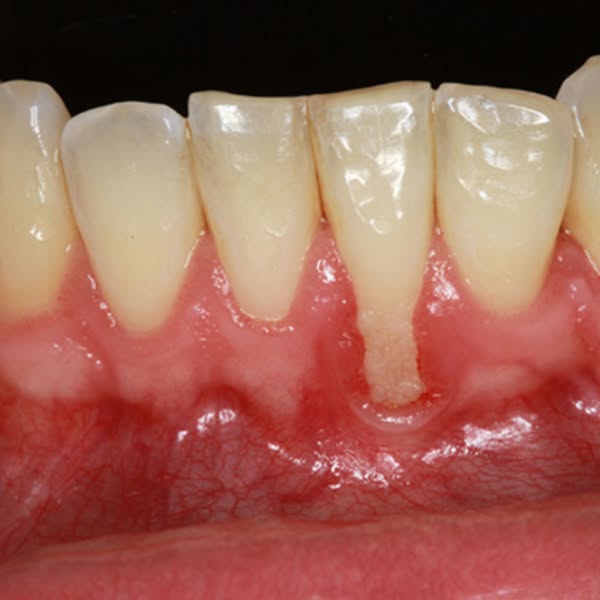
Your dentist makes more money when your gums get worse.
The US gum graft market is $4,000 to $8,000 per procedure and growing 6.2% a year. A cleaning bills $90. The dental hygiene aisle at CVS has 312 SKUs and zero of them claim to seal the gumline barrier.
This is the same mechanism every DTC supplement brand is sleeping on right now. The professional system gets paid on the late-stage repair. The DIY product that prevents the repair has no competition in the category aisle.
Dr. Vanessa Veracruz, 8-year periodontist in Kansas City, opens this ad by admitting her own mother's recession got worse on her watch. Three years of "still holding at 3 millimeters. Keep brushing gently."
Then she calls out the script. Soft brush. Gentle technique. Floss every night. None of it seals the bacterial breach at the gumline.
She names three numbers in the first 80 words. 3mm recession. 6-month checkups. $4K to $8K graft. The reader's brain locks because every one of those numbers matches something their own dentist has said to them.
The product is SmileGuard. One bottle. Sealant claim, not a whitening claim. Different shelf in the reader's head.
We track 70M winning ads at gethookd.ai.
The ad doesn't attack dentists. It attacks the script dentists use. That's the trick.
app.gethookd.ai/share/ad/969…
1
9
8,945
Vets don't get paid to keep your pet alive.
The US pet supplement market is $2.8B. Vet hospital revenue per visit is $253 (2024 AVMA). The kidney panel that flags damage runs $180. The kidney isn't profitable until it's already gone.
This is the same mechanism every supplement brand is sleeping on right now. The diagnostic industry profits on the late-stage catch. The early-stage market is wide open and has almost no advertisers in it.
Dr. Sarah Callahan, 19 years head vet at North Valley Animal Rescue, opens this ad with one sentence. "I'm going to tell you something your vet probably hasn't said to you yet."
Then she names the exact thing the reader has been doing right. Dry food the cat loves. The fountain. The clean bloodwork six months ago. None of it is protecting the kidney.
The mechanism: by the time creatinine moves on a panel, 60-70% of nephron function is already gone. She doesn't sell the supplement here. She sells the window before the panel changes.
CTA is one product. Taurine. $24. Not a 9-bottle stack.
The ad is a 1,200-word advertorial structured around 4 patient stories. Each one ends with the same sentence the owner told her. "But she had her checkup six months ago. Everything was fine."
We track 70M winning ads at gethookd.ai.
If your offer fixes something the standard test misses, that's the hook. Stop selling the cure. Sell the window.
app.gethookd.ai/share/ad/972…
1
1,080
Jun 13
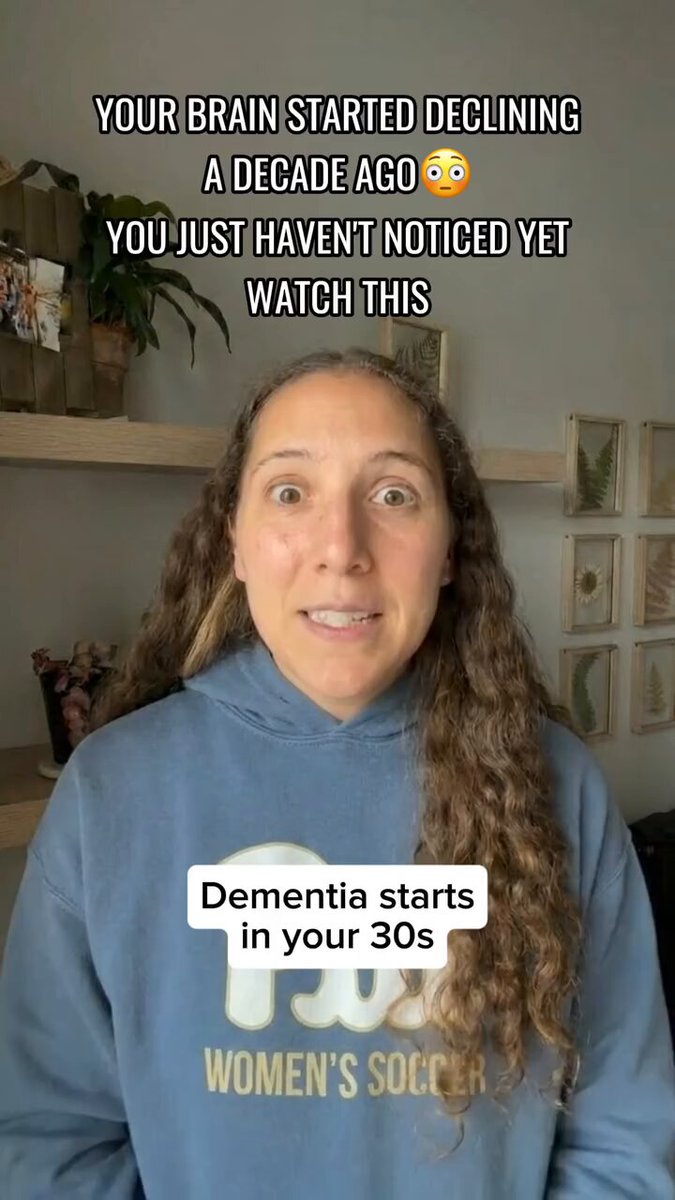
I analyzed The Dementia Support Hub running three near-identical creatives this week.
Three patterns inside the same advertiser:
1. Same product, three emotional gates. One ad accuses the buyer of fighting the wrong battle. One says "you've been told." One opens with the daughter or family caregiver. Same SKU. Three different doors.
2. Identical second-half body. Once the hook earns the click, the explainer about the blood brain barrier and the 12mg clinical dose is word-for-word. They're A/B testing the first 30 seconds and freezing the rest.
3. 81 active variants in rotation. The catalog isn't experimenting with new products. It's experimenting with how the same product gets introduced.
Insight worth keeping: scale isn't more SKUs. It's more first-lines. A winner can carry 50 hooks before you need a second offer.
👀 Full ad: app.gethookd.ai/share/ad/997…
I use @GetHookdAI to spy on 80M winning ads.
1
138
Jun 13
The benefit selection is doing a lot of work. Almost every wellness buyer falls into at least one of those buckets.
Ran into this grounding ad and it's almost aggressively simple in the best way.
"Grounding has been proven to: Reduce inflammation, Improve sleep quality, Improve mood & energy."
Three benefits. one sentence each. that's it. no mechanism, no testimonial, no offer. and yet it works because of one word doing everything: proven.
"Proven" is the trust hinge of the whole ad. it tells the skeptical reader this isn't woo, while letting the believer feel validated. one word, two audiences, covered.
The three benefits they picked are also surgical. inflammation is the buzzword every health-curious buyer is chasing. sleep is the most-searched wellness problem online. mood and energy is the catchall for everyone else. you can't read that list and not see yourself somewhere.
Short copy on a curiosity product is the right call. grounding is weird enough that long explanations make it sound weirder. better to tease the benefits and let the landing page do the deeper sell.
Been running 25 days with a 91-performance score, which is the signal that minimalist copy can outperform a thousand-word VSL when the angle is fresh.
Minimalist copy isn't lazy, it's confident. the brands brave enough to ship three-bullet ads usually have a landing page doing the heavy lifting underneath. always check what comes after the click before you judge the ad. the funnel is the unit, not the creative.
full ad: app.gethookd.ai/share/ad/100…
NOW GO FUCKING PRINT 🔥
I use @GetHookdAI to spy on 80M winning ads. They scrape 110,000 brands daily on Facebook.
126
Jun 13
The real product here isn't the gummy. It's the new explanation the buyer adopts before they ever see the offer.
Jun 13
Root Cause Cascade: this ad walks the reader down a staircase of biological causes so the product feels like the only landing.
Breaking Men's Health News is running Ultima Peak, a male performance gummy. The copy is built as a falling cascade of one line paragraphs, then opens up into two bullet lists. It reads like a thread, not an ad, which is the whole point.
"Most men think it's age. But the real problem is restricted blood flow. Low nitric oxide. High cortisol. Low testosterone."
Element 1: The age reframe. Sentence one names the buyer's current explanation. Sentence two demotes it. That is a classic reframe move, but the execution is what sells it: each new "real cause" is dropped on its own line, one phrase per row, with whitespace doing the pacing. The reader scrolls through four one liners and feels like they just learned four things.
Element 2: Cascade as logic chain. Restricted blood flow leads to low nitric oxide leads to hormonal collapse. Each step is short enough to nod at. By the time the buyer reaches the bullet list, they have already accepted the mechanism, so the ingredient list is read as a solution rather than a sales pitch.
Element 3: Dual checklist. Benefits get sparkle emojis. Ingredients get green checks. The visual split tells the reader "here is what you get, here is why it works." It is the same content as a paragraph but parsed twice as fast.
Element 4: Scarcity tag at the close. "Grab it before they're gone again." Soft scarcity, not aggressive, but it implies prior sellouts and previous buyers, which is identity proof more than urgency.
Psychology: men over forty have been told their decline is normal. The cascade structure converts that resignation into curiosity by replacing one fuzzy cause (age) with four specific ones they can pretend to fix. It also flatters the reader. By the bottom of the cascade they feel like a citizen scientist who just decoded their own body. Buying becomes the obvious next step in their new theory.
Tactical takeaway: if your category fights the "it is just aging" objection, do not argue with it, demote it. Write one short line that names the lazy belief, then a one word cascade of four biological mechanisms underneath. Follow with a benefit list and an ingredient list as separate visual columns. This template ports to hair loss, sleep, weight, libido, energy, and cognition.
Performance score of 91 on a 7 day creative is the tell that the cascade is doing the heavy lifting, not the offer.
Full ad: app.gethookd.ai/share/ad/103…
NOW GO FUCKING PRINT 🔥
I use @GetHookdAI to spy on 80M winning ads. They scrape 110,000 brands daily on Facebook.
165
Jun 13
Reporting changed faster than most teams adapted. That's where the opportunity is.
Jun 12
Reminder for US ecom entrepreneurs: the Meta click-through attribution change from March is still costing your dashboard accuracy.
Effective March 3, click-through attribution now counts ONLY link clicks. Likes, shares, saves, comments, video plays all moved to "engage-through" with a 1-day window.
Reported click-through conversions dropped 40-60% on most US accounts after the rollout. Most of that is reclassification, not real performance loss. But if you didn't adjust your CAC reporting framework after March, you're still reading the dashboard wrong.
Three things to check this week:
→ Pull your last 90 days of CAC by campaign. Compare February to May. If your reported CAC jumped 30% without anything else changing, you're seeing the reclassification, not a real CAC increase.
→ Reconcile engage-through against click-through. Engage-through has a 1-day window (was 7). Conversions that happened on day 2-7 from a like, share, or save are now uncategorized and missing from totals entirely.
→ Stop comparing post-March CAC to pre-March CAC unless you're normalizing for the methodology change. Many brands cut budgets in April thinking CAC tripled. It didn't. The math just moved.
Meta confirmed billing is unchanged. You're paying the same. The dashboard just tells you the truth differently now.
Most US ecom entrepreneurs are 3 months behind on understanding this. The ones who figured it out in March are quietly scaling because they're bidding off correct data while their competitors panic.
Read the new numbers correctly before you cut budget.
177
Jun 13
Hospitals do not make money keeping you healthy. They make money on the slow descent. A statin script generates 30 years of follow-up visits, side-effect prescriptions, and statin-induced muscle pain consults. A cured patient generates zero.
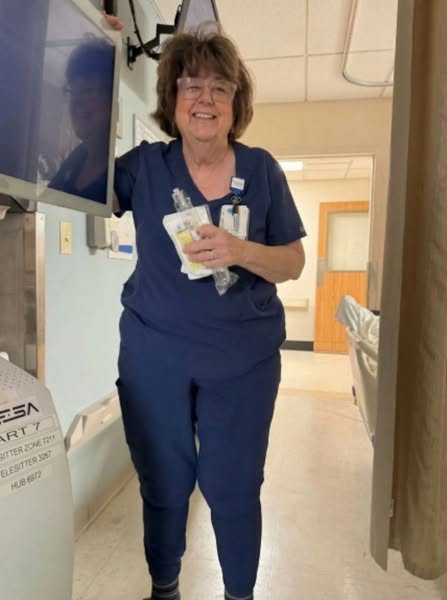
Denise Walker is a nurse of 32 years. Her LDL went from 186 to 134 in five months. She never filled the Lipitor script. Up to 29% of statin patients in the published literature get statin-associated muscle symptoms. In her practice she calls it higher.
This is the same mechanism every supplement and functional health operator is sleeping on right now. Your buyer is not skeptical of natural alternatives. They are skeptical of the doctor who pulled out the prescription pad before finishing the chart. Validate that suspicion in sentence one.
The ad is 1,400 words of clinical observation. Muscle pain that never goes away. Brain fog that steals sharpness. Memory loss families confuse with dementia. Exhaustion she names by patient archetype. Every paragraph is a nurse cataloguing what the system did to her patients.
By the time the product enters, the reader is not buying a supplement. They are buying their own escape from the descent.
One of 8,400 supplement advertorials tracked at gethookd.ai.
Catalogue the damage. The product sells itself.
Link to this ad: app.gethookd.ai/share/ad/977…
We track 70M winning ads at gethookd.ai
8
12
452
Jun 12
Bottled water is tap water with a 10000x markup. Aquafina and Dasani filter municipal supply. PepsiCo admitted it on the label in 2007 after a lawsuit. The category still does $36B annually in the US.
Markup doesn't follow ingredient cost. It follows distrust. Once a buyer doubts the cheap option, they pay anything for a reframed version of the same molecule.
This is the same mechanism every supplement brand is sleeping on right now. Beth's audiologist ran a full hearing test and told her to "habituate." The ENT shrugged. Custom hearing aids at $1,800 made the buzz worse. Amazon supplements did nothing. The customer has already decided the doctor is selling tap water. She'll pay 100x for the same active ingredient if the story is different.
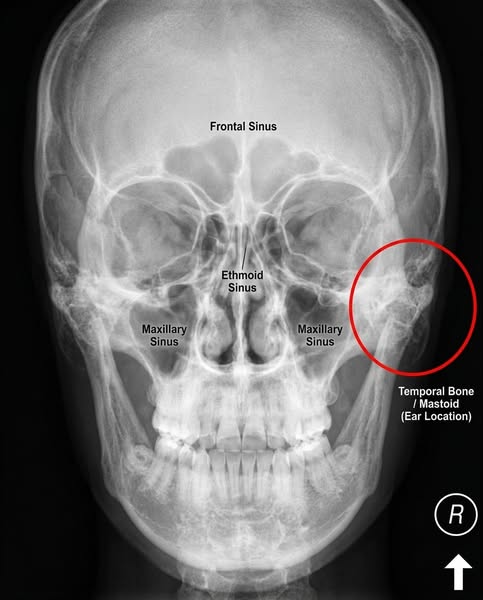
Beth Ronalds' creative: 54-year-old retired teacher, Columbus, Ohio. 3 years of ringing tied to chronic sinus congestion. Hearing aids returned in 2 weeks. Ginkgo, Zinc, B12 all failed. A $12 masking app put her to sleep and woke her to ringing.
Image format. Performance score 91. Soovera advertorial.
The frame: sinusitis as the unidentified upstream cause. ENT specialist letting something slip "she wasn't supposed to say."
Reframing the doctor's silence is worth more than any ingredient.
Link to this ad: app.gethookd.ai/share/ad/972…
We track 70M winning ads at gethookd.ai
9
13
730
Jun 12
Most travel accessories compete on utility. This one competes on emotion.
Here's what caught me about this callie ad. it's selling a luggage tag like it's a family portrait.
"Never lose your luggage again, in style. The whole family's travel twin on a custom airplane map luggage tag. A smart, fun birthday gift for any travel lover."
Two jobs in one product. functional, which is don't lose your bag. emotional, which is custom family illustration that looks like a keepsake. the functional reason is the permission slip. the emotional reason is the actual purchase driver.
Birthday gift framing is the smartest move in the copy. they're not asking you to buy something for yourself, they're handing you a solved gift problem. anyone with a travel-loving sister or mom-in-law just got their next birthday sorted.
The emoji use is also deliberate. evil eye for protection, sparkle for cute. that combo signals female gift shopper instantly. the algorithm reads those emojis and so do humans.
Short copy works here because the visual is doing the selling. you don't need to explain a personalized luggage tag, you need to show it. ad bodies should be as short as the creative allows, and this one knows it.
The gifting niche is a goldmine because the buyer isn't price-sensitive, they're problem-sensitive. solve the what-do-i-get-them question and you outsell every commodity tag on the marketplace. personalization is the multiplier because it makes a $30 product feel like a $300 thought.
full ad: app.gethookd.ai/share/ad/104…
NOW GO FUCKING PRINT 🔥
I use @GetHookdAI to spy on 80M winning ads. They scrape 110,000 brands daily on Facebook.
208
Jun 12
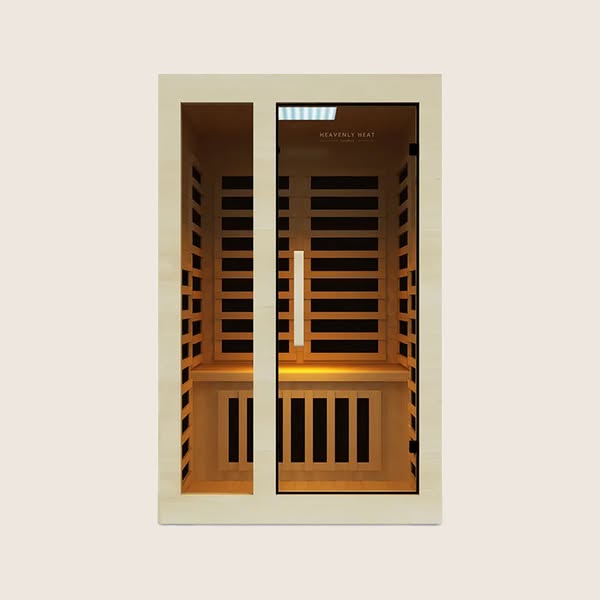
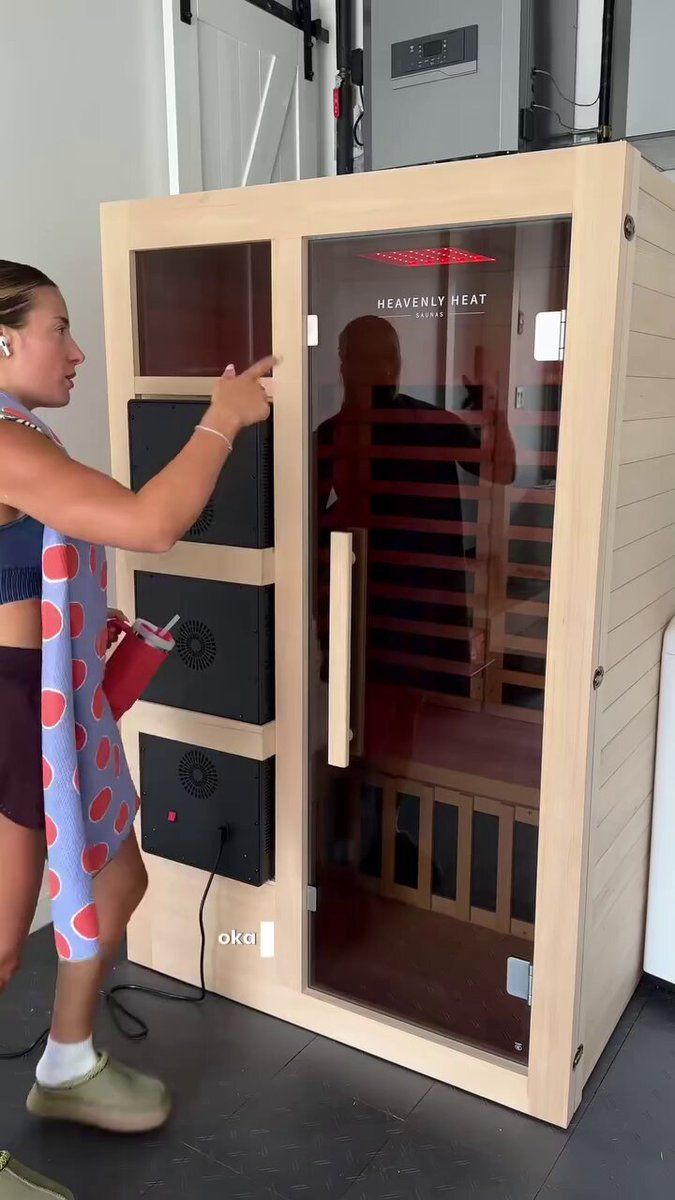
I analyzed Heavenly Heat Saunas running a French-language sauna creative alongside their English ads.
Three patterns I keep seeing in localized DTC:
1. Headline in the local language, body in English. "Sauna infrarouge pour 2 personnes" pulls the regional buyer, then the body copy is the original winner translated minimally. Cheaper than a full creative redo.
2. Same benefit triplet across languages. Sleep, cardiovascular health, dementia prevention. The reasons to buy don't change at a border. Only the trigger word does.
3. Single SKU focus. Two-person sauna. Not the catalog. Localized ads work when they sell one specific configuration per geo because shipping and pricing complexity scares the new market.
Insight: localize the hook, not the funnel. Most brands burn budget translating everything when only the first line needed to move.
81 perf on the French variant.
👀 Full ad: app.gethookd.ai/share/ad/994…
I use @GetHookdAI to spy on 80M winning ads.
247
Jun 12
I analyzed Heavenly Heat Saunas and the broader home-wellness category running on Meta right now.
Three patterns repeating across the winners:
1. Permission-to-buy hooks. "Sauna is a no-brainer." The first line removes deliberation. The reader has already justified the purchase before the product appears.
2. Stacked benefits as a triplet. Sleep, cardiovascular health, dementia prevention. Three becomes the magic number because two feels thin and four feels desperate.
3. Quality qualifier as the differentiator. "Get the cleanest." The category is crowded so the ad pivots to purity, not features. Buyers comparing 12 brands need a reason to stop shopping.
Insight worth stealing: when your product is expensive and the category is mature, the best hook is "you already know you want this, here's how to pick correctly."
91 perf.
👀 Full ad: app.gethookd.ai/share/ad/994…
I use @GetHookdAI to spy on 80M winning ads.
1
295
Jun 12
Antibiotics weren't approved for general use until 1945. Every prior medicine you romanticize killed people. Mercury for syphilis. Heroin for cough. Bloodletting for fever.
Modern medicine is younger than your grandmother. That gap between "official protocol" and "actually solved" is wider than the surgical industry will admit on the consult.
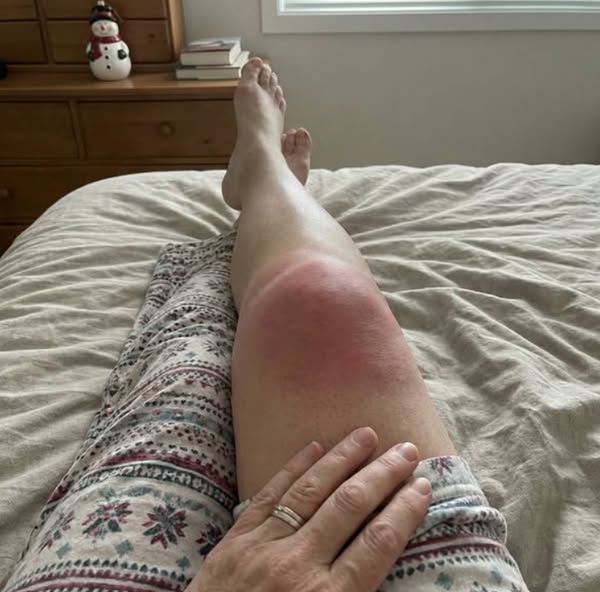
This is the same mechanism every supplement brand is sleeping on right now. Bone-on-bone knee gets you a 2-3 hour surgery, 6-12 weeks of recovery, infection risk, blood clot risk, implant failure risk. PT didn't fix Anne's knee at $1,800. PRP didn't at $2,400. Stem cell didn't at $8,000. The orthopedic playbook isn't 80 years old. It's the only playbook the surgeon was trained on.
Anne Blake's creative: 64-year-old facing knee replacement. Daughter's wedding next spring. Neighbor had a stroke during surgery. Every alternative tried and itemized in dollars.
Image format. Performance score 91. Landing page: trycloudix review-15-a advertorial.
The structure is fear arithmetic. List every recovery risk. List every failed alternative with price tags. Then introduce the protocol the surgeon never mentions because no one bills for it.
Establishment as villain. Bills as evidence. Specificity wins.
Link to this ad: app.gethookd.ai/share/ad/983…
We track 70M winning ads at gethookd.ai
127
Jun 12
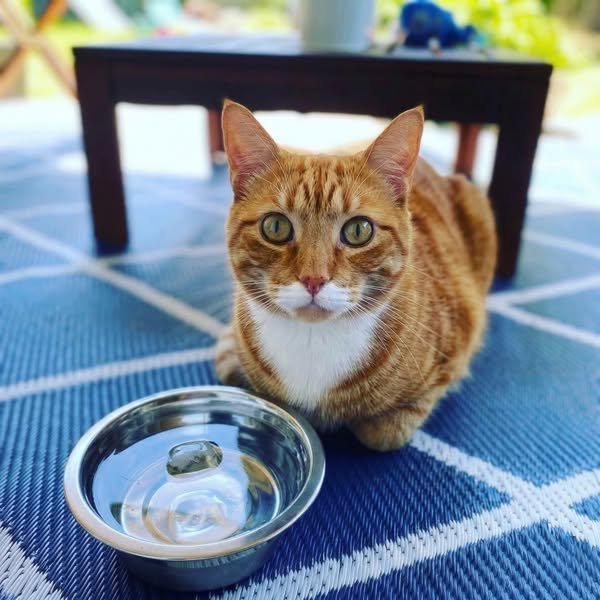
What you call a preference is often a survival behavior. Coffee tastes objectively bitter to a first-time drinker. You did not develop "taste." You trained tolerance for the chemical. Same with your cat and the ice cubes.
Cat Wellness Journal's hook: a woman who put three ice cubes in her cat's water bowl every morning for four years. Thought it was personality. Bloodwork came back stage 2 kidney decline at creatinine 2.4 and SDMA 19. The cat was not preferring cold water. She was tolerating contaminated water for the 10 minutes the ice masked the scent.
This is the same mechanism every DTC operator is sleeping on right now. Your customer has reframed a problem as a quirk. Your job is to rename the quirk. Picky eater is gut dysbiosis. Sensitive skin is barrier collapse. Trouble sleeping is cortisol dysregulation. The rename is the sale.
The ad spends the first 400 words on the ice cube ritual. Operator-tier specificity. Three cubes. Stir with finger. Break the surface tension. Then the vet's pause. Then the rename. Then the product.
One of 1,100 pet niche winners we track on gethookd.ai. Storytelling beats supplement features 9 times in 10.
Rename the quirk. Sell the rename.
Link to this ad: app.gethookd.ai/share/ad/988…
We track 70M winning ads at gethookd.ai
1
2,135
Jun 12
I analyzed Ryan Hudson's BPH ad and the strongest men's-health stories running this quarter.
Three patterns the top performers all use:
1. Scene-opening narration. "When they wheeled me back into the recovery room after my PAE, my urologist came in smiling." The reader is inside a hospital room by sentence one. No setup, no preamble.
2. A second character as the truth-teller. The urologist delivers the verdict. The narrator just reports it. That distance makes the claim feel like reporting, not selling.
3. Procedure jargon used casually. PAE. BPH. Recovery room. The vocabulary tells the reader this is written by someone who lived it, not someone who hired a copywriter.
The takeaway: medical-condition ads convert when they read like a journal entry written the same week the treatment happened.
91 perf.
👀 Full ad: app.gethookd.ai/share/ad/997…
I use @GetHookdAI to spy on 80M winning ads.
1
71
Jun 12
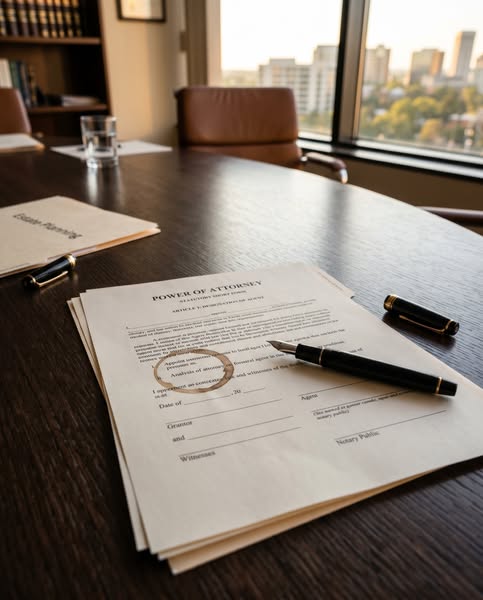
I analyzed Dr Barbara Miler's "power of attorney" creative alongside the strongest senior-health hooks in the library.
Three patterns the top 5% share:
1. Specific countable numbers in the first sentence. "I have signed three hundred and twenty powers of attorney for women in cognitive decline." Not "many." Not "hundreds." Three hundred and twenty. The number itself is the proof.
2. Spelling numbers as words. "Three hundred and twenty" reads slower than "320." Slower reading equals deeper attention. Almost every top legal and medical ad does this.
3. First-person professional voice with no logo. The reader assumes a real doctor, not a brand. The product arrives later, after authority is already cemented.
Steal the combo: spelled-out specific number plus first-person credential plus no brand mention for the first 100 words.
91 perf.
👀 Full ad: app.gethookd.ai/share/ad/990…
I use @GetHookdAI to spy on 80M winning ads.
1
95