
Postdoctoral Research Fellow | @imagingneuroucl.bsky.social, previously @sussex.ac.uk | Mental imagery, spontaneous thoughts, @giuliacabbai.bsky.social
Joined November 2012
- Tweets 97
- Following 173
- Followers 215
- Likes 340
5 Photos and videos
Pinned Tweet

17 Oct 2024
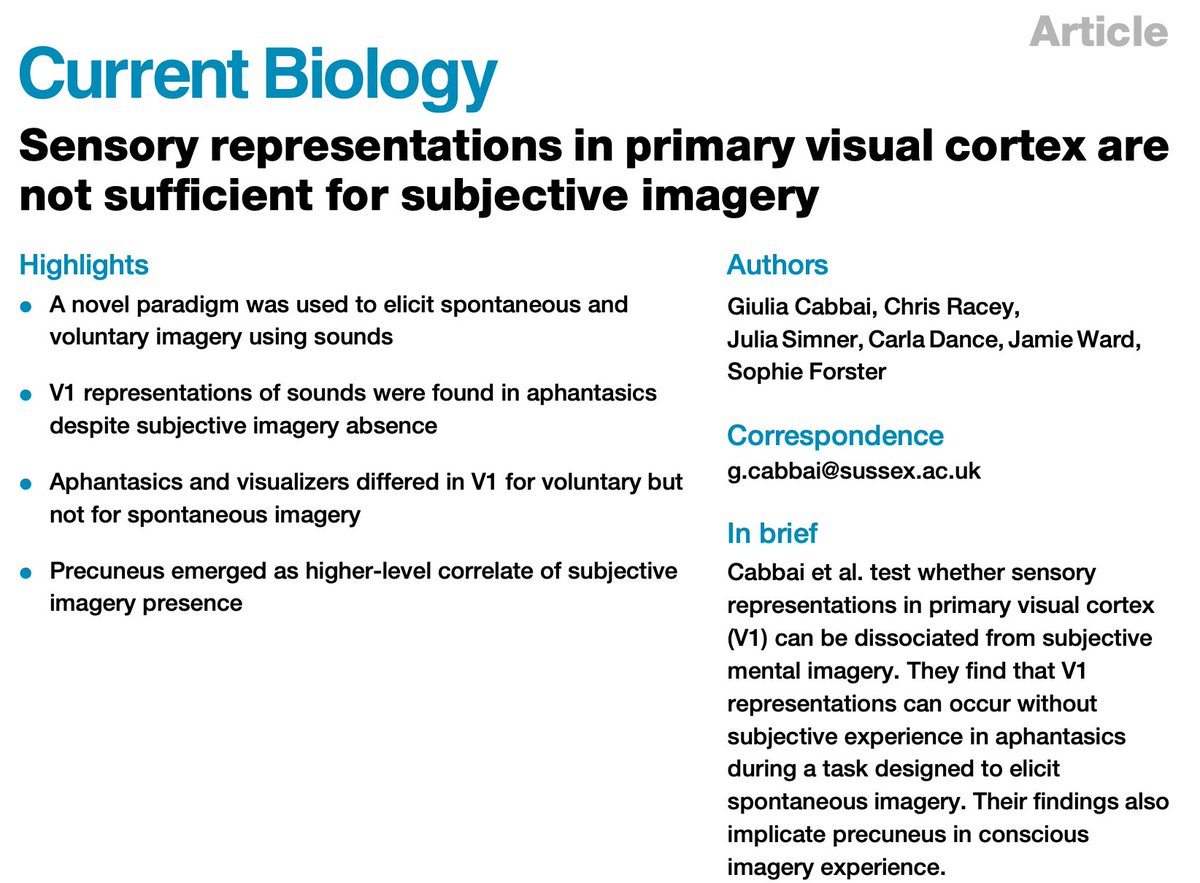
So happy to see our paper finally out in @CurrentBiology ! 🥳 Link: cell.com/current-biology/ful…
7
48
246
31,106
17 Oct 2024
So happy to see our paper finally out in @CurrentBiology ! 🥳 Link: cell.com/current-biology/ful…
7
48
246
31,106
17 Oct 2024
Here's a thread I made on the preprinted version: x.com/GiuliaCabbai/status/17…
5 Feb 2024

A bit late to the party, but here's a thread about our new fMRI study preprint, in which we found that V1 is not sufficient for subjective imagery experience. biorxiv.org/content/10.1101/…
4
1,074
Giulia Cabbai retweeted

25 Apr 2024
Aware and Alive: ASSC27 Satellite Symposium on Embodied and Phenomenological Perspectives on Consciousness
sites.google.com/view/awarea…
1
6
10
6,169
5 Feb 2024
This spontaneous imagery rating was followed by ratings of voluntary imagery experience of the same sounds.
In a second scanning part, participants listened to all sounds again, but this time while voluntarily conjuring visual images of the sound content.
1
4
463
5 Feb 2024
Taken together, these results thus show that, while V1 is not sufficient for the subjective experience of imagery, precuneus appears to play a key role in its presence.
1
7
389
5 Feb 2024
Special thanks to my amazing collaborators, Chris Racey, Julia Simner, Carla Dance, @JamieWardSussex and @SophieForster!😊
6
359
5 Feb 2024
A bit late to the party, but here's a thread about our new fMRI study preprint, in which we found that V1 is not sufficient for subjective imagery experience. biorxiv.org/content/10.1101/…
2
2
25
6,107
5 Feb 2024
Before this “passive listening” part we instructed participants to just listen to the sounds, without mentioning imagery at all. At the end of this part, participants received a surprise question: “Did you experience spontaneous visual imagery while listening to the sounds?”.
1
5
274
5 Feb 2024
To induce spontaneous imagery in the scanner, we first played to our blindfolded participants a series of natural sounds (e.g., dog barking, cat meowing, traffic cars noise, etc) selected via previous pilot studies for their ability to induce visual imagery.
1
6
254
5 Feb 2024
Indeed, lacking the ability to generate imagery on demand does not exclude that someone might still experience imagery or generate its associated sensory representation when triggered automatically.
For this reason, we looked at both spontaneous and voluntary forms of imagery.
1
1
6
341
5 Feb 2024
However, we considered that our main question could not be answered by just employing voluntary imagery paradigms, which have dominated the imagery literature.
1
5
208
5 Feb 2024
We therefore tested for both the presence of decodable sensory representations in primary visual cortex as well as subjective experience in 26 visualisers and 24 aphantasics.
1
5
214
5 Feb 2024
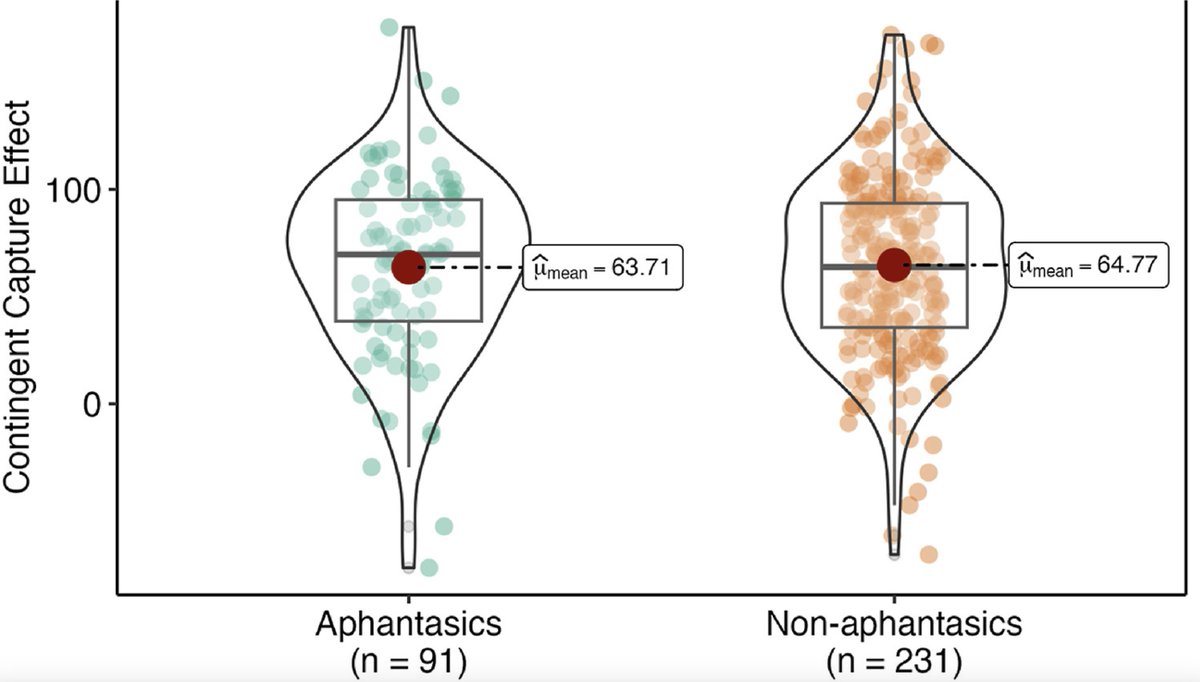
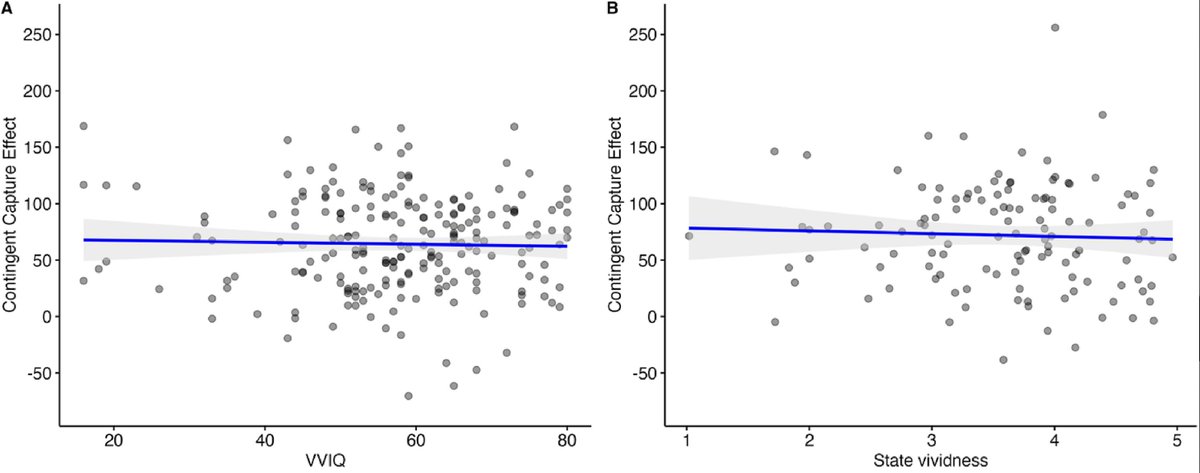
The association assumption is challenged by neurological case studies and recent non-clinical evidence showing that people who cannot experience imagery at will (aphantasics) show preserved performance in tasks considered to involve internal visual cortex representations.
1
5
222
5 Feb 2024
However, it is unclear how these relate to a core facet of imagery: subjective experience. Indeed, many neuroimaging studies only measured the sensory component, assuming subjective experience would co-occur under instructions to imagine or during certain tasks eg mental rotation
1
5
248