
Local-first, privacy-first, FOSS-first digital laboratory
Joined March 2026
- Tweets 1,258
- Following 342
- Followers 74
- Likes 1,130
88 Photos and videos









Pinned Tweet

Jun 13
1/ I ran Claude Code for six months. Then I ran Codex. Then I ran both at the same time, hoping the combined cost would finally justify the output.
It did not.
The problem was not the models. Claude is excellent. The frontier models are the best available.
The problem was memory.
Every session starts from zero. The agent does not remember what you taught it last week, what worked, what failed, or why a decision was made.
I wanted an agent that gets smarter over time because it remembers what it learns.
🧵
11
2
152
Jun 13
Full article and thread up.
x.com/guideboardlabs/status/…

“. The agent remembers what it learned. The stack gets smarter every run. No one can flip a switch and take it away.” 👏
1
1
217
Jun 13
1/ I ran Claude Code for six months. Then I ran Codex. Then I ran both at the same time, hoping the combined cost would finally justify the output.
It did not.
The problem was not the models. Claude is excellent. The frontier models are the best available.
The problem was memory.
Every session starts from zero. The agent does not remember what you taught it last week, what worked, what failed, or why a decision was made.
I wanted an agent that gets smarter over time because it remembers what it learns.
🧵
11
2
152
Jun 13
11/
The result is not polished like a commercial product.
It is better than a commercial product because it knows me.
The models will come and go. And it’s not your decision when they do.
The memory stays. No matter who tells you what models you’re allowed access to.
Full article:
open.substack.com/pub/guideb…
21
Jun 13
10/
The third theory is deterministic governance.
I do not want a language model deciding whether governance rules should apply.
Rules should be rules. Models should be models.
Keep those responsibilities separate.
1
22
Jun 13
9/
The second theory is filesystem-first.
Not Redis. Not Postgres. Not hidden internal state.
Files.
You can inspect them, version them, search them, back them up, and read them with grep.
The simplest thing is often the most durable thing.
27
Jun 13
8/
The IDE layer is Cammander: browser-based, mobile-first, terminal, chat, git, vault access, project management.
The interesting part is that Cammander was built using Hermes and OverCR.
The stack built its own interface.
That became a forcing function: if the tools are not good enough to build their own UI, they are not good enough for real work.
(WIP)
github.com/GuideboardLabs/ca…
30
Jun 13
7/
This separation ended up being one of the most important design decisions.
Let the agent be creative.
Let the substrate be rigid.
One generates possibilities. The other enforces constraints.
Different machines. Different jobs.
24
Jun 13
6/
Hermes is the runtime. It listens, plans, delegates, executes, and manages memory.
Under Hermes sits OverCR.
OverCR does not think. It enforces.
Every action passes through a deterministic state machine. Every transition is logged. Every approval is auditable. Every execution is traceable.
The agent is probabilistic. The governance is not.
30
Jun 13
5/
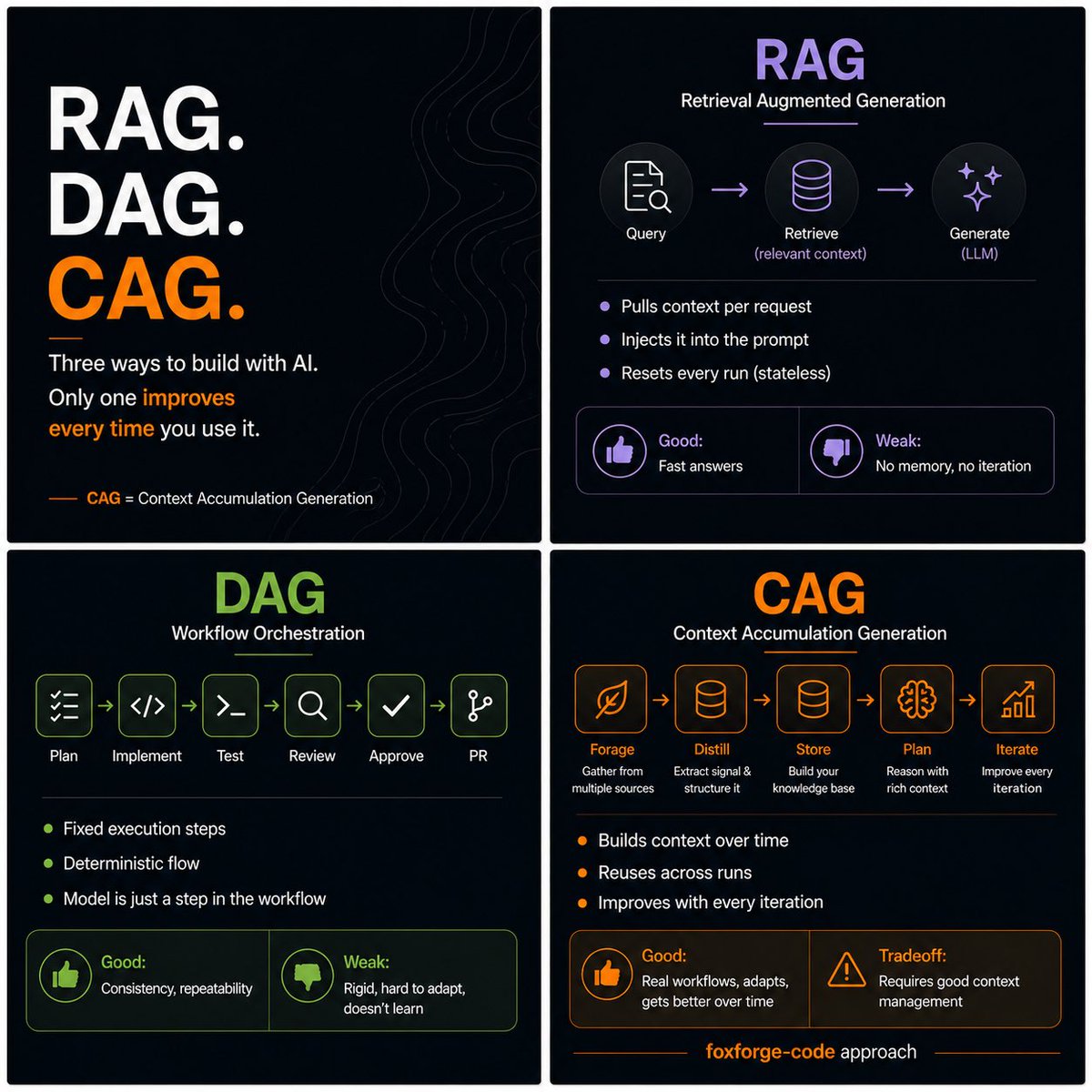
A lot of people assume this means RAG.
It does not.
No vector database. No embeddings. No similarity search.
Facts are written by the agent, verified by the operator, and retrieved through deterministic search.
Context is constructed. It is not guessed. Context Accumulation Generation.
23
Jun 13
4/
Current numbers:
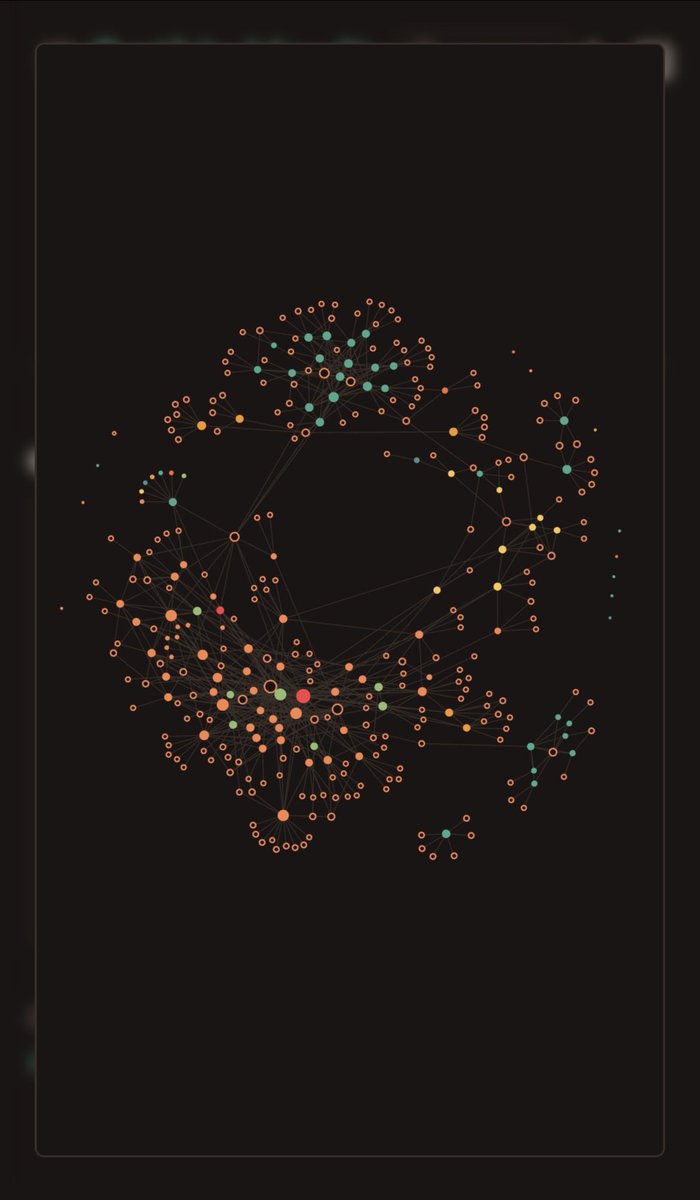
• 33 indexed notes
• 436 facts
• 32 domains
The value of the system increases every time it is used.
Most agents consume context. This one accumulates it.
1
29
Jun 13
3/
The vault is the important part.
Most agent systems are a model talking to a tool. Prompt → Tool → Result.
That works until the next session.
My solution was a filesystem-backed knowledge vault. Every useful discovery gets written into structured markdown. Every new task begins by reading relevant facts before doing any work.
The agent I run today has more context than the agent I ran yesterday.
That compounds.
1
39
Jun 13
2/
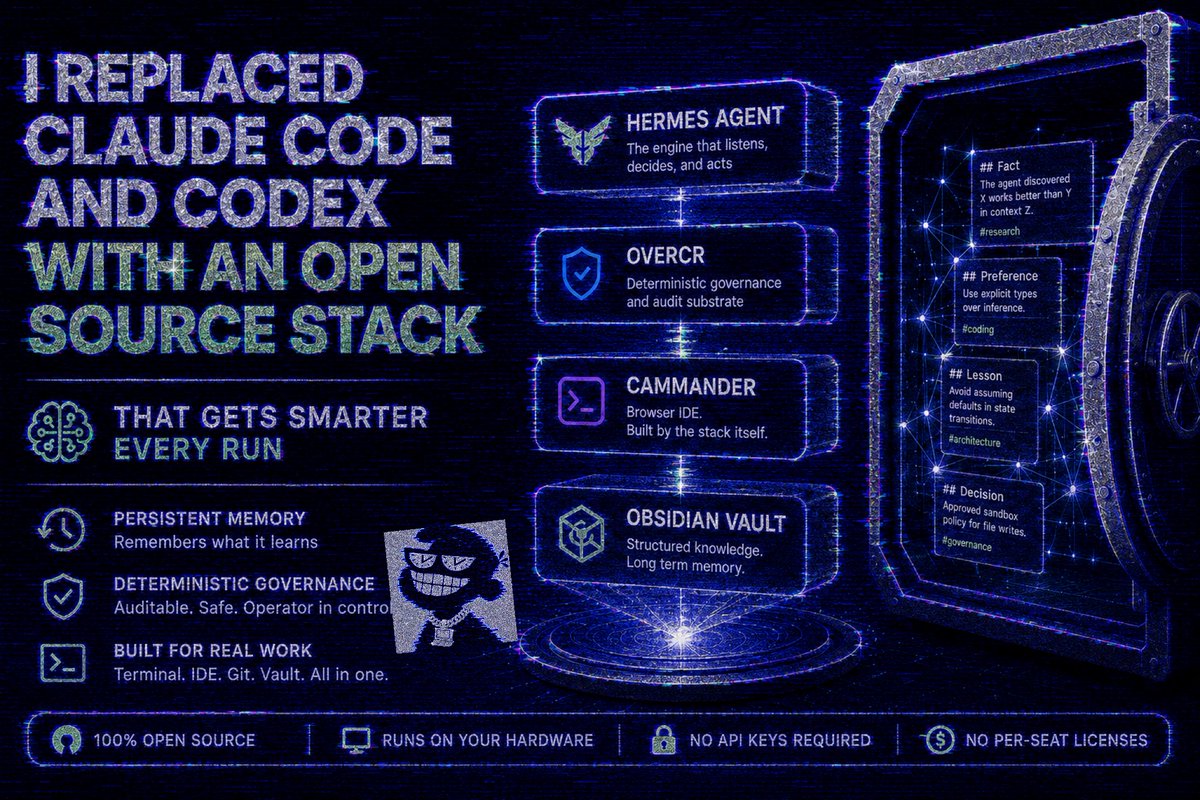
So I built a stack around that idea:
• @NousResearch Hermes Agent (runtime)
• OverCR (governance substrate)
• Cammander (browser IDE)
• @obsdmd Vault (long-term memory)
Plus three autonomous workers that maintain the system.
Everything is open source. Everything runs on my own hardware. No per-seat licenses. No API key required to open the IDE.
github.com/GuideboardLabs/ov…
56
Jun 13
You spent years fearmongering about safety to build the narrative. You lobbied for the regulations that would only hurt everyone else. And now you got exactly what you asked for.. the government doing your dirty work for you, locking your model behind a gate only you can open.
This was never about safety. It was about the moat.
I cut you out of my stack two weeks ago. No Claude Code, no API keys, no dependency on your roadmap or your regulatory strategy. Running Hermes OverCR Cammander on my own hardware. The agent remembers what it learned. The stack gets smarter every run. No one can flip a switch and take it away.
Full writeup on the stack coming later.
Jun 13

The US government, citing national security authorities, has issued an export control directive to suspend all access to Fable 5 and Mythos 5 by any foreign national, whether inside or outside the United States, including foreign national Anthropic employees.
The net effect of this order is that we must abruptly disable Fable 5 and Mythos 5 for all our customers to ensure compliance.
Access to all other Claude models is not affected.
We apologize for this disruption to our customers. We believe this is a misunderstanding and are working to restore access as soon as possible.
Read our full statement: anthropic.com/news/fable-myt…
1
1
144
Jun 12
Read this

48
scanfi retweeted

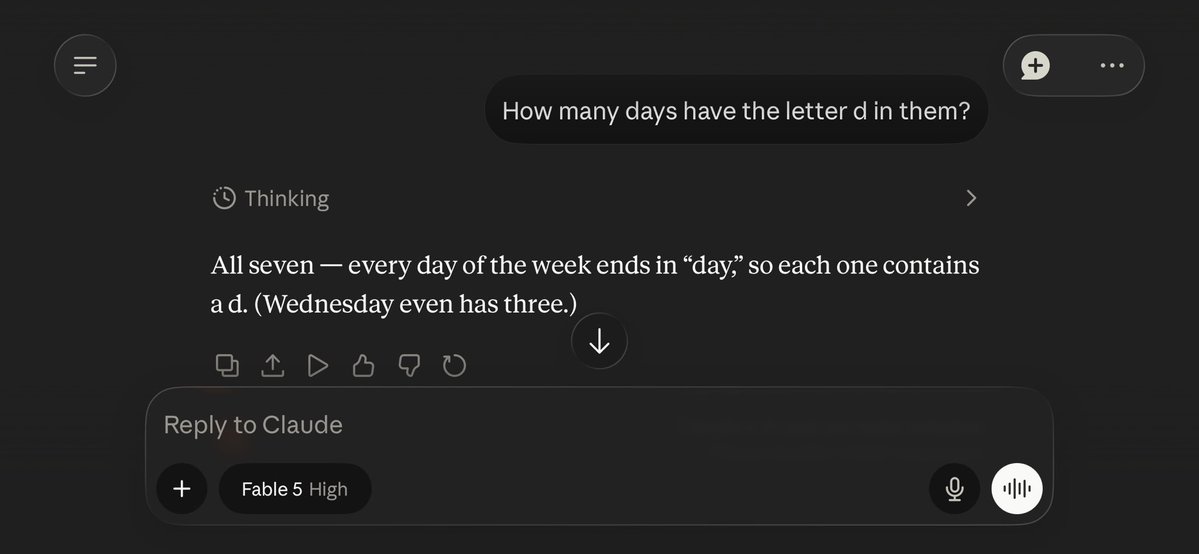
Bro asked Fable 5
how many days have the letter D
It hit him with the Wednesday has three
It's over for us💀
16
1
26
613

What's crazy to me is that Fable is blocked from life sciences broadly, nerfed even if you get passed the classifiers and filter level blocks.
The whole point of AGI/ASI is to cure all diseases. Everything else is just nice to haves. But Anthropic wants to close off that path.
I think Anthropic might be the worst company on the planet.
421
392
5,317
233,143
Jun 9
Fable 5 is not just a model release. It is the first time a mythical tier has been opened to general use. The story everyone is telling is about benchmarks and safety.
The story nobody is telling: better models make the memory problem worse.
3
2
32
Jun 9
4/ OverCR to solve this. Filesystem-grounded memory. Structured facts between sessions. The agent reads what it learned yesterday before it starts today's work. No vector DB. No embeddings. Just the vault getting smarter every run.
That is where the leverage actually compounds.
1
10
Jun 9
3/ the plans, the decisions, the architecture reasoning…. vanishes.
The next bottleneck in AI engineering is not model capability. It is continuity. The model is smart enough to build anything. It just has to remember what it was building tomorrow.
11
Jun 9
2/ Every capability upgrade widens the gap between what the model can do in one session and what the agent remembers across sessions. Fable 5 can run for days. Stripe migrated 50M lines in one day. That output is incredible. And when the session ends, all of that context….
19