We have moved to BlueSky: @healthsocrev.bsky.social
Joined February 2015
- Tweets 1,368
- Following 143
- Followers 1,251
- Likes 59
181 Photos and videos

Pinned Tweet

4 Aug 2024
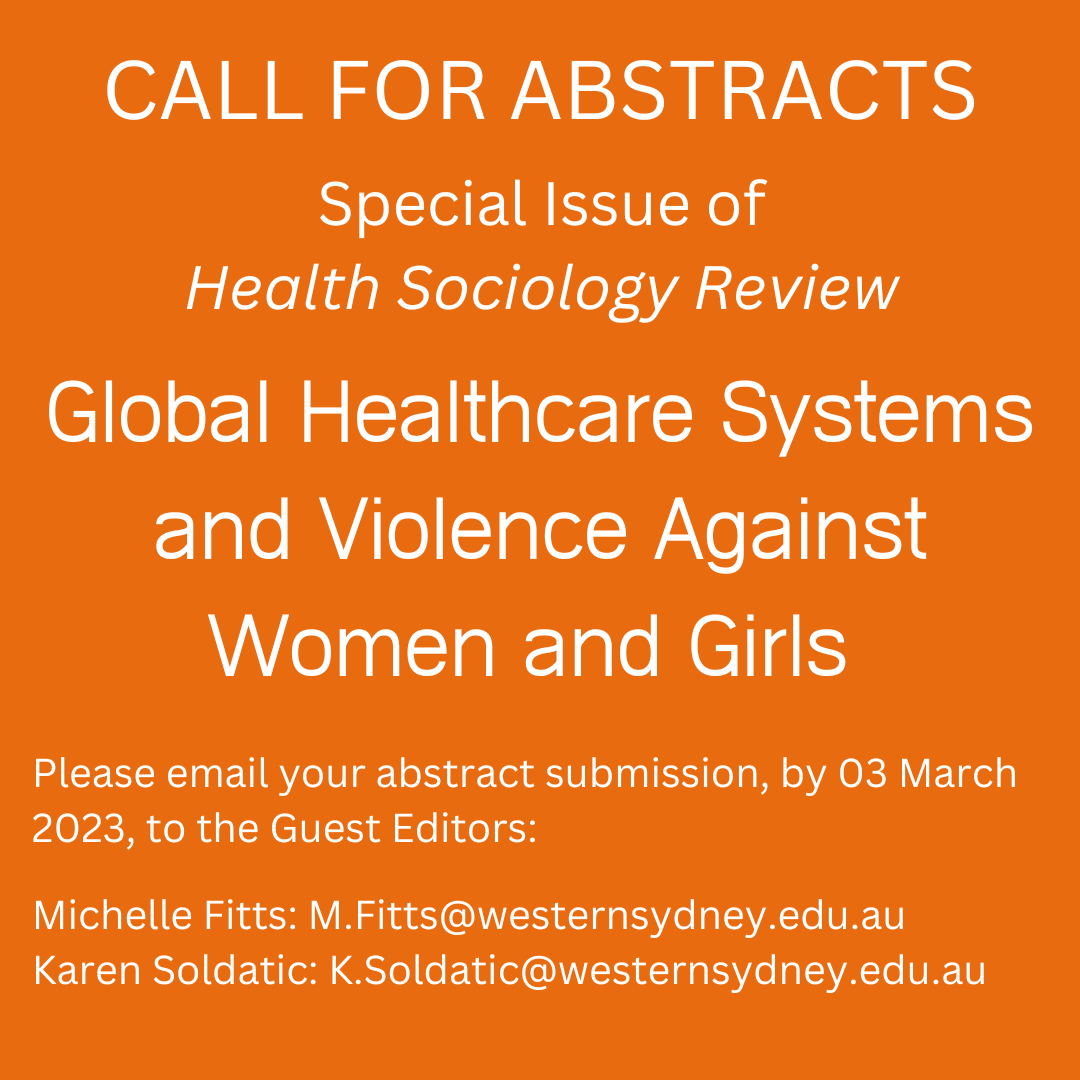
👏Our new special issue is out! 👏
Global Healthcare Systems and Violence Against Women and Girls includes an editorial and 8 excellent articles.
Michelle Fitts and Karen Soldatic introduce the special issue with their editorial. Read it here!
tandfonline.com/doi/full/10.…
2
3
391
23 Oct 2024
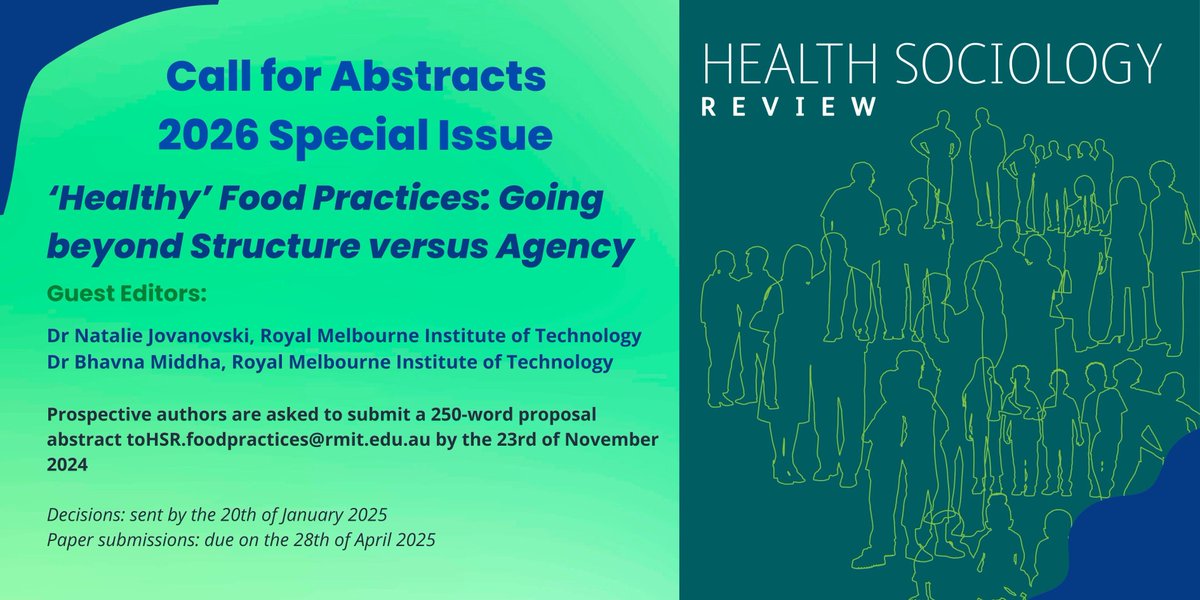
📣 Dive deep into food practices & health inequalities!
@HealthSocRev's 2026 special issue explores the intricate role of food.
Abstracts due Nov 23.
Let’s bridge disciplines and challenge perspectives!
#FoodStudies #HealthInequity #SubmitNow
buff.ly/4h6Bb0W
1
97
16 Oct 2024
🌱 Calling all researchers!
@HealthSocRev invites abstracts on food, health, & social practice theory for our 2026 special issue.
Join the conversation on interdisciplinary approaches to food!
📝 Due Nov 23.
For the full details, visit buff.ly/4h6Bb0W
#FoodHealth
3
2
259
14 Oct 2024
🍽️ Submit your abstracts for HSR's Special Issue on "Healthy Food Practices."
Exploring food's role in shaping health beyond structure vs. agency.
Abstracts due Nov 23! #HealthSociology #FoodStudies #SocialPracticeTheory
For the full details, visit buff.ly/4h6Bb0W
3
3
186
12 Aug 2024
📢New OPEN ACCESS article from our special issue!
Saartje Tack and Sawitri Saharso draw on semi-structured interviews with GPs to determine how GPs in the Netherlands navigate decision making processes around domestic violence intervention. 1/3
tandfonline.com/doi/full/10.…
1
111
12 Aug 2024
The authors explore the role of patient autonomy - a core principle in Dutch general practice. GPs must respect the autonomy of patients: 'people should be able to make decisions free from pressure and coercion from others about the (health) care they do and do not need.' 2/3
1
71
12 Aug 2024
GPs responses to domestic violence are influenced by notions of patient autonomy when responding to domestic violence situations where the women are of non-western migrant backgrounds. 3/3
66
10 Aug 2024
NEW article from our special issue!🙌🙌
In this article, Solange Franco and Amélia Augusto write about health professionals' intervention in the context of domestic violence against women. 1/3
tandfonline.com/doi/full/10.…
1
1
96
10 Aug 2024
The authors conducted focus groups with health professionals working in primary health care in an inland region of Portugal. Their findings point to a lack of specific protocol, insufficient information and limited skills in responding to domestic violence. 2/3
1
70
10 Aug 2024
Franco and Augusto discuss the implications for practice based on their findings. They provide insights into how health care responses can be improved to better prevent and address domestic violence. 3/3
63
9 Aug 2024
New OPEN ACCESS article!
This paper presents an interview with activist, Marsha Myrie, and attorney at law, Anya A. A. Lorde, on gendered disparities and violence against women in the Caribbean. 1/3
tandfonline.com/doi/full/10.…
1
88
9 Aug 2024
The authors bring attention to the 'plantocratic patriarchal culture' in Barbados, which they deem an important first acknowledgement to addressing the issues raised in the interview. 2/3
1
61
9 Aug 2024
The interview discusses how healthcare structures are not developed for marginalised women and girls. They call for a transdisciplinary approach to analysing the effectiveness of global healthcare systems - to make space for lived experiences. 3/3
51
8 Aug 2024
🚨NEW article alert🚨
In this OPEN ACCESS article, Judy Rose, Toni McCallum, Menka Tsantefski and Zoe Rathus illustrate the responses of healthcare and legal systems to women experiencing coercive control. 1/3
tandfonline.com/doi/full/10.…
1
72
8 Aug 2024
Using a drama-based method, Rose and colleagues wrote a play using the first-person narrative voice of a victim-survivor and performed it at a domestic violence conference. The play presented the challenges and barriers survivors of coercive control face. 2/3
1
61
8 Aug 2024
Kate—the victim-survivor—navigated health systems aimed at assisting women experiencing domestic violence. The conference audienced watched on as these systems failed her. Rose and colleagues show us how arts-based approaches can powerfully communicate research findings. 3/3
58
8 Aug 2024
Check out this OPEN ACCESS article from our special issue!
Mandy Hughes and Louise Whitaker explore the etiology of domestic and family violence in women from refugee backgrounds living in non-metropolitan Australia. 1/2
tandfonline.com/doi/full/10.…
1
2
112
8 Aug 2024
Through in-depth interviews with women of refugee backgrounds and stakeholders from the domestic violence sector, the authors reveal stressors that impact violence and offer insights into how best to support refugee women experiencing domestic violence. 2/2
1
59
7 Aug 2024
New OPEN ACCESS article from our special issue!
Michelle Fitts and Karen Soldatic examine the experiences of Indigenous women with traumatic brain injury from violence and their engagement with healthcare and service support in Australia. 1/3
tandfonline.com/doi/full/10.…
1
2
3
637
7 Aug 2024
Drawing on data from interviews and focus groups with Indigenous women, hospital staff and community-based service providers, Fitts and Soldatic find that Indigenous women are dealing with healthcare responses and services that are not designed or suited for their needs. 2/3
1
74
7 Aug 2024
'For Indigenous patients, their presentation may not be taken seriously, and treatment and care resources may be allocated in ways that disadvantage them compared to other patients.' 3/3
58