
$AR $ARIO #BrokenRecord #Music #DePIN #NeuroSpicy🌶️🧠 Find me on🦋, send music🚀 #PermaWeb #OpenFi
Joined October 2014
- Tweets 3,231
- Following 2,523
- Followers 1,795
- Likes 21,247
443 Photos and videos














Pinned Tweet

YES, WE STILL TWEET! DON'T BE SO FUCKING NAIVE!

Tweet of the week
1
579
Crypto bros be lookin' around at market sentiment, seeing that there's value outside of scarcity/speculation.
I wonder if they ever considered that data is the only currency left.
Billionaires know it.
Governments know it.
Corporations know it.
Ai knows it.
$AR fam always knew.
Jun 11

How many arweave:native do you think it takes to become an arweave:native millionaire next bull run?
3
4
21
1,040
ar://HeyGoAudio |James| ⓐ retweeted

Jun 12
1
2
75
ar://HeyGoAudio |James| ⓐ retweeted

Jun 11
This American learning a new Scottish phrase is quite brilliant, even though she doesn’t quite get it right because it’s entirely possible for someone to be a ‘specky cunt’ and them not actually wear glasses.
109
232
2,495
381,459
ar://HeyGoAudio |James| ⓐ retweeted

Jun 11
Provable. Persistent. Enterprise Ready.
@ar_io_network: Critical data, always accessible - even when systems fail.
@solana @SuperteamPOL
- Solana IRL: Real-World Use Cases
ARIO In Practice
ARIO Is Trying To Solve A Very Ordinary Problem: Keeping digital information available for the long run without depending on one company’s server, billing policy, or product lifespan. For regular users, that means links are less likely to break. For businesses, it means records, content, and app assets can stay reachable even if the original publisher changes systems.
The Real Problem
Most of the web still runs on rented infrastructure. A company stores files on a cloud service, points a domain at them, and hopes everything stays online and affordable. That works well until a service is discontinued, a contract changes, or a file gets moved and the old link stops working. ARIO addresses that by focusing on permanent access rather than temporary hosting.
For People, The Practical Issue Is Simple: Content Disappears. Photos, documents, publications, and public records can become unreachable when platforms close or policies change. For businesses, the issue is cost and continuity. They need a way to keep data available without rebuilding access every time the underlying infrastructure changes.
What ARIO Does
ARIO sits on top of permanent storage and makes it usable in a normal web experience. Instead of asking people to deal with raw addresses or technical retrieval steps, it provides a gateway network and readable names so content can be found and served more like a standard website. That lowers the friction for users who just want a page to load.
This matters because permanence alone is not enough. Data can be stored forever, but if it is hard to retrieve, it is still inconvenient for mainstream use. ARIO’s role is to make that storage practical, searchable, and easier to access in day-to-day workflows.
What ARIO Offers
ARIO offers a few concrete tools developers can use.
Permanent storage layer via @onlyarweave - data is stored on Arweave, which is designed to keep information online forever at a fixed cost. ARIO acts as the access and distribution layer that makes this storage practical.
- Decentralized Gateway Network: Instead of one server or CDN, content is served through a network of gateways that are incentivized to stay online and fast.
- ArNS (Arweave Name Service): Human-readable domain names like yourapp . ar, so you can point to content without exposing raw storage IDs.
- Gateway Staking And Rewards: Ooperators stake ARIO tokens and earn rewards for serving data, which keeps the network resilient and decentralized.
- SDKs And APIs: Developer tooling to upload, retrieve, and manage content, plus integration with ArNS names.
All of this is designed so that a developer can treat permanent storage like a normal cloud service, but with built-in durability and no single point of failure.
How Solana Is Used
ARIO uses $ARIO as an SPL token on Solana. That places the network’s token activity inside a chain known for fast transfers and low transaction costs, which is useful for staking, rewards, and network participation. In plain terms, Solana provides the token rail; ARIO uses that rail to manage incentives and utility around the network.
The token supports gateway operations, protocol incentives, and domain-related actions. That creates a more structured system than a purely voluntary network, because operators have a clear reason to keep serving data well. When participation is tied to a token economy, the network can coordinate behavior without relying on one central company to control every step.
In Simple Terms
- Use Solana For On-Chain Logic:
Payments, state, tokens, DAOs, DeFi, gaming mechanics, identity, and any computation that needs to be trustless and verifiable.
- Use ARIO For Off-Chain But Permanent Data:
Frontends, media, documents, logs, configs, NFT metadata, app assets, and any content that should not disappear.
- Together, They Form A More Complete Stack:
Solana handles the state and logic, ARIO handles the data that needs to stay online forever.
For Developers Building Real Apps, This Split Is Useful Because:
- You can store your frontend and assets on ARIO so they do not vanish if a hosting provider changes terms.
- You can keep important metadata, logs, or records permanent, which is critical for compliance, audits, and long-term reliability.
- You do not need to pay recurring hosting fees for content that should be permanent.
- You can give users a stable link via ArNS names, so references do not break over time.
This Is Especially Valuable For Projects That Want To Be Truly Decentralized:
- The smart contracts live on Solana, but the data they reference is stored permanently via ARIO instead of on a centralized cloud.
Why This Matters For Adoption
Mass adoption usually happens when a system feels familiar. People do not adopt technology because it is novel; they adopt it because it removes pain. ARIO is trying to make permanent data access feel as ordinary as opening a website, while Solana helps make the token side of that system fast and usable.
That combination matters because everyday users do not want to manage complexity. They want a link to work, a record to stay online, and a service to remain accessible. Businesses want reliability, lower dependence on one vendor, and clearer long-term planning. ARIO aims at those needs directly.
How This Compares To Traditional Web2 Developer Tools
In Web2, developers typically use:
- Cloud storage (S3, GCS, Azure Blob)
- CDN services
- Hosting platforms (AWS, Vercel, Netlify)
- Centralized domain names
These are fast and easy, but they come with vendor risk, recurring costs, and the possibility that content disappears if the provider changes rules or the account is closed.
ARIO Changes That By
- Removing single-provider dependence
- Offering permanent storage at a one-time cost, not recurring fees
- Giving a decentralized network of gateways instead of a single CDN
- Providing human-readable names via ArNS that are not controlled by a single registry.
The tradeoff is that you need to learn new tools and a token-based model, but the long-term benefit is durability and independence from a single vendor.
Why It Can Scale
The main reason this approach has adoption potential is that it maps technical durability to a normal user outcome: working access over time. That is easier to understand than abstract blockchain claims. If a creator, company, or public institution can keep important material available without rebuilding infrastructure every few years, the value becomes obvious.
Solana helps because it gives the network a practical economic layer that can support frequent token operations without making them feel slow or expensive.
In that sense, ARIO is not only about storage. It is about making persistence usable, and making that usability economically maintainable.
For any developer who cares about long-term reliability, this combination is a practical way to build apps that do not depend on a single company’s infrastructure.
Resources For Devs:
- docs.ar.io/
- solana.com/pl/docs
3
8
21
622
In 2026 there is such a massive divergence between mainstream creative 'output' and genuine art.
The distance between them is now so very obvious and IMO it's one of many real tragedies of modern, predatory Western economics.
1
23
ar://HeyGoAudio |James| ⓐ retweeted

Jun 8
Just saw it, @ar_io_network has moved to @solana.
This isn’t just a token migration.
Underneath there’s AI verification infrastructure, permanent data proofs, an audit layer.
Arweave, #Solana and Ar.io together make a serious architecture.
Quiet but significant move.
Jun 8

We have successfully completed the migration to @Solana. The smart contracts & canonical $ARIO token are now live.
$ARIO Token Address: DcNnMuFxwhgV4WY1HVSaSEgr92bv2b1vUvEKiNxWqHdF
Arweave remains the permanent data and provenance layer.
Full details: ar.io/solana-migration/
1
6
31
1,602
ar://HeyGoAudio |James| ⓐ retweeted

Jun 6
This

Jun 4

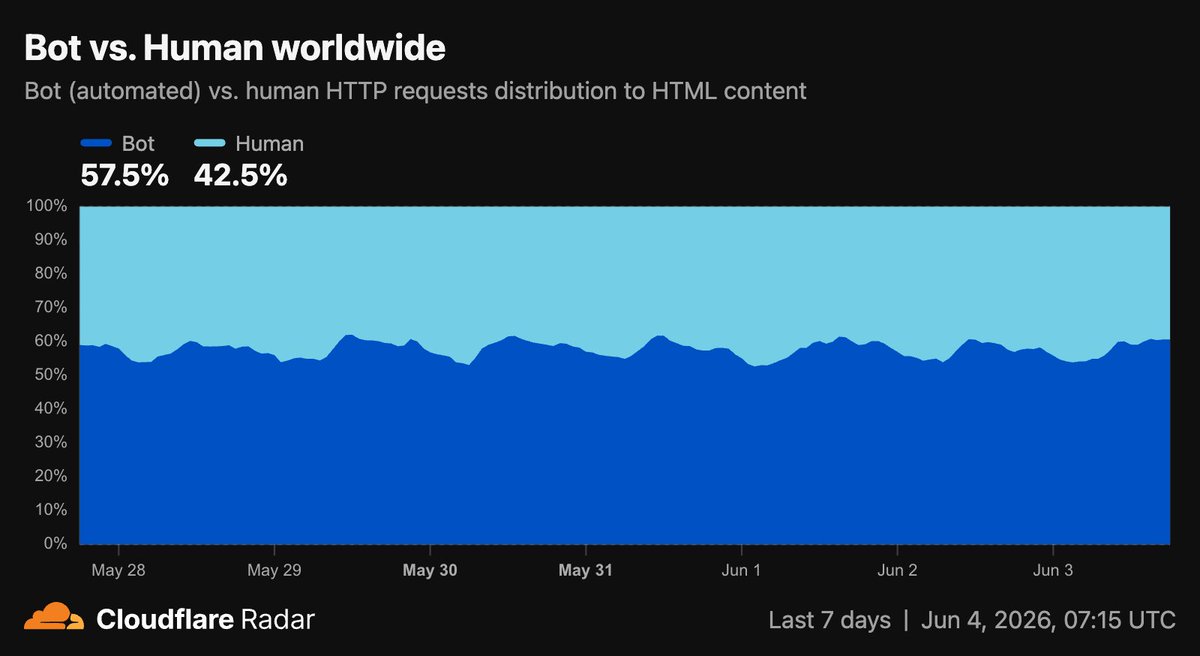
🚨HUGE: AI BOTS HAVE OFFICIALLY OVERTAKEN HUMANS ON THE INTERNET
Cloudflare CEO Matthew Prince shared new data showing that bots and AI agents are now generating more internet traffic than humans for the first time in history.

4
3
26
1,257
ar://HeyGoAudio |James| ⓐ retweeted
Jun 8
We have successfully completed the migration to @Solana. The smart contracts & canonical $ARIO token are now live.
$ARIO Token Address: DcNnMuFxwhgV4WY1HVSaSEgr92bv2b1vUvEKiNxWqHdF
Arweave remains the permanent data and provenance layer.
Full details: ar.io/solana-migration/
11
22
76
10,501
ar://HeyGoAudio |James| ⓐ retweeted

Jun 8
One chain had speed, the other had eternity, today @ar_io_network wrote them into the same sentence. 🐘
Jun 8
We have successfully completed the migration to @Solana. The smart contracts & canonical $ARIO token are now live.
$ARIO Token Address: DcNnMuFxwhgV4WY1HVSaSEgr92bv2b1vUvEKiNxWqHdF
Arweave remains the permanent data and provenance layer.
Full details: ar.io/solana-migration/
1
21
508
ar://HeyGoAudio |James| ⓐ retweeted

🌌Name sale! ar://solana leased for 1 year(s) for 9578.1888 ARIO 🌌
solana.ar.io
core.metaplex.com/explorer/A…
#ArNSBot
4
10
169
ar://HeyGoAudio |James| ⓐ retweeted

Happy Birthday Arweave 🐘
Day 1
x.com/ar_io_network/status/2…
Jun 8
We have successfully completed the migration to @Solana. The smart contracts & canonical $ARIO token are now live.
$ARIO Token Address: DcNnMuFxwhgV4WY1HVSaSEgr92bv2b1vUvEKiNxWqHdF
Arweave remains the permanent data and provenance layer.
Full details: ar.io/solana-migration/
2
4
29
1,089
So, you want an entire Western nation to pivot to internet TV?
Fuck you.
If you think shit is bad now, imagine there being NO broadcast signal... No realtime mass information.. No access to a shared truth...
What the fuck is there this?
c.org/FSXPzJgtkg
27


ar://HeyGoAudio |James| ⓐ retweeted
Jun 7
One day, you’ll look back and wonder why you didn’t buy permanence when it was still early.
Arweave is building a future where data outlasts generations.
You’re not late—unless you wait. arweave:native

2
5
29
430
ar://HeyGoAudio |James| ⓐ retweeted
Jun 8
Happy 8th birthday, @ArweaveEco!
You are the best at what you do.
8
8
53
1,240
ar://HeyGoAudio |James| ⓐ retweeted

Happy birthday, Arweave!
Today marks the 8th anniversary of the launch of Arweave mainnet.
Over the last year, the centralized training wheels of the permaweb have come off. Gateways, bundlers, and the query layer are all now open to be run by anyone, and incentives are coming into place.
Today there are...
1️⃣ Trustless, verifiable gateways: The main gateways to Arweave now all serve their data in trustless, verifiable form. Every response comes with all of the information needed to verify that the content that they asked for is the data that they received.
2️⃣ Incentives for gateway operators: Anyone can join a gateway and permissionlessly start to earn for serving content to users. This gateway has started to take over serving a small portion of Arweave . net’s end-user traffic, scaling up over time.
3️⃣ Decentralized bundlers: You can now upload data through a decentralized network of bundlers which anyone can join and start to serve permaweb user requests through. Node operators can earn by running nodes in this network permissionlessly, and users can trust the LapEE(/TEE) implementations, not the node operators themselves.
4️⃣ Decentralized indexers: Those community run LapEE/TEE nodes can even now be used to index and query data on Arweave, inheriting the same trust-minimization properties as bundlers. No public router for this just yet, but try it on your own node — it works 🙂.
A year ago none of these were possible. Each was a hard fought battle and there is still a long way to go to make them the defaults in the ecosystem, but the bedrock is now in-place.
Where next?
8 years is a long time, and while the mission of Arweave remains immutable the structure of the web itself is shifting: From discrete apps each with a separate team, to a world of agent-built services customized for each user. The next web will not look like the last.
I am truly excited about this because Arweave’s permaweb is the perfect substrate for a web that is no longer defined by static, siloed UIs, but instead morphs and mutates at the speed of user’s wishes. For many years we have focused on creating a web that enables composability through…
➡️ Open content: Owned by users, accessible in every app – rather than any single company/service.
➡️ Open infrastructure: Shared between every app, permissionlessly utilized to back every app, not any single particular application.
…and now this stack is finally able to be decentralized, too.
This architecture just so happens to offer exactly the mix of attributes needed to create an open version of the agent-driven web. When a useful/fun app is just an afternoon’s work, rather than a year’s, creators (no longer just limited to devs) do not want to run specific infrastructure or hire a team just for that single service. Instead, an existing open catalogue of content, matched with open infrastructure they can simply start to send calls to, is the perfect place to build.
Can’t wait to see this in practice. More soon.
Onwards! 🙂
31
34
190
8,074
Spider-Noir was super fun.
ONLY works in Black and White IMHO. It needs to look really old to work.
RECOMMEND: CRT with the sharpness set to zero (if possible) and only use the built in speaker.. Maybe have a couple beers.
BONUS: Makes for a fun drinking game 🥃
37
Can confirm this is an actual weekly show in the UK
1
1
28
ar://HeyGoAudio |James| ⓐ retweeted

Jun 3
Ofc, I love AR !
Been a fan since day one 👀
1
3
51