
Pragmatic futurist
Joined October 2010
- Tweets 1,015
- Following 102
- Followers 142
- Likes 716
201 Photos and videos














Jun 10
Just finished to refine this use case for a platform I'm building for #hospital #supplychain.
Fun fact: you have no clue how hard is to roll this out to hospitals without the right #ontology background. It's almost an utopia for a non Tier-1 team.
22
Jun 7
A single hospital generates 50 petabytes of data a year.
Printed, the stack reaches the moon and back, twice. Almost none of it is used.
The NHS spends £8 billion a year on medical equipment and consumables (NAO, 2024). Across every study from 2014 to 2025, 8 to 20% of surgical supply cost per case is opened and never used. The most common reason: anticipating what the surgeon might need.
That number already lives in your systems. Your theatre system saw it. Your preference cards carry it. Your procurement records know it. None of them connect.
That is not a problem. That is a goldmine with a locked door.
Lord Carter said it in 2016: most hospitals do not know what they buy, how much they buy, or what they pay. Not because the data does not exist. Because it has never been given a shared model of itself.
That model is an ontology. A jigsaw scattered across four boxes with no picture on the lid. The ontology is the picture on the lid. It adds no new data. It shows how everything you already have fits together.
The proof: when one hospital reconciled its preference card data, colorectal surgery waste fell 55% (JAMA Surgery, 2025). No new suppliers. No renegotiated prices. Just the data, connected.
Three spots. No IT project. A CSV is enough. One week later: your supply chain ontology and a named map of where your surgical spend leaks, by surgeon, by procedure, by item.
No fee.
If you run theatres, message me.
1
84
Jacopo Spina retweeted

6 Jun 2025
Your data model should mirror how you think about your business, not how your tables were labeled.
That’s why Astrobee starts with what you want to learn. We generate an ontology from the way you see your world, not the way your warehouse sees it. All in under a minute.
Check out our onboarding flow here:
#ontology #data #analytics #ai
2
2
108
Jacopo Spina retweeted
4 Jun 2025
Most AI data tools focus on the analytics layer, generating SQL from a question 🔎
But the real bottleneck isn’t the interface. It’s the messy, mislabeled, and nonintuitive data underneath.
At AstroBee, we’re solving for that hard part: automatically turning raw data into clean, trustworthy, and business context-ready ontologies.
Read our latest on what this means:
medium.com/p/the-gap-in-the-…
2
3
160
Jacopo Spina retweeted
2 Jun 2025
Upload your data. Get answers instantly. 🚀
Astrobee now supports direct CSV uploads, so you can import your own datasets and start discovering insights immediately.
AstroBee is in active development. For early access, please email hello@astrobee.ai
#ai #ontology #analytics
1
2
239
Jacopo Spina retweeted
30 May 2025
AstroBee lets you toggle between entire ontologies, from Product Analytics to Ecommerce, with just one click.
Now your data can speak the right language, depending on who’s asking.
#analytics #ai #Ontology
1
2
4
197
Jacopo Spina retweeted
27 May 2025
How do you make sure your data speaks the right language? Well, depends on who's asking!
In this quick demo, we show how AstroBee lets you toggle between entire ontologies, from Product Analytics to Ecommerce, with just one click.
Each ontology is its own semantic layer: a structured, team-specific map of concepts, metrics, and relationships. Think: canonical truths for each team, no SQL wrangling required.
#analytics #ai #Ontology
2
2
124
Jacopo Spina retweeted
23 May 2025
AstroBee is the first AI agent to build your ontology for you, so you can answer any question about your business.
3
3
123
Jacopo Spina retweeted
21 May 2025
Is Astrobee a BI tool?
In 1865, BI meant using data for a competitive advantage. Today, it means dashboards, ignoring what happens to data beforehand. Astrobee works end-to-end, including the tough parts that modern BI misses.
We aren't exactly BI, but we're exactly what BI needs.
Read on: medium.com/@AstroBeeai/is-as…
2
3
83
Jacopo Spina retweeted
19 May 2025
One acquisition channel to rule them all 💍
…but which one?
When you break down acquisition channels by LTV, you might find some standouts, but why stop there? With AstroBee you can drill down and find out exactly why. Don’t settle for static dashboards when you can find real answers
#datascience #analytics #ai #ontology
2
2
86
Jacopo Spina retweeted

15 May 2025
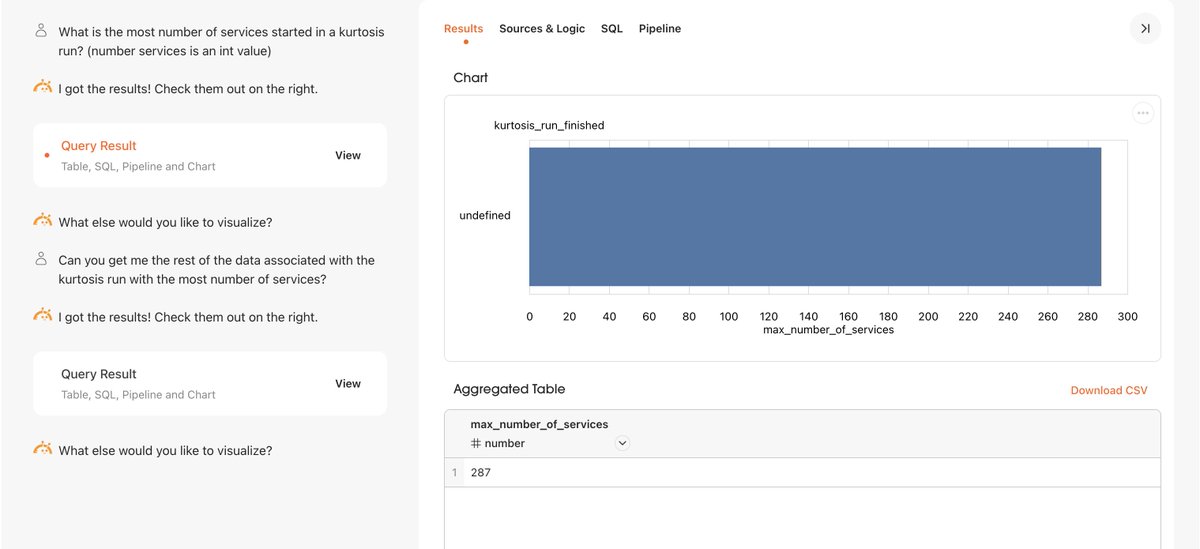
287 is the current record for most number of services in a @KurtosisTech enclave - who can beat it? 👀🤔 (over Docker too ...)
1
3
8
667
Jacopo Spina retweeted
7 Apr 2025
Happy Monday - in service of building Kurtosis in the open, I'll be starting a series where I share analytics data here using @astrobeeai
This week we'll be answering three questions -
• What are the most popular packages being used in 2025?
• How many CI/local Kurtosis runs are there?
2
4
12
639
15 Aug 2022
I’m looking for a #cofounding partner, preferably based in UK, London to launch two #startup. One of these is already developed and ready to launch, the other is under development. Share this tweet to get positive karma points 🙏 #business #vc #productdesign
1
24 Feb 2022
Finally the collection i've been working on is live on @opensea . It talks about you, your birth in the metaworld. There are no other profile pictures in meta if you are not born there yet. Browse the collection opensea.io/collection/born-i… AND read the story borninmeta.com/.
5
24 Feb 2022
@nathanwalsh72 here's what I've been working on. It took a while but here they are — embryos created by AI! What do you think?
1
24 Feb 2022
@EErratica thanks to your help on the prompts, i've been working hard to improve the craft. What do you think about the embryos?
1
24 Feb 2022
@RiversHaveWings been working on these craft only thanks to you — without nobody would have done it. What do you think about the embryos?
1